Feeds:
Posts
Comments

Posts Tagged ‘environment’

Last month, Steve Curwood of the radio show Living on Earth covered a special conference on climate change.

“Curwood: A coalition of 80 leading Islamic clerics, scholars and officials meeting in Istanbul has issued a declaration on climate change, ‘calling on all nations and peoples to phase out greenhouse gas emissions as soon as possible.’ …

“Islamic nations, including wealthy oil-producing states, are taking action on global warming, says Wael Hmaidan. He’s director of Climate Action Network International, one of the conference organizers and joins us now from Istanbul. …

“Hmaidan: I was really happily surprised by how rigorous the Koran and the Islamic teachings on the environment and the care for the planet. It’s a core function of Islam to care for the planet. It’s a responsibility. … It talks about the delicate balance that all the creatures have on Earth and it’s the responsibility of humans to protect this balance.

“It also talks actually about how humankind should not think that they are more important than other creatures. It talks about the role of all creatures and the need of respect, this diversity in the planet. So all of these kinds of proverbs from the Koran and the Islamic teachings, as well as stories about Prophet Mohammed’s life and his care for the environment clearly [makes] environmental care and climate change key issue for an Islamic teaching. And hearing strong statements saying that it is forbidden not to phase out greenhouse gas emissions coming from Islamic scholars is something very inspiring, even for climate activists. …

“There’s an agreement to establish an informal group … that will follow up on all the ideas that came out from the conference. And the ideas are varied, some of them are high-level, like I mentioned going to the UN agencies, to governments, but also the representatives of the organizations that attended want to create action plans in their communities of influence, to bring the declaration. … We need to transform all mosques to renewable energy, and so on. So a lot of ideas, and they’ve created this platform Muslims for Climate to continue the dialogue.”

More here.

Photo: Islamic Relief
Mohamed Ashmawey, CEO of Islamic Relief Worldwide and one of the Climate Change Symposium organizers addresses attendees.

Read Full Post »

I realized we hadn’t done any poetry for a while. So after I heard poet Mary Jo Bang on the radio show Studio 360, I thought I would share an unusual thing she has done. She has created a modern version of Dante’s Inferno — relying on poetic license and others’ translations to make it more accessible.

Studio 360’s host calls Bang a “poet’s poet, one whose books regularly make year-end best-of lists. Her latest book of poetry is called The Last Two Seconds, and it couldn’t be farther from the stereotypical pretty nature poetry. The collection is full of a sense of impending environmental collapse: natural disaster, extinction, climate change, and cataclysmic violence. …

“The book’s title is also connected to Bang’s sense of her own mortality. ‘Once you get into your 60s you know you have x amount of time. …’

“Bang also recently produced a new translation of Dante’s Inferno — a feat she accomplished without knowing Italian. She worked from previous translations, she explains, comparing the work of other scholarly translators to get an idea of the literal meaning of the original. ‘I could see what was going on; I could see the liberties that each of these translators had taken,’ she says. ‘That gave me permission to come up with my own way of saying it, but it established the borders.’

“Bang also updated Dante’s hell to include [more-recent fiends, including] South Park’s Eric Cartman, who is condemned for the sin of gluttony. ‘Dante wrote the Inferno in the vernacular. He wanted everyone to be able to read it. I wanted to do the equivalent,’ she explains.

“Bang teaches at Washington University in St. Louis, and she says her students appreciate the contemporary references. ‘They tell me things like, “I always wanted to read this and I tried several times and I couldn’t.” That’s exactly the person for whom I wrote this, because I was one of those people, too.’ ”

Maybe me, too.

Hear Bang read her work at Studio 360, here.

Photo: Matt Valentine
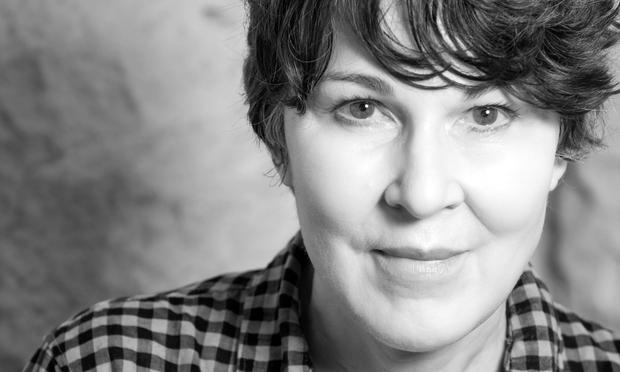
Poet Mary Jo Bang. (Does this woman look like she hit 60?)

Read Full Post »

Maria Popova linked to this story on twitter. It’s about how climate change is affecting a way of life for Fiji Islanders.

Meehan Crist writes at the blog Nautil.us, “The day that conservation biologist Joshua Drew, his two students, and I arrive in the Fijian village of Nagigi, the wind is blowing so hard that the coconut palms are bent sideways. ‘Trade winds,’ we are told. And, ‘El Nino. The villagers here also know that climate change is affecting the weather, but their more immediate problem, shared across the Pacific—and, indeed, the world—is an ocean ecosystem sorely depleted by overfishing.

“Nagigi is a village of about 240 people living in tin-roofed wooden homes strung along a sandy coastline. A single paved road runs the length of the village, parallel to the ocean, and along this road are homes clustered by family, painted in cheerful pastels, and connected by well-worn paths through the crab grass. ‘Before,’ said Avisake Nasi, a woman in her late 50s who has been fishing this reef her whole life, ‘you just go out and you find plenty fish. Now, you have to look.’ …

“If pressures mount from too many sides at once—rising ocean temperatures, acidification, pollution, overfishing—the combined pressure will be too much even for Fiji’s remarkably resilient reefs to bear. …

“Conservationists and humanitarian groups have recently united in the call for sustainable resource management, and in this trend, Nagigi is ahead of much of the Western world. Villagers have been discussing how they might use a traditional ban on fishing known as a tabu (tam-bu) to help manage their marine resources in new ways. …

“Drew presents his findings about how fish here are interconnected with other reefs, and how to best protect the species most important to the village in terms of food and income. He talks about how, for the last three years, he has been collecting baseline data about the species present on the reef so that if the village sets up a tabu, its effects can be measured.

“His audience is most interested in what Drew has to say about where to set up a tabu—include the mangroves at the left side of the village shore, because they act as fish nurseries—and for how long—three years would give crucial species enough time to mature and spawn. There has been some talk of a one-year tabu, which would be less of a hardship for villagers who will have to walk a mile or more to reach ocean where they are allowed to fish. But Drew’s data suggest this wouldn’t be long enough to make the sort of difference the village wants to see. ‘I can only offer information,’ Drew says at the end of his presentation, ‘the decision is yours.’ ”

The reporting for Crist’s  story was made possible by a grant from the Mindlin Foundation.

Try to see the related climate-change movie Revolution, which I wrote about here.

Photo: Meehan Crist
The view from Nagigi’s school to the sea, where many locals make their living

Read Full Post »

One of the websites I check for cool stories is the one for Living on Earth, an excellent environmental news magazine from Public Radio International. In a recent episode, host Steve Curwood interviewed the author of a new book on the rare Asian “unicorn.”

“CURWOOD: Deep in the forests of southeast Asia lives a creature nicknamed the Asian Unicorn, and it’s nearly as rare as the mythical creature, as well. … And it is right at the edge of extinction. Writer William deBuys accompanied conservationists on an expedition to study the saola, and his book The Last Unicorn lays out the story and the challenges of saving a species so rare. …

“DEBUYS: The saola was discovered to Western science only in 1992. Local villagers in the habitat of the saola [such as Laos] have known it was there forever, but this new discovery was made when scientists saw a rack of horns on the wall of a hunter’s shack. And these horns are the most distinctive features of the saola. They’re long, almost straight, and beautifully tapered to a very sharp point, so that when the saola stands profile, the two horns in perspective merge into one, and it appears to have only one horn, it appears to be a unicorn. Perhaps only dozens to a few hundred still exist, and there are none in captivity. …

“CURWOOD: Tell us what it’s like there in the forest. What would you hear in the forest?

“DEBUYS: Oh, the music of the forest was constantly inspiring and entertaining. The birdcalls never ceased. We heard laughing thrushes, and we heard drongos and Indian cuckoos and all kinds of birds with really distinctive calls. There was a kind of chorus behind us all the time.

“But the most marvelous thing occurred at first light, almost every morning. We heard the calls of gibbons. Gibbons are small apes, beautiful, slender animals that swing through the trees, so gracefully, and their calls are ethereal. And they call, male to female and female to male, in mated couples, and you can think of it as almost a kind of love song that you hear echoing through the forest. …

“Our expedition basically had three purposes: one was to look for saola habitat and for saola in that habitat. A second was to evaluate the poaching pressure on the landscape. And a third was to conduct a kind of conservation diplomacy in the villages of the forest. …

“CURWOOD: How many saola did you see?

“DEBUYS: Well, we saw none. No Westerner has yet seen a saola in the wild, and the joke is that saola are so like unicorns, and everybody knows that in the Middle Ages, the only people who had an outside chance of seeing a unicorn had to be absolutely pure of heart. And Robichaud and I joke that if that applies also to saola, then we were disqualified from the get-go.” More here.

Note the thoughtful discussion at Living on Earth about the rights and sensitivities of native peoples where the conservation efforts are focused.

Photo: William Robichaud / Wildlife Conservation Society
The first adult saola to be observed outside of its habitat.

Read Full Post »

Here’s a story about venture capital with a do-good focus.

Sacha Pfeiffer writes at the Boston Globe, “Among entrepreneurs, there’s a dreaded place called the Valley of Death. That’s where startup companies go when they run out of funding before making money on their own, and it’s an especially common fate for clean-energy startups, like manufacturers of solar panels and wind turbines. …

“But what if that early-stage, high-risk financing could instead come from philanthropists, who aren’t driven by profit? Later, traditional investors could step in and supply continued funding.

“That’s the concept behind PRIME Coalition, a year-old Cambridge nonprofit that has pooled $1 million from wealthy donors, including Hollywood actors Will and Jada Pinkett Smith, as seed money for its first investment: an energy storage startup company. …

“PRIME rethinks the traditional definition of charitable work and charitable giving. Its founder, 30-year-old MIT graduate Sarah Kearney, argues that companies whose products or services reduce greenhouse gases are doing a social good, just like soup kitchens and homeless shelters, so they should be able to receive philanthropic funding. In this case, the social benefits include conserving the environment and fighting climate change.

“The group searches for early-stage alternative energy companies … then locates philanthropists or socially minded for-profit investors to fund them. Those could include charitable foundations, investment offices of wealthy families, and donor-advised funds. …

“Peter Rothstein, president of the New England Clean Energy Council, said philanthropic funding ‘can make a significant dent’ in filling the need for early-stage capital for clean-tech companies.” More here.

It is not unheard of for philanthropy to put its investment dollars into companies that provide a social good. Read about the Heron Foundation’s decision to do so some years back in “Expanding Philanthropy’s Reach: Mission-Related Investing,” here.

Photo: Lane Turner/Globe Staff
PRIME Coalition founder Sarah Kearney says that companies whose products or services reduce greenhouse gases are doing a social good and should be able to receive philanthropic funding.

Read Full Post »

I think this children’s book, reviewed at Brain Pickings, is one I need to buy.

Maria Popova writes, “This Moose Belongs to Me (public library) — a disarming story about a boy who believes he owns his pet moose Marcel, only to discover that so do other people, who call him by different names, while the moose himself doesn’t quite get the concept of being owned and is thus oblivious to the boy’s list of rules for being a good pet. …

“For the backgrounds of his illustrated vignettes, Jeffers reapporpriates classical landscape paintings by a mid-century Slovakian painter named Alexander Dzigurski, rendering the project a sort of posthumous collaboration and a creative mashup.”

Read the intriguingly philosophical Brain Pickings review here.

And here is a children’s book reviewed by Asakiyume that embraces insights about both the environment and other cultures.

She writes, “Discarded plastic bags are more than just an ugly nuisance in the West African nation of the Gambia. There, plastic shopping bags kill livestock that eat them and provide a breeding ground for malaria-carrying mosquitoes.

“A woman named Isatou Ceesay found an ingenious solution. She learned how to make plarn [yarn made from plastic bags], and, with her friends, started crocheting small change purses from the discarded plastic bags, which she and her friends sold. The trash problem — and attendant health risks — disappeared, and Isatou and her friends had a new source of income. The project was so successful that Isatou started teaching women in other villages, and in 2012 she won the International Alliance for Women’s World of Difference award.

Miranda Paul, a writer who has lived and taught in the Gambia, wrote about Isatou in One Plastic Bag: Isatou Ceesay and the Recycling Women of the Gambia (illustrated by the fabulous Elizabeth Zunon).” Lots of reasons for buying that book here, at Asakiyume’s blog.

Art: Oliver Jeffers

Read Full Post »

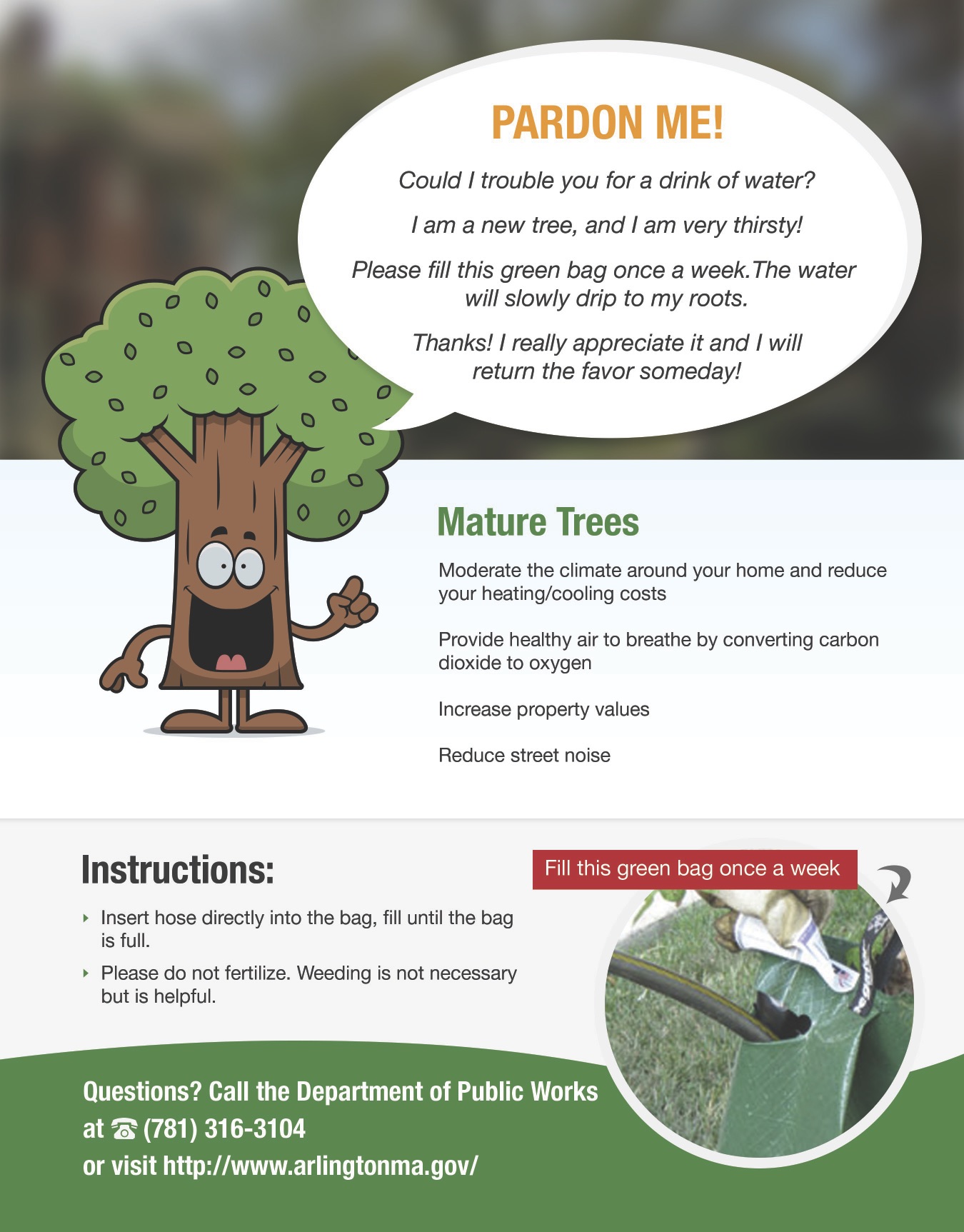
John (founder of www.mistersmartyplants.com) is a member of Arlington Tree Committee. He figured out a way to use Google Maps to identify heritage trees in town and got a sign made to encourage residents to adopt a thirsty tree.

Now that so many urban and suburban areas have taken down their trees to make construction projects easier, people are realizing what they’re missing.

Many have noted that trees play a role in residents’ mental and physical health.

University of Washington research social scientist Kathy Wolf has studied the health aspects and also has economic arguments. She has shown that an “urban canopy”  makes local shopping more agreeable for customers and lends vitality to downtown business districts. Read what she has learned, here.

Chris Mooney at the Washington Post notes other research. “In a new paper published Thursday, a team of researchers present a compelling case for why urban neighborhoods filled with trees are better for your physical health. The research appeared in the open access journal Scientific Reports.

“The large study builds on a body of prior research showing the cognitive and psychological benefits of nature scenery — but also goes farther in actually beginning to quantify just how much an addition of trees in a neighborhood enhances health outcomes. The researchers, led by psychologist Omid Kardan of the University of Chicago, were able to do so because they were working with a vast dataset of public, urban trees kept by the city of Toronto — some 530,000 of them, categorized by species, location, and tree diameter — supplemented by satellite measurements of non-public green space (for instance, trees in a person’s back yard). …

“Controlling for income, age and education, we found a significant independent effect of trees on the street on health,” said Marc Berman, a co-author of the study and also a psychologist at the University of Chicago. “It seemed like the effect was strongest for the public [trees]. Not to say the other trees don’t have an impact, but we found stronger effects for the trees on the street.”

Thank you to my high school classmate, Susie from Cleveland, for putting the Washington Post article on Facebook.

071115-Arlington-Tree-Watering

Read Full Post »

David Wilkes has a great story at the Daily Mail about a self-contained garden that hasn’t had to be watered in decades.

“To look at this flourishing mass of plant life you’d think David Latimer was a green-fingered genius. Truth be told, however, his bottle garden – now almost in its 53rd year – hasn’t taken up much of his time. …

“For the last 40 years it has been completely sealed from the outside world. But the indoor variety of spiderworts (or Tradescantia, to give the plant species its scientific Latin name) within has thrived, filling its globular bottle home with healthy foliage.

“Yesterday Mr Latimer, 80, said: ‘It’s 6ft from a window so gets a bit of sunlight. It grows towards the light so it gets turned round every so often so it grows evenly. Otherwise, it’s the definition of low-maintenance. I’ve never pruned it, it just seems to have grown to the limits of the bottle.’

“The bottle garden has created its own miniature ecosystem. Despite being cut off from the outside world, because it is still absorbing light it can photosynthesise.”

More here.

Photo: BNPS.CO.UK
Still going strong: Pensioner David Latimer from Cranleigh, Surrey, with his bottle garden that was first planted 53 years ago and has not been watered since 1972 — yet continues to thrive in its sealed environment.

Read Full Post »

As a longtime believer in “one and one and 50 make a million,” I am not surprised to learn that some big environmental problems are being successfully tackled through small-dollar grants.

Karen Weintraub writes at the NY Times, “In Pakistan and India, the blind Indus River dolphin, one of the most endangered species, swims a shrinking stretch of water, trapped by development and dams. …

“Overfishing, habitat loss and pollution threaten species in so many places that research and conservation organizations cannot do all that is needed. So, with the aim of making a dent through small, targeted efforts, the New England Aquarium, which sits on Boston’s downtown waterfront, has for 15 years awarded microgrants to projects across the globe. …

“The aquarium’s Marine Conservation Action Fund has paid out $700,000 since 1999, supporting 122 projects in 40 countries on six continents. Elizabeth Stephenson, the fund’s manager, calls these projects ‘stories of hope for the ocean.’

“The grants are modest. One researcher, Rohan Arthur, used his $6,700 payout from the fund to buy a ‘secondhand, beat-up compressor’ to fill his scuba tanks. But the support allowed him to maintain his critical assessment of coral reefs in the Arabian Sea off the west coast of India.

“Dr. Arthur, a senior scientist at the Nature Conservation Foundation in Karnataka, India, said that in some ways, he preferred the scale of the New England Aquarium gifts. …

“Small grants, he said, offer more freedom, but can still be transformative. …

“Gill Braulik, a dolphin expert based in Tanzania, used a … grant in 2011 to teach Pakistani scientists to take over her research on a blind dolphin species that lives only in the Indus River. …

“In 2011, a $6,000 aquarium grant allowed her to train the local researchers in complex survey methods and analysis. Now, two groups of local scientists have led the work. ‘They really don’t need me anymore,’ she said.”

Read more here.

Photo: Gill Braulik
Najam Ul-Huda Khan, left, interviews village elders about sightings of Indus River dolphins. 

Read Full Post »

Having given myself a serious scare reviewing the film Revolution (on the planet’s race to extinction through practices such as destroying critical forests), I was happy to read about a positive forestry initiative started in India and expanded to Haiti and Kenya. The pressures are the same in those countries as in Madagascar, which was featured in Revolution, but there is also a recognition that trees are life-giving.

Gregory M. Lamb writes at the Christian Science Monitor, “Aviram Rozin was excited. He had just returned from Haiti where the 80,000 Maya nut trees that volunteers with Sadhana Forest had planted there during the past five years had started to flower. Before long each tree would be producing huge quantities of nuts high in protein and other nutrients. One tree could supply enough yearly protein for a family of five.

“The nonprofit Sadhana Forest, cofounded by Mr. Rozin and his wife, Yorit, follows three simple strategies:

“• Plant indigenous trees in arid regions that once had been forested but have become barren, useless land.

“• With few exceptions, do the work using volunteers, both local and from around the world.

“• Since trees don’t grow overnight, plan on staying around for a long, long time to see the project through.

“The Rozins started Sadhana Forest in 2003, the year after they moved to India from Aviram’s native Israel to live in Auroville, an experimental township in southeast India that emphasizes sustainable living and has attracted immigrants from all over. The couple bought 70 acres of degraded land and set about creating a community dedicated to reforestation. …

“The aim of Sadhana Forest isn’t to buy and reforest massive tracts of public land. Rather, it is to teach local people how to grow trees on their own land. Faced with the dry climate, Rozin has come up with a simple, yet innovative, way to water the trees: wick irrigation. A two-liter plastic bottle filled with water is planted up to its neck next to each sapling or tree. A piece of cotton rope fed through a tiny hole in the bottom of the bottle acts as a wick, slowly moistening the soil. Loosening or tightening the bottle’s cap can control the rate of flow. …

“Each wick bottle becomes ‘a personal watering system for each tree,’ Rozin says, yet the materials are readily available locally and cost almost nothing. …

“Rozin, who studied psychology and later worked in management for an Israeli medical device company, does not have a degree in forestry but says that may have been a blessing in disguise.

“ ‘We found out that, in a way, ignorance is bliss because we’re very open to learning,’ he says. ‘We don’t think we know everything. A lot of innovation comes from listening to people, to being open.’ ”

More here.

Photo: Sadhana Forest
Volunteer Nixon Casseus (l.) and Sadhana Forest cofounder Aviram Rozin show off the first flowering Maya nut tree in Haiti.

Read Full Post »

In a move that will benefit the environment, farmers are placing increased emphasis on the quality of their soil and cutting back on ploughing. It took a kind of soil evangelist to create the revolution.

Erica Goode has the story at the NY Times.

“Gabe Brown is in such demand as a speaker that for every invitation he accepts, he turns down 10 more. …

“Mr. Brown, a balding North Dakota farmer who favors baseball caps and red-striped polo shirts, is not talking about disruptive technology start-ups, political causes, or the latest self-help fad.

“He is talking about farming, specifically soil-conservation farming, a movement that promotes leaving fields untilled, ‘green manures’ and other soil-enhancing methods with an almost evangelistic fervor.

“Such farming methods, which mimic the biology of virgin land, can revive degenerated earth, minimize erosion, encourage plant growth and increase farmers’ profits, their proponents say. And by using them, Mr. Brown told more than 250 farmers and ranchers who gathered at the hotel for the first Southern Soil Health Conference, he has produced crops that thrive on his 5,000-acre farm outside of Bismarck, N.D., even during droughts or flooding.

“He no longer needs to use nitrogen fertilizer or fungicide, he said, and he produces yields that are above the county average with less labor and lower costs. ‘Nature can heal if we give her the chance,’ Mr. Brown said.” More here.

Sounds like wisdom that even a backyard farmer could embrace.

Photo: Brandon Thibodeaux for The New York Times
“My goal is to improve my soil so I can grow a better crop so I can make more money,” [says Texas farmer Terry] McAlister, who farms 6,000 acres of drought-stricken cropland. 


Read Full Post »

otter-welcome

It was still chilly on Saturday, but a great day for the Musketaquid Parade celebrating the Earth. Bands, stilt walkers, homemade floats, drummers, tables for environmental advocates of all kinds.

Does the boy with the “forest” banner whose dad is on a cellphone remind you of the picture book Sidewalk Flowers?

In the afternoon, I helped my 3-year-old grandson dig holes for strawberry plants. (“It’s gonna be a flower. It’s gonna be beautiful!”)

joyous-drummers

perhaps-a-fox

stilts-and-wings

mariachi-band

Earth_Day-guitar

forest-and-cellphone

woodpecker-for-Earth-Day

Read Full Post »

We all have ambitions, and it seems that there are people in Providence whose ambition it is to hold the tree-hugging record. If you can help, the date is April 25.

According to Tim Faulkner at EcoRi, the goal is to be greener than Portland, Oregon.

“In an effort to establish its green cred and presumably give a big thanks to the environment, the city will attempt to wrest a unique world record from the undisputed champion of green cities: Portland, Ore.

“What’s the record? The largest tree hug. Portland set the benchmark in 2013, with 936 people hugging trees at one time.

“Providence and the Rhode Island Tree Council will host the group hug during its Earth Day Spring Cleaning on April 25. The record attempt will take place at Roger Williams Park, after some 40 neighborhood cleanups across the city. Last year’s cleanups drew about 2,200 volunteers, and organizers hope the Portland record will fall if at least half of them join the after party in the park.

“Registration for the after-cleanup party at Roger Williams Park will be held from 1-2:30 p.m. All tree huggers must register, and early registration is recommended. To register, click here. The event begins at 3 p.m., and all participants must hug a tree for a minute.”

More here on solar power, composting, bike sharing, Providence Mayor Jorge Elorza’s sustainability proposals, and plans for energy-saving streetlights.

Photo: Momma on the Move

Read Full Post »

Fred Pearce of Yale Environment 360 (a publication of the Yale School of Forestry & Environmental Studies) had a post on some positive change in Kenya recently. It came to me by way of the Christian Science Monitor Change Agent e-mail.

“In Kenya, local farmers are replacing state officials and forest wardens …

“Kenya’s five main ‘water towers’ — the Aberdare Mountains, the Mau forest complex, Mount Kenya, Mount Elgon, and the Cherangani Hills — cover just 2 percent of the country. But their elevation means that they intercept clouds blowing off the Indian Ocean, capturing most of the country’s rains. These places are the sources of all but one of Kenya’s major rivers. …

“Emilio Mugo, the acting director of the Kenya Forest Service (KFS) … says an important factor in [the process of reclamation] was the popularizing of the phrase ‘water towers.’ It unlocked a recognition about the nation’s precarious ecosystems and water supplies, and their link to forests.

“ ‘The new terminology galvanized public attention,’ he says. Calls to revive the towers became a national priority, culminating in the creation in 2012 of the Kenya Water Towers Agency to coordinate government activity.

“We are now looking at the towers as national assets,” says Francis Nkako, the CEO of the new agency. In the past five years, 81 square miles of the Mau forest system have been repossessed from illegal settlers for ecological rehabilitation …

“Control of the forests is being systematically given to democratically elected community forest associations (CFAs) that manage the forests under agreements with the KFS. …

“Under the agreements, CFAs are tasked with ensuring sustainable use of the forests, preventing illegal activity in them, managing and raising fees for grazing of livestock and firewood cutting in the forests, and starting new economic activities based on forest resources. No members of the community are allowed to live in the protected forests, but they can use them.” More here.

Photo: Fred Pearce
Sarah Karungari shows beehives set up by the community forest association (CFA) in Kimunye village in Kenya. Management of mountain forests is being systematically given over to democratically elected CFAs.

Read Full Post »

Over at TreeHugger, Kimberley Mok has a post on an Italian filmmaker’s study of breathtakingly beautiful marine life.

“The ocean is a mysterious place,” she writes, “full of wondrous creatures and hidden delights, waiting to be discovered. The very nature of this massive body of fluid is primordial and seen as a symbol of the subconscious in many cultures. Italian filmmaker Sandro Bocci, also known as Bolidesottomarino, recently released a sneak peak at a ‘non-verbal’ film he’s working on, titled ‘Porgrave.’ Showing captivating scenes of vibrantly coloured underwater organisms, it’s a close-up look at a ‘microworld’ that many of us never get to see — or may never get to see, if ocean acidification, pollution and habitat loss continues at today’s alarming rate.

“According to Bocci’s website, Julia Set Collection, the film is influenced by thinkers like Alan Moore, Jan Hanlo, Don DeLillo, Kurt Vonnegut, Alfred Van Vogt, and is

an experimental film orbiting scientific and philosophical reflections on time and space, and that through various shooting techniques, fields of magnification, and an exciting soundtrack, weaves a web between science and magic.”

Please click here. The photos are extraordinary.

Photo: Sandro Bocci

Read Full Post »

« Newer Posts - Older Posts »