Feeds:
Posts
Comments

Posts Tagged ‘equity’

Photo: Paul Singer/GBH News.
Ellie Paris-Miranda inside her new bookshop in downtown Brockton, Massachusetts.
This shop aims to build social networks as well as sell books.

I am thinking of a friend in Manhattan, a writer who loves books. Currently in her 90s, she passed through a difficult year with her husband’s illness. After he died, she didn’t feel like doing anything. She stayed home. She turned down overtures from friends.

Then one day, she tells me, she decided to go outside and walk a few blocks on Broadway. She had heard that there was a new independent bookstore. When she walked in and felt the literary atmosphere there, she began to cry. “These are my people,” she said.

That’s just one example of what a bookstore can mean to someone.

Paul Singer reports at GBH radio about other kinds of meaning a new bookstore intends to provide: “On a chilly Sunday afternoon in Brockton, Mayor Robert Sullivan sat in a cozy corner of a new bookstore on Main Street and read a bilingual children’s book to a couple dozen patrons and staff.

“The mayor had arrived to celebrate the opening of the Dr. Ellie Paris Social Bookstore and Ice Cream Cafe, a new storefront shop intended to encourage literacy and social networking particularly among Brockton’s large immigrant population.

“The book he read, Tiagu and Vovo, is written in English and Cape Verdean Creole and tells the story of an immigrant family learning the new language. 

“Ellie Paris-Miranda, the owner of the shop and an immigrant from Cape Verde herself, said having the mayor reading this book symbolizes why she wanted to open a bookstore.

“ ‘I really want to foster literacy, education, and upward economic mobility through giving communities access to not only books, but also a network,’ she said. …

“In her other job, Paris-Miranda is a tenure-track assistant professor of entrepreneurship at Wheaton College in Norton.

” ‘There’s this positive correlation between building successful business with the quality of the network, the relationships that you have that can be used as a financial resource,’ she said. ‘Especially for low income people, starting businesses and women who often don’t have all the resources needed.’

“The shop is just a few blocks from city hall and the courthouse, so she hopes her neighborhood customers will rub elbows and get to know city leaders over a sandwich or an ice cream cone.

“True to her own roots, Paris-Miranda’s shop shelves prominently feature books about financial planning and business strategy, as well as books in a variety of languages. She also refers to her customers as clients. …

“ ‘My “clients” are like long-term relationships I am building,’ she said.

“Eventually, Paris-Miranda said, she plans to teach English classes at the shop, as well as other programming on entrepreneurship and personal finance.

“The new bookstore is riding a wave of new interest in local bookshops, said Beth Ineson, executive director of the New England Independent Booksellers Association.

“ ‘We’ve had such a boom in eastern New England since basically 2020 for bookstores opening,’ Ineson said. … ‘We’ve had as many new stores join my organization in the past four years as the previous ten combined.’ …

“Part of the reason for this boom, Ineson said, is that the pandemic left many storefronts vacant, making commercial real estate more affordable. But another part of it is the need for community.

“ ‘It is really on everybody’s mind now how these stores can become places for community and for intellectual engagement,’ she said. …

“In Brockton, the Ellie Paris Social Bookstore replaces an empty storefront with the sound of chatter and a smoothie blender.

“Matt Stanton, a lifelong Brockton resident and member of the city’s Beautification Committee, said he hopes the new bookstore can be an engine for downtown revitalization.

“ ‘To me, this could be a catalyst to just, you know, really bring the downtown back,’ he said. ‘There’s a couple shops right up the street. If somebody comes in here, they walk up to the store in the next block. And it’s just great.’ ”

More at GBH radio, here.
Read Full Post »

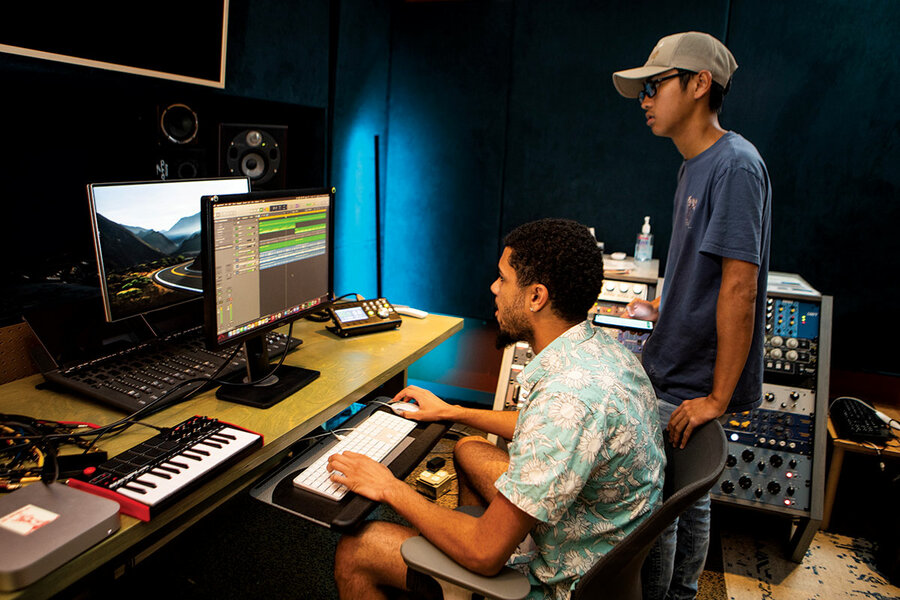
Photo: Melanie Stetson Freeman/CSM Staff.
Kyle Johnson (left) and Jonathan Hua-Phan create beats in a studio Aug. 24, 2023. Musicians can rent studio space for as little as $10 an hour – as opposed to the $100 an hour average rate in Boston.

Music belongs to everyone, but sometimes making music is expensive, especially if you need a soundproof studio with electronic bells and whistles. Fortunately, there are options.

Alessandro Clemente writes at the Christian Science Monitor, “Sanyé Mylo’s eyes twinkle with excitement. He is standing in the sound booth of The Record Co. in Boston, eager to bring his creation to life.

“ ‘This place is a musical creative sandbox,’ he says. With the press of a button, his latest rap track fills the room. As the speakers blast Mr. Mylo’s beat-pulsing rhythms, it’s hard to resist the urge to dance. ‘I didn’t know spaces like this existed,’ says Mr. Mylo, who grew up in the low-income neighborhood of Dorchester. ‘It’s the community. It’s the mission. It’s the energy. It’s more than just the environment.’

“Mr. Mylo is one of the young musicians in Boston who, thanks to The Record Co., has turned his music into a full-time occupation. The sound studio, located amid a graying backdrop of warehouses on Massachusetts Avenue, is an unexpected island of creativity and hope.

“Founded in 2010 by Matt McArthur, The Record Co. aims to give musicians more affordable access to creative workspaces and introduce the world of music to those who may have never considered their place in it.

“Mr. McArthur understands this challenge firsthand. As a music technology student at Berklee College of Music, he was frustrated by the high costs of renting time in production studios. …

“On average, a recording studio in Boston costs more than $100 per hour to rent. Mr. McArthur’s vision flipped that model on its head. He saw a recording studio not as a sanctuary for wealthy people but as a community hub available to all.

“He took out loans, collected donations, and opened a studio in a tiny basement in Cambridge, Massachusetts. Slowly but steadily, Mr. McArthur expanded it and eventually rented a new property to include rehearsal spaces and production suites.

“Today, The Record Co., with a full-time staff of more than 20 people, is a state-of-the-art, 12,000-foot facility that can be rented for as little as $10 per hour. Each month, it receives about 1,000 reservations, and around 3,500 musicians pass through its doors.

‘We don’t care if you’re good or trying to do it for a living,’ says Mr. McArthur. ‘Our philosophy is that every single person deserves to express their musical creativity.’

“At The Record Co., the ethos is clear: Music belongs to everyone, and so does the space to create it. The building has been shaped not only with an ear to acoustics but also with an eye to inclusivity, ensuring it is as welcoming to a musician in a wheelchair as to one who walks in with a guitar slung over their shoulder. …

“Beat the Odds serves low-income communities to help young people channel their energies into creative pursuits, and confront and discuss their mental health challenges. Thanks in part to the music production facility available at The Record Co., the group continues to expand its reach. It recently received a $600,000 grant from Boston Mayor Michelle Wu to finance its after-school programs. …

“Since rental fees don’t fully cover the operational costs, The Record Co. relies on donations. As a graduate of Berklee with her own memories of scraping by as a poor music student in Boston, Rachel Jordan says her investment feels personal. Now head of marketing for a tech startup in California, she says she welcomes the opportunity to help eliminate barriers to producing music, and she is committed to attracting investors to believe in the value of The Record Co.’s mission.

“ ‘There are so many quantitative ways to measure impact,’ says Ms. Jordan, ‘but sometimes the most meaningful way is through one human story at a time. We can talk about the economic impact of a thriving arts community, and that matters. But the artists themselves also tell the story of impact so well.’ …

“The Record Co.’s purpose becomes more meaningful in the context of the neighborhood surrounding it, which struggles with addiction and homelessness.

“In Boston, the stretch where Massachusetts Avenue intersects with Melnea Cass Boulevard is known as Methadone Mile, a reference to the addiction treatment centers that share the same block as the studio. Mr. McArthur, who lives in the neighborhood, acknowledges the challenges facing those with addictions, noting, ‘I’m not delusional to think that somebody is going to kick a chemical habit just because they got in the studio one day.’ Yet he holds that music offers a positive alternative to counter the pull toward destructive behaviors.

“Mr. Mylo can attest to the transformative power of music. He felt the one-size-fits-all educational system stymied his creativity. College seemed more like an insurmountable debt rather than an opportunity to learn and grow.

“A friend introduced him to Beat the Odds and The Record Co. Here he felt that his talent was not only recognized, but also nurtured.. .. Walls, built from years of distrust and self-preservation, began to crumble, recalls Mr. Mylo.  

“Now he works not only as a musician but also as a producer and mentor for new musicians who join Beat the Odds.”

More at the Monitor, here. No paywall.

Read Full Post »

Photo: Melanie Stetson Freeman/CSM.
Meidan “Abby” Lin poses in her apartment in Boston’s Chinatown. She and her husband bought the unit with help from the Chinatown Community Land Trust, which aims to stabilize the community through affordable housing, ownership of land, control of public lands like parks, and the preservation of cultural and historical sites.

One of the biggest challenges for America in these times is housing. Housing can help people with addictions get clean. It can reduce the need for long, polluting commutes to jobs in expensive urban areas, it can give people breathing space to pursue their interests and make better lives for their children.

One of the current experiments in providing housing that people can afford involves community land trusts.

Jocelyn Yang and Alexander Thompson write at the Christian Science Monitor, ‘In March 2016, [Meidan ‘Abby’] Lin; her husband, Yin Zheng; their young son, Yuchen; and Mr. Zheng’s mother left Fuzhou, Chin, … for another port half a world away on the Charles River in Boston.

“They shared their first apartment in Boston’s Chinatown with another family. During nights in that cramped space, Ms. Lin started dreaming of a place she could call her own. But Boston’s soaring real estate prices seemed to put that dream out of reach. Mr. Zheng works at a restaurant. Ms. Lin works at home.

“Then a friend told Ms. Lin about the Chinatown Community Land Trust. … The group was selling apartments at discount prices, and Ms. Lin jumped on the waitlist. But there was only one apartment big enough for her family. ‘I didn’t think we were able to get it,’ she says. All she could do was hope.

“Community land trusts [are] buying their own properties to preserve them as affordable housing in perpetuity and give residents more say over what happens in quickly changing neighborhoods. 

“That mission has gained new urgency over the past year as homeowners reap the rewards of a red-hot real estate market while renters are hit with steep rent hikes, deepening the divide between the housing haves and have-nots. …

“ ‘As neighborhoods change and gentrify really fast, the idea of having community control and having more say about how neighborhoods are changing and who’s going to be able to live in the neighborhood over time, from an affordability perspective, I think becomes really important,’ says Beth Sorce, who works with community land trusts nationwide at the Grounded Solutions Network, an affordable housing advocacy group. …

“Land trusts raise money from donations, grants, and government funds to buy property. Then they lease the house or apartment to a buyer well below market value, but the trust retains ownership of the land.

“This way, occupants typically get an ownership stake in their homes. They build equity over time, but at a rate that is often capped at 1% or 2% a year. The trust, which is governed democratically by residents and neighbors, can decide to whom the dwelling can be sold and at what price, usually through a covenant in the lease. This ensures the property remains affordable.

“The land trust idea was imported to the United States by civil rights activist Charles Sherrod in the early 1970s from the kibbutzim of Israel. Mr. Sherrod saw land trusts as a way for Black Americans to buy agricultural land in the South. …

“Andre Perry, a housing policy expert at the Brookings Institution [has shown] that an ‘intrinsic value of whiteness’ persists at almost every step of home buying from the appraisal to the sale. Minorities, but especially Black people, must pay more and get less. 

“By taking property out of the traditional market, land trusts reduce the discrimination baked into that system and empower communities to actively fight it, Dr. Perry says. …

“In California, justice is what drives Jacqueline Rivera and her fellow housing activists in San Jose. In the heart of Silicon Valley, where even high-paid tech employees struggle to find housing, development was pushing out vibrant Black, Hispanic, and immigrant neighborhoods.

“In community conversations Ms. Rivera and her colleagues held around the city in 2018, land trusts kept coming up. Ms. Rivera grabbed hold of the idea, and by 2020 she was heading up the South Bay Community Land Trust.

“Success has not come easily, though.  By definition, land trusts do not make profits, and fundraising is the biggest challenge they face. To buy their first property, a fourplex in downtown San Jose, they need to fundraise at least $1 million, on top of the half million dollars they need to pay professional staff and make the organization run. Speed is a problem, too. Developers snap up properties with cash in a matter of days, while the land trust moves ‘at the pace of community,’ Ms. Rivera says. 

“Yet, in order to disrupt traditional real estate, land trusts ‘still have to play in the real estate game,’ she adds.

“Advocates stress that land trusts are just one tool in a broader approach to the affordability crisis, but it could be a more effective one with government help. Ms. Sorce, of Grounded Solutions, says state and local governments should invest money in land trusts and change appraisal policies so land trust properties aren’t paying taxes based on their speculative value. With or without such help, land trusts must innovate to succeed.

“ ‘When we think about community land trusts, so many times we think about just the homeownership level,’ says Sheldon Clark, who recently served as president of the board of the Douglass Community Land Trust in Washington, D.C. ‘And that really just doesn’t cover the housing needs that we have.’

“Douglass has units it’s maintaining as permanently affordable rentals and other properties set up as cooperatives. They’ve also helped tenants take advantage of a District of Columbia law that entitles them to buy their unit if their landlord plans to sell.

“Really, land trust leaders say, homeownership is just one aspect of their focus on what Mr. Clark calls the ‘big C’ in community land trusts: the community.

“Douglass organized food drives during the pandemic and helps connect residents to credit unions, as many are unbanked. In Boston’s Chinatown, the land trust helped save a local park.”

Find other examples of how land trusts strengthen communities at the Monitor, here. No firewall; nice photos.

Read Full Post »

Photo: Time magazine, 2020.
At 15, scientist Gitanjali Rao made history with a device to detect lead in drinking water. ‘You don’t need a PhD to make a difference,’ she says.

More kids are getting into science these days, and I think their enthusiasm is going to benefit us all.

Anne Branigin reports at the Lily, “Gitanjali Rao just finished her final exam of the year and, like any other teenager, is eager to begin her summer.

“The 15-year-old is, in many ways, not your typical teen. She landed on the cover of Time magazine in 2020 as its inaugural ‘Kid of the Year’ for her scientific achievements, which include building a device, Tethys, that detects lead in drinking water.

“But Rao doesn’t see herself as exceptional. In fact, when she was younger, she didn’t even see herself as ‘the science type.’ She was driven, instead, by trying to find solutions to problems in her community. Once she discovered science and technology could be a means of finding those solutions, there was no turning back.

‘Using science and technology as social change became something that was intuitive to me and something that I wanted to keep doing,’ she said. …

“Rao says her passion for STEM has shaped her days and her goals — she is working on creating a global network of young innovators to tackle global problems. It also fuels her relentless optimism for the future and all its possibilities. …

“Anne Branigin: I’m curious what a normal day looks like for you during a very not-normal year.

“Gitanjali Rao: A normal day obviously involves being your normal high school student, just, you know, maintaining a social life, still doing homework every single day, studying for exams. But then there’s this added layer of my research and innovations. A lot of my work has been focused on running my innovation workshops for students all over the globe, which is also taking up a little bit — a lot of my energy and time trying to maintain that sort of situation as well. And also just being, even remotely, in the public eye obviously comes with its own perks, but also disadvantages of being able to manage that as well. …

“I love helping people. I love using science and technology to do that. So that priority always comes first. … I don’t do eight things at a time. I might do eight things in a day, but not eight things at a time because I know what I need to focus on. I know how to prioritize my work. …

“Anne Branigin: On the subject of your generation, there’s a recent study showing that interest in STEM is at an all-time high among young people.

“Gitanjali Rao: It honestly makes me really happy to see younger generations engaging in science. Today’s kids are tomorrow’s innovators and they [will] make the world better, stronger and more sustainable in the future. …

“Anne Branigin: What do you think makes your generation’s approach to science unique?

“Gitanjali Rao: So a question that I commonly get is, what is one word to describe your generation? And I like to say, hotheaded — but in a good way. Our generation, if we put our mind to something, we want to get it done. That’s how I have been. That’s how a lot of my friends have been. …

“Anne Branigin: In the past, we haven’t always seen people of color and women and other members of marginalized communities really be the drivers of this technology. I’m curious how you’ve been thinking about equity and how those conversations have come up with your peers.

“Gitanjali Rao: My generation is destined to be innovators more than any generation that came before. And we’re the first generation to grow up as natural innovators because of how we live, where we live and what we have access to from a technology standpoint.

“Where I want to see that equity change is in education. Access to resources is something that obviously people have faced across the world. It’s an issue still to this day. It’s the 21st century, and we’re still talking about girls and women struggling to get education. But what it’s important to recognize is that a lot of times, the ideas start in the bare minimum.

“With my device, Tethys, to detect lead in drinking water, I started with a cardboard box and a couple of drawings on a piece of paper. And honestly, what that turned into was not looking at what resources I had, but dreaming big and then thinking back to reality.

“So equity is something that we need to work together to make a difference. But until then, it’s about using what we have on hand. Most of the innovators that I talk to online don’t have their driver’s license. I don’t have my driver’s license. But at the same time, it gives me this opportunity to be like, ‘Okay, with the resources that I have on hand, without having money to spend, what can I do?’ “

More at the Lily, here.

Read Full Post »

The Atlantic magazine says Estonia is the new Finland, meaning that it is doing a bang-up job with quality education for all. Educating the poor turns out to be a salient strength of the system.

Sarah Butrymowicz writes, “In 2012, Estonia’s 15-year-olds ranked 11th in math and reading and sixth in science out of the 65 countries that participated in an international test that compares educational systems from around the world (called the Programme for International Student Assessment, or PISA).

“In addition to beating out western nations such as France and Germany and essentially tying Finland in math and science, Estonia also had the smallest number of weak performers in all of Europe, about 10 percent in math and reading and 5 percent in science.”

In comparison, the United States hovers in the middle of the pack.

“While there is less income inequality in Estonia than in the United States—and, with 1.3 million people, the country is significantly smaller—the Baltic nation also has its share of cultural diversity.

“When it achieved independence from the Soviet Union 25 years ago, Estonian became the official language and the language of school instruction. Yet about a fifth of its students come from families that still speak Russian at home, and they have historically lagged behind their native speaking counterparts on tests such as PISA. …

“Marc Tucker, president of National Center on Education and the Economy in Washington, D.C., visited Estonia last year to find out what they’re doing right. He said that after the fall of the Iron Curtain other former Soviet satellites, such as Hungary and the Czech Republic, transitioned to a system preferentially suited to the needs of its elites. Estonia, however, kept giving equal opportunities to students of all backgrounds. …

“There are many factors that may contribute to Estonia’s success on PISA beyond their focus on equality. Education continues to be highly valued. Teacher autonomy is relatively high, which has been shown to be related to better test scores. Teachers stay with the same students in grades one to three – or sometimes even up to sixth grade – allowing deep relationships to develop.”

Maybe we could learn something from this small Baltic state. Read more here about why Estonian students are so successful on tests and whether they are happy with the system and why the country is trying to encourage more individuality and creativity without losing rigor.

Photo: Ints Kalnins / Reuters
First graders take a computer class in Tallinn, Estonia.

Read Full Post »