Feeds:
Posts
Comments

Posts Tagged ‘esl’

Photo: Kelly Sikkema via Unsplash.
It’s amazing how many cultures use lemon and ginger tea to treat colds.

I have volunteered as an English as a Second Language (ESL) assistant for about eight years. Recently Teacher Allissa’s assignment for her students was to write about the home remedies their families use. These are adult students from countries as diverse as Turkey, the Dominican Republic, Afghanistan, Peru, China, Haiti, Cambodia, Guatemala …

Note the cold remedy mentioned most.

“When my children have a fever, I put them in the bathtub with warm water, salt and vinegar. It’s so good to lower the fever.”

“When someone is sick, I boil chamomile tea for them. I also make lentil soup or chicken soup.”

“In my country, when a person is sick, l give them some tea, some vegetable oil, soup and cinnamon tea.”

“I treated the children’s colds with tea with raspberry and lemon, and also tea with ginger, honey and lemon. For colds and viruses, the best noodle soup in chicken broth is served with a garlic yogurt mixture. Tasty and healthy for cough. In my country, Azerbaijan, many herbs grow in the mountains for various diseases.”

“Lemon tea is good for cough.”

“In China, we always think ginger tea can help people keep away colds.”

“Lemon tea is helpful to keep your immune system strong. Lemon contains vitamin C. Make sure to wear a hat, gloves, and a scarf if you’re going outside to stay comfortable.”

“I remember when I was in Haiti and had a sore throat, my mother used to boil ginger and lemon tea. Then when it was ready, she put honey in it. Then she gave me the tea to drink, and after a while I felt better.”

“Lemon is good for the people who are sick. For example, if they have a sore throat or are losing their voice. I make a lemon syrup with hot water and salt and keep it for one year. If you keep it more then a year, it’s no good. When you are sick, boil it with the water and drink it. The next day you will feel better.”

“When I have a cold, I prefer to drink lemon tea with honey. It is very useful for sore throat and runny nose. I also take anise tea for any stomach disorders.”

“I remember when I was a little girl and my mother would put limes with salt on my wrists and feet to help lower down my body temperature when I was sick. I’m really grateful that she taught me this because I now use this method to help cure my kids when they’re sick.”

“Lemon tea is very good for your body, especially when you have a fever and sore throat. When I have a fever, I drink it and it helps me. I advise you always to drink lemon tea.”

“Mint is a relaxing plant. When I have a stomach ache, I make mint with lemon tea. Oregano is the best herb with a roast chicken. Lavender is a miracle plant for me. It’s for detoxing, good sleep and headaches.”

“We treat colds with hot tea with ginger, lemon and honey. Prepare hot chicken broth soup with noodles and add garlic.”

“In Peru when we are sick with cough and fever, we drink hot water, a fresh eucalyptus leaf and also chamomile and a small piece of ginger, and we sweeten it with honey. We also rub our chest and back with Vicks VapoRub, and at night before sleeping, we place a slice of onion under the soles of our feet and put on our socks. The next day we take out the slice of onion, and the onion is all black and it is thrown in the trash, because it has already absorbed part of the cold. The onion strengthens our immune system. You can also place half an onion on top of the nightstand. The smell of the onion absorbs the flu viruses that are in our bedroom; it also serves to relieve asthma and helps the respiratory tract.”

I shared the onion idea with my 12-year-old granddaughter when she had flu last week. She didn’t try it.

Please share your own home remedies.
Read Full Post »

032717-ESL-class-Providence

I volunteer with English Language Learners at two agencies in Providence and one in Boston. The classroom teachers are all quite different in their approach, and I learn from them all. JVS in Boston has a rapid-employment model, so all the English learning is geared toward what you need for a job.

At one Providence agency, I work with a teacher who has brand-new refugees, some of whom, because of war or poverty, have never been to school in their native countries. She keeps the atmosphere friendly and light, but there is an understandable level of seriousness, given how new everything is to the participants.

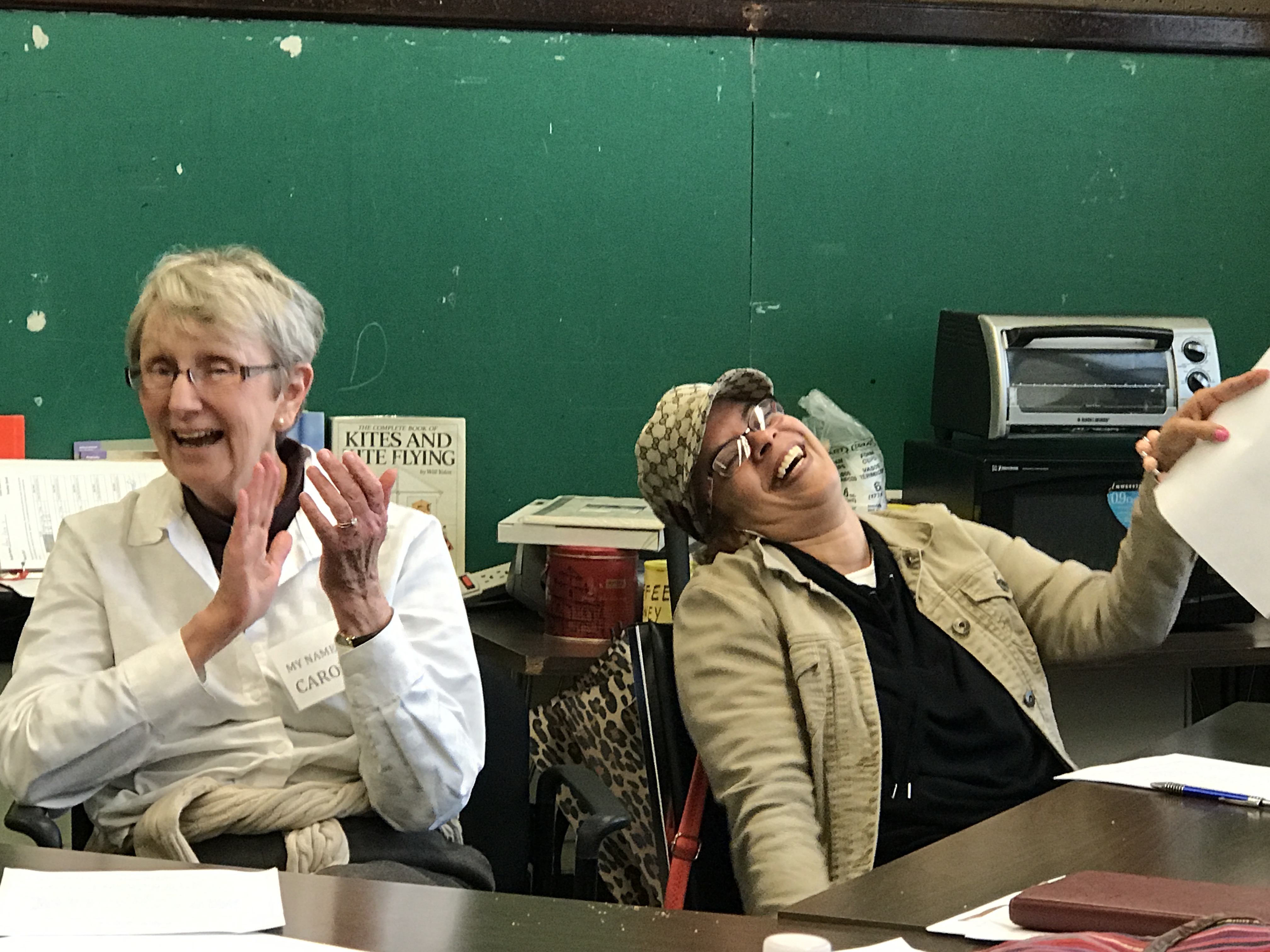
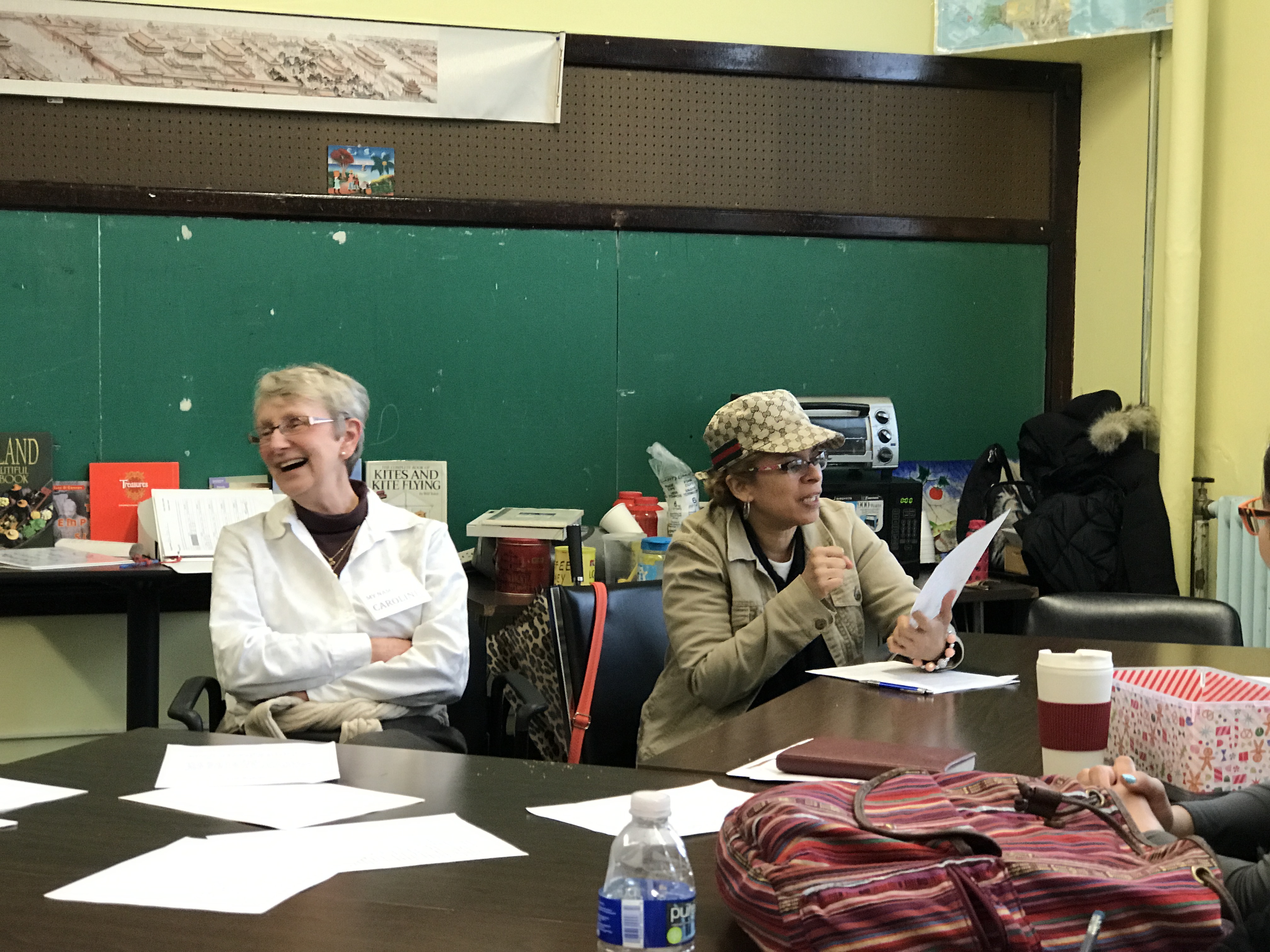
The teacher I assist at the Genesis Center has a class of immigrants whose language skills are a bit further along and who mostly come from Spanish-speaking countries and are not refugees. I believe the woman in the hat, above, is from Puerto Rico — so, born a US citizen. She wants to improve her English and loves to write.

On Monday, the teacher was following up on the previous week’s discussion of periodic tables, the instability of hydrogen, and the 1937 crash of the German pleasure blimp the Hindenburg in New Jersey. He showed the crash film to the class, one that I’ve seen often enough to know I really can’t take it. I look away.

I said, “What’s interesting is that when Orson Welles did his radio play at Halloween the following year about Martians landing in New Jersey, many listeners were so sensitized to disaster they thought the radio play, presented as real news, was true.

I said, “It might be fun sometime for the class to practice their English by reading the script.”

The next thing I knew the teacher had found the radio play on the web and was passing around copies.

When we were halfway through it, we discussed the ways Orson Welles had adapted the H.G. Wells sci-fi classic to New Jersey, with an authentic-sounding ballroom broadcast that was frequently interrupted by a studio announcer switching to reports of an unusual light burst on Mars and (after some more of the big band concert) a shiny cylinder falling on a farm in Grovers Mills. Details like the boom heard as far as 100 miles away in Elizabeth, New Jersey, added to the verisimilitude. So did the on-the-ground reporter conducting interviews with the farmer and a scientist who didn’t believe in life on Mars, as police sirens wailed in the background. We talked about how panicked some listeners were and how they jammed the lines at the radio station.

The teacher next had people write their own endings to the story. It was a lot of fun. The students don’t speak much English, but they certainly got the point about the panic. One woman, remembering how in her hometown some individuals thought the turn of the millennium was the end of the world and did away with themselves, put that into her story. Others envisioned panicked parents rushing to schools to pick up their children.

It was serious in a way, but we laughed a lot. I felt grateful to work with a teacher who is able to make up a good lesson on the spur of the moment like that.

Photos: David Buchalter

032717-ESL-hilarity-GenCenterJPG

Read Full Post »

Dorcas International of Rhode Island is a refugee-resettlement and immigrant-support organization that also offers education programs and services to native-born residents.

On the nonprofit’s website, you can find uplifting stories of DIIRI beneficiaries. Here is one.

Sidy Maiga, a master percussionist from Mali, wanted to take his skills to the next level. The first step was to get over his insecurity about education.

“His mastery of the djembe, a drum of West African origin that is rope-tuned [and] shaped like a large goblet, has taken him on tours all over the world and as a teacher in schools all over the East Coast … But without a high school diploma, he felt like he had hit a wall. …

“Sidy heard from friends about things you could do at Dorcas International Institute of Rhode Island. …

“He admits he was hesitant about going to school again. … He enrolled in an ESL [English as a Second language] class to get up to speed” before taking the high school equivalency test known as the GED “and felt himself getting discouraged — so he stopped going to class.

“However, after getting encouraging calls from DIIRI staff, Sidy decided he would give it another shot. … ‘I think they saved my life, and I’m glad I came back.’ …

“With the help and encouragement of DIIRI staaff, Sidy decided the next step would be college.”

Sidy starts at Berklee College of Music this year and says, “Once I learn the academic way of music, then I can teach African music to the world.”

More here.

Photo: Dorcas International Institute
Malian djembe drummer Sidy Maiga says Dorcas staff “saved my life.”

Read Full Post »

Thomas Whaley, a teacher of 7-year-old English-language learners on Long Island came up with a creative way to build confidence while building writing skills. He has students make the case for why they should be president.

Jasmine Garsd reports at National Public Radio, “Whaley does not look like the kind of guy that dabbles in magic markers. Before he was a second-grade teacher, he worked at a public relations company in New York City.

“He says he started thinking about doing something else while riding to and from work on the Long Island Rail Road. ‘I would talk with people on the train at 6 a.m. and 8 p.m. on the way home,’ he recalls. ‘They were people who had a complete disconnect from the young people of the world. They were all so focused on adults and the rat race. And I realized that this was not for me.’

“That was 16 years ago. He has been teaching ever since.

“In addition, Whaley has found time to write a novel called Leaving Montana, and he’s starting to write children’s books. Last year, he won the New York state teacher-of-the-year award.

“This second-grade presidential campaign is an example of why. He tells me he got the idea when he asked the children one day to raise their hands if they thought they could never be a U.S. president.

“The answer broke his heart.

” ‘Almost every single child who is an English-language learner believed that they couldn’t be,’ Whaley recalls. They’d say things like, ‘ “I can’t run for president because my parents are from a different country.” That was a biggie. “Because I’m poor, and you need a lot of money to be the president.” “Because I don’t like to read, or I can’t read.” ‘

“Whaley says the presidential speech project is about more than just learning to read and speak in public. He wants these kids to learn to boast about themselves.

” ‘Bragging about yourself, and your best qualities,’ Whaley says, ‘is very difficult for a child who came into the classroom not feeling any confidence whatsoever to read three or four words.’

“Robert Epstein, the principal at Canaan Elementary, says this is the essence of what makes Whaley such a great teacher.

” ‘There’s a sense of community that’s really unsurpassed,’ and the students will take risks as a result, Epstein says. He adds that Whaley goes above and beyond what is expected of him as a teacher. ‘If one needs sneakers, I’ve seen him go out and buy sneakers. He’s gone to homes. He’s constantly on the phone, constantly emailing parents.’ ”

More at NPR.

Photo: Christopher Gregory for NPR
Thomas Whaley walks his students back to class from the library.

Read Full Post »