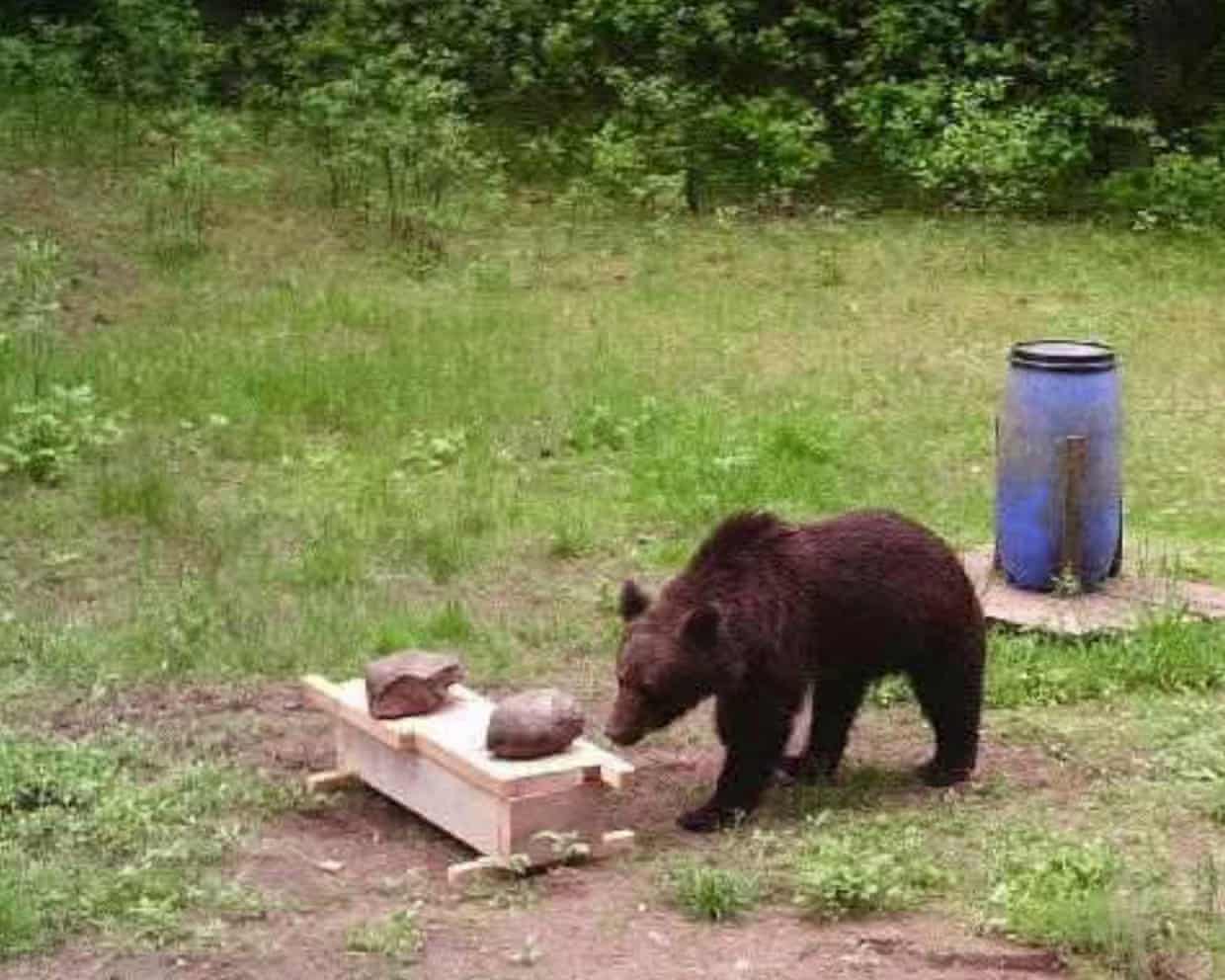
Photo: Paulius Peciulis/AP. This young bear was recorded by a hunter in the forest calmly feasting on baits in Pabradė, Lithuania, in June.
When I was young, I was surprised when my conservationist mother told me that hunting organizations like Ducks Unlimited were often sollid partners in protecting nature. But when I thought about it, I reaized that, of course, if you’re a duck hunter, you want enough ducks to hunt, and that means protecting their habitat.
Something similar may be the thinking of the Lithuanian hunters in today’s story who refused to shoot a bear.
Bears have started reappearing in small numbers, typically wandering in from neighboring countries such as Latvia and Belarus, where small bear populations still exist.
From the Associated Press in Warsaw via the Guardian: “A young female bear caused a stir after wandering out of the forest and into the leafy suburbs of the Lithuanian capital.
“For two days, the brown bear ambled through the neighborhoods of Vilnius, trotted across highways and explored backyards – all while being chased by onlookers with smartphones and, eventually, drones.
“The government then issued a permit allowing the bear to be shot and killed if it became aggressive and posed a threat to human life.
“That did not go down well with Lithuania’s hunters who, aware that there were only a tiny number of the protected species in the entire country, refused.
“The Lithuanian association of hunters and fishermen said it was shocked by the government’s approach.
“The association’s administrator, Ramutė Juknytė, said the bear was a beautiful young female who was about two years old and did not deserve to be shot. ‘She was scared but not aggressive. She just didn’t know how to escape the city, but she didn’t do anything bad,’ he said.
“The organization tracks the movements of bears. It believes there are only five to 10 bears in the Baltic country but does not have a precise number.
“The drama began [when] the bear entered the capital. It was the first time in many years that a bear had entered the city and it became a national story. The animal came within about 2-3 miles of the city center.
“Since causing a stir with their permit to kill the bear, Lithuanian authorities have been on the defensive. The deputy environment minister, Ramūnas Krugelis, said that the kill permit had been issued purely as a precaution in case the bear posed a threat, according to a report by the Lithuanian broadcaster LRT.
“The hunters proposed a more humane approach: sedation, tracking and relocation.
“As the debate over the bear’s fate unfolded, she took matters into her own paws and wandered out of the city. …
“Brown bears are native to the region and were once common. They were wiped out in Lithuania in the 19th century as a result of hunting and habitat loss.
“In recent years, they have started reappearing in small numbers, typically wandering in from neighboring countries such as Latvia and Belarus, where small bear populations still exist.
“Bears are protected under Lithuanian and EU law as they are considered a rare and vulnerable species in the region.” More at the Guardian, here.
Do you or your family members hunt? Over time, I’ve seen repeatedly that real hunters are supporters of gun-safety laws as well as conservation. They are definitely not the people who buy machine guns and shoot up schools. I hope that more and more, hunters will be the ones leading the charge for safety laws. Their viewpoint probably carries the most weight.
Photo: Robert Ormerod/The Observer. Zurich city center, where 99.2% of residents live within a 15-minute walk of essential services such as health care and education.
My parents always preferred homes that were out in the countryside, and as much as I loved my walks in the woods as a child, I knew from car-free summers on Fire Island that being able to walk to everything was pretty great. After marriage, my husband and I always chose homes in walkable communities, whether we were in upstate New York or Massachusetts or Minnesota.
Ajit Niranjan writes at the Guardian on the topic of walkable communities.
“When Luke Harris takes his daughter to the doctor, he strolls down well-kept streets with ‘smooth sidewalks and [ramps] for strollers at every intersection.’ If the weather looks rough or he feels a little lazy, he hops on a tram for a couple of stops.
“Harris’s trips to the pediatrician are pretty unremarkable for fellow residents of Zurich, Switzerland; most Europeans are used to being able to walk from one place to another in their cities. But it will probably sound like fantasy to those living in San Antonio, Texas. That’s because, according to new research, 99.2% of Zurich residents live within a 15-minute walk of essential services such as health care and education, while just 2.5% of San Antonio residents do.
“ ‘Zurich feels extraordinarily walkable to me, coming from the US,’ said Harris, a landscape architect from Portland, Oregon. ‘Most of the things you need are within walking distance – and if they’re not, it’s easy to take public transport.’
“Just a tiny fraction of 10,000 cities around the world can be considered ’15-minute cities,’ according to a study published in the journal Nature Cities [in September]. The researchers used open data to work out the average distance people must walk or bike to reach essential services – such as supermarkets, schools, hospitals and parks – and calculated the proportion of residents who have the necessities at their fingertips.
“ ‘When we looked at the results, we were amazed by how unequal they are,’ said Matteo Bruno, a physicist at Sony Computer Science Laboratories in Rome and lead author of the study.
“The researchers selected 54 cities to explore in detail and found that the most accessible cities were midsize European ones such as Zurich, Milan, Copenhagen and Dublin – all of which had essential services that could be accessed within 15 minutes by more than 95% of residents. At the bottom of the rankings were sprawling North American cities with a high dependency on cars, such as San Antonio, Dallas, Atlanta and Detroit.
“Small cities tended to score better but the researchers found that in some big metropolises, such as Berlin and Paris, more than 90% of residents live within a 15-minute walk of essential services.
“The authors developed an algorithm to explore how much these cities would have to change to become more accessible. They found Atlanta would have to relocate 80% of its amenities to achieve an equal distribution per resident, while Paris would need to relocate just 10%.
“Hygor Piaget, a co-author of the study who grew up in São Paulo, where 32% of people live within a 15-minute walk of essential services, said the study was not a proposal to destroy cities and reallocate their services but a mathematical exercise to get people thinking. ‘We’re searching for ways to make the lives of most people better,’ he said.
“The concept of a 15-minute city has been attacked in recent years by conspiracy theorists who see it as a government plot to control movement and restrict freedom. The vitriol has frustrated scientists, urban planners and doctors. …
“The authors say the study is limited by the quality of the open data, which is patchier in cities outside of Europe and North America, and how practical it is to walk in some cities. Heavy traffic, high crime, bad weather and steep hills may discourage people from walking even geographically short distances. …
“Researchers caution that making a city more accessible is not enough in itself to wean residents away from private cars. The Netherlands boasts some of the best bicycle infrastructure in Europe but has more cars per person than rural countries such as Ireland and Hungary.”
More at the Guardian, here. No firewall, but please donate occasionally. Not owned by US oligarchs!
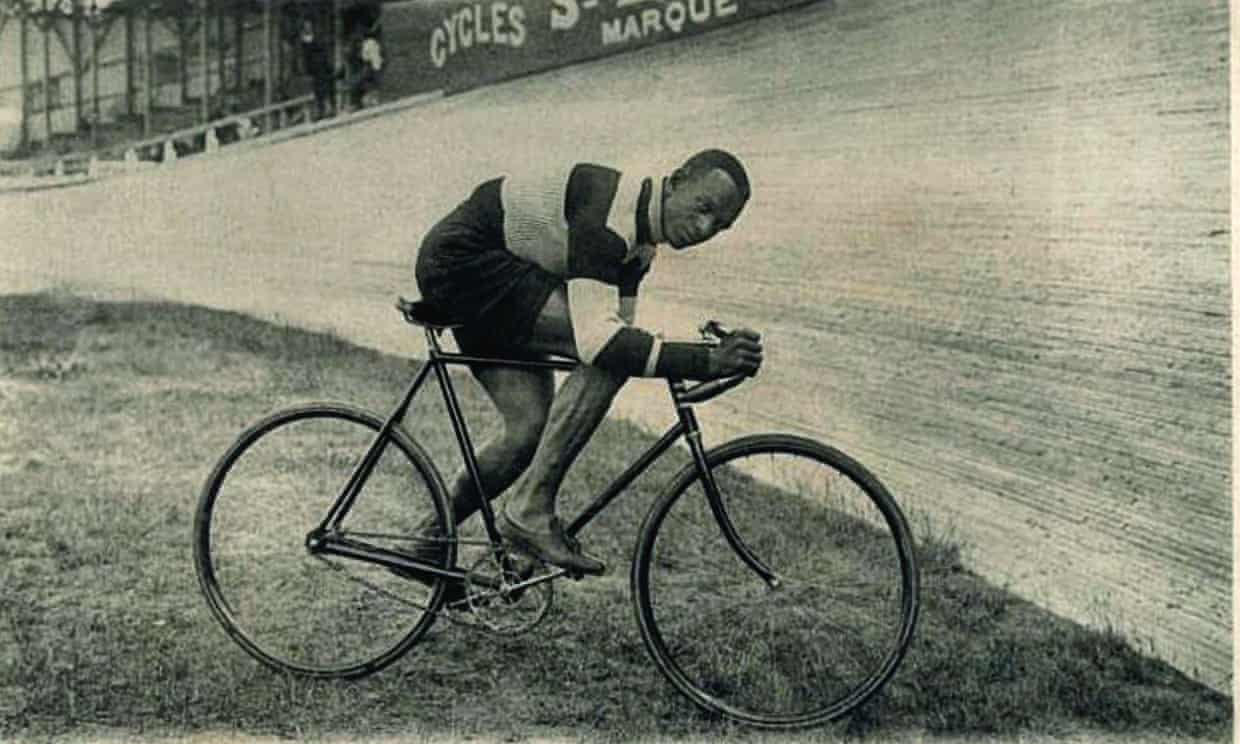
Photo: via Robert Turpin. Woody Hedspeth was one of several Black American cyclists in the early 20th-century to move abroad to further his career.
A country shoots itself in the foot when it pushes away talent. I’m thinking of asylum seekers who may have something to offer. I’m thinking of Black talent going to Europe to find a more welcoming and level playing field — writer James Baldwin, for example, singers Josephine Baker, Marian Anderson, and Paul Robeson.
Today I’m learning about Black bicycling champions turning to Europe in the early days of the competitive sport.
Rich Tenorio writes at the Guardian, “When cycling first took the US by storm in the late 19th and early 20th centuries, Black Americans joined in the new pastime. One Black cyclist, Marshall ‘Major’ Taylor, became a world champion in 1899. Yet American cycling installed a color line in professional racing. Opportunities became so limited that Black competitors had to take them wherever they could find them – including on the vaudeville stage and in Europe. Their story is documented in a new book, Black Cyclists: The Race for Inclusion, by Robert J Turpin, a professor of history at Lees-McRae College in North Carolina.
“ ‘We fall into the trap that history is linear,’ Turpin says. ‘With race relations, we think about the end of the Civil War: “Slavery ended, and things gradually got better and better for Black people.” My book shows what we already know: Things actually got worse for Black people in the US, especially from the 1880s through the 1920s … It got harder for Black cyclists to compete as professionals or even win prize money in general.’
“Turpin is a cyclist himself, and his college features a cycling studies minor, which he believes is the only such program in the US. His interest in the history of cycling extends to how it has been marketed over the decades – the subject of his previous book. …
“Turpin raises another issue: a lack of diversity in contemporary cycling. The book cites a 2020 USA Cycling survey of over 7,000 members in which just 3% reported they were Black or African American. Such underrepresentation extends to the [Olympics] and the Tour de France, where [in July] Biniam Girmay became the first Black African stage winner in the race’s 120-year history. Yet the book notes the increasing impact and influence of Black elite competitors such as 11-time national champion Justin Williams and the first Black female professional cyclist, Ayesha McGowan.
“Before attending graduate school at the University of Kentucky in 2009, Turpin learned about Taylor, whose exploits in cycling began as a teenager in Indianapolis, and crested with a world championship in the one-mile sprint in Montreal. In doing so, he became the first Black American world champion in any sport and his achievements were chronicled in an autobiography, The Fastest Bicycle Rider in the World. ‘He was an international superstar,’ Turpin says. …
“Several years later, Turpin returned to Taylor’s story. By that time, additional primary sources had been made publicly available through digitization. Turpin learned more about not only Taylor, but also his predecessors and peers. …
“Massachusetts became a venue for early Black success in cycling. David Drummond regularly won Fourth of July races in Boston. Taylor used his winnings to buy a home in Worcester – and the city’s first automobile. Katherine ‘Kittie’ Knox, a seamstress turned racing star, was famous for her self-designed outfits and her endurance. Knox illuminated challenges faced by cyclists who were both Black and female.
“ ‘If you were Black and a woman, those were two big strikes against you,’ Turpin says. …
“In 1894, a prominent nationwide cycling organization called the League of American Wheelmen, … barred all Black cyclists except Taylor from professional racing. The ban was not officially repealed until 1999 by the organization, which had been renamed the League of American Bicyclists.
“The book shows the ways in which Black cyclists responded. These included criticizing the decision in the Massachusetts state legislature and forming Black cycling leagues.
“ ‘I stress their agency,’ Turpin says. ‘I do not talk about them as victims. They were resourceful in figuring out alternative ways to still make a living and find social mobility.’ …
“Unlike Jim Crow America, international venues welcomed Black participation as professionals. Taylor left for France and Australia, and named his daughter Sydney after the city where he felt most welcome. Fellow racer Woody Hedspeth followed Taylor to France – and while Taylor returned to the US, Hedspeth remained in Paris.”
Photo: Rewilding Europe. By 1627, the massive auroch had been hunted to extinction across its entire range. But strands of its DNA remain alive, and in 2013, Rewilding Europe, together with the Dutch Taurus Foundation, embarked on a program to bring the auroch back to life.
Are you up for another “extinct but still around” story? This one is about the mighty auroch, whose bull form Zeus assumed in one Greek myth. The rewilding folks in Europe are using the auroch’s remaining DNA to bring it back.
Gerry Hadden at PRI’s The World reported recently on the herd being “back-bred” in Spain.
“The auroch — giant, wild cows — date back nearly 10,000 years and once roamed freely across Europe. Until they were hunted to extinction by humans. The last ones died in Poland in 1627, according to Ricardo Almazán, a safari guide in the mountains of Albarracín, Spain, where a herd of modern-day aurochs can be found.
“Today, the wild bovine — called tauros in Spanish — are here once again thanks to the nongovernmental organization Rewilding Spain.
“They are working to ‘rewild’ the auroch — or bring back the animal hunted out of the area to restore the wilds as they were before. …
“Aurochs played a key role in the ecosystem — namely, grazing the largest brush and small trees to keep forests from growing too dense and prone to burning. …
“Reintroducing the auroch to the wild involves crossbreeding cows with the ancient genes of the aurochs, according to Lidia Valverde from Rewilding Spain.
“So, taking the ‘genetic features from different breeds of cows that we know that are descendants of that wild ancient cow’ to create a new breed, she explained. But they’re not introducing an entirely new species — scientists have managed to recover more than 90% of the aurochs’ DNA, she said.
“Rewilding Europe, together with the Dutch Taurus Foundation, began the program to bring back the auroch in 2013. Now, the breeding of aurochs is happening in a selective way in Spain, Portugal, Croatia, Czech Republic, Romania and the Netherlands. And, more than 600 of the animals have been bred since the end of 2017, according to Rewilding Spain.
They are reminiscent of fighting bulls, but up to three times bigger.
“Almazán said these new aurochs look and behave just like their forebears. They are reminiscent of fighting bulls, but up to three times bigger. An auroch may weigh over 2,000 pounds, with horns hovering 7 feet above the ground. They are Europe’s largest herbivore.
“Almazán said their presence in the forest is evident in the fact that a lot of trees have been knocked down — the aurochs walk along and smash them flat and then eat the wood and everything. The cows’ behavior has a larger, ecological benefit, he said. The new clearing has allowed the sun to reach the forest floor for the first time in years, giving other plants the chance to grow and attracting insects, birds and other grazers, like deer.
“Local farmer, Paco Rollola, who works with Almazán to help keep the aurochs from straying too far, said that lightning struck a tree nearby recently, but it didn’t start a fire because there was no undergrowth around the tree. The aurochs had eaten it all, he said. Without them, he said, everything would have burned down.
“Valverde of Rewilding Spain said that the beasts are not only making this forest healthier, but they’re also helping the local economy [by] attracting tourists to an area seldom visited.”
More at the World, here. I am fascinated by rewilding projects, but as for these giant animals, I just hope they don’t bulldoze (to coin a phrase) the wrong trees. Can’t you just imagine a science fiction film in which the program runs amok?
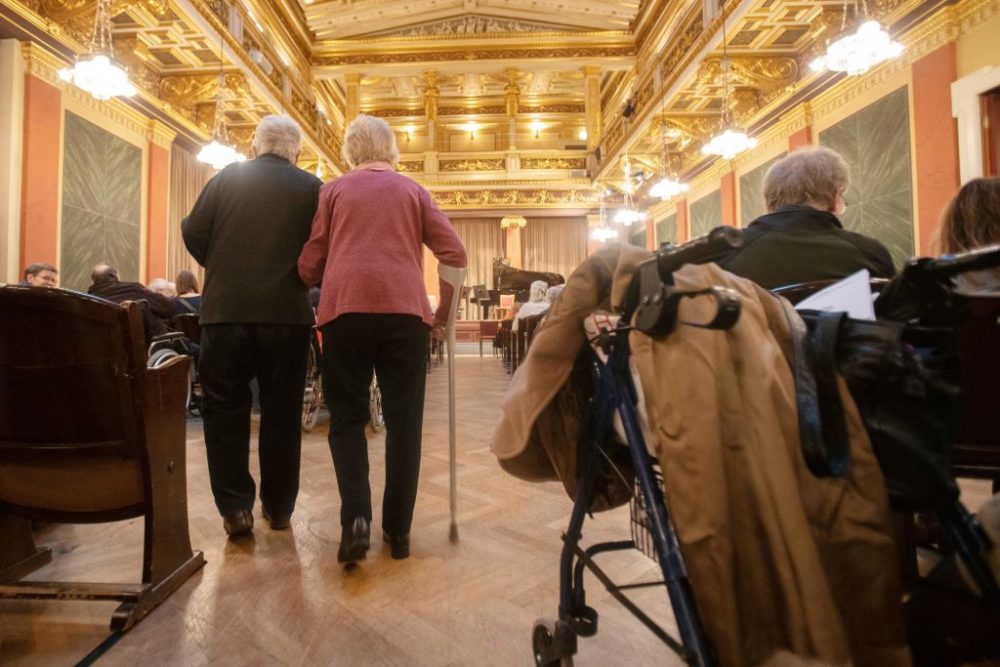
Photo: Alex Halada/AFP via Getty Images. Elderly spectators arrive to attend a concert specifically tailored to people living with dementia at the Wiener Musikverein in Vienna on December 5, 2022.
Meghna Chakrabarti of WBUR’s On Point had a great show recently about enlightened dementia communities in the Netherlands and other parts of Europe.
I came away feeling that the reason we have little like this in the US is because of insurance. We are such a crazily litigious society, we can’t afford to take the slightest risk, even if it means an older person will have a happier aging experience.
Producer Paige Sutherland and host Meghna Chakrabarti shared highlights from the show at the WBUR website.
“Is there a better way to care for dementia patients? And what might that look like?
” ‘I think it really focuses on what’s the day-to-day life and looking at this balance between safety and freedom,’ Dr. Tia Powell [professor of psychiatry and bioethics at Albert Einstein College of Medicine] says.
“And that’s exactly what the Netherlands did when they opened up the first-ever ‘dementia village,’ where residents can live freely despite their memory loss.
” ‘Officially, it’s a nursing home, so we offer highly complex care, skilled nursing. But it does not look anything like a nursing home,’ [advisor at Be Advice] Iris Van Slooten says. …
“On the idea behind a ‘dementia village’
“Iris Van Slooten: It should be about the individual; it should be about the person living in that place and need to deal with dementia. And you want to continue your life even though you are dealing with dementia. And so you want to continue life like you did before and not be hospitalized. I always ask our visitors and the people we work with, would you want to live in a hospital for the rest of your life? And then always the answer, of course, is no.
“So then why did we do that to the people that were living with us? … You can continue with your life, you can stay a human being. And what makes you a human being, for instance, is that you can make your own choices every day. Like … what do I have on my sandwich? Or in what place do I want to be right now? Very, very simple choices we make every day but are taken away from people that live in a nursing home.
“On what the village looks like
“Iris Van Slooten: You will enter through a door and then you will enter the hallway. And that is a safe neighborhood where the outside of the homes are the barrier to the … broader surroundings. And we had a door because there were laws in place back when we designed … we had to keep people inside. But you will find 27 homes in a normal looking community. In a normal neighborhood. The homes look like normal Dutch homes with a normal living room, a kitchen, private bedrooms.
“And when residents also step out of the front door, … they are really outside. And there are many streets and many gardens they can explore. We have a restaurant, a pub, a theater, many club rooms, a supermarket. So, everything you will find in any neighborhood, in any community. So yeah, very normal, and especially on a sunny day and in spring and summer, of course, then you see a lot of people walking around, having conversations, meeting each other, grabbing a chair, enjoying a drink in a restaurant. It’s just life. …
“Every resident that lives there has severe dementia. So, you need to have an indication from the Dutch government saying you have severe dementia. … We have teams in the houses that support the household and really run the household. But we also have a quite extensive medical support team, including a specialist, elderly care, doctor, but also a psychiatrist, an official therapist, a social coach. …
“Say someone left their home, and they wanted to go to the village supermarket, but got lost or forgot the way. How do you help that person get to where they wanted to go?
“Iris Van Slooten: One thing we highly value in the Hogeweyk is having freedom and giving the freedom to these people and not restraining them. … They are free to walk around on their own. A lot of people can find their way because also people with severe dementia, they still have learning abilities, and the place is designed [so that it is] recognizable for them. …
“So also the staff in the restaurant, also the reception, also the technicians, also me when I’m there. … When I look out my office and I see somebody in the rain without a coat on, it might slip to the attention of a staff member in house. But then it’s also my job to go over there and find a jacket for that person. …
“On helping people maintain their independence and humanity in the ‘dementia village’
“Dr. Tia Powell: [As] a bioethicist, really all of our challenges can be summed up by the tension between maintaining freedom, which is part of what all human beings strive for, and safety. And this argument’s been going on forever for hundreds of years.
So I do think that many of the ways in which we provide care today in the U.S. for people with dementia do not focus on care, but they focus on other issues. You know, maintaining regulations, all kinds of other things.
“And we have forgotten about freedom and joy.”
A bit from the transcript on the sad US situation.
“Meghna Chakrabarti: Beth Ounsworth … was living a very rich life full of friends and music. As a member of her choir, she was independent in her own apartment in Philadelphia. And that started changing when Beth was about 69 years old. She began forgetting simple things like what day and time she had scheduled meetings, directions to common places. …
“And so her children finally took her to see a neurologist. And Beth was diagnosed with Alzheimer’s disease. Now, we spoke with her daughter, Meg Ounsworth Steere. Because Meg wanted to care for her mother, but with two young children at home, it just wasn’t possible. So they looked at assisted living centers near where Meg lived in Boston.
“Meg Ounsworth Steere: So she did go and visit a few assisted living centers with me. … We went to lunch, and she just looked around and she was like, Not me, not now. And I was like, okay, you know? And that’s when we had this conversation about she was like, I don’t want to be in a place where I’m just surrounded by old people. I want to be in a place where there are, you know, babies, too, and young families, and I can feel a part of a community. …
“Chakrabarti: So Beth stayed in Philadelphia, but it wasn’t easy. Daughter Meg had to find full time aides to take Beth to all of her appointments and to help with all of her daily activities. Meanwhile, the disease progressed.
“Ounsworth Steere: It got to a point when I took her to the neurologist. He would give her a mini mental state exam and 30 is normal. My mom was testing at a four at that point. Partially because she has aphasia and so she doesn’t really understand words. And so he was like, you know, she’s not going to answer the questions that were like, do you know who the president is? …
“Chakrabarti: So the family decided it would be better for Beth to live in a memory care facility. And they found a good one near Boston. Beth moved in in 2018, and ever since then, Meg and the family have been paying about $100,000 out of pocket for the facility every year.
“Ounsworth Steere: What worries me is that I know I’m on the luckier side and it’s still not perfect. So I can’t quite fathom what it’s like when you have to go to a facility that can’t possibly retain the aides that they want. … Or where aides are just less engaged and involved, they’re just kind of physically there. Kind of like the first aides that I had, but not really assisting, you know, and engaging with and kind of trying to love the resident and then the people who can’t afford care at all. I just, I don’t know how that’s possible.
“Chakrabarti: Meg visits her mother often. Beth is nonverbal now, However, Meg gets to communicate with her in a different way: by singing.”
If you click on the arrow at WBUR, here, you can listen to the whole show. PS. I blogged about the Dutch dementia village in 2016, here!
Photo: Fabrizio Bensch/Reuters. Dancers from the Berlin State Ballet during the dress rehearsal for a production of Don Quixote in Berlin last December.
I am often surprised to see how much “Old Europe” leads the way into the future. Not only do we count on Europe to curtail the monopolistic excesses of tech companies like Apple and Google, but we look to thought leaders there for ideas on dealing with everything from climate change to improving arts access.
“Young Germans are to join other Europeans in being offered a voucher to spend on their choice of cultural offerings under a scheme launched by the government. The €200 Kulturpass, whichwill be made available to all 18-year-olds, has twin aims: to encourage young adults to experience live culture and drop stay-at-home pandemic habits; and give a financial boost to the arts scene, which has yet to recover from repeated lockdowns.
“Germany’s culture minister, Claudia Roth, described the cultural passport as the ‘equivalent of a birthday present’ for the 750,000 people who will turn 18 in 2023. It will bring the EU’s most populous country in line with France, Italy and Spain, which have introduced similar schemes.
“The finance minister, Christian Lindner, described the pass as ‘cultural start-up capital’ that its recipients can use within a two-year period for everything from theatre and concert tickets to books or music. It will be managed via an app and a website that provides a direct connection to a virtual marketplace of everything from bookshops to theaters. …
“Online platforms such as Amazon and Spotify have been excluded from the scheme, which places an emphasis on smaller, often local organizations, such as independent cinemas and bookshops.
Individual purchases will be limited in value to prevent someone from using the voucher to buy, for example, a single concert ticket for €200.
“Launching the Kulturpass, Roth and Lindner said that if successful, the scheme would be extended and probably rolled out to a wider age group, possibly from the age of 15 upwards.
“A similar scheme, announced last year by Spain’s Socialist-led coalition government, offers young people a €400 culture voucher when they reach 18. According to the Spanish government, 57.6% of all those who turned 18 in 2022 registered for the voucher scheme in its first year.
“France’s Pass Culture, or youth culture pass, a promise from President Emmanuel Macron’s 2017 election campaign, was trialled across the country the following year and – after a lengthy delay due to the pandemic – officially launched in 2021.
“The app-based pass gives every 18-year-old €300 to spend on cinema, museum, theatre and concert tickets, as well as on books, art materials, arts courses, musical instruments or a subscription to a French digital platform. …
“This year the €200m-a-year scheme was extended to over-15s, in two parts: a collective allowance of (depending on age) €25-30 per pupil per year available to teachers for class visits to exhibitions, films, plays, concerts or workshops, plus from €20-30 that each teenager can spend individually.
“In 2016, Italy introduced a ‘culture bonus’ of €500 for every 18-year-old under prime minister, Matteo Renzi, It has been maintained by the culture ministry despite various changes of government since then and an attempt by populist leaders to scrap it in 2018. …
“Roth said the German pass would open up a range of cultural opportunities for young people comparable with the Interrail Pass, a train ticket that has allowed generations of Europeans the opportunity to travel cheaply around the continent.
“Olaf Zimmermann, the chairman of the German Cultural Council, an umbrella organization representing more than 200 cultural associations, said the voucher was a ‘meaningful way to support both young people and the world of culture which have suffered in particular from the pandemic.’ But he said that establishing what young adults … should cover as many areas as possible, from drawing classes to the purchase of a musical instrument.”
Photo: Christoph Vorburger. European common frogs were among the beneficiaries of an initiative to dig ponds.
Where I grew up, there was a pond that was good for frogs. We hunted for tadpoles in the spring, and later I learned to catch the big bullfrogs in my hands and immobilize them briefly by running a finger down their spine. I still dream of doing that in front of my grandchildren one day, but the frogs around here have no interest in helping me look cool.
Rowenna Hoskin writes at the BBC about a recent effort in Europe to increase the numbers of vanishing frogs.
“Switzerland has reversed the decline of more than half of endangered frogs, toads and newts in one region, research finds,” she reports. “After conservationists dug hundreds of new ponds in the canton of Aargau, amphibian numbers significantly increased.
“The European tree frog population in particular ‘exploded,’ scientists say. …
“In 1999 Aargau decided that a mass conservation effort was needed to combat the loss of amphibians. The collapse of the European tree frog was of particular concern.
State authorities, nonprofit organizations, private landowners and hundreds of volunteers worked for 20 years to build 422 ponds in five regions in Aargau.
‘Older ponds had become unsuitable for some amphibians due to lack of space, a high number of predators, and dense vegetation. By creating new ponds, the conservationists gave the species more space to thrive. Of the eight endangered species, 52% increased their regional populations and 32% were stabilized.
“Lead author of the study Dr Helen Moor told BBC News she was excited to see ‘such a clear increase’ in numbers considering the simplicity of the solution.
” ‘Species will come, they will settle and start using the space if you offer it to them,’ she said.
“One of the species that dramatically increased was the tiny European tree frog. This frog likes to jump from shrubs to trees, Dr Moor explains, and is one of the most mobile species, capable of traveling several kilometers.
“It needs a very specific habitat to thrive, preferring shallow ponds created by meandering rivers on floodplains. But this type of habitat has disappeared in many places in Switzerland, leading to the species’ decline. Switzerland, like the UK, has high population density with large road and railway networks, and much of the non-urban land is intensely farmed, Dr Moor explains. …
“Over 20 years the regional population of the European tree frog quadrupled in one area. It could only be found at 16 sites in Reusstal in 1999 but by 2019 the species was living in 77 places. …
‘The key message is that it pays to do something, even if it feels overwhelming,’ Dr Moor said. …
“Some ponds will need to be cleared of vegetation and drained to remove predator larvae that threaten tadpoles. Dr Moor hopes this conservation success will convince other landowners to create ponds and diversify habitats.
Photo: Romy Arroyo Fernandez/NurPhoto/Rex/Shutterstock. A giant puppet representing migrant children, Little Amal, has crossed Europe “on foot” from Syria. She is seen here in Antwerp, Belgium.
‘We’re not politicians, we’re saying to people: remember refugees are people. We hope that the memory of this odd, beautiful child walking through a village or city or over the mountains helps change the weather a little bit.’
I liked this visceral approach to helping those of us who have no need to migrate to feel the humanity of those who do.
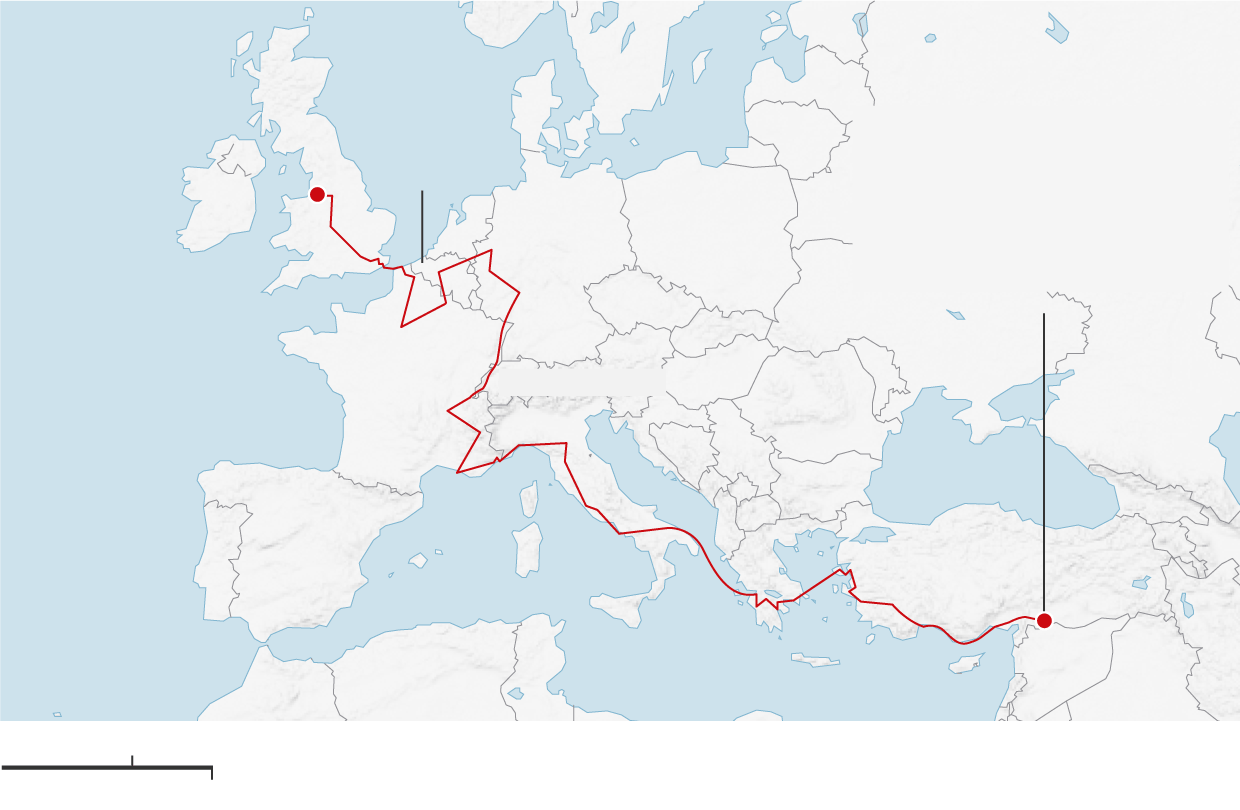
Harriet Sherwood wrote about the idea at the Guardian in September, “The transcontinental odyssey of Little Amal will begin its final stage this week when the giant puppet of a nine-year-old Syrian girl reaches the shores of the UK after walking thousands of miles across Europe.
“Bells will chime and choirs will sing as Little Amal appears on the beach on Tuesday in Folkestone, Kent, after making the same cross-Channel journey that has been taken so far this year by more than 17,000 people seeking refuge from conflict, hunger and persecution. …
“ ‘It’s been challenging, it’s been difficult at times, but it’s also been amazing and incredible,’ said David Lan, one of the producers of The Walk, who has been ‘on this journey right from the beginning three years ago, and on every step of the way’ since Little Amal left Gaziantep near the Turkish-Syrian border at the end of July.
“The idea of Little Amal’s journey in search of her missing mother evolved from The Jungle, a highly acclaimed play about young refugees in a camp near Calais that opened at the Young Vic in London in 2017. The play’s producers, the Good Chance theatre company plus Lan, Stephen Daldry and Tracey Seaward, came up with the idea of taking its message of displacement, loss, dignity and hope to villages, towns and cities across Europe.
“Little Amal, whose name means hope in Arabic, was created by Handspring, the company that made the equine puppets in War Horse. She stands 3.5 metres (11ft 5in) tall and is operated by a team of eight puppeteers working shifts to control her legs, arms and facial features. …
“Since leaving Gaziantep, Little Amal and her entourage of about 25 people have navigated Covid border requirements to cross from Turkey to Greece and then through Italy, Switzerland, Germany, Belgium and France to the UK.
“Along the way, they have taken part in concerts, parties and workshops. In Rome, Little Amal was blessed by Pope Francis. In many places, thousands of local people have walked with her through their town or village.
“But the most powerful connections had been with refugees, said Lan. ‘People who are marginalised, shoved to the side, see a representative of themselves or their children centre-stage and being celebrated. That’s very moving.’
“Only in one place has the welcome been less than warm. In Kalambaka, a village in northern Greece, which is home to ancient Greek Orthodox monasteries built into rocks, the village council decided not to receive a ‘Muslim doll from Syria,’ as the mayor described Amal. ‘It’s distressing, but it’s how the world is,’ said Lan.
“In London, Little Amal will celebrate her 10th birthday on Sunday 24 October at a party at the V&A. Children from all over the capital have been invited to join in musical performances and workshops. Yotam Ottolenghi is coordinating a team of chefs to create a giant birthday cake consisting of several hundred cupcakes in a rainbow of colours and flavours.”
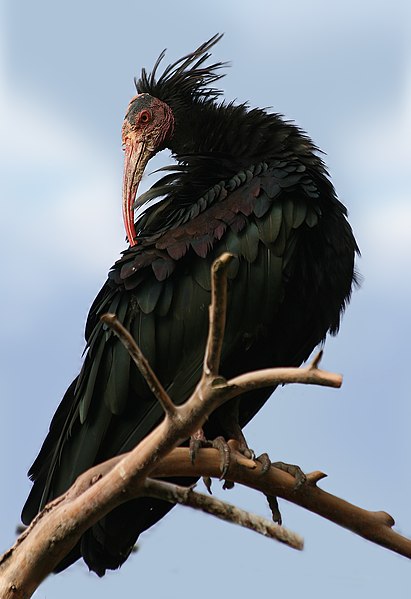
Recently, my husband pointed out an amazing story in the Audubon magazine about birds that were extinct in Central Europe. Today they are being reintroduced and learning where to fly by following a human-powered light aircraft.
Esther Horvath wrote, “Anne-Gabriela Schmalstieg and Corinna Esterer aren’t your typical foster mothers. For starters, the youngsters they care for aren’t humans — they’re captive-bred Northern Bald Ibises, a species that went extinct in Central Europe more than three centuries ago.
“For six months each year the two 20-somethings dedicate their lives to the birds, living onsite in campers at the Schönbrunn Zoo in Vienna, Austria, and looking after the ibises from sunrise to sunset seven days a week. The entire first month the women must abstain from coffee, alcohol, and cigarettes because they have to spit in the birds’ food to make it easier to digest. The chicks eat as many as 15 times a day, dining on a mash of rat, mouse, and chicken, as well as fresh grasshoppers.
“When the ibises aren’t eating or resting, the foster moms spend as much time as possible bonding with them. …
“From day one, they call over and over: ‘Komm, komm, Waldies, komm, komm’ (‘Come, come, ibis, come, come’). When the chicks are three months old, their caretakers move them from the zoo to an aviary in Seekirchen, where they slowly become accustomed to a microlight aircraft and learn to follow it during training exercises, the women calling all the while. …
“The birds journey between the same breeding grounds their ancestors did centuries ago and a suitable overwintering site. Unlike back then, humans now watch them every flap of the way thanks to GPS tags attached to each bird. (To follow their annual trek, download the Animal Tracker app.)
‘For us it is very emotional,’ Schmalstieg says. ‘The birds follow the aircraft because we are sitting in it.’
If you get the Audubon magazine, you can see the actual craft with the birds following it high in the air. Read the online version here.
Erik’s sister and family are off on their five-month European sailing trip. The three children have homework to do during the first part of the trip, when they would ordinarily be in school. All five family members are contributing to a WordPress blog they call Burning Cloud. Four write their posts in English; the youngest sometimes writes in Danish. The entries are a lot of fun to read.
Here is the oldest child’s May 11 post:
this is a word for word conversation.
Klara : the first qustion is, why are we not moving
Klaus: because we are waiting for our gear to come back from the repair shop
Klara : the second question is: when are we going to move?
Klaus: on Friday
Klara: the third question is: what is wrong with the motor?
Klaus: the gear is leaking a bit of oil.
Karl-Oscar: how will they fix the gear?
Klaus : it will be repaired in Køge with some spare parts that are cominng form Gottenburg.
written by Axel.
Join the fun at Burning Cloud Blog. You can follow the route on maps the family posts periodically along with other entertaining pictures. (Don’t miss the photo of everyone making sushi on shipboard.)







 Suzanne's Mom's Blog