Feeds:
Posts
Comments

Posts Tagged ‘financial’

Photo: NiemanLab.
Now nonprofit, the Salt Lake Tribune has achieved something rare for a local newspaper: financial sustainability.

Yesterday we talked about getting news from a whistler in the mountains. Today we look at a more traditional approach, but one that is also seeing changes. Here’s one of NiemanLab’s deep dives into what’s going on in US news delivery.

Sarah Scire writes, “It started when Andy Larsen, sports reporter and data columnist for the Salt Lake Tribune, got annoyed with an ‘obnoxious’ ad on the Tribune’s own site. He brought his frustration about the digital clutter to someone else who happened to be working late in the newsroom — chief development officer Ciel Hunter.

“ ‘I asked her: “Hey, how much money do we make on this? Is it really worth it?” ‘ Larsen said. ‘That led into a conversation about how much we make from digital ad revenue overall, when compared to sponsorships and donations, which then led to talks on everything else. I was pretty floored and impressed with her transparency on everything over the course of the next couple of hours, which then led me to ask about making those same numbers public, and if I could help with the project.’

“That’s how Larsen ended up writing an annual report that gives the public — including nosy newshounds like you and me — a look at the inner workings of the first legacy newspaper in the U.S. to become a nonprofit.

“Larsen said he was given access to ‘internal financials and metrics of every kind.’ … He also interviewed [chief executive officer Lauren Gustus], Hunter, and director of finance Doug Ryle about the company’s finances and future plans. …

“This public-facing report is a first for the 153-year-old Salt Lake Tribune, which took inspiration from Defector and the Texas Tribune. It imagines an audience that includes subscribers, local residents, potential donors, news industry followers, and — as its origin story suggests — at least some of the Tribune’s own employees.

“News organizations have historically sought to maintain a strict separation between business and editorial operations to protect newsroom independence, and it’s been said — maybe not unfairly — that journalists don’t know much about the business of news. There are signs that is changing. … We’ve seen news organizations open communication that gives journalists a better idea of what, exactly, needs to happen for their publication to survive and thrive — and where they fit in.

“ ‘A firewall between business and editorial is essential for the integrity of the product, IMO,’ Larsen said. ‘On the other hand, that firewall can also be limiting when it comes to belief between the two groups — frankly, I think some of our own writers, including myself, had just assumed that our business was in worse shape than it was, just based on us operating in the newspaper biz in 2024. One way to get the information out to staff without breaking that firewall was just publishing everything to everyone.’

“Larsen said some expenditures stood out to him but that, mostly, he was happily surprised with what he found poking around his employer’s finances. ‘Honestly, that we were seeking donations to specifically address my biggest Tribune if-I-was-czar wants — a better website, free to all — brought me joy.’ …

“Larsen also takes time to address some common misconceptions and criticisms he encounters as a Tribune reporter, including readers who believe Paul Huntsman runs the paper (Huntsman, who rescued the paper from hedge fund ownership eight years ago, stepped down as board chair in February) or assume the Tribune is failing financially. …

“ ‘People in Utah appreciate knowing how we’re doing,’ Gustus said. ‘This is understandable, both because everyone thinks local news is on the rocks and here in Utah it’s the Tribune that can publish stories nobody else does.’ …

“The Tribune expects revenue and expenses to dip in 2024 after chief revenue officer Chris Stegman departed the Tribune in May and brought several Tribune advertising employees with him. Executive editor Gustus praised Stegman for helping turn the Tribune toward financial sustainability but said the change has allowed the newspaper to reorganize its business-side operations to better reflect the nonprofit mission, including moving philanthropy and advertising into the same division, and reduce expenses. …

“The newspaper has not made layoffs — which Larsen describes as ‘damaging to the soul of the Tribune‘ — since 2018 and has grown the newsroom by 10%.

“In July, staff at the Salt Lake Tribune announced their intention to form a union — including, as he disclosed in the annual report, Larsen himself. The newspaper’s management voluntarily recognized the Salt Lake News Guild four days later. …

“The paper edition (now printed twice a week) of the Salt Lake Tribune has 9,165 subscribers — down from 36,000 print subscribers when the Tribune ended its 149-year run as a daily paper back in 2020 and 200,000 subscribers at its peak.

“As of early June 2024, the Salt Lake Tribune also has 30,362 digital subscribers. Digital access costs $8 for the first three months and $8 per month after that. … The newspaper anticipates digital subscription revenue will edge out print revenue for the first time in 2024.”

Larsen also stated in the report, “Our goal is, at some point in the years to come, to remove that paywall. To allow all, regardless of their ability to pay, to read more Tribune journalism.” I would follow it then because Utah is a whole different world to me. “Free” is possible. Thanks to ads and donations, the nonprofit paper in my town is free to all.

More at NiemanLab, here. No paywall.

Read Full Post »

The Providence-based Capital Good Fund, which helps low-income folks get on their feet financially, has been testing an interesting fund-raising idea. Participating artists donate to the Capital Good Fund half the proceeds of a work that they sell through the fund’s platform. The art offerings change every few weeks. I include one example below, and there are more at https://squareup.com/market/cgfund. The selections feature a range of styles. Some works are representational, others impressionistic or abstract.

The organization’s website explains its mission: “Capital Good Fund is a nonprofit, certified Community Development Financial Institution that takes a holistic approach to fighting poverty. We offer small loans and one-on-one Financial & Health Coaching to hard-working families in America. Our mission is to provide equitable financial services that create pathways out of poverty.” More here and here.

The Rhode Island Foundation posts at its own blog about its latest partnership with the Capital Good Fund, an initiative designed to overcome the incentives that drive people to costly payday lenders. Read about that here.

Art: Carol C. Young
Barn on Robin Hill, 11″ x 11″ Giclée, limited edition signed print

Read Full Post »

I am psyched. I blogged a while back about UBS banker Geoff Hargadon, who is also a conceptual artist with a crazy sense of humor.

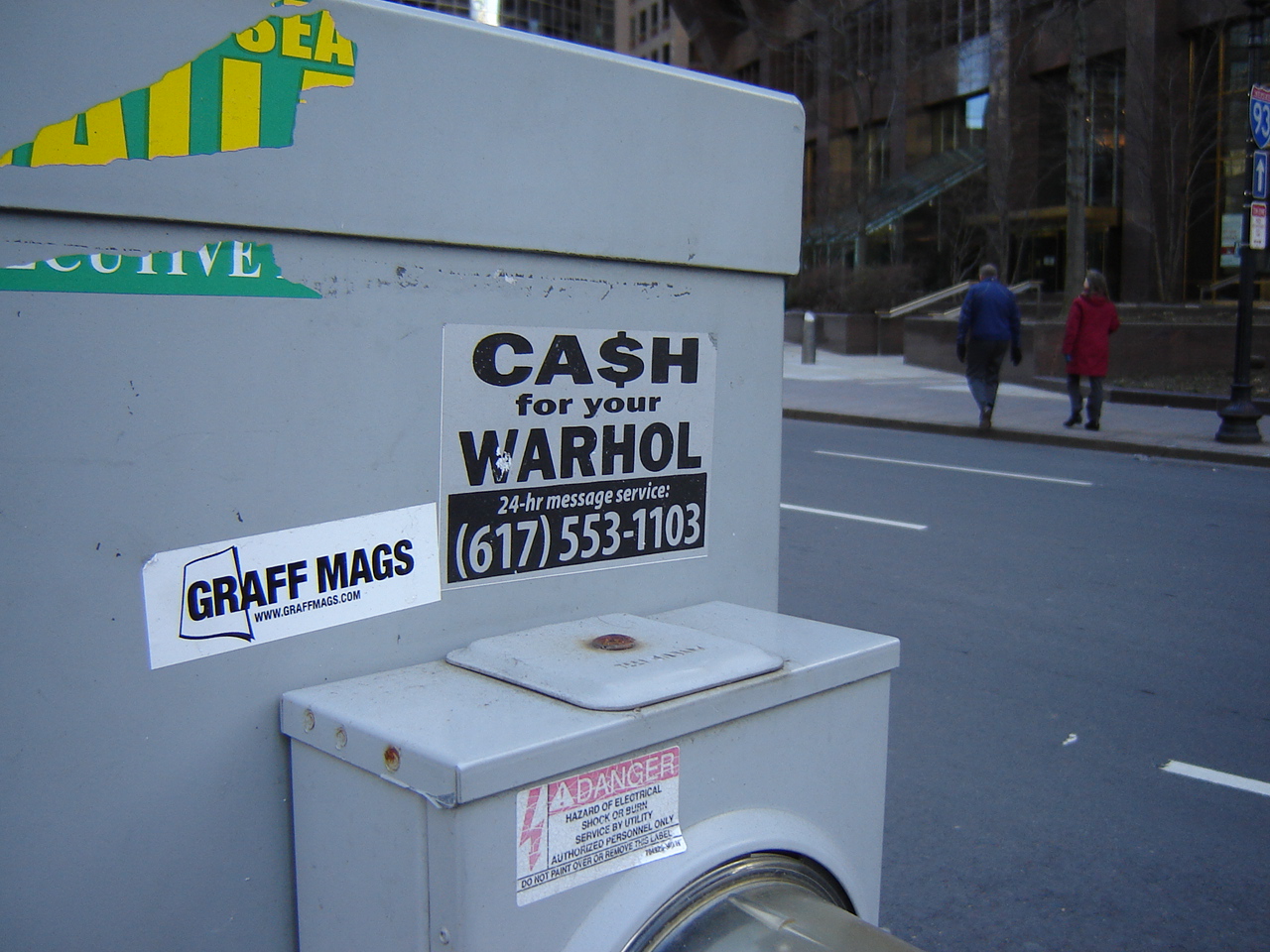
After Brandeis University’s then president made noises about selling the art collection of the Rose Museum, Hargadon put a sign outside on the grass: “Cash For Your Warhol.” It looked like the signs on telephones poles or in abandoned lots that lure the unwary into deals too good to be true.

Hargadon has put his signs up hither and yon, like the street artist Banksy in a way, or Shepard Fairey.

Yesterday I noticed one in the Boston financial district as I waited for the light to change. It’s at the corner of Congress and Franklin streets. I came back today and took a picture. Anyone want to call the number?


Read Full Post »

Recently the Economist magazine offered a pretty comprehensive summary of efforts that government entities, nonprofits, and banks have made to get people who do not use banks (the unbanked) into the banking system. The push is not only because banks want customers. In fact, many of the new programs for reaching the unbanked require banks to make big concessions.

The bigger concern is that low-income people and immigrants  get taken advantage of by payday lenders, check cashers, and the like.

One program that is now in several U.S. cities actually started with the innovative Bank On San Francisco. Bank On San Francisco emerged to meet a need. First, a broad range of stakeholder groups evaluated why low-income people often preferred using payday lenders. Having found that the customers liked the hours, locations, and apparent clarity about costs, the groups developed a system that could meet more needs. (In New Haven the police were involved in a similar effort because too many immigrants carried all their cash on their persons, and that led to too many muggings.)

I’m interested in this issue, and so I was intrigued by a NY Times story on traveling tellers rural India.

“Swati Yashwant, a 29-year-old mother of one, is part of a growing legion of roving tellers intent on providing bank accounts to the nearly 50 percent of India’s 300 million households that do not have them. Using a laptop computer, wireless modem and fingerprint scanner, Ms. Yashwant opens accounts, takes deposits and processes money transfers for farmers and migrant workers in this small town 70 miles south of Mumbai, India’s financial capital.

“To reduce the risk of robbery or theft, no transaction by law may exceed 10,000 rupees (about $212). And in practice, many amount to no more than a dollar or two. But with the bulk of India’s population living in villages that have never had a bank branch, Ms. Yashwant, with her electronic devices, is a missionary of financial modernity.” Read more here.

The Indian idea looks like one that might be gainfully imported to the United States.

Read Full Post »

Have you been reading about Elizabeth Warren, the temporary head of the new Consumer Financial Protection Bureau? People say she is too controversial to be approved by the Senate and that maybe her employee, Raj Date, a former banker, would be a good compromise candidate. Maybe so, but I just want to tell you about the extraordinary consumer advocate that I know Elizabeth Warren to be.

As a professor at Harvard Law School and an expert on bankruptcy, she has worked tirelessly to reverse the erosion of the of the middle class and lower-income families that has occurred over the last few decades. The CFPB was really based on her work, and she is the right person for the job. Growing up among a lot of older brothers, she learned to argue for herself and be persuasive. I have sat in meetings and heard her talk about her research and outreach, and my jaw just dropped. She is so passionate, and her arguments are so clear and incisive. She is capable of persuading many others who think they have different positions, because she always can find the common interest. But I think the country needs a consumer advocate who doesn’t back down.

Elizabeth Warren has a powerful effect on people. One day several years ago, I was standing in a grocery checkout line and by chance I overheard the cashier telling a customer that when she was thinking of filing for bankruptcy, she contacted Elizabeth Warren and received energetic help — for free. Later she would e-mail Warren anytime and get a response and advice. Probably Warren can’t answer such e-mails now, but I will check with that cashier next time I see her.

If Elizabeth Warren hired Raj Date, then he is a good guy. But if he is a real consumer advocate, I don’t see that his chances of being approved by the Senate are any greater than hers.

Comments may be sent to suzannesmom@lunaandstella.com. Luna & Stella is apolitical, but Suzanne said I could write about anything that interests me, and that is what I have been doing.

Read Full Post »