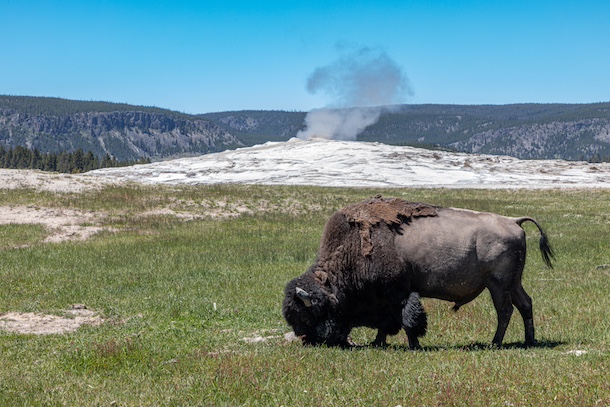
Photo: Dietmar Rabich, Wikimedia Commons, CC BY-SA 4.0.
The American bison is a well-loved symbol of the prairie, and for good reason. Bison provide important ecosystem services.
I have blogged several times about Frank and Deborah Popper’s insights on the loss of population in the industrial Midwest and the idea of returning former urban areas to prairie, a kind of Buffalo Commons. (See one post, here.) It’s an optimistic concept: Instead of crumbling under the loss of “the way things were,” we can learn not only to accept the change but feature it.
But what if the prairie itself is disappearing? The environmental radio show Living on Earth investigates the role of agribusiness.
“The American prairie is one of the most biodiverse ecosystems in the world, with numbers of species rivaling even a tropical rainforest. But today, just one percent of eastern tallgrass prairie remains, and western shortgrass prairie is disappearing at a rate of more than a million acres a year. Author Josephine Marcotty joins host Paloma Beltran to discuss her book Sea of Grass: The Conquest, Ruin, and Redemption of Nature on the American Prairie.
Paloma Beltran
How did the idea for Sea of Grass first come about?
Josephine Marcotty
Growing up, I really had little or no contact with the prairie because it was gone. … I grew up in a suburb of Detroit, and the prairie was something I read about in books like Laura Ingalls Wilder, but not something that I had experienced. So it was only when I started exploring the prairie that was left and understanding what we had lost that inspired me to write, not only about agriculture, but about what we were losing by expanding agriculture in the Midwest.
Beltran
Can you describe the American prairie for us? You know, what does it feel like to visit such a place and what makes it special?
Marcotty
The tallgrass prairie, which is now almost completely gone, used to be an extraordinary place where grasses would be taller than a standing person, and in order to see over the top of them, you had to stand on top of a horse. It was a place where people could get lost, and often did in those tall grasses, or in the massive wetlands that used to occupy a third or 25% of the mid part of the country. It was an extraordinary place full of animals that we no longer have, wolves and bears and other carnivores, extraordinary birds. So I mean, the thing that I like about a prairie is the immense silence. All you hear is the sound of wind, and that enormous sense of space that you get, which is very similar to [being] out on a great lake or out on an ocean. …
Beltran
Let’s talk about one of the main characters in your book, the buffalo. …
Marcotty
They are what biologists call a keystone species on the prairie. They have been around for millions of years. … They were huge. And they shared the grasslands with giant sloths and other animals that you know have long gone. But over time, they became a key part of the grassland ecosystem. So they come through and they eat the grass short and that creates an environment that’s conducive to birds that like short grass, or insects that need short grass, and then they move on, and then the grass grows taller, and then that becomes an ecosystem for other animals that like taller grass. One of the things that they do is they wallow.
If you’ve ever been to Yellowstone National Park or any other park where you can see bison, you’ll see them roll over and just create these huge clouds of dust, and then when they leave, there’s a little wallow. Those wallows are really important for collecting water when it rains, and scientists have found that there’s unique species of animals and insects that will live in and around those wallows when they collect water. Bison, they carry seed across thousands, hundreds of miles when they eat the grass, and then they move the seed up to other parts of the of the grassland. …
Prairies create a whole universe of organisms around them, and that’s an excellent way of sequestering and processing carbon, of sequestering and processing nitrogen, both of which are very important for world health in terms of air pollution and in terms of climate change. The world’s grasslands contain more carbon than humans have released since the Industrial Revolution, more than the planet’s forests and atmosphere.
[But] we’re plowing up about a million acres a year, and that’s the equivalent of adding 11.2 million cars to the road every year. … For many, many decades, intensive agriculture stopped at around the 98th parallel because it was too dry in the West to really graze crops properly. And instead, that’s why we have cattle there. That’s because it was good country for cattle and bison. But through genetic technology, we now are creating seeds like for corn that is much more capable of withstanding severe weather, that can thrive in dry conditions. … And the profits from that are much greater than from growing cattle. So you can sell a piece of land that has been plowed for much higher price than you can sell it if it hasn’t been plowed. …
What’s driven the loss of grasslands … is just growing corn for our gas tanks.
More at LOE, here.


 Suzanne's Mom's Blog