Feeds:
Posts
Comments

Posts Tagged ‘frog’

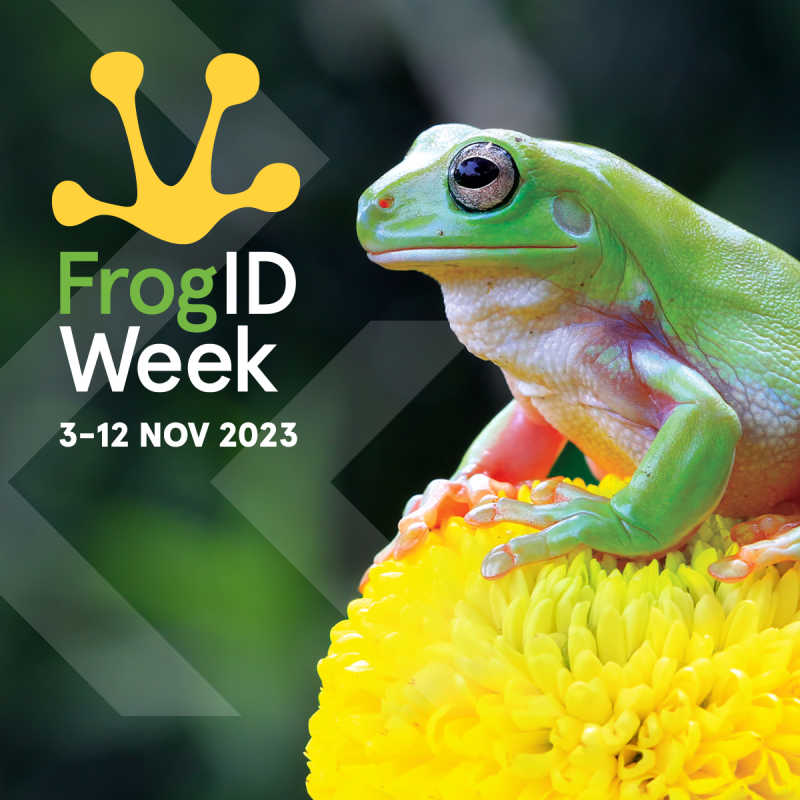
Photo: FrogID.
Sunday is the last day this year to submit your recording of a noisy frog for Australia’s special FrogID Week. But you can send in recordings year round. In southwestern Western Australia, for example, there are frog species that aren’t calling right now.

Crowdsourcing via the internet can be a great thing. In Australia, both children and adults are helping scientists conduct the annual frog census — sometimes discovering new species. This example of citizen science is spearheaded by the Australian Museum.

Ellen Phiddian reports at Cosmos, “People around Australia are once again being urged to head outside and record frog calls for FrogID Week, from 3-12 November 2023. Heralded as Australia’s biggest frog count, it’s an annual push for valuable data on Australia’s amphibians.

“ ‘This is a time of year when most frog species across Australia are breeding and calling,’ Nadiah Roslan, project coordinator of FrogID, tells Cosmos. ‘That call that we hear is actually a male frog calling out for a female frog. A majority of species – over 90% – will be calling now. So it’s a good time for us to get a snapshot of frog health and frog distribution across the continent.’

Launched by the Australian Museum in 2017, FrogID is a free app that people can use to record frog calls. These recordings get uploaded to a Museum database, where trained listeners can identify the frogs.

“It builds on decades of citizen scientist frog recordings, which are a vital tool for ecologists to assess frog populations.

“It’s yielded a trove of data far bigger than any single team of ecologists could collect. Information from FrogID has been used to track declining frog numbers, study deadly chytrid fungus, and learn how frog calls differ.

” ‘We’re not sure how well we will go with it being an El Niño year. Frogs do like it when it’s more wet.’

“Many frog species will only call after rainfall, and they typically need wet conditions to breed. So we are expecting fewer frog calls, but hopefully thousands of submissions across every state and territory of Australia,’ says Roslan.

“Nevertheless, fewer frog calls than the past few wet years is still very valuable data.

“ ‘It’s important to get this year-on-year data and repeat recordings from locations to understand patterns and trends over time,’ says Roslan.

“Roslan says that everyone, even ‘frog novices,’ can contribute to the project. First, download the app on your phone or other smart device.

“ ‘Set up a free account so that our scientists can let you know what frog species you’ve recorded, and then go out at dusk or early evening – that’s when most frog species will call,’ says Roslan. …

“ ‘We do want as many recordings this week as possible, so [record] every day you can. Even if it’s the same frog calling. … Every call counts.’ “

I first heard this story at The World. You can listen here. There’s more information at the FrogID website, here, and at Cosmos magazine, here.

And the Australian Museum adds, “Students can join us for a free virtual excursion during FrogID Week and meet Dr Jodi Rowley online to learn about Australia’s frogs.”
Read Full Post »

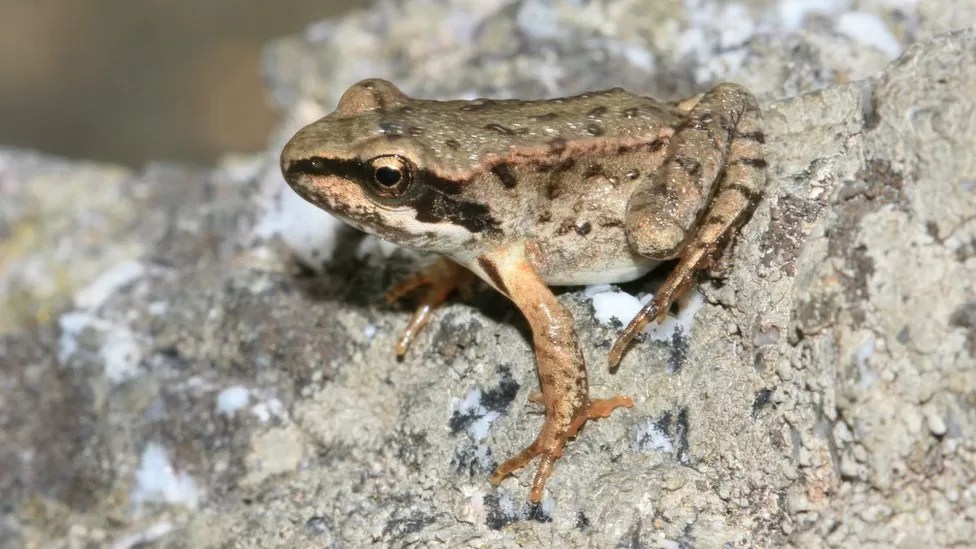
Photo: Christoph Vorburger.
European common frogs were among the beneficiaries of an initiative to dig ponds.

Where I grew up, there was a pond that was good for frogs. We hunted for tadpoles in the spring, and later I learned to catch the big bullfrogs in my hands and immobilize them briefly by running a finger down their spine. I still dream of doing that in front of my grandchildren one day, but the frogs around here have no interest in helping me look cool.

Rowenna Hoskin writes at the BBC about a recent effort in Europe to increase the numbers of vanishing frogs.

“Switzerland has reversed the decline of more than half of endangered frogs, toads and newts in one region, research finds,” she reports. “After conservationists dug hundreds of new ponds in the canton of Aargau, amphibian numbers significantly increased.

“The European tree frog population in particular ‘exploded,’ scientists say. …

“Globally, amphibian populations are in significant decline due to factors including habitat loss, urbanization, road infrastructure, disease and invasive species.

“In 1999 Aargau decided that a mass conservation effort was needed to combat the loss of amphibians. The collapse of the European tree frog was of particular concern.

State authorities, nonprofit organizations, private landowners and hundreds of volunteers worked for 20 years to build 422 ponds in five regions in Aargau.

‘Older ponds had become unsuitable for some amphibians due to lack of space, a high number of predators, and dense vegetation. By creating new ponds, the conservationists gave the species more space to thrive. Of the eight endangered species, 52% increased their regional populations and 32% were stabilized.

“Lead author of the study Dr Helen Moor told BBC News she was excited to see ‘such a clear increase’ in numbers considering the simplicity of the solution.

” ‘Species will come, they will settle and start using the space if you offer it to them,’ she said.

“One of the species that dramatically increased was the tiny European tree frog. This frog likes to jump from shrubs to trees, Dr Moor explains, and is one of the most mobile species, capable of traveling several kilometers.

“It needs a very specific habitat to thrive, preferring shallow ponds created by meandering rivers on floodplains. But this type of habitat has disappeared in many places in Switzerland, leading to the species’ decline. Switzerland, like the UK, has high population density with large road and railway networks, and much of the non-urban land is intensely farmed, Dr Moor explains. …

“Over 20 years the regional population of the European tree frog quadrupled in one area. It could only be found at 16 sites in Reusstal in 1999 but by 2019 the species was living in 77 places. …

‘The key message is that it pays to do something, even if it feels overwhelming,’ Dr Moor said. …

“Some ponds will need to be cleared of vegetation and drained to remove predator larvae that threaten tadpoles. Dr Moor hopes this conservation success will convince other landowners to create ponds and diversify habitats.

“The research is published in the Proceedings of the National Academy of Sciences.

This shows what can be accomplished when people identify a problem and make up their minds to do something about it.

More at the BBC, here. No firewall.

Read Full Post »

I’m hearing more and more these days about “good bacteria,” including in a song by singer-composer Will McMillan on the friendly bacteria we humans carry around.

Now, it seems, bacteria found in soil may help to save amphibians from dangerous fungal epidemics. Public Radio International’s environmental news program, Living on Earth, has the story.

“Around the world, fungal diseases have been killing millions of frogs and bats and snakes. And a newly emerging disease in salamanders in Europe is scaring biologists here, so the US Fish and Wildlife Service has introduced a ban on their import to try to protect amphibians in the US.

“But now scientists see some hope in soil bacteria that get onto the salamanders and frogs and apparently protect them. Doug Woodhams is an assistant professor of biology at UMass Boston, who’s been working with amphibians in Panama – and he explained what his team has found to Living on Earth’s Helen Palmer.

“WOODHAMS: Some of the amphibians have beneficial bacteria that live on their skin and these have antifungal properties.

“PALMER: This is kind of like having good bacteria in your gut, for instance, that stop you from getting sick. … Is there any evidence that  good bacteria actually work against devastating funguses?

“WOODHAMS: Yeah, there’s quite a bit of evidence. Many of the bacteria that we can culture from some amphibian species are able to inhibit the fungus in culture. We also have some population-level data that shows populations that tend to have these antifungal bacteria can persist with Bd in the environment and survive. …

“Bd is the chytrid fungus that’s been spreading around the world and devastating amphibian populations. So salamanders, frogs, toads. Populations that tend to have more of these beneficial bacteria seem to be surviving, and populations that don’t have as many of the individuals that have these bacteria seem to disappear. …

“The next thing we want to try is adding some of these bacteria, not just to petri dishes, but to soil and see if infected amphibians can be cleared of their infection by being housed on soil that’s been inoculated with these bacteria. …

“There are other fungal pathogens, so it could be something that you could apply in a cave that could reduce White-nosed syndrome [in bats]. Also, rattlesnakes have been recently affected by fungal disease during hibernation, so it could be applied into a rattlesnake den.”

More on the science here.

Photo: Matt Becker
The Appalachian Mountains are home to this Cow Knob Salamander, Plethodon punctatus, from George Washington National Forest, Virginia.


Read Full Post »