Feeds:
Posts
Comments

Posts Tagged ‘fruit’

Photo: Erika P. Rodríguez.
The stinky durian has loyal fans. Says one, “I consider it the No. 1 fruit on the planet.”

My husband remembers the smelly Limburger cheese his father used to keep in the refrigerator. It seemed like a horrible thing for anyone to choose to eat. And yet some people loved it. No accounting for tastes. The durian, a fruit, inspires similar reactions.

Thomas Fuller has a report from Puerto Rico.

” ‘I don’t like to use the word “smell,” ‘ said Juan Miranda Colón, a self-described fanatic of the world’s most odoriferous fruit. ‘I prefer to say it has an aroma.’

“Mr. Miranda, a farmer in Puerto Rico, was minutes away from feasting on the fruit, durian, and as its stink wafted through the humid, sticky air of the rainforest around him, he said his tongue tasted sweet with anticipation.

“ ‘I consider it the No. 1 fruit on the planet,’ he said resolutely as he watched others messily shove gobs of custardy durian flesh into their mouths. ‘I start eating, eating, eating. I can’t control myself. I wish I had a second stomach.’

“It was early August, and Mr. Miranda was taking part in an annual ritual at Panoramic Fruit, a farm 30 dizzying minutes up a potholed, zigzagging road from the western Puerto Rican city of Mayagüez. A multinational collection of durian fanatics had gathered for the harvest.

“An electrician had trekked from Tennessee to get his fix. A doctor had flown in from central California. There was a couple from Florida, and a family from Texas. Desperate would-be buyers from the other side of the island had also come, unannounced and imploring the farm manager for durian.

“ ‘I call them the rare-fruit nuts,’ said Ian Crown, the owner of the 94-acre farm, who lives most of the year in Massachusetts but treasures his trip to Puerto Rico for the summer harvest of tropical fruits obscure to most Americans: rambutan, mangosteen, pulasan, cupuaçu and many others.

“But it’s durian, unlike perhaps any other fruit, that grips its enthusiasts with obsession.

“Much is made of durian’s odor, which Anthony Bourdain, the food adventurer, compared to that of a dead body left out in the sun, but the fruit’s appearance is also particular and somewhat otherworldly.

Covered in very sharp and dangerous spines, the fruit looks like a giant puffer fish tethered to a tall tree.

“Calling it rare is of course relative. Durians are plentiful in their native Southeast Asia. … But in North America, fresh durian is hard to come by, not least because the odor makes it difficult to transport. H Mart, a chain specializing in Asian foods, recently posted a sign on a bin of durian at one of its stores in Queens. ‘DO NOT WORRY IT IS NOT A GAS LEAK,’ the sign said. …

“Yen Vu and Gleb Chuvpilo, a couple who drove to the farm from their home in San Juan, bought eight medium-size durian at $5 per pound. It was enough to feed a large, hungry family for a week, but the couple said they would probably polish them off in a weekend. Their love for the fruit has taken them on much longer journeys: Twice they have traveled to Borneo just to gorge on it.

“Ms. Vu says durian was an early litmus test in their relationship. After meeting at a salsa lesson in New York City, she queried Mr. Chuvpilo, an entrepreneur and venture capitalist born in Ukraine, on whether he had tried the fruit. He liked it. But what if he had hated it?

“ ‘It definitely would have put a strain on the relationship,’ said Ms. Vu, who is originally from Vietnam and has enjoyed durian since she was a child. …

“Teresa Chang, a family doctor who lives in Santa Ynez, Calif., remembers excitement growing up in western New York when someone came into the house with a haul of durian. ‘Oh my God! Get the cleaver!’ someone would yell before attacking the thick olive-green husks that surround the flesh. ‘They would eat it and then dance through the living room,’ Dr. Chang said. …

“For the uninitiated, the taste of durian is difficult to describe, partly because even when they’re from the same tree, durians can have such a variety of flavors.

“Dr. Chang bit into the ochre-yellow flesh of one durian and paused to consider what she was tasting. A hint of graham crackers, she concluded. Someone else mentioned burned sugar. Durian can be bitter or bubble-gum sweet. With the texture, and sometimes the taste, of crème brûlée, they resemble dairy products that happen to grow on a tree, Mr. Crown, the farm owner, says.

“He cut a small sample of one durian with the tip of his knife and dabbed the flesh into his mouth. ‘It’s like a kick in the head with a creamy, delicious, sweet taste on the back end,’ he said.

“Mr. Crown, a former commodities trader with a degree in agriculture and a curiosity about Southeast Asian fruits, bought the farm in 1994 after spending years scouting for a place that had the right climate and soil. …

“The first trees Mr. Crown planted were rambutan, the hairy, walnut-size fruit similar to lychees. Then he put in mangosteen trees, which produce sweet, bright white fruit encased in purple orbs.

“But his rare-fruit friends insisted that he was missing a key crop.

“ ‘Everybody said, “You have to have durian!” ‘ Mr. Crown recalled. So before even tasting it, he planted the trees. Fortunately, he doesn’t mind strong smell. ‘I have some cheese experiments in my fridge that would frighten the board of health,’ he said.”

So interesting that the durian, even from the same tree, has different tastes. Doesn’t a children’s book describe something like that? Alice in Wonderland? The Lion, the Witch, and the Wardrobe? Help me out.

And please let me know if you eat this fruit. More at the Times, here.
Read Full Post »

produce_carrot

Photo: Brett Forsyth, Flickr, CC BY 2.0
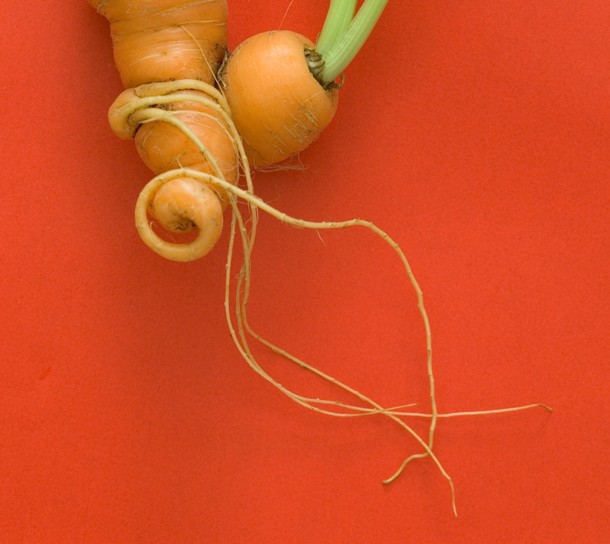
Much of US food is wasted because of aesthetics, but more people are realizing that twisty carrots are as good as ordinary carrots — “perfect imperfections.”

I like how the radio show Living on Earth manages to find the environmental angle for whatever is in the news.

A recent episode addressed how “social distancing and staying at home is whetting consumers’ appetite for grocery delivery” and how some companies that deliver “aim not only for convenience but for reducing food waste.” Host Steve Curwood introduces Bobby Bascomb’s interview with Abhi Ramesh, CEO of Misfits Market.

“STEVE CURWOOD: Companies including Hungry Harvest, Imperfect Produce, and Misfits Market work with farmers to collect produce that isn’t quite good enough for supermarket shelves but is still perfectly edible. They’ll pack them up and deliver weekly straight to your door. …

“BOBBY BASCOMB: Please explain your business model to us. …

“ABHI RAMESH: We essentially rescue a lot of different types of products that would otherwise go to waste in our food system. And we ship it directly to households. And the idea is that you can save money and also help combat the global food waste problem. …

“We make it a priority of ours to work with non-commercial farms. … We figure out what is consumable for human consumption, and we repurpose it and ship it directly to people.

“BASCOMB: And why would it otherwise be going to waste?

“RAMESH: [We see] three big buckets. The first one is an aesthetic reason. … The second big bucket is size constraints. So we’ll have products that are either too small or too large to sort of fit into the size restrictions that regular buyers would want. So we see some of that. And the third bucket, which I think a lot of people don’t necessarily think about, is simply excess. So you know, nature operates in interesting ways and isn’t necessarily always predictable. And buying patterns from large supermarkets and grocery chains are also not super, super in line with what growers are producing. So the food system produces a lot of excesses accidentally, and we’re able to purchase that and sell it to our subscribers at a big discount.

“BASCOMB: And where would these imperfect and excess fruit and vegetables go if not for services like yours? …

“RAMESH: If a grower is not able to sell stuff, they’ll either toss it or they’ll end up leaving it in the ground. So we, a lot of times we’ll see farms that choose not to harvest something that they’ve grown just because they think there’s not a market for it. …

“BASCOMB: Surely it could end up in a food pantry or something like that, though? …

“RAMESH: There’s a very, very, very small number of them that actually have the infrastructure today to go and ship items consistently to food banks and food pantries. … At Misfits Market, we sort of see ourselves as building that kind of pipeline and that infrastructure where it didn’t exist already. So we’re aggregating food from a lot of different growers. We sell what we can to folks that want to save food, want to eat more affordably. And then we actually donate a pretty large chunk of it to food banks and food pantries. …

“BASCOMB: Now, how do you know that the produce in a Misfits Market box would actually have gone to waste? I mean, an ugly carrot, for example, can still be shredded, or a bruised tomato can be made into sauce or something, right? …

“RAMESH: Yeah. So you know, in theory, [but] for every one grower that has access to, you know, a carrot shredder, there are twenty other carrot growers that do not. …

BASCOMB: Looking down the road, what do you see for the future of Misfits Market and this idea of avoiding food waste more generally? …

“Our goal over the next couple of years is to really grow Misfits Market to be a national brand that sort of embodies a lot of things we want to embody around the affordability of food and sustainability and food waste. … And also in the process, educate households and consumers on what they can do on their end to sort of tackle that food waste problem.

More at Living on Earth, here.

Read Full Post »

040418-yellow-tulips

When I was 11, I had a bit part in a children’s play based on the fairy tale “The Love for Three Oranges.”

One at a time, three princesses emerged from three “oranges” in front of a prince who was a little slow on the uptake. A girl who had also been my partner Card when we painted the roses red in Alice in Wonderland was the first to emerge, crying out, “Water, water, I die of thirst!” and promptly dying. I died next.

By the time the third princess split open her orange and struggled to stand, the prince had managed to come up with some water and revived her. (I don’t recall anything else about the story but am pretty sure it didn’t resemble the one on Wikipedia.)

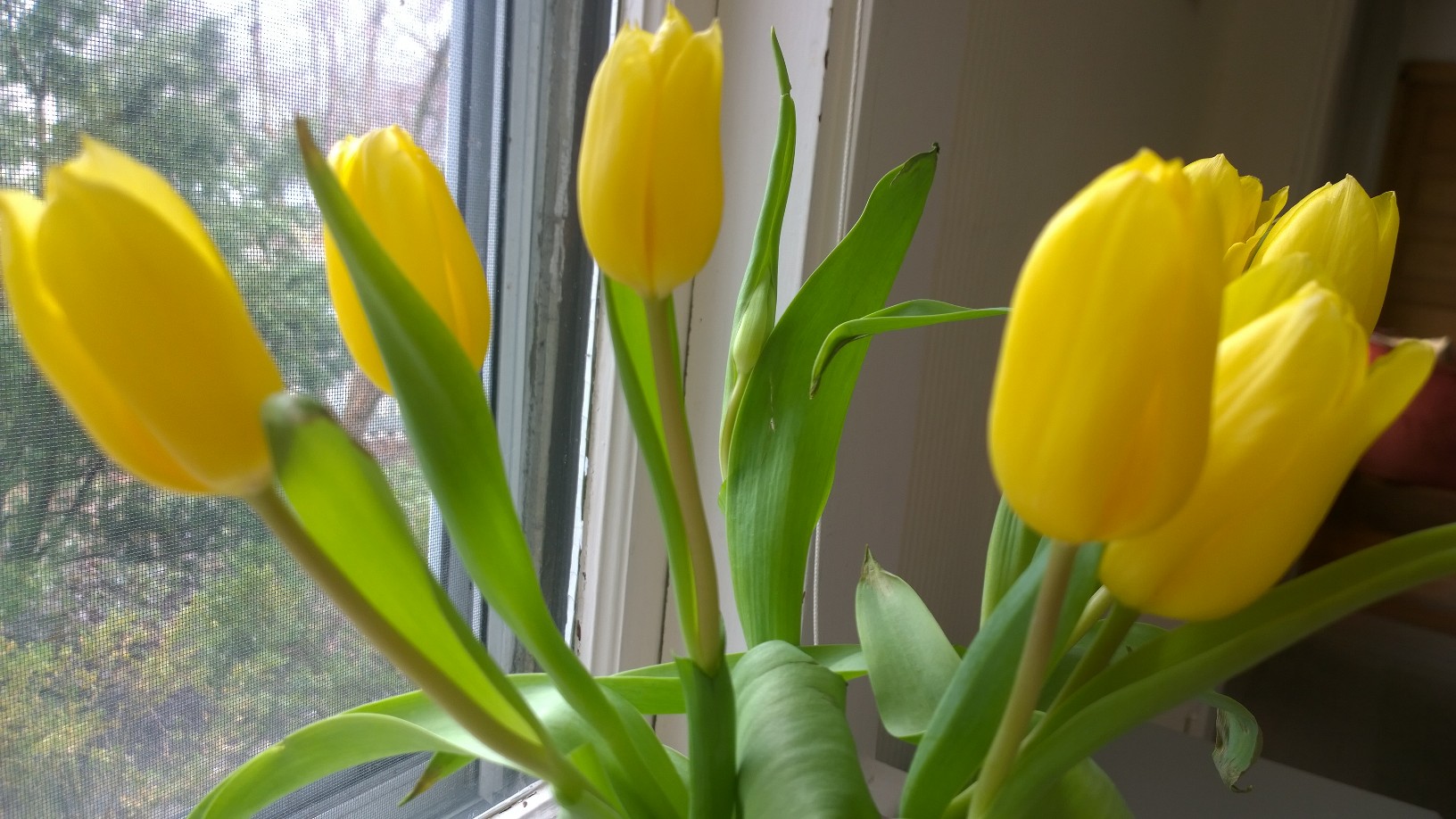
The Love for Three Oranges came to mind recently when I noticed that the tulips above were withering too fast. They’d been forced in time for Easter, I guess. I would have liked to hold on to their cheerfulness for longer than a few days.

I’m hoping that the tiny bud you see in the photo will bloom before the stem dies. I was so happy when I realized after buying the bouquet that there was a nascent flower tucked in where at first I saw only green.

Have you noticed that peaches, for example, when forced, sometimes rot from the inside out before they are ripe enough to eat? Fruit, flowers, and people all need to slow down, don’t you think, lest we wither before we fully bloom.

And speaking of slowing down, do check out the song that Will McMillan wrote on that very topic, here. It’s called, “Can We Slow It Down?” He performed the composition recently at the Unitarian church in Medford, where, he says, it  complemented the sermon perfectly.

Read Full Post »

Art: Albrecht Dürer
“Virgin and Child With Pear,” at the Uffizi Gallery in Florence.  Heritage fruit archaeologist Isabella Dalla Ragione says it’s not a pear.

I loved reading about this side effect of an Italian woman’s work to preserve heritage fruits: she discovered that a fruit in a famous painting was mislabeled.

Elisabetta Povoledo writes at the NY Times, “On her farm, Isabella Dalla Ragione pursues a personal mission — saving ancient fruit trees from extinction — with a strong sense of urgency. Rescuing vanishing varieties is a race, she says, ‘and lots of times we arrived late.’ …

“To find and collect their forgotten varieties, for decades she and her father chatted up farmers and motley locals in the Umbrian and Tuscan countryside. They gathered branches, and with them the traditions and chronicles tied to the fruits. …

“But because fruit was not always described in detail in written records, she also began to examine the works of Renaissance and Baroque painters working in Umbria and Tuscany at a time when ‘artists had close relations to agriculture’ and were sensitive to the seasons and local varieties, she said. …

“A closer look at Albrecht Dürer’s ‘Virgin and Child With Pear,’ at the Uffizi Gallery in Florence, for example, reveals a clear misnomer, Ms. Dalla Ragione said.

“ ‘If it were a pear, it would show a stalk on top,’ she said. ‘Mary is clearly holding a muso di bue apple.’ …

“Ms. Dalla Ragione created a nonprofit foundation, the Arboreal Archaeology Foundation, in 2014 ‘because it made it easier to give a future to all this,’ she said.”

Read more about her quixotic but intriguing work here.

Photo: Francesco Lastrucci for The New York Times
Isabella Dalla Ragione picking apples on her farmstead in San Lorenzo di Lerchi, Italy.

Read Full Post »

Good news for scavengers who collect fruit they see going to waste in cities.

A new study reveals that, unlike urban root vegetables or leafy vegetables that grow close to the ground, fruit is not in danger of contamination by lead and, mysteriously, contains more nutrients than most grocery-store fruit.

Bella English writes at the Boston Globe that Amy Jarvis, of Boston’s League of Urban Canners [LUrC], was concerned about fellow forager Matthew Schreiner, who had tested positive for high levels of lead. She “went online and found [Wellesley College geoscience professor Dan] Brabander, who since 2003 has been working with the nonprofit Food Project, monitoring lead in urban soil.

“In the past year, LUrC members have given Brabander and his students 197 foraged food samples to analyze, including berries, cherries, apples, plum, peaches, and pears. Both groups believe it is the only such ‘citizen-scientist’ collaboration in the country.

“ ‘It’s an example of a successful approach to doing applied science that matters,’ says Brabander. So far, he and his students, including Wellesley juniors Ciaran Gallagher and Hannah Oettgen, have analyzed 40 samples for trace elements, both toxins and nutritents.

“Their results startled many, including themselves. Urban fruit not only doesn’t absorb high levels of lead, it has more than twice the amount of calcium concentrations as commercially grown fruit. The results were the same for washed and peeled fruit as they were for unwashed and unpeeled samples.

“The primary source of lead in an urban environment is the soil, and leafy vegetables and root vegetables, which grow close to the ground, take up lead in more significant amounts than fruit. ‘If most of the fruit is high up [on trees], that minimizes the likelihood that re-suspended soil, or soil with lead in it, will reach up there,’ Brabander says.” More here.

Photo: Pat Greenhouse/Globe Staff
Wellesley College student Ciaran Gallagher checks the lead content in an apple tree in Cambridge.

Read Full Post »

Remember this post on rhubarb batteries? Well, according to radio show Studio 360, there’s no need to draw the line at rhubarb. Especially if you are creative, like photographer and artist Caleb Charland.

Julia Lowrie Henderson writes. “His series Back to Light is inspired by that old science class experiment: if you stick a galvanized nail in one end of a potato and a copper wire in the other, it will become a battery. Charland generates enough electricity from the fruit to power the lights that illuminate his shots. He uses long exposures to take these photographs, but nothing is added digitally to the images.

” ‘My practice as an artist combines a scientific curiosity with a constructive approach to making pictures,’ Charland says. ‘I utilize everyday objects and fundamental forces to illustrate experiences of wonder.’ ”

From the Artist’s Statement on his website: “The way we understand the world relies so much on our ability to measure it. Given that many measurements are based on the proportions of the human body it’s clear we measure stuff to find our place amongst it all and to connect with it in some way.

“By exploring the world at hand, from the basement to the backyard, I have found a resonance in things. An energy vibrates in that space between our perceptions of the world and the potential the mind senses for our interventions within the world. …

“For me, wonder is a state of mind somewhere between knowledge and uncertainty. It is the basis of my practice and results in images that are simultaneously familiar yet strange. Each piece begins as a question of visual possibilities and develops in tandem with the natural laws of the world.”

More here. Click through the pictures. To my mind, citrus makes especially appealing batteries.

Photo:  Caleb Charland
Orange Battery, 2012

Read Full Post »

How great an idea is this? Somerville’s League of Urban Canners gleans neglected fruits from city lots and neighbors’ trees and turns them into jellies, jams, and preserves.

Writes Kathleen Weldon in the Boston Globe, “The group is the brainchild of Sam Katz-Christy of Somerville, who was struck by inspiration last fall after receiving 10 pounds of plums from a neighbor who happened to have an unusually productive backyard tree. Armed with little more than a cookbook and a bit of courage, he and his family preserved their windfall in glistening Mason jars. The committed locavore, who commutes by bike to his job in Cambridge’s Central Square, began to notice just how much unused fruit was hiding in plain sight among the squares and one-way streets he traveled. His daily rides became a treasure hunt.

“After recruiting a posse of workers from his network of food-loving friends, he began knocking on doors, offering an unusual deal to the owners of neglected one-tree orchards: the League would pick their crop, can the harvest, and give residents back 10 percent of the results. The volunteers keep the rest.

“The initiative has proven remarkably successful. More than 220 sites are currently listed in the League’s database, representing more than 3,500 pounds of collected fruit. …

“Though at first the League expected to reap mostly apples and grapes, soon it became clear that Somerville, Cambridge, and Jamaica Plain were rich with ripe possibilities from mulberries to pears, raspberries to quince. A single tree in Harvard Square yielded 245 pounds of apricots, which turned into countless jars of jam.” Read more.

Suzanne loved the mulberries growing in our neighborhood when she was about five. I wonder how we might get our hands on mulberry preserves.

Mulberry season is long past, but there’s still plenty of produce out there, as evidenced by the hardy farmstands at the farmers market today.

Read Full Post »

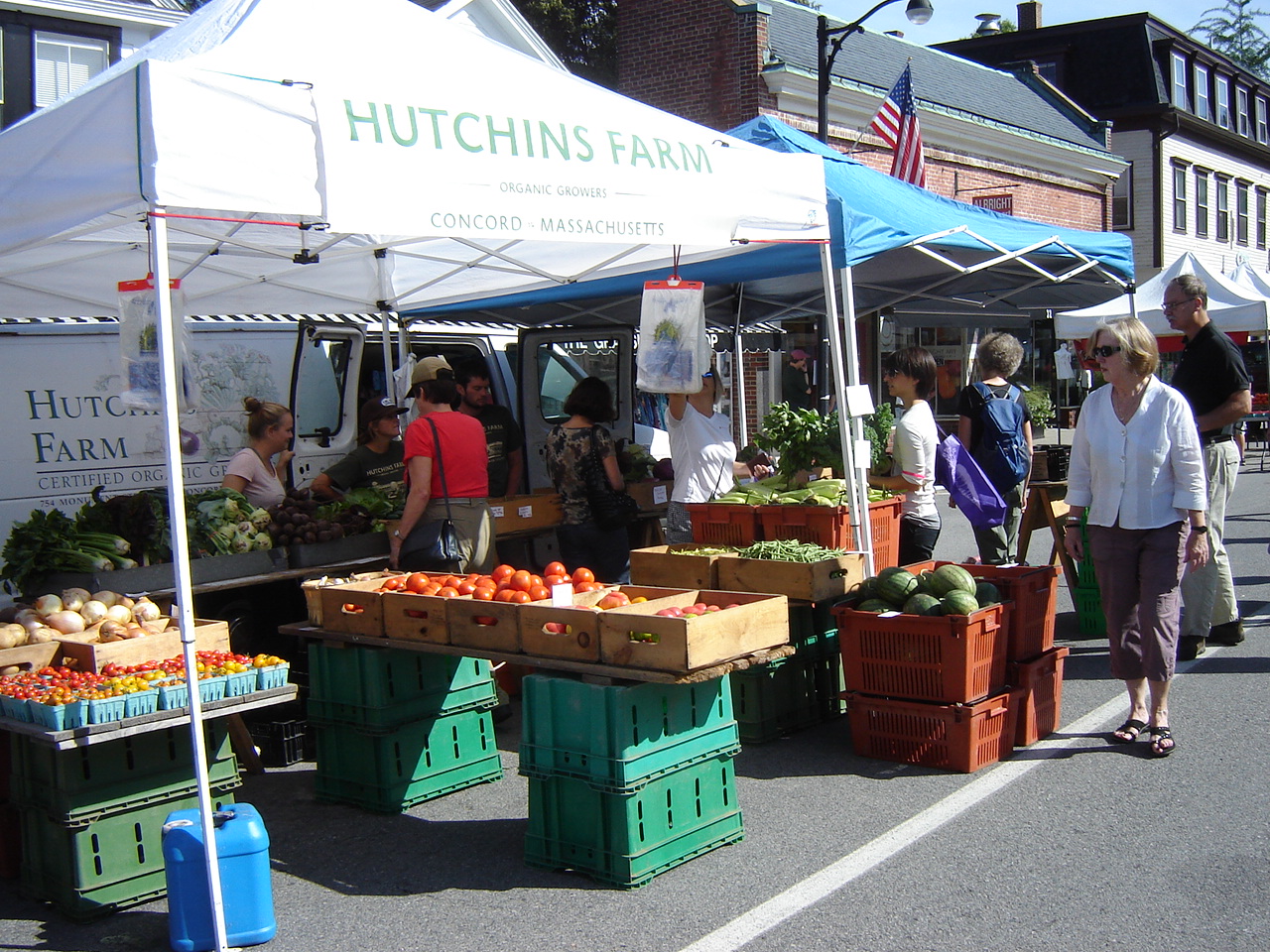
Concord’s main business street, sometimes called the Milldam because it was built over a dam, got blocked to traffic this morning, and farmers set up booths. Concord doesn’t do this often because most farmers around town have their own stands. I bought a small yellow watermelon, corn, lettuce, green beans, and a tomato. Because I was on foot I resisted buying more, but the raspberries looked wonderful as did some seasoned salt, pots of flowers, dried hydrangeas, and homemade soaps.

Among the farms represented were Verrill Farm (where we went for Mothers Day brunch this year),  Pete & Jen’s Backyard Birds, Frank Scimone Farm, and Hutchins Farm (pictured).

Last year we attended the Concord farms’ annual Stone Soup dinner, a benefit organized by the town’s Agricultural Committee — quite elaborate and delicious. A scholarship was awarded that night to a young local farmer as part of the campaign to encourage the next generation to pursue or stay in agriculture. I was surprised to learn that there are 18 farms in Concord. Read more here.

Read Full Post »