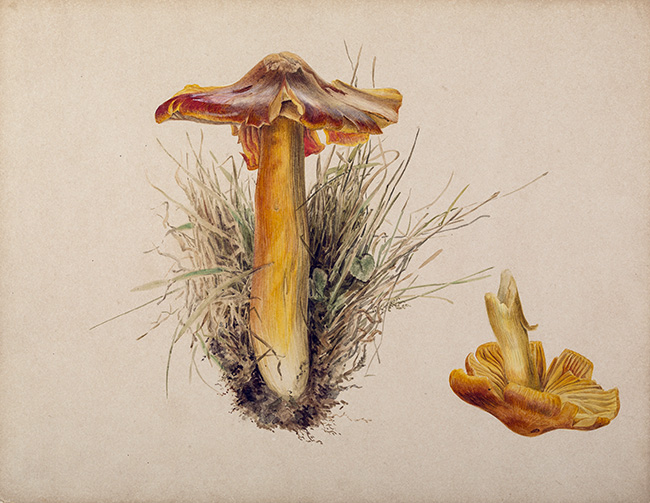
Art: Beatrix Potter via the Marginalian.
The mighty mushroom.
As the blogger at Spores, Moulds, and Fungi in New Zealand could tell you, mushrooms are important to the efficient functioning of the planet.
Today’s article explains how, if encouraged to do their own thing, fungi can prevent the worst climate-change wildfires. Here are excerpts from Stephen Robert Miller’s report at the Washington Post.
“If you’ve gone walking in the woods out West lately, you might have encountered a pile of sticks. Or perhaps hundreds of them, heaped as high as your head and strewn about the forest like Viking funeral pyres awaiting a flame.
“These slash piles are an increasingly common sight in the American West, as land managers work to thin out unnaturally dense sections of forests. …
“The federal government has committed nearly $5 billion in the Inflation Reduction Act and Bipartisan Infrastructure Law to thinning forests on about 50 million Western acres over the next 10 years. Although this can be accomplished with prescribed burns, the risk of controlled fires getting out of hand has foresters embracing another solution: selectively sawing trees, then stripping the limbs from their trunks and collecting the debris.
“The challenge now is what to do with all those piles of sticks, which create fire hazards of their own. Some environmental scientists believe they have an answer: mushrooms. Fungus has an uncommon knack for transformation. Give it garbage, plastic, even corpses, and it will convert them all into something else — for instance, nutrient-rich soil.
“Down where the Rocky Mountains meet the plains, in pockets of forest west of Denver, mycologists like Zach Hedstrom are harnessing this unique trait to transform fire fuel into a valuable asset for local agriculture.
“For Hedstrom, the idea sprung from an experiment on a local organic vegetable farm. He and the farm owner had introduced a native oyster mushroom to wood chips from a tree that fell in a windstorm.
“ ‘That experiment showed us that the native fungi were helping to accelerate the decomposition really substantially,’ he said. Working with local governments, environmental coalitions and farmers, he is now honing the method. …
“When slash piles are set alight, they burn longer and hotter than most wildfires over a concentrated area. This leaves behind blistered soil where native vegetation struggles for decades to take root. As an alternative, foresters have tried chipping trees on-site and broadcasting the mulch across the forest floor, where it degrades at a snail’s pace in the arid climate. Boulder County also carts some of its slash to biomass heating systems at two public buildings.
“ ‘We’re removing a ton of wood out of forests for fire mitigation,’ Hedstrom said. ‘This is not a super sustainable way of managing it.’ He hopes to show that fungi can do it better.
“Jeffrey Ravage is a forester with the Coalition for the Upper South Platte, which manages protection and restoration of a more-than-million-acre watershed in the mountains southwest of Denver. He describes the action of saprophytes, a type of fungi that feeds off dead organic matter, as ‘cold fire.’ Like a flame, saprophytic fungi break organic material into carbon compounds.
Mycelium, the often unseen, root-like structure of the fungi, secretes digestive enzymes that release nutrients from the substrate it consumes.
“Whereas a flame destroys nearly all organic nitrogen, mycelium can fortify nitrogen where it’s needed in the forest floor. … Standard thinning costs somewhere around $3,000 per acre, about a third of which is spent hauling out or burning the slash. Using mycelium could drastically reduce that cost. With the right kind of fungi, he said, ‘we can do in five years what nature could take 50 years to a century to do: create organic soil.’
“Though the method is new, it’s not untried. At the Balcones Canyonlands Preserve, north of Austin, biologist Lisa O’Donnell deploys mycelium to combat invasive glossy privet [successfully]. … For mycelium to be a truly viable solution to wildfires, however, it would have to work at the scale of the Western landscape. Hedstrom is experimenting with brewing mycelium into a liquid that can be sprayed across hundreds of acres. …
“Ravage doubts it could be so easy. ‘Half the battle is how you target the slash,’ he said. Success stories like Balcones are rare. Ravage has spent a decade cultivating wild saprophytes and perfecting methods of applying them in Colorado’s forests.
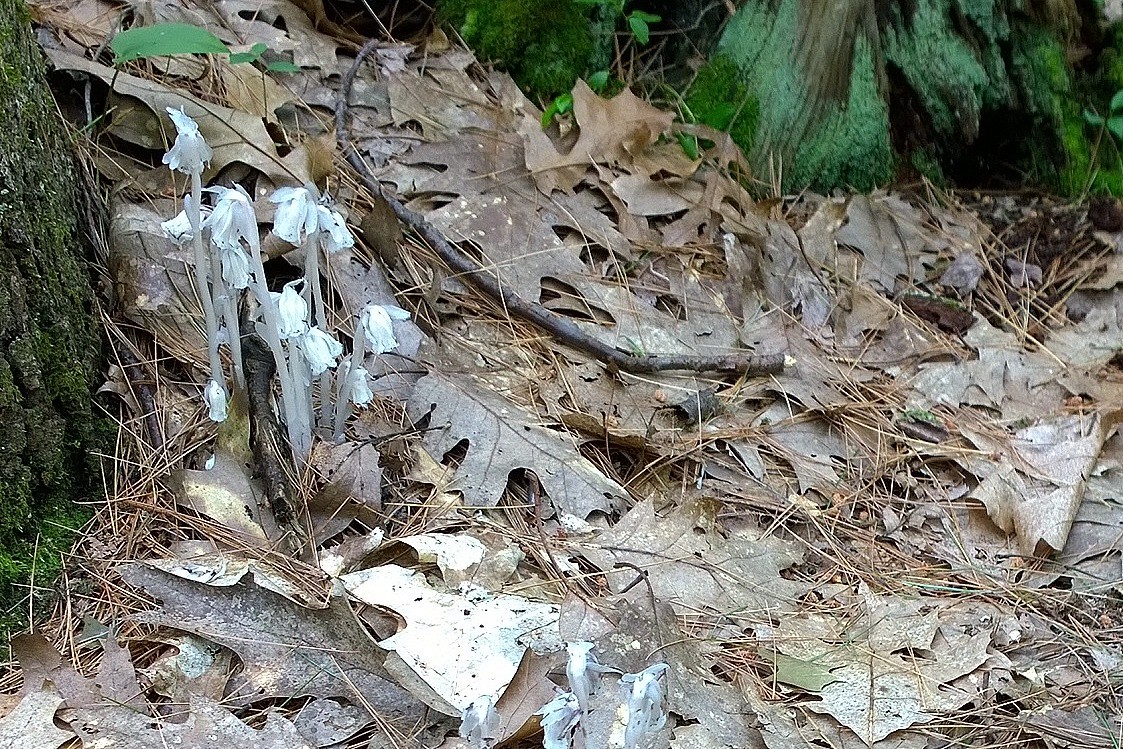
Photo: Suzanne and John’s Mom
Indian Pipe is a kind of saprophyte.
“He begins by mulching slash to give his fungi a head start. Then he seeds the mulch with spawn, or spores that have already begun growing on blocks of the same material, and wets them down. Fungi require damp conditions and will survive in the mulch if it is piled deeply enough. Given the changing character of Western forests, however, aridity poses a serious hurdle.
“At his lab in the Rockies, Ravage grows about a ton of spawn annually. To meet the demands of forest-fire mitigation, he wants to produce 12 tons every week. This presents an opportunity for intrepid mushroom farmers, should the government choose to fund them.”
The article was produced in collaboration with the Food & Environment Reporting Network.
More at the Post, here.
 h
h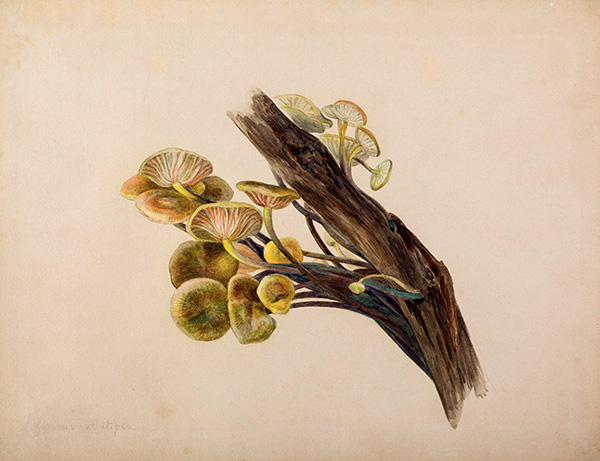

 Suzanne's Mom's Blog