Feeds:
Posts
Comments

Posts Tagged ‘gentrification’

Photo: Sonja Dümpelmann, CC BY-SA.
Window-box gardening has been a Philly tradition since the 1800s. 

Although not a gardener myself, I love looking at other people’s gardens. Who doesn’t? It’s not surprising that landscaping plays a big role in quality of life, even in urban renewal.

That’s why Sonja Dümpelmann, Professor of Environmental Humanities, Ludwig Maximilian University of Munich, decided to research the role of Philadelphia’s flower boxes. She was interviewed at the Conversation.

“How did you become interested in window boxes?
When I first moved to Philadelphia from Cambridge, Massachusetts, in August 2019, I was immediately struck by the window boxes. The lushness and freshness of the plants in many of the boxes, and sometimes in sidewalk planters, made walking more pleasant and interesting. ….

“I noticed that there were three categories of window boxes. Many were visibly cared for, often freshly planted and decorated several times a year in accordance with the changing seasons. Some were derelict and had spontaneous growth of saplings and different grasses. And a third category were boxes outfitted with plastic plants, perhaps signaling absentee owners or landlords who seek to simulate care.

What makes them landscape architecture?
“Window boxes – especially the planted boxes, but also painted boxes that are empty – change outdoor space and building exteriors. They make them more colorful and interesting, and they break up plain vertical walls by protruding from the facade.

“You could say that the window boxes ‘greet’ passersby. They connect private indoor space with the public realm of the street. … ‘Gardens in a box,’ as they were also referred to by early promoters, can make homes and entire neighborhoods look and feel different. They forge distinct identities with their plant selection and the style and color of the boxes.

“Window gardening became popular in Victorian England and continental Europe in the 19th century. It began as an indoor activity and was practiced especially by women, but it soon also moved outdoors. …

“Window gardening became a means of female social reform during the Progressive Era. During this period in the late 19th and early 20th centuries, when industries and cities were growing fast, women sought to improve education, public health and living conditions, especially for poor and immigrant communities. By offering plants, flowers and entire window boxes, the women supported homemakers of lesser means.

“However, these boxes were also a way to make sure that order in and outside of homes was maintained. Window gardens became cultural symbols of cleanliness and good housekeeping. …

When did it become political?
“In Philadelphia there were two big window-gardening movements. The first occurred in the late 19th and early 20th centuries, and I describe it as ‘window-box charity.’ The second, which I call ‘window-box activism,’ began in the 1950s.

“Window-box charity was carried out primarily by white philanthropists and social workers who would distribute plants and goods sent from outside the city to the urban poor and sick, especially immigrants and Black Americans. Sometimes the window boxes were ready to be installed outside the windows. Other times recipients built and planted boxes themselves.

“Several decades later, in the mid-20th-century, plants became a vehicle for white suburban garden club ladies and Black inner-city residents to counter urban decay resulting from racism and public disinvestment. On annual planting days, the garden club ladies brought plants into the city and joined residents in planting and installing window boxes to brighten up their neighborhood blocks.

“Plants were key in both window-box charity and window-box activism. People came together to care for plants, creating friendships among neighbors and ties between low-income and wealthy neighborhoods. The women used plants and window boxes to protect private space and increase the safety of public space. In the 1960s, the Philadelphia police reported less crime on streets with window boxes.

“Of course, window boxes and plants alone could not solve larger urban social problems such as poor housing conditions and racial discrimination. So while they could be catalysts of neighborhood change, they also helped to camouflage and quite literally naturalize larger social problems that required political responses.

“Like a smaller version of public parks, community gardens and street trees, window gardens can contribute to green gentrification. This occurs when the construction of parks or the planting of trees contributes to an increase in property values that leads to the displacement of long-term residents in low-income neighborhoods.

“Window gardening did help save some of Philly’s old row house neighborhoods from demolition during urban renewal beginning in the 1950s. However, quite a few of these neighborhoods – such as Washington Square West and Graduate Hospital – have since been gentrified. …

“The 20th century window-box activism drew the attention of sociologists and other national and international observers, especially because it brought white and Black residents together during the tensions of the Civil Rights Movement. It also raised public awareness about unequal access to urban green spaces. Yet despite the movement’s good intentions and positive effects, racial segregation remains a persistent problem in Philadelphia.”

Read more at the Conversation, here. No paywall. Lovely pictures. Tip of the Hat to radio show Living on Earth for the lead.
Read Full Post »

3776Photograph: OST Collective
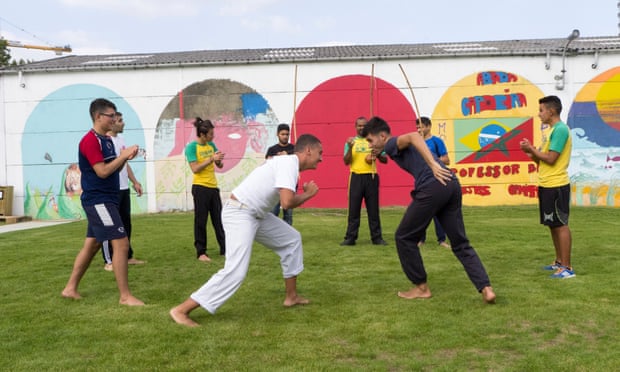
A Brussels nonprofit that reactivates abandoned buildings offers “free space to whoever wants to organize regular activities that are open to all.” Here you see young people practicing capoeira, an Afro-Brazilian martial art, in one of the free spaces.

When I had lunch with Kai recently, we talked about his work investing in real estate for a publicly traded Chinese company. Progressive by nature, he tries to ensure that any gentrification of an urban neighborhood honors the needs of the local community. It’s not always easy.

I thought of Kai when I read about a Belgian approach to managing space during the period between abandonment and development.

Laurent Vermeersch writes for the Guardian, “When industrial activity moves out of central urban areas, property developers tend to move in quickly to build high-end housing. But things don’t necessarily have to turn out this way. With financial support from the city authorities, a group of enthusiasts in Brussels turned exactly this kind of site into a socio-cultural activity centre to benefit local youth.

“ ‘Young people need space. Space to play, party and express themselves, but also to experiment, fail and learn. The problem is that access to space is not democratic,’ says Pepijn Kennis, a 27-year-old member of Toestand (meaning ‘state of being’), a Brussels non-profit that specialises in the reactivation of abandoned buildings and places. ‘We give free space to whoever wants to organise regular activities that are open to all.’

“Toestand’s biggest project yet is Allée du Kaai, a complex of several warehouses and open space along the Brussels canal, a rapidly changing part of the city. Just across the street is Molenbeek … which suffers from high levels of poverty and unemployment. Although much of the area surrounding Allée du Kaai is marked by deprivation, with families cramped into tiny housing units without access to good public space and services, there are also pockets of gentrification. … Toestand’s goal has been to bring together different population groups in a city facing growing inequality.

“The Allée du Kaai site has been active for about two years. … Walking around it on a busy day, you can feel a sense of creativity and potential in the air. There’s a bike repair workshop taking place, as well as a cooking class. Elsewhere kids are skating, or learning to print on T-shirts. A local band is rehearsing in a back room. There is even a tiny cinema in a former city bus. Others are playing ping-pong, strolling on the waterfront, or just hanging around against the backdrop of big graffiti walls. …

“Toestand is actually paid by local authorities to manage the site. ‘We have a contract with the Brussels Region Environment agency,’ says Kennis. ‘They are planning to make a park here, but that’s not going to happen anytime soon, so in the meantime they wanted to do something meaningful with the place.’ …

“As is the case in many other cities around the world, pop-up culture has taken root in Brussels – but many examples tend to be very commercial. … The kind of social calling that Toestand brings to the table, however, can probably only exist with support from city authorities. Private owners are usually extremely reluctant to make buildings public, even if they’re abandoned. They fear the temporary occupants won’t vacate the place as soon as more lucrative plans take shape. Allée du Kaai is also exceptional in the sense that the land it occupies will remain wholly public after Toestand’s activities move on, because the buildings will give way to a park. …

“To bring together different people in Allée du Kaai, Toestand decided to work together with associations active in local communities, but at first it wasn’t easy to engage people from the neighbourhood and build a network. The skate park, however – as well as hip-hop and breakdance events – proved helpful in attracting a variety of young people.

“Another people-connector are the rabbits on the site. ‘They were brought here by Ismaël, a local teenager, and his dad,’ says Kennis.

“ ‘They were keeping rabbits on the balcony of their tiny flat and asked to bring them here as soon as they heard about our space. One day the chef de cabinet of the regional minister of environment was visiting and started talking with Ismaël. Turned out they both know a great deal about rabbits, so they talked for quite some time about how to feed them. This is at the heart of our philosophy: creating a space where people can meet and interact. Even people who’d probably never cross paths in the normal world.’ ”

More at the Guardian, here.

Read Full Post »

Photo: Tim Clyne
Genesis Blu calls herself a “raptivist” — a mix of rapper and activist. She also works as a psychotherapist.

I heard Genesis Blu interviewed on National Public Radio (NPR) one day when I was driving and thought you might be interested. She is a rapper, an activist, and a psycotherapist.

NPR’s Lulu Garcia-Navarro interviewed her at SugarHill Recording Studios, where Genesis Blu recorded the tracks for her EP, “Bluming Season.”

“Genesis Blu calls herself a ‘raptivist,’ mixing hip-hop with advocacy. She says she dedicates time to ‘facilitating change in her community.’ The dual passions for politics and music started at a young age.

” ‘I would be like 12 years old, going to a nightclub, where people are smoking and drinking. I was always a different type of kid, so my songs would be about the struggle, the political climate — even that young. And they would be like, “Where is this little girl coming from with this stuff?” ‘

“But when she got older, she put the music career on hold and focused on school — a lot of school. She got a bachelor’s, a master’s and started her doctorate. Until she had an epiphany one day — she wanted to be back in the community, writing music. She was in the middle of her dissertation.

” ‘I literally stopped that day, put down that pen and picked up another pen and a notepad and began to write music,’ she says. ‘And I’ve been doing that since.’

“Well, it’s not quite all of what she’s been doing since. She’s also a full-time psychotherapist. Blu works with children and families and teens ‘who are removed from their home due to abuse of some sort or due to their emotional disturbances,’ she says.

” ‘People ask me to choose [between music and therapy] and I cannot, I love them equally,’ she says. ‘Because you’re able to change lives both ways.’ ”

Here are some highlights of the interview.

” ‘I don’t want my people left behind. So, what’s happening [in Houston] right now is gentrification, in the worst way. They are pushing these people out. And there’s not many other options [of places] to go, because we don’t have a great public transportation system …

” ‘It’s upsetting a lot of us who have been in this community and are working in this community. And so even though I’m very happy about the diversity, what it also is doing is allowing people to come in with a bunch of money, throw money at some things, tear some things down, buy it out — and then leave the people who have been here stranded.’ …

” ‘My history is that my grandmother grew up in another neighborhood in Houston as well called Acres Homes. So living between Greenspoint and Acres Homes, which were rivals at the time when I was a kid by the way. So I would have to go to my grandmother’s house after school if my mother couldn’t be home from work.

” ‘And that was interesting because I was bullied — a lot. Because I’m too proper for the black kids and I’m not white enough for the white children, so I’m in a very awkward place. But still loving the culture of where I come from.

” ‘But my grandmother was also an activist. She was very influential in the war on drugs here in Houston. So … she would have me marching with her. So I get that from her.’ ”

More at NPR, here.

Read Full Post »

Even if, like me, you never got into the TV show “The Wire,” you may know that it was about a troubled section of Baltimore. You also may be interested in a new school there, intended to serve as a real community gathering place.

New York Times design critic Michael Kimmelman has the story.

“In many ways, public schools are gated communities, dead zones,” writes Kimmelman. “They’re shuttered after dark and during the summer, open to parents and students while in session but not to the larger community.

“A new public school in one of the poorest neighborhoods in East Baltimore wants to challenge the blueprint. Designed by Rob Rogers, of Rogers Partners in New York, Henderson-Hopkins, as it’s called, aspires to be a campus for the whole area — with a community center, library, auditorium and gym — as well as a hub for economic renewal.

“This is the neighborhood where parts of ‘The Wire’ were filmed. In 2000, when the city’s mayor convened local business leaders, the vacancy rate was 70 percent. Poverty was twice the city average. Crime, infant mortality and unemployment were all through the roof.

“The idea that emerged — of making the school the centerpiece of a major redevelopment project — is a grand urban experiment. Operated by Johns Hopkins University in collaboration with Morgan State University, the school, which opened in January, belongs to a $1.8 billion plan that also includes new science and technology buildings, a park, retail development and mixed-income housing. While gentrification might threaten to displace the poor, the school is to be the glue that helps bind the district together.” Read more here.

Photo: Matt Roth for The New York Times
Henderson-Hopkins, which shares its library, gym, auditorium, and other features with the surrounding area, is designed to catalyze change in a blighted section of Baltimore.
 

Read Full Post »

Most street artists don’t think in terms of permanent museum collections. They don’t expect their work to be admired forever. Still, it must be a little sad to see it torn down.

Meghan alerted me, by way of twitter, to the demise of Boston’s only graffiti park, Bartlett Yard, about to be demolished.  Dig has the story.

“Rosa Parks, Mr. Miyagi, and the Incredible Hulk gaze down from the wall, their faces nearly big enough to drive a bus through. A giraffe in a space helmet floats carelessly through the light purple cosmos,” writes Dan Schneider at Dig.

“This barely begins to cover the intricate murals found at the Bartlett Yard, an 8.6-acre parcel of land just blocks away from Dudley Square in Roxbury, formerly used as a bus garage by the MBTA. Since the beginning of the year, the property’s owners have allowed an event planning group called Bartlett Events to turn half of the property into a community art space.

“In May, Bartlett Events held Mural Fest, an open call for graffiti muralists, which drew an estimated 1,000 artists and community members together in a frenzy of aerosol, transforming the Yard from a 125-year-old dilapidated bus garage into the massive public art installation.

“If you want to take in the art at Bartlett Yard, however, you’d better do it soon.

“Come this November it’ll all be torn down to begin construction of Bartlett Place, a mixed-use development of housing with—in all likelihood—no graffiti. …

“The Bartlett Bus Yard has been out of commission since the late nineties, following a community-led effort to shut it down due to concerns about bus exhaust contributing to high rates of childhood asthma in the area. Since then the Yard has been abandoned …

“With a few weekends’ worth of hard work, however, several dozen volunteers were able to clean out most of the Yard’s two main buildings and surrounding blacktop prior to opening day.”

Residents express mixed feelings about the redevelopment, which some fear could lead to the dreaded gentrification and push out lower-income people. Others think it will be good to have more variety.

In any case, it sounds like the artists want to stay around even if the art is  ephemeral.

For Jason Turgeon,  an environmental scientist and one of the founders of Bartlett Events, “the notion of trying to create a permanent graffiti museum would simply miss the point.

“ ‘I come from the Burning Man world, so I know that art doesn’t have to be here forever. Some people say, “You have to save this!” And I say “No, it’s okay. There will be more art after this.” ‘ ”

Read more at Dig.

Photo: DigBoston.com

Read Full Post »