Feeds:
Posts
Comments

Posts Tagged ‘gold’

Photo: Reuters.
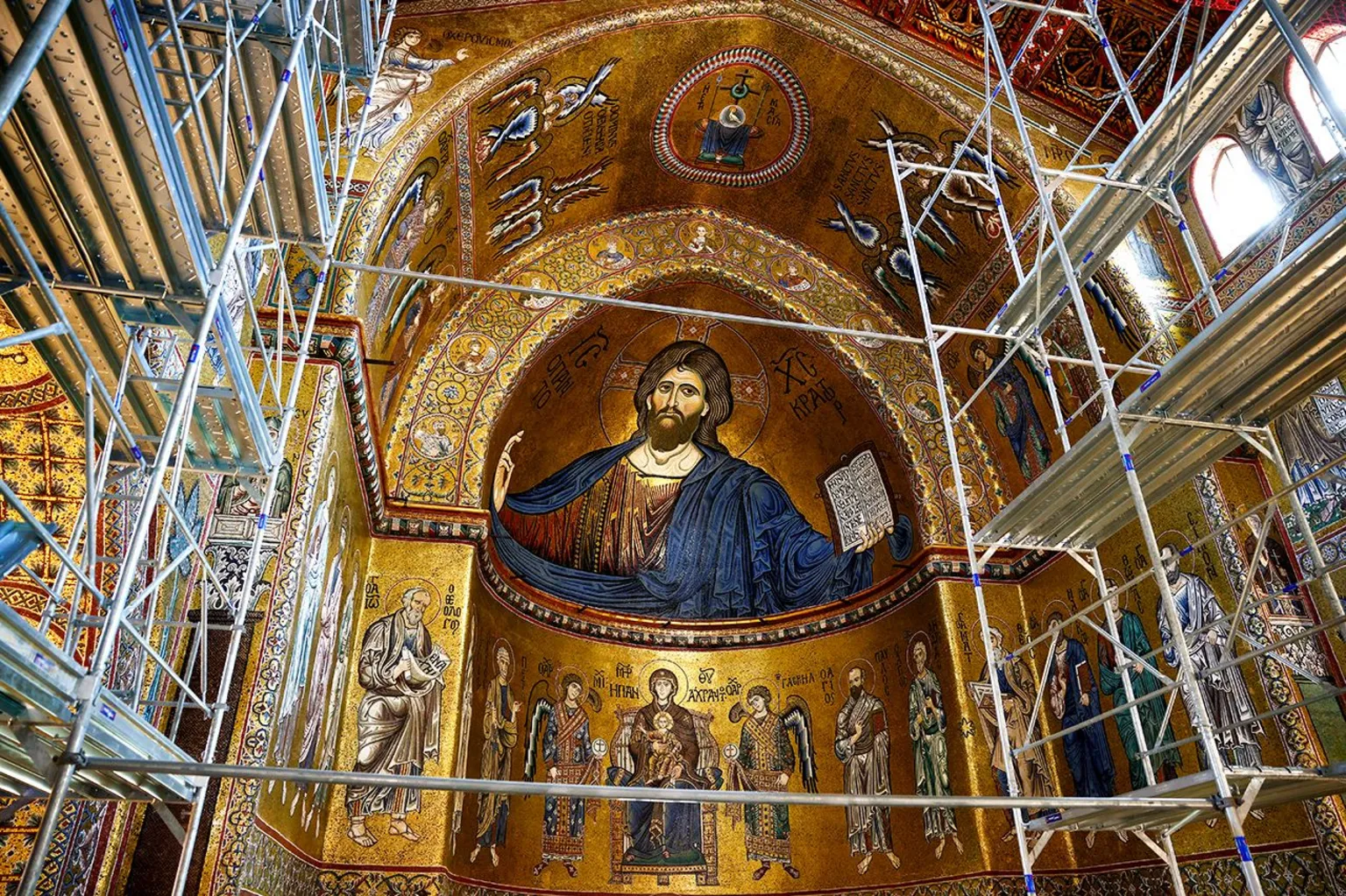
The Monreale cathedral was declared a Unesco World Heritage Site in 2015, and has recently undergone extensive restoration.

Some organized religions eschew signs of wealth and pomp. For others, such things emphasize the value they put on their faith. I always like hearing about the individual stonemasons who gave their heart and soul to carving small corners of the great cathedrals, but I have mixed feelings about covering churches in gold, however beautiful. I was not part of the fundraising for my church’s dome, which one member paid to gild, covering the sky-blue paint.

All to say that an extraordinary amount of gold is now drawing tourists to a cathedral in Sicily, a UNESCO World Heritage site.

The BBC’s Sara Monetta writes, “On a hill overlooking the city of Palermo, in Sicily, sits a lesser-known gem of Italian art: the cathedral of Monreale. Built in the 12th century under Norman rule, it boasts Italy’s largest Byzantine-style mosaics, second in the world only to those of Hagia Sophia in Istanbul.

“Now, this Unesco World Heritage site has undergone an extensive restoration to bring it back to its former glory. The Monreale mosaics were meant to impress, humble and inspire the visitor who walked down the central nave, following the fashion of Constantinople, the capital of the surviving Roman empire in the east.

“They span over [69,000 square feet] and contain about [4.6 pounds] of solid gold. …

“Local experts from the Italian Ministry of Culture led a series of interventions, starting with the removal of a thick layer of dust that had accumulated on the mosaics over the years. Then they repaired some of the tiles that had lost their enamel and gold leaf, making them look like black spots from down below. Finally, they intervened in the areas where the tiles were peeling off the wall and secured them.

“Working on the mosaics was a challenge and a big responsibility, says Father Nicola Gaglio. He has been a priest here for 17 years and has followed the restoration closely, not unlike an apprehensive dad.

” ‘The team approached this work almost on their tiptoes,’ he tells me. ‘At times, there were some unforeseen issues and they had to pause the operations while they found a solution. For example, when they got to the ceiling, they realized that in the past it had been covered with a layer of varnish that had turned yellowish. They had to peel it off, quite literally, like cling film.’

“The mosaics were last partly restored in 1978 , but this time the intervention had a much wider scope and it included replacing the old lighting system.

” ‘There was a very old system. The light was low, the energy costs were through the roof and in no way it made justice to the beauty of the mosaics,’ says Matteo Cundari. He’s the Country Manager of Zumtobel, the firm that was tasked with installing the new lights. …

“I ask Fr Gaglio what it was like to see the scaffolding finally come off and the mosaics shine in their new light. He laughs and shrugs.

” ‘When you see it, you’re overwhelmed with awe and you can’t really think of anything. It’s pure beauty,’ he says. ‘It’s a responsibility to be the keeper of such world heritage. This world needs beauty, because it reminds us of what’s good in humanity, of what it means to be men and women.’ “

More at the BBC, here. No firewall.
Read Full Post »

Photo: Adri Salido.
From the Christian Science Monitor: “Elsa Cerda (with spear) leads Yuturi Warmi, a group of Indigenous women who guard against illegal mining in the community of Serena in the Ecuadorian Amazon.”

As a group of indigenous women in the Ecuadorian Amazon have shown, when something is wrong in your neighborhood, it pays to join with others and fight.

Al Jazeera wrote a good report on this last year.

“As a child, Leo Cerda would spend his mornings helping his family cultivate cassava, plantains and other fruits and vegetables in their chakra, a traditional garden in Kichwa communities.

“In the Ecuadorian village of Napo, traditions form a large part of family and spiritual life. At around 3 am each morning, before heading to their chakras, many families take part in a traditional tea ceremony. Once freed from his farming duties at around midday, Cerda recalled running to the river to swim and fish with friends. Fish would later be grilled on an open fire and eaten with large amounts of fruit.

“ ‘As a kid, I got to enjoy nature,’ Cerda told Al Jazeera.

“These days, however, the 34-year-old spends his days chasing gold miners from his community and campaigning against those who threaten to destroy his ancestral lands. …

“ ‘Within three years, everything changed,’ Cerda said. ‘The land has been poisoned. There are no more fish, except ones that are contaminated. People eat them, and they get sicker and sicker.’

“A recent study carried out in mining areas of the northeastern Andean foothills of the Ecuadorian Amazon, close to where Cerda lives, revealed high concentrations of toxic metals. They are up to 352 times above permissible limits established by environmental guidelines. …

“Mariana Capparelli, a researcher who contributed to the study, told Al Jazeera it was ‘very sad to see the conditions these communities are exposed to as well as the total degradation of an ecosystem that is so important for the entire planet.’ …

“Due to what critics say is an absence of sufficient government regulation, mining in Ecuador has led to environmental pollution and adverse effects on the health of Indigenous communities. In recent months, authorities have carried out several raids against illegal miners.

But with widespread state corruption and tip-offs given to miners, machinery is sometimes withdrawn immediately before police operations take place, activists say. …

“Ecuador has a national system of protected areas that aims to safeguard biodiversity and local ecosystems in national parks, wildlife refuges, marine reserves and other designated areas throughout the country. Although the government has taken some steps to protect local water systems, rivers have traditionally not been included in this system. …

“According to Andres Tapia, a spokesperson for the Confederation of Indigenous Nationalities of the Ecuadorian Amazon, illegal mining has become ‘uncontrollable’ in parts of the country. …

“ ‘I thought I would always be able to drink from this river,’ Eli Virkina, a member of an Indigenous Kichwa community in Napo, told Al Jazeera. ‘Now I’m at this point where maybe I shouldn’t even swim in the water. That is really heartbreaking for me.’ …

“Across Napo, Indigenous communities and organizations have been monitoring, mobilizing and resisting mining activities. To defend their land, they have formed alliances and connections across riverine communities, including the Amazon’s first women-led Indigenous guard.

“In February 2022, a landmark Constitutional Court ruling recognized the rights of Indigenous communities to have a final say over extractive projects that affect their territories. The ruling ‘offers one of the strongest legal precedents in the world, which upholds the rights of Indigenous peoples to decide on the futures of their ancestral territories,’ according to the Amazon Frontlines advocacy group.

“But in December [2022], the ruling was disregarded when the government approved a mining project in Las Naves in Bolivar province without gaining the consent of affected communities.

“In the meantime, Napo has installed four alarm systems around the village to signal when miners are close by.

“ ‘In our territory, spears were not used anymore, but now we have one in at least every house because it’s part of the way we have to defend ourselves,’ said Majo Andrade, a member of the female-led Indigenous guard Yuturi Warmi. …

“Virkina says Indigenous resistance is vital to the region’s future. ‘Once [Indigenous people] disappear, it is way easier for miners and people to come in and access the river,’ she said. ‘When we have stronger Indigenous communities, we have stronger forests and a stronger river.’ More at Al Jazeera, here.

Adri Salido has a collection of beautiful pictures at the Christian Science Monitor and adds a few more comments to the story of Yuturi Warmi: “Yuturi Warmi refers to a type of ant (Paraponera clavata) that will attack when an enemy enters its territory.

“The group, which formed in 2020, joined with other Ecuadorian and international organizations to urge the government to enforce laws against illegal extraction and to restore habitat. But officials have not acted, according to Yuturi Warmi. Since then, the group has worked to ensure that no illegal mining takes place in its community. It patrols the riverbank, conducts canoe inspections, and maintains constant surveillance. So far, it has kept intruders out of Serena. 

“The situation is far different upstream, in Yutzupino, where illegal extraction has destroyed the basin of the Jatunyacu River, a tributary of the Amazon River.”

More at the Monitor, here. No firewall. Great collection of photos.

Read Full Post »

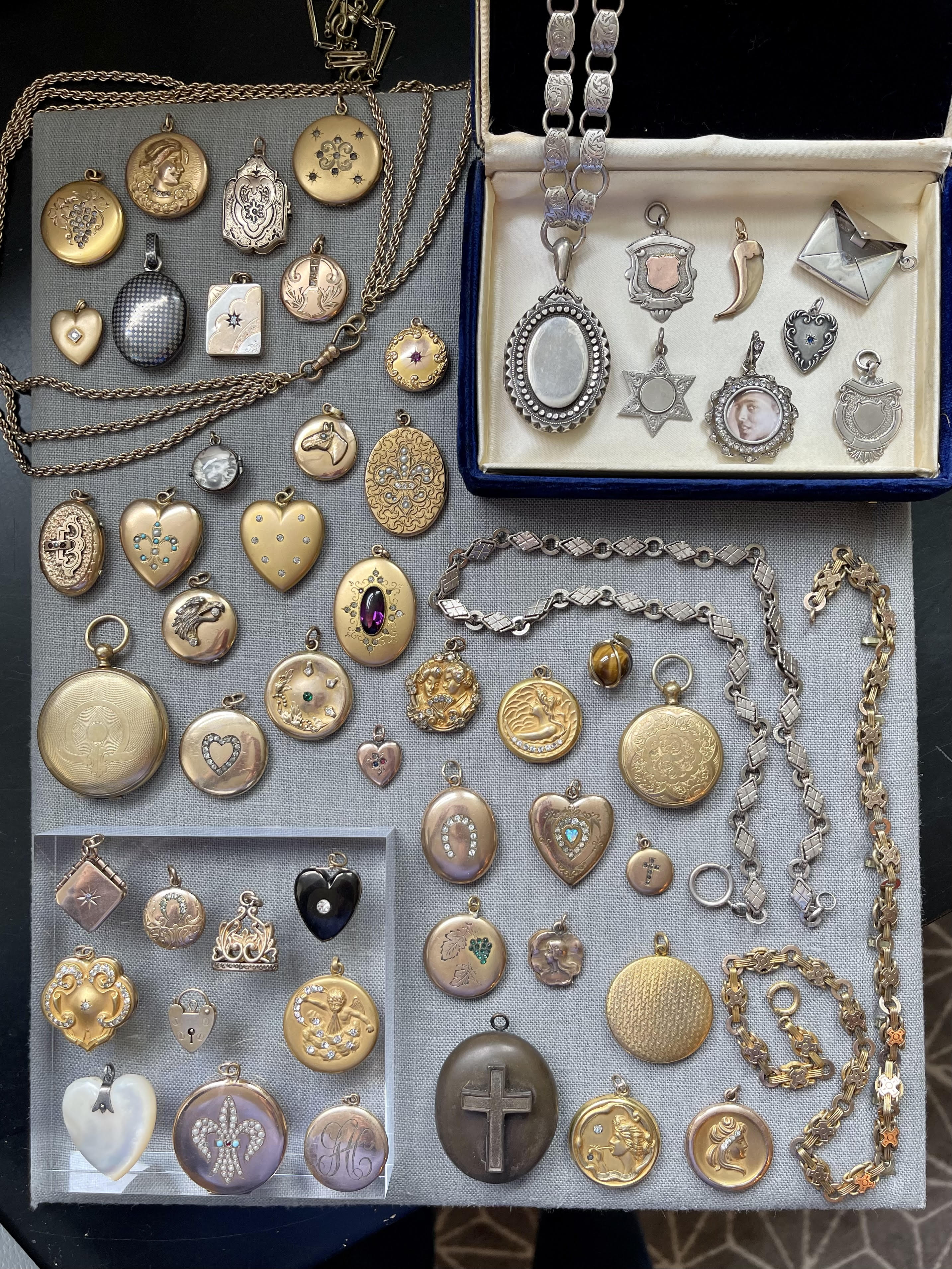
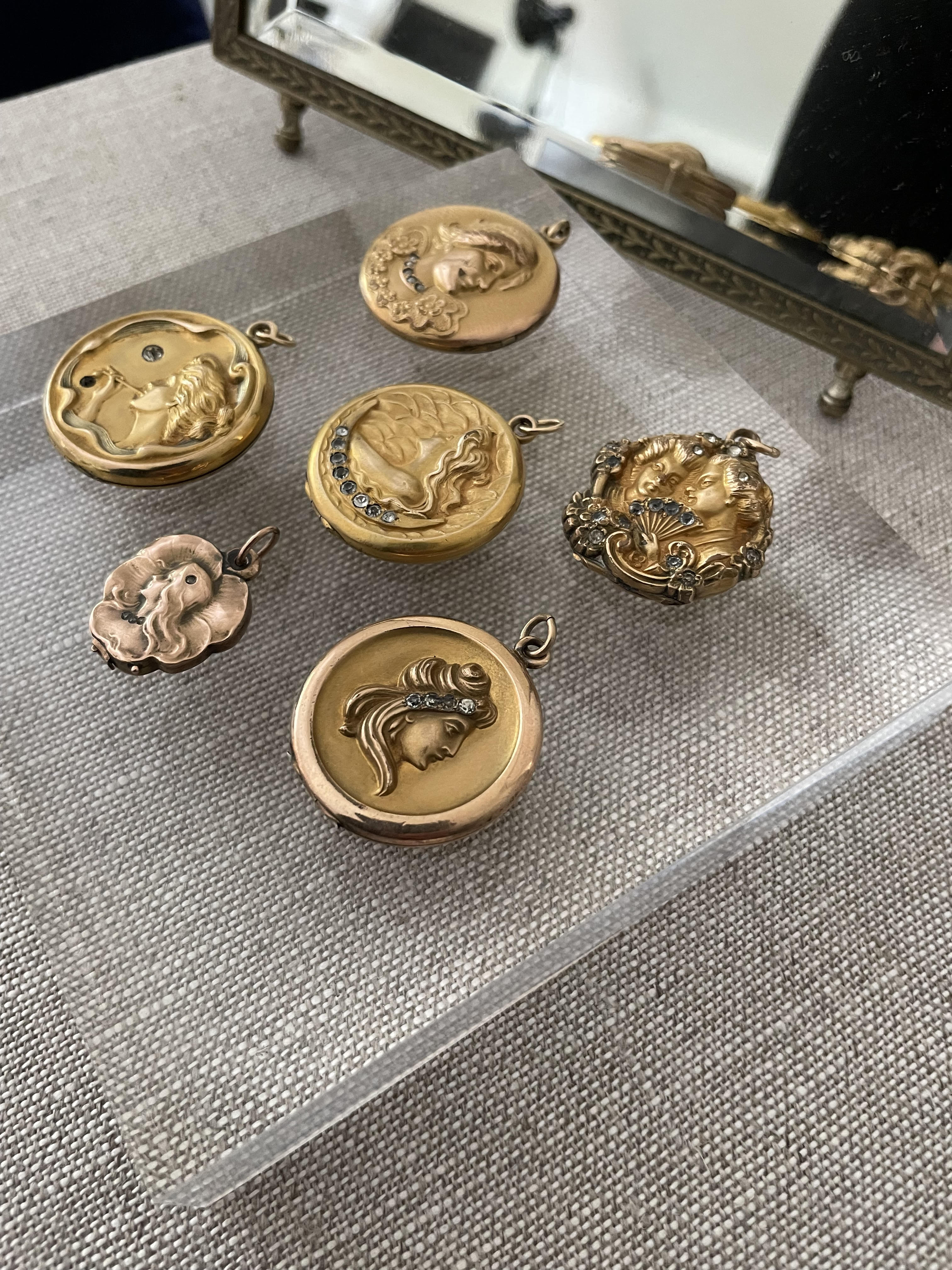
For friends old and new, here’s a bonus post just to remind you that this blog is hosted by my daughter‘s vintage and contemporary jewelry company, Luna & Stella.

And that she has a sale going on right now!

Please check out Suzanne’s Shop Small Sale. Everything in the Shop Small collection is 15% off through Monday, November 29, 2021: see https://www.lunaandstella.com/collections/shop-small-sale.

In addition, there are lots of good deals in the Luna & Stella Archive Sale: https://www.lunaandstella.com/collections/archive-sale. Find gold and silver lockets, charms, and contemporary birthstone jewelry for every taste. I think the chains are pretty special, too — hard to find.

Read Full Post »

Photo: Wreckwatch magazine.
Archaeologists are learning more about the Srivijaya Empire of Indonesia, which once dominated maritime trade routes. But nighttime divers selling to the black market may stop the research in its tracks.

I’ve been reading a murder mystery that takes place after a very dark time in India’s history — the time called Partition, when Britain made a ghastly, clumsy attempt to create one Hindu nation and one Muslim nation out of a country Gandhi had hoped would stay whole. I’m at the part in the book where it appears that the ugliness of different faiths slaughtering each others’ families might have been exacerbated by lust for gold. Where some have a lot of wealth, others may have nothing.

That’s my roundabout introduction to a report on newly found treasures of a defunct civilization — and my way of saying that lust for wealth can’t end well.

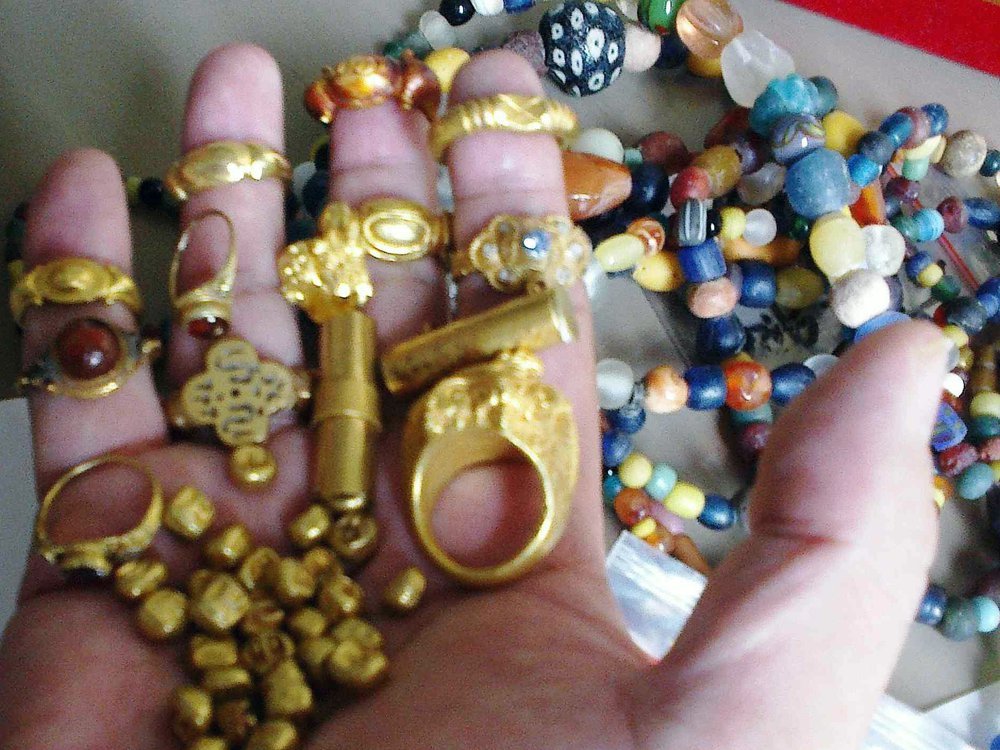
Livia Gershon reports at Smithsonian magazine, “Local divers exploring Indonesia’s Musi River have found gold rings, beads and other artifacts that may be linked to the Srivijaya Empire, which controlled sea trade across large swaths of Asia between the 7th and 11th centuries C.E.

“ ‘In the last five years, extraordinary stuff has been coming up,’ British maritime archaeologist Sean Kingsley, who reported on the discoveries in the autumn issue of Wreckwatch magazine, tells the Guardian’s Dalya Alberge.

‘Coins of all periods, gold and Buddhist statues, gems, all the kinds of things that you might read about in Sinbad the Sailor and think it was made up. It’s actually real.’

“Among the discoveries are a life-size Buddhist statue covered in precious gems, temple bells, mirrors, wine jugs and flutes shaped like peacocks, reports Stephanie Pappas for Live Science.

“The kingdom of Srivijaya began in Palembang, a city located on the Musi River on the island of Sumatra. Per Encyclopedia Britannica, the empire controlled the Strait of Malacca — a key route between the Pacific and Indian Oceans — and established trade with groups in the Malay Archipelago, China and India. Srivijaya was also a center of Mahayana Buddhism.

“Seventh-century Chinese reports indicate that Palembang was home to more than 1,000 Buddhist monks. Chinese Buddhists stopped in the city to study Sanskrit during pilgrimages to India, according to Indonesia’s Ministry of Tourism. In 1025, war with India’s Chola dynasty reduced Srivijaya’s power, though it continued to play a role in trade for another two centuries. 

“As Kingsley writes in Wreckwatch, archaeologists have found no traces of royal court buildings, temples or other structures. It’s possible that the island’s volcanoes covered them. But another likely explanation is that the city was built mostly out of wood, with homes and other buildings constructed on rafts that floated on the river—a type of architecture still seen in some Southeast Asian countries today, per Live Science. Such structures would have rotted away long ago. …

“Per Wreckwatch, the kingdom was rich in gold, which it used strategically to build relationships with China and other regional powers. …

“Kingsley tells Live Science that no official archaeological excavations have been conducted in or around the Musi River. But amateurs have been finding treasures there since 2011, when construction workers discovered a number of artifacts while dredging sand from the river. Soon, local fishermen and workers began exploring the body of water. …

“Large numbers of these artifacts then showed up on the antiquities market. Many ended up in private collections, leaving little physical evidence about the civilization for scholars to study. …

“Indonesia put a moratorium on underwater archaeology in 2010. But as Kingsley points out, a black market in artifacts discovered during nighttime dives continues.

“ ‘Fishermen don’t stop fishing and they don’t stop discovering,’ he tells Live Science. “ ‘Only now, they’re even more unlikely to report finds to authorities. … Newly discovered, the story of the rise and fall of Srivijaya is dying anew without being told.’ “

More at the Smithsonian, here.

Read Full Post »

http3a2f2fcdn-cnn-com2fcnnnext2fdam2fassets2f180910100856-03-roman-gold-coins

Photo: Ministry of Cultural Heritage and Activities
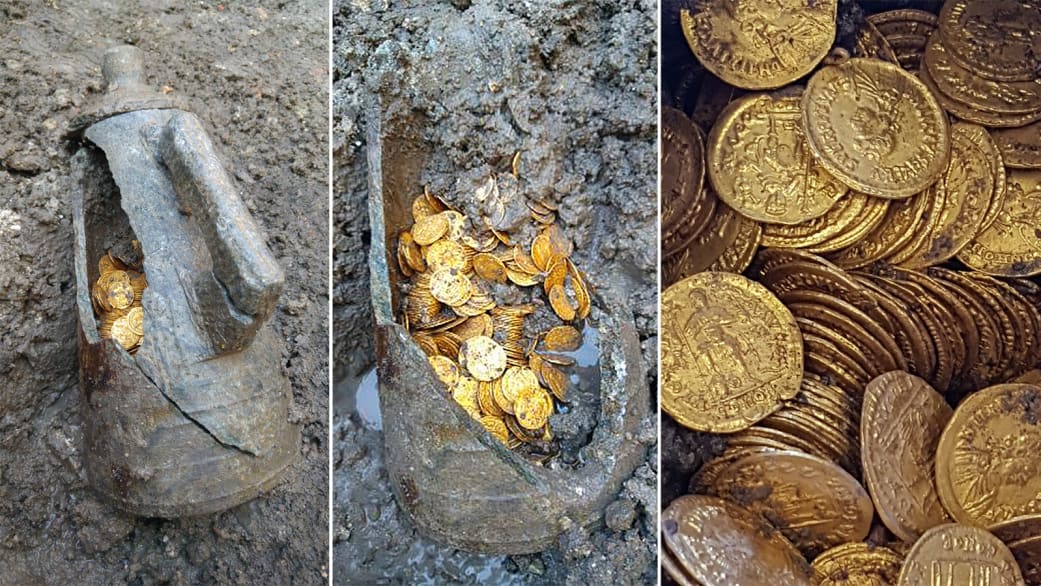
A trove of ancient gold coins hidden in a soapstone jar was recently unearthed in Como, Italy.

When you were a kid, you believed in the possibility of finding buried treasure. I, for one, believed so thoroughly, I could be easily taken in. My neighbor Kenneth Jukes was a great one for tall tales, and I remember distinctly being persuaded by him that some charcoal refuse in a stream was actually gold. I took it to my parents who were annoyingly skeptical. My grandmother said to my father, “But what if it is … ?” Kenneth looked sheepish.

Nevertheless, people do find gold in unexpected places. Kids may know things grownups have forgotten.

As Amanda Jackson and Gianluca Mezzofiore report at CNN, “Archaeologists are studying a valuable trove of old Roman coins found on the site of a former theater in northern Italy. The coins, at least 300 of them, date back to the late Roman imperial era and were found in a soapstone jar unearthed in the basement of the Cressoni Theater in Como, north of Milan.

” ‘We do not yet know in detail the historical and cultural significance of the find,’ said Culture Minister Alberto Bonisoli in a press release. ‘But that area is proving to be a real treasure for our archeology. A discovery that fills me with pride.’

“Whoever placed the jar in that place ‘buried it in such a way that in case of danger they could go and retrieve it,’ said Maria Grazia Facchinetti, a numismatist. … ‘They were stacked in rolls similar to those seen in the bank today. … They don’t go beyond 474 AD.’ …

“The ministry did not place a value on the coins. But reports in the Italian media suggest they could be worth millions of dollars.

“The historic Cressoni Theater opened in 1807 before transitioning into a cinema and eventually closing in 1997. The site is not far from the Novum Comum forum area, where other important Roman artifacts were discovered, according to the ministry.”

More at CNN.

Read Full Post »

kazakhstan-treasure

In the remote Tarbagatai mountains, where Kazakhstan meets northern China, archaeologists have found an ancient treasure.

I have heard that the day-to-day life of an archaeologist is all mud and digging and measuring — not glamorous. But imagine having your efforts rewarded by unearthing a pile of gold! You don’t get to keep it, of course, but it must be a thrill to feel a sudden connection with artisans of thousands of years ago.

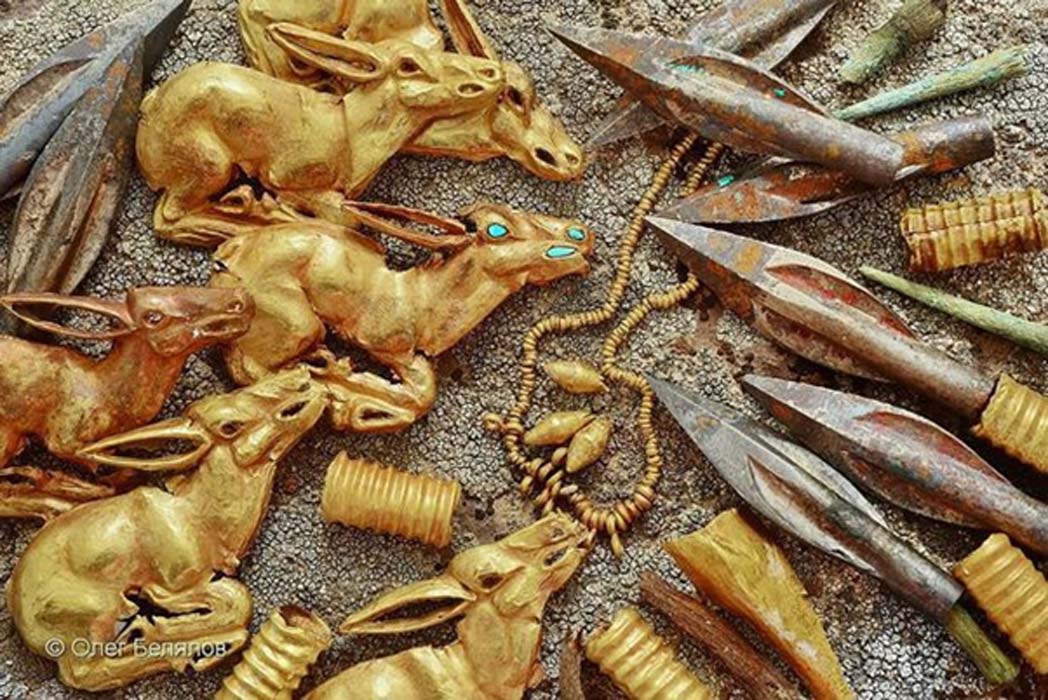
Natasha Frost writes at the History website, “Archaeologists have unearthed a cache of thousands of millennia-old pieces of gold jewelry in an ancient burial mound in Kazakhstan.

“The remote Tarbagatai mountains, where Kazakhstan meets northern China, was once home to the Saka. These expert horsemen were a nomadic people who moved across Eurasia through Iran, India and Central Asia for many hundreds of years—until they were conquered by Turkic invaders in the 4th century A.D. It’s believed these glittering objects may have belonged to members of their elite.

“Though many mysteries remain about the Saka people, their skill with metal is well documented. Among the finds are intricate earrings shaped like little bells, a necklace studded with precious stones, and piles of chains and gold plates. Tiny animals have been expertly wrought out of gold. The items show evidence of micro-soldering, a highly sophisticated technique for artifacts estimated to be as much as 2,800 years old. …

“Some 200 other burial mounds have [been] found on the fertile Kazakh plateau, which was regarded as a paradise by Saka kings. Few have been found with quite so much treasure, however, since widespread looting during the time of Peter the Great depleted many of the burial sites of their riches. Experts say that the area has become a focus for archaeologists, who hope to find other precious objects in other sites. …

“Local politicians are celebrating the discovery, which they say helps to inform them about their ancestors. ‘This find gives us a completely different view of the history of our people,’ former Prime Minister Danial Akhmetov said, in an interview with Kitco News. ‘We are the heirs of great people and great technologies.’ ”

More here.

Read Full Post »

Photo: Rachel Sussman
Rachel Sussman’s “Study for Sidewalk Kintsukuroi #02 (MASS MoCA),” photograph with enamel paint and metallic dust.

What a lovely art idea! Mending cracks with gold resonates with me on so many different levels. You start with sidewalks and then …

Allison Meier writes at Hyperallergic, “Artist Rachel Sussman had traveled for years photographing the most ancient organisms on Earth when a photograph on social media of a shattered bowl reassembled with gold introduced her to the tradition of kintsukuroi, also called kintsugi. In this Japanese practice, broken pottery is repaired with gold dust and glue. …

“This sense of time and its visibly healed scars, and the beauty of imperfections, helped inspire her current Sidewalk Kintsukuroi series, of which the newest edition is in ‘Alchemy: Transformations in Gold,’ currently at the Des Moines Art Center in Iowa. As part of the exhibition, which considers the cultural and historical connotations of gold, Sussman repaired a fissure in the museum’s marble floor, an embedded installation now in their permanent collection.

“ ‘We’re not talking the millions of years it took for the Grand Canyon to form, but by noticing the crack in the marble floor of the Des Moines Art Center that formed over the course of several decades, it serves as a reminder that natural processes are happening all around us, but at a pace that is far too slow for us to observe with the naked eye,’ Sussman explained.

“The Alchemy exhibition includes images of her Sidewalk Kintsukuroi gold dust alterations on photographs of cracks on the streets of Soho and Williamsburg in New York City. Each patching, whether a physical surface or photograph, can take weeks of physically straining work. …

“ ‘Over time, even the repairs will be destroyed,’ Sussman stated. … “Such is the transient nature of everything in the universe. All the more reason to value the time we have.”

” ‘Alchemy: Transformations in Gold’ continues at the Des Moines Art Center (4700 Grand Avenue, Des Moines, Iowa) through May 5.”

Love this concept! Let’s mend everything in ways that go beyond the need.

More at Hyperallergic, here.

Hat tip: Gwarlingo on twitter.

Read Full Post »

I recently saw a National Geographic special about money and the central bank. The documentary took viewers into the vault at the NY Fed, where gold bars are stored. Although the security is really tight, anyone may sign up for a tour there. The film also went to places where cameras are usually not allowed, like the National Bureau of Engraving and Printing, which prints dollar bills.

It also went to offices deep underground in the gold and diamond district of New York City. I thought Suzanne would be interested to see the broker who buys gold. Being in the jewelry business with Luna & Stella, she naturally is aware that gold has been expensive since the economic downturn. The film showed the multilingual broker buying small bags of gold objects, which were then shown being melted down and made into a gold bar.

National Geographic has also blogged about the movie: “What Jake Ward of Popular Science magazine discovers in this one hour special is that without the engines that power the world’s financial systems, that world would grind to a halt.

America’s Money Vault follows 55 million dollars worth of gold as it makes its way down into the most valuable gold vault in the world. Hidden deep under the streets of New York City, hundreds of billion dollars in gold bars  …

“Jake goes behind the storefronts to see how everybody from the street level to the brokers make their money buying, selling and even finding gold. He meets Onikwa Thomas who calls himself the urban miner and claims to earn up to four hundred dollars a week off of gold specks found in the cracks of sidewalks.”  More from the documentary.

P.S. Speaking of Luna & Stella, Suzanne’s birthstone jewelry company, gold vermeil angel wings can make a lovely gift for the right person.

Photograph: National Geographic

Read Full Post »