Feeds:
Posts
Comments

Posts Tagged ‘Gothenburg’

Photo: Boston Globe.
A headline in the Boston Globe from 1924.

I didn’t get to post this story about a charitable Gothenburg-born Boston immigrant last year, but I think you’ll agree that it’s a bit of Christmas history that will always be fresh.

Jenny Ashcroft wrote about it at Fishwrap, the official blog of Newspapers.com.

“On Christmas Day in 1921, a Swedish immigrant quietly wheeled his hot dog stand to a street corner in Boston’s North End and distributed 500 free hot dogs to hungry children. Axel Bjorklund was no stranger to poverty. He barely made ends meet himself, but he wanted to give back. His cart was soon swamped with hundreds of shivering children wearing tattered clothing that did little to stave off the cold. Their hungry faces beamed when Axel handed them a steaming hot dog. Eventually, the food was gone, but Axel’s determination to repeat the event wasn’t. The Hot Dog Santa tradition was born. Over the next eight years, Axel gave away some 10,000 hot dogs before he died in 1930.

“Born in Gothenburg, Sweden, on August 6, 1869, Axel Bjorklund emigrated to America in 1889, eventually settling in Boston’s North End neighborhood. The area had become a melting pot of immigrants, most of whom were impoverished as they struggled to establish lives in a new country. The Spanish Flu Pandemic hit the North End particularly hard, leaving families even more destitute and many children orphaned.

“The first Christmas hot dog giveaway in 1921 was so successful that Axel decided to expand in 1922 and doubled the number of hot dogs to 1,000. His hot dog giveaway grew with each year until he distributed 3,000 annually. The children loved Axel and nicknamed him ‘Hot Dog Santa.’ …

“Axel’s annual Christmas Day hot dog giveaway eventually moved to New Year’s Day, but it was an event the children anticipated all year. As Axel’s generosity expanded, so did his health challenges. He was plagued with rheumatism, which led to frequent hospitalizations. His finances struggled, too, and he could no longer pay his rent. Not wanting to end the hot dog giveaway, he appealed to the public to help him continue the tradition.

“In December 1928, just before the annual hot dog giveaway, Axel’s landlady kicked him out because he hadn’t paid rent. The Salvation Army stepped in to help, but Axel was broke. The next two years saw Axel skipping between the poor house, the Cambridge Home for the Aged, or obtaining temporary lodging from generous benefactors. Despite his circumstances, in 1929, he participated in his final hot dog giveaway.

“On November 10, 1930, Axel Bjorklund passed away, penniless and alone at a Massachusetts hospital. He had no relatives and was set to be buried in a potter’s field when newspapers published word of his death. Citizens stepped forward, offering to contribute to a fund to give Axel a proper burial. The Swedish Charitable Society coordinated, and Axel was laid to rest in the Cambridge Cemetery.

“If you would like to learn more about the Hot Dog Santa or discover other heartwarming Christmas stories, search Newspapers.com.”

It hurts to think that today there are still plenty of shivering, hungry American children who could use this 1920s Good King Wenceslas.
Read Full Post »

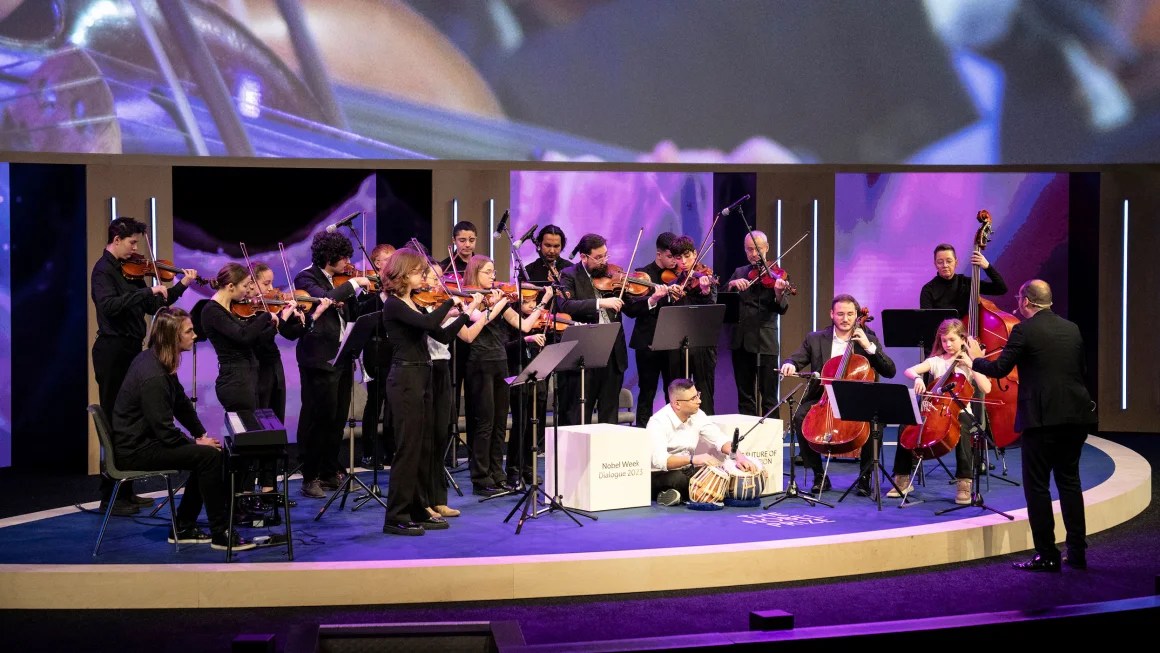
Photo: Anna Svanberg/Nobel Prize Outreach.
The Dream Orchestra started with just 13 members. Now there are more than 400, including this group performing at a Nobel Foundation event in Gothenburg, Sweden, in December 2023. 

Sweden has long been a country that took in refugees, but what I know from family members there is that Sweden doesn’t always do a good job helping immigrants integrate and feel at home. That’s why the orchestra leader in today’s story stands out.

As Mostafa Kazemi, originally from Afghanistan, recalls, the conductor told him that of course he could play an instrument even though he thought he couldn’t. “He’d been in Sweden for a matter of months,” Catherine E. Shoichet at CNN reports. “No one had talked to him like this before.”

The long and interesting article about the Dream Orchestra begins, “Ron Davis Álvarez stood on a train platform in Stockholm, stunned by what he saw. The Venezuelan orchestra conductor was visiting Sweden as part of a university exchange program. … He watched throngs of people getting off trains, their faces drawn and exhausted. Volunteers raced past him to hand out bananas and water to the new arrivals.

“ ‘I was completely in shock, seeing all of these young boys arriving,’ Álvarez recalls. He asked someone what was going on.

“The answer: ‘They are from Syria and Afghanistan. Many of them are unaccompanied. They traveled here alone.’

“ ‘What will happen to them?’ Álvarez asked. No one knew. …

“Álvarez was there watching, and he had an idea. That idea would change his life, and the lives of hundreds of others he hadn’t met yet. …

“It wasn’t long before Álvarez was back in Sweden. He’d been tapped as the artistic director of El Sistema Sweden, based in the coastal city of Gothenburg. … As he began his new role, the memory of what he’d seen months earlier on the train platform remained seared in his mind.

“El Sistema Sweden’s work was focused on younger children enrolled in Swedish schools. The youth he’d seen pouring into the train station were already in their later teenage years. It’s an age when many might assume it’s too late to learn an instrument.

“Álvarez knew it wasn’t. And he knew he had to try to help them. … With a handful of instruments on loan, he visited schools to drum up interest. Eventually, he recruited a group of 13 youth from Afghanistan, Syria, Eritrea and Albania. He dubbed them the Dream Orchestra.

“ ‘I remember coming into the room and there were a lot of girls and boys, and I was nervous,’ Álvarez says in a short film about the orchestra featured on its website. … Many of the Dream Orchestra’s members had never played an instrument before they joined. They came from different countries. They didn’t speak the same languages. …

“Mostafa Kazemi lights up when he recalls the day he met Álvarez in 2016.

“ ‘Which instrument do you play?’ the conductor asked him.

“ ‘I can’t play,’ Kazemi replied.

“Álvarez’s response was confident and unflinching: ‘Yes, you can. Come and pick which one you want.’

“Kazemi, originally from Afghanistan, was 16 years old at the time. He’d been in Sweden for a matter of months. No one had talked to him like this before. So a few weeks after the Dream Orchestra began, Kazemi became one of its first members. He picked the cello. …

“The small ensemble rehearsed on Fridays and Saturdays. Those were Álvarez’s days off, and also a time when he knew it was important to keep young people occupied and off the streets.

“At first, teaching the group wasn’t easy, Álvarez recalls. He was used to instructing younger Spanish-speaking students who came from similar backgrounds. This would require a different approach.

“Álvarez spoke English, and some of the other members of the Dream Orchestra did, too. But still, misunderstandings were frequent, even comical at times. Body language was key to overcoming those obstacles. So was finding a way to connect more deeply with each person – to learn what music they liked and where they came from and who they were.

“Another key part of Álvarez’s approach with these older students: giving them the confidence to make mistakes.

“I tried to build confidence – first the confidence of the sound.’ …

“ ‘Ron was full of energy all the time,’ Kazemi says. ‘And that made us want to do more and more and more. We were practicing at home. I even brought some more students. I told my friends. … And everyone told their friends, and everyone came to orchestra.’ …

“Now, eight years later, the Dream Orchestra has more than 400 members from nearly 20 countries who speak around 20 languages between them. …

“As [Álvarez] sees it, politicians and world leaders could learn a lot from this music ensemble.

“ ‘I see the orchestra like society,’ he says. ‘When you are in an orchestra, you need to learn how to hear each other, how to listen to each other, compassion, how to empathize.’

“That’s not to say there haven’t been challenges over the years. Some students at first struggled with taking direction from female conductors and teachers, Álvarez says, and tensions have boiled over at times between members of the orchestra whose home countries have a history of conflict with each other.

“Some conductors might direct their orchestras simply to play on and ignore these difficulties. Álvarez says he addresses them directly. He wants the orchestra not only to be a safe space, but a place where its members can grow and learn to live together.

“ ‘We are all people that need to respect each other. It’s difficult because you cannot erase this history, but you can rewrite the future,’ he says.”

More at CNN, here. No firewall.

Read Full Post »

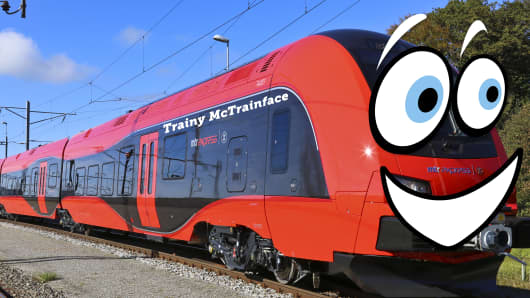
Artist's impression of the MTR Express' newly unveiled Trainy McTrainface

Photo: MTR Express
Artist’s impression of a Swedish rail company’s newly unveiled Trainy McTrainface.

Heraclitus said you cannot step in the same river twice. (It is never the same river; the water is always new.) But as if they actually could keep stepping in the same river, human beings keep trying to replicate whatever was once popular.

It was kooky enough to try naming a boat Boaty McBoatface, now the popularity of that name is supposed to give a boost to a similarly named train.

Alex Hern writes at the Guardian, “It’s happened again. A public vote to name four trains running between the Swedish cities of Stockholm and Gothenburg has resulted in one of the four being called Trainy McTrainface in an echo of the name chosen by the British public for the new polar research vessel.

“Trainy McTrainface received 49% of the votes in a poll, jointly run by Swedish rail company MTR Express and Swedish newspaper Metro. …

“The other trains have already been named by the public: one is named Estelle, after the five-year-old daughter of Sweden’s Princess Victoria, the next in line to the Swedish throne.

“Another is named Glenn, after a long-running joke that everyone in Gothenburg is called Glenn.

“The joke has a basis in fact: the name is particularly common in the city and its surrounding area, with its popularity stemming from the 1980s, when local football team IFK Göteborg had four players all called Glenn in its lineup. Forty-three per cent of voters supported the name Glenn. …

“The public vote was eventually overruled in the case of Boaty McBoatface and the ship named the RRS Sir David Attenborough, with an onboard submersible receiving the Boatface appellation.

“MTR Express said the McBoatface decision had led to disappointment worldwide and it hoped the name Trainy McTrainface would ‘be received with joy by many, not only in Sweden.’ ” More at the Guardian, here.

Even if you believe in the wisdom of crowds, using a crowd to name a product rarely results in an inspired selection. I remember how disgusted Ursula’s mother was after a food company to which she had submitted creative names for a new margarine made the boring choice of Blue Bonnet.

Read Full Post »

Most of my family (other than me) does a lot of biking. John, for example, biked from Arlington, Mass., to Syracuse, N.Y., last week just because he felt like it. It took several days.

My husband bikes most weekends in good weather. And he reads a biking magazine where he saw a story he thought would interest my Swedish readers.

Writes April Streeter at Treehugger (reprinted by the biking magazine), “If you want to find an unassuming place where bicycling is a way of life and nobody makes a big deal about it, head south. The south of Sweden, that is, where the small university town of Lund has a big bicycle habit. They just don’t advertise it.

“In Lund, 60% of the populace bikes or takes public transport to go about their daily tasks. And then there’s Malmö, Sweden’s third largest city — only 20 miles southwest of Lund. Malmö also doesn’t have a reputation for fantastic biking. But some [Swedes] say it is the country’s best biking city — ahead of both Stockholm, the capital; Gothenburg, the second largest Swedish metropolitan area, and a host of smaller bike-friendly burgs.

“Just across the Øresund sound from Copenhagen, Malmö has always lived a bit in the shadow of the Danish capital. But in the last few years it has done a lot to take a place among the great biking cities of Northern Europe, mostly by its investment in infrastructure and pure commitment to get people on their bikes. That has paid off — cycling has increased 30% each year for the last four years, while car trips under five kilometers have dropped.

“Now Malmö is upping the stakes by putting up 30 million Swedish crowns (about US$4.1 million) toward the building of a four-lane super cycling highway between it and its bike-happy northern neighbor city Lund.” See the article here.

Here is a slide show on Lund, at the NY Times.

Ramboll/Screen capture

Read Full Post »