Feeds:
Posts
Comments

Posts Tagged ‘Harlem Renaissance’

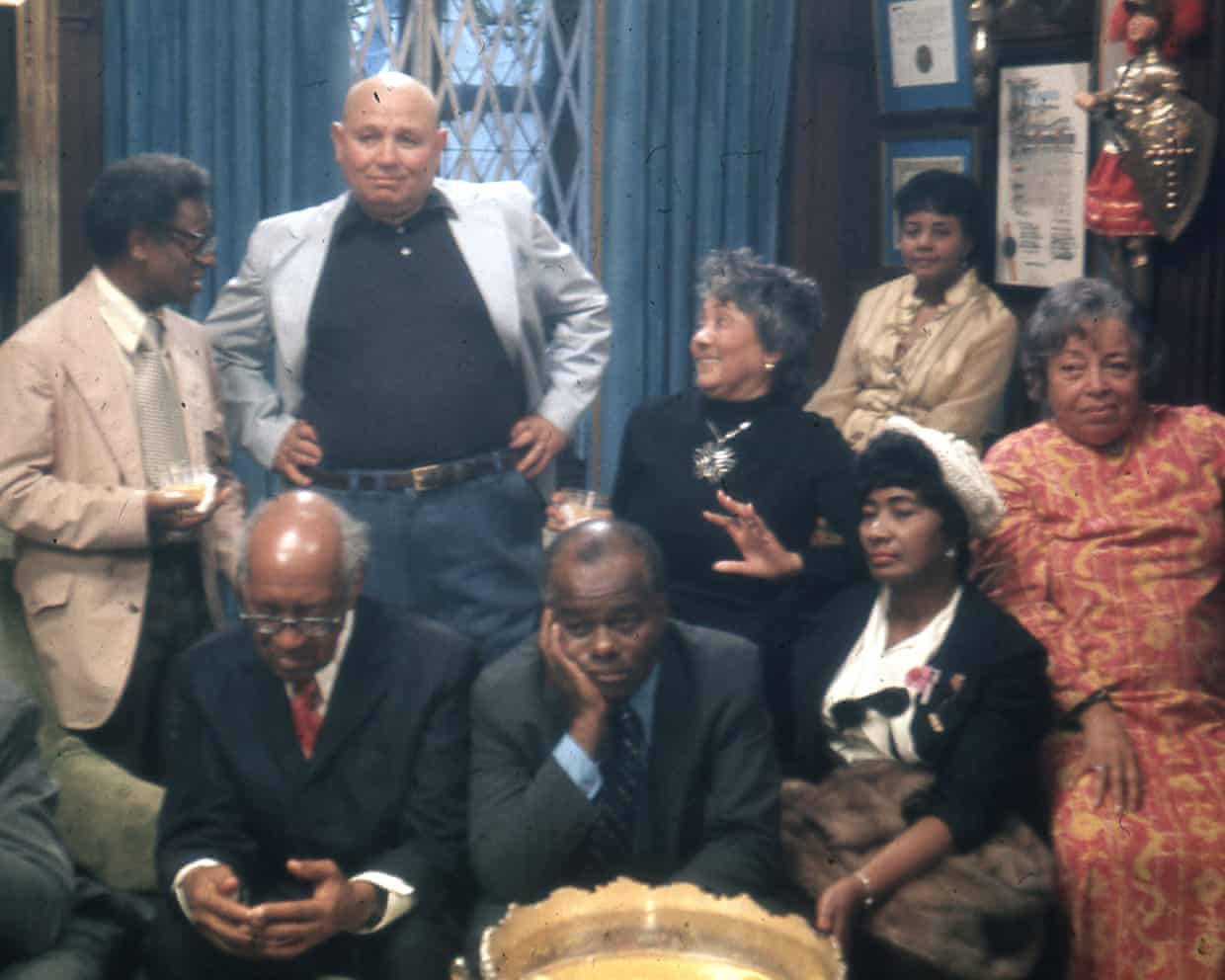
Photo: William Greaves Productions.
The film Once Upon a Time in Harlem centers on a cocktail party William Greaves hosted in August 1972 with men snd women of the Harlem Renaissance who were still living. 

Many Americans know of the Harlem Renaissance as the flourishing of African American arts and culture in New York in the 1920s and 1930s. But a documentary about it was filmed mostly in the 1970s when William Greaves rounded up the remaining members of the movement and had a party.

Nadia Khomami explained recently at the Guardian, “In 1969, the pioneering documentarian William Greaves wrote of his fury over the racially degrading stereotypes that white film producers threw up on American screens. …

“Three years later, Greaves began work on what he considered the most important footage he ever shot: a feature documentary gathering surviving figures of the Harlem Renaissance to reflect on the movement they had built half a century earlier.

“Now, more than 50 years after cameras rolled, Once Upon a Time in Harlem is finally receiving its international premiere in Cannes’ Directors’ Fortnight – completed not by William Greaves, who died in 2014, but by his son David and granddaughter Liani.

“The documentary centers on a cocktail party Greaves hosted at Duke Ellington’s townhouse in Harlem in August 1972 – an attempt to capture the voices of artists, writers, musicians and organisers whose work had transformed Black American culture in the 1920s, but whose stories were already at risk of being sidelined.

“Greaves invited every surviving participant he could locate. Many had not seen one another for decades. They included the painter Aaron Douglas; the queer artist and writer Richard Bruce Nugent; the poet Arna Bontemps; the musicians Eubie Blake and Noble Sissle; the photographer James Van Der Zee; and Ida Mae Cullen, the widow of Countee Cullen.

“For four hours, Greaves filmed them as they laughed, reminisced and debated. The resulting film follows the rhythm of the party itself: tentative greetings and warm memories gradually giving way to animated debates over politics, language and legacy.

“David Greaves, who was there in 1972 aged 22, worked on the shoot as a cameraman under his father. …

“Duke Ellington himself was unwell and did not attend, but his sister Ruth was present. ‘There were four cameras, two crews circulating through the apartment catching conversations, these little moments between them,’ David said. ‘Mostly my father just let them freestyle, it was very fluid.’

“Among the film’s strengths is precisely that looseness. At one point, guests debate whether the term ‘Negro’ should be discarded in favor of ‘Afro-American.’ Elsewhere, they discuss Marcus Garvey and Langston Hughes and the global reverberations of anti-colonial struggle. Aaron Douglas reflects on jazz, telling the room: ‘It would be considered a revolution in relation to other music. It was not a revolution to us.’

“For David Greaves, those conversations feel strikingly current. ‘When they talk about whether to call themselves Black or Negro, that’s a discussion still happening now – you’ve got Black, African American, people of color. And then there is still this question of what the diaspora should do in relation to Africa.’ …

“The film also reminds viewers how recent America’s racial violence remains. David points to footage accompanying the anti-lynching poem ‘The Lynching,’ ending on a young white girl watching with what he calls ‘fiendish glee. … The US is not that far away from that time.’ …

“For him, the film arrives as Black history is once again being fought over in the US. … ‘They’ve been doing everything they can to erase the Black experience in America, even removing signage from park service sites. What this film does is show a group of wonderful people sitting around talking about a time 50 years ago, and about their own present. These giant intellectuals that the media didn’t even realize existed.’ …

“After William’s death, the material passed to his widow Louise, who continued working on it until her own death in 2023. David and Liani then took over, restoring and digitizing 60,000 feet of 16mm film. …

“When shaping the final cut, he followed one of his father’s principles: ‘My dad used to say if there’s something that affects you viscerally, go with it.’ …

“David, who has spent the past three decades publishing Our Time Press, a Brooklyn community newspaper focused on Black civic and cultural life, with his wife, Bernice Green, said he hoped to release the film in time for Greaves’ centenary in October, with retrospectives planned in New York and at the Barbican in London.

“ ‘My dad was appreciated by those who knew documentary film, but he didn’t have the acclaim that he has now,’ he said. ‘This film should cement him as a chronicler of the history of African Americans.’ ”

More at the Guardian, here.
Read Full Post »

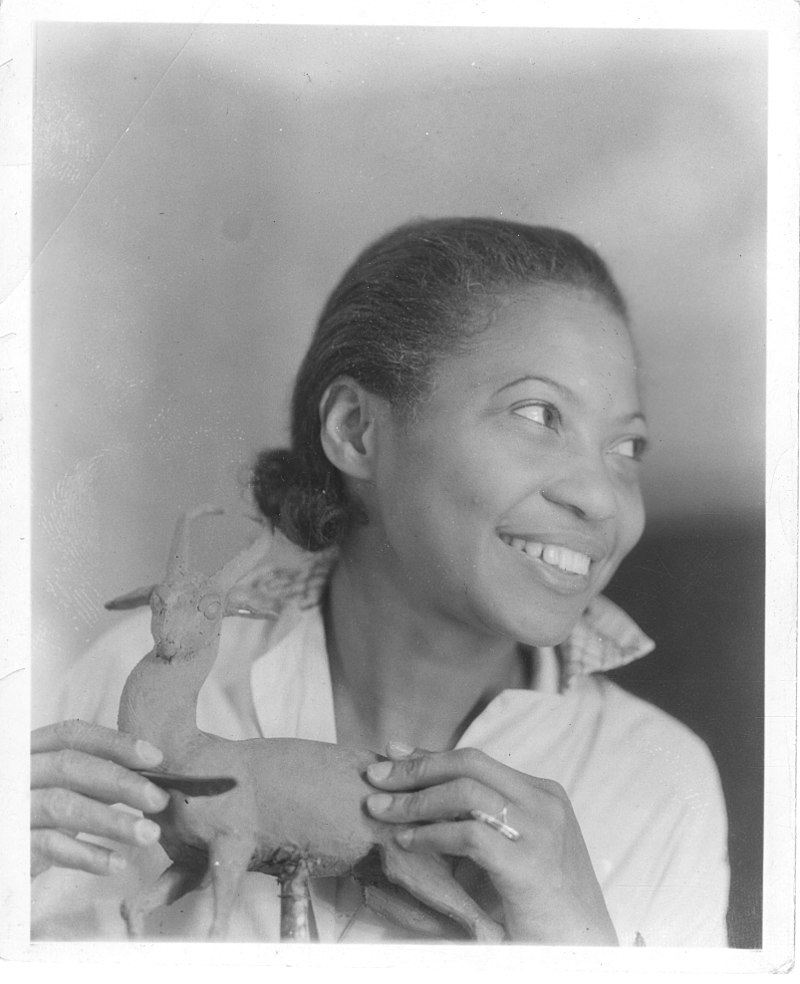
800px-Augusta_Savage2C_H-HNE-20-87Augusta Savage, 1892-1962, American sculptor, an important figure in the Harlem Renaissance.
Last night I watched a fascinating documentary about a glamorous movie star who would have preferred to be recognized as the brilliant inventor that she actually was: Bombshell: The Hedy Lamarr Story. And I realized that lately I seem to be learning about many women whose achievements failed to garner the fame of their male contemporaries.

No time like the present to start honoring them. Here is the story of an African-American sculptor of the Harlem Renaissance.

Wikipedia has a good entry. “Augusta Christine Fells was born in Green Cove Springs (near Jacksonville), Florida on February 29, 1892, to Edward Fells, a Methodist minister, and Cornelia Murphy. Augusta began making figures as a child, mostly small animals out of the natural red clay of her hometown, Green Cove Springs Florida.

“Her father was a poor Methodist minister who strongly opposed his daughter’s early interest in art. ‘My father kicked me four or five times a week,’ Savage once recalled. … She persevered, and the principal of her new high school in West Palm Beach, where her family relocated in 1915, encouraged her talent and allowed her to teach a clay modeling class. This began a lifelong commitment to teaching as well as to creating art.

“In 1907 Augusta Fells married John T. Moore. Her only child, Irene Connie Moore, was born the following year. John died shortly thereafter. In 1915, she married James Savage; she kept the name of Savage throughout her life. …

“In 1919 [she] was granted a booth at the Palm Beach County Fair where she was awarded a $25 prize and ribbon for most original exhibit. Following this success, she sought commissions for work in Jacksonville, Florida, before departing for New York City in 1921. She arrived with a letter of recommendation from the Palm Beach County Fair official George Graham Currie for sculptor Solon Borglum and $4.60. Borglum declined to take her as a student, but encouraged her to apply to Cooper Union in New York City where she was admitted in October 1921.

“She was selected before 142 other men on the waiting list. Her talent and ability so impressed the Cooper Union Advisory Council that she was awarded additional funds for room and board when she lost the financial support of her job as an apartment caretaker. …

“In 1923 Savage applied for a Summer art program sponsored by the French government; although being more than qualified, she was turned down by the international judging committee solely because she was a black person. … The incident got press coverage on both sides of the Atlantic, and eventually, the sole supportive committee member sculptor Hermon Atkins MacNeil – who at one time had shared a studio with Henry Ossawa Tanner – invited her to study with him. She later cited him as one of her teachers.

“After completing studies at Cooper Union, Savage worked in Manhattan steam laundries to support herself and her family. … During this time she obtained her first commission for a bust of W. E. B. Du Bois for the Harlem Library. Her outstanding sculpture brought more commissions, including one for a bust of Marcus Garvey. Her bust of William Pickens Sr., a key figure in the NAACP, earned praise for depicting an African American in a more humane, neutral way as opposed to stereotypes of the time. …

“Knowledge of Savage’s talent and struggles became widespread in the African-American community; fundraising parties were held in Harlem and Greenwich Village, and African-American women’s groups and teachers from Florida A&M all sent her money for studies abroad. …

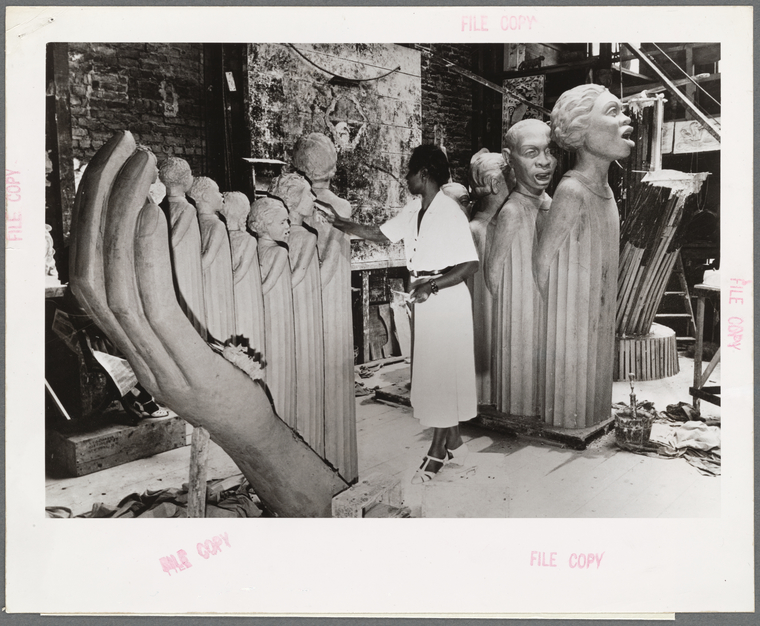
“Savage received a commission from the 1939 New York World’s Fair; she created Lift Every Voice and Sing (also known as ‘The Harp’), inspired by the song by James Weldon and Rosamond Johnson. The 16-foot-tall plaster sculpture was the most popular and most photographed work at the fair; small metal souvenir copies were sold, and many postcards of the piece were purchased. … Savage did not have funds to have it cast in bronze or to move and store it. Like other temporary installations, the sculpture was destroyed at the close of the fair. …

“In 1945 Savage moved to Saugerties, New York. … While she was all but forgotten at the time of her death, Savage is remembered today as a great artist, activist, and arts educator; serving as an inspiration to the many that she taught, helped, and encouraged.”

More at Wikipedia, here. I love all the random details at Wikipedia — like her cultivating a garden at her Saugerties home and selling pigeons, chickens and eggs. Check it out.

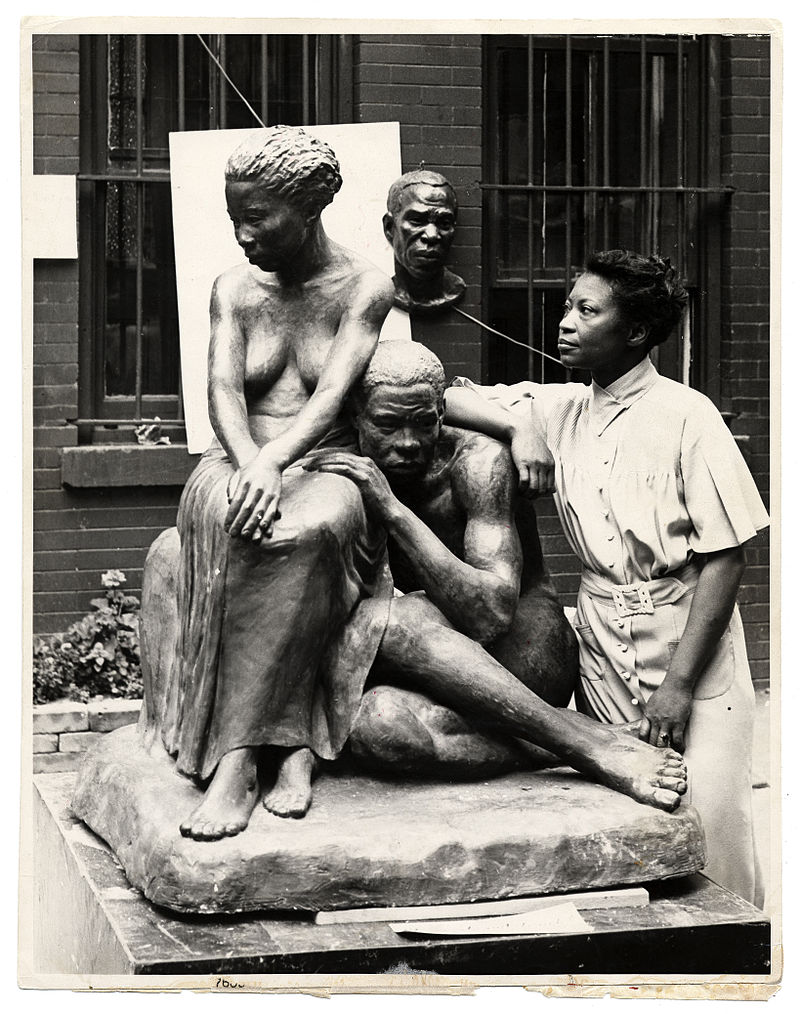
Photo: Andrew Herman
Augusta Savage posing with her sculpture
Realization, 1938, created as part of the Works Progress Administration’s Federal Art Project.

800px-archives_of_american_art_-_augusta_savage_-_2371

Read Full Post »

Candice Frederick, of the New York Public Library’s Schomburg Center for Research in Black Culture, recently posted research by Katherine Ellington on an African American artist who was new to me.

From Ellington notes: “Augusta Savage was among [a] group of artists who came to Harlem from the Jim Crown South in search of opportunity and where her creative expression could thrive.

“My quest for Augusta Savage (1892 –1962) sculpture led me to a first-time visit to the Art and Artifacts Division of the Schomburg Center for Research in Black Culture. … As a young girl in the early twentieth century, Savage began shaping ducks out of red clay found in the backyard of her home in Green Cove Springs, Florida. Savage’s work gained local attention when she entered and won a prize at a local county fair, which led to community support for further study.

“In 1921, she moved to Harlem after studying at State Normal College for Colored Students (now Florida A & M University). Savage later completed a four-year program in sculpture in three years at Cooper Union. …

“In 1931, Savage … opened the Savage Studio of Arts and Crafts — a fine arts training ground for over 1,500 students including many well-known Harlem Renaissance artists such as Charles Alston, Ernest Crichlow, Norman Lewis, Morgan Smith and Marvin Smith, Jacob Lawrence and Gwendolyn Knight Lawrence. …

“In 1934, Savage became the director of the newly established Harlem Community Art Center, after she was commissioned by the 1939 World’s Fair. Around that time she created “The Harp” as a series, but it was destroyed during the cleanup after the fair. …

“Savage’s art was often in response to the fight against racism. She used a variety of methods, shaping clay and plaster, casting bronze, and later years, carving marble and wood. In the Augusta Savage collection, there are works that illustrate themes such as nineteenth-century romanticism and African and Greek culture. As a trained portraitist, her busts include Marcus Garvey, W.E.B. Du Bois, James Weldon Johnson and Gwendolyn Bennett.”

More here.

Photo: The New York Public Library. Image ID: 1654255
“Harp,” by Augusta Savage

Read Full Post »