Feeds:
Posts
Comments

Posts Tagged ‘helsinki’

Photo: Oodihelsinki.
Veera the robot on patrol at $116 million Oodi library in Helsinki, Finland. Last year, the average Finn visited libraries nine times and borrowed 15 books.
Finns really love libraries.

Whenever I write about libraries, I think of blogger Laurie and the young adult fantasy series she wrote called the Great Library Series. Laurie is someone who appreciates the power of books, the magical power of reading.

Apparently the Finns do, too.

Oliver Moody reports at the Times [of London], “In the €100 million [~$115 million] Oodi library, which looms over central Helsinki like a cruise ship from the future, robots called Tatu, Patu and Veera trundle back and forth between the shelves and the reading rooms.

“Against this backdrop, foreign visitors might be surprised to see how many children and teenagers are engaged in an almost unsettlingly archaic activity: reading and borrowing books. …

“Last year the average Finn visited them nine times and borrowed 15 books, resulting in the highest lending figures for 20 years.

“The appetite for children’s and young adults’ literature has risen to a record for the third year in a row, with a total of 38 million loans in 2024. That works out at about 40 books or other pieces of material, such as audiobooks, for each person under the age of 18. …

“Even by the standards of a country that is often ranked as the most literate on the planet, the numbers are remarkable. In Britain, the total number of loans has fallen to less than half of what it was at the turn of the millennium, despite a tentative recovery in the wake of the pandemic, and about 40 libraries a year are closing.

“Visits to German public libraries are still about a fifth lower than they were before the advent of Covid-19 and about one in five of them has shut down over the past decade.

“The most obvious explanation for the phenomenon is that Finland values its libraries and invests accordingly. The state spends about €60 [~$70] per capita on the public library system each year, approximately four times as much as the UK and six times as much as Germany.

“Where other countries rely on corporate skyscrapers or shopping centers for their visions of architectural modernity, Finland often looks to its libraries, such as Oodi and Vallila in Helsinki, the main Metso library in Tampere, or the revered 20th-century designer Alvar Aalto’s projects in Rovaniemi and Seinajoki.

“They have traditionally served as engines of social mobility and integration. Erkki Sevanen, professor of literature at the University of Eastern Finland, grew up in a working-class family in Eura, a thinly populated district of villages 110 miles to the northwest of Helsinki.

“ ‘My parents and relatives did not used to read books, but there was a fine and well-equipped public library in our home village,’ he said. ‘It opened a whole world of classical literature and philosophy for me in the 1960s and 1970s.’

“Sevanen said the public libraries were a significant part of the reason he had ultimately pursued a university career, and that today they perform a similar function for immigrants to Finland. …

“The roots of this culture predate Finland’s independence in 1918. Like large parts of Scandinavia and continental northern Europe, it was profoundly influenced by Lutheran Protestantism and its insistence that each individual should engage with the texts of scripture for themselves.

“ ‘The ability to read was a requirement for everyone who wanted to get married. To demonstrate their reading skills, people were tested at church gatherings,’ said Ulla Richardson, professor of technology-enhanced language learning at the University of Jyvaskyla.

“The movement gathered steam in the 19th century, when Finland was a semi-autonomous duchy in the Russian empire and the new public libraries were focal points for an emerging sense of national identity.

“They remain important hubs for Finnish society, providing a space in which people can be alone and together at the same time. ‘Many Finns tend to consider libraries almost as sanctuaries,’ Richardson said.

“Alongside computers and internet access, they offer board games, video games, musical instruments, sewing machines, seasonal theatre passes and even sports equipment in some cases. These services are particularly valued by families with straitened financial means, who might not otherwise be able to afford school textbooks or other media.

“ ‘The libraries are spaces that children and teens can access freely, especially if they don’t have other places to go,’ said Richardson. ‘These days we also have self-service libraries open when there are no personnel working.’ ” More at the Times, here.

The point about libraries helping immigrants acclimate reminds me that when I was still volunteering onsite instead of online (before Covid), we would take classes of immigrants to the nearest public library in Providence and explain how to get a library card.
Read Full Post »

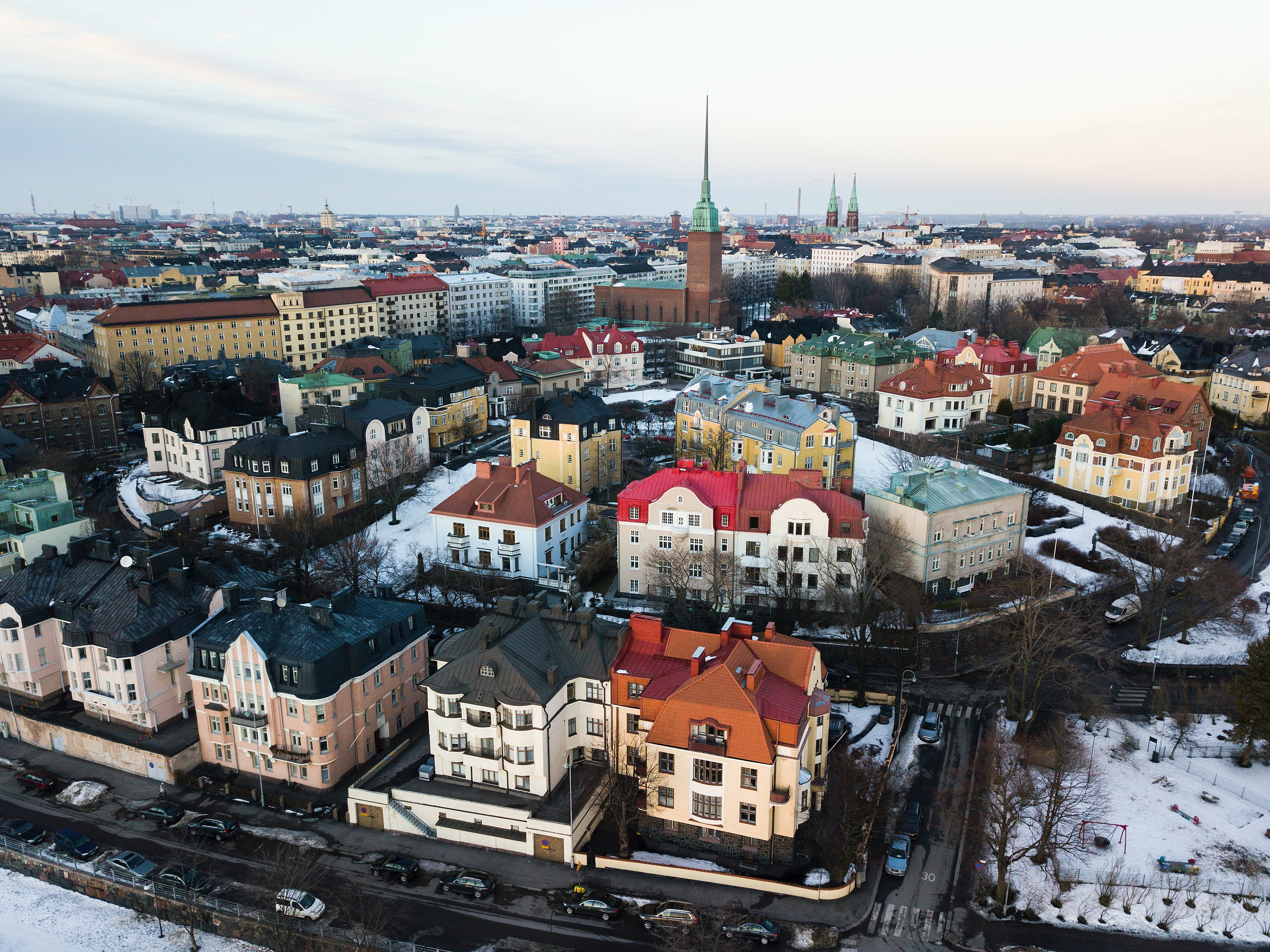
Photo: Julius Jansson via Unsplash.
Aerial view of the centre of Helsinki, which is still a low-rise city.

I like learning how different countries make their cities more livable. Finland is known for being a trendsetter in many areas, including funny contests, housing, education, eldercare, basic income — and urban living.

Gillian Darley at Apollo magazine wrote recently about design in Finland.

“The Helsinki skyline is startlingly low for a capital city, its further horizons determined by water and scattered wooded islands. In the centre, urban civility and a clear-headed planning regime have established a height limit of around eight stories, punctuated by occasional eminences. The standout is the heroic central station, designed in the early 1900s by Eliel Saarinen. …

“Otherwise, only a few spires and the lofty white Lutheran cathedral, the jazz-style tower of the Hotel Torni and pencil-thin chimneys from redundant power stations cut into the ordained pattern. One of the power stations, Hanasaari, which closed down this March, is currently preoccupying the city authorities. They have turned to Buro Happold for advice, in the hope that the firm’s experience with Battersea Power Station may help rescue the 1970s brick shell.

“A little further east, overlooking the harbor, a gaggle of multi-story blocks has recently loomed – as if testing the water. Otherwise, only a few spires and the lofty white Lutheran cathedral, the jazz-style tower of the Hotel Torni and pencil-thin chimneys from redundant power stations cut into the ordained pattern. …

“Another factor is starting to determine the physiognomy of the city centre: some of it is, and more will be, sited below ground. There is no single clear reason for this, though factors include the exigent climate, respect for that polite skyline, and the key part that open space plays as amenity, in the city as in the overwhelmingly forested country.

“The use of subterranean space and the creation of a new realm overhead are becoming a speciality of Helsinki-based architectural practice JKMM. The Amos Rex art museum (named for the Finnish publisher and patron Amos Anderson) sits beneath a swooping pedestrian square – formerly a bus terminal, now an unorthodox playground of sculptural skylights and domes at the foot of a cheerful art-deco clock tower.

“The galleries below are reached via the handsome glazed entrance of the Lasipalatsi (‘Glass Palace’), part of a restored modernist complex together with the Bio Rex cinema (1936) next door. Elegant stairs sweep into a lobby and the sequence of soaring new galleries. …

“[Another] subterranean structure is due to open in 2027: this is an ambitious underground annex for the National Museum of Finland in central Helsinki. The spectacular new space is flagged by a circular cantilevered entrance, a concrete vortex from which visitors will descend on a series of stairs to the galleries and facilities below. Above, a public garden will be open all year round.

“For decades, visitors to Finland had been drawn by Alvar Aalto’s questing version of modernism, seen as closely aligned with Nordic social democratic aspirations and sustained by a tight group of followers, at home and abroad. Inevitably, his work has been challenged by the passing of time and changing usage. In Helsinki, the shrouded hunk of the white Carrara marble-clad Finlandia Hall, dating from 1971, is in the middle of a recladding expected to take five years; the crisp Academic Book Store of the 1960s – a smart street-front clad in beautifully detailed copper, with dramatic angular roof lights bursting into life within – is compromised by chipped and stained marble facings on the entry columns.

“West of central Helsinki is another post-war landmark: the ‘garden city’ of Tapiola, which has been highly influential in European town planning. It shares its roots with British first-generation New Towns and, patched and amended though it is, it still offers compelling evidence of an urbane landscape, the antithesis of the formless out-of-town development. …

“When considering a future for the best works by Aalto and his circle, there is often a clash between function and feasible preservation, but in Tapiola there is also a town of 9,000 people to consider. The building materials of the early 1950s, especially in schools and sports buildings, have not stood the test of time; the hazards of asbestos are ubiquitous. The swimming hall, already restored once, is wrapped in sheeting and plywood, its fate uncertain.

“Yet the best of the flats and housing are highly sought after: the terraced houses, with perky monopitch roofs and skinny clerestory windows on to the roadside, benefit from back gardens and immediate access to a natural landscape of rock and pinewoods.  The little cinema has been restored and is highly valued, the lake remains centre stage and expanses of open parkland stretch out on every side.

“The societal hopes that brought Tapiola into being in 1953, according to the ideas of a visionary lawyer, Heikki von Hertzen, may have faded. Established according to principles of social enterprise, Tapiola has been outstripped by Espoo, the municipality of which it is a part, and which is a product of modern broad-brush urban development. But Tapiola is more than just a name in the history of town planning – it richly deserves a second look and, even, another close look at those founding principles.

More at Apollo, here. No paywall.

Read Full Post »

In Helsinki, Finland, where young people traditionally leave home at 18 but can no longer afford urban rents, Millennials are applying by the hundreds to live with the elderly.

According to Kae Lani Kennedy at Matador Network, “Retirement homes are serving as more than a community for the elderly. These facilities are providing affordable housing for the city’s growing population of homeless millennials.

“ ‘It’s almost like a dorm, but the people aren’t young. They’re old,’ explains Emil Bostrom, a participant in ‘A Home That Fits,’ a new housing project that allows millennials to move into retirement communities. Bostrom is a 24-year-old kindergarten teacher, and though he has a steady income, it is not enough to compete with 90,000 other renters in a city that has roughly 60,000 affordable rental properties. …

“Bostrom, along with many other young adults, can enjoy discounted rent in exchange for socializing with the seniors in their community. …

“By interacting with a younger generation, the elderly involved with ‘A Home That Fits’ have the opportunity to be engaged in an active and diverse community, instead of being left behind in a forgotten generation.” More here.

And check out a post I wrote about the same phenomenon in Cleveland, here. Both initiatives sound like fun to me.

Video: Seeker Stories

Read Full Post »

Bill Littlefield, at Only a Game on WBUR radio, got a lesson in the subtleties of Finnish baseball when he interviewed the Wall Street Journal’s Brian Costa recently. Costa went to Finland to report on pesäpallo, a game whose players are sometimes scouted by US baseball teams.

“Brian Costa: The biggest difference is the pitcher, instead of throwing the ball from a mound at the batter, stands beside him and throws it up in the air and sort of gets out of the way. But there are base paths, there’s four bases, there’s home plate, players field with gloves. …

“Bill Littlefield: Critics of baseball in the U.S. say the games are too long. It’s too slow. There’s not enough action. Would such critics be happier with pesäpallo?

“Brian: Oh, they would love pesäpallo. There are very, very few strikeouts, very few swings and misses, so pretty much every ball that gets pitched gets put into play. …

“Bill: What’s it like for fans attending a game of pesäpallo? And how many are there? Is this a big popular attraction?

“Brian: This is really not a city sport, so [in] Helsinki, you won’t see that much of it. But it is the sport of the Finnish countryside. You’ll have towns where the local population may be 3,000 people, and they’ll get 3,500 at a game. …

“Bill: You note that a scout from the New York Yankees was in Finland last month for All-Star weekend there. … [But] Finnish players, I gather, do not seem very interested in playing baseball as we know it?

“Brian: No they’re not. It’s very interesting. … None of them seemed to really follow Major League Baseball. The people who I asked about their impressions of it kind of smirked or winced or just said, ‘eh.’ I mean, they feel like they’ve got a better version of it.”

More here.

Video: PattijoenUrheilijat

Read Full Post »

Here’s a funny lead I got from @smallercitiesu (SmallerCitiesUnite!) on twitter today. It’s about tapping the body heat of cows in India and other poor countries to create electricity. And as you might guess, there are a couple of designing Finns behind it.

Caroline Pham writes at the magazine Good that Finnish design students Liva Kallite and Netta Korhonen created a bovine wearable that could help out some of “the approximately 1.3 billion people around the world who live without electricity. …

“Introducing the Cowolt, a two-piece ‘energy harvesting blanket’ outfitted with thermoelectric modules that essentially harness an animal’s body heat, turning it into charge for batteries. According to CityLab: ‘The difference between the creatures’ internal temperature of about 102 degrees and cooler, ambient air would then create electricity via the Seebeck effect. They estimate a vest could charge a 12-volt battery in 26 hours on the power of one robo-cow.’

“Creators Kallite and Korhonen, both students at the Aalto University School of Arts, Design, and Architecture in Helsinki, point out the deficiencies in alternate means of electricity like kerosene (inefficient, expensive, health risks), solar energy (high maintenance and high up-front costs), diesel power generators (too large scale for personal use), and micro hydro power (negative effects on natural surroundings). Essentially, these aren’t efficient options for those without electricity, and harnessing what these people might have on-hand, like farm animals, is a more realistic mode.

“Who knows whether it will actually catch on, but the hope is that Cowolt would provide enough charge to power smaller devices such as lamps, telephones, and radios, and thus provide those without stable sources of electricity with opportunities to be a little more self-sustaining in their everyday lives.” More here.


Read Full Post »

Poet friend Ronnie expressed admiration on Facebook for Colorado’s governor, who actively supports the arts, and she linked to an announcement about applying for the Governor’s 2014 arts awards.

“The 2014 Governor’s Creative Leadership Awards are now accepting nominations, through Feb. 27, 4 p.m. Formerly the Governor’s Art Awards, and given to locations or districts (Pueblo won one last year), this year it will recognize organizations and individuals who ‘demonstrated a significant commitment to Colorado’s creative landscape through civic leadership and volunteerism including advocacy, vision, collaboration or innovation.’ …

“Nominations are accepted under the following categories:

• “Arts and creative placemaking: Presented to individuals or organizations that use the arts to envision new futures through activities such as activating a public space, animating a community or sparking redevelopment.

• “Arts and community action: Presented to individuals and organizations that have demonstrated selfless service, inspired others to take action or catalyze change in their community using the arts.

• “Arts and social change: Presented to individuals or organizations that work to solve a critical social problem such as homelessness, drug prevention, abuse, poverty or racism using creativity and/or arts.”

In addition, you have until Feb. 3 to nominate Colorado’s poet laureate. More here on Colorado’s efforts.

Why don’t more states and cities promote the arts? I can think of places right now that should have their own creative arts districts. Or maybe a design district. Suzanne tells me that Helsinki, Finland, has attracted international recognition for its own design district, here. I like how they define it as a state of mind rather than by specific street boundaries:

“Design District Helsinki is a neighbourhood and a state of mind.  It is creativity, uniqueness, experiences, design and Finnish urban culture.”

Photo: Salida Creates
Downtown Salida is a Certified Colorado Creative Arts District.

Read Full Post »