Photo Gabriela Campos/The New Mexican.
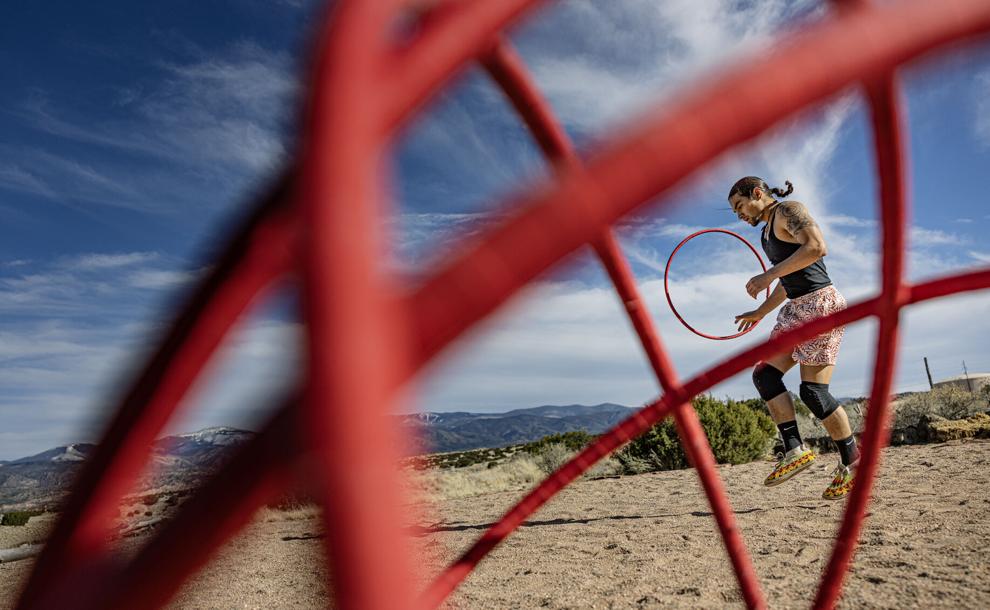
Josiah Enriquez, three-time world champion hoop dancer, dances during one of his weekly practice sessions in Pojoaque.
I heard of hoop dancing in the past but didn’t know much about it. Today’s article helps fill that gap for me. At least I now know hoop dancing is nothing like the hula hoop craze. It’s more about healing.
Cormac Dodd writes at the New Mexican, “Josiah Enriquez’s moccasins etched rapid, intricate patterns in the sand as he danced at the end of a dirt road, a portable speaker offering up powwow songs amid the juniper.
“Although he stirs crowds around the U.S. with peerless performances of contemporary hoop dancing, this rural arena has long been the spot where Enriquez, 23, toils and trains with a devotion not unlike that of a professional athlete. He is seen now as the nation’s foremost hoop dancer.
“His face revealed utter absorption on a recent day as he controlled a red hoop rapidly circling his arm.
“ ‘It’s a beautiful dance,’ he said, almost breathless after a long dance. ‘I don’t know where I would be without it.’
“Enriquez (Pojoaque and Isleta pueblos, Navajo Nation) has been distinguishing himself on what is widely considered to be the most prominent stage in competitive hoop dancing — the Heard Museum’s annual World Championship Hoop Dance Contest in Phoenix — winning his third consecutive world title in February. This marked a major career moment.
“Hoop dances have long been part of traditional Indigenous healing ceremonies, featuring quick, complex footwork as the dancer forms various shapes, many mimicking the movements of animals, using hoops. Tony White Cloud of Jemez Pueblo is credited with starting modern hoop dancing in the 1930s.
“Enriquez is the lead instructor at the local Lightning Boy Foundation in Pojoaque, a community organization that stages the Youth Hoop Dance Championship in Santa Fe and instructs about 75 students, according to its website. …
“Already considering next year’s World Championship Hoop Dance Contest, Enriquez knows he would be the first dancer to win four world championships in a row in the competition’s 36 years if he triumphs again.
“At this year’s event, he told the story of the Chicken Dance — mimicking a hunter stalking his prey as he capered in front of a crowd.
” ‘Growing up, I’ve always had the rhythm, the love for the dance,’ he said.
“ ‘In the last three years, there’s no question: He’s the best dancer,’ said George Rivera, a decorated Northern New Mexico artist, president of the Lightning Boy Foundation and former governor of Pojoaque Pueblo. ‘We’re just so proud of what he does. He’s such a good role model and he gives back to everyone.’ …
“Born and raised in Pojoaque Pueblo and a graduate of Pojoaque Valley High School, Enriquez began competing in hoop dancing events about a decade ago. It took him years, he said, to mature.
“He now speaks with a maturity beyond his years, noting he views hoop dancing as medicine for the people. He has moved people to tears. He has been told he is ‘good medicine.’ …
“A spiritual leader at the pueblo, he is also proud of the work he does as an instructor with the Lighting Boy Foundation, finding fulfillment in teaching and mentoring the next generation of dancers — aware of the positive role hoop dancing, and the dedication it requires, can play in a young person’s life. …
“Enriquez is not the only dancer associated with the organization that found success at the Heard Museum’s competition in February: Mateo Ulibarrí (Pojoaque and Santa Clara pueblos) finished first in the teen division for the fourth consecutive time, and JaiPo Harvier (Pojoaque, Santa Clara and Taos pueblos, Tohono O’odham Nation) finished second.
“Enriquez sweated through a set Thursday afternoon in the throes of a full-body dance, ending with one hand gripping a large sphere, representing Earth, shaped from the hoops. The Sangre de Cristo Mountains towered in the distance.
“He said growing up in Pojoaque Pueblo and participating in traditional dances shaped his outlook on dance, recalling how he was always told soreness after a dance means you have taken away the audience’s pain. Enriquez thinks about this in his approach to contemporary hoop dance, too.
“ ‘When you’re dancing, you pray for the people because it’s important that they feel it and it’s important that they get the life that you’re giving from your dance,’ he said.
“ ‘When you’re dancing for our feast days,’ Enriquez added, ‘they tell us if you’re sore the next day, it’s because you’re taking all the soreness from the people that can’t dance or people that are sick, you take it and you fill it. It’s a sacrifice that our people make for the better of our village.’ ”
More at the Santa Fe New Mexican, here.


