Feeds:
Posts
Comments

Posts Tagged ‘housing’

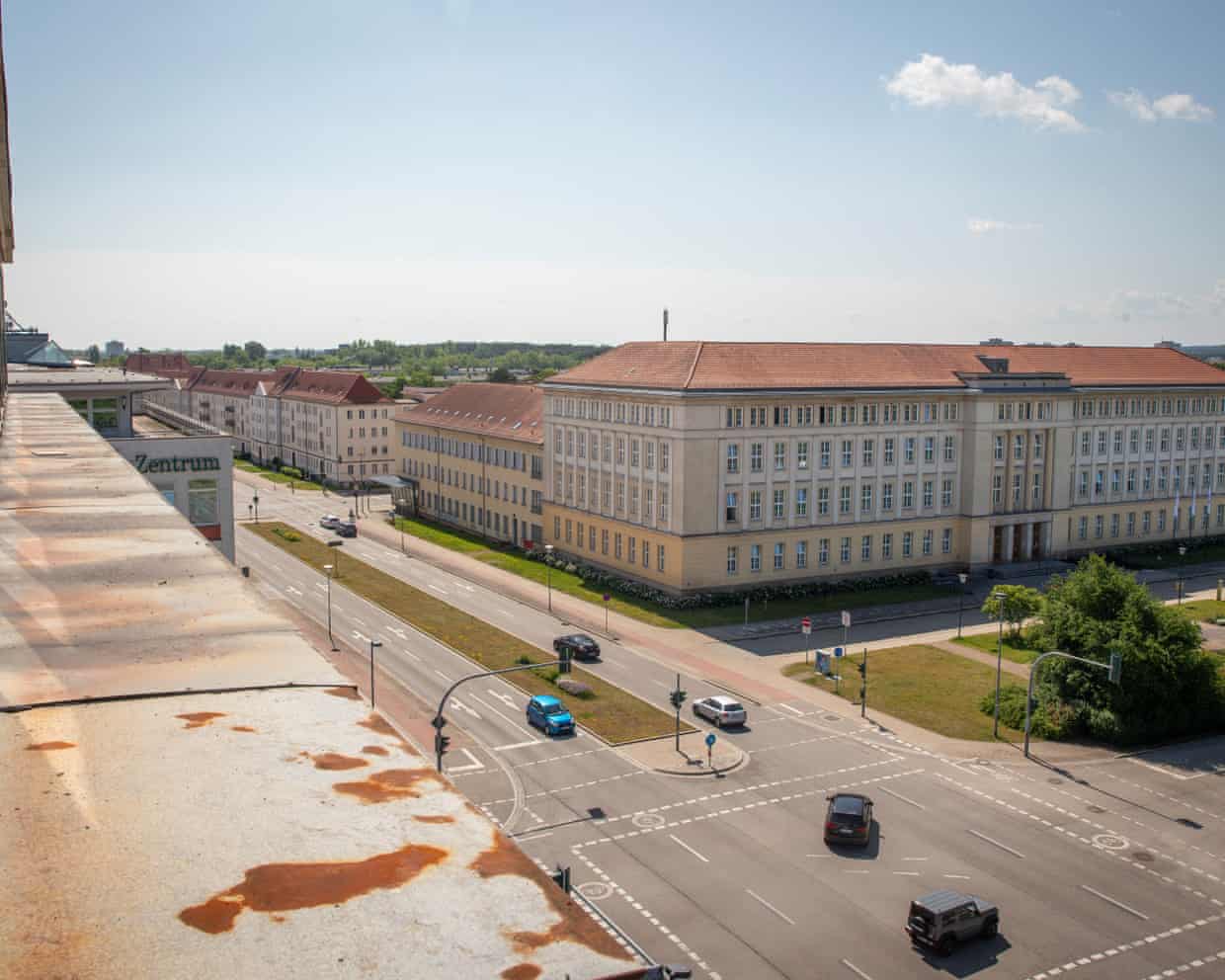
Photo: Christian Jungeblodt/The Guardian.
Eisenhüttenstadt, Germany, was built in Soviet-controlled east Germany shortly after the second world war. It has not been considered a desirable place to live in recent years, but it is not giving up.  

This idea to bring more residents to a city that has lost population was new to me. There are probably lots of other places that could try the same approach.

Deborah Cole writes at the Guardian, “An innovative contest by a city in formerly communist east Germany to curb depopulation by offering a fortnight of free housing has stunned local officials with its success.

The competition drew more than 1,700 applications from around the world to try living in Eisenhüttenstadt, a Soviet-style planned city on the Polish border, near Berlin, which was built around a steel plant in the aftermath of the second world war.

“ ‘We ourselves were very surprised by the reach our Probewohnen (trial living) project has had,’ Julia Basan, the municipal economic development officer spearheading the campaign, told reporters on Thursday.

“She said those who had thrown their hat into the ring since May had ‘the most wide-ranging motives’ including one foreign man who simply said he ‘wanted to marry a German woman.’ But the majority were ‘very realistic applications,’ Basan said.

“The two winners, both German professionals, will move into spacious furnished flats in the city centre in September and be treated to a red-carpet orientation program.

“Melanie Henniger, a 49-year-old IT consultant and self-described ’empty nester’ living in the north-western city of Bremen, said she had grown up in nearby Frankfurt an der Oder and was interested in returning to her eastern roots.

” ‘This is a great chance to get to know the region again, because otherwise I wouldn’t have any opportunities at all as I don’t know anyone there any more,’ she said. ‘In the best case scenario, I can put down new roots there again.’

“The other successful applicant, 39-year-old Jonas Brander, is a Berlin-based film-maker working on a documentary about Eisenhüttenstadt.

“ ‘I’m very interested in the city and its people and I want to get very close to life in my work,’ Brander said, adding that he was drawn to its ‘living history.’

“Eisenhüttenstadt, which is celebrating its 75th anniversary, was the first city to be founded – in east or west Germany – after the Nazi period. It was built according to a socialist model designed to blend work and family life for the good of all.

“But the years since national reunification in 1990 have been hard on the town, which has fewer than half the 53,000 residents it counted before the fall of the Berlin Wall.

“The shrinking and aging population has compounded a skilled labor shortage for local industry, in what economists say can easily turn into a death spiral. …

“Basan said the program had allowed Eisenhüttenstadt to put its best foot forward, touting its renovated and affordable neoclassical housing, verdant surroundings perfect for swimming and cycling, and plentiful childcare and work opportunities.

“ ‘We even had one family, from another European country, who heard about us via the Probewohnen program and are moving here on their own steam. They’ve already signed a work contract with a local company,’ she said.

“ ‘They did it all themselves and we’re just thrilled.’ ”

More at the Guardian, here.
Read Full Post »

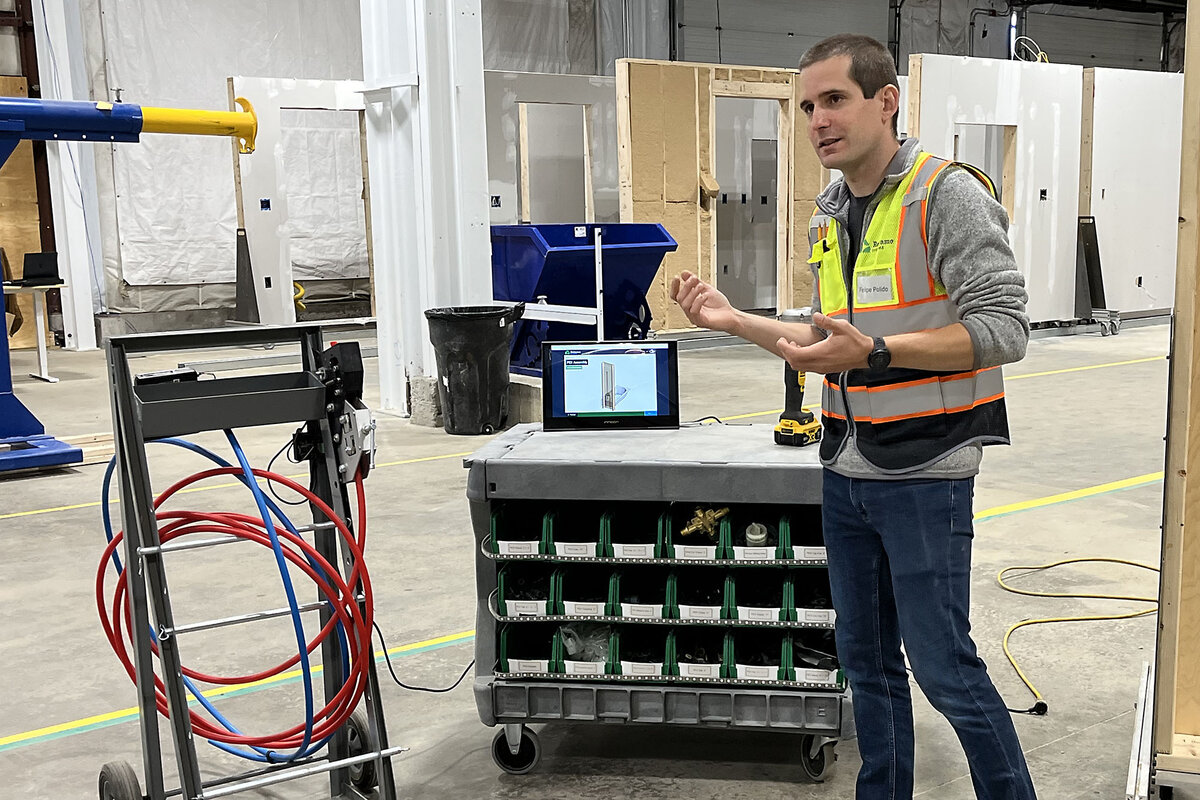
Photo: Jacob Posner/Christian Science Monitor.
Felipe Polido, co-founder and head of technology at Reframe Systems, explains how the company uses robots and simplified processes in construction.

Innovations of the kind we continue to need in areas such as medicine, housing, and carbon reduction will probably rely more on entrepreneurs and businesses than on government for years to come.

I won’t be the one to begrudge any visionary a reasonable profit. In fact, the only thing that worries me about today’s story is the reduced need for human workers. See what you think.

Jacob Posner writes at the Christian Science Monitor about one company aiming to do so by benefiting others.

“A growing number of startups are trying to reinvent the U.S. homebuilding industry, with big goals of making it both more efficient and more climate-friendly. It is a disruption that many say is past due. The construction industry is not only struggling to meet housing needs but also is one of the country’s largest emitters of greenhouse gases. …

“Massachusetts-based Reframe Systems is among the new companies hoping to change one of the nation’s largest industries. Reframe is developing a ‘next generation’ modular construction method to build high-efficiency housing. Employees follow instructions on iPads to install plumbing and electrical components into robot-made walls, then transport these modules to construction sites, where they are stacked into multifloor units.

“But the challenges are myriad. Despite a huge influx of investor funding, the share of housing stock built through high-tech modular construction remains small. …

“[Recently a crowd] gathered to see a robot build a house. In a concrete-and-steel factory in Andover, Massachusetts, yellow-vested consultants, sustainable builders, and possible investors strain to see past a clear fence. Behind the barrier, a giant blue arm jutting from the floor comes to life.

“Its sensor-covered hand analyzes a pile of wood before emitting a loud hiss, then carefully suctions a two-by-four. Rotating at the shoulder and extending its elbow, the robot methodically delivers the plank to a partially completed wall.

“On the other side of the factory – about the size of a hangar for small planes – a few human workers are on their lunch break. They are employees of a three-year-old company called Reframe Systems, which is one of a growing number of startups across the United States scrambling to reinvent the homebuilding industry. …

“More than 100 startups have entered the industry in the past two decades, according to estimates by Tyler Pullen, a senior technical adviser at the Terner Center for Housing Innovation at the University of California Berkeley. He says there are likely more than 200 construction innovation companies currently doing business in the U.S.

“Like many of these, Reframe is focused on a new form of modular construction to upend one of the county’s largest industries. The company aims to create affordable, net-zero houses, which generate the same or more energy than they consume. Reframe CEO Vikas Enti says he can deliver a hefty return to investors – all while making a significant dent in the housing and climate crises. The next step, he says, is to build a factory that can produce 500 apartment units per year using lessons learned from his small, pilot factory in Andover. Then, he hopes to build a network of facilities across the country, varying their sizes to meet the demands and needs of their region. …

“So far, Reframe has completed one two-bedroom house. …

“The current model for modular construction – using assembly-line technologies to build homes – has its origin in the period after World War II. … But federal support for the movement dwindled, and in recent years, modular construction companies have mostly focused on the luxury housing market and sustainability-focused buyers. …

“The need for companies like Reframe is clear, modular boosters say.

“Energy consumed by residential buildings is responsible for around 15% of all U.S. emissions. Fossil fuels warm most of the country’s roughly 145 million apartment units and houses, in addition to keeping their stoves running and heating water. …

“Reframe was founded by roboticists who used to work at Amazon. Following instructions on iPads, its human employees insert plumbing and electrical wiring into the robot-made walls, turn them into ‘modules,’ and bring them to construction sites, where they are stacked into multifloor, highly energy-efficient homes. Because the iPad instructions are akin to a Lego or Ikea manual, Reframe can employ fewer high-cost, high-skill laborers.

“Having most of the needed professionals – electricians, plumbers, architects, engineers – under the same roof solves a problem of communication Mr. Pullen sees as endemic to the traditional construction industry. Every different professional involved must work together, but they are all ‘masters of their own kingdom,’ he says.

“While not all companies offer net-zero buildings like Reframe, Mr. Pullen says building in a factory setting lends itself to tighter structures that hold their temperature better. Plus, factory construction results in less waste. Companies know what they need to order for hundreds of projects at once; in traditional building, ad hoc orders require far more trucks and often leave behind excess material like piping and drywall.”

More at the Monitor, here. No paywall.

Read Full Post »

Photo: Rasmus Hjortshoj.
Dortheavej residence in Copenhagen. Social housing accounts for about 20% of all housing stock in Denmark and is available to anyone, regardless of income.

I’m always interested in housing stories, partly because among the issues that the department I worked in at the Fed addressed was housing. After the mortgage meltdown in 2008, I remember, we had a gigantic event at the Patriots’ football stadium to gather borrowers in danger of foreclosure under one roof with organizations that could help them.

Today’s story looks at new ideas in public housing from around the world. Maddie Thomas reports at the Guardan, “The social housing of last century often calls to mind towering blocks of flats, poorly maintained with dark, pokey and cold units. But alongside a rise in community living, the 21st century has brought quality construction, sustainability, and quality of life to the forefront of social housing design.

“Australia’s commitment to and funding for social housing stock is limited. But by 2037, Australia is estimated to have 1.1 million people seeking social housing. Professor of architecture and head of the University of NSW’s school of the built environment, Philip Oldfield, says that for an investment in social housing to match cosmopolitan cities like Paris or Barcelona, more housing of quality needs to be built.

“ ‘Architects are trained in this … so when they’re given the opportunity to do it well, Australian architects will create as good a housing as anywhere else in the world,’ he says. ‘At the moment, the system, with few exceptions, doesn’t give them that creative opportunity to deliver … the kind of world class social housing we would love to see.’

“While Australian not-for-profits are building design-led affordable housing for low to middle income earners, government-funded social housing for those on waitlists is lacking. Oldfield says organizations like Nightingale Housing are pioneers in built-to-rent housing, with 20% of apartments assigned to community housing providers for those most in need. But examples like Sydney’s Sirius building, previously owned by the state government, show that Australia needs more purpose-built social housing to cater to demand and match international standards.

“ ‘In conventional market-led housing, you build for the people who purchase the house … so you don’t consider as much the energy bills that are going to accumulate over time,’ he says. ‘With social housing, you’re not trying to create a profit so you can consider things like the life cycle costs for housing in a much more significant way.’ …

“Social housing in Denmark is available to anyone, regardless of income. Highly regulated to ensure quality construction, social housing accounts for about 20% of all housing stock in Denmark. In 2013, global architecture firm Bjarke Ingels Group was commissioned by Lejerbo, a Danish organization building housing for those in need, to design ‘Dortheavej’ – a social housing block in Copenhagen.

“Bjarke Ingels’ ‘winding wall’ of social housing has 66 units for low-income citizens, with a small balcony and floor-to-ceiling windows in each.

“ ‘The stacking of prefabricated elements consisting of two kinds of stacked modules, which are repeated to create the characteristic checkered pattern,’ says Kai-Uwe Bergmann, partner at Bjarke Ingels. ‘By gently adjusting the modules, the living areas open more towards the courtyard while curving the linear block away from the street to expand the sidewalk into a public square.’

“The stairwells allow for the units to be filled with daylight, and views of the neighboring green space. Pathways through the site give access to the street. The apartments themselves range from 60 to 115 sq m [~646 to ~1200 square feet], but with open plan designs, space within the units themselves is flexible.”

Read housing stories from Mexico City, Paris, Barcelona, Los Angeles, and Vienna at the Guardian, here; no paywall. You’ll appreciate the variety of approaches around the world and enjoy some great photos.

Making Home Home blog, looking at you!

Read Full Post »

Photo: Dezeen.
Abandoned Los Angeles skyscrapers covered in graffiti.

Is graffiti a scourge or an art? I guess that depends on the graffiti and your point of view. In Los Angeles, graffiti on a monumental scale is the subject of debate.

Corina Knoll reports at the New York Times that, first, there were fancy buildings.

“It was a billion-dollar aspiration meant to transform a neighborhood. A trio of shimmering skyscrapers would feature luxury condos, a five-star hotel and an open-air galleria with retailers and restaurants. …

The vision was called Oceanwide Plaza, and the chief executive said it would ‘redefine the Los Angeles skyline.’ An executive for the design firm said it would create ‘a vibrant streetscape.’ The website said it would be a place of ‘rare and unexpected moments.’

“All these statements, some would say, proved to be true. Just not in the way originally imagined.

“Funding for the venture quickly evaporated. The towers went up but were unfinished and empty. Plagued by financial and legal issues, the plaza was in a quiet limbo for five years. …

“Now those skyscrapers have become a symbol of street swagger, ‘bombed’ with the work of dozens of graffiti writers and artists. Their aliases cover windows that rise more than 40 stories, visible from the nearby highways.

“ ‘Everybody’s talking about it, of course,’ said Ceet Fouad, a French graffiti artist based in Hong Kong, known for his commissioned murals featuring cartoon chickens. … ‘It’s the best promotion you can have.’

“The sentiment is obviously not universal. Many Angelenos see the graffiti as unconscionable vandalism, encouraging waves of crime. Those who live near it say it has jarred their sense of safety. Civic leaders see it as an immediate hazard to the neighborhood as well as to trespassers, not to mention a worldwide embarrassment.

“Others have admired the work, some traveling to see the embellished towers for themselves and ruminate on what they represent. …

“A subculture took note that no one was bothering to clean off the fresh paint. Crews were trudging up together, their backpacks rattling with spray paint. Some lugged up gallons of paint and roller brushes. Security guards on patrol were easy to evade. Inside, they saw loose wires dangling from ceilings and rebar left exposed. Ladders and buckets littered the concrete floors. Bathtubs were full of water from the rain.

“ ‘We got a little lost at first; it’s kind of like entering a little city,’ said a graffiti artist who goes by Aker and managed to paint his alias twice. Although advice was passed around (bring water, the flight up is killer), he said there was no coordination among artists, just individual ambition. …

” ‘This is the problem of the city, people do whatever they want,’ said Rodel Corletto, who built Aladdin Coffee Shop on a nearby corner four decades ago.

“Mr. Corletto, 76, said that over the last 15 years, his windows have been broken, his chairs thrown into the street. He often feels like there is no recourse. The plaza, he said, was a larger example of downtown’s lawlessness. …

“In mid-February, city leaders were scrambling to figure out their role in a private property gone wrong. They had a responsibility, they said, to keep people safe and set an ultimatum: The plaza owner, Oceanwide Holdings, a conglomerate headquartered in Beijing, was ordered to secure the property within a matter of days. …

” ‘For them to have just completely abandoned these properties speaks more volumes about their irresponsibleness as opposed to the graffiti artists,’ said Kevin de León, the councilman who represents the area.

“The city earmarked $1.1 million to start to secure the property, including fencing. Mr. de León also said city leaders were looking into estimates for graffiti removal and putting a lien on the property. ‘The taxpayers will be repaid,’ Mr. de León insisted. …

“Some residents have openly wondered whether the funds might be better used to house the homeless. Or whether the trespassing will be curbed completely. …

“Whatever happens, graffiti artists like Aker say the takeover magnified and transformed a company’s folly hiding in plain sight.

“ ‘They failed not just themselves but the city,’ he said. ‘And this is what happens when things just get left — graffiti artists are like spiders, we’ll go out and put webs up there.’ “

Many outlets have covered this. More at the Times, here, at Dezeen, here, and at the Guardian, here.

Read Full Post »

Photo: Charles Lawrence.
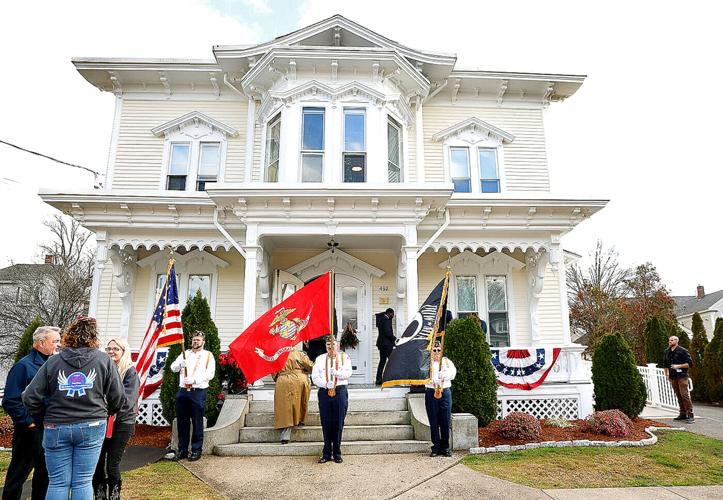
A renovated 1865 Woonsocket, RI, home now provides living space for homeless female veterans.

When one thinks of homeless veterans, one tends to think of men. I remember visiting a new space for veterans when I worked at Rhode Island Housing. Saccoccio & Associates were the architects for the historic renovation of the Heaton and Cowing Mill in Providence, which created 20 units of veterans housing. It was beautifully done, but it did not house women.

So I was interested to read about housing specifically for female veterans in nearby Woonsocket, Rhode Island.

Bella Pelletiere has the story at the Valley Breeze.

“Homeless female veterans in Woonsocket will now have a home to spend the holidays in, say representatives from Operation Stand Down Rhode Island.

“[In November] the historic house at 495 South Main St. was reopened as transitional housing for female veterans in honor of the late Marine Corporal Andrea Ryder.

“Operation Stand Down Rhode Island is Rhode Island’s primary nonprofit resource for homeless and at-risk veterans. OSDRI facilitates a combination of permanent supportive, transitional and recovery housing to low-income and disabled veterans and has 88 locations for housing throughout the state.

“Executive Director Erik Wallin told The Breeze that since 2010, OSDRI has been operating a six-unit facility in Johnston for female veterans. That facility was recently filled to capacity and they have been trying to find alternative ways to house female veterans, who are currently allowed to stay between 6 and 24 months. …

“In May, Wallin told news sources that lead paint had been discovered during renovations, but OSDRI was working with the city and painters to restore the building. Though it was a long process, he said they knew they wanted to restore this ‘magnificent piece of architecture’ for the veterans who were coming to live there.

He added that they wouldn’t house veterans in any building they wouldn’t put their own family members in. …

“OSDRI dedicated the home to Ryder, a Rhode Island native who enlisted in the Marine Corps after graduating high school and was diagnosed with stage three melanoma when she left the service. After numerous surgeries she appeared to be in remission. In 2014, Ryder learned both that she was pregnant and that the cancer had returned at stage four.

“Ryder give birth to her baby girl in 2014, and in 2020, she ultimately succumbed to her illness after spending some time in hospice.

“Wallin said that throughout the years, they had gotten to know Ryder and her family, hosting fundraisers and supporting her until she died. …

“Many officials attended the reopening of the [house], including Tony DeQuattro, president and chairperson of the board of OSDRI, Sen. Sheldon Whitehouse, and Ryder’s family members.

“Ryder’s mother, Donna Paradiso, as well as her daughter, Olivia, and husband, Dennis Bourassa, also came to celebrate the life of their loved one and her name that will live on at 495 South Main St.”

These stories of veteran homelessness are so sad. You just know every time a war starts up that some who serve will come back traumatized. Some will end up homeless. We never do enough for them, but organizations like Operation Stand Down keeping chipping away at the needs.

More at the Valley Breeze, here. No firewall.

Read Full Post »

Photo: Sarah Rose Sharp/Hyperallergic.
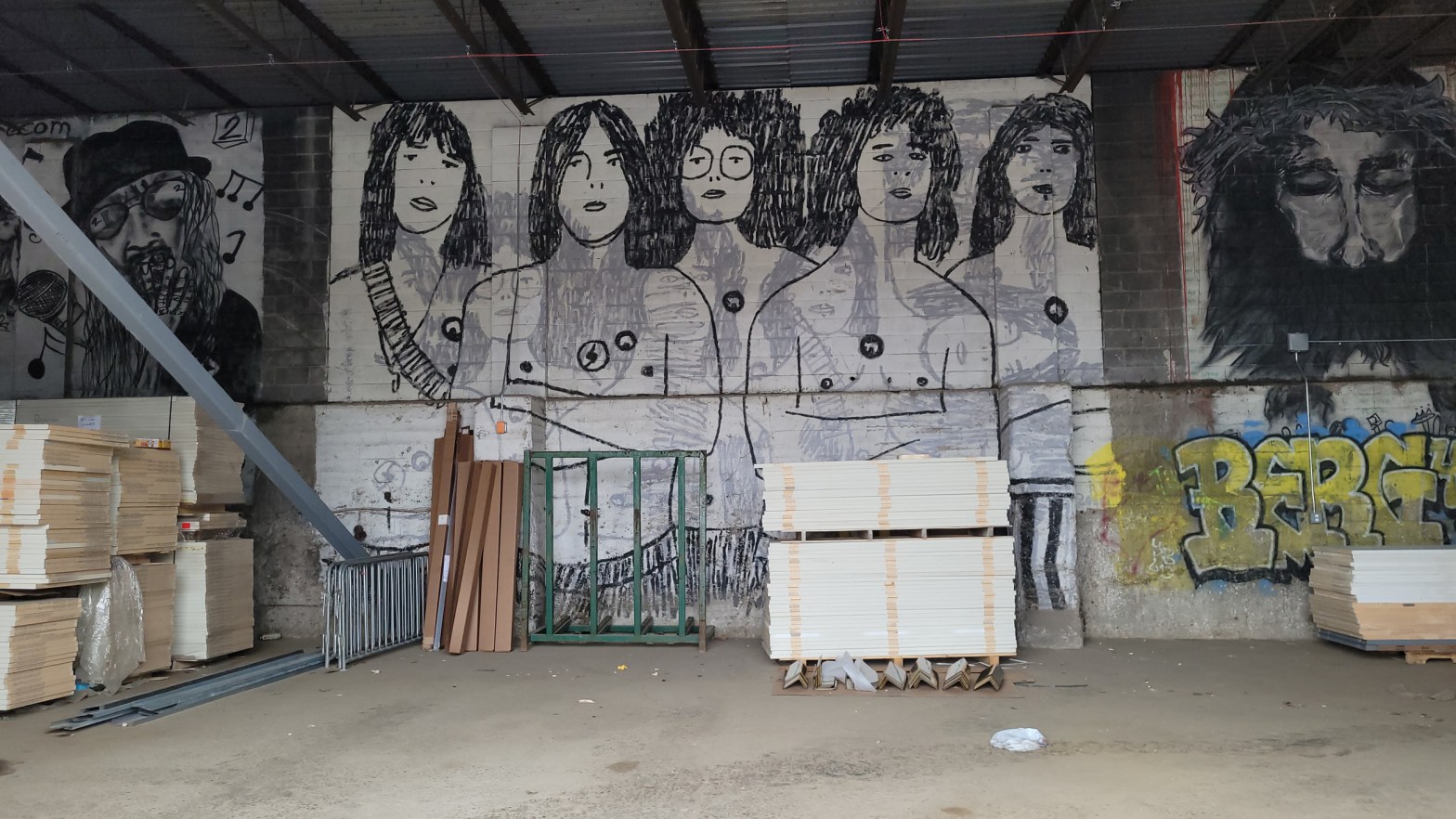
The only public mural commemorating iconic Detroit band MC5 remains intact, as housing for artists is built around it.

When you base housing development on what people can pay to live there, good things may happen. If only the development of the artist community in Fort Point, Boston, had been based on that principle! City planners of the past and their favored developers have pretty much ruined Fort Point — and all of Seaport — and set the area up for drowning in a future hurricane.

Sarah Rose Sharp opines at Hyperallergic, “Artists are fundamentally problem solvers. They are generally understood to be solving problems of a personal-expressive nature, or perhaps ones related to community, and occasionally political or environmental problems. They are not often considered the front line for solving, say, problems of city infrastructure. But maybe they should be.

“[Ten years ago] if you’d asked Oren Goldenberg what he does, he might have said ‘filmmaker’ or ‘producer,’ or he might have narrowed his eyes and asked: ‘Who wants to know?’ These days, however, the answer is a little more complicated. At some point in the last decade, Goldenberg stopped making films as a document, and stepped through the frame to build the world-as-document. … Our School (2005-2009) is a feature-length documentary that seeks to reveal the experience of going to high school for one day, from dawn to nightfall, in his home city of Detroit.

“ ‘When I was doing Our School, I’m like, should I just go be a teacher? What’s going to really help with the education crisis? It’s gonna be a teacher, right?’ said Goldenberg during a walking interview with Hyperallergic across the site of his latest undertaking. Ten years ago, the grounds we are walking on would have been identified by in-the-know Detroiters as Recycle Here!, a community-grown waste management center piloted by Matthew Naimi in a city that had famously suspended trash pick-up for decades, to say nothing of recycling. A lot has changed in ten years, and for the last seven, Goldenberg has been right at the heart of it.

“Nowadays, Recycle Here! is a recognized part of city infrastructure, but the facilities that surround it have undergone a startling transformation. In place of the crumbling outbuilding that once belonged to the former Lincoln automotive factory (still indicated by the adjoining Lincoln Street and its eponymous art park, also developed by Naimi and his associates), a new complex is emerging. Once a free space and favorite haunt of street artists, that has tragically claimed at least one life, the complex is on the home stretch of work that has stabilized the structure and secured facilities. The project is expected to launch this year with communal gathering spaces, a fresh venue for longtime neighbor Marble Bar, and 81 live-work units calibrated to hold the community that occupied the former structure.

“ ‘In doing this project, I’ve learned that our presumptions around development and construction are just wrong,’ said Goldenberg. ‘When you think of high-end developments, they create a projection of who can we attract, as opposed to who is here, because they need something that could pay the cost to renovate a historic building. …

“ ‘You have to create different models of verification,’ Goldenberg continued.

‘When we first started getting money here, people asked: Why is your commercial rent so low? I replied: “Well, it’s for Recycle Here! They’re already here, this is all they can pay.” ‘

“This isn’t the first time Goldenberg has taken an interest in housing. Brewster Douglass, You’re My Brother (shot 2010-11, released 2012) is a documentary about the first public housing for low-income Americans, erected in Detroit. …

“In another past project, Goldenberg once more explored community-building in a historic space. Though he created the video Make it History: the Downtown Synagogue, Goldenberg’s more notable legacy with the organization is arguably the series of after-dark House music dance parties, which sought to bring in new energy and a wave of younger constituents to the Isaac Agree Downtown Synagogue, built in 1921 and currently the last remaining free-standing synagogue in Detroit. …

“ ‘I think a lot of directors consider films holy, and worth more than the humans who make them,’ said Goldenberg. ‘I push very hard against that. I just don’t think it’s true. No one should die making your movie, no one should be exhausted. [This new movie] is different. People are going to live here.’

“In Detroit, the shattering of infrastructure, regulation, and ownership opened a window, one that is now rapidly closing as entrepreneurial forces have seized upon the city as a development opportunity. But for a minute, and maybe even a minute longer, there are so many problems that artists have been able to get their hands on and start to solve in the way that artists do: A way that places a completely different valuation on what community means, what a recycling center means, what a building means. Filmmakers and producers already know how to imagine a world into being, through the sheer power of belief. Goldenberg is showing what happens when that belief becomes a home that others can occupy.”

More at Hyperallergic, here. No firewall. Subscriptions encouraged.

Read Full Post »

Photo: Lea Suzuki / The Chronicle.
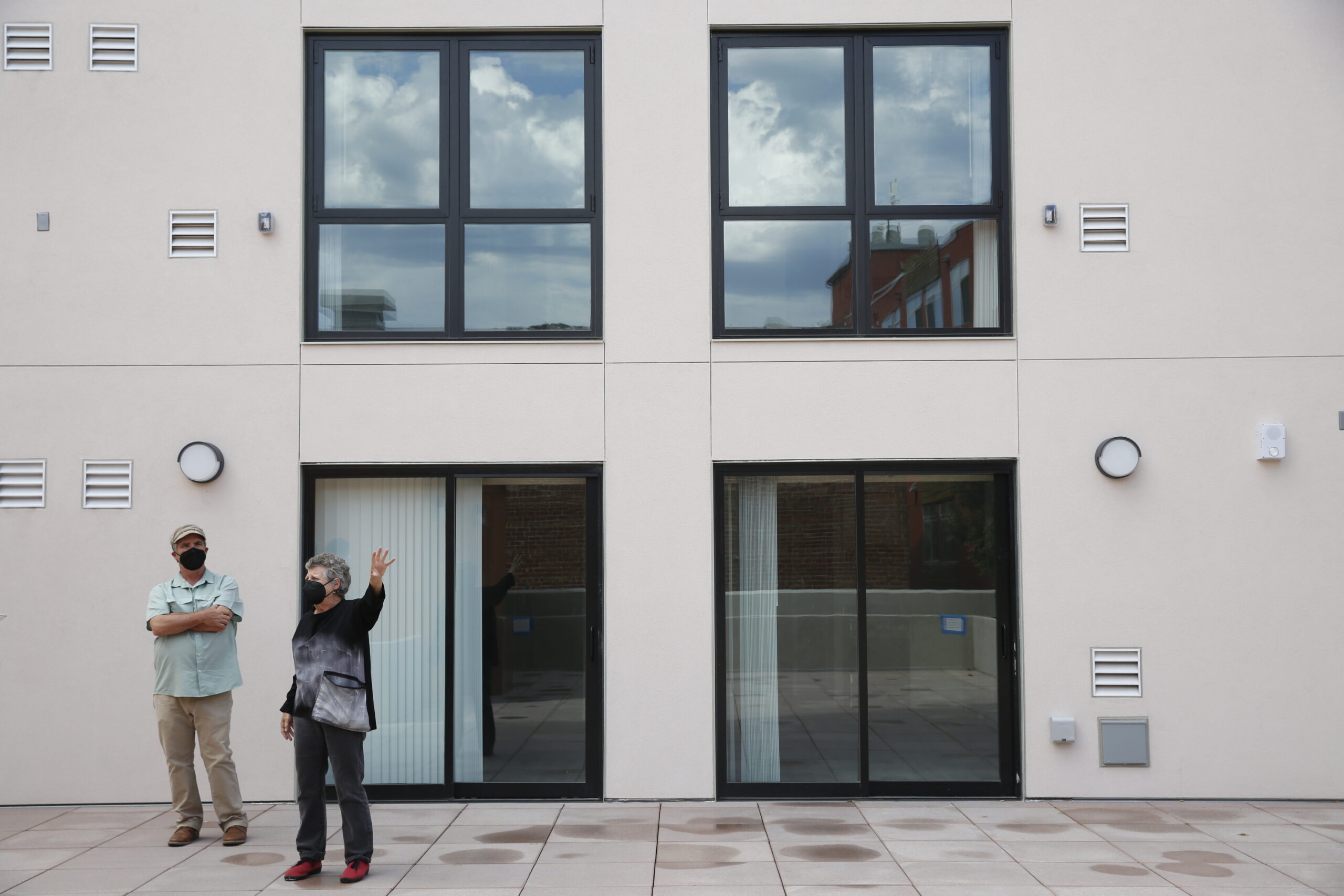
Mark Morrisette, facilities director, and Susie Medak, managing director of Berkeley Rep, at a building that will host performers in the pricey Bay area.

Every day, it seems, I read a story on how the current cost of housing affects a different group of people. Yesterday it was about elderly people in Rhode Island becoming homeless and advocates asking the governor to lift local restrictions to house them.

Today it’s about arts leaders using their characteristic creativity to figure out a solution for visiting performers in one of the most expensive regions in America.

Lily Janiak  reports at the San Francisco Chronicle, “Across the breezeway from Berkeley Repertory Theatre’s new Medak Center, fuchsia light from the set of the new musical Goddess streamed through an open loading bay door, like a portal to Narnia.

“Such a sight might frequently greet the company’s out-of-town actors, directors, designers and playwrights — as well as its fellows, Berkeley Rep’s interns — when they wake up each morning and walk next door to work from their new home.

“But the 42,885-square-foot, $26.2 million center, which plans to host a dedication ceremony on Sept. 3, isn’t just about short commutes. It marks a historic and visionary investment in artist housing in a region with ballooning real estate costs.

“Berkeley Rep’s outgoing managing director, Susie Medak, the center’s namesake and the driving force behind its construction, remembers when housing out-of-town artists cost the company $300,000 to $400,000 per year. These days it’s more like $2 million. Before the pandemic postponed the most recent season opening, Berkeley Rep had committed to paying for 7,000 nights at a nearby Marriott hotel for this past year. …

She remembers when housing out-of-town artists cost the company $300,000 to $400,000 per year. These days it’s more like $2 million.

“Assuring comfort and quiet was another objective for the Medak Center. In a university town, a living situation that looked promising during daylight hours might be beset by 3 a.m. parties.

“ ‘I can’t tell you the number of times we’ve had to move actors in the middle of a run,’ Medak said.

“The new center, located next door to Berkeley Rep’s Roda and Peet’s theater, has 45 units with capacity for 128 occupants. Fellows will share three-bedroom units. When Berkeley Rep’s not using those rooms, it plans to rent them to other nonprofits. …

“The building also features a classroom and a studio workshop space, which could host anything from movement classes to small experimental performances. … Other amenities include new storage space, a third-floor terrace with gardening beds for organic produce for residents, and a covered loading dock for the theaters so crews no longer have to load and unload sets while exposed to the rain.

“The building has key-card access, laundry on every floor and full kitchens in every unit. It’s also Gold LEED-certified for environmental efficiency.

“A trendy gray palette marks the interior. For one wall of the exterior, Berkeley Rep has commissioned a four-story mural by Oakland artist Cece Carpio to honor Ohlone peoples, on whose ancestral and unceded lands Berkeley Rep now sits.

“The theater has owned the property where the Medak Center was built since 1991, but for years it contained an empty lot and a warehouse. The project was a decades-long dream until Signature Bank helped finance it. The theater company finally broke ground in 2019.

“One comparable local facility is the San Francisco Conservatory of Music’s Ute and William K. Bowes Jr. Center for Performing Arts, which opened in 2020 and can house 400 conservatory students and 10 visiting artists, as well as 52 students from the San Francisco Ballet School. Those students pay for rooms, however, while Berkeley Rep’s fellows get free housing as part of their contract as workers.

“ ‘The Bowes Center brought together a range of our ambitions: positioning the institution right in the middle of Civic Center, providing much needed additional performance and teaching space, giving our students beautiful, safe accommodations in a place where they can work and live,’ said President David H. Stull.

“That meansfor example, a guest artist such as superstar Chinese pianist Yuja Wang might live and create and record music in the same building as students. …

“The San Francisco Ballet School has been able to increase student beds from 40 to 52 since the Bowes Center opened, said Jennie Scholick, director of education and training.  And now that students live right next to where they take classes, as opposed to a bus ride away in Pacific Heights, the school can accept younger students.

“At Berkeley Rep … the company’s first fellows [were] set to move into the new building Sept. 26, followed by visiting artists in Berkeley Rep’s Ground Floor program, and then the cast and creative team for Wuthering Heights later in the fall.

“The board’s commitment to the Medak Center through pandemic delays and uncertainty, Medak said, was ‘the greatest statement of our intent to exist on the other side of this pandemic. Building this building is a statement of optimism.’ ”

It’s not something every city will have the priorities or resources to tackle, but it’s an inspiring idea, don’t you think? More at the San Francisco Chronicle, here.

Read Full Post »

Photo: Genna Martin/Crosscut.
Writes Crosscut, “In their roles as King County support services specialists, Kirk Rodriguez, right, and Joe Barnhart walk the area around the King County Courthouse and City Hall Park, as they build relationships with those who live or hang out in that area, … using their own lived experiences with homelessness to form connections.”

After a recent post on better approaches to homelessness, Hannah sent me a link to a New York Times opinion piece by Maia Szalavitz.

“The needs of homeowners and businesses and those of people who are unsheltered often conflict, ” she writes. “Community leaders, faced with increasing crime and disorder, frequently see police sweeps as the only answer, while advocates for homeless people argue that this response is merely a stopgap that does more damage than good.

“But what if there was a way to stop shifting ‌‌people from encampments to jails to shelters to hospitals and back again? In Seattle a unique collaboration among businesses, neighborhood groups, the police, advocates and nonprofits is fighting cynics and misperceptions driven by politics to cut homelessness.

“The coronavirus pandemic presented Seattle with a crisis and an opportunity. In early 2020, authorities closed congregate shelters, emptied jails and stopped new arrests for minor crimes. Lisa Daugaard, a lawyer, saw a rare chance to develop a new approach to addressing homelessness that didn’t involve law enforcement.

“She’d already had success in getting officials to cooperate across siloed systems: In 2019, she won a MacArthur ‘genius’ award for helping to create a program originally called Law Enforcement Assisted Diversion, which has now been replicated in over 80 jurisdictions across the United States.

“Instead of re-incarcerating homeless people who typically already have long histories of minor arrests, police departments that participate in LEAD refer them to case management services. The program has an overall philosophy of harm reduction, which, in addition to securing shelter, focuses on improving health, rather than mandating abstinence from drugs and other risky behaviors. LEAD originated as a collaboration of public defenders, the police and prosecutors, who put aside differences to work on solutions.

“Peer-reviewed research published in 2017 by the University of Washington found a 39‌‌ percent reduction in felony charges for participants (a group of over 300 people suspected of low-level drug and sex work activity in downtown Seattle) in LEAD compared with controls and an 89‌‌ percent increase in the likelihood of being permanently housed for participants after they started case management. ‌‌

“At the height of the pandemic, when the police were ordered not to make minor arrests or referrals to LEAD, Ms. Daugaard decided to try something new. With federal pandemic funds becoming available and desperate hotel owners newly open to being paid to house nontraditional guests, she said she saw ‘our chance to show that there is another way.’

“Ms. Daugaard and her colleagues created a program now known as JustCare. JustCare staff members, rather than police officers, would respond to urgent calls about encampments. After building trust with ‌‌local homeless people, the workers would move them into housing without strict abstinence requirements and then help clean up the site. The police would be contacted only as a last resort.

“An early success involved an encampment on a major thoroughfare, Third Avenue‌‌, where around two dozen tents were ‌‌erected directly outside the popular local restaurant Wild Ginger, which had closed under pandemic restrictions. A co-owner, Rick Yoder, wanted to reopen the restaurant in the summer of 2021, but he told me, ‘I couldn’t get the windows repaired because the guy said, “I’m not going near those tents.” ‘ …

“Outreach workers from JustCare managed to house ‌‌those living in the encampment and clean up the site without police reinforcement. …

‌”The work begins with no-strings offerings of items like food, water and clean needles‌‌. These regular visits help‌‌ demonstrate trustworthiness and defuse fear about coercion. Creativity is also a must: Conflicts arise over everything from open drug use to burning items for heat. Workers neutralize tense situations with humor and compassion and by recognizing that often bizarre behavior is driven by fundamental needs like hunger, thirst and exhaustion.

“Alison McLean owns a condo in the Pioneer Square neighborhood and contacted JustCare for help dealing with tents that started being pitched against her building during the pandemic. …

“JustCare began its outreach. ‘Maybe two weeks later, they were like, “We found housing for everybody,” ‘ Ms. McLean said. …

“Between the fall of 2020 and this past spring, JustCare closed 14 encampments and placed over 400 people in hotels and other lodging.”

More at the Times, here. Thanks, Hannah. Good tip.

Read Full Post »

Photo: Nadia Abdullah via Sentinel Source.
Nadia Abdullah, 25, with Judith Allonby, 64, holding Mango the cat, have been roommates in Malden, Mass., since 2019.

Pretty much all my friends are investigating what Roz Chast calls Places or else at-home services — especially if they expect to need assisted living or memory care eventually. According to today’s story, there’s an interim step, particularly for seniors who live alone, and it’s gaining in popularity.

Cathy Free reports at the Washington Post, “Nadia Abdullah was on the hunt for an affordable apartment in the Boston area a few months before she graduated from college.

“ ‘It was a little frustrating because I couldn’t find anything in my budget,’ said Abdullah, 25, who was sharing on-campus housing with four other students until she graduated from Tufts University.

“At the same time, Judith Allonby, 64, was debating whether to move out of her family’s old home in Malden, Mass., after her parents died. Her two-story house seemed too large for one person and it required a lot of upkeep, but she liked the neighborhood.

“ ‘I rely on public transportation,’ said Allonby, an attorney.

“Then she and Abdullah discovered an alternative: an intergenerational housing arrangement that would benefit them both. While researching their options, they each learned about Nesterly, an online home-sharing agency that matches young renters with not-so-young people looking to supplement their incomes and share their space.

“Abdullah and Allonby each passed the agency’s background check, then they were paired in an arrangement designed to fit their specific needs: Allonby would rent the first floor of her home to Abdullah for $700 a month in exchange for help with the housework and gardening and occasional grocery runs. And Abdullah would get a safe and spacious place to live just six miles from Boston and a 30-minute drive from her robotics engineering job in Beverly, Mass. …

“Allonby said she was surprised at how compatible they turned out to be. ‘It’s really nice to have somebody else around, and Nadia brings a different atmosphere and energy than I had with my 88-year-old mother,’ she said. ‘Nadia is definitely not listening to Frank Sinatra.’

“About 18 percent of Americans live in multigenerational households — meaning two or more adult generations — according to a study from Pew Research Center published this year. Such arrangements have quadrupled in the United States since the 1970s, with about 60 million U.S. residents now living with adults who are of a different generation, according to the study.

“Contributing to that trend is that more young people are priced out of the housing market and more seniors want to age in place, said Donna Butts, executive director of Generations United, a D.C.-based organization that focuses on programs and policies that connect generations. …

“In the United States, several universities foster such arrangements, including Winona State University in Minnesota, Quinnipiac University in Connecticut and the University of California at Berkeley, which has an intergenerational housing program that started in 1986.

“At Drake University in Des Moines, music students are given the opportunity to live rent-free at a local senior living center in exchange for performing several times a month for the residents.

“Molly McDonough, a 22-year-old vocal performance major, recently moved into Wesley Acres, a senior living community that offers everything from independent apartment life to long-term care. …

“She said she was happy to find a pleasant, one-bedroom apartment waiting for her last month on the center’s fourth floor. ‘It came fully furnished, with towels, dishes and anything else I needed,’ McDonough said. ‘They also allowed me to bring my two cats.’ …

“McDonough now often shares meals with senior residents in the communal dining room and she enjoys hearing their life stories. …

“Shortly after she moved in, she found a note on her door from Arlene DeVries, 81, who lives at Wesley Acres with her husband, Fred DeVries, 83.

“ ‘Arlene wanted to give me a tour of Wesley Acres and I found out she’d also been a voice major at Drake,’ McDonough said. ‘Right away, we became good friends.’ …

“In Canada, college students and seniors are moving in together, too.

“Michael Wortis, 85, a retired physics professor from Burnaby, B.C., near Vancouver, said he was intrigued when he received an email last year from Simon Fraser University, where he’d taught for 15 years.

“The university had recently started an intergenerational housing program with Canada HomeShare. Wortis, whose wife died of Alzheimer’s disease in 2015, decided that he could use a little help around the house, in addition to someone to chat with.

“He was matched with Siobhan Ennis, 27, a health sciences graduate student who had been living with three roommates and was looking for some quiet study space.

“In exchange for $400 a month to rent the bottom level of Wortis’s home, Ennis now mows the lawn and helps clean up around the house, and she and Wortis dine together several times a week. They also garden together and have movie nights. …

“As a bonus, Ennis makes terrific stir-fries, he said, and she’s better at figuring out problems with high-tech equipment than he is.

“Ennis said she believes that she actually benefits the most from the arrangement.

“ ‘Michael is such a great person — I love having him as my roommate,’ she said. ‘There is always something to talk about and he’s always direct and thoughtful. We’ll be friends for life.’ ”

More at the Post, here. See my 2019 post on Nesterly here.

Read Full Post »

Photo: Mi Casa.
At Genesis , an intergenerational community in Washington, DC, older adults provide care and social support to individuals and families facing vulnerabilities, who in turn, promote the well-being of the elders as they age.

Because we don’t know the future, we need to make a plan. Catch-22: we can’t make a plan because we don’t know the future.

If we will always be able to handle the usual things that grown-ups handle, we may want to stay in our homes. For couples, if only one of us needs extra care, we may want to be where two lifestyles are possible. If we want to take interesting walks, we need to be where there are interesting walks. If we can’t walk or operate a wheelchair, a walkable neighborhood may not be as important as, say, being around good conversationalists or having easy access to books.

And what about being able to interact with people of other generations?

As Matt Fuchs reported at the Washington Post in September, “Research has shown that older and younger adults need one another: Mixed-age interactions make seniors feel more purposeful, and young people benefit from their elders’ guidance and problem-solving skills. ‘They fit together like pieces of a jigsaw puzzle,’ said Marc Freedman, chief executive of encore.org, a nonprofit group dedicated to uniting the generations.

“But in practice, such closeness can be hard to come by. Many young adults flock to cities, while older people often isolate within the walls of 55-and-over communities. Parts of the country are as segregated by age as race, fewer people are having children, and people live by themselves in record numbers, including 27 percent of adults over 60. …

“One solution is establishing residential communities that are designed to nurture these bonds.

“ ‘There’s a trend toward intergenerational living,’ said Elin Zurbrigg, deputy director of Mi Casa, a D.C. nonprofit that provides mixed-age housing through its Genesis program, in collaboration with city officials. Demand may be rising because of the pandemic, which has exposed loneliness as a serious health issue and has prompted many Americans to move for fresh starts. …

“[Here are some ways] mixed-age communities benefit their residents.

“[First] they cultivate purpose. A shared purpose with neighbors is what Estelle Winicki, a 78-year-old retiree, always envisioned for herself, but finding that wasn’t easy. In Boulder, Colo., she rarely crossed paths with neighbors. … Her therapist suggested Bridge Meadows, which operates two complexes of townhouses in Oregon that bring together seniors, former foster-care children and their adoptive parents. Residents are encouraged to spend time with their age opposites.

“Winicki, who lives at Bridge Meadows in Portland, doesn’t need persuasion. She starts many of her days helping her neighbors’ children get ready for school. ‘It gives me such pleasure to see these kids grow with a strong foundation,’ she said. ‘They know they can rely on me, and I like helping.’

“[Second] they provide mental health support. ‘The first thing you see among all the generations [at Bridge Meadows] is the sense of “I belong” and “I matter,” ’ said Derenda Schubert, Bridge Meadows’ founder and a clinical psychologist. Such an environment allows mixed-age communities such as Bridge Meadows to provide safety nets that protect residents’ mental health. …

“[Third] they offer professional advantages. In other communities, the generational glue is professional. PacArts, a mixed-age building in the San Pedro area of Los Angeles, provides affordable housing to artists. Luis Sanchez, a 53-year-old painter, said he can count on his neighbors whether he’s having a rough patch with health — he’s had two kidney transplants — or his work. An older neighbor has hired him repeatedly to assist with large painting projects. ‘I’ve learned a tremendous amount,’ Sanchez said. ‘She knows techniques and materials I would’ve never used.’

“Eva Kochikyan is a musicologist and teacher residing at Ace 121, a similar building in Los Angeles County. … She grew up in Armenia, where residents socialized regardless of age, but after relocating to Los Angeles, she barely saw her neighbors. In moving to Ace 121, the 41-year-old re-created the experience of a big extended family. …

“Kochikyan recalled her 4-year-old wandering into the building’s communal art studio, sitting right next to an accomplished painter in his 70s and picking up a brush. ‘No lecturing, just working together,’ she said. ‘These connections happen naturally.’

“[Fourth] they may keep older people active. Seniors may get more movement when inspired by the vigor of youth. … Kochikyan thought of a neighbor as an ‘old grandma’ after watching her frown during a solo workout. Since then, though, the baby boomer has befriended a group of children who enjoy kicking her yoga ball with her. During these sessions, her intensity picks up and her face lights up, Kochikyan said, ‘like she drops 20 years off her age.’ ”

Read about other potential benefits and check the most recent research at the Post, here.

Read Full Post »

Photo: World Housing.
In a tiny village on the outskirts of Nacajuca, Mexico, builders are creating new homes using an oversize 3-D printer.

Pop-up temporary cabins, 3-D-printed buildings: whether such super-cheap housing is a good idea or not, it’s probably the wave of the future because we are so far behind providing shelter for all. Typhoons, floods, entrenched poverty, opioid devastation. All require new solutions to homelessness.

First, let’s take a look at 3-D homes in Mexico.

Debra Kamin reports at the New York Times, “Pedro García Hernández, 48, is a carpenter in the southeastern Mexican state of Tabasco, a rainforest-shrouded region of the country where about half of the residents live below the poverty line.

“He ekes out a living making about 2,500 pesos ($125.17) a month from a tiny workspace inside the home he shares with his wife, Patrona, and their daughter, Yareli. The home has dirt floors, and during Tabasco’s long rainy season, it’s prone to flooding. Dust from his construction projects coats nearly everything in the home, clinging to the bedroom walls, the pump toilet and the counters of his makeshift kitchen.

“But that will soon change. In a matter of months, Mr. Hernández and his family are moving to a new home on the outskirts of Nacajuca, Mexico: a sleek, 500-square-foot building with two bedrooms, a finished kitchen and bath, and indoor plumbing. What’s most unusual about the home is that it was made with an 11-foot-tall three-dimensional printer. …

“And now, the era of the 3-D printed community has arrived. Mr. Hernández’s home is one of 500 being built by New Story, a San Francisco nonprofit organization focused on providing housing solutions to communities in extreme poverty, in partnership with Échale, a social housing production company in Mexico, and Icon, a construction technology company in Austin, Texas.

“When New Story broke ground on the village in 2019, it was called the world’s first community of 3-D printed homes. Two years and a pandemic later, 200 homes either are under construction or have been completed, 10 of which were printed on site by Icon’s Vulcan II printer. Plans for roads, a soccer field, a school, a market and a library are in the works.

“Single-family homes are a good testing ground for the durability of 3-D printed construction because they are small and offer a repetitive design process without much height, said Henry D’Esposito, who leads construction research at JLL, a commercial real estate firm.

They can also be constructed to tolerate natural disasters: Nacajuca sits in a seismic zone, and the homes there have already withstood a magnitude 7.4 earthquake. …

“ ‘We know that being able to build more quickly, without sacrificing quality, is something that we have to make huge leaps on if we’re going to even make a dent on the issue of housing in our lifetime,’ said Brett Hagler, New Story’s chief executive and one of four founders.

“The organization was started in 2015, shortly after Mr. Hagler took a trip to Haiti and saw families still living in tents years after the 2010 earthquake there. Across the globe, 1.6 billion people live with inadequate housing, according to Habitat for Humanity. …

“Speed is only one factor in bringing a village to completion — New Story has teamed up with local officials in Tabasco to bring sewage services, electricity and water to the community.

“Mr. Hernández, who has plans to expand his construction business to a larger space in his new home, said he was not focused on a move-in date. He cares about the long-term impact the home will have for his daughter, who is studying to become a nurse.

“ ‘When we receive the house, my daughter will be able to rely on it,’ he said. ‘She won’t have to worry anymore.’ ”

Meanwhile in Boston, construction crews have been working on a pop-up, temporary community to relieve the pressure at a trouble spot known locally as Mass and Cass.

Milton J. Valencia reports at the Boston Globe, “The crews had already built new pop-up cabins over the last two weeks. And on this day, they were digging through concrete to connect to water and sewer lines, putting the finishing touches on a new, makeshift cottage community to house people who are homeless.

“The pop-up community — which could be fully operational by Monday — is just one piece of what state and city officials hope will be the solution to a sprawling tent encampment at the intersection of Massachusetts Avenue and Melnea Cass Boulevard, what has become the epicenter of the region’s opioid crisis.

Photo: Suzanne Kreiter/Globe.
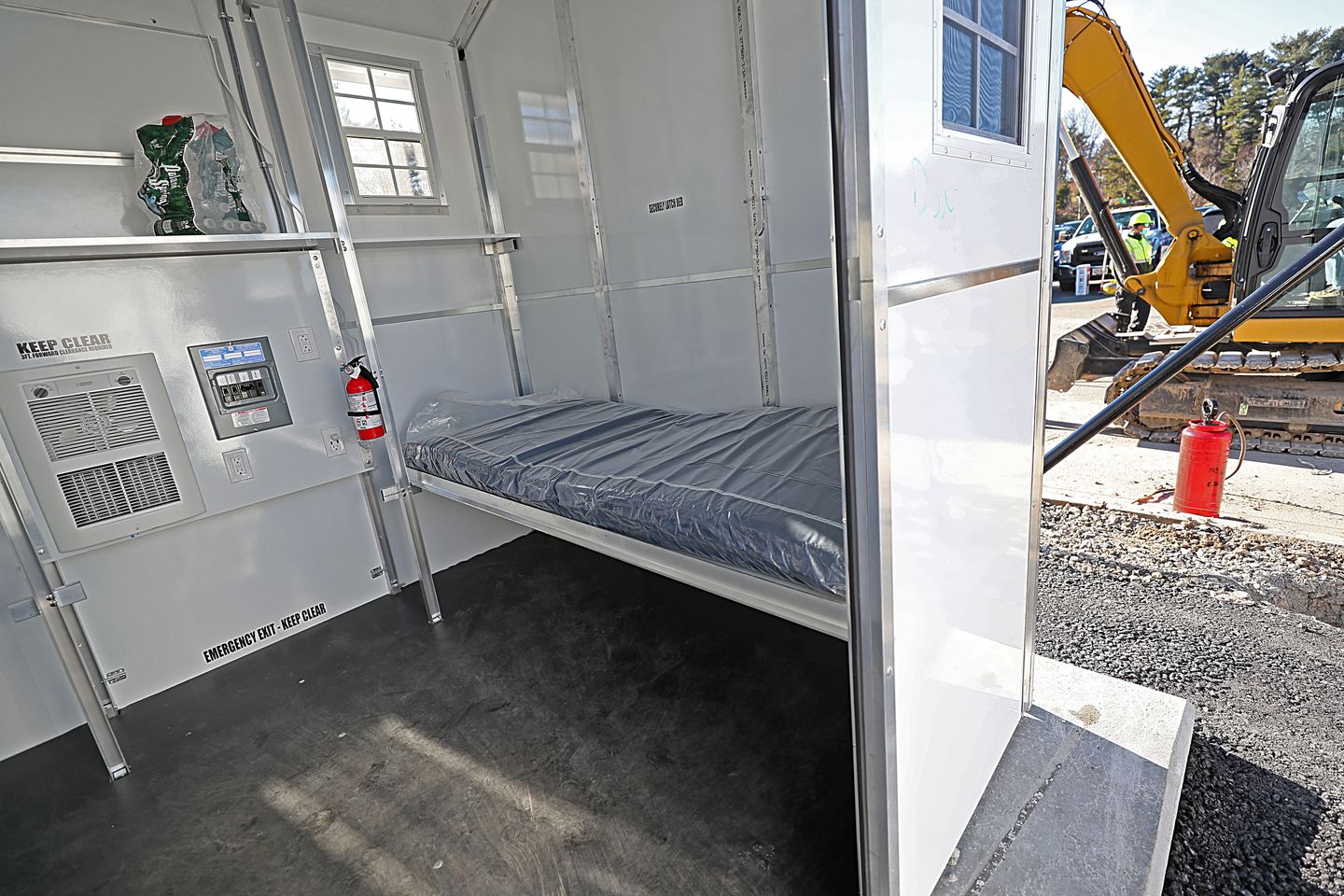
An inside view of one of the temporary cottages on the grounds of the Lemuel Shattuck Hospital campus.

“Seventeen sleeping cabins, ranging in size from 64 to 100 square feet, are lined up in two rows. At one end is a courtyard. And at the front of the village is a 500-square-foot structure that will serve as a common room, where those living there can gather for meals or counseling. Other services — to help treat addiction or mental illness — will be available at the site. And at the end of the day, those living there can retire to their own personal sleeping space. …

“As city officials and social workers push people to leave their tent encampments near the Mass. and Cass intersection, they invite them to the new cottage community, marketing it as a temporary but appealing option that could serve as a warmer, safer transition to long-term housing.”

Will there, in fact, be safer, long-term housing? That is the question.

More on 3-D homes at the Times, here, and on Boston’s pop-up community at the Globe, here.

Read Full Post »

Image: Revery Architecture/Westbank/Squamish First Nation.
2021 artistic rendering of Senakw. The Squamish First Nation has set a goal of housing every member within a generation.

Just before the pandemic, I read at the Guardian about an indigenous-led development for Vancouver, Canada. And yes, it’s still going forward. The market-rate aspect of the development is supposed to fund the parts that benefit the First Nation providing the land. I found a more recent story from the Daily Hive.

Kenneth Chan reports, “By the end of this year, site preparation for construction could begin on the Senakw development. … Squamish First Nation members overwhelmingly voted to approve the massive development on their 12-acre Kitsilano reserve in late 2019. Thus allowing band leaders to seal the partnership with local developer Westbank and continue their work with refining the design concept.

“In an interview with Daily Hive Urbanized, Khelsilem, a spokesperson and councillor of the First Nation, said the heights of several buildings have been increased, including the tallest tower, now up from 56 storeys to 59 storeys at 172 metres (564 ft). … The first of four construction phases will target the westernmost parcel of the reserve — a narrow strip of land between the bridge and Vanier Park. …

“He said, ‘Some of the motifs of the building have been refined to incorporate Squamish culture and identity, and there is starting to be a bit more imagining of where the public gathering spaces will be.’

“The ground plain commercial space component of the project has changed too, with open public courtyards sunken into the landscape, activated by retail, restaurants, cafes, and potentially grocery stores and fitness centres.

“It also takes advantage of the space under the Burrard Street Bridge, using the structure as a cover for an ‘outdoor restaurant,’ gathering areas, a playground, and basketball courts.

“The residential component of the project still carries a total of 6,000 units, possibly enough to house as many as 9,000 people. …

“The housing tenure composition has not been finalized, but Khelsilem maintains purpose-built market rental housing will likely account for at least 70% of the homes. The below-market rental housing component dedicated to Squamish members has grown slightly to roughly 300 units. …

“The First Nation has set a goal of housing every member within a generation, defined as in 25 years. More than half of its 4,000 members live on reserve, and over 1,000 are on the housing waitlist, with the most recent housing allocations offered to members who have been waiting for over three decades.

“Senakw’s non-market housing component for members will help achieve some of this broader goal directly. The real win is that the revenue generated by the market housing will provide the First Nation with the capacity to pursue greater self-determination. It will greatly enhance their ability to provide current members and future generations with more services, such as eldercare, education, and language and culture support. It would also help fund more member housing initiatives beyond this reserve. …

“Khelsilem adds many members have also expressed excitement about the trades training and employment opportunities that will be offered by the construction project.

“ ‘It is important for the public to understand that this is an economic development venture, it is not an affordable housing project. It is an economic development venture so that we can generate significant amounts of revenue to be invested into our community because we’ve been without the means to do it otherwise,’ said Khelsilem. …

“The infusion of thousands of market rental homes at Senakw will serve to improve overall housing affordability in Metro Vancouver by filling some of the demand from moderate-income households.

“ ‘The reality is new market rental housing is affordable for middle class workers and families in Vancouver, and that’s who this housing will be for,’ he said, adding that strong demand for rental housing has persisted even under COVID-19 conditions.”

More at the Daily Hive, here.

Read Full Post »

Shelter

America, January 12, 2020

At a time of year that many communities around the world are telling the story of finding shelter in a stable, it feels ironic that even in a pandemic wealthy countries can’t find it in their hearts to protect people from being evicted.

In America, if the December rescue bill is signed, renters will be protected until the end of January 2021, about a month.

Coronavirus shut down businesses, and people lost jobs and couldn’t pay rent. Have we no collective will to protect the most vulnerable? Landlords, especially small landlords, need protection, too. It’s not just up to them.

The burden of pandemic losses must fall on us as a group. As a taxpayer, that would be my priority. I can do without more bombers and military aid to Saudi Arabia. As a people, many of us celebrating Christmas today, what are our priorities? What does Christmas mean?

At the Washington Post, Heather Long and Rachel Siegel interviewed Americans who are in danger at this season.

“Most told The Post they are ‘not political people’ and are struggling to understand why Congress and the president would be able to celebrate Christmas when 14 million Americans are slated to lose unemployment aid on Saturday, the government is set to shut down on Tuesday, and an eviction moratorium that has prevented millions from losing their homes during a pandemic ends on New Year’s Eve.

“Waitress Robyn Saban summed up the sentiment of many: ‘I’ve worked for 18 years at a diner under very hard conditions. I never called in sick except when my husband died. And now Congress is just leaving town. It makes me furious because they are leaving people hanging.’ …

“Tony Bowens, 31, spent nine days in a hospital in March fighting for his life against the deadly coronavirus. In many ways, he’s just grateful this Christmas to be home with his wife and two kids, even though very little is the same. As his family struggles to pay rent, he can’t believe [there’s no] agreement on aid. …

“Bowens has ongoing complications from covid: Headaches, temperatures that spike for a day, crippling leg pains and trouble breathing. He lost his IT job in March and has not been able to work since. He received $65 a week in unemployment through the Pandemic Unemployment Assistance program that Congress created this year to assist independent contractors and gig workers like him, but it will end the day after Christmas unless a relief bill gets enacted.

“His family is barely getting by on his wife’s job as a state government worker in Illinois. They are behind on rent and the electric bill, and they worry about more layoffs for state workers.

“Bowens said extending unemployment is ‘one of the most important things’ in the relief package because a $600 one-time check won’t last long, ‘but unemployment would go for 11 weeks. I was going to be able to get that again.’ ”

More on evictions at the News and Observer in Charlotte, North Carolina, here, at US News, here, at the Washington Post, here, and at CNBC, here. Eviction Lab is worth checking, too, here.

Read Full Post »

Photo: Jessica Rinaldi/Globe Staff
Dean Kaplan and Sarah Heintz chatted in the apartment they share in Cambridge, Massachusetts.

Empty nesters are faced with a challenge: they hate to leave their home, but maybe it would be practical to get a smaller, cheaper place with more people around and less snow shoveling in winter. Meanwhile, grad students have a different conundrum: their university may be in a high-rent area, but they don’t have much money.

Idea!

Dugan Arnett at the Boston Globe describes one creative solution that is working out for both empty-nesters and young adults.

“After living with more than a dozen different roommates in his young life, most of them strangers, Dean Kaplan is well-versed in the particulars of those first meetings — the short introductions, the perfunctory pleasantries, and then the quick getting on with life. …

“In late August, though, as he stood on the front porch of a sizable multistory house in Cambridge ready to meet his newest roommate, he found himself uncharacteristically nervous and eager to make a good first impression.

“Of all the roommates he’d had in the previous few years, Sarah Heintz would be the first septuagenarian. In fact, Kaplan, a student at Harvard’s Graduate School of Education, and Heintz, a 77-year-old whose grown daughter now lives across town, are part of an experiment in connecting young people in need of cheap rent with older residents who wouldn’t mind a little extra companionship and an occasional hand around the house.

“The notion is driven by the Boston area’s housing crisis, which has propelled rents through the stratosphere [while] some 90,000 spare bedrooms are going unused in the homes of aging empty-nesters.

“That got a pair of MIT urban-planning graduate students thinking: Those rooms might be valuable to young people, especially students. And they might also provide a way for older people, who increasingly are living alone, to stay in their homes as they age.

“ ‘They get helped around the house, doing everyday sorts of things — walking the dogs, going grocery shopping, technology tutoring, and feeling that they can help a young person get started in their life,’ said one of the students, Noelle Marcus.

“To match these odd couples, Marcus and classmate Rachel Goor last year launched a startup called Nesterly, which works roughly on the principles of a dating app, with searchable online profiles and features that help work out details of a lease. …

“That day in August when Kaplan showed up on Heintz’s porch, he came with his mother and some luggage stuffed with clothes. Heintz invited them in and gave them a tour.

“At first glance, they would seem an unlikely pairing. … But as Heintz led Kaplan and his mother through the house, his nerves started to ease.

“ ‘The walls are covered in books,’ Kaplan said later. ‘And that made me feel at home immediately.’ …

“Under the terms of their lease agreement, rent is $800 a month (about half the cost of apartments Kaplan had been looking at before the arrangement with Heintz), knocked down to $700 if he devotes eight hours each month to helping Heintz with a range of chores.

“But even without that incentive, they said, they’ve discovered they like doing favors for one another. He helps in the garden and gives her a hand logging into her e-mail account; she offers him rides to Market Basket and recently taught him the proper way to gut a fish.” Read more here.

I love this idea, but I just have to say one thing. There are plenty of septuagenarians who don’t need help logging on to their email accounts. It’s a lazy journalistic assumption that is really starting to grate.

Read Full Post »

0321-ddp-finland-homeless

Photo: Gordon F. Sander
Residents at a Housing First facility near Helsinki, Finland. Emmi Vuorela, right, is the resident coordinator. 

“Housing First” is a model that parts of the United States have adopted on a limited scale. It provides housing to homeless people without making behavior changes a prerequisite. The theory is that a person is more likely to get off an alcohol dependency, say, if he has the stability of shelter.

Now Finland has not only seen the wisdom of the concept, it has decided to go much bigger and provide every homeless person with housing. It’s amazing what can be accomplished when a society as a whole makes up its mind to do something sensible. Sensible because the program not only helps individuals but pays for itself.

Gordon F. Sander writes at the Christian Science Monitor, “As anyone who has visited Europe recently can attest, the scourge of homelessness has reached epidemic proportions.

“The only exception to the trend is Finland, according to FEANTSA, the European Federation of National Organizations Working with the Homeless. There, homelessness is, remarkably, on the decline.

“Per the latest statistics, the number of homeless people in Finland has declined from a high of 18,000 30 years ago, to approximately 7,000: the latter figure includes some 5,000 persons who are temporarily lodging with friends or relatives. In short, the problem has basically been solved. ..

“Finland opted to give housing to the homeless from the start, nationwide, so as to allow them a stable environment to stabilize their lives.

“ ‘Basically, we decided that we wanted to end homelessness, rather than manage it,’ says Juha Kaakinen, CEO of the Y-Foundation, which helps provide 16,500 low-cost apartments for the homeless. …

The elimination of homelessness first appeared in the Helsinki government’s program in 1987. Since then virtually every government has devoted significant resources toward this end.

“Around 10 years ago, however, observers noticed that although homelessness in general was declining, long-term homelessness was not. A new approach to the problem was called for, along with a new philosophy. …

“The concept behind the new approach was not original; it was already in selective use in the US as part of the Pathways Model pioneered by Dr. Sam Tsemberis in the 1990s to help former psychiatric patients. What was different, and historic, about the Finnish Housing First model was a willingness to enact the model on a nationwide basis.

“ ‘We understood, firstly, that if we wanted to eradicate homelessness we had to work in a completely different way,’ says Mr. Kaakinen, who acted as secretary for the Finnish experts. … ‘We decided as a nation to do something about this.’…

“One of [the] goals was to cut the number of long-term homeless in half by producing 1,250 new homes, including supported housing units for tenants with their own leases, and around-the-clock presence of trained caring staff for residents who needed help. …

“As far as the not inconsiderable cost of producing the 3,500 units created between 2008 and 2015 – estimated at just under $382 million – [Sanna Vesikansa, the deputy mayor of Helsinki] declares that ‘the program pays for itself.’ As evidence, she points to a case study undertaken by the Tampere University of Technology in 2011. It showed society saved $18,500 per homeless person per year who had received a rental apartment with support, due to the medical and emergency services no longer needed to assist and respond. …

” ‘That doesn’t cover the contribution to the economy [from] residents who moved on from supported housing and got jobs,’ she adds.”

More at the Christian Science Monitor, here.

Read Full Post »

Older Posts »