Feeds:
Posts
Comments

Posts Tagged ‘industrial’

Photo: BBC News.
Rooted in Hull, a nonprofit that teaches people how to grow produce in urban areas, flourishes in the industrial heartland of Hull, UK.

Here’s a city in the UK that is essentially giving residents permission to save the planet in those small ways that can add up. It’s about growing healthful food where polluting industry once held sway.

Kevin Shoesmith writes at BBC News, “Hull looks set to become the first UK city to give people the ‘right to grow’ food on disused council land.

“Council bosses say the move would bring communities together, reduce antisocial behavior and make places look better, as well as put quality food on dinner plates. As campaigners call for the idea to be adopted nationally, BBC News visited one Hull-based community group that is ahead of the curve, growing healthy food in the shadows of factories. …

“In multiple raised beds on a graveled patch of land off St Peter’s Street, plants flourish, irrigated using a system which collects and stores rainwater from the roof of the Royal Mail’s sorting office next door.

“Stopping to inspect an apple tree as an HGV rattles by, Martin King, manager of Rooted in Hull, a not-for-profit community organization, said staff and volunteers have proven food can be grown almost anywhere.

” ‘You don’t need a lot at all,’ he says, grinning. ‘Joinery students at Hull College made the raised beds for us.’

“The organization acquired the land in 2015, with Mr King explaining it was once a basin used to hold ships delivering timber to a nearby dock. A stipulation of the lease, he told me, is that no foundations must be dug, hence the presence of containers, a compost toilet and even a reed bed that filters dirty dishwater. …

“[King is] supportive of Hull councillors who recently unanimously passed a ‘right to grow’ motion. If approved by the city council’s scrutiny committee, a map would eventually be produced showing suitable land it owns that could be used by those who want to grow their own fresh food.

“Hull would become the first city in the UK to give people a right to grow on unused council land. …

“Inside a grocery box before us is an abundance of autumnal vegetables destined for the dinner plates of volunteers. Glancing over the road towards the muddy banks of the River Hull, [King] says: ‘Let’s wash away the idea that Hull is some rundown backwater.’

“Incredible Edible, a network of more than 150 community growing groups, is pressing for more councils to do the same. The group insists unused land could ‘with a little TLC be turned into oases for food and wildlife.’ …

” ‘Land already earmarked for building in the future could be temporarily used to grow food,’ [Councillor Gill Kennett] says. ‘Years pass before the foundations are laid and fruit and vegetables could be grown over several seasons.’

“Councillor Mark Ieronimo, the council’s infrastructure portfolio holder, says the city is ‘blessed with green areas,’ adding there are also spaces that are no longer used, such as former car parks. … ‘This will bring people together and it’ll improve mental health and reduce food waste.’

“Back at Rooted in Hull, two volunteers beaver away, weeding and removing the remains of wilted, summer crops. Kale and butternut squash are in plentiful supply.

“Mr King agrees community gardening projects such as this one can help boost mental wellbeing. He says the group works with many vulnerable members of society, including Hull All Nations Alliance (HANA), which helps refugees.

” ‘We had a group of kids from HANA come down,’ he points out. ‘They made chips and pizzas using produce grown here. We help tackle social isolation.’

“At the back of the yard, there are three beehives. ‘A man serving a sentence at HMP Hull used his graphic skills to design labels for the honey,’ Mr King informs me.

“Mr King is content but conscious that more spaces, not just in Hull, could be used in a similar way for food production.”

More at BBC News, here.
Read Full Post »

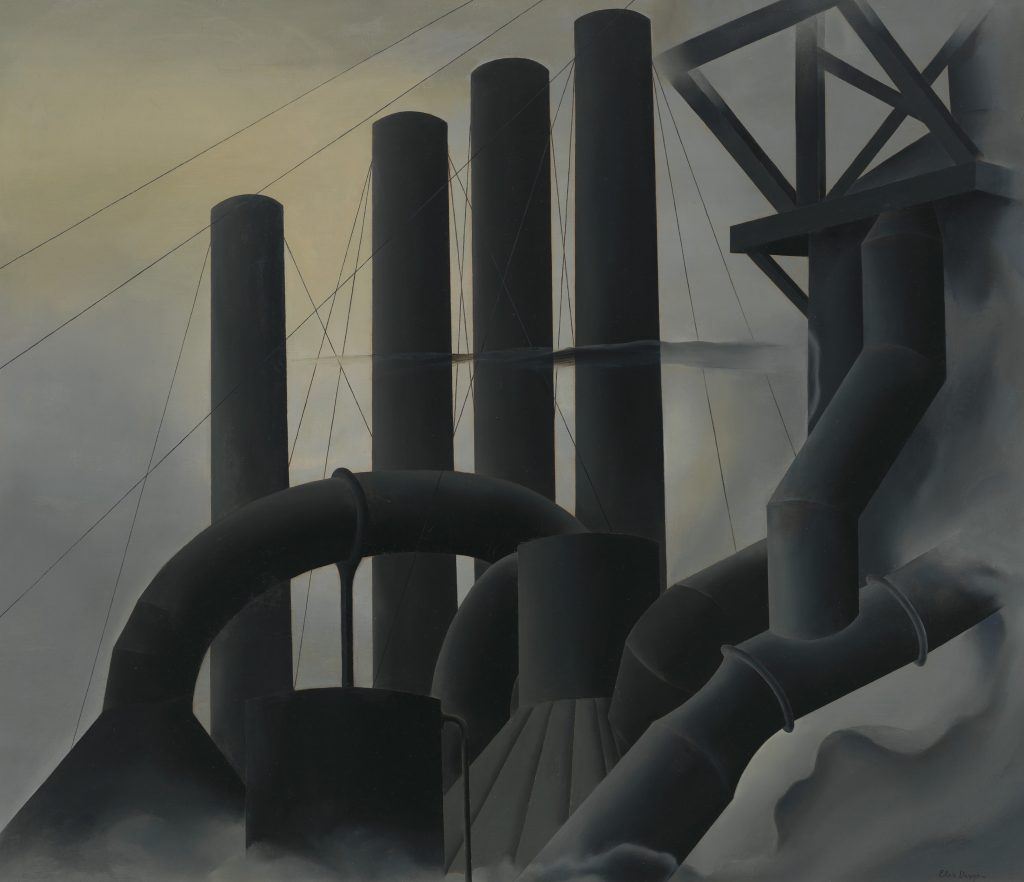
Art: Elsie Driggs, Pittsburgh, 1927, Whitney Museum of American Art, New York
“Beauty is everywhere if you know how to look for it.”

You don’t have to love pollution to love industrial monstrosities transfigured by art. In fact, the tension between what you know smokestack flames are spewing and the beauty of the fire against the blue sky is part of the appeal. Which is not to say I wouldn’t happily give it up.

Still, I was interested in this article on the general topic at the Millions. Bill Morris writes, “In the early years of the twentieth century, an eight-year-old girl named Elsie Driggs was traveling by train with her parents from Sharon, Pennsylvania, to New York. She had dozed off by the time the train reached Pittsburgh, but as the writer John Loughery would recount years later in Woman’s Art Journal, her sleep was interrupted: ‘She was awakened by her father to witness the drama of the black night-sky over Pittsburgh ablaze with soaring flames from the steel plants. It was a memorable sight.’

“So memorable that 20 years later, with her artistic career beginning to flourish, Driggs returned to Pittsburgh hoping to recapture the scene in paint. But the fiery Bessemer steel-making process had been abandoned by then, so there were no longer any flames spurting into the night sky. Worse, the local mill’s managers insisted that a steel mill was no place for a young lady—and they were suspicious that she was a union organizer or industrial spy. But Driggs did not give up. ‘Walking up Squirrel Hill to my boarding house one night, I found my view,’ she told Loughery. ‘It was such a steep hill. You looked right down on the Jones and Laughlin mills. You were right there. The forms were so close.

And I stared at it and told myself, ‘This shouldn’t be beautiful. But it is.’ And it was all I had. So I drew it.

“And then she made a painting from her sketches. And then, nearly a century later, while viewing an exhibition of the Whitney Museum’s permanent collection, my eye was drawn to a smallish black-and-white painting — just 34 by 40 inches — that from a distance appeared to be abstract. … As I got closer I realized it was a stark depiction of cylindrical industrial smokestacks bound by wires at the top left and a gush of smoke at the bottom right. The smokestacks are black and gray, the only color coming from a hint of sulfur in the pale sky. And that’s it: smokestacks, wires, smoke, sky. No flames, no human beings. How did this unremarkable image manage to be so otherworldly beautiful?

“The card on the wall told me that the picture was called ‘Pittsburgh 1927’ and it was painted by Elsie Driggs. She soon followed it with an equally stark painting of silos and ducts and smokestacks called ‘Blast Furnace,’ and then a monumental, faceted painting called ‘The Queensborough Bridge.’ These paintings gained Driggs entry into a group dubbed the Precisionists, an informal movement of mostly young artists who in the 1920s were drawn to America’s emerging industrial landscape of factories and skyscrapers and bridges, which they rendered with both a geometric precision that echoed Cubism and a sparseness that sometimes bordered on abstraction, typified by ‘Pittsburgh 1927.’

“There were other Precisionists on the walls of the Whitney the day I discovered Elsie Driggs, most notably Charles Sheeler and Charles Demuth. While Driggs was in Pittsburgh, Sheeler was in Detroit on a commission to photograph Henry Ford’s sprawling River Rouge complex, the workplace of 75,000 people, then the largest factory in the world. Sheeler’s assignment was part of the corporation’s publicity campaign for the Model A, which was about to replace Ford’s obsolete Model T. Sheeler spent six weeks roaming the complex with his camera, producing 32 prints that the company used for publicity and that are now regarded as high art. Possibly his most memorable image is ‘Criss-Crossed Conveyors, River Rouge Plant, Ford Motor Company,’ a picture of two conveyors making an X over a tangled netherworld of fences and buildings and ironwork, all of it topped by eight slender smokestacks that reach into the heavens. …

“One of Sheeler’s works from the Rouge was in the Whitney show — a painting made five years later called simply ‘River Rouge Plant,’ an oddly serene depiction of the factory’s coal processing and storage facility. The exterior walls of the buildings are creamy or tan, the foreground waters of a boat slip are glassy and calm, the sky is blue. There are no workers, no smoke or sparks or grease or slag heaps. The only hint of the repetitive, soul-crushing work that was done there is the nose of a freighter visible on the right. Part of Henry Ford’s genius was to make everything he needed to produce cars — what’s known as vertical integration, the cutting out of all middlemen — and so to make steel he had coal brought up by train from Appalachia, while his fleet of freighters brought iron ore down from Duluth, Minnesota. You would not know this by looking at Sheeler’s stately photographs or serene paintings, nor would you know that Ford was a union-busting anti-Semite who ruthlessly policed the morals of his captive work force. Sheeler was not concerned with such unpleasant facts. For him, all that mattered was that the Rouge was a visual gold mine. ‘The subject matter, he wrote to his friend Walter Arensberg, ‘is undeniably the most thrilling I have ever worked with.’ American factories, he added, were ‘our substitute for the religious experience.’

“Hanging on a wall near ‘River Rouge Plant’ was Charles Demuth’s painting ‘My Egypt’ from 1930, a depiction of a grain elevator in his hometown of Lancaster, Pennsylvania. The gray structure, topped by exhaust ducts and flanked by a smokestack, is seen from a low angle, giving it a monumental, nearly monstrous presence. Diagonal lines hint at stained glass — and at the notion, widespread at the time among Sheeler and others, that industrial structures were the cathedrals of the machine age. …

“By depicting industrial architecture and machinery but not the humans who built and operated it, the Precisionists left themselves open to the charge [of] glorifying the machine while minimizing or simply ignoring its human costs. …

“What was behind the Precisionists’ tendency to focus on machines rather than their operators, on the mechanical rather than the human? Was it a way of condemning the pulverizing power of the industrial age? Or was it a way of glorifying these monuments to human ingenuity and will? Or could it be that it was not one or the other, but a bit of both? Or neither? 

“One possible answer comes from Elsie Driggs. The year she painted ‘Pittsburgh 1927,’ Charles Lindbergh became the first person to fly solo across the Atlantic Ocean. A year later, Driggs experienced her first flight, aboard a Ford Tri-Motor that carried her from Cleveland to Detroit. It was an ethereal experience, judging by the painting she executed that year, ‘Aeroplane,’ which was included in ‘Cult of the Machine.’ It shows a curvaceous, silvery plane floating through the heavens. Black diagonal lines suggest the whirring of propellers — and identify it as the work of a Precisionist. It’s a lovely, loving homage, clearly a way of glorifying this airborne monument to human ingenuity and will.”

More at the Millions, here. Wonderful pictures. No firewall.

Read Full Post »

Album cover for The Bathrooms are Coming!, a 1969 American-Standard musical (Blast Books)

I heard a great Studio360 show today. It was on the industrial musicals once used by corporations to get the sales team charged up to go out and sell.

“In the 1950, 60s, and 70s, a subgenre of musical theater entertained thousands. It had showstoppers composed by some of the brightest talent in the business. But instead of selling out Broadway houses, these shows played to packed hotel ballrooms and convention halls. …

“ ‘It was to build morale and build a sense of being on a team,’ explains Steve Young. ‘You weren’t isolated, you were a part of a greater whole that was looking out for you.’ A writer for David Letterman, Young has made himself the curator of the world’s largest collection of corporate musical theater performances. ‘Sales Training,’ a groovy number from 1972, includes specs for York air conditioner’s new line. ‘Once in a Lifetime’ breathlessly heralds the arrival of the 1958 Ford Edsel.

“Writing these musicals was no simple task and corporations spent lavishly to attract top talent. In 1966, John Kander and Fred Ebb wrote Go Fly a Kite for General Electric (in which Benjamin Franklin meets modern utility executives) — they went on to win a Tony for Cabaret. …

“Steve Young is co-author of the book  Everything’s Coming Up Profits.”

If you like musicals, you really must listen to the whole Studio360 show. It’s too funny.

You don’t want to miss “PDM (Power Distribution Management) Can Do”
from Go Fly a Kite — General Electric, 1966, by John Kander, Fred Ebb, and Walter Marks, or “An Exxon Dealer’s Wife.” Be sure to catch the song composed to sell Edsels and the haunting American-Standard number “My Bathroom” from 1969. (“My bathroom, my bathroom is a private kind of place.”)

Studio360’s show,”Curtain Call: Industrial Strength Musicals,” may be found here.

Read Full Post »

Photo: Getty Popperfoto
L.S. Lowry, (pictured in 1957), the artist from Manchester, is the subject of a major new show at the Tate Britain gallery.

Some years ago when my husband was in England on business, he acquired a print of workers coming and going outside a factory. The original was by L.S. Lowry, whose paintings of industrial Britain turn out to be very popular in the UK.

Popularity, however, is not a ticket to being shown at the Tate Britain. Belatedly, Lowry will receive a retrospective in 2014.

Oliver Wainwright at the Daily Mail writes, “Clouds of smoke belch from forests of chimneys, while armies of spidery figures scuttle to and fro between narrow terrace houses and imposing factory gates.

“Crowds of fans shiver on the edge of a football field, a fist-fight breaks out, and barefoot children tease a stray cat on the street corner.

“These are the scenes depicted in the haunting paintings of L.S. Lowry who, more than any other artist, managed to capture the strange, bleak beauty of daily life in northern industrial towns.

“His dream-like images captured the popular imagination, adorning chocolate boxes and biscuit tins, tea towels and jigsaws.

“Yet they are scarcely to be found on the walls of our major national galleries. The Tate owns 23 of his works, but has only ever exhibited one on its walls in the past 20 years — and then only briefly. …

“Why has it taken so long?

” ‘He’s a victim of his own fan base,’ said Chris Stephens, Tate Britain’s Head of Displays. ‘What makes Lowry so popular is the same thing which stops him being the subject of serious critical attention. What attracts so many is a sort of sentimentality about him.’

“This is a strangely inverted piece of art world logic,” Wainwright comments, “where the popularity of an artist is seen as an obstacle to showing their work.”

If you’re an artist, be careful to stay off “chocolate boxes and biscuit tins, tea towels and jigsaws” — or wait to be discovered by art experts of a future generation.

More here and here.

 © The estate of L.S. Lowry
L.S. Lowry, Coming out of School, 1927

Read Full Post »