
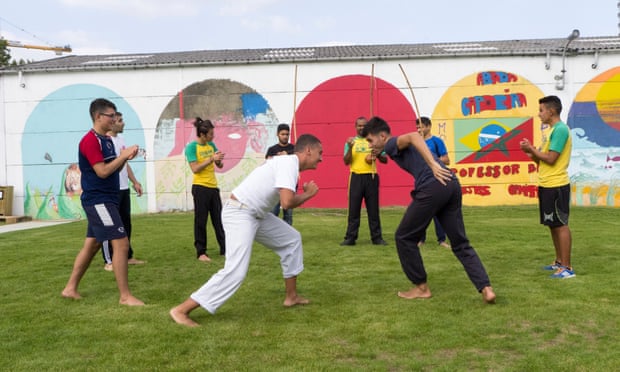
Photo: Artists for Humanity.
At Artists for Humanity, teenagers are able to express their artistic creativity and talents while also earning money, bridging passion and profit.
Today’s story is about a wonderful nonprofit I visited several times in the years I was working at the Boston Fed. Its mission to involve urban kids in making art — and earning some money from it — is still sending joy into the world.
Kana Ruhalter and Arun Rath have an update at GBH radio.
Artists for Humanity (AFH), they report, has been giving “talented teens — most of whom are people of color from low-income communities — the opportunity to earn and create.
“Through murals, sculptures and more, Artists for Humanity … brings joy, beauty and a sense of belonging to their community. And, by paying its artists, they’re addressing economic inequities as well.
“Anna Yu, the executive director, and Jason Talbot, co-founder and managing director of program, joined GBH’s All Things Considered host Arun Rath to discuss the decades-long history of the nonprofit. …
“Jason Talbot: Back in 1991, they had just defunded art in schools. I was a Boston Public School student at the Martin Luther King Jr. Middle School, and [AFH’s] former executive director, Susan Rodgerson, came to the King School to reintroduce art. … I found her willingness to hear out my ideas and implement them in projects was super refreshing. We continued to work together with the other fellow co-founder, Rob Gibbs, in a studio over in SoWa [South of Washington Street].
“There were just us six boys in that studio, and we painted and we created a gallery exhibition. It just showed us the capabilities of art, it helped us understand this artist community and we just loved doing work there.
“Our organization has evolved over the years. We’ve built in this entrepreneurial aspect where we’re producing and selling art to clients. It’s just been an extremely enriching experience. …
“Arun Rath: Anna, tell us about that enrichment. How has the organization evolved since that? …
“Anna Yu: While the core of the model is essentially the same — meaning this radical idea of paying teens to create client project work that is of the quality of a professional — that piece is always running through our work. But today, we are the largest employer of youth in the city of Boston, which is over 400 teens that we employ.
“[Today] we not only provide after-school employment, we also partner with schools during the school day in a program we call Co-Lab. …
“Rath: What are some of the success stories? …
“Talbot: Teenagers — one thing that’s pretty universal is they really are looking for adult experiences, you know? So to be in the workplace, to be respected, to be able to attend meetings, to be able to propose ideas, it really gets our young people super excited about having a career and really re-invested in their education.
“And teens are graduating at a higher rate; AFH graduates 100% of our high school students, and we’re able to offer secondary education to 100% of our teen artists. …
“Rath: Tell us about the business side of this. How do you get these young artists paid? …
“Yu: Something that is so radical about the organization — it’s hard to believe that Artists for Humanity has been doing this for 33 years — is that clients actually hire us to create work for them. So it’s often beautifying office spaces, it’s creating a unique or custom piece of art for them, it can even be branding and promotional materials. It could be a website.
“The beautiful thing is they are paying teens to do this work, and they are valuing their voices, their creativity. And they’re getting a very unique product at the end of the day. …
“Rath: Talk about the collaborative process between these young artists and the professionals.
“Talbot: Well, AFH is a tremendously collaborative organization. … Our clients really get visionary work. Our teens are up on the latest trends. They’re digital natives — they know what’s going on — and they’re really able to help our clients have some really great new innovative ideas. …
“Rath: You’ve seen so many go on to become adults and blossom in amazing ways. Are there any moments of joy you’d like to share? …
“Yu: The beautiful thing about Artists for Humanity is that a lot of our alumni are actually not just artists. Many of them do become artists. Many of them actually pursue a career in STEM, or some of them go on to become lawyers. We have [one] who’s actually on our board of advisors right now, and she’s a lawyer at the Fed. … We have someone who is an alumni from AFH and is at Harvard Medical School. So it’s really this idea that by opening up these pathways, by inspiring them to think creatively, by building that confidence, they can really achieve anything.”
More at GBH, here.

 Photograph:



 Suzanne's Mom's Blog