Feeds:
Posts
Comments

Posts Tagged ‘insect’

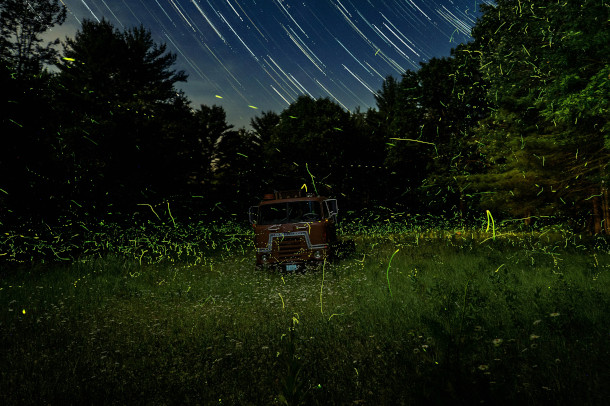
Photo: Robert Ritchie, Unsplash via Living on Earth.
The streaks of light in this 30-minute timelapse image show fireflies in a Wisconsin field.

Where are the fireflies of our childhood? Although the population perked up around here this past summer, possibly because of all the rain, firefly lovers have reason to be worried about the long term. Today’s story explains what’s going on — and how we can all help.

Eric Berger writes at the Guardian, “Max Vogel, a 29-year-old public defense attorney, was picnicking with friends in early August at Prospect Park in Brooklyn, New York, when he noticed flashes of light appear in the air around him.

“They were fireflies, bioluminescent insects that the Washington DC native had not seen while living in Oregon, where there are few, if any. For many Americans who live where fireflies do, their flashing lights at dusk are a tangible rite of summer – though one that may now be under threat. …

“Vogel said, ‘It’s like a shooting star that just is surprising and gives you the childlike wonder of how you felt when you first saw fireflies in your yard.’

“Even in areas of the US where there are typically fireflies, people are especially excited to see them this year because there appear to be more this summer after a steady decline in recent years, according to scientists.

“Despite that welcome news, researchers caution that it does not necessarily signal a reversal of the downward trend. They remain concerned about the long-term viability of the firefly family, which includes more than 2,000 species, some of which are at risk of extinction due to factors such as light pollution and climate change.

“ ‘It’s been really uplifting to hear all of the reports of huge increases in fireflies,’ said Candace Fallon, senior endangered species conservation biologist for the Xerces Society for Invertebrate Conservation. ‘But they are also insects, and insects are notorious for having populations that bounce up and down each year, and so it’s hard to say that their populations are increasing from a single year of data.’

“Fireflies, also known as lightning bugs, are beetles that come out at night during summer and produce a bioluminescent gleam, primarily to attract a mate.

“Cultures around the world treasure the bugs, including in Japan, where they are symbols of love and fallen soldiers.

“ ‘Catching fireflies is a relatively harmless thing that you can do that really connects you to your natural world,’ said Matt Schlesinger, chief zoologist with the New York Natural Heritage Program, which is participating in a project to identify which firefly species occur in state parks.

“Scientists in the US and Canada do not have baseline data on firefly species, which makes it difficult to quantify how much the population has decreased, and they must instead rely on anecdotal reports and documented habitat loss, which point to a downward trajectory, Fallon said.

“She and other researchers conducted a study published in the journal PLOS One which found that 18 species in North America are threatened with extinction. But the scientists also did not have enough data on more than half of the assessed species to determine their extinction risks. …

“The primary factor behind fireflies’ decline is habitat loss and degradation, according to the Xerces Society. That includes land being disrupted by development, light pollution and pesticide use. Artificial lighting at night makes it hard for the bugs to communicate and mate, Fallon said.

“Climate change, including an increase in droughts and rising sea levels, also affect firefly populations, she said.

“Still, there are some firefly species that appear to be doing ‘just fine,’ Schlesinger said [adding that] the kinds that specialize in particular habitats are the ones struggling. …

“ ‘If they can still have a big year, at least those species are probably doing fine and have the potential to recover,’ Schlesinger said. That said, ‘any single year doesn’t tell you about the long-term trajectory of firefly populations. …

“Kids should continue the tradition of venturing out with jars in the summer but should then release the bugs rather than collecting them, Schlesinger said.

“Other ways to help fireflies survive include: not using pesticides, reducing artificial lighting at night, and allowing the grass to grow long and the leaves to pile up in your yard.

“ ‘A lot of fireflies pupate in leaves, and so when we rake those and put them in bags, we’re destroying their habitat at a very small scale,’ Schlesinger said.

“Despite the concerns about extinction, Fallon is encouraged by master gardeners in Arkansas who created a firefly sanctuary, and by lawmakers in Maryland who approved legislation earlier this year which introduces new regulations on what type of lighting can be bought with state funds. …

“ ‘I think we have enough time to make a difference.”

More at the Guardian, here. See also the radio show Living on Earth, here.

Read Full Post »

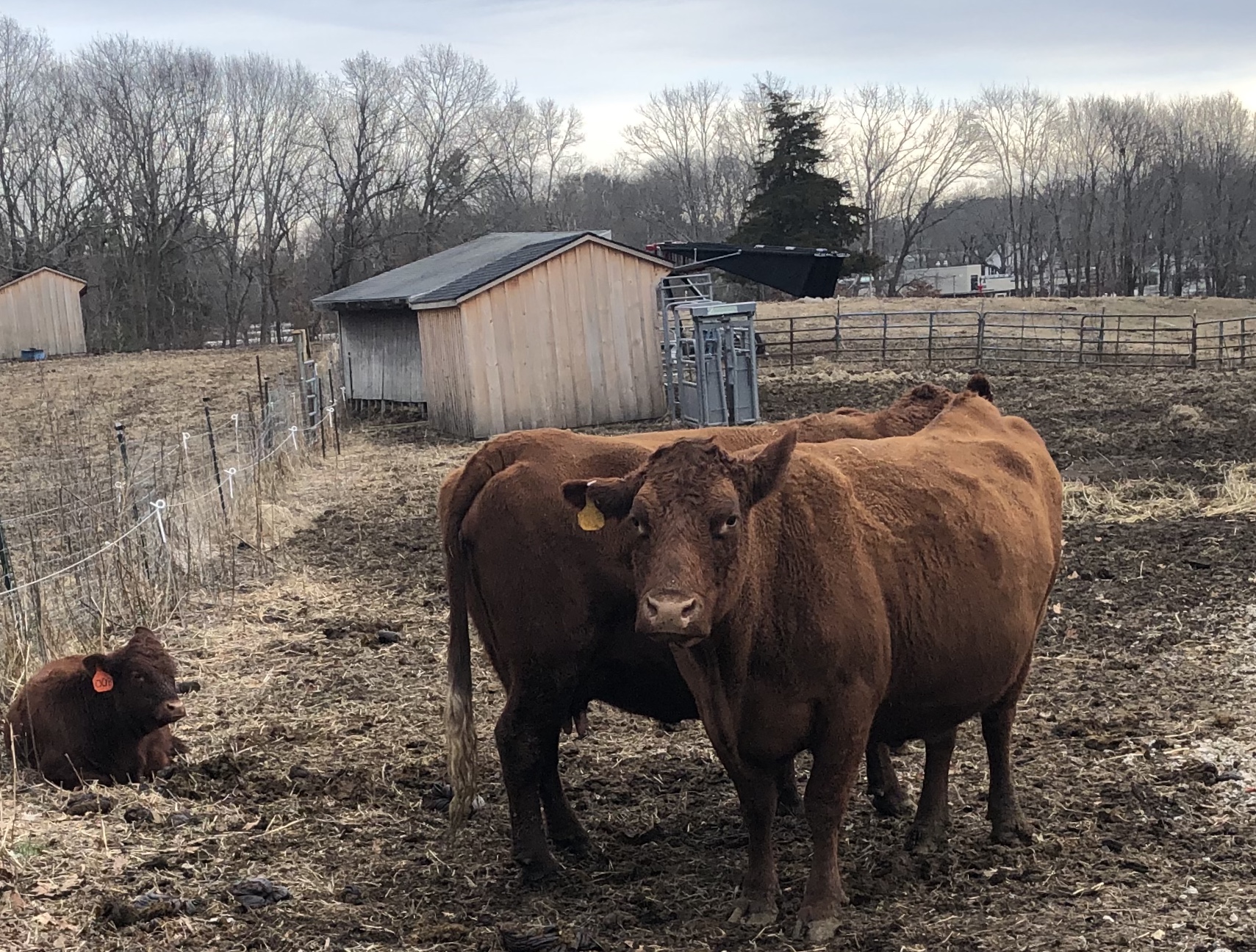
Photo: Suzanne and John’s Mom.
Cattle at Codman Farms, Lincoln, Mass. “Cows are often described as climate change criminals,” says Grist, “because of how much planet-warming methane they burp.” But, Grist adds, raising ruminants can also lead to deforestation, making alternatives to meat doubly important.

The other day at dinner, my husband regaled Sally and me with the latest on Europe’s use of mealworms as alternative proteins. The idea of eating mealworms — straight, no chaser — was not appealing to me even though I know they often sneak into the packaged nut and grain products we buy at the store. Which is why I freeze those products for 24 hours. I suppose I eat frozen mealworms that way, but it’s inevitable.

Grist magazine reported recently on the damage that livestock agribusinesses do to the planet when they cut down trees to graze more animals.

Max Graham says, “To feed the world’s growing appetite for meat, corporations and ranchers are chopping down more forests and trampling more carbon-sequestering grasslands to make room for pastures and fields of hay. … The greenhouse gases unleashed by this deforestation and land degradation mean food systems account for one-third of the world’s human-generated climate pollution.”

At Nature magazine I learned that alternative proteins are gaining traction in France, of all unlikely places. The focus is not on eating insects straight.

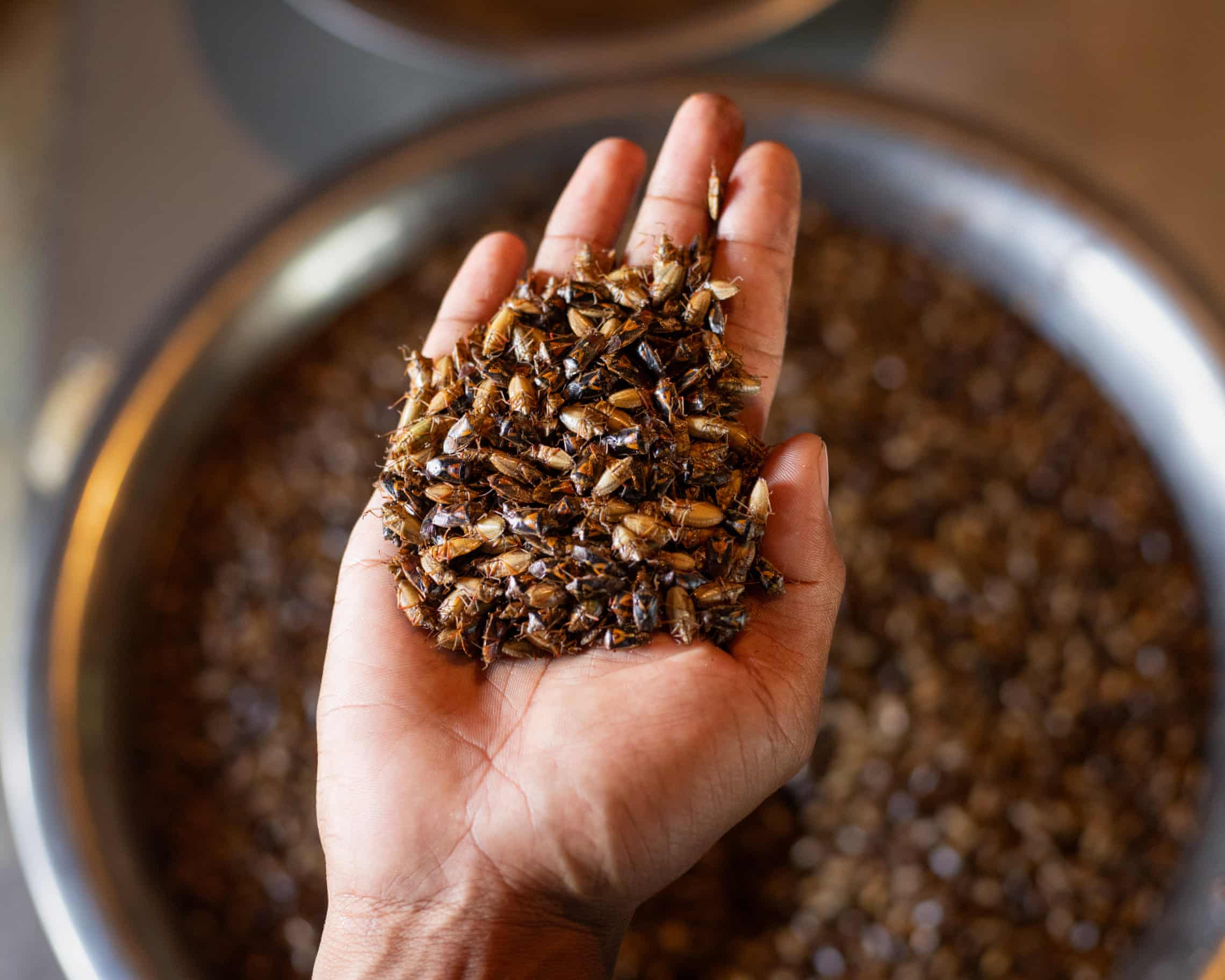
Rachael Pells writes at Nature about “the world’s largest vertical insect farm — home to at least 3 trillion mealworm beetles (Tenebrio molitor). The company’s chief executive and co-founder, Antoine Hubert, says that the beetles have a good life, as far as being an insect goes. Each of their stacked plastic trays is kept at an optimal 60% humidity and a balmy 25–27 °C. Nutrition, growth and moisture levels are all recorded for analysis, and human visitors are allowed to inspect the trays only from a distance — to prevent contamination of this prized ecosystem.

“The beetles are raised in this way from larvae to adult, at which point they meet a quick death in steam before being harvested into oil, protein and fertilizer.

“Insects have come under the spotlight over the past few years, as scientists seek alternative sources of protein to feed the rapidly expanding global population. A direct nutritional comparison shows that edible insect species have greater protein potential than do conventional meat products — 100 grams of mealworm larvae produces 25 g of protein, whereas 100 g of beef contains 20 g of protein. Insects also have a high food-conversion ratio when compared with livestock.

“To produce the same amount of protein, for example, crickets require around six times less feed than do cattle, four times less than sheep, and half that of pigs and chickens. But various attempts by companies to market insects as a mainstream food source in Europe and North America have fallen flat and largely been dismissed as a fad. And some researchers have concerns about the effects on the environment, ranging from whether escaped insects might disrupt local ecosystems to the impact of insect ‘factories.’ So why farm insects at all?

” ‘The world is facing a huge food sustainability crisis,’ explains Huber, an environmental engineer. ‘Insect protein is one very realistic and obvious solution to mitigating some of those challenges,’ he says.

“With the global population expected to reach almost 10 billion by 2050, United Nations forecasters have warned that food production will also need to increase by as much as 70%.

“However, because mealworm burgers are, at the moment, unlikely to sell out in your local supermarket, Ÿnsect grows insects for animal feed. This is given to fish, pigs and poultry, taking the pressure off conventional agricultural land use.

“The use of vertical farming has grown rapidly over the past few years, spurred on, in part, by advances in LED lighting, the cost of which fell by 94% between 2008 and 2015. Several start-ups (including Infarm in Berlin and Aerofarms in Newark, New Jersey) use the system to produce vegetables such as lettuce for human consumption. And the global market of the vertical-farming industry is expected to grow from US$3.7 billion in 2021 to $10.5 billion in 2026.

“Meanwhile, sales of plant-based alternatives to meat that are designed to reduce the demand for cattle farming — an industry responsible for 65% of all livestock emissions — seem to be stalling. When meat-substitute company Beyond Meat in El Segundo, California, went public on the stock market in 2019, its share price rose by 163%. But after the initial excitement, sales slowed, and they have remained about the same since 2020.”

As with most innovations, there are caveats. Get the details at Nature, here. And for a report on livestock and deforestation, check out Grist, here. No paywalls for either one.

Read Full Post »

Photo: Aram Boghosian for The Boston Globe
Jean Devine (left) and Jayden Pineda, 7, make a meadow at the Waltham Y.

I’m excited that today the Boston Globe caught up with my friend Jean’s terrific biodiversity-education outreach. Readers may recall that I blogged here and here about how she and Barbara Passero got started on “meadowscaping” — hoping to ween homeowners from using pesticides and herbicides that harm the environment and contribute to global warming.

Debora Almeida reports on the educators’ latest work with kids: “Swimming, crafting, and playing games are staples of day camp, but kids at the Waltham YMCA are doing something new this summer.

“They’re learning how to plant and cultivate a meadow — and why they should.

“ ‘We just want to save the world, that’s all,’ said Barbara Passero, cofounder of Meadowscaping for Biodiversity, an outdoor environmental education program for students of all ages, which has partnered with the Y for the project.

“Over the course of the summer, Passero and program leader Jean Devine are teaching children the fundamentals of meadow upkeep and the importance of planting exclusively native plants. They are the best hosts for pollinators, such as bees, butterflies, and moths. In turn, the insects attract other wildlife such as birds and rabbits, building biodiversity.

“While some people’s first instinct would be to spray pesticides to protect their hard work from leaf-munching insects, Passero knows that birds will take care of the insects on their own. She also refuses to use any toxic substances around the children, who truly get their hands dirty digging in the meadow. Seth Lucas, program administrator at the Waltham Y, said kids love the activity. …

“The meadow started as a patch of weedy grass, but is in the process of becoming a 10-by-60-foot flourishing garden. Passero and Devine are setting the meadow up for success with native plants that come back year after year. The plants are self-sustaining and spread on their own.”

Such a happy story! Do read the whole thing here.

Read Full Post »