Feeds:
Posts
Comments

Posts Tagged ‘jobs’

Never underestimate the ingenuity of a 20-something in a bad job market. Kids have no choice but to keep inventing things. With three entrepreneurs in the family, far be it from me to say that this inventing business has gone too far. But spray-can cupcakes?

Billy Baker has the story at the Boston Globe.

“It all started a little over a year ago, when John McCallum, one of the Harvard students, was sitting in the lab at his Science & Cooking class, trying to come up with ideas for his group’s final project. As he puts it, they were spitballing a bunch of possibilities that all followed the same theme: ‘ways to eat more cake.’

“[Joanne] Chang had appeared before the class earlier that semester and talked about the chemistry behind what makes cakes rise. As McCallum stared off into the distance, thinking about cake, he happened to notice someone spraying whipped cream from a can.

“That’s when the 20-year-old from Louisiana had his eureka moment: cake from a can.

“McCallum wondered if he could borrow the technology from the whipped cream can and create a similar delivery mechanism for cake batter, in which an accelerant releases air bubbles inside the batter, allowing the cake to rise without the need for baking soda and baking powder.

“To his surprise, it worked.” More here.

Maybe baking one cupcake at a time isn’t such a bad idea after all.

Photo: Essdras M. Suarez/Globe staff
Chef Joanne Chang of Flour bakeries fame tested the creation of Harvard students John McCallum and Brooke Nowakowski, and the verdict was a thumbs up.

Read Full Post »

There is a constant drumbeat in the news these days about the cost of college. Of course, it’s not really news. Families have struggled to pay for generations, and there have always been students who worked their way through (Suzanne’s dad, for one). And there have always been a few institutions seeking ways to help them.

Lisa Rathke writes in the Boston Globe about today’s “work colleges,” which believe that working your way through has many advantages, especially if all students are in the same boat.

She writes, “After college, many students spend years working off tens of thousands of dollars in school debt. But at seven ‘Work Colleges’ around the country, students are required to work on campus as part of their studies — doing everything from landscaping and growing and cooking food to public relations and feeding farm animals — to pay off at least some of their tuition before they graduate.

“The arrangement not only makes college more affordable for students who otherwise might not be able to go to school, it also gives them real-life experience while teaching them responsibility and how to work together, officials said. …

“With rising college costs and a national student loan debt reaching more than $1 trillion, ‘earning while learning’ is becoming more appealing for some students. But the work-college program differs from the federal work-study program, which is an optional voluntary program that offers funds for part-time jobs for needy students.

“At the seven Work Colleges — Sterling College, Alice Lloyd College in Pippa Passes, Ky., Berea College in Berea, Ky., Blackburn College in Carlinville, Ill., College of the Ozarks in Lookout, Mo., Ecclesia College in Springdale, Ariz., and Warren Wilson College in Asheville, N.C. — work is required and relied upon for the daily operation of the institution, no matter what the student’s background.” Read more.

Photo: Sterling College via Associated Press
At the seven Work Colleges, it’s not optional: Students must hold jobs during their undergraduate careers and pay off some of their tuition before they graduate.

Read Full Post »

Some recent grads seem more serious than their predecessors, perhaps the result of having to face tough realities in the Great Recession.

Martha Irvine writes for the Associated Press, “The full effect won’t be known for a while, of course. But a new analysis of a long-term survey of high school students provides an early glimpse at ways their attitudes shifted in the first years of this most recent economic downturn.

“Among the findings: Young people showed signs of being more interested in conserving resources and a bit more concerned about their fellow human beings.

“Compared with youths who were surveyed a few years before the recession hit, more of the Great Recession group also was less interested in big-ticket items such as vacation homes and new cars — though they still placed more importance on them than young people who were surveyed in the latter half of the 1970s, an era with its own economic challenges.

“Either way, it appears this latest recession ‘’has caused a lot of young people to stop in their tracks and think about what’s important in life,’’ says Jean Twenge, a psychology professor at San Diego State University who co-authored the study with researchers from UCLA.

“The analysis, released Thursday, is published in the online edition of the journal Social Psychological and Personality Science.” More.

One would never say that the Great Recession was a good thing. And it may be that some young people are too serious at too early an age. But it never hurts to start thinking early about what matters in life.

Photo: AP/Alex Brandon
Drew Miller at a building under construction in Silver Spring, Md. Miller quit a steady government contract job to take a chance on a company that’s using “smart technologies” to help big corporations cut lighting costs. Though it meant taking a small pay cut, he says having a job that helps the environment was a ‘‘huge’’ motivator.

Read Full Post »

Mark Guarino has a nice story in the Christian Science Monitor about a Chicago woman of great determination.

” ‘Pollinate’ is a word that Brenda Palms Barber likes to throw around when talking to people about her work.

She pollinates jobs for recently released inmates looking for a second chance. She pollinates faith among the people who take a chance in hiring them. She pollinates an upswing in North Lawndale, one of the most impoverished neighborhoods in Chicago, about five miles west of downtown.

“She also pollinates honey. At least that’s the job of the bees she has spent five years raising.

Indeed, Ms. Barber has brought swarms of bees to the city’s West Side, using them to foster job creation among a stigmatized group of people who live on the bottom rung of the economic ladder: black males who exit the state or county prison system with little formal education or job skills….

” ‘We have to be their first employers,’ she says. ‘We have to prove to society that people who did bad things, people who need second chances, can be positive in the workplace, that they will be loyal and hard-working and honest employees.’ “

More here.

Photo: David Harold Ropinksi/Sweet Beginnings
Brenda Palms Barber’s honey-products program has hired 275 ex-offenders since 2007. After 90 days, they shift to the outside workforce.

Read Full Post »

“Want proof that the goals of business and the needs of the most vulnerable can align?” asks Sarah Treuhaft (in YES! Magazine, by way of the Huffington Post, by way of the Christian Science Monitor).

“Meet Jeff Brown, fourth-generation grocer and owner of the 10-store ShopRite regional chain based in Philadelphia.

“By mixing old-fashioned customer service with innovative new approaches, Brown is chipping away at the nation’s jobs challenge, starting in the communities hardest-hit by the financial crisis.

Treuhaft goes on to describe one of Brown’s employees: “After being sentenced to jail for five years for selling drugs in his hometown of Lancaster, Pa., Louis Rivera was determined to turn his life around. An eighth-grade dropout, he spent his first year in prison preparing for and obtaining his GED. Upon release, he moved to Philadelphia and sent out dozens of resumes, hoping, at age 31, to secure the first real job of his life. No employer responded. …

“He walked down the street from his apartment to Jeff Brown’s ShopRite grocery store … Louis had gone to the right place. He did not know it at the time, but ShopRite is the only grocery-store chain in Philadelphia, and possibly in the nation, with an explicit focus on hiring ex-offenders.”

And with proper screening and training, ex-offenders turn out to be just as satisfactory as other employees.

“Brown believes his success with hiring ex-offenders is due to a strong partnership with a nonprofit workforce training organization, ABO Haven, that screens ex-offender candidates to find those who are a good match for the grocery’s culture, provides training in ‘soft skills’ like how to be successful in a work environment, and then checks back in with the workers once they are on the jobs.” More.

City of Philadelphia photograph by Kaitlin Privitera
Mayor Michael Nutter visits ShopRite following ground-breaking for the expansion of the Cheltenham Brown’s ShopRite

Read Full Post »

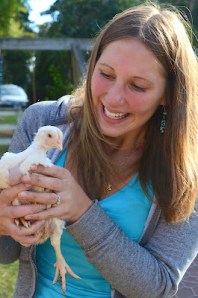
My friend’s great niece doesn’t come from professional farmers, but the gardening gene goes back at least to her Italian great grandfather. Now, having graduated from a liberal arts college and worked for various park services, she is — like a surprising number of young people today — going into farming.

At a farm blog, she describes raising organic chickens in Connecticut.

“Hi! Nichki and Laz from The Wooly Pig here, taking over the Barberry Hill Farm blog for an entry!

“We are young aspiring CT farmers who were lucky enough to meet Kelly and Kingsley last March and over the past several months they have become our good friends and farming mentors. This fall, the Goddards have been so kind as to lend us their pasture and their expertise so that we can raise our very first batch of chickens for our community.

“Our birds are pasture raised, which means they are brought up outdoors with plenty of access to fresh vegetation, open air, and sunlight.

“They are fed a strictly organic diet — an added cost for us that we feel is a worthwhile investment in our customers’ health. …

“We can’t thank our customers enough for supporting local, sustainable agriculture. Your good decisions help build strong, healthy communities right here in Connecticut. …

“For more information on our chickens, please contact us by email at TheWoolyPig@gmail.com.”

Read the engaging Barberry Hill Farm blog here. And if you live near Madison, Connecticut, get your chickens from The Wooly Pig

Photograph from http://www.barberryhillfarm.com.

Read Full Post »

Dr. Paul Farmer, the subject of a great Tracy Kidder book called Mountains Beyond Mountains, has spent many years delivering medical care — and working to alleviate poverty — in remote areas of Haiti. His nonprofit organization, Partners in Health, takes the word “partners” seriously. The teams do not tell the locals what is good for them but makes a point of learning from them and helping them get what they need.

In recent years, Farmer has been in demand in other countries, too. One focus area has been Rwanda. I liked a recent Boston Globe article on the approach to building a Partners in Health hospital there.

“The designers quickly realized that the challenge was not simply to draw up plans, as they had first thought, but rather to understand the spread of airborne disease and design a building that would combat — and in some cases sidestep — the unhealthy conditions common to so many hospitals.

“Learning from health care workers that hospital hallways were known sites of contagion, poorly ventilated, and clogged with patients and visitors, MASS Design decided that the best solution would be to get rid of the hallways. Taking advantage of Rwanda’s temperate climate, they placed the circulation outdoors, designing open verandas running the lengths of the buildings. …

“When it came to building, MASS Design looked at the Partners in Health model of involving local poor communities in health care, and realized that they could apply the same ideas to the construction process. The hospital was built entirely using local labor, providing food and health care for the workers. Unskilled workers received training that would help them get more work; and skilled laborers, notably the Rwandan masons who built the hospital’s exterior from carefully fitted together local volcanic stone, refined their craft and found themselves in demand all over the country. The construction process also beefed up local infrastructure — new roads and a hydroelectric dam — creating more jobs and literally paving the way for future projects.”

To paraphrase what Farmer often says, the biggest challenge to health is poverty. Read more.

Update on the designers from the June 19, 2012, Boston Globe.

Read Full Post »

« Newer Posts