Feeds:
Posts
Comments

Posts Tagged ‘lake’

Photo: Suwa City.
Kiyoshi Miyasaka, a Shinto priest, leads parishioners from the Yatsurugi Shrine onto the frozen Lake Suwa in 2018, the last time the Miwatari, or Sacred Crossing, formed.

Climate change shows up in many ways around the world, especially where humans have kept records for centuries. One such place is in Japan.

Martin Fackler and Hisako Ueno report at the New York Times, “For at least six centuries, residents along a lake in the mountains of central Japan have marked the depth of winter by celebrating the return of a natural phenomenon once revered as the trail of a wandering god.

“It would only appear after days of frigid temperatures had frozen Lake Suwa into a sheet of solid white. First, people were awakened at night by a loud rumbling. Dawn broke to reveal its source: a long, narrow ridge of jagged ice that had mysteriously arisen across the lake’s surface, meandering like the spiked back of a twisting dragon.

“This was the Miwatari, meaning the sacred crossing, which local belief held was left by a passing god of Japan’s native Shinto belief. Its appearance evoked feelings of awe but also reassurance among the residents, who ventured onto the ice to perform a ceremony honoring what they saw as a visitation from the supernatural.

In the rare winters when the ice ridge did not appear, the god’s absence was viewed as a warning that the natural world was out of balance.

“So  important was the Miwatari that residents recorded whether it appeared, the condition of the lake and what historical events accompanied it. They have loyally written these descriptions every winter since 1443, creating a remarkable archive that attests to centuries of monotonously cold winters.

“But recently, the chronicles of Suwa have told a different, more alarming story. For the past seven winters, the Miwatari has failed to appear because the lake didn’t freeze. While there have been occasional years without ice, an absence of this length has happened only once before in the archive, and that was a half millennium ago.

“In fact, Lake Suwa has not fully frozen over — what locals call ‘an open sea’ — for 18 of the past 25 years. Kiyoshi Miyasaka, the chief priest of Yatsurugi Shrine, which for the past three and a half centuries has borne the duty of maintaining the records, says ice has failed to appear with regularity since the 1980s. He and other locals blame the disappearance of the ancient rhythms on global climate change.

“ ‘In old times, an open sea was regarded as a bad omen,’ said Mr. Miyasaka, 74, whose shrine’s traditional stone gate and tile-roofed wooden buildings stand about a mile from the lakeshore. ‘We hear about melting of ice caps and Himalayan glaciers, but our own lake is also trying to alert us.’ …

“Only parishioners in their 60s or older remember when the Miwatari was still big enough to make a sound that could wake them at night. The last time an ice ridge formed, in 2018, it was barely six inches tall.

“ ‘When I was child, the ice spikes rose higher than my height,’ said Isao Nakazawa, 81, a retired auto company worker. ‘We knew when it appeared because it made a sound like a taiko drum, “Gon-gon-gon!” ‘

“These days, the Miwatari has lost much of its religious significance. Residents in Suwa, a small, sleepy city wrapped along the lake’s edge, see it as a local rite of winter. …

” ‘Carrying on a tradition for 580 years binds our community together,’ said the mayor, Yukari Kaneko, 66. ‘I fear what’s happening now is a warning to rethink how we’re living.’

“Science has also robbed the ice ridges of their mystery by explaining how they arise. When Lake Suwa freezes, its surface hardens into a slab some two and a half miles across. On particularly cold nights, the ice contracts, opening cracks that fill with lake water, which also freezes. As temperatures rise again, the slab expands back into its original shape, pushing the newly formed ice upward into buckled ramparts. …

“While Mr. Miyasaka says he feels discouraged by the failure of the ice ridge to return, he intends to keep updating the archive.

“ ‘You cannot just quit something that has been around for more than 580 years,’ said Mr. Miyasaka, whose family has held the position of chief priest for five generations. ‘I will not be the one who ends it.’ ”

More at the Times, here.

Read Full Post »

Photo: Claudia Morales.
The
Guardian reports from Bolivia: “The founders of Team Uru Uru found that totora reeds – which have long been used by their Indigenous community to build houses, boats and even floating islands – can absorb heavy metals.”

“One and two and 50 make a million.”

I still believe in that line from the Pete Seeger folk song about righting wrongs. Today I want to point out that, when it comes to protecting the environment, it’s often indigenous people who see what’s going wrong and decide to do something about it.

Sarah Johnson writes at the Guardian, “Looking out over Lake Uru Uru in the Bolivian highlands, it is hard to imagine that it once supported thousands of people, and was a sanctuary for wildlife, including 76 species of birds.

“Plastic waste now stretches as far as the eye can see, the water is tinged black or brown, and the stench is overwhelming.

“But in among the filth that chokes the water are submerged rafts that hold thousands of native reeds called totora – a bulrush that can grow to 6 metres [~20 feet] and was used to make Lake Titicaca’s famous floating islands. This aquatic plant, Schoenoplectus californicus, has been shown to be very effective at absorbing heavy metals and contaminants.

“Made of recycled plastic collected from the lake, the rafts were placed there by the Uru Uru Team, a group of about 50 Indigenous people.

“For years, lakeside communities have faced pollution from the mining industry, and from the waste of the nearby city of Oruro. The pollution also threatens flora and fauna in the lake, an internationally recognized wetland under the Ramsar convention.

“ ‘It’s very difficult to live and work in these conditions,’ says Dayana Blanco, 25, an Aymara woman who is co-founder of the Uru Uru Team and a Fulbright fellow studying peace-building at the University of Massachusetts in the US.

“ ‘The smell here is very strong and affects our health. When the sun rises and sets, it is intolerable. I had stomach ache from it once. Who knows what illnesses we could get in the future?’

“People living around the lake … used it for drinking water, fished in it, irrigated their crops with it and watered their cattle, says Blanco. This is no longer possible and many of the community have been forced to migrate.

“The lake used to be home to about 120,000 flamingos but only half that number remain. Years of damage to the lake’s fragile ecosystem has pushed wildlife into a small area of unspoiled habitat.

“Changing temperatures and rain patterns have seen Lake Uru Uru’s shoreline recede dramatically over recent years and, as Oruro city has grown, people have built houses in what were protected areas. Bolivia’s other highland lakes, all protected under Ramsar, face similar threats. …

‘Indigenous people know that if a lake dies, it’s as if the soul of a people dies,’ says Tatiana Blanco, 30, Dayana’s sister and in the Uru Uru Team.

“ ‘With colonialism and globalization, new generations have lost their way,’ she says. ‘They’ve forgotten where they’ve come from and that we are not superior to animals, plants, mountains, lakes and rivers. It is because of this lack of respect and care for nature and mother Earth that there’s an imbalance.’

“Fed up with the ever-increasing pollution, the sisters and other young women formed the Uru Uru Team in 2019.

“The first step was to clean the water. Their forebears used totora and so they decided to do the same. As well as being used to build floating platforms and houses, totora is important for treating sewage and mining wastewater as it traps minerals in its roots, leaves and stems.

“They transplanted about 600 young totora from a place where they grow in abundance and placed them on top of rafts made out of plastic bottles and a grid of sticks.

“ ‘We didn’t think the totora would grow, because the pollution is so strong. The water has a lot of heavy minerals,’ says Dayana. ‘But we’ve seen the plants remediating nature little by little and having an effect.’

“The team commissioned laboratory tests from Juan Misael Saracho University in Tarija, which found that areas in the lake with totora had reduced pollution by 30%. Flamingos and other birds have begun to return.

“The Uru Uru Team has planted about 3,000 totora plants so far. … The team’s aim is to plant 4,000 totora a year and completely clean up the lake to bring back the birds and allow the community to grow vegetables again.

“A 2023 Future Rising fellow, she is writing a graphic novel that tells the Uru Uru Team’s story from the perspective of a lake flamingo. The group has a Facebook page and international organizations, such as the United Nations children’s agency, Unicef, have provided technical support.

“Last year, the Uru Uru Team won the UN Development Programme’s 14th Equator prize, which celebrates initiatives by Indigenous peoples and other communities in adapting to and mitigating the climate crisis.”

Read more at the Guardian, here. No paywall but donations encouraged.

Read Full Post »

Photo: Whpq at Wikimedia Commons.
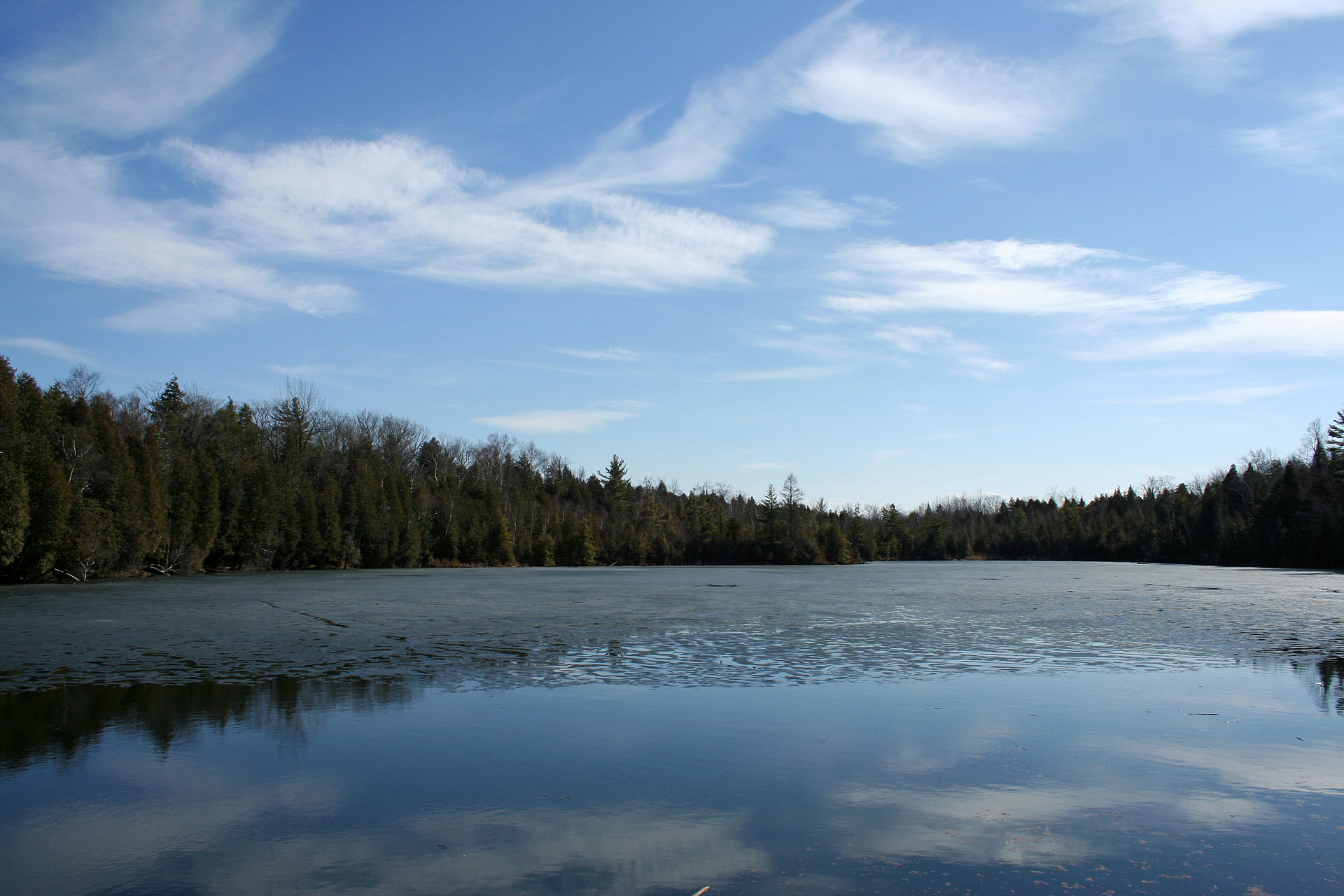
Crawford Lake in Ontario, Canada, is giving up its secrets to geologists.

There is always something new to learn from the ancient record if we know how to read it. Case in point: the unusual characteristics of a deep lake in Canada are helping geologists understand a bit more about today’s rapid changes to the planet.

Sarah Kaplan, Simon Ducroquet, Bonnie Jo Mount, Frank Hulley-Jones, and Emily Wright each contributed to the story at the Washington Post.

“This summer, researchers will determine whether Crawford Lake should be named the official starting point for [the current] geologic chapter, with pollution-laden sediments from the 1950s marking the transition from the dependable environment of the past to the uncertain new reality humans have created.

“In just seven decades, the scientists say, humans have brought about greater changes than they did in more than seven millennia. Never in Earth’s history has the world changed this much, this fast. Never has a single species had the capacity to wreak so much damage — or the chance to prevent so much harm.

“ ‘It’s a line in the sand,’”’ said Francine McCarthy, a professor of Earth sciences at Brock University in Ontario, who has led research on Crawford Lake. …

“Every new phase of Earth’s history begins with a ‘golden spike‘ — a spot in the geologic record where proof of a global transformation is perfectly preserved.

“An exposed Tunisian cliff face bearing traces of an ancient asteroid impact marks the transition from the age of the dinosaurs to the Cenozoic era. Hydrogen molecules uncovered in Greenland’s ice denote the start of the Holocene — the 11,700-year stretch of stable temperatures that encompasses all of human civilization, up to and including the present day.

“These spikes are like exclamation points in the story of the planet, punctuating a tale of shifting continents, evolving species and temperatures that rose and fell as carbon levels fluctuated in the atmosphere. They mark the starts of epochs — small segments of geologic time. And they have helped scientists interpret the forces that shaped Earth’s past climates, which in turn allows them to forecast the effects of modern warming.

“In 2009, the International Commission on Stratigraphy — an obscure scientific body responsible for defining the phases of Earth’s past — created a new working group to investigate the evidence for the Anthropocene. The group’s mission: to identify a potential ‘golden spike’ site that might convince fellow scientists of the new epoch’s validity.

“Their search spanned from mountain summits to the depths of the ocean, from the Antarctic ice sheet to tropical coral reefs. And, in 2018, it led them to McCarthy’s office door.

“Before that moment, few beyond her field knew of McCarthy’s research studying lake sediments for signs of past climate change. Her outreach work was meaningful, but largely local: advocating for conservation of the Great Lakes, teaching geology to students at her midsize public university.

“Crawford Lake was similarly modest. … Yet McCarthy’s colleague Martin Head, a geologist at Brock who had been involved with the Anthropocene Working Group, was intrigued by the rare chemistry uncovered at Crawford.

“Crawford Lake developed thousands of years ago, as water filled a sinkhole in the limestone cliffs of Southern Ontario. Though tiny, the lake is exceptionally deep — so deep its waters are separated into two distinct layers.

“The upper waters are warmed by the sun and mixed by the wind. The layer below is cold and dark, with barely any life to disturb the sediments that accumulate at the bottom. All year long, a constant stream of dead microbes, animal droppings and other organic debris drifts through the Crawford’s waters to settle on the lake bed.

“But during summer, when the the temperature and acidity levels are just right, the water also produces minerals of a white color called calcite that falls to the lake bed forming a thin white cap. Each annual pair of dark and light sediments is also laced with material from outside the lake — pollen grains, pollution particles — that can serve as indicators of the changing environment.

“No other water body is known to possess this particular combination of attributes, making Crawford Lake a unique bellwether of global change. …

“As she considered her colleague’s proposal, McCarthy thought about the decades she’d spent studying prior planetary upheavals. Her work on lake sediments from the past several million years had shown her how dramatic swings in temperature destabilized ecosystems and drove species to extinction.

“Without drastic action to stave off modern climate change, she said, that history could repeat. …

“First, researchers had to tether a wooden raft in the deepest part of the lake, right over the spot they wanted to sample. To extract the lake’s layered sediments, the team used a tool called a ‘freeze corer.’ … The long aluminum wedge was filled with a mixture of alcohol and dry ice, making it much colder than the surrounding water, soil and air.

“They suspended the freeze corer from a tripod and lowered it through a hole in the raft. Down, down it went, through 75 feet of water, until finally it sank into the squishy mud on the lake bottom. Then they waited. It would take about 40 minutes for the lake sediments to freeze onto the corer’s chilly surface.

“Finally, it was time to pull the corer back up. Clinging to its face was a five-foot slice of mud, cut from the lake bottom like a piece from the center of a cake.

“Back on shore, McCarthy traced a gloved finger over the core’s delicate brown and white stripes — sharper than any other sample she’d seen. … Each sample, she knew, would give her a glimpse into a thousand years of the lake’s history, revealing its deepest responses to the changing world above. Each was like a new page from the diary of the Earth. …

“The archive inside Crawford Lake’s cores shows how human pressures on the lake built up over the centuries like steam inside a kettle, until finally the kettle boiled over.

“But humanity’s influence hasn’t always been so destructive.The first people to make their mark on the lake were Native villagers who built longhouses near the lakeshore. Researchers have counted more than two centuries’ worth of sediments from the lake’s ‘Indigenous period’ containing crop pollen and other evidence of human habitation alongside ancient goose droppings and traces of trees.

“Around the start of the 16th century, all signs of the settlement vanished for reasons still unknown. … Sediments from subsequent eras showed Europeans’ growing influence on the landscape. White pine pollen counts dwindled as people cut down trees. Traces of ragweed marked how different species flourished in the cleared land.

“The impacts piled up throughout the 19th and 20th centuries. Tiny black bits of fly ash — a byproduct of burning coal and oil — drifted into the lake from rapidly industrializing cities. Heavy metals like copper and lead increased in the mud.

“And then, around 1950, the world reached a tipping point.

“ ‘This is when humans essentially overwhelmed the Earth as a functioning system,’ said Head, McCarthy’s collaborator. Crawford Lake — and the rest of the planet — were fundamentally, irrevocably transformed.

“The sharpest sign of change was a surge in radioactive plutonium that started in Crawford Lake’s mud around 1950. … A lighter form of nitrogen — a molecular signature of burning fossil fuels — proliferated. The amount of fly ash increased eightfold in less than five years.”

More at the Post, here. If you have a subscription, you can see very cool graphics showing odds and ends floating downward through water.

Read Full Post »

Photo:  Svt Nyheter
Saga Vanecek, an 8-year-old Swedish-American girl, pulled a 1,500-year-old sword from a lake in southern Sweden last July, prompting comparisons to Arthurian legends about the Sword in the Stone and the Lady of the Lake.

You never know when wonders will appear. This little girl was not out helping archaeologists on a dig like the 13-year-old boy in this earlier post. She was just dawdling in a lake while her father was calling her to hurry so he could watch the World Cup on television. And then — a miracle.

Jon Henley writes at the Guardian, “An eight-year-old girl has pulled a 1,500-year-old sword from a lake in southern Sweden.

“ ‘I felt something with my hand and at first I thought it was a stick,’ Saga Vanecek told the local Värnamo Nyheter [VN] newspaper. ‘Then it had a handle that looked like it was a sword, and then I lifted it up and shouted: “Daddy, I found a sword!” ‘

“The find, made in July but announced only [in October] for fear it would trigger a summer stampede to the site at Tånnö on the shore of Lake Vidöstern, felt ‘pretty cool and a bit exciting,’ she told the Swedish public broadcaster Sveriges Radio. …

“Her father, Andrew, said in a Facebook post that the sword, estimated by experts from the nearby Jönköping county museum to date to the 5th or 6th century AD, before the Viking era, was still in the remains of its wood and leather scabbard.

“He told VN he had been waiting impatiently for his daughter to come in from the water because the football World Cup final was about to start, but she was busy skimming stones. Then she stooped and held up the ancient weapon.

“Neighbours confirmed to the Swedish-American family, who moved to Sweden from Minnesota last year, that the rusted artefact did indeed look old, and Nevecek called an archaeologist the next day.

“Annie Rosén, from the museum, said: ‘I was on holiday, but when I saw the pictures I went straight away. You cannot imagine such a sword – so well preserved.’

“Another expert at the museum, Mikael Nordström, [said] they were exploring the possibility it could have been a place of sacrifice. … Subsequent searches by museum staff and local council workers uncovered a brooch from roughly the same period but there were no other significant finds.”

More at the Guardian, here. And you can read Saga Vanecek’s own report here.

May 2019 be the year that girls everywhere pull miracles from lakes and stones.

Read Full Post »

A beautiful day is always a good excuse to walk the grounds of the deCordova Museum in Lincoln, Mass., enjoying the sculptures and lake view.

A little history from the museum website: “DeCordova Sculpture Park and Museum is located on the former estate of Julian de Cordova (1851-1945). The self-educated son of a Jamaican merchant, Julian de Cordova became a successful tea broker, wholesale merchant, investor, and president of the Union Glass Company in Somerville, Massachusetts. Although he married into the locally prominent Dana family of Boston, Julian achieved prosperity without the advantages of inheritance or social position. …

“Inspired by his trips to Spain and his own Spanish heritage, Julian remodeled his summer home in Lincoln, Massachusetts in 1910 to resemble a European castle. …

“For Julian, the visual arts served as a medium for self-improvement and enlightenment. In his later years, he opened the doors of his estate to share the wonders he had collected during seven decades of world travel. Julian envisioned a place where art would continue to educate and excite beyond his lifetime. To meet that end, he gave his property to the town of Lincoln in 1930 with the stipulation that his estate would become a public museum of art following his death.

“Julian’s will established a committee of incorporation, whose duties included formulating the policy, objectives, and supervision of the new museum with the guidance of professionals in the field, such as the Director of the Museum of Fine Arts (MFA) in Boston. Independent appraisers determined that Julian’s collections were not of substantial interest or value, so the collection was sold and the proceeds were used to create a museum of regional contemporary art.”

It’s nice to have an institution that focuses on New England artists, especially one that also offers a beautiful park for families to enjoy.

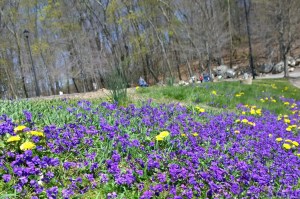
The yellow cables that seem to vibrate between the concrete blocks are a startling aspect of Stephanie Cardon’s sculpture Beacon. The collection of giant leaves, by Alan Sonfist, is called The Endangered Species of New England. The purple carpet is by Mother Nature and is called Violets.

042416-DeCprdova-lake

042416-DeCordova-giant-leaves


042416-violet-carpet-Lincoln-Mass

Read Full Post »

I’m thinking of a hymn I like and a line that seems to go with Thanksgiving,  families, friends, and all the familiar faces that make up one’s context.

“Roots, hold me close.”

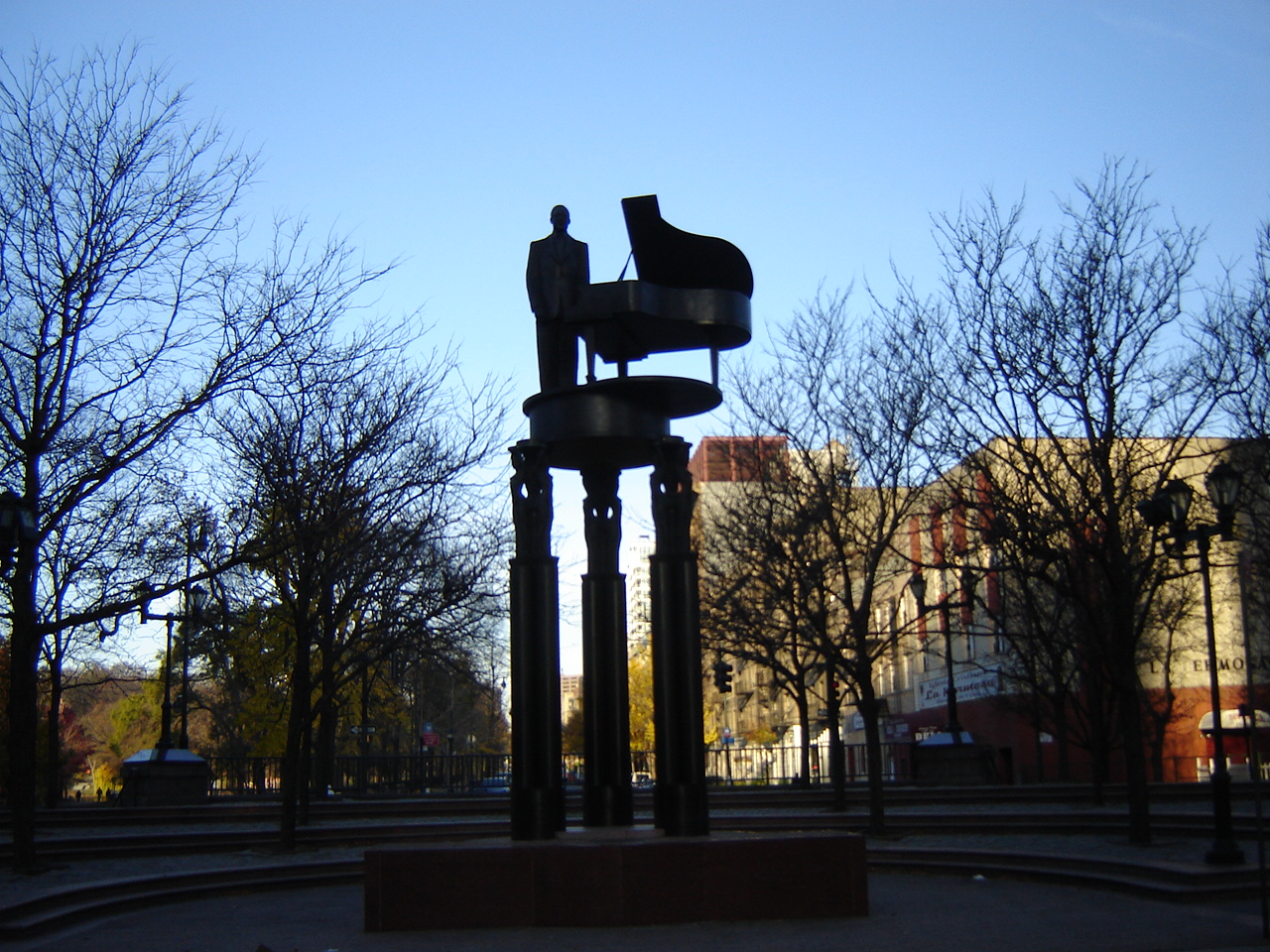
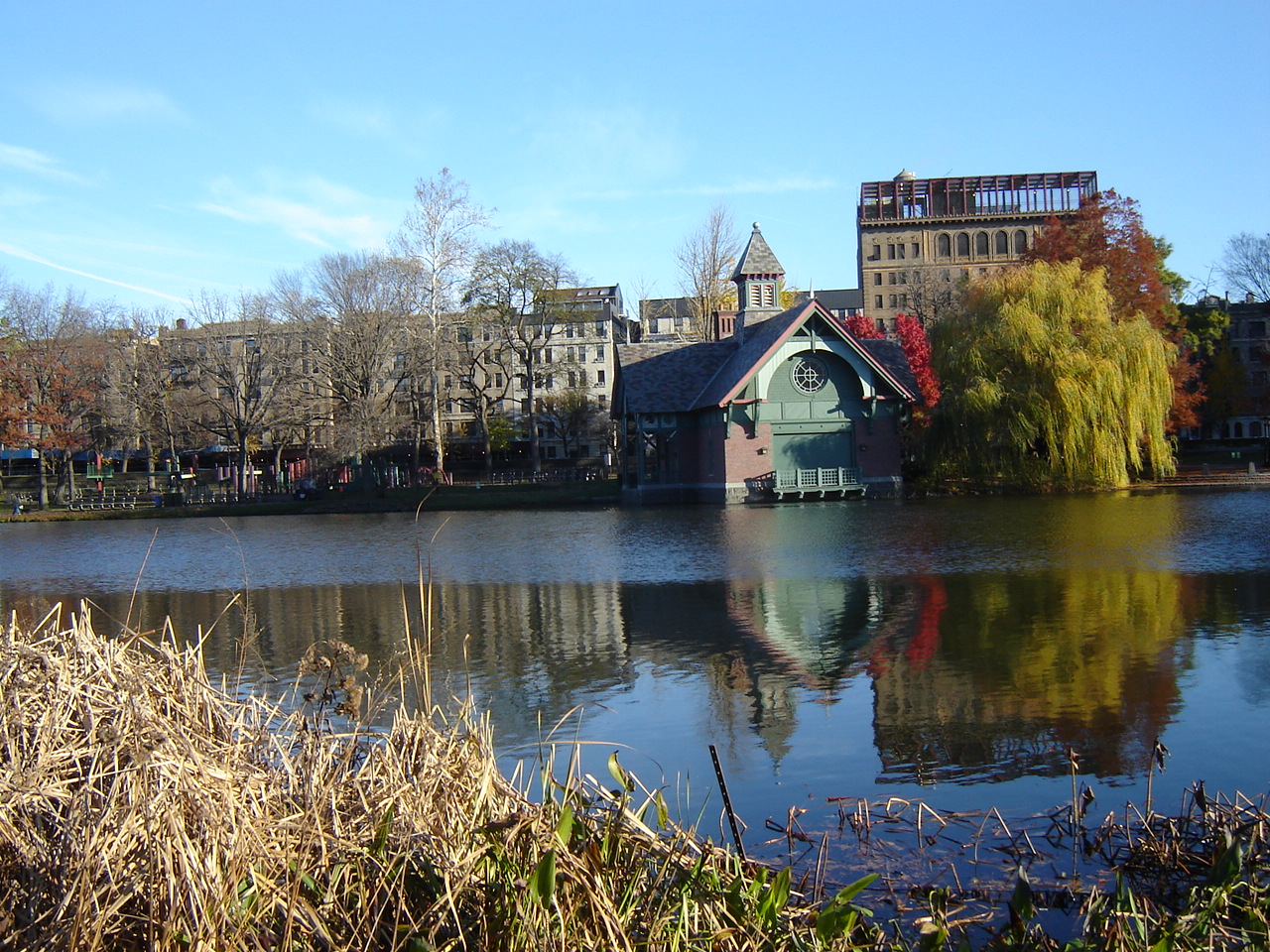
An early walk turned up these roots bordering Central Park. Also a fancy streetlight at Duke Ellington Circle. And the Dana Discovery Center on the lake called Harlem Meer.

We bought flowers on the way back to Suzanne’s apartment, then got to work helping cook the feast. The cranberry sauce from my previous post was a big hit. Also the Swedish apple pies from Erik’s cousin.


Read Full Post »