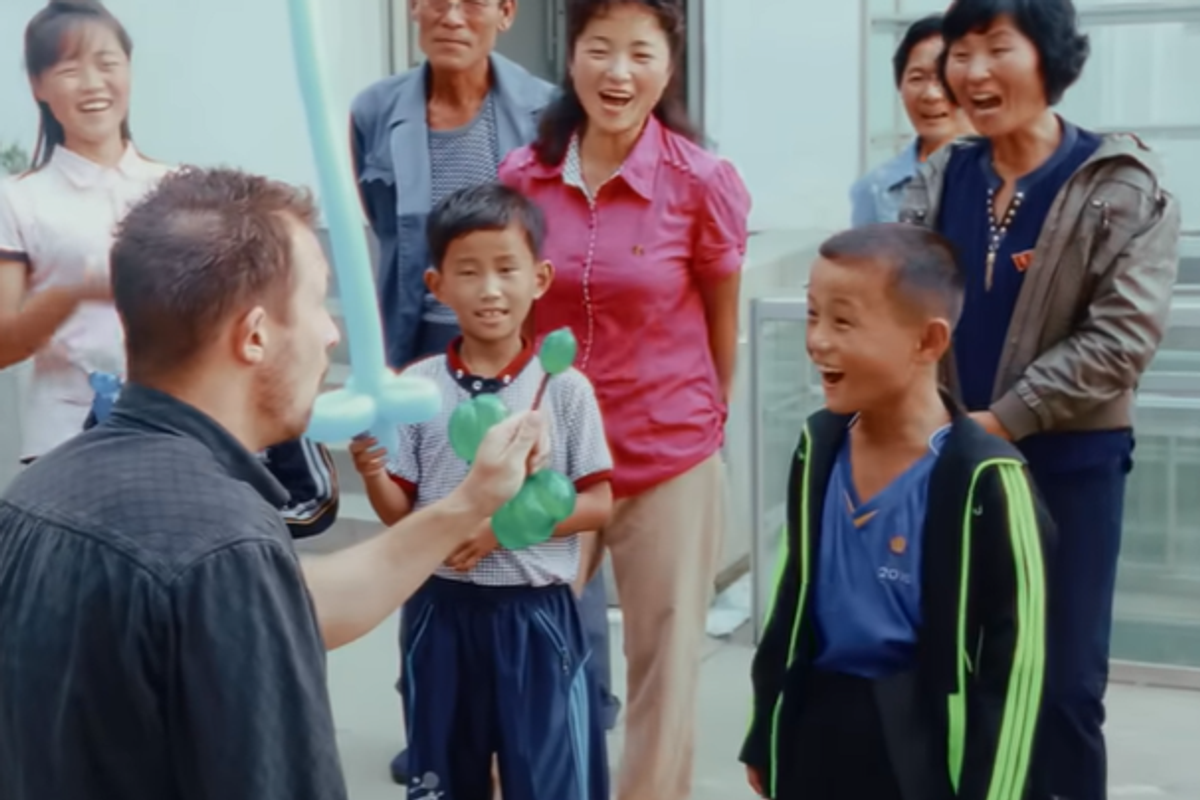
Photo: via Freeport Traveler/YouTube. Jesper Grønkjær, of Denmark, performs magic for children in North Korea.
What does it take to venture into enemy territory to entertain children? A Danish magician just does it.
Tod Perry writes at Upworthy, “North Korea is the most oppressive place in the world, and its people lack freedom of speech, press, or movement. The government, headed by Kim Jong Un, controls all aspects of its citizens’ lives, and those who stand up against the regime are punished harshly. It’s also hostile to people outside the country for fear that outside ideas could destabilize the regime.
“The country is so isolated from the rest of the world that it just recently opened its border to allow a small number of tourists to visit its Special Economic Zone for the first time since the COVID-19 pandemic. …
“Another of North Korea’s recent visitors was [Danish] magician and adventurer Jesper Grønkjær, who set out to see if he could manage to get a smile from its citizens. ‘I’ve spent my life proving one universal truth: a smile is the shortest distance between all people on Earth,’ Grønkjær said.
” ‘We know you can suppress people, but you can’t suppress a smile. I will investigate that, and where better to do it than in one of the strictest countries in the world?’ he opens his video on the Freeport Traveler YouTube page. When Grønkjær visited North Korea, he was accompanied by two guards wherever he went, and his passport was taken from him. At night, he was locked in his hotel like a jail cell. However, he still elicited huge grins from children and adults alike as he wowed them with magic tricks with animal balloons, a stuffed ferret, red foam balls, card tricks, and much of his joyful brand of Abracadabra.
“While visiting North Korea, Grønkjær watched the country’s ‘Day of the Sun Celebrations‘ at Kim Il-Sung Square in North Korea. Held each year on April 15th, the holiday celebrates the birthday of Kim Il-Sung, the country’s founder, and features dancing, military tests, parades, and concerts. For North Koreans, the holiday is akin to Christmas.
“Grønkjær’s trip to North Korea isn’t the only exotic and potentially dangerous place where he has performed magic. He has also performed for Indigenous people in Peru, the descendants of the Incas in the Andes mountains, and the Masai warriors in Tanzania. The magician of 20 years has also performed for orphanages in Uganda, the jungles of Irian Jaya, the ice caps of Greenland, and the Las Vegas strip.
“Grønkjær uses his adventurous expeditions as subject matter for his various lectures, print articles, and appearances on Danish television. When he’s back home, he performs more than 225 nights a year for family events, circuses, weddings, and corporate parties. …
“Grønkjær’s work shows that no matter where you live on the planet or what language you speak, we all share the same sense of wonder and humor. While nefarious forces in the world work to drive us apart, he proves it takes very little for all of us to realize our shared humanity.”
More at Upworthy, here. Listen to a radio interview at The World, here.
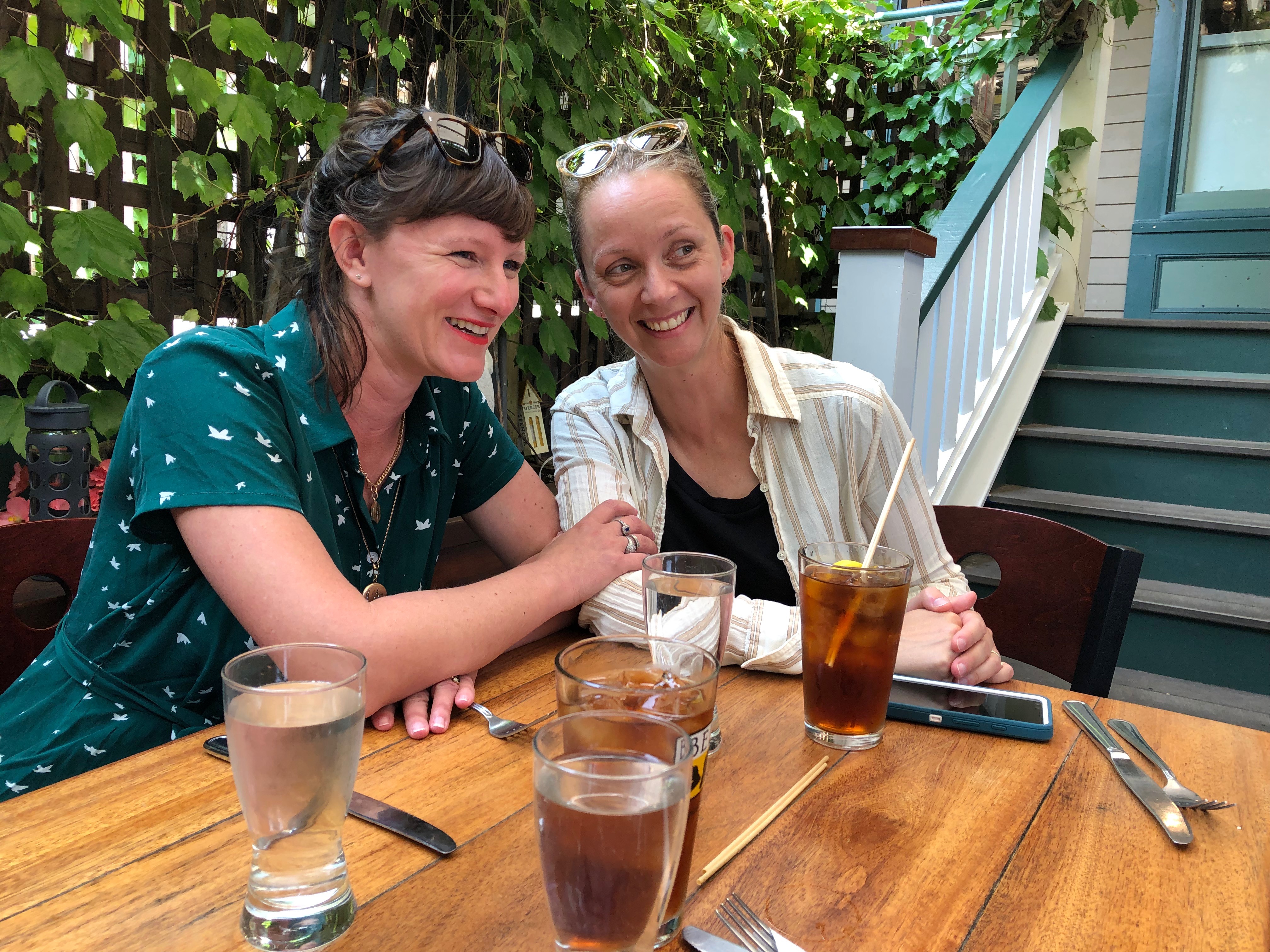
Photo: Suzanne and John’s Mom. Suzanne and Kate on Cape Cod. They laugh a lot.
When I saw today’s article by Teddy Amenabar at the WashingtonPost, I knew it would be blog material. That’s not just because friends have been important to me since childhood (Hello, Hannah!), but because I’ve been learning about the particular virtues that conversation with friends has for older people. There’s the value of relaxing, having fun. But there are also cognitive benefits from focusing on what friends are saying and responding thoughtfully.
Amenabar writes, “One of the more surprising findings in the science of relationships is that both romance and friendship often start the same way — with a spark. … A growing body of research shows friends are essential to a healthy life — and they are just as important for our well-being as healthy eating habits or a good night’s sleep.
“Platonic love trumps romantic love in a number of ways. People with strong friendships tend to have better mental health and studies suggest they’re in better physical health, as well. Researchers have found large social networks lower our risk of premature death more than exercise or dieting alone.
A six-year study of 736 middle-aged Swedish men found having a life partner didn’t affect the risk of heart attack or fatal coronary heart disease — but having friends did.
“A 10-year Australian study found that older people with a lot of friends were 22 percent less likely to die during the study period than those with few friends. Notably, having a social network of children and relatives did not affect survival rates. …
“There are multiple theories about the association between friendship and better health. Part of the effect may be due to the fact that it’s easier for healthy people to make friends. A strong social network could be an indicator that someone has more access to medical care. And, someone with more friends may just have a better support system to get a ride to the doctor’s office.
“But there is also a psychological effect of friendship that likely plays a role. Friends help us cope with stress. In one study at the University of Virginia, many people were intimidated at the prospect of climbing a steep hill. But researchers found that when people were standing next to a friend, they rated the hill less challenging than those who were alone.
“Brain imaging studies suggest that friendship affects brain systems associated with reward, stress and negative emotions, offering an explanation for why social connection benefits mental health and well-being. Friendship even seems to affect our immune response. In one remarkable study, 276 healthy volunteers were given nose drops containing a cold virus. Those with diverse social ties were less likely to develop cold symptoms. …
“Friends don’t just appear out of thin air, Franco said. Here’s her advice for making new connections and maintaining the old ones.
“Take the initiative. Trust your gut when you’re meeting new people. We’re particularly good at knowing when someone is a potential new friend (remember that spark). And, you should assume people like you. We often underestimate how positively others think of us, Franco said. …
“Start with a text. Start small by scrolling through your phone and shooting a text message to an old friend you’ve been meaning to reconnect with.
“Show your gratitude. If a potential friend reaches out to you to grab coffee or pizza, tell them how happy you are they reached out, and that you appreciate the effort, Franco said. In a University of Utah study, researchers asked 70 college freshman to keep a check list of certain interactions — like going to see a movie together or calling just to say hello — they did with new friends. After three months, the researchers found that close friendships were more likely to form when the pairs expressed affection to each other. …
“Invite friends to things you’ve already planned. If it’s hard to find time for friends, think of the tasks you already have to accomplish and tag on a friend, Franco said. The next time you workout at the gym, for example, you could invite someone to join. ‘Ask yourself: Are there parts of your day right now that you’re doing anyway that you can just do in community with other people?’ Franco said.
“Join a book club, take a class or play a sport. Regular interaction with people who share the same interests as you could lead to friendship. Another University of Maryland study that found cadets who sat next to each other in police academy were more likely to become close friends. …
“While having friends is good for your health, not having them can be detrimental.According to the Centers for Disease Control and Prevention, loneliness has been associated with higher rates of depression, anxiety, and suicide. For older women, loneliness and social isolation can increase the risk of heart disease by as much as 27 percent.
“Loneliness is essentially the perceived gap between the relationships you have and the relationships you want in your life, said Adam Smiley Poswolsky, the author of Friendship in the Age of Loneliness.
“A 2018 study found that loneliness is common across age groups. … Social media can exacerbate our perception of loneliness by bombarding us with photos and videos of friends and acquaintances seemingly spending their time without us, said Poswolsky.
“[Said] Poswolsky, ‘No one feels like they can talk about it because there’s a lot of shame associated with loneliness.’
“Billy Baker, the author of We Need to Hang Out, a memoir of his personal journey to find new friends as a middle-aged man, said he realized he needed to build beyond the lifelong friendships he made in high school or college.
“Baker said he didn’t have very many people he could call in the middle of the night if there was an emergency. To remedy this, he started a fraternity for neighborhood dads to meet every Wednesday night, and the group now gets together on other days and on the weekends.
“Baker said he’s spent years ‘checking off so many other boxes,’ to be a good father and husband, but he’s never had ‘hanging out with my buddies’ on the list.
“ ‘We all know how to do this,’ he said. ‘What very often happens in those moments is you feel that spark with someone and you say: “Hey, we should grab a beer some time!” But, how often do you go grab that beer?’ ”
As Suzanne and her fellow Girl Scouts used to sing,
“Make new friends “But keep the old. “One is silver “And the other gold.”
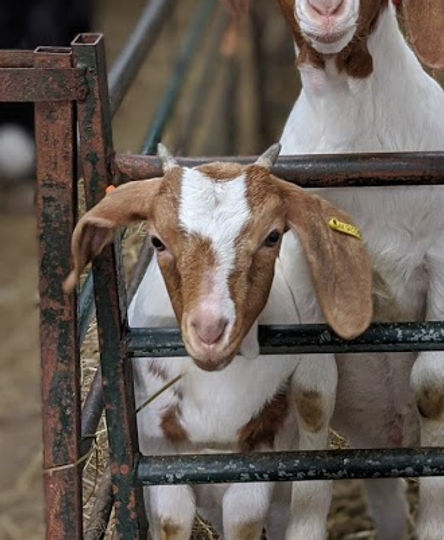
Photo: Cronkshaw Fold Farm. This is Lulu. “Lulu likes to use her treacherous screech to interrupt any time a goat other than her is booked for a call.”
Everybody loves goats. I’ve lost count of the number of times my youngest grandchild has had me tell her the story of the goat that ate my brother’s mitten when he was 2 or 3. Maybe the goat only pulled the mitten off. Not sure. But eating makes a better story, and my granddaughter likes me to embroider the tale with all sorts of other details that never happened.
Meanwhile, in England, goats are participating in Zoom calls. Sydney Page reported the story for the Washington Post.
“At this point in the pandemic, Zoom fatigue is universal. But one woman has a solution you never knew you needed: a live goat on the call.
“Cronkshaw Fold Farm in Lancashire, England, has been offering up their goats to make spontaneous, up-close appearances in virtual meetings anywhere in the world.
” ‘It started as a joke. It wasn’t actually supposed to be a thing,’ said Dot McCarthy, 32, who runs the family farm, which spans two generations.
“The goats drop in on otherwise mundane virtual gatherings, including seemingly serious business meetings, birthday parties, baby showers and high school math lessons. Out of nowhere, a goat will appear in the meeting with its name displayed on the screen.
It’s typically a surprise to all attendees but the organizer. The idea is that the goat ‘crashes’ the party. …
“At first, ‘it was just to give people a laugh, and I thought, maybe we’ll get a few more egg and meat sales because people are on the website,’ McCarthy said. ‘But what actually happened was people were like, “Yes, I need a goat.” ‘
“After sharing a post on the farm’s website explaining the idea one evening early in the pandemic, she woke up the next morning to 200 emails requesting a goat call. In the past 11 months, Cronkshaw Fold Farm has facilitated more than 10,000 five-minute video calls on conferencing platforms.
“While the main idea is to get some laughs during a grim time, the goat video calls have managed to keep the 500-year-old farm afloat — and staff members employed. …
“ ‘You just see people screaming and saying, “Why is there is a goat in here?!” ‘ McCarthy said, adding that each goat is labeled with their name when entering a call because they each have a particular personality.
“People like to have their pick, she said. That’s part of what makes it fun. Seven of the farm’s 40 goats are showcased on the website, with a photo, a brief bio, as well as a ‘what to expect’ section displayed for each. …
“Alongside training sheepdogs and selling eggs, meat, produce and manure (for gardening purposes), the farm financially depends on hosting educational visits, weddings and other events, all of which paused during the coronavirus pandemic.
“Employee wages are normally reliant on these events, McCarthy said, leaving her in a bind. ‘They work so hard,’ she said, explaining that she was adamant about keeping her two employees on the payroll. ‘I just iterated through idea after idea, asking myself what we can do to make money.’ …
“ ‘A few friends who work in the tech sector were saying how bored they are with video calls, and I was like, “You know what would be funny? If you just had a goat appear in your call. Why not throw a goat into the mix?” ‘
“Since April, the spontaneous service has brought in around $60,000, allowing McCarthy to continue paying her staff members. Plus, additional funds go toward her long-term goal of converting the farm to renewable power.”
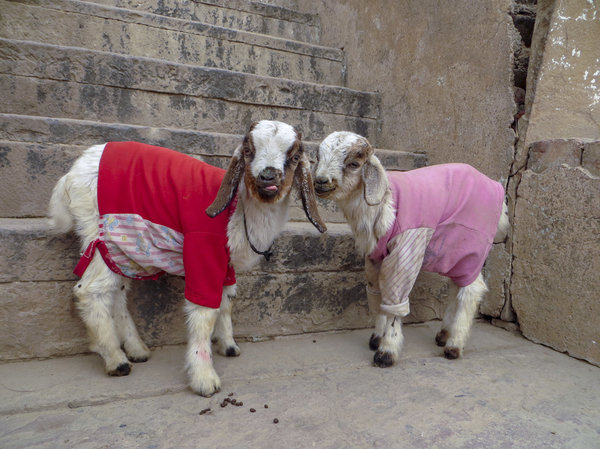
By the way, in Lunenburg, Massachusetts, you can go hiking with a goat for a reasonable fee. Check it out. Are you on Instagram? You’ll get a kick out of @sweateredgoats from Bangladesh and India.
Photo: Christy Sommers. An Iowa native’s Instagram account features sweatered goats in Bangladesh and India. Check out my previous post.

 Suzanne's Mom's Blog