
Feeds:
Posts
Comments

Posts Tagged ‘law’

Photo: Miryan Delgado.
Satipo and Nauta municipalities are the first in Peru to grant legal rights to stingless bees. 

Today’s article is about protecting special bees in the Amazon. As I read it, I couldn’t help thinking about a novella called The Bee Wife, by novelist, blogger — and advocate for indigenous Amazonian languages — Francesca Forrest.

The article is about stingless bees in Peru being granted legal rights.

Damien Gayle at the Guardian, “Stingless bees from the Amazon have become the first insects to be granted legal rights. …

“It means that across a broad swathe of the Peruvian Amazon, the rainforest’s long-overlooked native bees – which, unlike their cousins the European honeybees, have no sting – now have the right to exist and to flourish. Cultivated by Indigenous peoples since pre-Columbian times, stingless bees are thought to be key rainforest pollinators, sustaining biodiversity and ecosystem health.

“But they are faced with a deadly confluence of climate change, deforestation and pesticides, as well as competition from European bees, and scientists and campaigners have been racing against time to get stingless bees on international conservation red lists.

“Constanza Prieto, Latin American director at the Earth Law Center, who was part of the campaign, said: ‘This ordinance marks a turning point in our relationship with nature: it makes stingless bees visible, recognizes them as rights-bearing subjects, and affirms their essential role in preserving ecosystems.’

“The world-first ordinances, passed in two Peruvian regions in the past few months, follow a campaign of research and advocacy spearheaded by Rosa Vásquez Espinoza, founder of Amazon Research Internacional, who has spent the past few years traveling into the Amazon to work with Indigenous people to document the bees.

“Espinoza, a chemical biologist, first started researching the bees in 2020, after a colleague asked her to conduct an analysis of their honey, which was being used during the pandemic in Indigenous communities where treatments for Covid were in short supply. She was stunned by the findings.

” ‘I was seeing hundreds of medicinal molecules, like molecules that are known to have some sort of biological medicinal property,’ Espinoza recalled. ‘And the variety was also really wild – these molecules have been known to have anti-inflammatory effects or antiviral, antibacterial, antioxidant, even anti-cancer.’

“Espinoza, who has written a book, The Spirit of the Rainforest, about her work in the Amazon, began leading expeditions to learn more about stingless bees, working with Indigenous people to document the traditional methods of finding and cultivating the insects, and harvesting their honey.

“Found in tropical regions across the world, stingless bees, a class that encompasses a number of varieties, are the oldest bee species on the planet. About half of the world’s 500 known species live in the Amazon, where they are responsible for pollinating more than 80% of the flora, including such crops as cacao, coffee and avocados.

“They also hold deep cultural and spiritual meaning for the forest’s Indigenous Asháninka and Kukama-Kukamiria peoples. ‘Within the stingless bee lives Indigenous traditional knowledge, passed down since the time of our grandparents,’ said Apu Cesar Ramos, president of EcoAshaninka of the Ashaninka Communal Reserve. ‘The stingless bee has existed since time immemorial and reflects our coexistence with the rainforest.’

“From the outset, Espinoza began hearing reports that the bees were becoming more difficult to find. ‘We were talking actively with the different community members and the first things they were saying, which they still do to this day, is: “I cannot see my bees any more. It used to take me 30 minutes walking into the jungle to find them. And now it takes me hours.’ “

“Her chemical analysis had also turned up some concerning findings. Traces of pesticides were appearing in the stingless bees’ honey – despite their being kept in areas far from industrial agriculture. …

“For years, the only kinds of bees to have official recognition in Peru have been European honeybees, brought to the continent by colonizers in the 1500s.

“ ‘It almost created a vicious cycle. I cannot give you the funding because you’re not on the list, but you cannot even get on the list because you don’t have the data. You don’t have the funding to get it.’ In 2023, they formally began a project to map the extent and ecology of the bees, ‘because by that time we had already spoken with the [International Union for the Conservation of Nature (IUCN)] and some government people in Peru and understood that that data was critical.’

“The mapping revealed links between deforestation and the decline of stingless bees – research that helped contribute to the passing of a law in 2024 recognising stingless bees as the native bees of Peru. The law was a critical step, as Peruvian law requires the protection of native species. …

“In experiment in 1950s Brazil to create a strain that would produce more honey in tropical conditions led to the creation of the Africanized honeybee. … Now, Espinoza and her colleagues found, these Africanized bees have begun outcompeting the comparatively gentle stingless bees in their own habitats. …

“Living a semi-nomadic lifestyle in a remote part of the Avireri Vraem Biosphere reserve, Elizabeth [an Asháninka elder] farmed and kept bees at a spot in the forest some distance from her home. But she described how her stingless bees had been displaced by Africanized bees, which attacked her violently whenever she visited.

“ ‘I felt so scared, to be honest,’ said Espinoza. … ‘I want them gone.’ “

Read what happened next at the Guardian, here.
Read Full Post »

Today’s challenge features my favorite lines from “America the Beautiful,” the 1895 poem by Katharine Lee Bates, with music by Samuel A. Ward. The challenge is to sing it along with me — outloud — without choking up.

“O beautiful for spacious skies,
“For amber waves of grain,
“For purple mountain majesties
“Above the fruited plain! …

“America! America!
“God mend thine ev’ry flaw,
“Confirm thy soul in self-control,
“Thy liberty in law.”

Read Full Post »

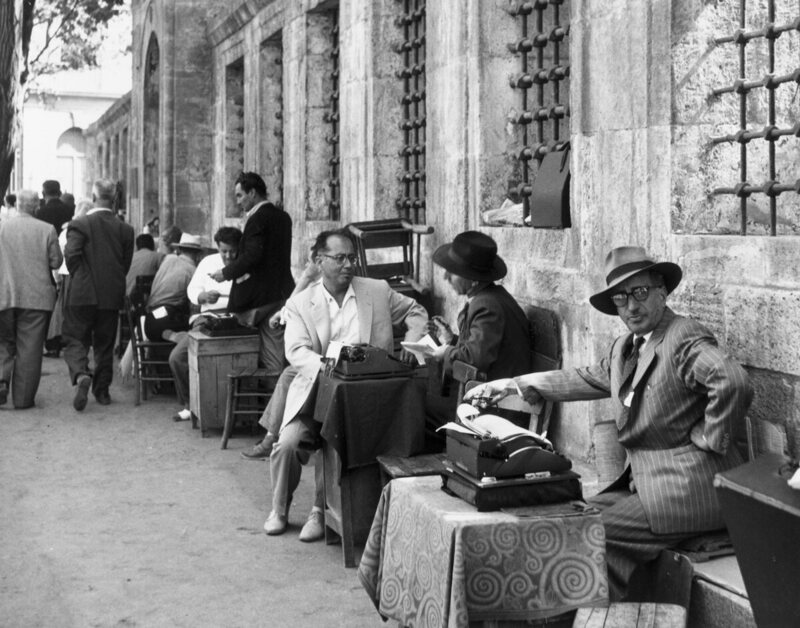
Photo: Bruch / Stringer
A street in Istanbul where people could go to have documents typed up while they waited, 1959. The tradition is only just dying out now.

In Turkey, public scribes have offered a document-typing service for generations. Now, partly because of the opposition of lawyers and partly because of new laws providing legal access to the indigent, the tradition is fading away.

Joshua Allen writes at Atlas Obscura, “On a side street near Istanbul’s Çağlayan Courthouse, an electric sign reading ‘Petition Writer’ points to the open door of 67-year-old Hayrettin Talih’s tiny, one-room office. …

“Talih sits in front of a manual typewriter, in the same pose as a black-and-white photograph of himself, from 40 years earlier, which is tacked on the wall beside him.

“Occupying the chairs opposite his desk are a couple of older citizens who are explaining a property dispute with a relative. Talih listens, demands clarification where necessary, and finally applies his fingers to the chattering typewriter, producing an affidavit that the couple will use to start proceedings at the courthouse, and hopefully get their rightful dues.

“Although he is not a lawyer, Talih has clients who clearly trust him to translate their experiences into Turkish legalese, which is replete with archaic Ottoman words — much like the Latin phrases beloved of English-speaking lawyers. An understanding of this obscure language is vital to Talih’s work as a public scribe or arzuhalci, a profession he entered almost 50 years ago. Now, he is one of the last of his kind. …

“Public scribes were a necessity in the Ottoman era, when the language used in state documents was even farther removed from ordinary speech and a large percentage of the population was illiterate. On top of legal work, the scribes also made a living by writing love notes and letters for soldiers who travelled to fight in the wars that consumed the Ottoman Empire in the late 19th and early 20th centuries. …

“The scribes say that they do not claim to be lawyers, as they merely help clients to express themselves on paper. ‘Let’s say I wrote something I don’t know about, and the person lost all his expenses and lost the case. Won’t he turn around and complain about me for putting him in that loss? It’s better not to write something you don’t know,’ Talih says.

“[Scribes] defend their profession as the only option for those who cannot afford a lawyer. … But according to İmmihan Sadioğlu, a lawyer at the Istanbul Bar Association, … the legal labyrinth cannot be navigated by an amateur, and the specific wording that the scribes use in the initial documents can be crucial. …

“After all, there is a government system in Turkey that covers the costs of those who cannot afford to pay a lawyer. … As this government support becomes better known, Sadioğlu and her fellow lawyers believe that the last scribes will see the writing on the wall.

“ ‘If a disadvantaged person can access justice easily, then he won’t look for other solutions. As for the state, it should increase the level of funding for legal aid,’ Sadioğlu says. ‘Someone who can receive a better and higher quality service from a free lawyer will not consider risking his rights by using a scribe.’ More at Atlas Obscura, here.

Don’t you love the fedora in the old photo? I think I’d ask for the help of a scribe just to sit and admire that hat.

Read Full Post »

Sheikh Khalifa believes the United Arab Emirates would benefit in multiple ways if people there had more time to read. So he saw to it that a law got passed requiring employers to do their bit.

The National reports, “Employees will be given time off work to read under a law that was passed [in October], which also exempts reading material from taxes and fees.

“The President, Sheikh Khalifa, announced the law, which is aimed at achieving the country’s vision of a knowledge-based economy. …

“As part of the law, the Government will give a ‘knowledge briefcase’ to the families of newborns.

“Schools will be obliged to encourage reading among pupils, as well as a respect for books. Books that are no longer wanted must not be destroyed, but preserved, reused or donated, Sheikh Mohammed said.

“Fees and taxes for distributing, publishing and printing reading material will be scrapped, and facilities for authors, editors and publishing houses will be provided. Sheikh Mohammed said the law would consolidate ‘the cultural image of books in our society, and oblige coffee shops in shopping malls to offer reading material for customers.’ …

“A national fund will be set up to support reading initiatives and assist media organisations to advertise the importance of books. The fund will also be used organise a month dedicated each year to promoting literature.”

More here.

It’s an unusual approach, but it seems OK as long as there is freedom to choose what gets read. Lately, I’ve been immersed in the beautiful, wrenching autobiography of poet Jimmy Santiago Baca and learning all over again how literacy gives people wings. Baca learned to read in prison at around age 20 and it transformed his life.

Read Full Post »

As I noted the other day, the approach to saving the Harlem home of Langston Hughes is online fund-raising.

Meanwhile in France, the home of James Baldwin may be saved by a squatter and a quirky French law.

Shannon Cain writes at LitHub.com, “To clean the floor of James Baldwin’s guest room would take 32 disposable cleaning wipes. I figured this out on my hands and knees, estimating the square footage of the terra cotta tile surface. There were 40 wipes in the package. If I used one wipe per roughly two square feet, I’d have enough. I was camping here without running water or electricity, but damned if I was going to live inside a dusty mess.

“Four days earlier, struggling under the weight of a camping backpack laden with supplies, a duffel of linens, bag of books and a deluxe inflatable bed, I’d pushed aside the unlocked wire barrier of the ten-acre property and entered the 17th-century stone house, illegally.

“It wasn’t hard to do; the door had been busted off its frame long before I arrived and the place was wide open. I was sweating, exhausted and elated; I’d spent the previous six hours traveling by trains and buses from Paris, stressing hard about this moment, worried I’d be detected. …

“I needed to establish my squatters’ rights, which according to French law would be mine after 48 hours. The cancelled postage on the postcard I was about to send to myself would serve as one of these proofs. … To send a letter, one addresses it to the Ancienne Maison Baldwin, chemin du Pilon, St. Paul de Vence 06570. It seems the post office, at least, remembers James Baldwin. …

“The squatter’s law in France is meant to dissuade land speculation and absentee ownership. It is perhaps one of the purest manifestations of socialism. For seven years, the real estate developer that owns the Baldwin house has let this historic structure and its magnificent gardens go to seed. In the meantime, they’ve been busy with other projects, including the construction of an enormous American-style shopping center in Nice, all superstores and parking lots, reputedly built within a flood plain.

“In my research over the last months I have heard nothing but disdain and outright hatred for this corporation among the local people. ‘He’s a bandit, that one,’ muttered a local business owner.”

Read the whole crazy adventure and how Cain outfoxes the “bandit,” here.

Photo: Shannon Cain
Former home of writer James Baldwin on the French Côte d’Azur.

Read Full Post »