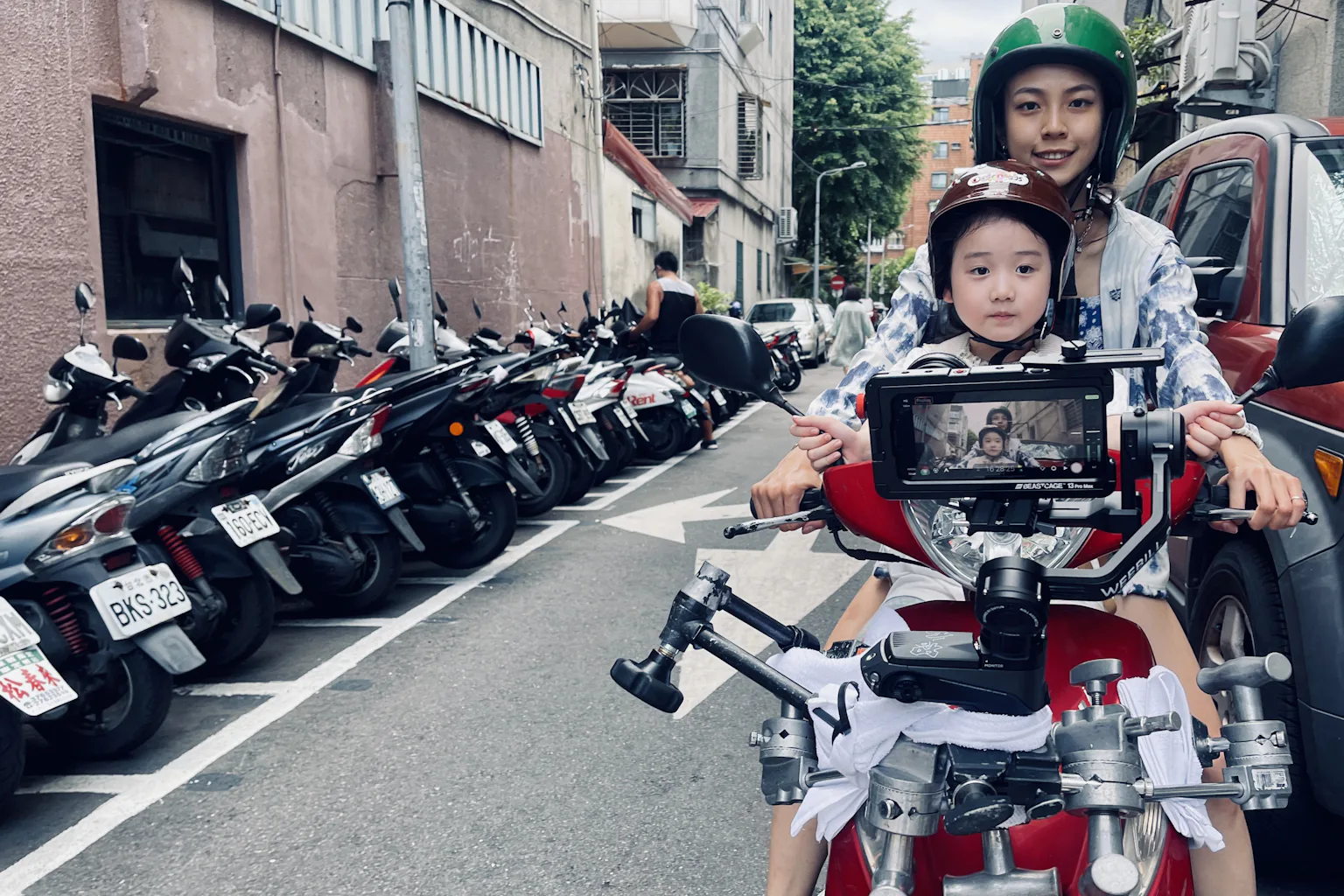
Photo: LHG Films.
A still from Left-Handed Girl, a movie created on a phone.
A good subtitle for today’s story about making films on smartphones would be “There’s no one coming. … You have to do it yourself.”
Victoria Mapplebeck, professor of digital arts at Royal Holloway, University of London, writes at the Conversation about overcoming the challenges.
“When my feature documentary Motherboard was released, I was in my late 50s. I had filmed it over 20 years, on five generations of smartphones, documenting the pain, joy and comedy of raising my son Jim alone. …
“The film that changed everything for me was Tangerine, which was famously shot on an iPhone 5 in 2014. Its energy and immediacy blew me away.
“Around the same time, I came across an interview with director Ava DuVernay, the first black woman to win the best director prize for her film Middle of Nowhere at the Sundance Film Festival in 2012. Her advice to fellow filmmakers was to stop waiting for the right agent, financier or producer to ‘discover’ you. ‘There’s no one coming … You have to do it yourself.’ …
“Jim grew up on camera. I filmed his first day at school and his last day at college. I filmed days out, dance-offs and bedtime routines. I filmed the difficult stuff too: the day I was diagnosed with breast cancer, Jim’s reaction to meeting his dad for the first time at 14 and the rollercoaster teen years that followed. The smartphone made that access possible. Jim liked its spontaneity and low-fi intimacy; sometimes he filmed me on his phone too. …
“I could film on buses, trains and in hospitals without months of emails trying to secure access. During chemotherapy and radiotherapy, filming on a phone wasn’t intimidating and no one ever said ‘no.’ Sometimes nurses even helped me shoot, pressing record as I disappeared into another CT scan. …
“Over the last 15 years, as a filmmaker and professor of digital arts, I have seen extraordinary shorts and features made on smartphones. Many were created by early career filmmakers who would have struggled to access industry funding without a smartphone and a minimal crew. …
“This July, I’ve co-curated SMART, a one-day Smartphone filmmaking festival at Finsbury Park Picturehouse. The festival will celebrate filmmakers who have pioneered this way of working and got their films across the finish line despite the odds. I will also be screening Motherboard, followed by an audience Q&A with my son Jim and me.
“The program ranges from no-budget DIY shorts to internationally acclaimed features. It includes Shih-Ching Tsou’s Left-Handed Girl (2025), co-written and edited by Tangerine director Sean Baker – who won an Oscar for his film Anora in 2025 – and shot Tangerine on an iPhone with a small, agile crew.
“Tsou has been producing films with Baker for 25 years, but Left-Handed Girl is the first feature she has directed and co-written. When I interviewed her recently, she acknowledged how long it had taken to get the film financed: ‘I had the idea in, like, early 2000. So that’s how crazy this whole journey is.’
“Tsou is drawn to the freedom smartphones give filmmakers, but what really interests her is their access and intimacy. When she first considered setting her film in a Taipei night market, Taiwanese producers told her it would be impossible to shoot there for real. ‘They all said you need to build your night market. You have to hire all the extras,’ she told me. ‘I’m like, no, that’s not how I’m going to do it.’
“Instead, she shot on location with the iPhone 13 she still carries today. At first the 20 person crew and rig was too large, attracting crowds who stopped to watch. Only after reducing the crew size even further could Tsou successfully capture child actor Nina Ye running through the shops and kiosks of the night market as everyday life continued around her. …
“Several of the filmmakers showing shorts at SMART as part of the filmmaker panel discussion, are at the start of their careers. Tsou’s advice to them was simple: learn more than one skill. ‘You need to be able to write your own story and try to shoot your own story. And try to edit your own story. If you have these three basic skills, you don’t need anything. You don’t need money.’ “
More at the Conversation, here. No paywall.

 Suzanne's Mom's Blog