Feeds:
Posts
Comments

Posts Tagged ‘london’

Photo: Rory Murphy.
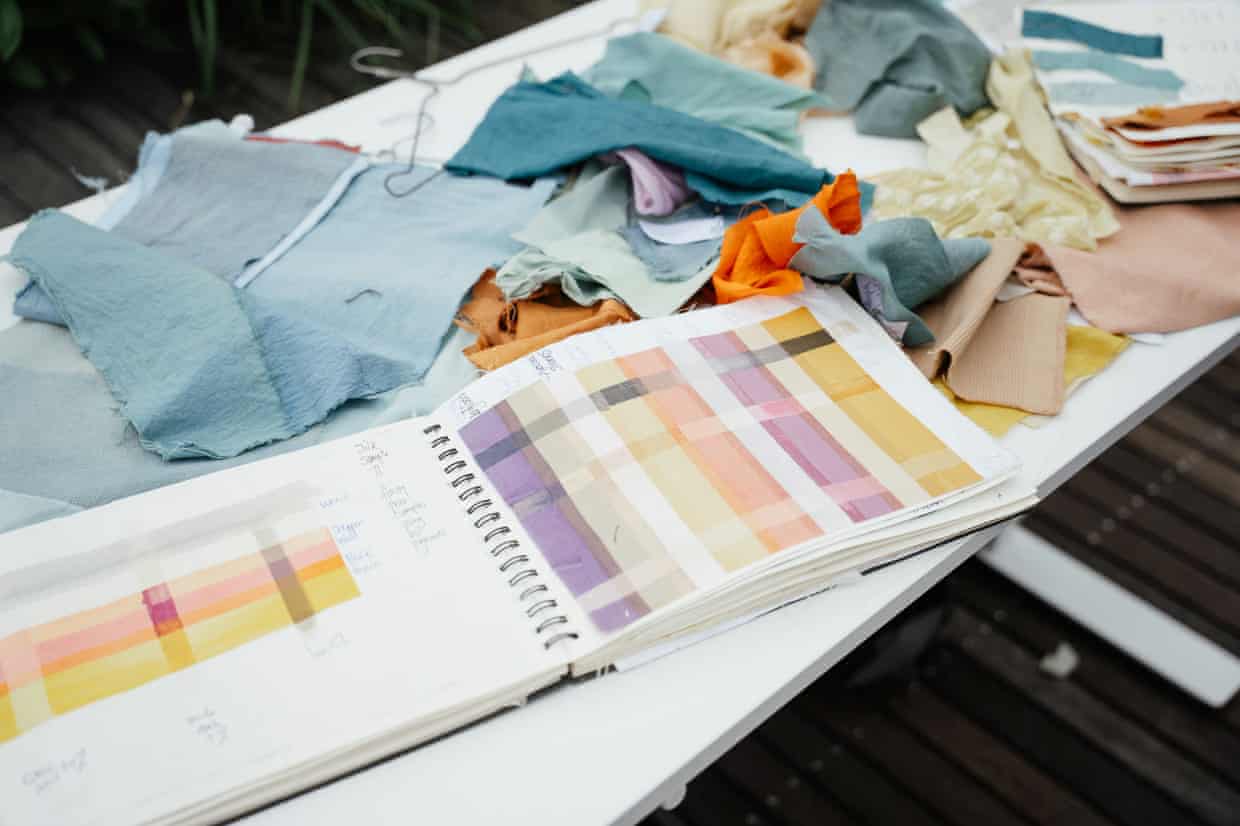
Chemical dyes are often toxic for the environment and bad for human health, and that is why the National Theatre in London is planning to use natural dyes from a rooftop garden in its costumes.

My friend Ann is deep into using natural dyes for her textile art, and she even grows the plants that are used for those dyes. It is not just that she is concerned about all the synthetics in our environment, she loves the colors that nature produces.

In London, the National Theatre is on the same track.

Helena Horton  writes at the Guardian, “Squint at the roof of the grey, brutalist National Theatre on London’s South Bank and you might be able to spy a riot of color spilling from the concrete. This is the theater’s new natural dye garden, from which flowers are being picked to create the colors for the costumes worn in the theater’s plays.

“Chemical dyes are often toxic for the environment and bad for human health, so the costume designers at the theater are experimenting with using flowers including indigo, dahlias, hollyhocks, camomile and wild fennel to create the vivid colors used in their productions.

“The textile artist, Liz Honeybone, is buzzing with excitement about the opportunities the new garden is bringing. … She has been very concerned about the health impacts of using harsh, synthetic chemical dyes, which require users to be swaddled in protective clothing. …

“ ‘There used to be a thing called dyer’s nose, which is basically when the aniline dyes came in,’ Honeybone said, ‘They used to destroy your nasal membrane.’ …

“The theater is planning to use natural dyes from the garden in every production at the South Bank going forward, starting with Playboy of the Western World, which is on this autumn and winter.

“Claire Wardroper, costume production supervisor at the theater, said it was ‘a beautiful early 19th century piece, with lots of nice woolly jumpers, because it’s set in rural Ireland, and we can certainly get some nice colors into them.’ …

“They are trying to bring a gentler, more environmentally friendly way of dyeing into the mainstream. ‘We are saying that if you want to use this horrible synthetic dye, you can do that, but you can achieve this beautiful look by using a natural dye, and we can do it a little bit slower and a bit more sort of organically,’ said Honeybone.

“Wardroper added: ‘It’s unfortunate to say, but the theatre and film and anything creative in one-shot opportunity entertainment has a history of being incredibly wasteful.’ …

“Honeybone said: ‘It’s been such a good harvest. My indigo is more than I can cope with. I’ve got three shows going on at the moment, so I’ve had to recruit people to help me.’

“People may imagine the colors extracted from flowers will be muted compared with synthetic dyes, but Honeybone said this could not be further from the truth and she has been able to create neon greens and yellows. ‘Our forefathers were drowning in color. They loved it, it wasn’t hard to get and all the tapestries that were up on the wall were a riot of color. What we’re seeing now is the sad, faded leftovers,’ she said.

“Honeybone says she has become ‘obsessed’ with natural dyeing. ‘My daughter gave me a bunch of flowers on Mother’s Day, and I noticed there was some golden rod in it, so whisked that out and dyed with it just to see what it yielded. And it was the most glorious, strong yellow.’

“The garden is not only used for dyes but also as a refuge from the hustle and bustle of the theatre. The pair said actors were frequently seen pacing among the flowers, or sitting down on benches to learn their lines.

“The space is also a haven for wildlife. The grey concrete of the South Bank does not have a huge amount to offer pollinators, and they have been swarming to the garden to sample the nectar from the varied dye plants.

“Wardroper said: ‘We’re seeing so much more wildlife, like hummingbird moths, and we’ve got bees on the National Theatre roof which produce honey for the National Theatre. And they’re loving the variety of plants that we’ve planted as well. These are a new stock of plants that they just haven’t had access to. So the bee person that comes in and caters to the bees is very happy.’

“The pair hope that most if not all of the costumes at the theatre can eventually be produced using natural methods. But for now, Honeybone is enjoying the opportunity to start using these dyes.

“She said: ‘This is such an all round sensory experience, totally engulfed in the smells and the feeling. … It is just wonderful.’ ”

More at the Guardian, here. (Gotta love that someone in this earthy-crunchy field has a name like Honeybone and that Wardroper oversees the wardrobe!)

Read Full Post »

Photo: Seabound.
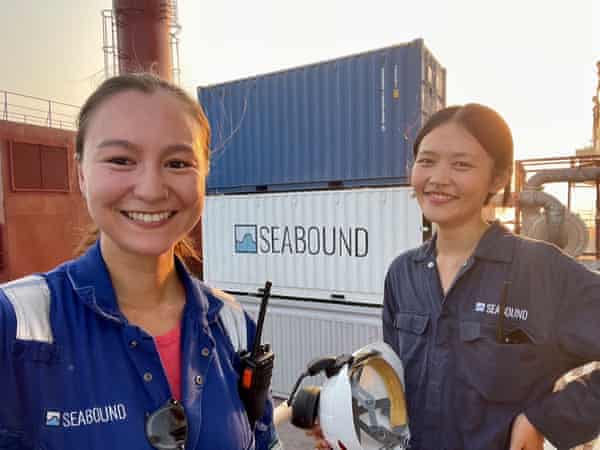
Seabound co-founders are chief executive Alisha Fredriksson (left) and chief technology officer Rojia Wen. Seabound’s carbon-capture prototype sailed for two months on a midsize container ship. 

Today’s story is about two women in the male-dominated shipping industry and their work on what might be a stepping stone to sustainability. The challenge is that the process to create their carbon-absorbing pellets also involves carbon release.

Emma Bryce writes at the Guardian, “An industrial park alongside the River Lea in the London suburb of Chingford might not be the most obvious place for a quiet revolution to be taking place. But there, a team of entrepreneurs is tinkering with a modest looking steel container that could hold a solution to one of the world’s dirtiest industries.

“Inside it are thousands of cherry-sized pellets made from quicklime. At one end, a diesel generator pipes fumes through the lime, which soaks up the carbon, triggering a chemical reaction that transforms it into limestone.

“With this invention, Seabound, the company behind it, hopes to capture large amounts of carbon directly from the decks of cargo ships, and help clean up this strikingly polluting industry. …

“Behind all this is Alisha Fredriksson, a young entrepreneur who once dreamed of being a doctor but reached a turning point in her career after reading a report from the Intergovernmental Panel on Climate Change that detailed the global implications of 2.7 F degrees versus 3.6 F degrees of warming.

“ ‘That’s when I realized that everyone around the world will be affected by the climate crisis, and so if I cared about large-scale social impact, the best thing I could do would be to help tackle it,’ says 30-year-old Fredriksson, chief executive of Seabound. …

“Trials have shown that her invention can scrub most of the carbon from the ship exhaust, filtered through its lime-pebbled interior. Ultimately, the goal is to have this device strapped to ships across the world’s oceans, she says. …

“She and her co-founder, Roujia Wen, hit on the idea of scaling down the existing quicklime-based carbon-capture technology typically employed at industrial plants. They then made a prototype, and attracted about $4m in funding from investors. Some of this came from shipping companies. ‘It all happened really quickly. Suddenly we had money, and we had to go build it,’ says Fredriksson. …

“Since then, successive prototypes of the Seabound container have taken her from the company’s test-bed in east London, to … a three-week voyage to test its efficiency. This showed that a Seabound unit can capture 78% of all the carbon from the exhaust that is pumped through it, and 90% of the sulphur, a toxic air pollutant.

“The latest prototype is being built to the dimensions of a standard 20ft shipping container, so that it can seamlessly slot in with cargoes on deck, Fredriksson says. … Once in port, the limestone-filled units can be substituted for containers of fresh quicklime. This product is made by heating limestone to high temperatures in kilns, an energy-intensive process that also releases CO2 from the limestone, making production extremely carbon-intensive.

“Companies are trying to make quicklime using kilns heated with renewable energy, or developing methods to capture the released CO2 so that it doesn’t enter the atmosphere. Seabound is working to source this ‘green’ quicklime, Fredriksson says. …

“Some critics are concerned that decarbonizing technologies could distract from solutions, such as zero-emission ammonia fuel or wind-powered innovations, that are essential to push the shipping industry to net zero.

“ ‘The potential for short-term use of carbon-capture retrofits on existing vessels should not become a justification to extend the lifespan of fossil fuels or delay the shift to truly sustainable alternatives,’ says Blánaid Sheeran, climate diplomacy policy officer at Opportunity Green, a nonprofit organization focused on gaps in global climate policy.

“But Fredriksson believes Seabound’s technology could support this transition. In April, at a meeting of the International Maritime Organization, UN member states agreed to a landmark deal that will start charging ships for every ton of emissions above a threshold. That threshold will gradually decrease to push the industry towards green fuels.

“Seabound slots into this new regulatory landscape, according to Fredriksson, by enabling ships to decarbonize their fuels, thereby lowering their emissions, and gradually adjust to the rules by adding more containers over time. …

“Fredriksson says [Seabound’s] offering is cost-effective and she has already had a commitment from one company to fit the first full-scale containers on to its ships this year.”

More at the Guardian, here. No firewall. Donations sought.

Read Full Post »

Photo: Martin Godwin/The Guardian.
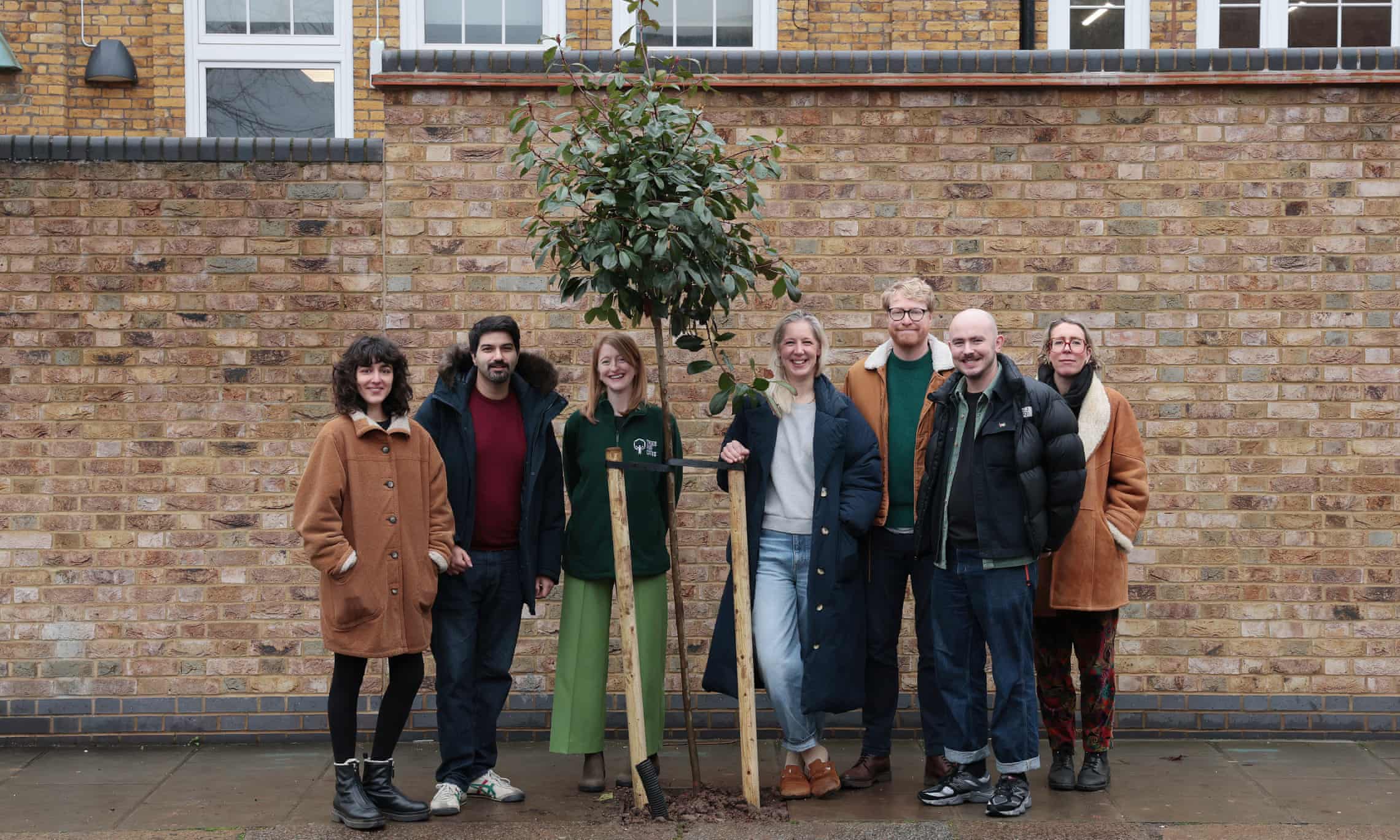
Residents in Tottenham, north London, with a tree sponsored through Trees for Streets. “City residents are working out how to fill their streets with trees as evidence grows of their benefits,” says the Guardian.

Can you bear another story about planting trees to beautify and bring warming temperatures down in neighborhoods?

Although really in-depth biodiversity efforts go further (read about Miyawaki urban forests here), street plantings are important, too. Each time I read about another community organizing to plant trees, I want to share the news.

Olivia Lee writes at the Guardian, ” ‘I wanted to do something that would benefit as many people from the community as possible,’ says Chloe Straw, pointing at a small but promising sapling visible through the window of her local cafe.

“In 2023, Chloe began chatting to her neighbors in Haringey, north London, about trees. ‘I thought it’d be really nice to raise some money for trees on the main road. Everyone uses West Green Road, regardless of whether you have a lot of money or not, regardless of your background.’

“After getting in touch with Trees for Streets, a sponsorship scheme that guides communities across England on how to plant trees in their local areas with support from local councils, a small group was formed to work out how to do it. As a first step, Straw and friends were provided with an interactive map to choose the location of the trees, and that was passed along to Haringey council.

“Then they got help to set up a crowdfunding campaign, which was shared in local WhatsApp groups and community forums, secured 168 backers and raised more than £6,000 [$8,000] in one month.

“Mohamed Eljaouhari, a co-chair of Haringey Living Streets, said [of WhatsApp], ‘It is a very powerful tool for getting a very simple message out very quickly to a lot of people. I got in contact with, like, a thousand people in a few minutes, because I forwarded on the message with a bit of an explanation to a local group here, a local group there, people who were interested in the environment and maybe wanted to help West Green.’

“The remaining costs were covered by Haringey council. The result? Twenty beautiful trees planted across the neighborhood. …

“Around the world, city residents are working out how to fill their streets with trees as evidence grows of their benefits. As temperatures rise, research has shown that urban trees can play a fundamental role in keeping cities cool, evaporating water to provide a natural form of air-conditioning, cooling air temperatures and reducing the urban heat island effect. Work by Friends of the Earth in five English cities in 2023 showed that areas with more trees and greenery were up to 5C cooler. …

“Public funds are stretched everywhere, and the community model followed by Trees for Streets empowers local people to take their own action without waiting for a government plan.

“The Pennsylvania Horticultural Society (PHS) is a non-profit organization in Philadelphia that trains individuals to lead community groups to plant trees across the US city. So far their program, Tree Tenders, has trained more than 6,500 people, who have led volunteers in planting more than 3,000 trees each year.

“[Andrew Conboy, an urban forester in Philadelphia, says,] ‘There’s a heavy emphasis on native species here in the Philadelphia area, which is good thing because the native species are ultimately better for our wildlife and for our ecosystems, because those are the species that evolved here.’ …

“The Garden City Fund, a charity in Singapore, runs a similar initiative, the Plant-a-Tree program. Individuals and organizations can donate to the cost of a young tree and then plant it in one of their managed green spaces.

“Tree People, an environmental advocacy organization, runs a forestry program that supports communities to plant and care for trees in cities in southern California. The organization also runs the School Greening program, which provides training to parents, students, teachers and district leaders to plant and maintain trees in schools. …

“As the West Green residents take turns discussing their local initiative over cups of coffee, it’s clear that one of the most significant impacts the project has had is in strengthening connections within the community. …

“[Says Dan Snell, an urban forest officer at Haringey council,] ‘There was another tree scheme on my mum’s street who lives in Haringey … suddenly there were all these new street trees and my mum had met a load of neighbors that she hadn’t really met before, even though she’s been there for 30 years. It’s had this really lovely long-term effect on bringing the street together.’ It’s such a wonderful thing to connect over.’ “

Plant a tree, make a friend. More at the Guardian, here. No paywall.

Read Full Post »

Photo: Hereford Cathedral and the Hereford Mappa Mundi Trust.
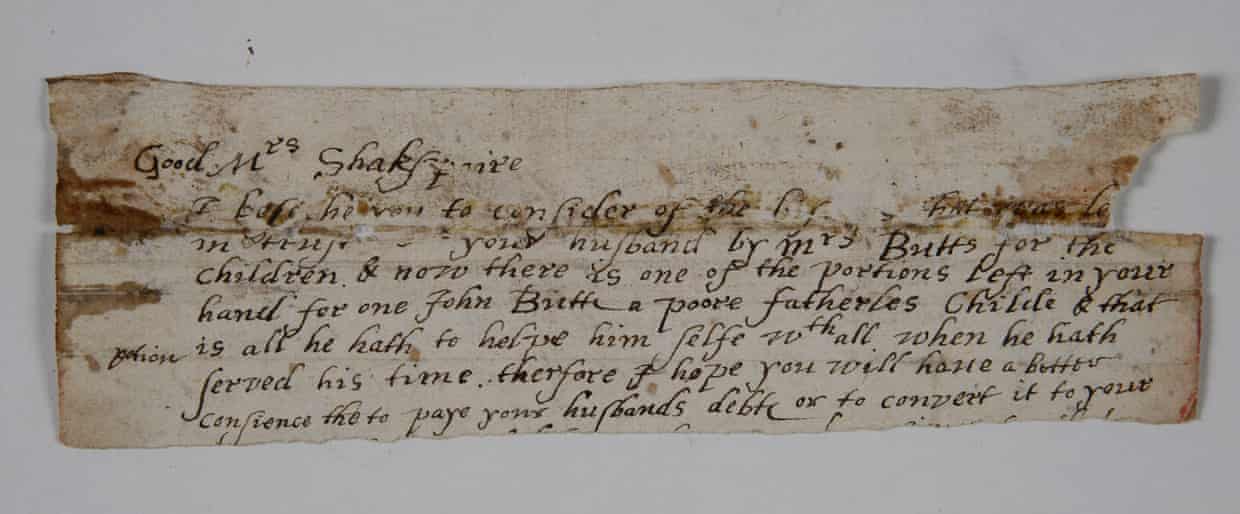
The letter fragment seems to place Anne Hathaway in London with William Shakespeare. 

Where do our firm convictions about history come from? Sometimes the accepted wisdom is based on facts, sometimes on what the influencers of the time thought, sometimes on mistakes. If for example, we have always thought Shakespeare had a bad marriage because his wife never came to London with him, what does new information contradicting that do to the accepted wisdom?

And there’s always new information.

Dalya Alberge writes at the Guardian, “It has long been assumed that William Shakespeare’s marriage to Anne Hathaway was less than happy. He moved to London to pursue his theatrical career, leaving her in Stratford-upon-Avon and stipulating in his will that she would receive his ‘second best bed,’ although still a valued item.

“Now a leading Shakespeare expert has analyzed a fragment of a 17th-century letter that appears to cast dramatic new light on their relationship, overturning the idea that the couple never lived together in London.

“Matthew Steggle, a professor of early modern English literature at the University of Bristol, said the text seemed to put the Shakespeares at a previously unknown address in Trinity Lane – now Little Trinity Lane in the City. It also has them jointly involved with money that Shakespeare was holding in trust for an orphan named John Butts.

“Addressed to ‘Good Mrs Shakspaire,’ the letter mentions the death of a Mr Butts and a son, John, who is left ‘fatherles,’ as well as a Mrs Butts, who had asked ‘Mr Shakspaire’ to look after money for his children until they came of age. It suggests the playwright had resisted attempts to pay money that the young Butts was owed.

“Steggle said: ‘The letter writer thinks that “Mrs Shakspaire” has independent access to money. They hope that Mrs Shakspaire might “paye your husbands debte.” ‘

“They do not ask Mrs Shakspaire to intercede with her husband, but actually to do the paying herself, like Adriana in The Comedy of Errors, who undertakes to pay a debt on her husband’s behalf, even though she was previously unaware of it: “Knowing how the debt grows, I will pay it.” ‘ …

“The fragment was preserved by accident in the binding of a book in Hereford Cathedral’s library. Although it was discovered in 1978, it has remained largely unknown because ‘no one could identify the names or places involved,’ Steggle said.

“Crucial evidence includes the 1608 book in which the fragment was preserved, Johannes Piscator’s analyses of biblical texts. It was published by Richard Field, a native of Stratford, who was Shakespeare’s neighbor and his first printer.

“Steggle said that it would be a ‘strange coincidence’ for a piece of paper naming a Shakspaire to be bound, early in its history, next to 400 leaves of paper printed by Field, ‘given Field’s extensive known links to the Shakespeares.’

“John Butts seems to have been serving an apprenticeship because the letter mentions ‘when he hath served his time.’ Scouring records from the period 1580 to 1650, Steggle found a John Butts, who was an apprentice, fatherless and in the care of his mother. …

“Steggle found John Butts in later records, placing him in Norton Folgate, outside the city walls, and living on Holywell Street (Shoreditch High Street today), home to several of Shakespeare’s fellow actors and associates.

“It was an area in which Shakespeare worked in the 1590s, first at the Theatre in Shoreditch, the principal base for the Lord Chamberlain’s Men throughout those years, and then at its near neighbor, the Curtain theatre. Shakespeare’s lifelong business partners, the Burbages, were involved in innkeeping and victualing nearby.

“Steggle said: ‘The adult John Butts, living on the same street as them, working in the hospitality industry in which they were invested … would very much be on the Burbages’ radar. So Shakespeare can be linked to Butts through various Norton Folgate contacts.’

“If the writing on the back of the letter – in another hand – was written by Anne, the words would be ‘the nearest thing to her voice ever known,’ he noted.

“The research is being published in Shakespeare, the journal of the British Shakespeare Association.”

What accepted wisdom will future historians overthrow by their scouring of our — probably digital — records? And will they draw such broad conclusions about what they find? I myself don’t see how you claim that Shakespeare had a good or bad marriage on the basis of his wife’s residence in London. But it’s fun to see how long new ideas can keep turning up.

More at the Guardian, here.

Read Full Post »

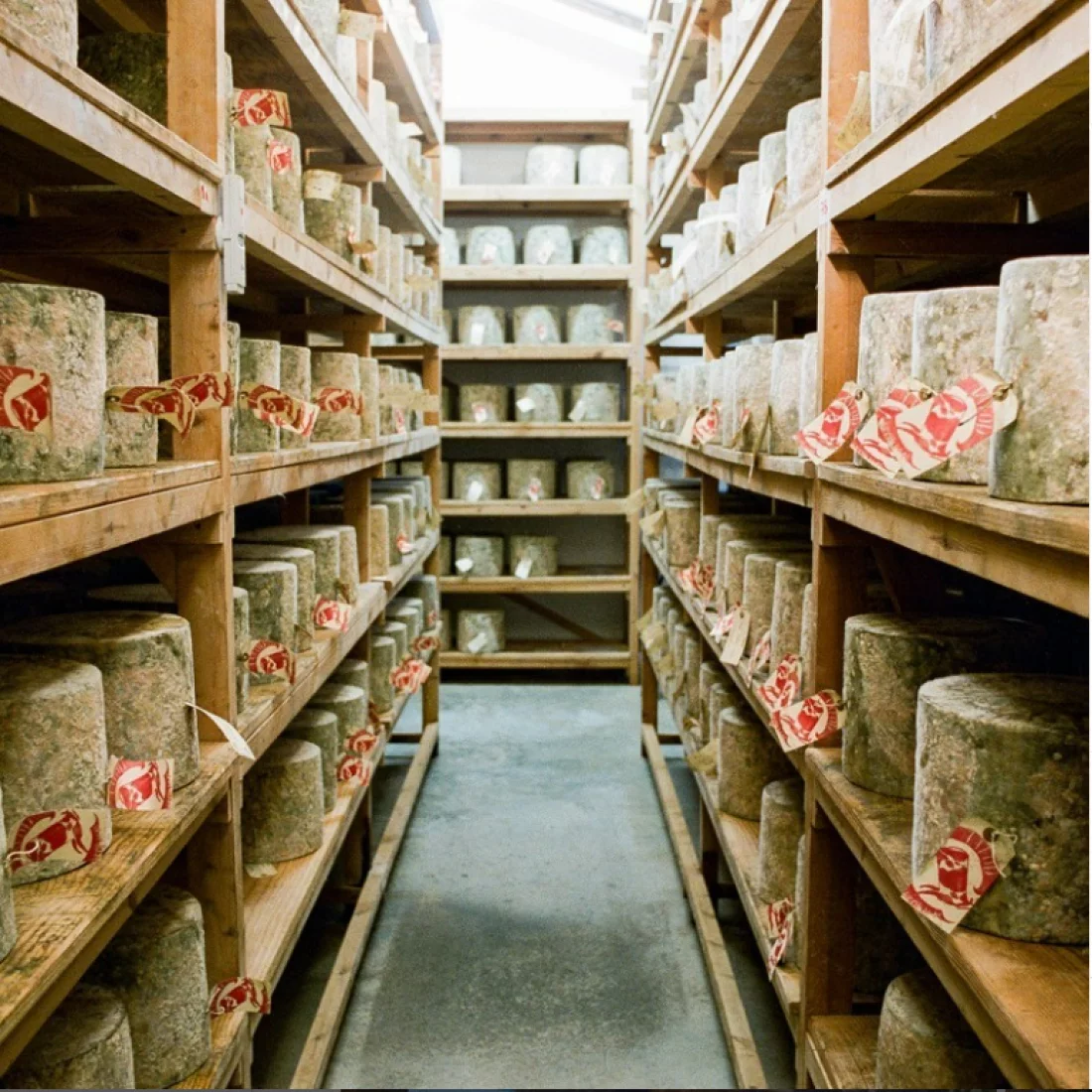
Photo: Neal’s Yard Dairy/Instagram.
London-based distributor Neal’s Yard Dairy announced recently on Instagram that it was “the victim of a sophisticated fraud” involving high-value cheddar cheese.

You really don’t want to get mixed up with people who are intense about cheese. Years ago, when I was a member of Cheese Lovers International, I crossed knives with the highly emotional founder, whose name I no longer recall. To compensate for something I once complained about, he told me he would give me a discount on every order for my life. Unfortunately, his staff had no way of knowing about my discount. Explaining got to be too much work.

Rachel Treisman and Juliana Kim have a great cheese story at National Public Radio.

“Authorities in London have arrested a 63-year-old man in connection with the cheese heist of 2024, in which tens of thousands of pounds of high-value cheddar were stolen from a major distributor. ..

“ ‘The man was taken to a south London police station where he was questioned. He has since been bailed pending further enquiries,’ a police spokesperson said.

“Over the past week, the British artisanal cheese community has been reeling after Neal’s Yard Dairy announced it had been the ‘victim of a sophisticated fraud resulting in the loss of over £300,000 worth of clothbound Cheddar’ — the equivalent of more than $389,000.

“ ‘The theft involved a fraudulent buyer posing as a legitimate wholesale distributor for a major French retailer, with the cheese delivered before the discovery of the fraudulent identity,’ the company said.

“The thief made off with 950 wheels — over 22 metric tons, or roughly 48,500 pounds — of Hafod, Westcombe and Pitchfork cheddar. … The wheels came from three different artisan suppliers across England and Wales.

“ ‘Between them, these cheeses have won numerous awards and are amongst the most sought-after artisan cheeses in the U.K.,’ Neal’s Yard Dairy said. … The crime cuts deep: Cheddar, which originated in a village by the same name in Somerset, England, is the best-selling cheese in the U.K. and a big source of national pride.

“Last week, British celebrity chef Jamie Oliver explained in an Instagram video that there is ‘only a small handful of real cheddar cheese makers in the world,’ and that’s where the stolen cheese came from. …

“Neal’s Yard Dairy is shouldering the cost of the crime, having already paid the artisan cheesemakers in full. The company says it is now taking steps to ensure its own financial stability. …

“Tom Calver with the cheesemaker Westcombe says they were led to believe they were sending their products to France via Neal’s Yard Dairy.

“ ‘These guys … basically impersonated a wholesaler-slash-customer, quite a large retailer over in France,’ he said in an Instagram video, showing a row of empty shelves and noting he had posted excitedly about the 10-ton order just weeks earlier. ‘It was a hoax, it was theft, it was fraud. I mean, it’s nuts.’

“Patrick Holden, whose Hafod Welsh cheddar was taken, told the BBC … he believes they may be trying to sell it in the Middle East or Russia, ‘because people won’t ask questions there.’

“ ‘I think if they tried to sell it closer to home they’d find it difficult,’ he said, naming North America and Australia as examples. ‘Because the international artisan community is very connected.’ …

“Neal’s Yard Dairy is asking its ‘esteemed community of cheesemongers around the world’ to keep an eye out for the cheese and contact them if they are offered or receive any suspicious deals — especially clothbound cheddars of certain weights (10 kg and 24 kg) with the tags detached. …

“ ‘Because we can potentially trace it back — hopefully, maybe, I don’t know.’ “

I have one more question: Where was Ratatouille at the time of the crime?

More at NPR, here.

Read Full Post »

Photo: Hansons Auctioneers.
Ten rediscovered Salvador Dalí prints were scheduled to be auctioned off in September. 

Have you ever bought something and stored it away, only to forget about it for years? I have. Mystery objects turned up when I was downsizing, but nothing of great value. I remember a folk art candle holder of brown painted pottery, for example. It was sweet, but I have no idea why or when I bought it.

Lianne Kolirin at CNN wrote about a different kind of discovery.

“Ten signed Salvador Dalí lithographs have been discovered in a garage in London, where they have been stashed for half a century. The artworks, which were discovered by an auctioneer during a routine valuation, are now expected to fetch several thousand dollars at auction.

“The colorful prints were uncovered when the expert was called to a property in Mayfair, central London, to give the customer an assessment of some antiques at the property. But the visit took a turn when the pair went out to the garage of the client, who has not been identified.

“Chris Kirkham, associate director of London’s Hansons Richmond auction house, recalled … ‘It was an amazing find. … I was invited to assess some antiques at a client’s home. During the visit the vendor took me to his garage and, lo and behold, out came this treasure trove of surrealist lithographs – all 15 of them.’

“Together with the 10 Dalí lithographs, which are a mixture of mostly mythological and allegorical scenes, were another five by Theo Tobiasse, a French painter, engraver, illustrator and sculptor.

“ ‘They’d been tucked away and forgotten about for around 50 years. It felt quite surreal. You never know what you’re going to uncover on a routine home visit,’ said Kirkham. … ‘The prints ended up in his garage. They were rediscovered because the seller has been having a clear out. He’s looking to retire and move abroad, so now his lithographs will finally see the light of day at auction. …

“Dalí, a leading member of the Surrealist group, was born in Figueres in Catalonia in 1904 and died there in 1989. A prolific artist, he was renowned for his bizarre images which famously included melting clocks.”

According to Artnet News, the seller, who “paid just $655 for the lot in the 1970s,” sold them in September for $26,200. (Click here.)

More at CNN, here. I once read that it’s advisable to do downsizing regularly — maybe every year. That way you find out what you’ve got that would be better to move elsewhere. Maybe it would help if every time we acquired something new, we promised ourselves to give away something else.

Read Full Post »

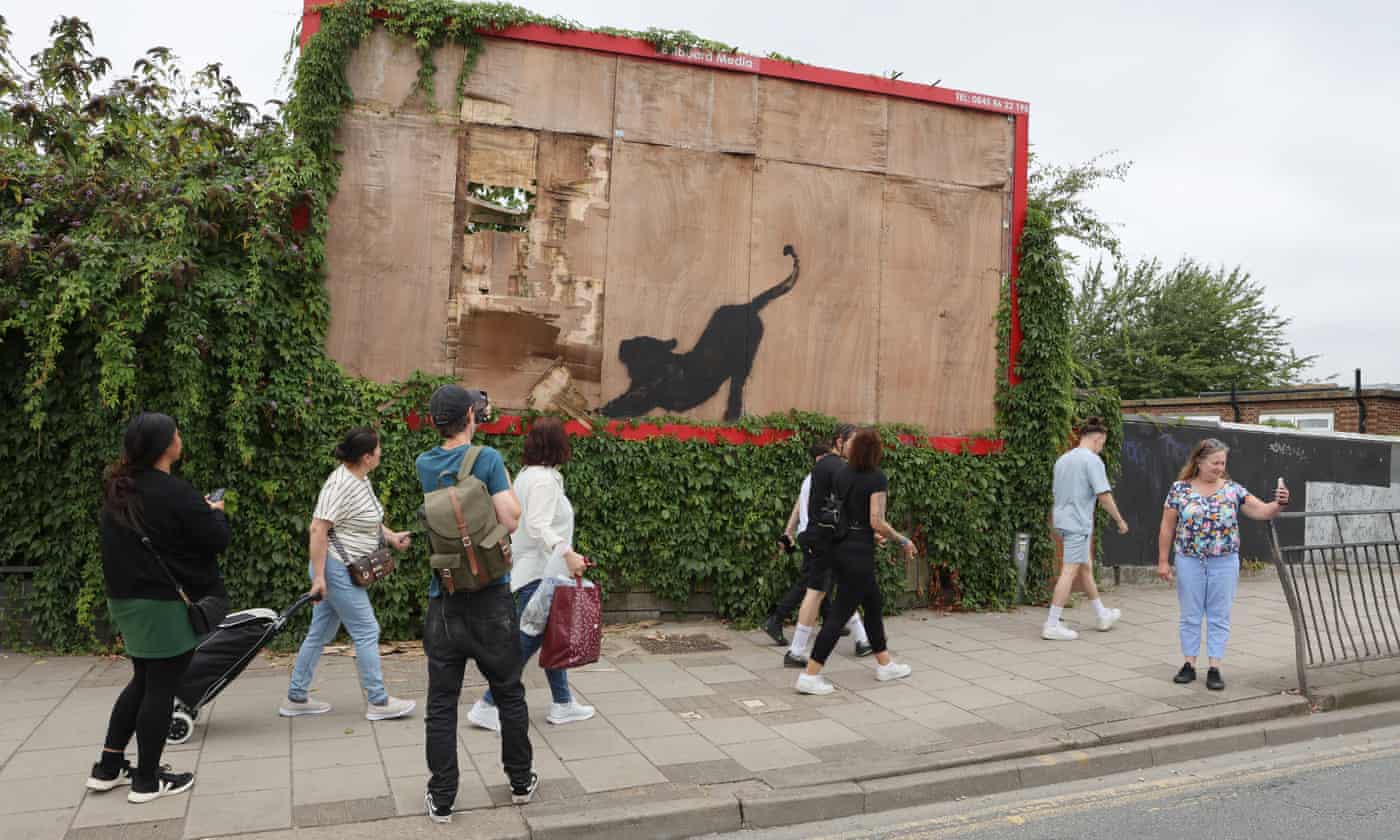
Photo: Andy Hall/The Observer.
The Banksy cat mural in Cricklewood, north-west London, before the billboard was removed last summer.

I love the stealth artworks of Banksy and have taken a few photos of murals that could have been his, except that they were in Boston and New York.

People love guessing what the pieces mean, what his angle is.

At the Guardian last August, Vanesa Thorpe demonstrated that Banksy’s views are increasingly transparent.

“A big cat by Banksy appeared briefly, ­stretching in the morning sun, on a bare advertising hoarding on Edgware Road in Cricklewood, north-west London, on Saturday. A few hours later,” Thorpe writes, “it had gone, removed by contractors who feared it would be ripped down.

“The anonymous artist known as Banksy, who confirmed the image was his at lunchtime on Saturday, also promised a little more summer fun to come. …

“For a week now, the streets of the capital have been ­populated by a string of unusual animal sightings, courtesy of Banksy, ­including ­pelicans, a goat and a trio of monkeys.

“The artist’s vision is ­simple: the latest street art has been designed to cheer up the public ­during a period when the news headlines have been bleak. … Banksy’s hope, it is understood, is that the uplifting works cheer ­people with a moment of unexpected ­amusement, as well as to ­gently underline the human capacity for ­creative play, rather than for destruction and negativity.

“Some recent theorizing about the deeper significance of each new image has been way too involved, Banksy’s support organization, Pest Control Office, has indicated.

“When a goat teetering on a ­precipice first appeared on Monday near Kew Bridge, in south-west London, some thought it might be a symbol of humanity’s folly. Others speculated it might be a visual pun on the idea of the goat, now standing for ‘greatest of all time’ in popular parlance.

“On Tuesday, two silhouetted elephant heads popped up, their trunks reaching out to each other through the bricked-up windows of a house in Chelsea.

“Next came perhaps the most joyous so far when a trio of monkeys was revealed on Wednesday, swinging their way across a bridge over Brick Lane in east London.

“On Thursday, an outline of a howling lone wolf, painted on to a large satellite dish on a roof in Peckham, was removed by two masked men with a ladder, who made off with their prize. …

“On Friday, a pair of hungry pelicans appeared above a Walthamstow fish and chip shop on a corner of Pretoria Avenue, their long beaks snapping at fish. …

“While Banksy’s new menagerie has been springing up, the rescue boat the artist funds has been working to help endangered asylum seekers to reach safety. The M V Louise Michel, a high-speed lifeboat, patrols migrant routes in the Mediterranean.

“It has picked up at least 85 ­survivors in the past couple of days, taking them safely to Pozzallo, Sicily. … Five years ago, Banksy announced that he would finance the vessel, named after a French feminist anarchist, with the intention of rescuing refugees in difficulty as they fled north Africa.

“In June, at Glastonbury, an inflatable migrant boat created by Banksy was used to crowdsurf during performances by Bristol indie punk band Idles and rapper Little Simz. The Conservative home secretary at the time, James Cleverly, said the artist was ‘trivializing‘ small boat ­crossings and ‘vile.’

“Banksy responded that the detention of the Louise Michel by Italian authorities at the time was the really ‘vile and unacceptable’ development.

“His latest street art, however, is deliberately lighthearted, like Banksy’s lockdown series the Great British Spraycation of 2020. Banksy’s seaside series also memorably featured chips, with an image of a seagull hovering over oversized ‘chips.’ …

“Another image from the lockdown campaign made reference to the ­refugee crisis. It showed three children sitting in a rickety boat made of scrap metal. Above them, Banksy had inscribed: ‘We’re all in the same boat.’ “

More at the Guardian, here. No paywall. Delightful photos.

Read Full Post »

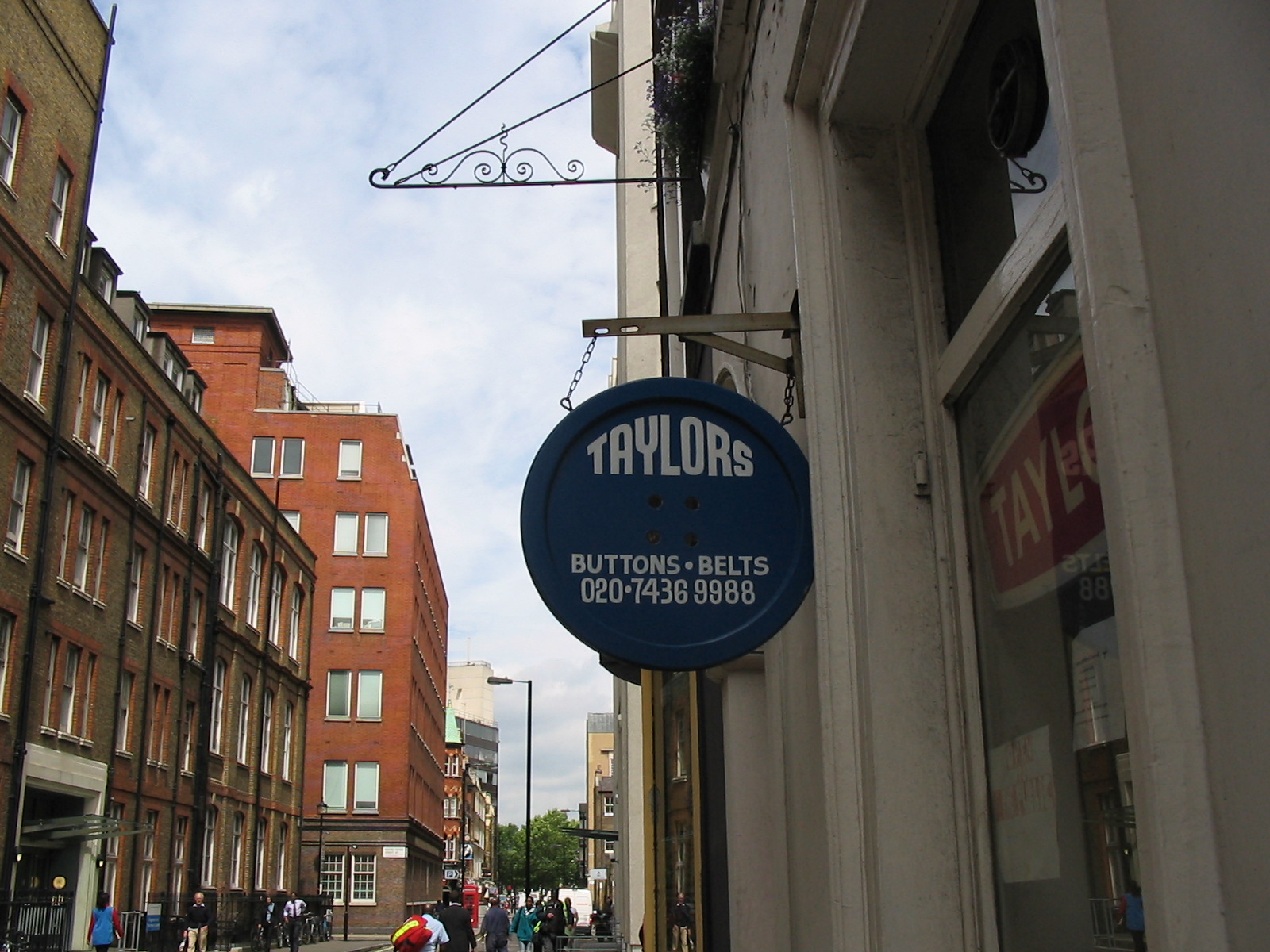
Photo: Taylors Buttons.
The Taylors Button Shop has been established in London over 100 years.

A long time ago, a parent family at the Elwanger-Barry Nursery School in Rochester, New York, closed down their button business and donated a lifetime supply of buttons to the school. Poured into an indoor sandbox, the buttons became one of the two favorite play centers of three-year-old Suzanne. The fuzzy box and the button box.

That’s one reason I’m interested in button stories. And when an editor from last year’s Ukraine social-media project (see this post) wrote on Facebook about a 100-year-old button store in London she visited, I had to learn more.

The Gentle Author at Spitalfields Life interviewed Maureen Rose of Taylors Buttons for a bookshop’s blog:

“Taylors Buttons is the only independent button shop in the West End. It’s more than 100 years old and it’s only been owned by two families in that time. It was founded by the original Mr Taylor; then there was Mr Taylor’s son, who retired in his late eighties when he sold it to my husband,” Maureen Rose said.

“I was a war baby. My mother was from Whitechapel and she opened her own millinery business in Fulham at nineteen. She got married when she was twenty-one and ran her business all through the war. As a child, I used to sit in the corner and watch her make hats, but I didn’t take up millinery – something I regret now, as she was very talented and she could have taught me.

“I helped my mother for a while: I did a lot of buying for her in Great Marlborough Street, where there were many millinery wholesalers. There was a big fashion industry in the West End: I used to go to see the collections from houses like Hardy Amies and Norman Hartnell. It was so glamorous. Now it’s all gone.

“My late husband, Leon Rose, first involved me in this business. He started his career in a button factory learning how to make buttons. Then his uncle, who had a factory in Birmingham, got in touch to say, ‘There’s a gentleman in town who’s retiring and you should think about taking over his business.’ So he did.

“My mother went in to help when he needed someone for a couple of hours a day, and then – of course – there was me! I’ve been working here for more than 40 years now and since my husband died in 2007 it has been a one-woman show.

“Every button tells a story and I have no idea how many there are in the shop. Some are more than 100 years old, but most I make to order. You send me the fabric – velvet, leather or whatever – and I’ll make you whatever you want. We used to do only small orders for tailors: two fronts and eight cuff buttons for a suit. Nowadays I do them by the hundred. I don’t think Leon ever believed that was possible.

“Anybody can walk into my shop and order buttons, but I get a lot of orders for theatre, television, film, fashion houses and weddings. I get gentlemen who buy expensive suits that come with cheap buttons: they come here to buy proper horn buttons to replace them.

“My friends ask me why I have not retired, but I enjoy working here. What would I do at home? I’ve seen what happens to my friends who have retired: they lose the plot. I meet nice people in the shop and it’s interesting. I’ll keep going for as long as I can.”

Interview originally published on the Spitalfields Life blog by The Gentle Author. 

More here. And there’s detailed button information at the Taylors Buttons website, here, where you can also learn that Dickens lived in the building once. Hat tip: Ro.

Read Full Post »

Photo: Sophia Evans/The Observer.
Gilbert, left, and George at their new gallery on April 1. When artists want control, they sometimes open their own museums.

I am always curious about innovations in the museum world. If you search this site on the word “museum,” you will find a wide range of posts, including one about a pandemic-era “mini museum for stir-crazy gerbils,” here, and a 2018 post on micro museums, here.

Vanessa Thorpe reported at the Guardian recently about two guys in London who decided to open a museum for their own work.

“Every creative person yearns for a room of their own,” wrote Thorpe. “But for the stars of Britain’s contemporary art world, it seems that now only a venue of their own will do. [In March] it was Tracey Emin in Margate; on [April 1] it was the turn of the veteran duo Gilbert and George.

“ ‘It is very exciting to see so many people,’ said George Passmore, 81, after the gates swung wide at 10 am to let in an orderly queue of first visitors. ‘Most amusing,’ added his lifelong collaborator – and, since 2008, civil partner – Gilbert Prousch, 79. …

“ ‘Do you know the gates [at this building] are painted in a shade called Invisible Green?’ asked Passmore. ‘It was invented for the great garden designer Humphry Repton when he noticed the grounds of the stately homes he created were being walked across by the public. He needed to put up barriers in a color that would not stand out. It is odd, because it is not invisible at all.’

“The pair’s decorative wrought-iron gates are also not intended to keep out the public. Far from it: the Gilbert and George Centre, which they have planned for years, is a built representation of their slogan ‘art is for all’ and designed as a gift to the community they have lived and worked alongside together for most of their working lives.

“Passmore, born in Devon, and Prousch, born in Italy, met in 1967 while studying sculpture at St Martin’s School of Art in London and developed a unique and entertaining style that places their own images in a variety of visual contexts and poses. ‘We are two people but one artist,’ they have been fond of explaining.

“This first show in the venue features vast photographic screens of leaves and organic products, including figs, roses, dates and leafy greens through which the artists peer or can be seen lolling on benches, either resting or in a swoon. …

“Mark Schofield, 50, a longtime fan, brought his parents, Jackie and Tony, down from Peterborough to see the show. A scientist who now lives in Boston, he was bowled over by the galleries.

“ ‘There’s this clear contrast that I love between the deadpan faces and the joy and mischief of the art. It is so English, somehow,’ he said.

“Rachel Scott, a painting conservator from Dalston, was also struck by the humor of the work. … For Bash Ali, 44, a charity worker and artist, the trip up from the south-east of the city had been well worth it. ‘It really works. It is such a great space.’

“The ‘naughty and a bit rude’ tone of much of Gilbert and George’s art was part of the appeal, said Paul Rudgley from Birmingham, who was visiting the centre with his artist friend Arran Patel from London. But in the end, as a collector of Pantone colors and a former paint industry executive, it was the bright and bold hues that won the day for him.

“The opening of the Gilbert and George Centre followed last weekend’s seaside event in Margate, Kent, when a new artists’ space run by Tracey Emin, a comparative newcomer on the subversive art scene, was unveiled. And over in south London, Damien Hirst’s Newport Street Gallery has also given space to displays of work from his own art and his wider collection since 2015. Admission to each of these three new private galleries is free, although Hirst’s is currently closed.

“Emin, 59, wore a full town crier’s outfit for the opening of her venue. Called the TKE Studios and T.E.A.R. (Tracey Emin Artist Residency), it has been constructed inside a former Edwardian bath-house after a [$1.3 million] investment. As the artist cut the ribbon, she promised: ‘We are going to make Margate an artistic mecca’ before she announced new plans to buy up a nearby derelict pavilion, for swimmers and surfers.

“Early to the trend for running his own artistic space, Turner prize finalist Yinka Shonibare offered more than just a gallery to visitors to his experimental space in east London. Called Guest Projects, and launched a decade ago, his project still offers residences for performers as well as visual artists and musicians.

“When it started, it provided food, too, in a special supper club called the Artists Dining Room where guest chefs create dinners inspired by the work of artists including Louise Bourgeois, David Lynch, Frida Kahlo and Jean-Michel Basquiat.

“ ‘Artists should have a space in which they can fail, and the art market doesn’t really allow room for failure – there’s too much at stake, Shonibare said at the time.”

More at the Guardian, here. You can enjoy all the pictures as there is no firewall.

Read Full Post »

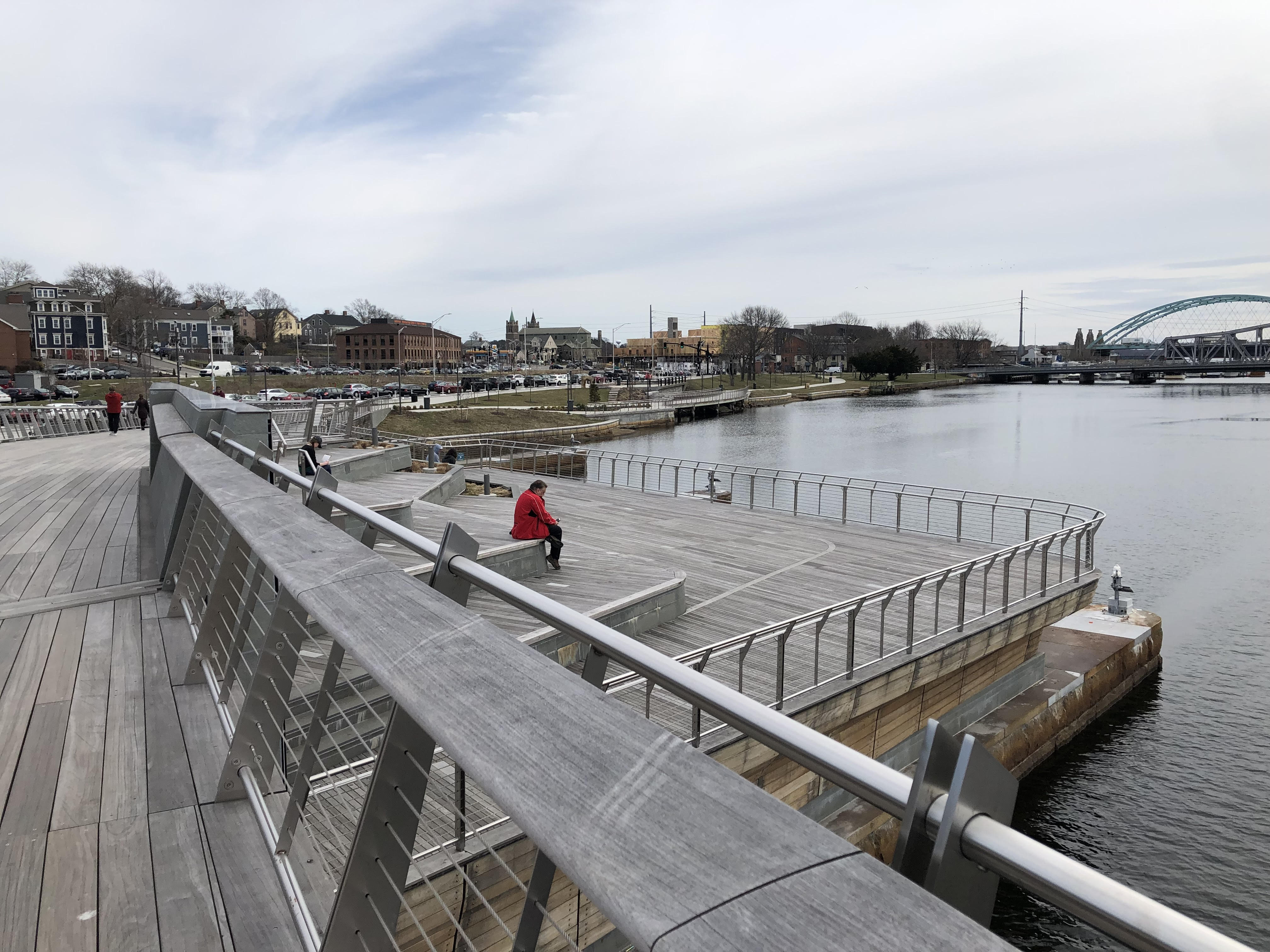
Photo: Suzanne and John’s Mom.
The beautiful pedestrian bridge over the Providence River in Rhode Island. This is a city that values free public space.

On Twitter and Mastodon, I follow a guy (@FortPointer) who is a voice in the wilderness for free public amenities in Boston. He himself may be able to afford the prices that have been slapped onto events that were once going to be accessible for all, but he is outraged for the sake of lower-income people — and for the world-class city Boston could have been. He may be Don Quixote, but there are those of us who believe in the mission.

For example, there used to be a pleasant footbridge that went over Fort Point Channel and connected two parts of the city. I loved to walk there on my lunch hour. Bikers biked it. When the old bridge wore out, the city — under cover of needing access for emergency vehicles — decided to replace it with a bridge for cars and trucks. The Fort Pointer was outraged. So was I!

Today’s article from the Guardian talks about footbridges that enhance life for pedestrians in London.

Rowan Moore writes, “All the world loves a bridge that moves. Usually, the point of a bridge is that it is fixed – when so much trouble has been taken to overcome gravity and tame nature, instability is the last thing that you want – so there is surprise and delight when it confounds its own rigidity. I give you as an example Tower Bridge.

“In an overlooked part of east London, weed-strewn and still industrial – a district un-steamrollered by the giant apartment blocks going up in much of the old docklands, close to where the River Lea joins the Thames – two curve-cornered squares of steel frame the view. They look like heavy metal sculptures. They are actually essential elements of the recently completed Cody Dock Rolling Bridge, designed by the architect Thomas Randall-Page and Tim Lucas of the engineers Price & Myers, which moves in a way that no bridge has done before. Its purpose is to make good a missing link in the Leaway, a ‘green corridor’ that runs from Hertfordshire then along the Olympic park towards the Thames. It also serves as an emblem for the Gasworks Dock Partnership, a charitable social enterprise that has created a ‘community-based arts and creative industries quarter’ on what was derelict land.

“As its name says, the bridge rolls. It crosses a channel that runs from the Lea to an adjoining dock, and most of the time it provides a flat steel deck, level with the ground, which pedestrians and cyclists can use to get from one side to the other.

When necessary, those squares can be turned through 180 degrees, such that the deck is raised in the air and turned upside down, which gives enough headroom for boats to pass underneath.

“It is operated by two manual winches, the tonnage of steel balanced in such a way that a bit of human muscle can shift it. The simplicity of its idea requires fiendish mathematics and precise construction. The squares roll along sinuous tracks, kept in place by interlocking teeth and sockets, the angles and forces of each one different from its neighbor. Cake Industries, the company that built it, employed furniture-makers to construct the moulds for the concrete elements of the structure. …

“Meanwhile, in a gentler place some distance up the Thames, another structure has been completed that is also in the nice-to-have rather than must-have category. It is a bridge under a bridge, a way of getting a riverside path to pass below the Victorian iron arches of Barnes Railway Bridge. Previously, users had to trek inland, through a menacing tunnel under the tracks, and back again to the riverbank. Now they can travel over a broad, winding deck, falling then rising again, that projects over the water with a mild frisson of peril.

Dukes Meadows Footbridge is designed by Moxon Architects, a practice based in London and Aberdeenshire with several other bridges to its name, and the structural engineers COWI. This, too, has required ingenuity, albeit less for the self-imposed reasons at Cody Dock: the deck has to just clear the high-water mark of the tidal river, while giving enough room beneath the arches, without obstructing access for maintenance for the old structure. It could impact neither on the many rowers who use this stretch (the Oxford and Cambridge boat race finishes nearby), nor on the endangered snails in a neighboring nature reserve, which meant that its route and its lighting were designed not to disturb them. …

“The result is faceted and intriguing, its irregularity driven by the imaginative response to circumstance. ‘It’s marvelous,’ says an elderly user, unsolicited. Funded by the London borough of Hounslow and the mayor of London’s Liveable Neighbourhoods scheme, it makes a striking contrast with the years-long, still-ongoing struggle to make Hammersmith Bridge, the next crossing downriver, safe for traffic. It’s easier, evidently, to build one that doesn’t actually cross a river than to repair one that does.

“Moxon is also working on a plan, long promoted by local citizens, to make a disused part of the old railway structure into a linear park – a small version of New York’s High Line, or a successful version of Boris Johnson’s doomed Garden Bridge. Like the new footbridge, this project is shaped more by quality-of-life considerations than the hard industrial imperatives that drove either the original railway bridge or the big old structures of docklands.”

What is your experience of footbridges?

More at the Guardian, here. No firewall. Great pictures.

Read Full Post »

Photo: Emily Turner.
Emily Turner (pictured) planned to take 16 buses in total, traveling exclusively by buses that fall under the government’s £2 [$2.40] local bus program. 

The other day, a friend asked me what I will do if I decide to give up driving: for example, how will I get to the Providence grandchildren from Massachusetts. Public transportation, I said. It will take all day, and I’ll have to go there less often and stay longer, but it’s doable. I’ve tested it.

Because public transportation in the US is not the best, I think you really have to reorganize your life around using it. And you have to assume everything will take a lot longer. But what’s the hurry?

Here’s a woman in the UK who decided to test how far she could go just using public buses. She’s been buoyed by all the people following her adventure on social media.

Sophie Zeldin-O’Neill reported last month at the Guardian, “A British woman undertaking an epic three-day expedition from London to Scotland using only local buses has expressed her surprise at the level of support from thousands of people following the chronicles of her journey on Twitter.

“Writer and podcast host Emily Turner, from London, began her nearly 400-mile journey in the early hours of [Feb. 10], announcing on Twitter: ‘I’ve been wanting to do this for YEARS!!’ …

“She plans to arrive at her destination, Edinburgh, on Sunday, taking 16 buses in total, and traveling exclusively by those that fall under the government’s £2 [$2.40] local bus program. …

“Turner, who hosts the Roundel Round We Go podcast about the London underground, planned her trip to coincide with her 35th birthday on Friday, and is attempting to keep the total cost under £35 [$42].

“On Friday night, she tweeted: ‘And that concludes my 35th birthday. When my mother turned 35, she was about to give birth to me, but I feel like today I have given birth to a whole Twitter bus lover community, so to each their own.’

“In response to one Twitter user who commented ‘I bet it’s going to cost more than a single megabus ticket,’ Turner replied, ‘Oh definitely! It was more about the journey than saving money.’

“Upon arriving in Leeds, she explained some of the background to her penchant for public transport, saying: ‘Leeds is a city I’ve spent about three weeks in previously. They were while I was doing intensive teacher training, and I was spending a lot of time with large groups of people, which I found exhausting, so I’d escape and go ride buses.’

“Thousands of people around the UK have followed her account before and during her journey, providing tips and encouragement – and sharing their own bus-related anecdotes. One Twitter user said: ‘Looks like you passed my house on the Stagecoach 59 from Barnsley this morning. Wish I’d known, I’d have got you a coffee and a sandwich from Noble’s at Busy Corner.’ …

“Turner has been compiling a bus-themed playlist, with songs including Erica Banks’ ‘Buss It’ and ‘Vengabus’ by the Vengaboys.

“In response, she has been offered tips for audio accompaniments to the voyage: ‘I hope you liked the 16-minute @GratefulDead song I recommended earlier,’ said one follower. ‘If you’ve got another long bus ride still to come, I’ve got a 30-minute one ready for you.’

“A newer follower added: ‘Very much enjoying the @ETWriteHome bus tour … I did a similar hitchhike to Paris from Edinburgh in 2010. If you can muster the energy down to @NewbarnsBrewery when you make it to Edinburgh there will be a drink on the bar for you.’

“Despite trying to adhere to a strict schedule en route to Scotland, Turner’s journey has been disrupted and delayed at various points. On Friday, she boarded an unplanned bus at Luton, and on Saturday, she got stuck after her card was declined – something which, it transpired, was because she had carried out more than the permitted number of Apple Pay transactions in a single day.

“At the time of writing, Turner is in Newcastle. She plans to get the train back to London on Sunday evening.”

Have you had public transportation adventures worth sharing? I seem to recall that blogger Asakiyume tweeted that her son had planned a similar trip in the US. And the reason I learned that public transportation to and from Providence was doable was a blizzard.

I left my car in the Amtrak garage in Providence and trained it to South Station in Boston. From there, I took the subway to Porter Square, Cambridge, and hung around for the commuter rail to my town. When I got to town, I walked across the snowy street to my house, a block from the train.

It was the only moment I needed my snow boots.

More at the Guardian, here.

Read Full Post »

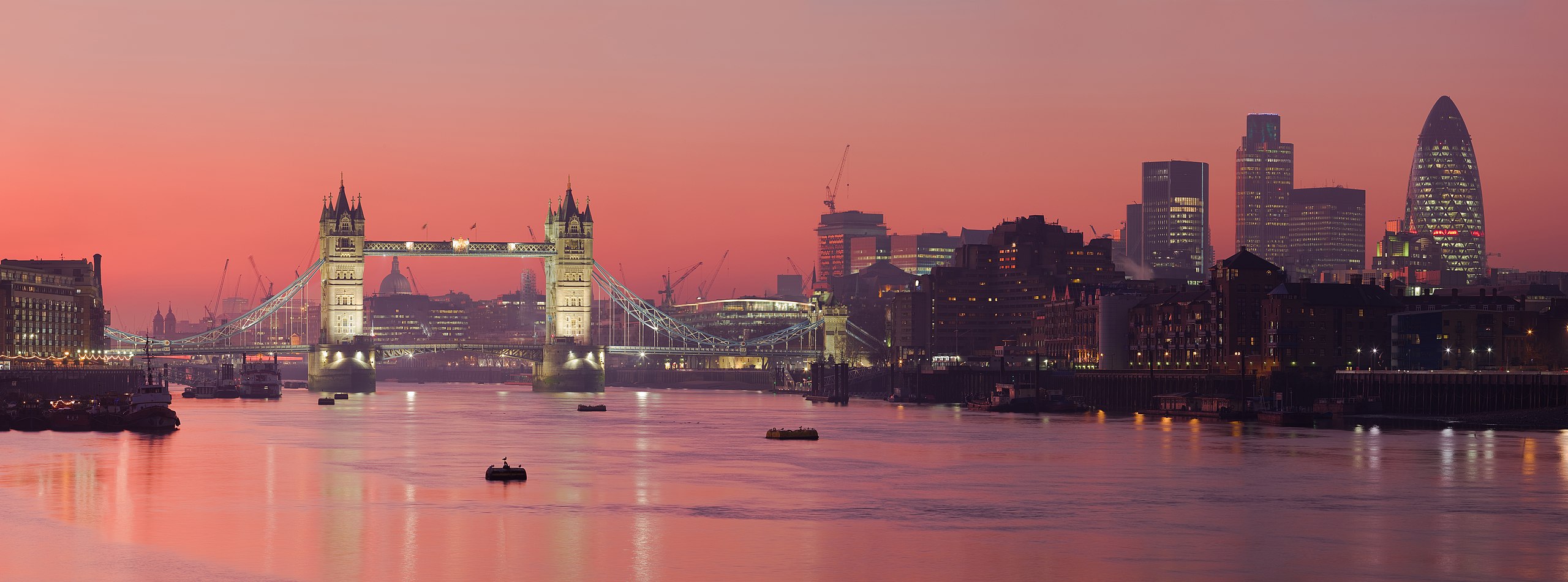
Photo: Diliff, David Iliff. License: CC BY-SA 3.0.
Sunset over the Thames River in London.

When I worry that humans may never repair any of the damage we have done to the environment, I remind myself that once upon a time the Erie River routinely caught fire and no longer does.

Similarly, as Veronica Edmonds-Brown, Senior Lecturer in Aquatic Ecology at the University of Hertfordshire, reports for the Conversation, fallible humans have brought back the Thames.

Edmonds-Brown writes, “It might surprise you to know that the River Thames is considered one of the world’s cleanest rivers running through a city. What’s even more surprising is that it reached that status just 60 years after being declared ‘biologically dead‘ by scientists at London’s Natural History Museum.

“Yet despite this remarkable recovery, there’s no room for complacency – the Thames still faces new and increasing threats from pollution, plastic and a rising population. …

“Where it bisects London, it has experienced pressures from expanding numbers of citydwellers since medieval times. The river became a repository for waste, with leaking cesspits and dumped rubbish reducing many of its tributaries to running sewers. [Read Dickens novel Our Mutual Friend.] Many of these small rivers now lie underneath the streets of London, long covered up to hide their foul smells. …

“The final straw was the hot summer of 1858 – referred to as the Great Stink – when the high levels of human and industrial waste in the river actually drove people out of London. The civil engineer Sir Joseph Bazelgette was commissioned to build a sewage network to alleviate the problem, which is still in use today. What followed was over a century of improvements to the network, including upgrading sewage treatment works and installing household toilets linked to the system.

“Bombings across the city during the second world war destroyed parts of the network, allowing raw sewage to again enter the river. What’s more, as the Thames widens and slows through central London, fine particles of sediment from its tributaries settle on the riverbed. These were, and remain, heavily contaminated with a range of heavy metals from roads and industry, creating a toxic aquatic environment.

“For most fish to thrive, the water they live in must contain at least 4-5 milligrams of dissolved oxygen per litre (mg/l). Measurements taken during the 1950s showed that dissolved oxygen (DO) levels in the Thames were at just 5% saturation: the rough equivalent of 0.5 mg/l. That meant the river could only support a few aquatic invertebrate species like midges and fly larvae. …

“From Kew to Gravesend, a 69km [a 43-mile] length of river, no fish were recorded in the 1950s. Surveys in 1957 found the river was unable to sustain life, and the River Thames was eventually declared ‘biologically dead.’

“With considerable effort from policymakers, the river’s fate began to change. From 1976, all sewage entering the Thames was treated, and legislation between 1961 and 1995 helped to raise water quality standards. …

“One of the main turning points in the Thames’ health was the installation of large oxygenators, or ‘bubblers,’ to increase DO levels. … The flounder was officially the first fish species to return to the Thames in 1967, followed by 19 freshwater fish and 92 marine species such as bass and eel into the estuary and lower Thames. The return of salmon during the 1980s was a thrilling marker for conservationists, and today around 125 species of fish are regularly recorded, with exotic species like seahorses even being occasionally sighted.”

Although, as Edmonds-Brown notes, this recovery is remarkable, “there remain deeper, unresolved issues relating to contaminated sediments still entering the river.” Read more at the Conversation, here.

Read Full Post »

Photo: Anna Chojnicka via Republic World.
She bruises bananas to make art.

Connie Chang has such a funny and inspiring tale at the Washington Post! You’re going to love this one!

“Anna Chojnicka was bored as she quarantined last year in her London apartment because of a suspected case of covid-19. She was so bored that she absent-mindedly picked up a banana on her kitchen table and started running her fork along the outside of the peel.

“The dark lines that appeared on the peel looked interesting to her, and she watched as the marks gradually got darker. She continued doodling and was soon fascinated. She drew eyes, a nose and a mouth and — satisfied with how it looked — decided to see how far she could go with it. …

“Chojnicka, 35, started making pictures that were more and more intricate using the same method — only pressure, no paint — until she sketched an Ethiopian coffee pot and cup. Her new hobby was born. …

“Since that first day she figured out what she can do by bruising a banana peel, Chojnicka has been posting her daily creations on Twitter and Instagram, where she has thousands of followers. … She inspects her daily sketch, takes a photo and then eats the banana — she doesn’t like waste.

“Her popular banana art ranges from familiar cartoons such as Homer Simpson (which she cheekily labeled ‘self portrait’) to painstakingly rendered portraits of people such as Greta Thunberg. She does puns, like a zipper around a partially peeled banana. She is often inspired by current events, such as the coronavirus vaccine drive. She recently made one with the slogan ‘Empowered women empower women,’ nestled in a yin-yang of two women in profile.

“ ‘Bananas have a really beautiful way of going from yellow to black by way of gold, orange, and brown,’ said Chojnicka, who liked art as a child but hadn’t practiced it much as an adult until last year. …

“Her art comes to life by oxidization. Just like apples, bananas oxidize, or turn brown, as the enzymes in their cells are released and interact with the oxygen in the air. Cells that are damaged — because they’ve been poked with a fork or dropped on the floor — brown faster. By varying when she applied the marks, Chojnicka discovered that she could create a palette of shades, resulting in surprisingly intricate pictures.

‘I saw an opportunity to put it to some good,’ said Chojnicka, whose day job is working for a company that supports local businesses focused on social or environmental issues.

“With the help of her social media followers, she has raised about $1,600 for FareShare, a charity in the United Kingdom that provides food to people in need. Admirers, moved or just amused by Chojnicka’s art, have donated to the organization through the fundraising site JustGiving.

“Once she realized her fruity art had a following, she decided to branch out into other causes close to her heart. She helped bring attention to the Grand Ethiopian Renaissance Dam, which aims to address the country’s energy shortage. She felt close to that project, she said, because she worked in Ethiopia for four years and said the dam ‘has the potential to lift people out of poverty.’ …

“Among her most popular pieces was a banana she made in February scrawled with the word ‘banana’ in different languages. ‘What language(s) do you speak? Do you see your language here?’ she asked in a caption on the post. Responses flooded in from all over the world: Brazil, the United States, South America, Africa, Asia and Europe.

“The post ended up ‘sparking separate conversations between people around the commonalities in their languages,’ Chojnicka said. …

“Chojnicka said she realizes that bruising a banana to make a sketch isn’t everyone’s thing. But for anyone who might want to give it a try, she has a few tips.”

The tips are fascinating. For example, she shows how to get different shades of brown by waiting different periods of time. Learn more at the Washington Post, here.

Read Full Post »

Penguins Watching TV

Whether or not the penguins at the UK’s Sea Life actually “miss” having people around, the staff hoped to prevent boredom and keep penguins accustomed to visitors during lockdown by showing them movies. According to a senior curator, penguins prefer colorful, lively films and have no patience for romantic conversations.

Monica Humphries writes at Insider, “Like so many of us, the penguins at the Sea Life London Aquarium are getting into the holiday spirit by watching Christmas movies. As the aquarium’s Gentoo penguins await the arrival of [more] visitors, they’ve filled the past few weeks by watching holiday classics, like ‘Elf.’ …

” ‘It’s great to see how much our Gentoo Penguins are enjoying the Christmas movies we’ve put on for them,’ Leah Pettitt, an aquarist at the aquarium, said in a statement. …

“Experts at zoos and aquariums are constantly designing games and activities for animal enrichment, according to various zoo websites. They report that this enrichment stimulates, encourages, and challenges their minds and keeps animals’ natural instincts sharp. 

“There’s a long debate on whether animals should be held captive in the first place. Aquariums, for instance, often provide educational opportunities for children and adults alike, but on the flip side, they further the idea that animals should be held captive for human entertainment. For penguins in enclosures, enrichment is one way to help them engage in beneficial, natural behaviors. 

“In one study from 1995, researchers found that animal enrichment could improve health, like reproductive success or increased inclusive fitness. The same study notes that a common shortcoming of animal enrichment is when it has little function relevance, like listening to music or playing with toys. 

“A 2006 study found that an enriching environment decreases animals’ stereotypic behavior, which are repetitive and functionless actions, like pacing or overgrooming. 

“For penguins in enclosures, enrichment is one way to help them engage in beneficial, natural behaviors.  By watching Will Ferrel dressed as an elf, the penguins engage in one of the five forms of animal enrichment.

“And it’s not just the penguins at the London Aquarium enjoying Will Ferrell’s acting. Gentoo penguins in Sea Life aquariums across the UK have watched films and TV shows to stay entertained. 

“Earlier this year, penguins were spotted frolicking through the Nelson-Atkins Museum of Art in Kansas City, Missouri. Meanwhile, penguins were roaming the streets in Cape Town, South Africa.”

I admit I haven’t seen Elf and am probably not qualified to judge, but I’m having trouble imagining a Will Ferrell movie keeping any mind “sharp.”

More at Insider, here. You can also can listen to Public Radio International’s Marco Werman interview the aquarium’s senior curator, James Robson, about the project, here.

Read Full Post »

Photo: Dazzle Club/Cocoa Laney 
Members of the Dazzle Club in February 2020 demonstrating techniques to subvert facial-recognition technology.

In my early online years, I naively thought I could protect my privacy by using a different photo at all my social media sites: the blog, Gmail, Facebook, Twitter, Instagram … Now I know hiding my face is a lost cause.

Interestingly, there are young people in England who don’t believe the cause is lost. A March PRI (Public Radio International) story explains how you can go to a protest and not be tracked when you exercise the Right of Assembly (US term). I couldn’t resist sharing the story because recently individuals that Dickens’s Sam Weller would call “The Law” have started covering their own faces despite demands to see yours. Irony.

So if you are a Yellow-Vest Mom and your Covid face mask seems insufficient, consider makeup.

Orla Barry reports, “It’s a rainy evening in East London and a group of people with their faces daubed in bizarre make-up is making their way silently through the neighborhood’s busy streets. Nobody speaks although many commuters and tourists stare. This is The Dazzle Club.

“Set up by four artists, the group dons camouflage make-up and leads a silent public walk once a month in protest of live facial recognition police cameras in London. The make-up is called CV Dazzle and, when applied correctly, it tricks the cameras into being unable to detect a face. Artist Evie Price, who leads the walk on a February night, worries about what the police do with the information the cameras observe.

” ‘What are they doing with the data that they’re collecting?’ said Price. ‘They say it’s for safety purposes and preventative policing, but we have no evidence that what they’re actually using it for is working.’

“London is already one of the most surveilled cities in the world with around 420,000 CCTV cameras in operation. Washington, D.C., has around 30,000 in comparison. …

“Civil liberties campaign group Big Brother Watch believes the technology could alter how the police view members of the public. Director Silkie Carlo compares the cameras to a police line-up.

‘It actually starts to reverse the presumption of innocence. It means that members of the public in our everyday lives are effectively being subjected to a constant police lineup, constantly having our identities checked to make sure that we’re not criminals,’ Carlo said.

“The cameras [work] by scanning people’s faces and then comparing those images to a list of suspects police have already inputted into the system. London’s assistant police commissioner, Nick Ephgrave, said the technology does not store images of people’s faces, unless they are on the list. …

” ‘The only images that are retained are those where there has been an alert. And they are retained for a maximum of 31 days,’ Ephgrave said.

“London police claim the cameras are 70% accurate, but that does not concur with the findings of an independent study into the technology. Professor Pete Fussey, an expert in surveillance with Essex University was commissioned by the police to review the effectiveness of the system. His results differed greatly from those of the police.

‘On the six trials that I observed, there were 42 times in which the facial recognition system alerted operators that someone passed the cameras, who matched the database. In only eight of those cases, was it verifiably correct that the person was without any doubt the person that had been matched,’ Fussey said.

“That’s an accuracy rate of 19%.

“But despite the independent report, London police are not the only ones pushing for the technology to be expanded. Retailers across Britain have also started to use live facial recognition cameras in their stores. Facewatch, one company that provides facial recognition technology, says the failure of police to tackle low-level crimes, like shop-lifting, is driving more shop-owners to use the cameras. Facewatch CEO Nick Fisher says they’re proving very effective. …

“The Dazzle Club doesn’t yet know if the camouflage makeup will truly fool police cameras. Artist Georgina Rowlands, a fellow Club founder says they haven’t been able to access the software the London police use. …

“After an hour, the silent walk comes to an end and the group all head to a local pub to have a beer and chat. Claudia and James, who didn’t share their full identities, joined the walk that night for the first time. Claudia says she found the experience uplifting. …

“James said he was worried about the extent to which the cameras are already being used around the world. ‘Facial recognition is a huge thing already and especially when you look at what’s happening in China. [The walk] just seemed a really nice way of, you know, pushing back against that.’ ” More here.

Note that “a beer and a chat” probably went on lockdown shortly after this story was published.

Read Full Post »

Older Posts »