Feeds:
Posts
Comments

Posts Tagged ‘Louisiana’

Photo: Melanie Stetson Freeman/CSM.
One Man Swamp Band street musician Brian Belknap performing in the French Quarter of New Orleans in April.

Here’s a story of resilience, 20 years after the devastation of Hurricane Katrina in New Orleans, Louisiana.

Patrik Jonsson writes at the Christian Science Monitor, “When Hurricane Katrina careened into Mississippi and Louisiana 20 years ago this week … the overtopping of New Orleans’ levees caught local, state, and federal officials flat-footed in the days after the storm’s Aug. 29, 2005, landfall just east of New Orleans, near the Pearl River. …

“As I head back to New Orleans ahead of the 20th anniversary of that historic storm, looking to chronicle the growth that has taken place since that disaster threatened to wash away the soul of this vibrant city, I’m following some of the paths I took when covering the aftermath of Hurricane Katrina, remembering that time, those scenes.

“Twenty years after that catastrophe, New Orleans’ larger recovery has been a complicated story of progress, ongoing challenges, and missed opportunities.

“It was still a lawless city when I arrived in 2005. As dark descended and I settled into my van for the night, so did fear. Rumors abounded – most outrageous, but some not far from the truth about the human toll. About 1,800 people are believed to have perished during Katrina and its aftermath, most from the storm surge in Mississippi and catastrophic flooding in New Orleans. The most expensive natural disaster in United States history, it caused over $200 billion in damage. …

“Communities reemerge, but they reemerge differently. People search for what once was – a piece of flatware, a boat transom, a bent-up old .22 rifle. Or an old guitar. They drag the past from the wreckage and use it to imagine the future.

This year, I’ve brought my Guild A-20 dreadnought guitar, my road companion. I’m realizing that this reporting trip is also to build a connection across the decades – maybe one as rickety and rusty as that old Huey Long – and to see the effects on communities and people, including myself, and how they recover. …

“This time I am staying in a rental, a shotgun-style short-term place near the Tremé, the city’s iconic music district.

“I go to a nearby coffeehouse the next morning, where schoolkids in uniforms are already plinking away standards on a well-tuned upright piano. Wrens are cajoling amid the Magnolia grandiflora. I sip chicory-infused coffee and chat with the shop owner about a day that’s dawning with surprising coolness.

“Afterward, I find a great, steep stoop from where I can less watch but rather consider the city. I grab my Guild and sit down, strum some cowboy chords in B major, and noodle some lines from my reporter’s notebook: ‘She’s an angel, even when she’s falling down / She’s an angel, in the wrong part of town.’ …

“Brian Belknap traded a guitar for a life in New Orleans.

“The Chicago native arrived a decade ago, well after the ravages of Katrina. Like so many before him, he fell for the languid city’s slow charms. With little money, he lived on the streets for a while, busking for change. But then he traded his 1942 Martin D-18 for a battered shotgun shack in St. Roch. …

“Every day, Mr. Belknap walks into the French Quarter in the early, cooler parts of the day, setting up the instruments that now make up his One Man Swamp Band on Royal Street.

“ ‘There’s still desperation here,’ Mr. Belknap says. ‘But out here it’s an intimate experience. The people are close. The music is everywhere. Even in hard times, the sense of joy is unmistakable.’

“To punctuate that point, he grabs an accordion, gives a kick on a high hat pedal, and rolls into an original song about folks stomping the varnish off a dance floor.

“Though he’s not a native, in some ways Mr. Belknap’s presence here is a small part of New Orleans’ recovery. The city lost a third of its population after the hurricane. But it has been bouncing back – though not to what it was before Katrina.

“There’s a new $15 billion system of levees, floodgates, and drainage canals built to better withstand storms like Katrina. The public school system, among the worst in the country before 2005, has been revamped. Today, graduation rates have risen significantly, and more New Orleans high schoolers are going straight to college than before.

“But the city continues to grapple with the lasting impacts of the initial federally funded rebuilding plan, called Road Home. Over $9 billion in federal funds was allocated for residents to rebuild – but within a tangle of Byzantine application procedures. Disbursements, too, were based on property values before Katrina struck. This left mostly Black, low-income residents with far less to rebuild, and long-standing racial disparities continue today.

“ ‘Katrina in many ways reshaped the way we think about vulnerability in disasters,’ says Jeannette Sutton, a sociologist who studies emergency preparedness at the State University of New York at Albany. Road Home and other programs, she says, have proved that ‘If you were poor before a disaster, the [disaster response] is not going to improve your well-being’. If you were barely getting by before, you’re not going to be better off with the funding in the aftermath. But those who could ‘afford’ a disaster are probably going to recover pretty well.’ …

“Gentrification has also changed the flavor of New Orleans in many ways. The city continues to debate limiting short-term and highly profitable tourist rentals – like the one I’m staying in – which create a demand for housing and cause other rents to rise. The checkerboard of empty lots in the hard-hit Lower Ninth Ward, too, still defines many of the failures of the federal rebuilding plan. …

“Liz LeFrere was 8 years old, living in New Orleans East, when Katrina struck. She thought she’d miss a day or two of school. Four months later, the family returned to live in the broken city, since her father was a police officer.

“Ten years ago, when she was a student at Tulane, the campus flooded on Aug. 29 – the Katrina anniversary. Ms. LeFrere broke down in uncontrollable tears. ‘It came out of nowhere,’ she says. ‘It’s definitely part of a communal trauma.’

“Yet the storm’s indelible impact also created a new life for her. Today, Ms. LeFrere is part of an artist collective dedicated to understanding Katrina and its aftermath through art – including massive portrait murals that now dot and define the city.

“Artists like Ms. LeFrere are committed to telling a tangibly redemptive story. ‘The art is where expression can be a catalyst for change,’ she says. The murals ‘help create a sense of people seeing themselves reflected in the face of the city. The narrative of New Orleans expanded.’ ”

There’s a lot more at the Monitor, here. Impressive photos. No paywall, but subscriptions keep responsible news coming. Reasonable prices.

Read Full Post »

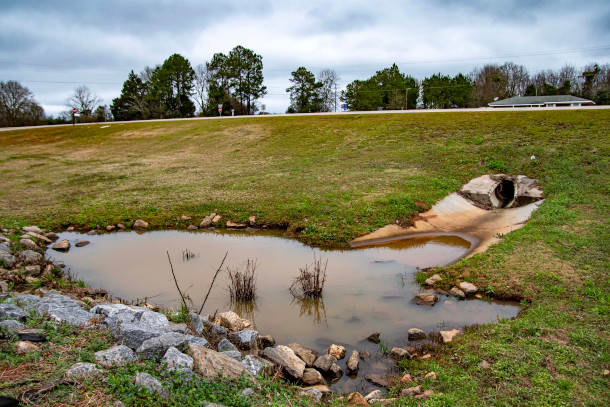
Photo: Lee Hedgepeth, Inside Climate News via Living on Earth.
These highway drainage pipes send water directly toward homes in Shiloh, Alabama — homes  that Black landowners have maintained since the Reconstruction era. Other neighborhoods benefit from drainage that runs parallel to roadways.

“Climate injustice” is not a term favored by the billionaire class, but removing out-of-favor words doesn’t make the realities they represent go away. Whether injustices occur on purpose or by accident, they happen. But around the world, ordinary people do what they can to fight back.

Paloma Beltran, associate producer of environmental radio show Living on Earth, has written that recent government decisions “will have a ripple effect across communities that have been pushing back against the impacts of industrial pollution for years. On this week’s show, we spoke with Patrice Simms, the Vice President of Litigation for Healthy Communities at Earthjustice, about the federal government’s role in protecting people from environmental discrimination. … Here’s some of what he said:

“ ‘Really significantly for me, what continues to motivate me is my tremendous respect and appreciation for the people on the front lines of pollution and exposures. I work really closely with communities across the country who are in very real ways, fighting for their lives, fighting for their families, fighting for their well-being, and fighting for their communities. And these aren’t people who are getting paid to do this. These are people who are doing this because they have to. They’re doing this because they’re watching their children get sick. They’re doing this because they’re watching their communities die. And there’s nothing more motivating than understanding and knowing the members of these communities. … It’s an honor and a privilege to get to work with them and beside them and for them, and that keeps me going every day.’

“So it feels like an opportune time to highlight a few environmental justice leaders who have shared their stories with us:

  • “Sharon Lavigne is a former school teacher who has become a fierce environmental defender out of love for her community. She’s from Cancer Alley, an eighty-five-mile stretch of the Mississippi River, from Baton Rouge to New Orleans. Slave plantations once lined this part of the river, and many descendants of former slaves still reside in that area. In the 1960s, petrochemical plants began flooding the area, in part due to the river allowing trade, transportation and the disposal of waste in an unseen and cheap way. Most of these plants are in close proximity to predominantly Black communities, exposing them to toxic emissions. According to a 2023 study published in Environmental Challenges, toxic emissions in Louisiana are 7 to 21 times higher in communities of color compared to white communities, and chemical manufacturing is the largest contributor to this disparity. Sharon Lavigne … co-founded Rise St. James, a faith-based grassroots organization fighting against the proliferation of chemical industries in St. James Parish, Louisiana. In 2021, Sharon won the prestigious Goldman Environmental Prize for her activism. For more, take a listen to our conversation. ….
     
  • “Nalleli Cobo grew up within 30 feet of an oil well — one of more than 5,000 oil and gas wells across Los Angeles, California, 700 of which are currently active. Like much of her community, Nalleli suffered from chronic headaches, nosebleeds, stomach pain, and asthma, and at the age of 19, she was diagnosed with cancer. Following treatment, Nalleli is now cancer free, but unable to have children. In March 2020, she joined a coalition of environmental justice organizations and successfully sued the city of Los Angeles for environmental racism and violation of CEQA, which is the California Environmental Quality Act. AllenCo Energy was forced to close down its well located near Nalleli’s home. … Tune into my interview with her here.
     
  • “Andrea Viduarre is another environmental justice advocate who organized her community and convinced the California Air Resources Board to adopt transportation regulations that limit trucking and rail emissions. (However, the state withdrew these rules [after the 2024 presidential election.] Southern California’s Inland Empire serves as a the hub for logistical infrastructure and is home to a predominantly Latino population. A staggering 40% of all US goods move through the area, a lot of which is transported through diesel trucks which emit toxic pollutants linked to cancer, asthma and premature death. Andrea Viduarre’s work has made huge strides in getting pollution out of her community. … You can learn more about in our discussion here.
     
  • “Robert Bullard is known to many as the father of environmental justice. He ran the first study on eco racism in 1979, and found that toxic facilities in Texas were disproportionately located in Black communities. His research was used in the Bean v. Southwestern Waste Management Corporation lawsuit, the first case to use civil rights law to challenge environmental racism. He’s the founding director of the Bullard Center for Environmental and Climate Justice, as well as Distinguished Professor of Urban Planning and Environmental Policy at Texas Southern University. He’s been advocating on behalf of the predominantly Black community of Shiloh, Alabama, whose homes have been repeatedly flooded since a nearby highway was widened in 2018. Dr. Bullard joined us back in 2024 to talk about this case.”

It has always lifted my spirits to see everyday people doing what they can where they are. Public radio’s environmental show Living on Earth will lift your spirits.

PS. Join me on Mastodon? @DudeShoes.

Read Full Post »

Photo: Chris Granger/Times-Picayune.
New Orleans 12th grader Dejah Grimes was part of a pilot program, soon to be expanded, that gives students $50 per week with no strings attached.

Paying kids to do something they should be doing anyway — for their own sake — does not always have the intended result. But I can see that to keep some teens in school, it might help. And for those who’d stay in school anyway, what a nice bonus!

Marie Fazio writes at the Times-Picayune, “Every Wednesday morning for nearly a year, Dejah Grimes woke up to a $50 deposit in her account, money she was free to spend however she chose.

“Most weeks she gave the card to her mom, who put it towards the water or electric bill. Occasionally she used it to go to the movies or the mall with her friends, or to pay for school expenses, including the recent purchase of a black polo shirt with the G. W. Carver school logo embroidered on the breast, a privilege reserved for seniors.

“ ‘It helped my family a lot,’ Grimes said. ‘It really made life easier.’

“Now, hundreds of other New Orleans teens are set to receive similar assistance as part of a groundbreaking study on the impact of providing young people with a ‘universal basic income,’ or recurring cash payments with no strings attached. 

“After promising preliminary findings and a $1 million investment from the city of New Orleans, a guaranteed income program that began with 20 students at The Rooted School in 2020 will expand this fall to 1,600 high school seniors at schools across the city over the next three years. Deemed the ‘$50 Study,’ the program gives students $50 per week and follows their academic and financial progress. It’s one of the first of its kind to study the impact of universal basic income on youth. 

“Researchers said that high schoolers over the past two years — 386 students from The Rooted School in New Orleans, The Rooted School Indianapolis and G. W. Carver High School — who received payments missed fewer days of school, showed more literacy growth and enjoyed more financial stability than their peers who did not receive money. …

“At the height of the pandemic in 2020, [Jonathan] Johnson, then executive director of Rooted New Orleans, noticed an alarming spike in absenteeism among his students, many of whom had to take on extra shifts at work to help their families make ends meet. 

“Hoping to alleviate some of the financial stress on students, they launched a ‘micropilot’ with 20 Rooted seniors, ten of whom received weekly payments. From 2022 to 2024, they expanded to a randomized control trial with 386 students over two cohorts.

“According to preliminary data, which has not yet been peer reviewed, students who were given the funds attended an average of two more school days per semester and their reading test scores grew by nearly double that of the control group. Researchers also found students who received the money demonstrated better ‘financial capability,’ a term used to refer to financial literacy and real-world application, and scored higher on tests measuring their financial well-being.

“Stacia West, who co-founded the Center for Guaranteed Income Research at University of Pennsylvania and acts as lead researcher for the $50 study, said the program can provide young people with valuable lessons, including how to navigate — or avoid — risky financial instruments such as payday loans and credit cards.

“ ‘The fact that these kids are able to interact with these financial markets so early,’ said West, who is also an associate professor at the University of Tennessee, ‘means they’re going to be better equipped when they get into their 20s to make better financial decisions.’

“Students in phase one of the study, which took place from 2022 to 2023, only used about half of cash assistance. About 47% of the money remains in the students’ bank accounts, suggesting many are saving.

“Of the money they did spend, about 50% went towards food and groceries, 30% to goods and services, 12% to transportation, 3% to healthcare and the rest to other expenses.

“Results from the second phase of the study, which followed 28 students from Rooted Indianapolis, 47 students from Rooted New Orleans and 155 students from G. W. Carver — a Collegiate Academy-run high school — will be published in the spring.

“Grimes, who participated in the second phase, said having the money helped her family with unexpected expenses, like food and travel purchases while out-of-town for her great-grandmother’s funeral. This summer, she used it to pay for Ubers back and forth to work as a camp counselor-in-training at Live Oak Camp. …

“Malik Williams, a junior at G. W. Carver, said he spent money on food and school supplies, including a pair of New Balance sneakers and a pair of headphones.

“New Orleans used to have a guaranteed basic income program aimed at young people ages 18-24 that was part of a national initiative called Mayors for Guaranteed Income. An effort to expand the program in December was not funded by the city council.

“Jeff Schwartz, Director of Economic Development at the City of New Orleans, said in a statement that the agency is ‘thrilled to be an investor’ in the $50 study. …

“West said that the Rooted School’s study is the first to track the impact of guaranteed income on young people. … ‘I think this could be a new way to think about educating and socializing our children financially.’ “

Not to mention relieving some of the stress that interferes with learning, I’d say. Financial literacy shouldn’t be the only goal. Staying in school, learning more, having a better shot at a good future as a result … what about that? I hope to track down the newer study once it’s completed.

More at the Times-Picayune (Nola.com), here.

Read Full Post »

Photo: Melanie Stetson Freeman/CSM.
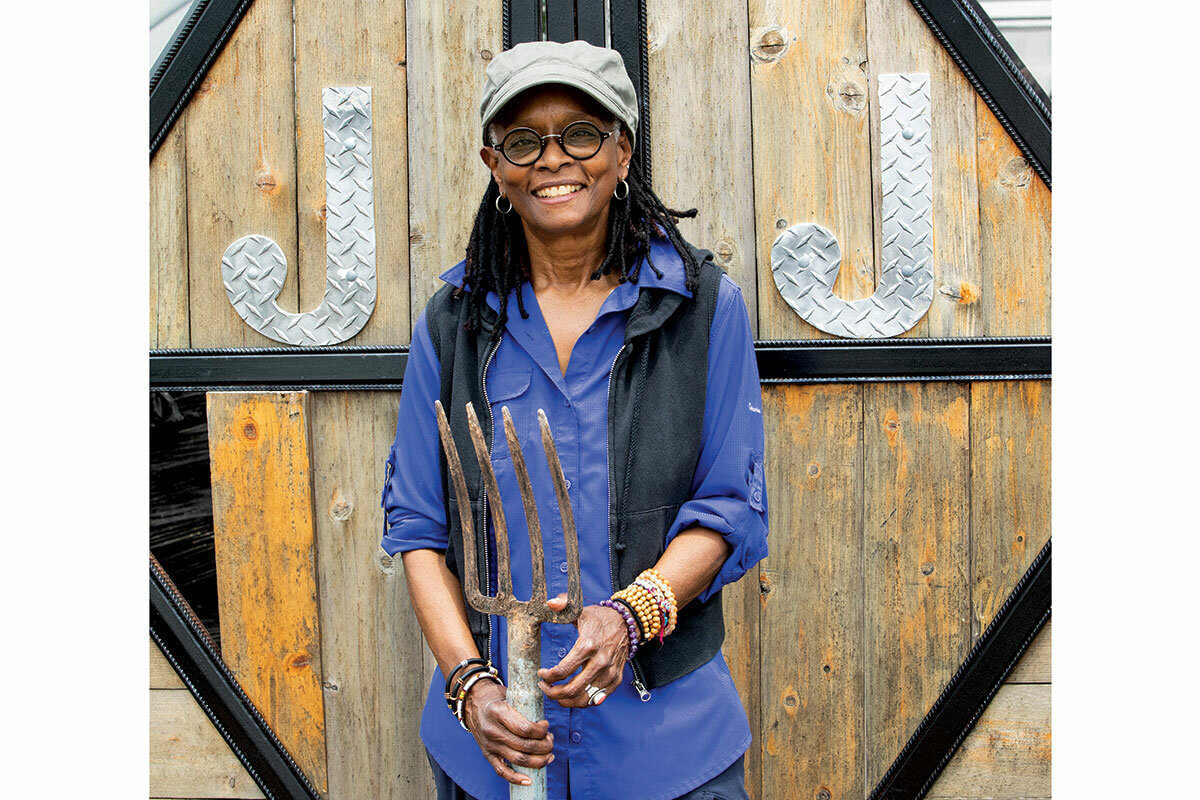
Konda Mason, founder of the nonprofit Jubilee Justice, poses at her farm in Alexandria, Louisiana, May 7, 2023. She teaches Black farmers a sustainable and environmentally friendly method for growing rice.

There are people who try their hand at many different things over a lifetime until something clicks. Or until all the pieces converge to make a new whole.

Consider Konda Mason, currently of Louisiana. Diane Winston has a long article about her at the Christian Science Monitor.

“It’s past daybreak on a muggy July morning when Konda Mason reaches the farm, a 5-acre plot in rural Louisiana. Mindful of the heat to come, several workers are already weeding, and Ms. Mason – her daily meditation and yoga done – is ready for a busy day.

“She’ll field calls from farmers and suppliers, check the progress of the industrial rice mill she’s building, and meet with a journalist curious about why a Black Buddhist from Oakland, California, is growing rice in a red county of a very red state. …

“A slender, muscled woman with waist-length dreadlocks, Ms. Mason sees the farm as the apex of her efforts as a social entrepreneur and eco-spiritual activist. Today she’s sporting a red bandanna to shade herself from the sun, but in her nearly 70 years, she has worn many hats. She’s been a concert promoter, filmmaker, and supporter of Black innovators and problem-solvers. As with her other endeavors, this new project manifests the values that have guided her life: love, justice, community, and a willingness to leap into the unknown.

“ ‘I was taught by my family that I had a role to play in making this world a better place,’ Ms. Mason told listeners in her keynote address at the 2015 Wisdom 2.0 forum in San Francisco. …

“ ‘The question I ask myself is, how can you go deeper, what do you have to let go of in order to do that, and are you willing to do it?’

“This time, going deeper meant leaving her home, her sister, her partner, and her friends to promote what she hopes is a revolution in rice production. Her goal is to support a more sustainable and less expensive way to grow rice, in hopes of staunching the loss of Black-owned farmland. Working alongside an agronomist from Cornell University, she uses what’s called the System of Rice Intensification, common in developing nations but new to American farmers. Going deeper has also meant mastering the complexities of soil and weed management, crop rotation, fertilization, the milling of rice, and bringing it to market. Equally complex, of course, is working in a region where race relations are historically fraught. …

“Though deeply committed to Buddhism, Ms. Mason is not an evangelist. At the farm, she rarely discusses her practice, and if she does, she talks about mindfulness, not Buddhism.

“ ‘Konda’s had many lives, and I never thought there would be a home for her,’ says Dianne Houston, a longtime friend. ‘But the combination of working on the land with people who share her beliefs about social justice – all the boxes are checked.’

“Ms. Mason’s work on the 3,700-acre former plantation is equal parts passion project, spiritual mission, and response to the loss of 12 million acres of Black farmland over the past century. … Since arriving in Louisiana in 2020, Ms. Mason has grown a network of nearly a dozen Black farmers whom her team visits regularly. Her agronomy colleagues offer technical assistance, and she provides rice seed and access to loans. She secured a centrally located, solar-powered industrial mill for processing the plants, and has a distributor to help with marketing. When she’s not working the land or promoting the project, Ms. Mason sometimes dons another hat, leading intentional conversations across racial and economic divides.

“Both the farming project and the conversations are part of Jubilee Justice, a nonprofit Ms. Mason created to help change a system that she says has profited by discriminating against people of color and despoiling the planet. It’s the natural outcome of her lifework. …

“in 1973, when she arrived for her first year at the University of California, Berkeley, … a new friend introduced her to yoga and broadened her taste in music. Soon Ms. Mason was running the Berkeley Jazz Festival, a well-funded community program sponsored by the university. Ultimately, she left school to team up with the manager for Sweet Honey in the Rock, a Black, female a cappella group whose music blended blues, gospel, and jazz. The two joined forces to promote female musicians. 

“ ‘We would put a Native American group with a Black group or a lesbian group,’ she says. ‘We kept building coalitions. We did it all over the country.’  …

“[Some years later in Louisiana] she helped organize a gathering of progressive women; most of the wealth-holders were white, and the activists people of color. Among the attendees was Elizabeth Keller, a white woman and devout Christian. Her grandfather had purchased a former plantation in Louisiana, hoping to ‘redeem’ the land, but he never did. When he died, he left all 3,700 acres to her.

“At the gathering, Ms. Keller spoke about the farm and her desire for healing there. She had prayed for someone to show her the way, and, to her surprise, Ms. Mason seemed to be the answer to that prayer.  The plantation could be redeemed, Ms. Mason realized, by using the System of Rice Intensification (SRI) to cultivate a pilot crop and develop a network of Black farmers to adopt the technique. 

“Ms. Keller, acknowledging that Ms. Mason ‘saw something I couldn’t,’ agreed to let her use the land.  Now Ms. Mason needed expertise. She cold-called Erika Styger, the Cornell agronomist, who knew from working with farmers around the world how SRI increases crop yields, improves the soil, cuts costs, enhances profits, and reduces the environmental impact of rice production. It took some convincing, but in the end, Ms. Mason’s vision and practicality persuaded her to provide technical assistance.”

Read more at the Monitor, here. No firewall. Subscriptions are encouraged and are reasonably priced.

Read Full Post »

Photo: Amy via Louisiana Radio Network.
Do you know where to find the “Strawberry Capital of the World”?

When I was volunteering last spring with the Ukrainian media team, we often chatted by text when work was slow, and Leilya happened to mention that Louisiana was the strawberry capital of the world.

She said the strawberries started in February! This year’s Ponchatoula Strawberry Festival is scheduled for April 14 to 16, so you still have time to get down there.

The festival website says, “Since 1972, the Ponchatoula Strawberry Festival has attracted visitors from near and far to celebrate our local strawberry farmers, non-profits, and our special community, flourishing into the largest free harvest festival in the state of Louisiana.”

Events seem to include non-strawberry events, such as rides, an egg toss, and a ceremony for fallen heroes: “Join us in Veterans Square, commonly referred to as the Strawberry Parking Lot, to witness history as we support our Fallen First Responders and Wounded Veterans from 9/11. The Ponchatoula Strawberry Festival is proud to bring the Tunnel To Towers Foundation’s 9/11 Never Forget Mobile Exhibit to Louisiana for the first time! This high-tech exhibit will sit among local Veteran booths, representatives from our country’s Military Forces, and the ‘Spirit of Louisiana’ Fire Truck.”

To learn more about the actual strawberries, I turned to the Strawberry Marketing Board, here: “Louisiana’s strawberry industry dates back to the 1800s when the Great Economic Migration brought a wave of Italians and Hungarians to America with hopes of finding work. Many moved to Louisiana and began strawberry farms in the warmer weather and rich soil.”

“The Louisiana State University (LSU) Ag Center, here, adds, “Tangipahoa Parish is still the leading strawberry-producing parish, growing 75% of the total acres in Louisiana and accounting for 79% of the state’s total gross farm value. Louisiana strawberries can be found in grocery stores, farmers markets and roadside stands as early as November, December and January.

“Early fall is the time to plant strawberries. Home gardeners can successfully grow strawberries with even a small area, plenty of sun and some TLC. … Strawberry plants are typically sold in local garden centers as bare-root plants, but they also can be found as transplants. Plants can be purchased online, too.

“In Louisiana, we need to plant short-day or day-neutral strawberry varieties. Short-day plants begin to produce flowers when the days shorten during fall and winter. They initiate flower buds when there is 14 hours of daylight per day or less. Day neutral means day length doesn’t affect flower production. These strawberries will blossom and set fruit no matter how long or short the days are.”

There was also a piece at Fox News, here.

Every year there are signs that spring is on its way. One of the earliest comes on Feb. 27 when National Strawberry Day is observed.

“While the industry has shrunk over the decades, Southeast Louisiana still holds a strong presence in the strawberry industry with most of the production concentrated in the eastern part of the Florida Parishes.”

The state’s marketing board website, also notes, “The crop peaked in 1931, with Tangipahoa Parish becoming the most important center of distribution as farms along the City of New Orleans rail line could ship as far north as Chicago and even by commercial truck on Highway 51. The activity was so heavy in the area that there was a boom of people moving into the area to farm and experiment with the fertile soil and temperatures to create new breeds of berries.

The Klondyke strawberry was cultivated in Tangipahoa Parish around the Independence area and the name was given to reflect how the growing industry at the time was like the ‘gold rush’ that occurred in the American west and Alaska just prior to the Civil War.

“Today, most Louisiana farms are small and independently run and some allow the public to come to pick their own berries to buy on-site.”

“The Louisiana radio network noted in February that the crop did not get the ideal weather this year.

“As we approach the peak of strawberry season, Springfield strawberry farmer, Trey Harris said it’s been a tough year so far weather-wise. He said production is down from this time last year, but the current unseasonably warm temps are speeding things up.

“ ‘But I see a lot of blooms, a lot of green fruit coming really strong right now. We’ve just to … hope that we can get some really sunny days like today and cold nights so we don’t just get overflooded with berries right now,’ said Harris.

“Harris said highs in the 80s and lows in the 70s are causing a growth spurt among strawberries. And while you might assume strawberry farmers welcome rain, Harris said they are able to control water consumption, and too much water and fog at this point can affect the taste of strawberries.

“ ‘We really don’t want rain at all, we don’t want any rain on the strawberries because it’s going to make them taste like water,’ said Harris. … He said its vital residents support locally grown berries now more than ever.

“ ‘That’s why it’s very important that the people in Louisiana buy strawberries from all of us local farmers. We only have a few Louisiana strawberry… maybe 15 farmers left.’ ”

Read Full Post »

Photo: Emmett FitzGerald.
Dean Wilson
, protector of Louisiana swampland.

Now that we know how important wetlands are for the environment and for protecting us from the worst effects of hurricanes, it doesn’t seem like a fringe occupation to be a protector of swamps. Among those who take Louisiana’s wetlands seriously is the scrappy nonprofit Louisiana Bucket Brigade. Another defender is Dean Wilson. Emmett FitzGerald at Living on Earth [LOE] interviewed him recently.

“LOE: Once, cypress swamps covered hundreds of thousands of acres across the American South. Logging, oil and gas extraction and swamp drainage transformed the landscape. But over recent years, Dean Wilson has worked to protect the remaining cypress swamps of Louisiana’s Atchafalaya Basin from illegal loggers and oil prospectors. Recently, the European biomass industry has set up shop in the state, and conservationists are concerned for the future. Living on Earth’s Emmett FitzGerald reports. …

“EMMETT FITZGERALD: Dean Wilson doesn’t sound like a Cajun, but he’s been living in the swamps of Southern Louisiana for 30 years now.

“DEAN WILSON: I remember the first time I saw the swamp I fell in love with it. You know you see the beautiful green trees, with the Spanish moss, over water, and those egrets flying around like angels. Uh, I just really fell in love with that.

“FITZGERALD: Dean grew up outside of Madrid, in Spain, but he came to Louisiana in his early twenties on his way to South America. He wanted to get used to the humidity and the mosquitoes before doing scientific research in the Amazon. But he never left the Bayou State.

“WILSON: When I realized I could actually make a living off the land, I decided to stay. I was a commercial fisherman for 16 years, full-time. So I made my living hunting and fishing the swamps in the Atchafalaya Basin for 16 years.

“FITZGERALD: Dean says people call all kinds of marshy wetlands swamps, but true swamps are actually pretty rare, and the Atchafalaya Basin is the largest in the United States.

“WILSON: And the difference between a swamp and a marsh is that a swamp is a flooded forest. So you actually go in the springtime when the waters high you go with a boat through the forest and you can see the birds and the animals the otters minks alligators all the things that live in the swamp. It’s a magnificent place. One of the most beautiful places on earth. The Cypress trees grows to different shapes; they can live to up to 4000 years old. So the Cypresses are incredibly beautiful.

The difference between a swamp and a marsh is that a swamp is a flooded forest.

“FITZGERALD: A few years ago, Dean gave up commercial fishing and turned his attention to protecting the ancient Cypress forest he calls home. Now, Dean patrols the swamp in his little motorboat as the head of the conservation organization Atchafalaya Basinkeeper. Today Dean and I are joined in his boat by his German Shepherd Shanka, and a fellow conservationist.

“PAUL ORR: I’m Paul Orr and I’m Lower Mississippi Riverkeeper. …

“FITZGERALD: Dean pulls the boat through the undergrowth into a clearing in the forest, and suddenly hundreds of giant cypress trees are all around us. Their trunks flare out at the bottom like grass skirts. Dean says this cypress forest is teeming with life.

“WILSON: The swamps of the Atchafalaya are considered by scientists the most productive in the entire world. You can go to the Amazon and you may have more biodiversity, but if you get an acre of the Atchafalaya Basin and you’re supposed to get more pounds of fish and crawfish than any other wetlands in the world.

“FITZGERALD: Full-grown cypress trees have nooks and cavities that birds love to nest in.

“WILSON: Nearly half of the waterfowl population in North America come at one time or another through the Atchafalaya basin. So it is a critically important ecosystem not only for North America but the whole western hemisphere.

“FITZGERALD: As we float between the trunks, Dean says swamps like this one once covered much of the American South.

“WILSON: Most people have seen the Amazon river flooding millions of acres of rainforest. The Mississippi used to do the same thing, used to flood 24 million acres of forest. For somebody to picture how big is 24 million acres, there was a time when you could get in a boat, right now this time of year and through this water, could go through this forest, and never leave the forest all the way to Missouri.

“FITZGERALD: But that five-hundred-mile waterway didn’t last. A lucrative timber industry developed in Louisiana around 1700. And then in the 19th century new steamship technology allowed companies to log southern cypress forests quickly and efficiently.

“WILSON: By the year 1900 it was the largest industry in coastal Louisiana, was the cypress logging industry. Uh, and people thought it would last forever. By 1920, it was all over. They logged every single forest in this state. Didn’t leave a single acre standing.

“FITZGERALD: In 1927, the Mississippi River spilled its banks, killing hundreds of people and displacing hundreds of thousands in the most destructive flood in US history. The Army Corps of Engineers responded to the crisis by building levees all up and down the Mississippi to control the flow of the river. The levees were designed to protect cities like New Orleans, but they straight-jacketed the river and prevented the natural flooding of Louisiana’s cypress swamps.

“WILSON: It drained all those forests. Farmers came in, they cut those trees down and today it’s mainly farmland. When people drive through Arkansas, Northern Louisiana, Mississippi through what is called the Delta area, it’s all farmland but it used to be like the Atchafalaya Basin.

“FITZGERALD: Today although the Atchafalaya Basin is smaller than it once was, it’s still one of last great cypress swamps left in the United States. Like all swamps it’s protected under the federal Wetlands Protection Act, and Dean Wilson and Paul Orr want to do everything in their power to preserve it. In 2008, they noticed an uptick in illegal logging in the Atchafalaya. They followed the supply chain all the way to the garden mulch aisle.

“ORR: We realized pretty quickly from following the logs and then finding bags of cypress mulch and following those to Wal-Mart, Lowes and Home Depot that there was this tremendous push to try and build a cypress mulch industry.

“FITZGERALD: But Dean says the companies that supplied the mulch weren’t clear about where it came from.

“WILSON: Home Depot, Lowes and Wal-Mart were selling the mulch as environmentally harvested. The bags would say ‘Made with environmentally-harvested cypress, from Florida’ – you have a Florida address, so they were actually deceiving the public into buying their mulch.

“ORR: And deceiving the retailers — I think that some of the retailers were not very happy that that was not what they said it was.

“FITZGERALD: So when Paul and Dean brought this issue to the attention of the retailers in 2008, the stores agreed to stop selling Louisiana Cypress mulch. But Dean’s still worried about illegal logging. He says the problem is enforcement.

“WILSON: We have laws to protect wetlands, the problem is those laws are not being enforced, and the government isn’t even putting in the resources to enforce them, they don’t even have a boat, so they can’t be enforced.

“FITZGERALD: And Paul Orr believes that problem starts with the cozy relationship between big business and the state government.

“ORR: I guess it was like the late 90s, early 2000s, the Louisiana Department of Economic Development put an ad in a lot of national publications and it was like a guy in a suit doing a back bend and it said, ‘Louisiana bends over backwards for business.’ And that’s really been the culture in Louisiana — the wealthy business people just give away all of our natural resources and our tax monies and everything for business.”

Oh, Homeowners, here’s a simple thing you can do: don’t buy mulch.

More at Living on Earth, here. There is no firewall, but donations are encouraged.

Read Full Post »

Photo: Jonathan Bachman/Reuters.
In Louisiana, climate change is erasing Isle de Jean Charles. French-speaking and indigenous residents are moving to higher ground, amid fears of losing their language and culture.

We all know someone who begins to rebuild right after a natural disaster like a wildfire or hurricane, and who are we to judge? But as extreme weather incidents become more common, some of those most affected are, with aching hearts, facing the necessity to be practical.

Patrick Cox reported at PRI’s the World, “Hurricane Ida killed dozens of Lousianans and displaced tens of thousands of others. Among the hardest hit were bilingual and French-speaking communities close to the Mississippi Delta. 

“Alces Adams lives halfway between New Orleans and the Gulf of Mexico in the small community of Cut Off in Lafourche Parish. Hurricane Ida destroyed his trailer.

“People in this part of Louisiana — bayou country — have long learned to live under adverse weather conditions. But things have gotten much worse in recent years. Rising sea levels, erosion and storm after storm have flooded entire communities. For some French speakers, Hurricane Ida was the last straw, and now many are moving away.

“A year after Ida, Adams’ trailer looks just as it did the day after the storm — twisted and torn apart with furniture spilling out, as if attacked by a pack of wild animals. Next to it is a new trailer, Adams’ temporary home provided by FEMA, the Federal Emergency Management Agency.

“Adams was born a block away in his grandparents’ house. His family’s older generation spoke only French. Adams said his grandmother learned English, but refused to speak it, except for one word: ‘Yeah.’ 

“ ‘English was forced on us about 100 years ago,’ Adams said. That’s when English was declared the only language of instruction in public schools. Adams recalled listening to his older relatives as they told him stories in French. Even then, he said, he considered the language beautiful. ‘I loved listening to that.’

“Adams’ grandmother and others told him stories of storms and floods they had survived. It helped prepare him — still a child — when Hurricane Betsy battered the region in 1965. …

“Adams doesn’t know what’s next for him. He comes from a long line of Cajuns who he said were compelled to move from one place to another, to escape poverty or discrimination, or hurricanes and flooding. 

“The French language has been a constant in all of this generational change. Adams knows that each time a French speaker moves away, it’s another micro-blow to the survival of French in southern Louisiana.

“Tulane University linguist Nathalie Dajko has been tracking the decline of French in Lafourche and neighboring Terrebonne Parishes for nearly 20 years. She was in graduate school at Tulane when Hurricane Katrina hit in 2005. It left hundreds of thousands of people homeless. Some even ended up in camps that were scattered across several southern states. Dajko visited a few of the camps as part of a gig she had with Save the Children, a nongovernmental organization.

“ ‘Every now and again, we’d come across these French speakers,’ Dajko said. ‘They would be so excited to meet somebody who spoke French, and they would talk about how they missed the French.’ …

“Louisiana French isn’t standard Parisian French. But French has had longstanding roots in the region after France claimed it in 1682. With the area drawing French speakers, the language gained a foothold. It even spread to local Indigenous tribes in the 1700s. They’d formed protective alliances with the colonial French against the British. Some of their descendants still speak French, especially those who live closer to the ocean — and the floods and storms.

“Across a causeway from one of the larger bayous in Terrebonne Parish is an island called Isle de Jean Charles. Abandoned dwellings are everywhere: collapsed walls, caved-in roofs, debris. A couple of the houses are being fixed up. But most aren’t.  Near the end of the road, a house with a sign outside says, ‘Isle de Jean Charles is not dead.’ … 

“Chris Brunet, who answered the door in a wheelchair, said he spoke French at home and English at school. Like Alces Adams, Brunet’s grandmother only spoke French; his parents were bilingual. Everyone living on the island was a member of the Biloxi-Chitimacha-Choctaw tribe. …

“ ‘Hurricane Ida is the first storm to damage the house,’ he said, pointing out his damaged roof. … Likely to be gone soon is this entire island. In the past 65 years, Isle de Jean Charles has shrunk from 22,000 acres to just 320. 

“It’s not just the storms. There are many reasons why the land is vanishing: rising sea levels, the rerouting of the Mississippi river — some of it natural, some engineered — canal construction, land erosion, some of that caused by oil and gas extraction. Then there’s the levee system, expanded after Hurricane Katrina: a life-saver for those living within it; potentially catastrophic if you’re on the outside of it.

“That’s why Brunet, and almost everyone else on the island, is leaving, with federal government assistance, to a city 35 miles inland where virtually no one speaks French.

“ ‘If I had to predict, I would suggest that people are not going to maintain French,’ linguist Nathalie Dajko said. … Still, Dajko has studied these French and bilingual communities for close to two decades, and said they’re full of surprises. 

“ ‘People have been predicting the death of Louisiana French for generations and it just won’t die,’ she said.”

More at the World, here. For a refresher on Longfellow’s fictional Evangeline, one of the French-speaking Acadians expelled from Canada to settle in Louisiana, click here.

Read Full Post »

Photos: Valaurian Waller.
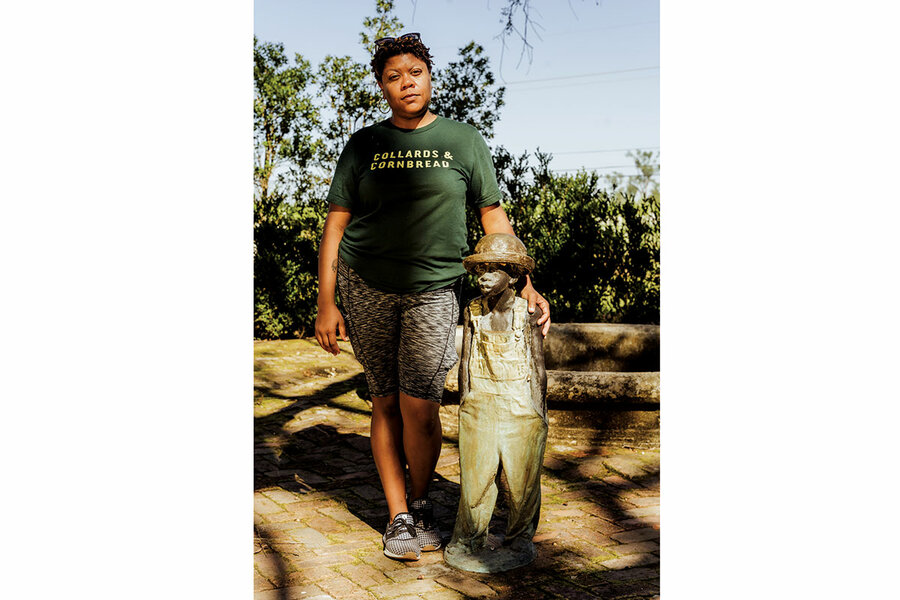
Ederique Goudia is a chef who came through for her community after Hurricane Ida. She is seen here with a statue commemorating child slaves on the Whitney Plantation — the only museum in Louisiana with an exclusive focus on the lives of enslaved people.

Have you been following the efforts of Chef José Andrés and World Central Kitchen as they serve the displaced people of Ukraine? Inspirational. Today I have a related story. It’s also about chefs who help desperate people by giving what they know best.

Xander Peters has the story at the Christian Science Monitor. “Ederique Goudia isn’t the type who stops moving. From November through February, her life was like a hurricane’s gust, tossing her about the country between the community that raised her and the place she now calls home.

“In early November, Ms. Goudia and an entourage of chefs made their way from Detroit to her childhood hometown of Wallace, Louisiana, a community of nearly 600 about 50 miles outside New Orleans that had been pummeled by Hurricane Ida’s Category 4 strength last summer. Her foodways colleagues Raphael Wright and Jermond Booze, among a host of others from their home in Detroit, rallied around her and organized a day of service for the community, followed by their group’s inaugural diaspora dinner. …

“The day after they arrived back in Detroit, Ms. Goudia and company made a beeline back to the kitchen, where they began working alongside colleagues to prepare 50 family-sized Thanksgiving meals for their food-insecure community members. The meals were prepared through the food security group Make Food Not Waste, of which Ms. Goudia is the lead chef. 

“Food relief is about more than physical sustenance for Ms. Goudia and the many chefs who volunteer alongside her. It is a rung on the ladder to stability. And it can be the glue that holds communities together. ‘It creates a shared song amongst people, of a reset,’ says Detroit chef Kwaku Osei-Bonsu, founder of ​​BlackMetroEats and one of the volunteers who traveled to Wallace with Ms. Goudia. …

“After Ida hit southeast Louisiana, [friends from the nonprofit Taste the Diaspora] were among the first to ask how her family fared, and they were well aware that it wasn’t feasible to get to Louisiana to help right away, as disaster recovery dragged on for weeks after the storm. They then suggested hosting local pop-up fundraisers. Before long, they had gathered a group of 15 or so members of the Detroit food community interested in traveling to Wallace. …

“[Ms. Goudia] knows small towns like hers don’t often receive disaster relief quickly while efforts concentrate on metro areas like New Orleans and Baton Rouge first. Wallace sits in the middle of a petrochemical corridor and has long struggled with environmental justice issues.

“Ida made landfall on Aug. 29. As Ms. Goudia checked on her family, the Detroit food scene leaped into action. … In total they raised $8,500 and they distributed it to Wallace residents through the Descendants Project, an advocacy group for descendants of formerly enslaved people in Louisiana’s river parishes. … 

“By the time Ms. Goudia and her colleagues were ready to head to Wallace themselves, word had spread through the Detroit area. Soon sponsorships began rolling in: The Kresge Foundation, which expands opportunities for low-income individuals nationwide, was the first major group to chip in. Then ProsperUS Detroit, an economic development initiative, pitched in. Turning Tables NOLA caught wind of their efforts soon after and offered to help as well. …

“The Detroit food community’s support for Ms. Goudia and her hometown was, in some ways, as emotionally overwhelming as watching Ida hit her family. At the same time, it wasn’t surprising. It’s what Ms. Goudia has come to know as the heart of Detroit.

“ ‘The hospitality that lives in Detroit, it isn’t a one-off,’ says Ms. Goudia. ‘It isn’t surprising at all, because there is this Southern hospitality that’s here, that’s unmatched.’

“On the day of the Wallace dinner, as always, Ms. Goudia didn’t stop moving. She and her volunteers worked through the afternoon to prepare an evening meal of a beet-based African dish, mirliton dressing, baked spaghetti, cornbread tea cakes, and pralines.

“As he leaned against a picnic table out front, opening cans of corn, Mr. Osei-Bonsu of BlackMetroEats reflected on his and others’ trip down South so far, and what he hoped the meal would mean for the community.

“Healing a community’s emotional wounds through food ‘is definitely something that’s impactful,’ Mr. Osei-Bonsu says. ‘Today will be about so much more than just the consumption of food. It’ll also be a dialogue.’ …

“Ms. Goudia says from her home in Detroit several weeks later [that the point is] to use ‘food in a way that breathes life into people, that gives them what they didn’t think they needed at the time.’ She stops and reflects for a moment. ‘I think we were successful in that. … Everybody that came on the trip is now family. Not only with me, but with the residents of Wallace. I was blessed to be able to provide that for them.’ ”

More at the Monitor, here.

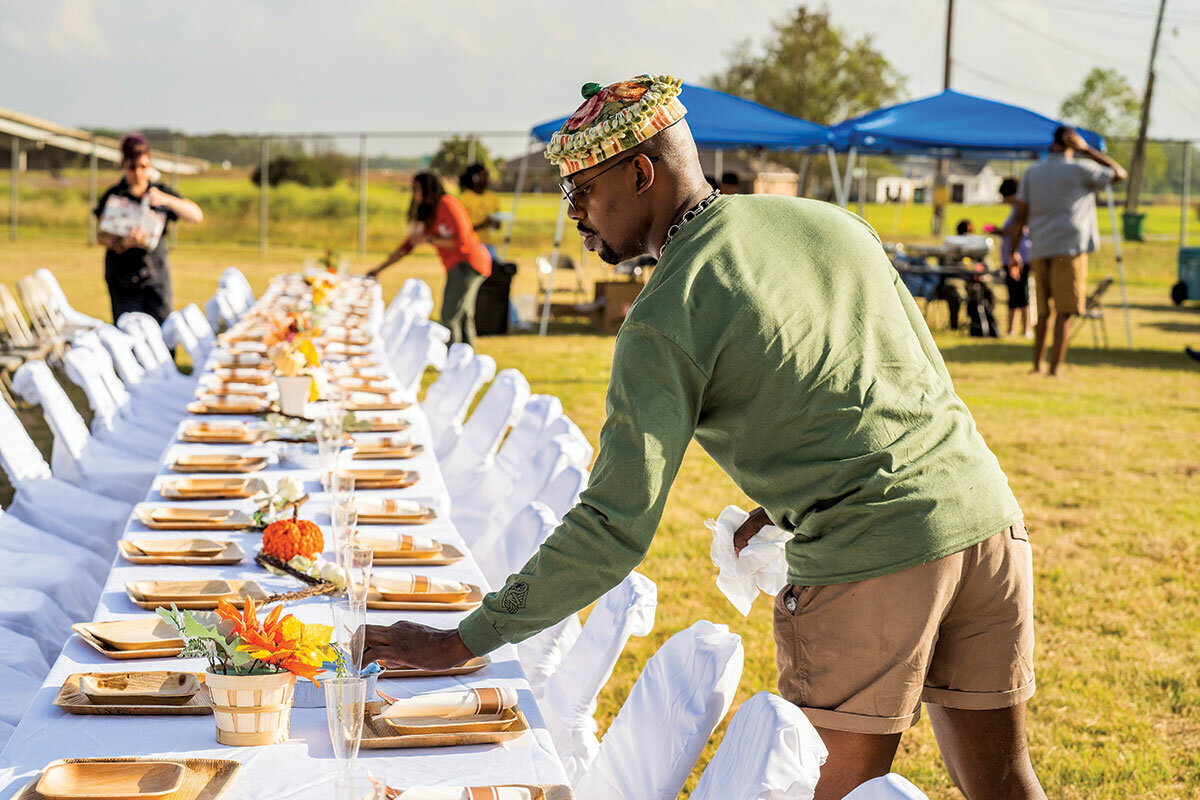
Kwaku Osei-Bonsu, Detroit-based chef and founder of BlackMetroEats, sets the table for a 100-person Taste the Diaspora community dinner in Wallace, Louisiana, Nov. 21, 2021.

Read Full Post »

Photo: Goldman Environmental Prize.
Founder of RISE St. James and 2021 Goldman Environmental Prize winner Sharon Lavigne speaks at the first annual African American Celebration at the grave site of enslaved ancestors at the Buena Vista Cemetery. The land was purchased by Formosa Plastics for a proposed petrochemical complex.

Ever since textile artist Jamie Bourgeois did a fabric-dying experiment with the polluted waters around Louisiana’s Cancer Alley, I’ve been supporting the Louisiana Bucket Brigade and Rise St. James — grassroots nonprofits fighting back against industries like Formosa Plastics.

So I was delighted to see that radio show Living on Earth interviewed a leader of that fight.

“In the aftermath of Hurricane Ida, the communities of the Louisiana region known as ‘Cancer Alley’ were left to deal with destroyed homes, no electricity, and polluted water. That’s on top of the toxic air they breathe every day because of industrial pollution, and Black residents have been fighting for environmental justice there for decades.

“Sharon Lavigne is the founder of RISE St. James and a 2021 Goldman Prize recipient for her work in organizing against a massive Formosa plastics plant, and she joins Host Steve Curwood to discuss the hurricane’s impacts and the health effects of industrial pollution in her community.

“STEVE CURWOOD: The climate emergency is in a downward spiral, as President Joe Biden recently observed when he visited areas hit hard by Hurricane Ida and its aftermath. …

“The poor and disadvantaged are especially hard hit from big cities to places like former farmland along the Mississippi. This 85 mile stretch between Baton Rouge and New Orleans is called Cancer Alley, and it’s the site of some of 150 petrochemical plants, a notorious source of toxic chemicals for locals on a normal day. But in the aftermath of Hurricane Ida many plants released even more pollutants than average as they dealt with high winds, high water and as much as 15 inches of rain.

“Many residents of this region are low income, descendants of the Black slaves who once toiled on the vast sugar plantations of the lower Mississippi. … Sharon Lavigne lives on land bought by her grandfather in St James Parish. She retired as a special education teacher to devote herself full time to advocacy as founder of RISE Saint James, an environmental justice group working to stop even more toxic industrial development in cancer alley. Her organization and others sued Formosa, a Taiwanese company that wants to build an ethane cracking plant nearby. That prompted the Army Corps of Engineers and the courts to require an updated environmental impact statement of the facility and earned Sharon the 2021 Goldman Environmental Prize for North America. …

“SHARON LAVIGNE: I live on the west bank of the Mississippi River in St. James Parish, and Hurricane Ida, it just, it has so much destruction. So many homes have their roof off. Some of the homes are totally demolished. And when it came, it stayed here while it didn’t move fast like it normally moves like hurricanes normally move. So this one was the worst I have ever experienced. …

“In the master bedroom, over half a room, the insulation, and the sheet rock is all on the beat, the carpet is wet. Everything is, I hope, I hope I can salvage the furniture, because that was my mother’s bedroom set. And I hope I can save it but we have to get all the stuff all insulation and sheet rock off of it first, to see how much we can save. … We don’t have electricity right now. We don’t have anything. …

“CURWOOD: Sharon, I understand you’re the founder of RISE St. James. That’s its a grassroots environmental organization. You mobilized against this $12.5 billion plastics manufacturing plant. Now what kinds of toxic pollutants [went] into release? What were the chemicals involved?

“LAVIGNE: Benzene. Benzene is one, and that’s cancer causing. Formaldehyde. There’s a whole bunch of chemicals, a whole lot of greenhouse gases that they’re going to release in the air and into the water. … Even though we have twelve refineries and industries in the fifth district where I live. They don’t care. They want to add some more to us. So once they add this industry to us, we’re not going to be able to live. It’s going to be too much in the air for us to breathe and live. We are having trouble breathing. Now we have people with asthma. We have people with all all types of respiratory illnesses. We have people with cancer all up and down this river. …

“And our governor approved this industry. Our parish officials approved this industry and they live here in St. James. That’s the part that hurt me, because they live here with us. … I don’t care if I don’t have any money. I’m going to fight for my community. And this is where I’ve been all my life. And this is where I want to stay. …

“CURWOOD: What about the location of this plant? …

“LAVIGNE: This plant would be two miles from my home. It would be one mile from a church and a school, public school. And that’s when I said no more. … I didn’t know how many we had, to be honest with you, until I went to a community meeting. And when I went to that meeting, I found out so many things that were going on, and all the chemicals and the people that were sick. One lady was on oxygen and she had cancer. … I said, I asked them, ‘Why don’t we fight from Formosa?’

“And they said, ‘Oh, the governor approved that. And they said the parish council is gonna approve it too and once they approve it, it’s a done deal. There is nothing you could do about it.’ And I told them, ‘We need to do something about it because we have too many. And they said, ‘Oh, Sharon, you are wasting your time. You can’t fight industry.’ …

“I prayed and I asked God what I should do. And he told me to fight. So that’s when I started to fight. I didn’t know what to do to fight. I didn’t know how to do this, this type of thing because I was never involved in involved in environmental issues, I was never involved in anything in the parish. We formed RISE St. James in October of 2018. Then we started meeting other organizations in New Orleans and different places, in that we formed a coalition and we called it Coalition against Death Alley. …

“The governor came down here in 2019, November 1st. … When somebody came to me, and asked me if I will speak to the governor, I said, ‘Sure, I sure would.’

“I said, ‘Governor, I would like you to stop Formosa. Don’t let it come into our neighborhood.’ And this is what he answered me: ‘I’m going to do a health study.’ … I was so hurt. I was so let down because he just threw it off like it was nothing.”

Then the community filed lawsuits. Read more at Living on Earth, here.

Read Full Post »

As readers know from my post on Shagufa Habibi, I am one of a group of people who believe in this young Afghan immigrant and her dream to end child marriages, first by gaining relevant skills. It doesn’t matter that the dream seems impossibly big. After all, when people believe in you, big things do happen. Young Greta Thunberg may not have ended global warming, but you know she won’t stop until there are serious changes.

Today’s story is about a young man from a poor family in Lake Charles, Louisiana, who had people who believed in him.

As Kellie B. Gormly wrote at the Washington Post, “Russell J. Ledet spent four years patrolling the doctors’ parking lot at Baton Rouge General Medical Center, where, as a security guard, he watched people in white coats come and go from the building. He fantasized about what his life could be.

“In a moment of bravery one day, Ledet was walking with a doctor and asked: ‘Hey, do you think I could shadow you?’ To Ledet’s surprise, the doctor, a surgical resident, replied: ‘Yeah, why not?’ Ledet recalled.

“Whenever Ledet had free time over the next several months, he was in the operating room and visiting patients with Patrick Greiffenstein.

“ ‘It just so happened, God put me in the right place at the right time, and it worked,’ said Ledet, 34, of Gretna, La.

“Now, seven years after he was a security guard at Baton Rouge General Medical Center, Ledet is assigned to the hospital as a medical student. He is doing his pediatrics rotation at the Louisiana hospital and is in his third year at Tulane University School of Medicine. …

“He sometimes runs into people he used to work with when he was a guard. Once when he was recently in the emergency room, one of them yelled out: ‘You did it! You actually did it!’

“Ledet grew up in Lake Charles, La., with a single mother who worked as a certified nursing assistant. They relied on food stamps to eat. After high school, Ledet joined the Navy and was stationed in Washington, D.C., from 2004 to 2007. He entered the Reserves, and his wife — Mallory Alice Brown-Ledet, whom he met in high school — persuaded him to go to college while she worked at a bank. They moved back to Louisiana in 2009, and Ledet enrolled in Southern University and A&M College in Baton Rouge.

“Ledet initially thought he would become a social worker, like the ones who had helped his family when he was a child. But one day, his chemistry professor told him that based on his performance in class, he should major in biology or chemistry. Ledet took on both sciences as a double major. That same year, he started the security-guard job to help support his family — which included a new baby, Maleah. …

“The doctor whom Ledet shadowed 10 years ago — now is a trauma surgeon at University Medical Center in New Orleans. … ‘It’s hard not to like him right away,’ said Greiffenstein, explaining why, in part, he said yes when Ledet asked to shadow him. He said Ledet’s path to becoming a doctor has been ‘remarkable.’

“Ledet graduated from college in 2013 and … moved east with his family to attend New York University, where he earned a PhD in molecular oncology in 2018. … His research on prostate cancer earned recognition, but Ledet fondly recalled his shadowing days in Baton Rouge and felt called to the clinical, hands-on work of a physician. …

“About an hour after his second daughter, Mahlina, was born, Ledet got an email from Tulane University in New Orleans: a full scholarship to medical school. …

“Over the summer, Ledet started his third-year rotations, after indicating his location preference for Baton Rouge General Medical Center. He was thrilled when he got it. …

“He plans to open a clinic in New Orleans offering mental health services for marginalized communities. And to be a better business owner, Ledet managed to squeeze in one more project: He is working on an MBA while in medical school. …

“ ‘I’m just grateful, man,’ he said. ‘I’m grateful I made it here. I’m grateful that I didn’t give up. I’m grateful that people believed in me.’ ”

Read more here.

There are just some people who if they say they are going to do a thing, then you know it’s going to happen.

Read Full Post »


The Swinomish community in Washington State has seen the future in rising waters. Much of the tribe’s 15-square-mile reservation is at or near sea level.

Today I have a story about how recognizing climate change can put a community one step ahead of the game. Indigenous people around the country are taking steps to deal with the inevitable before it’s too late.

Terri Hansen writes at Yes! magazine, “Chief Albert Naquin was astounded when emergency officials warned him in September 2005 that a second hurricane would soon hammer the southern Louisiana bayous where Hurricane Katrina had struck less than a month earlier. The leader of the Biloxi-Chitimacha-Choctaw tribe, Naquin took to the Isle de Jean Charles’ lone road to urge residents who had returned home after Katrina to leave their listing, moldy homes once again. …

“Hurricane Rita flooded the island for weeks, adding insult to injury that had already reduced the tribe’s homeland to a sliver of what it once was. Rising sea levels, hurricanes, erosion from oil production, and subsidence have since shriveled the Isle de Jean Charles peninsula from 15,000 acres to a tiny strip a quarter-mile wide by a half-mile long. There were once 63 houses flanking the town’s single street. Now only 25 homes and a couple fishing camps remain. …

“In January, Louisiana received a $48 million grant from the Department of Housing and Urban Development to move the Biloxi-Chitimacha-Choctaw and Houma Nation tribal members to more solid ground and reestablish their communities, making tribal members the first climate change refugees in the United States. …

“Across the country, 24 tribes have responded to climate change with plans for adaptation and mitigation, and more are in development. …

“As rising temperatures cause heatwaves, droughts, floods, wildfires, and increase the severity of weather events, tribes are on the forefront in respect to both degree of impact and in initial efforts to respond to adaptation, said Ed Knight, director of planning and community development for the Swinomish tribe in Washington state. …

“Using a unique model based on an indigenous worldview, the tribe updated its adaptation strategy in 2014 with environmental, cultural, and human health impact data. It now views health on a familial and community scale, and includes the natural environment and the spiritual realm, said Jamie Donatuto, Swinomish community and environmental health analyst.”

Will government support for tribes’ efforts continue? Read more here.

Read Full Post »

There can be unexpected ramifications to keeping cats, as art forgers described in Science magazine discovered to their regret.

In an article on how experts check the authenticity of a putative Velázquez or a painting found along with mummies, Lizzie Wade writes, Investigations into the artist responsible for more modern works often have a specific goal: To figure out if the work in question is a forgery.

“Bonnie Magness-Gardine manages the Art Theft Program at the Federal Bureau of Investigation in Washington, D.C. For many years, she and other investigators had seen innumerable forgeries of the work of Clementine Hunter, a self-taught and incredibly prolific African-American painter from Louisiana.

“Many people tried to copy her distinctive folk-art style, but only two regularly succeeded: William Toye and his wife Beryl Ann Toye, a couple from New Orleans. They were so good at imitating Hunter’s style that ‘they got away with this for years,’ Magness-Gardine says.

“In 2009, the Federal Bureau of Investigation finally gathered enough evidence to confiscate the Toyes’ supposed Hunter collection, and during the raid they noticed that ‘they lived in a very modest house with approximately 30 cats,’ Magness-Gardine says.

“When forensic investigators analyzed the seized works, they found cat hair embedded in the paint — a characteristic not shared by Hunter’s authentic work. ‘That’s essentially what brought them down,’ Magness-Gardine says. William Toye pled guilty to art fraud in 2011.”

More here.

Art: Clementine Hunter/ Bridgeman Images
Picking Cotton, 1950s (oil on board), Minneapolis Institute of Art, The Ethel Morrison Van Derlip Fund. Hunter is a favorite of would-be forgers.

Read Full Post »

Saw an amazing photography show this morning. Lori Waselchuk chronicles a program at a maximum security prison. The exhibit flyer says, “A life sentence in Louisiana means life. More than 85% of the 5,100 inmates imprisoned at the Louisiana State Penitentiary in Angola are expected to die there. Until the hospice program was created in 1998, most prisoners died alone.”

The inmates who work in the hospice program are pictured caring for others and keeping a 24-hour watch when someone is near death. They “go to great lengths to ensure that their fellow inmate does not die alone.”

I don’t want to be a pollyanna about this (I can see that some patients are still so susceptible to violent outbursts that volunteers may visit them only by speaking through a small window), but I am interested that many of the hospice workers discover a new side of themselves. George Brown, 49, says, “The most important thing I have learned as a hospice volunteer is that I have a heart and it has feelings.” Sometimes the guards find a new attitude in themselves, too. The flyer adds that the show, Grace Before Dying, “reflects how grace offers hope that our lives need not be defined by our worst acts.” Read about it here.

I have heard about one or two similar prison programs. Here is a piece about the Yoga Prison Project , started at San Quentin in California. And here is a movie about a prison meditation project called Dhamma Brothers.

My second cousin Alex was so energized by teaching meditation in a Boston prison that she is now entering a graduate program to gain more skills.

Read Full Post »