Feeds:
Posts
Comments

Posts Tagged ‘magazine’

Photo: Autodesk Instructables.
Building a ship in a bottle. “Hobbies are about doing things: planning, painting, building, contributing an article to your favorite magazine,” writes Alexander Poots at UnHerd.

Niche print magazines seem to survive even after everyone else has gone online. According to an article at UnHerd, that’s especially true of magazines about hobbies.

Alexander Poots writes, “Phil Parker is the editor of Garden Rail magazine. He’s a passionate man — especially on the subject of steam engines. ‘The steam engine is the nearest anybody has come to building a living thing,’ he says. … He talks about the joy of seeing them in action. The smells, the hiss and chuff, the weight of them on the line. It’s a joy that many people want to recreate at home. …

“Layouts in back gardens across Britain range from tiny loops of track to colossal, intricate landscapes. Parker knows a guy whose line crosses Lilliputian bridges and snakes through mountains 10 feet tall. Layouts are much more than models, he says. They really are railways, albeit on a smaller scale than usual. A keen sense of ownership is important: ‘these are their railway lines.’

“Ardent hobbyists are often viewed as eccentric. I think they might be the only normal people left. As a rule, they are active and engaged. They are more interested in making than consuming. They dream and they do. A passive appreciation for steam engines or military history or orchids isn’t enough. Hobbyists want to take part.

“ ‘I grew up fascinated by history, and wargaming helps you make that interest interactive,’ says Daniel Faulconbridge, editor of Wargames Illustrated. ‘It’s not good enough for me that I just read about the Battle of Hastings, I want to collect the figures that represent the troops that fought in the battle, and then paint them and play a game with them.’ …

“Magazines like Garden Rail and Wargames Illustrated are at the heart of the hobby world. The variety is extraordinary. Hornby MagazineAirfix Model WorldThe Orchid ReviewLute News. Monthly publications dedicated to remote control aircraft and koi keeping. Some hobbies have broader appeal than others — the UK has enough carp fishermen to support both Total Carp and CARPology. But even the more niche titles have a readership large enough to keep them viable in a brutal publishing environment. …

“The physical hobby magazine has in fact proved surprisingly durable. Both Faulconbridge and Parker acknowledge that their readers tend to be older, and prefer print media because it’s what they grew up with. There’s also a practical aspect: if you’re following a guide to painting a model Landsknecht, it’s easier to have a paper copy open on the table than faff about with a phone or tablet. …

“Again and again when talking to Parker and Faulconbridge, I am struck by the emphasis on the physical. Hobbies are about doing things: planning, painting, building, contributing an article to your favorite magazine. ‘You come into a hobby and you’re not being encouraged to binge-watch something on the tele — which is a very, very passive activity — you’re being encouraged to have a go at something,’ Parker observes. …

“Hanging out with like-minded people is the best way to have a go. Community is a word that comes up a lot in my chats with the editors. … Parker emphasizes that railway modeling exhibitions are as much social gatherings as they are celebrations of the hobby. As anyone who has worked an allotment knows, shared enthusiasms have a way of collapsing social barriers. Parker remembers one exhibition where he sat around a pub table with ‘a physics professor, a guy who ran his own bus company, a Liberal Democrat councillor, a theatre manager, a bishop and two lawyers. Our common interest was model railways. You find yourself meeting a really wide variety of people.’

“Still, it’s a mistake to think that these groups are purely focused on the hobby itself. Wargames and model railways are often the starting point for other things. Friendships are made, money is raised for charity, and support networks are formed. ‘Men are particularly bad at chatting,’ says Parker. ‘But they will chat about steam engines and they will chat about garden railways, and that chat can then move on to more valuable topics. We run the largest model railway forum in the world, and tucked away on it is a prostate cancer discussion group.’ …

“Hobby magazines survive because they are outgrowths of these communities. Most articles are written by hobbyists, in what Faulconbridge describes as ‘a fanzine approach.’ Neither the editors nor the contributors are in it for the money. They just love it. In a recent thread on X, Stone Age Herbalist observed that the continued success of the hobby magazine can be attributed to a particularly British — and more broadly Northern European — genius for voluntary association. Whether centered around giant vegetables or antique fountain pens, little communities bubble up everywhere. …

“A link between hobbies and productive industry can also be found in the world of railway modeling. Parker tells me that, ‘I’ve just reviewed a loco from a company based in Doncaster, Roundhouse Engineering. You’d be amazed, we do still build steam locomotives in this country! It’s a proper Rolls Royce engine model, beautifully constructed. They do pretty much everything in-house.’ This pride and attention to detail is at the root of what all hobbyists are up to. …

“Hobby magazines are heartening advertisements for that reward. Planning, making, getting things wrong, having a laugh about it.”

More at UnHerd, here.

Are bloggers hobbyists? We seem to check a lot of the boxes in the definition.

Read Full Post »

Photo: Stiftung Jüdisches Museum Berlin/Jewish Museum Berlin/ Convolute 816/Curt Bloch collection
Het Onderwater Cabaret, 1943. The satirical magazine, now on exhibit in Berlin, was produced by a German Jew hiding in a Dutch attic during the war.

Both the New York Times and the Guardian reported recently that a German Jew, hiding like Anne Frank in a Dutch attic during WWII, produced an angry, humorous magazine because he could. His magazine was in the news thanks to an exhibit in Berlin.

Nina Siegal writes at the Times that many people hid in attics during the war but that Curt “Bloch’s experience was different because, in addition to sustenance and care, his helpers brought him pens, glue, newspapers and other printed materials that he used to produce a startling publication: his own weekly, satirical poetry magazine.

“From August 1943 until he was liberated in April 1945, Bloch produced 95 issues of Het Onderwater Cabaret, or the Underwater Cabaret. … Writing in both German and Dutch, [he] mocked Nazi propaganda, responded to war news and offered personal perspectives on wartime deprivations.”

Charlie English at the Guardian has more from the perspective of Bloch’s daughter, Simone, now 64.

“As the daughter of antiques dealers, Simone Bloch grew up in a New York house filled with rare and mysterious materials. The dining room was packed with precious volumes, including a collection of small, hand-written magazines, illustrated with collages in a dadaist or surrealist style.

“ ‘All of my parents’ books were kind of intimidating,’ Simone, now 64, says. ‘But this was weirder. It wasn’t something I would ever want to pick up.’

“She found them a little creepy, with their frequent images of Adolf Hitler and other wartime leaders. It was only many years later that Simone came to understand that these magazines represented her father’s resistance to the Holocaust.

“Born in Dortmund in 1908, Curt Bloch was the first in his family to go to university, studying law in the German capital, which at that time was the centre of the buzzing avant-garde cabaret scene. Curt was Jewish and objected to Hitler from the first. In 1933, when Hitler introduced a law banning Jews from civil service positions unless they had fought in the first world war, Bloch wrote a biting response to the authorities, declaring that, no, he hadn’t served in the war since he was only five when it had broken out. When the Gestapo came knocking, Curt was ready. He slipped out of a top floor window with some cash he’d hidden, and fled across the rooftops, eventually reaching Holland.

“But he wasn’t safe for long. The Germans invaded the Netherlands in 1940, and … Bloch took refuge in the crawlspace above the attic of a small suburban house in Enschede, on the German border. It was here that he began to produce the first issue of his magazine. He wrote in fountain pen, made collages from cuttings and stitched the pages together by hand. He called his volume the Underwater Cabaret in reference to the Dutch term for people in hiding, ‘divers,’ and to the favored form of political theatre in Weimar Berlin. Friends in the Dutch resistance helped circulate the Underwater Cabaret to 30 or so other ‘divers.’ They would bring the issue back a week later, by which time Bloch had prepared a new one.

“Alongside political commentaries, Bloch published highly personal writing. His mother Paula and little sister Hélène had followed him to the Netherlands, and had also gone into hiding. In May 1943 they were detained. … He devoted several poems to Hélène, one of which contained the lines: ‘Stay strong against the hatred, betrayal, and scorn / And when the war someday comes to an end / I will go looking for you.’

“Writing this kind of material was extremely dangerous. … Why take the risk? Simone believes it was a way for her father ‘to fight his own despair.’ It was a demonstration that, even in such circumstances, resistance was possible. ‘It’s getting away with something when you can’t get away with anything,’ Simone suggests. …

“In all, Bloch produced 95 magazines. The last issue is dated 3 April 1945. By that day Enschede had just been liberated, and Bloch could leave his hiding place. He travelled back to Amsterdam, where he met and married an Auschwitz survivor, Ruth Kan. In 1948 they emigrated to the US. …

“It was only recently, after years of research conducted in part by her daughter, Lucy, that Simone came to understand the full significance of the zine as a rare literary monument capturing a terrible period in history.”

More at the Times, here. And at the Guardian, here. Is it any wonder that today’s Germany is a loyal supporter of Israel? Unlike America, I suggest, Germany has reckoned with the weight of history.

All 95 copies of the Underwater Cabaret are on loan to the Jewish Museum Berlin, where an exhibition will run to 26 May.

Read Full Post »

Sometimes a small, well-networked country or state can do a better job making challenging things happen than the big guys can. I’m thinking, for example, about West Virginia’s remarkable success in getting the Covid vaccine into people’s arms. (NBC has a cool story about Mom & Pop drugstores and the advantage of knowing your community.)

Today’s story comes from a very different part of the world and concerns a very different topic: the struggling print-magazine industry.

Elle Hunt reports at the Guardian, “At 8.31am on a Thursday, Henry Oliver received a text message from his employer, alerting him to a company-wide Zoom call in 29 minutes’ time.

“The day was 2 April 2020, a week into New Zealand’s national lockdown to control the spread of coronavirus. Oliver, who is the editor of Metro magazine, and his team had been scrambling to adjust to remote working and – with magazine publishing not among the ‘essential services’ permitted to continue through the pandemic – a new digital-first operation.

“Within an hour of that text, Oliver and the 300-odd other employees of Bauer Media New Zealand were told they were being made redundant, the titles they worked on would be put up for sale, and the entire company was to close. …

“A privately owned German company operational in 13 countries, including the US, UK and Australia, Bauer had been a pillar of the New Zealand magazine industry since 2012. In particular it was known for its current affairs and long-form features journalism, as the home of the Auckland-centric Metro, North & South and The Listener – titles with steady subscriber bases and some of the most experienced and awarded journalists in the country on staff.

“In its suddenness and its sweep, Bauer’s decision seemed to sound a death knell for an entire industry. … Yet less than a year later, not only have Bauer magazines been brought back to life under new ownership, but also new titles have been launched – reflecting a flurry of investment and innovation in New Zealand media precipitated by the pandemic.

“Sydney private equity firm Mercury Capital purchased Bauer NZ for an unspecified sum in June (later renaming it Are Media) – extending a lifeline to The Listener and four other mastheads.

Metro and North & South were both acquired by independent investors seeking to preserve New Zealand’s tradition of long-form features journalism.

“Meanwhile, four entirely new monthly titles – staffed by former Bauer editors and writers, with former CEO Paul Dykzeul advising – were launched by School Road Publishing in November.

“The recovery, since the dire outlook in April, has exceeded all expectations: testament to the appetite of New Zealanders not just to read magazines, but to make them.

“The day after he was made redundant, Oliver started work on a zine. With a budget procured from property developer Britomart Group, he was able to deploy the talents of many of the journalists and designers who had been let go with him from Bauer. He gave it the tongue-in-cheek title Essential Services, describing it as a ‘small affirmation of life in the face of media industry collapse.’

“Oliver went on to produce two more issues with funding from government agency Creative New Zealand. … ‘I just thought to myself, it’s not really up to a German billionaire whether I get to make magazines or not.’

“Others too had spied opportunity in among the rubble. German-born journalists Konstantin Richter and Verena Friederike Hasel … made a ‘spontaneous’ offer on North & South to ensure its survival, as subscribers themselves. Richter is also a board member of the Swiss media giant TX Group, founded by his family, and splits his time between the two countries. …

“Richter describes their vision as ‘a mix of change and tradition’: retaining North & South’s time-honoured focus on issues that span the length of New Zealand, bridging the urban-rural divide – while injecting news and perspectives from further afield. He sees an opportunity to build on the tradition of investigative and long-form features journalism in a nation that is more receptive than others to the concept.

Metro, meanwhile, was bought by media entrepreneur Simon Chesterman, who retained Oliver as editor and moved the magazine to quarterly publishing. It relaunched with a splash in November with an exclusive essay from Lorde.

“Oliver says they were aligned on the importance of an Auckland-centric title in the age of coronavirus. ‘We’re going to be living in a more local world for the foreseeable future, so a city magazine, an authority on a specific place, can be more relevant than ever.’

“Plus, at a moment of up-to-the-minute, pandemic-driven doom-scrolling, ‘here is space for a slower media,’ says Oliver. ‘That was really what was taken away with the shutdown of the magazines.’

“To [Colin Peacock, host of Radio New Zealand’s Mediawatch programme], the industry’s reinvention suggests a new era of ‘start-up-style media’ in New Zealand. … Peacock points to Shepherdess – a new quarterly magazine for rural women, which launched in mid-March – and the free ‘mountain culture’ publication 1964 as examples of how print might be reinvented to serve a specific, perhaps localised audience. …

“In April, Bauer’s Australia and New Zealand chief executive Brendon Hill had said magazines would be ‘untenable’ in New Zealand through the pandemic: ‘Publishing in New Zealand is very dependent on advertising revenue and it is highly unlikely that demand will ever return to pre-crisis levels.’

“But the industry’s bounceback from catastrophe reflects New Zealand readers’ loyalty to their long-standing magazines – potentially to a fault, Peacock suggests. … The resurrection of The Listener, almost identical in form and focus, suggests there was next to no enthusiasm for a refresh, says Peacock. …

“Richter and Friederike Hasel are hopeful that North & South readers will embrace a new global perspective – especially at this time of transition, not just for New Zealand’s media but New Zealand itself. Bauer’s exit was ‘a shock to many,’ says Friederike Hasel – ‘but I think something good might come out of that.’ ”

More at the Guardian, here.

Read Full Post »

blackorpheus01

I’ve always been interested in other countries and cultures and have tried to read books from afar if they are written in English or translated into English. Years ago, the works of Africa writers Chinua Achebe and Wole Soyinka were among my favorites. I have continued to read other African writers, but none have interested me as much as those two.

Recently I learned that some new authors have complained that African literary magazines — often the place to launch a writing career — have not been open to younger voices.

An article in Okay Africa provides an overview of the magazines that publish African literature and explains why the number of outlets has been increasing.

Tadiwa Madenga writes, “African literary magazines and journals don’t just shape literary culture, they offer the most rebellious responses to political and social movements. They not only respond to the cultures they’re in, these magazines also create distinct cultures of their own that reflect the personalities of their editors.

“Some are experimental and bold, some are satirical and polemic, some can also be aesthetically conservative, but they all find beautiful ways to confront the most pressing issues in society. Magazines archive stories that might not always gain the attention that books will, but are sometimes the most thrilling work in a writer’s career. Here are five of the most notable literary magazines that have shaped contemporary African literature.

“Based in Nigeria, Black Orpheus was groundbreaking as the first African literary periodical on the continent publishing works in English. It was founded in 1957 by German editor Ulli Beier, and was later edited by Wole Soyinka, Es’kia Mphahlele, and Abiola Irele. The magazine stopped printing in 1975.

“At a time when African writers needed spaces where they could simply gather and enjoy each other’s works, the magazine was started to promote African literature, publishing the works of literary giants like Chinua Achebe, Ama ata Aidoo, and Christopher Okigbo in their early career. The best part of the magazine was that it introduced literature from French, Spanish, and Portuguese speaking regions to an English speaking audience …

Transition was founded [in 1961] by Rajat Neogy in Kampala when Uganda, like other African nations, was gaining its independence. Like Black Orpheus, the magazine published notable writers like Achebe, Ngugi wa Thiong’o, Nadine Gordimer, and Taban lo Liyong when they were new writers.

Transition … has had fearless takes on politics that eventually forced it to be transferred to Nigeria when Soyinka was editor, and later to the U.S. Transition is now housed at Harvard University and is still producing provocative work …

Kwani? began after a group of Kenyan writers, artists, and journalists became frustrated with the slow publishing scene in the country that mostly accommodated earlier writers like Ngugi from the Transition and Black Orpheus generation. A new publication was created in 2003 for emerging writers that has led to the incredible literature we enjoy today from Kenya. The journal has published works by writer like Yvonne Owuor, Parselelo Kantai, Andia Kisia, Uwem Akpan and Billy Kahora.

“Edjabe is a Cameroonian journalist and a DJ who engages literature, music, and politics with a rebel spirit [in the magazine Chimurenga]. Edjabe founded Chimurenga in 2002 in Cape Town at a time where South Africans were having lively discussions about life during and after political and social revolutions. What makes Chimurenga unique is not only the amazing writing that they publish, but the ways the platform evokes other mediums with literature. …

“While the other literary magazines and journals where mostly print magazines, JALADA represents the digital moment where African literature is thriving on online platforms like Saraba, Enkare, and Brittle Paper. JALADA began after a group of writers from various African countries published their work on their own website which became so popular they began receiving submissions from other writers.”

Read more here.

600x600


Read Full Post »

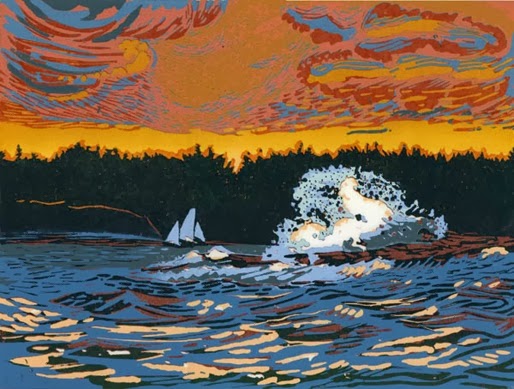
Artist Susan Jaworski-Stranc is having a show she’s calling Water Blues at Centro Restaurant and Bar in Lowell. The exhibit, which includes oil paintings and linoleum prints, runs to March 17 at 24 Market St.

If you can get to Lowell on Sunday, Feb 23, there’s a reception where you can meet the artist, 1 pm to 3 pm.

My husband and I have been to a number of art shows in Lowell, which is quite a creative community. Our favorite Lowell artist is a former boss of mine, Meredith Fyfe Day, who held down a newspaper job while she was artist in residence at the Whistler House. I worked for her at the Harte-Hanks community newspaper chain in the early 1990s.

Here’s the intriguing artist statement from Jaworski-Stranc: “I am a printmaker, specializing in the creation of linoleum block prints. After each successive printing of a color, the surface of the block is reduced while at the same time the printing surface is built up with multi-layered colors. Born from one block of linoleum, my relief prints have the nuance and rich textural surfaces of an oil painting.

“Although Picasso coined this method of working, a ‘suicide print,’ I rather think of this printmaking process as emulating the journey of life. While creating my prints, I am never able to re-visit past stages. I can only proceed forward with the acceptance of all good and not so good choices which were mediated and acted upon with the hope and joy of completion.”

When Asakiyume and I met in December at the Worcester Art Museum, there was an exhibit on printmaking that showed what prints looked like at each of the layering stages. Challenging work. I love that Jaworski-Stranc sees the printmaker’s role as accepting each previous stage and working with it. As she says, “The journey of life.” Another good topic for a poem.

Find out more about Susan Jaworski-Stranc here. And thank you, Vyü magazine, for the lead.

Read Full Post »