Feeds:
Posts
Comments

Posts Tagged ‘print’

Photo: Kamal Alkhatib via Unsplash.
Saying hello.

Part of the fun of blogging, for me, is figuring out what photo should go with the featured article. Most of the time, I choose the one that comes with the article, but today, I decided to see what the website Unsplash had to offer. I like the “hello” picture above, and I like giving the photographer credit on social media.

The story, by Jonathan Wells at the BBC, tells us more than we ever imagined about the word “hello.”

“It’s been 200 years since the word ‘hello’ was first used in print – though its beginnings date back to the 15th Century. How has the language of greetings evolved around the world — and what does it tell us about ourselves?

“We use ‘hello’ dozens of times a day without thinking – during phone calls, emails and face-to-face encounters. We sing it along with Adele and Lionel Richie, and we have watched it spun into moments of screen gold in Jerry Maguire (‘You had me at hello’), and Scarface (‘Say hello to my little friend!’). It’s been used to sell everything from mobile phones (Motorola’s ‘Hello, Moto’) to lingerie (Wonderbra’s iconic ‘Hello boys’), and it has been borrowed to name computer programs and celebrity magazines. …

“Two centuries ago, on 18 January 1826, ‘hello’ made what is thought to be its earliest recorded appearance on the page, in a Connecticut newspaper called the Norwich Courier. …

“By the 1850s, it had crossed the Atlantic to Britain – appearing in publications such as the London Literary Gazette – and became increasingly common in print. Like the go-to greetings in other languages, ‘hello’ also says something about the English-speaking world – depending on which variation, abbreviation or inflection of the word we choose to use. …

“Whether due to dialect or accent influences, or the brevity demanded by online communication, which ‘hello’ you choose says a lot about you, and can indicate age, nationality, or even mood. According to linguists, elongated variations such as ‘heyyy’ could be construed as flirtatious, ‘hellaw’ might suggest you’re from the southern US, ‘howdy’ from western US, and the clipped ‘hi’ may indicate a curt disposition. …

” ‘These subtle intonational contours can change its meaning,’ says Alessandro Duranti, professor of linguistic anthropology at the University of California, Los Angeles. ‘For example, when someone says “hello” with a stretched final vowel, it can question what the other person just said, as in “Hello, are you paying attention?” or “Hello, you must be kidding.” ‘

“This capacity to convey nuance through tone and form is no modern invention; even in its first printed appearances, ‘hello’ was a patchwork of influences, derivations and applications drawn from several languages.

“The pre-printed origins of the word ‘hello’ are disputed. The most commonly cited etymology is the Old High German ‘halâ’ – a cry historically used to hail a ferryman. The Oxford English Dictionary also points to ‘halloo’ (a hunting call that urged hounds to run faster) as a possible linguistic root. It notes several early spellings, including ‘hullo,’ ‘hillo’ and ‘holla’ – the latter thought to have derived from the 15th-Century French ‘hol,’ an exclamation meaning ‘whoa!’ or ‘stop!’ In English sources, the OED lists the earliest form as the late-16th-Century ‘hollo.’

“Simon Horobin, professor of English language and literature at Magdelen College, Oxford, notes that such semantic shifts and spelling changes may also be explained by regional accents and differences in pronunciation. … ‘But for origins and early history,’ he adds, ‘we are dependent upon written evidence, which is patchy at the best of times. For a colloquial word like this, which would have appeared much earlier and more frequently in speech than in writing, it is especially tricky to establish a definite timeline.’ “

More at the BBC, here. And just for fun, read what British people mean by the word “sorry,” here.

Read Full Post »


Art: Susan Jaworski-Stranc
Neighbors

I’m on the email list of 13 Forest Gallery in Arlington, Mass. The first time I went there, the owner enlivened his art opening with guest opera singers.

This time, he had a printmaker demonstrate a type of linoleum printing that Picasso dubbed “suicide” printmaking. Others use the word “reduction” instead of “suicide.”

When I tell you how the work is done, you will understand why Picasso felt as he did.

Instead of carving, say, four different blocks for a four-color print, the artist uses only one block. A mistake at one stage can end the whole project.

Lowell resident Susan Jaworski-Stranc has been doing reduction linoleum printmaking for more than 30 years. As the website for 13 Forest explains, “with each layer, you carve more of the block away — so once a layer has been printed and you start carving for the next layer, there’s no going back.”

The artist herself says, “After each successive printing of a color, the surface of the block is reduced while at the same time the printing surface is built up with multi-layered colors. Born from one block of linoleum, my relief prints have the nuance and rich textural surfaces of an oil painting.

“Although Picasso coined this method of working a ‘suicide print,’ I rather think of this printmaking process as emulating the journey of life. While creating my prints, I am never able to re-visit past stages. I can only proceed forward with the acceptance of all good and not so good choices which were mediated and acted upon with the hope and joy of completion.”

On August 13, the gallery was packed as Jaworski-Stranc demonstrated. Many in the audience were experienced printmakers who asked intelligent questions that showed the rest of us what sorts of issues matter to artists.

One person asked if Jaworski-Stranc knew what the picture was supposed to look like in advance, and she explained that she started with a detailed drawing. Another artist wanted to know if the colors of Jaworski-Stranc’s very first reduction print (which she showed us) were what she anticipated.

The artist laughed, holding up that print. “Are you kidding? How would I ever think up a color like this!?”

Clearly, despite all the careful planning that goes into a print, Jaworski-Stranc relishes the beauty of randomness.

More here.

Art: Susan Jaworski-Stranc
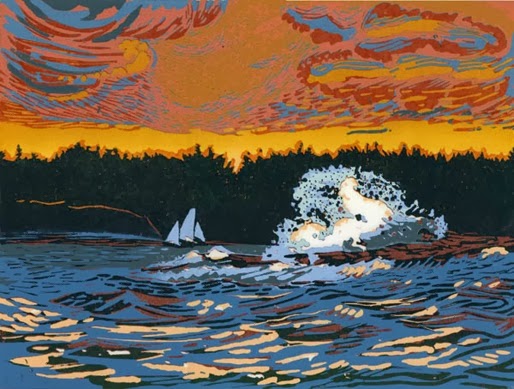
Coastal Forces at Sunset

Read Full Post »

Artist Susan Jaworski-Stranc is having a show she’s calling Water Blues at Centro Restaurant and Bar in Lowell. The exhibit, which includes oil paintings and linoleum prints, runs to March 17 at 24 Market St.

If you can get to Lowell on Sunday, Feb 23, there’s a reception where you can meet the artist, 1 pm to 3 pm.

My husband and I have been to a number of art shows in Lowell, which is quite a creative community. Our favorite Lowell artist is a former boss of mine, Meredith Fyfe Day, who held down a newspaper job while she was artist in residence at the Whistler House. I worked for her at the Harte-Hanks community newspaper chain in the early 1990s.

Here’s the intriguing artist statement from Jaworski-Stranc: “I am a printmaker, specializing in the creation of linoleum block prints. After each successive printing of a color, the surface of the block is reduced while at the same time the printing surface is built up with multi-layered colors. Born from one block of linoleum, my relief prints have the nuance and rich textural surfaces of an oil painting.

“Although Picasso coined this method of working, a ‘suicide print,’ I rather think of this printmaking process as emulating the journey of life. While creating my prints, I am never able to re-visit past stages. I can only proceed forward with the acceptance of all good and not so good choices which were mediated and acted upon with the hope and joy of completion.”

When Asakiyume and I met in December at the Worcester Art Museum, there was an exhibit on printmaking that showed what prints looked like at each of the layering stages. Challenging work. I love that Jaworski-Stranc sees the printmaker’s role as accepting each previous stage and working with it. As she says, “The journey of life.” Another good topic for a poem.

Find out more about Susan Jaworski-Stranc here. And thank you, Vyü magazine, for the lead.

Read Full Post »

If I come to work early, I often take a walk at lunch. I love the Greenway, which is especially nice in spring and summer. And the Fort Channel district (the Mayor likes to call it the Innovation District) seems to have something new to see almost every week — repurposed warehouses, galleries, restaurants, pocket parks.

Fort Point Arts got bumped from its space next to Flour (a yummy restaurant) on Farnsworth, so one lunchtime I made a point of checking out its new space off A Street.

I especially like that they show art depicting the Fort Point neighborhood — partly because walking there makes me attached to that part of Boston, and partly because Fort Point is changing fast. (About 18 years ago, when I went to an arts open house there, many artists had studios with beds on ledges and  tiny kitchens. Some artists were squatting in dangerous buildings with wires hanging down, no heat, no doors, no lighting. That world is gone.)

Laura Davidson was one of the featured artists when I was last in the Fort Point Arts shop. She had some block prints of her neighborhood that I admired.

Be sure to check her home page. Everyone should have a home page that looks like a treasure map.

Art:Endangered Neighborhood” reprint of 1995 view of Fort Point), 2012, Laura Davidson

Read Full Post »