Photo: Steve Ettlinger,. Steve Ettlinger, the author of Twinkie, Deconstructed, has displayed this Twinkie in his home for 21 years.
Do you sometimes think about treats you enjoyed as a kid and wonder if they are still around?
Double Bubble bubblegum? (Still around.) Necco wafers? (Yes.) Dixie ice cream cups with pictures of movie stars inside lid? (Nope, but if you can live without the actual ice cream, try eBay.)
Hannah Goeke has a fun story at the Boston Globe about the Hostess cupcakes called Twinkies. “Two things will survive the apocalypse, as the myth goes,” she says, “cockroaches and Twinkies. In Maine, one of those famous snack cakes is turning 50 this year after a high school chemistry teacher decided to put its shelf life to the test in an experiment that continues to this day.
“During a class discussion on food additives in 1976, a student asked teacher Roger Bennatti how long a Twinkie would last. Bennatti sent a student down to the store to pick up a couple.
“ ‘I ate one and put the other one up on top of the chalkboard,’ he recalled in a phone interview.
“According to Hostess, the company that makes Twinkies, the golden sponge cake has a shelf life of about 45 days. But the George Stevens Academy in Blue Hill, Maine, is now celebrating the 50th anniversary of their Twinkie experiment.
“When he retired in 2004, Bennatti recalled, his students only had one question. ‘What will happen to the Twinkie?’ The snack had been sitting untouched in the classroom for nearly 30 years, but seemed no worse for wear.
“Libby Rosemeier, assistant head of the George Stevens Academy and one of his former students, carried on his legacy. The Twinkie is now stored in an airtight glass box in a school office, brought out occasionally for curious visitors.
“The Bangor Daily News wrote about the long-running experiment when Bennatti retired, and the sturdy snack became a sensation.
“But Bennatti says Hostess never got in touch with him.
” ‘Are you kidding me? They want me dead,’ he quipped. ‘No food company wants their claim to fame to be, hey, this lasts 50 years.’ …
“To last so long, Twinkies contain few [health department] recommendations, replacing dairy and a real cream filling with a mix of sugar and shortening, corn syrup, water, salt, and cellulose gum. The snack is mainly made of flour, sugar, eggs, and over 30 other ingredients, according to Steve Ettlinger, the author of Twinkie, Deconstructed.
“While the original Twinkie recipe had fresh ingredients, the cakes spoiled too quickly during delivery to stores, Ettlinger said. The manufacturer started looking for substitutes.
“Ettlinger began studying Twinkies to learn more about additives and asked Hostess headquarters and bakeries to find out what the filling contained. ‘I asked one in particular in Biddeford, Maine; they said if I told you, I’d have to kill you,’ Ettlinger said. …
“Ettlinger preserved a Twinkie in its original packaging in his home for 21 years.
“ ‘I got fascinated with them … I’m about to turn 77. I’m gonna write in my will that that Twinkie is gonna go to either my daughter or my son.’ ” (Gee, I hope they don’t fight over it!)
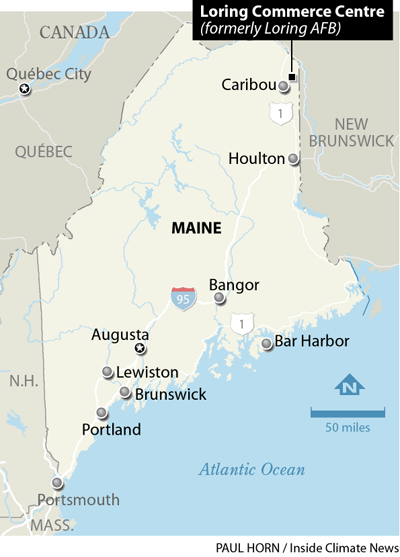
Above: At the former Loring Air Force base in Maine, there are hopes that a planned data center will use less water for cooling equipment by using a technique that submerges computer components in a nonconductive, oil-based fluid to draw heat directly from the source.
The rapid increase of energy-guzzling buildings for artificial intelligence has people talking about better ways to cool the systems. One idea is to build them in somewhere off Planet Earth, which sounds like a horrible idea to me. Meanwhile in Maine, developers are investigating a different approach.
Ryan Krugman writes at Inside Climate News, “Once a Cold War outpost near Maine’s northern border, the former Loring Air Force Base could soon be home to a very different kind of facility: the state’s first large-scale data center. The sprawling 450-acre site in Limestone, Maine, would host the giant server farm as part of a plan still in its early stages to reinvent part of the base as a hub for green technology.
“Since its closure in the early 1990s, the Loring Development Authority has redeveloped the base into a business park and a commercial airport. More recently, it has also become a sustainability-focused campus through the company Green 4 Maine.
“Developers say Loring’s fiber network and access to renewable hydropower make it an ideal site for a next-generation data center powered entirely by green energy and using water-free cooling technology. But questions remain over how such an energy-intensive project could impact utility rates, grid reliability and a sensitive surrounding environment.
“Traditionally, data centers, among the most power-hungry and resource-dependent buildings in the world, rely on massive cooling systems to keep thousands of servers from overheating. Some use energy-intensive fans that circulate air through vast server halls, while others depend on large volumes of water to absorb heat. ‘I wake up every morning wondering why we still use air to try and cool electronics,’ said Herb Zien, vice chair of LiquidCool Solutions, one of the developers of LiquidCool Data Center. ‘As a thermodynamics engineer, I used to use air to insulate, not cool.’
LiquidCool Solutions, a privately held company based in Rochester, Minnesota, takes a different approach to cooling electronic technology.
“Its ‘immersion cooling’ technology, Zien said, submerges computer components in a nonconductive, oil-based fluid that draws heat directly from the source — eliminating the need for fans, air conditioning or water. The system produces no toxic byproducts or emissions and, according to the company, nearly eliminates both noise and evaporative loss. Loring, company officials say, will serve as the first large-scale data center built entirely around its technology—its first real-world test. …
“The developers say [the data center] will be entirely powered by renewable energy—mainly hydroelectricity. [But] Versant Power, the region’s transmission and delivery utility, wrote in an email that … it could not verify that the supply would come from hydro or renewable sources. The utility added that grid upgrades would likely be necessary to support the project — costs that would be covered by the developers.
“A Harvard Law School Environmental and Energy Law Program study found that, while initial costs are paid for by the developers, data center projects often shift expenses onto ratepayers through discounted or tailored negotiated contracts, wholesale market charges and grid upgrades that may exceed what’s necessary for reliability.
” ‘Adding 50 megawatts to such a small, isolated grid is huge,’ said Hepeng Li, an assistant professor at the University of Maine’s College of Engineering and Computing. Northern Maine’s independent grid has a peak load of roughly 150 megawatts, meaning the data center alone could consume more than a third of the region’s total demand.
“Nearly 50 megawatts of mostly hydroelectric power — currently supplied by New Brunswick Power — is available at a nearby substation, according to Zien. New Brunswick Power told Inside Climate News that no supply agreement or memorandum of understanding is in place with either Green 4 Maine or the Loring Data Center project. …
“Developers also plan to install on-site diesel generators to provide backup power during grid outages. While standard for data centers, a diesel backup system can emit harmful air pollutants — including particulate matter, volatile organic compounds and nitrogen oxides — posing potential risks to the Mi’kmaq Nation and the Aroostook National Wildlife Refuge, which border the site. …
“Project officials say generators would not be installed immediately and that some future users might choose to operate without them. …
“Those uncertainties would only grow if the project succeeds and the developers expand the data center beyond its initial 2- to 6-megawatt capacity. Even so, supporters and researchers say that if the cooling technology performs as promised and the developers can secure a reliable supply of Canadian hydropower, the project has the potential to chart a new direction for cleaner, water-free data center development.”
More at Inside Climate News, here. I admire inventors who come up with useful ideas. But I don’t know about this one. When there is money to be made, inventors often seem too sanguine about how well things will work. Imagineering combined with practicality is a consummation devoutly to be wished.
Photo: Hannah Hoggatt/Midcoast Villager. The Villager Cafe in Camden, Maine, serves as a newsstand and events space for the Midcoast Villager. It allows locals to mingle comfortably with reporters — and maybe share news.
Blogger Laurie Graves in Maine had a fantasy podcast at one point that involved a café/sandwich shop run by elves. I couldn’t help thinking about it as I read today’s story.
Mackenzie Farkus, a staff writer at the Christian Science Monitor, reports, “Inside the Villager Cafe, the scent of freshly brewed coffee lingers, and chatter is sporadically interrupted by chirps from a cafégoer’s walkie-talkie. Three women settle into a window-side table. They’ve known each other since high school, and they regularly meet to discuss politics.
“It’s an apt place to do so. Print copies of the Midcoast Villager— an online daily and weekly print newspaper covering midcoast Maine — are displayed near the cash register. … Just upstairs, a small, bustling newsroom is rushing to meet the weekly print deadline.
“The Villager Cafe, which opened in April, isn’t just a café. It’s a newsstand and events space for the Midcoast Villager. The newspaper wants the café to be a ‘third space for community engagement,’ in the words of deputy editor Alex Seitz-Wald. …
“Last year, 130 newspapers shut down at a rate of almost 2 1/2 per week, according to a report from Northwestern University’s Local News Initiative. As of last October, 206 counties across the U.S. don’t have a local news outlet at all. … The loss of local newspapers is ‘really damaging to civic life and civil discourse, and the ability of average people to be informed about their community,’ says Meg Heckman, an associate professor of journalism at Northeastern University in Boston.
“ ‘It’s a lot harder to know what’s going on in town hall, [or] what changes to federal environmental policy might mean to rural farmers or fisheries or tourism,’ she adds.
“Reade Brower has long been regarded as Maine’s ‘media mogul.’ In 2019, he owned six of Maine’s seven daily newspapers, more than 20 weekly publications, and three printing presses. In 2023, he sold the vast majority to the National Trust for Local News, a nonprofit. Four of the papers he held onto … became the Midcoast Villager. It published its first issue in late 2024. …
“U.S. newspapers earned $49 billion in advertising revenue in 2006; that number dropped to less than $10 billion in 2022.
“Around 85% of U.S. adults believe that local news outlets ‘are at least somewhat important to the well-being of their local community,’ according to a 2024 Pew Research Center survey. But only 15% say they’ve paid or given money to any local news source in the past year, which has largely remained unchanged since 2018.
“People have been curious to check out the café, says Aaron Britt, publisher … says Mr. Britt. ‘And I’ve just heard like nothing but great things. People like the food, people run into everybody that they know. … Community members can feel like, “Oh, this is my spot.” ‘ …
“ ‘I think a lot of where we are today is due to the perception that there are editors and writers away in this tower who are covering issues, but they’re not fully connected with readers,’ [Kathleen Fleury Capetta, co-founder of the Midcoast Villager] says. ‘We’re trying to shift that perspective.’ …
” ‘The café’s goal at the very start has been, “How do we connect our community and create a respectful place of dialogue?” ‘ says Mr. Brower. ‘We believe we’re achieving that.’ …
“Staffers at the Midcoast Villager have already fielded calls from other media organizations interested in the approach.
“ ‘Anybody is welcome to call us up and steal our idea if they like it,’ Mr. Brower says.” More at the Monitor, here.
In my town, we have a community paper, too. It’s doing very well thanks to donations and ads. As delightful as the Villager Cafe sounds, I hope our paper will stick to what it knows best and not try to get into the food business. The rents alone would guarantee failure here.
Photo: Chip Clark/Smithsonian Institution/Department of Vertebrate Zoology, Division of Birds. Ornithologist Roxie Laybourne, originator of forensic ornithology, examining a feather.
I love reading murder mysteries. Not all of them, mind you. I’m a sucker for any mystery from a foreign country or unfamiliar culture, but I recently discarded an Icelandic one that was too noir.
I love mysteries partly for the sense of helping a detective solve a puzzle, and for learning new things. Sometimes it’s a country I’m learning about, sometimes a science. After reading today’s article, I am hoping there will soon be a mystery based on the scientific career of Roxie Laybourne.
Chris Sweeney wrote at the Boston Globe Magazine recently about the “mild-mannered scientist” who created the field of forensic ornithology.
“Murders weren’t Roxie Laybourne’s forte, but she had a job to do. On the evening of April 26, 1972, the 61-year-old ornithologist climbed into the back seat of a detective’s car at Bangor International Airport. … As the car neared the hotel, she noticed a smattering of peculiar structures lining the sides of the road. …
“At her hotel, Laybourne received a handwritten letter from Peter Culley, the young state prosecutor who’d soon be interrogating her on the witness stand. … Culley, a lifelong Mainer who was just a few years out of law school, had plotted an exhaustive case against Henry Andrews, a 35-year-old laborer who stood accused in state court of the brutal murder of Hazel Doak, his elderly former landlord. Laybourne would appear in the penultimate act of the prosecutor’s script, the last witness he’d call before closing arguments. …
“She was an authority — perhaps the authority — on feathers. Culley hoped that if any embers of doubt were still smoldering in the jury box by the time Laybourne took the stand, she’d extinguish them by offering up scientific analysis showing that feathers recovered from the scene of the crime matched bits of feather that were found on Andrews’s clothing at the time he was apprehended. …
“Build an economy on the back of butchered chickens and life will get messy. As Laybourne observed on her first morning in town, the industry’s leftovers were everywhere. Some residents had to rake feathers off their lawns and others complained of a foul stench that would drift through their yards. Most unappetizing was the steady stream of putrefied byproduct that flowed out of the processing plants and into Penobscot Bay. The bloody, fatty industrial runoff caked the shoreline and congealed into a blanket that bobbed atop the water. At low tide, a rust-colored stain could be seen on the rocks and sand, earning Belfast the unfortunate nickname ‘the City with a Bathtub Ring.’ …
“To showcase the local industry’s might, Belfast started hosting an annual Maine Broiler Day in 1948. What began as a one-day barbecue soon ballooned into a weekend-long bonanza of grilled protein and ice-cold beverages. State and local politicians strutted through the crowds to press the flesh with constituents and the chicken companies sponsored a Broiler Queen contest in which women were judged on ‘poise, personality and appearance,’ according to the New England Historical Society. …
“On the weekend of July 17, 1971, however, the celebration soured. That’s when, according to prosecutors, Henry Andrews blew into town on Friday with two friends who were ready to party.
“Drinks flowed early and the first place Andrews took his buddies was a sturdy white farmhouse a mile outside of town. He had rented a room there a few years earlier while clearing trees on the surrounding property. During the impromptu visit, Andrews found Hazel Doak, a 71-year-old widow who had lived there for more than 20 years. She was Andrews’s landlord during his time in town and the relationship was allegedly rocky.
‘Doak didn’t appreciate Andrews showing up unannounced that Friday: After a tense exchange, she asked the two men accompanying Andrews to remove him from her property and get lost. They complied, shook off the uncomfortable start to the weekend, and made their way into town for dinner and a night of drinking.
“Around 1:45 a.m., an inebriated Andrews reportedly ditched his pals and teetered over to the Main Street taxi stand, where, through droopy eyes and slurred words, he asked for a ride back to the Doak farm. …
“At 10:30 the next morning, Doak’s longtime friend Edith Ladd pulled up to the house. The two women had spoken on the phone the previous night and made plans to head over to the broiler festival together. Ladd went to the back entrance that she typically used and found it still latched shut. She went around to the front of the house, where the door swung wide open. Inside, she found Doak’s lifeless body heaped on a bed, clad in nothing but a nightgown. …
“Ladd called the police and huddled in her car with her daughter, grandson, and other family members, who had been waiting patiently to get to the festival. When the officers arrived, they followed the trail of feathers downstairs and found the cellar door cracked open. The best they could surmise, someone had grabbed Doak’s pillow and smothered her with such force that it burst the pillow open and sent feathers everywhere, including onto the murderer. …
“Near the end of the weekend, a soaking-wet Andrews walked into the Belfast Police Station and, according to police testimony, allegedly declared, ‘I came to give myself up.’ …
“The sheriffs on duty knew exactly who Andrews was and what he was wanted for. They placed him under arrest and collected his clothes — and the feathers that were stuck to them. Police sent several bags of evidence to the FBI for careful analysis at the bureau’s crime lab in Washington, D.C. …
“Knowing the murder weapon was a pillow, the agents in Washington understood that the feathers stuck to his clothes might be a key piece of trace evidence, but they had no clue how to analyze them in any meaningful way. Fortunately, they had heard all about a little old lady named Roxie Laybourne over at the Smithsonian.”
Now I’ve done the unforgivable for a mystery! I’ve left you with a cliffhanger. You’ll have to read the rest of the story at the Globe, here. It’s a long one.
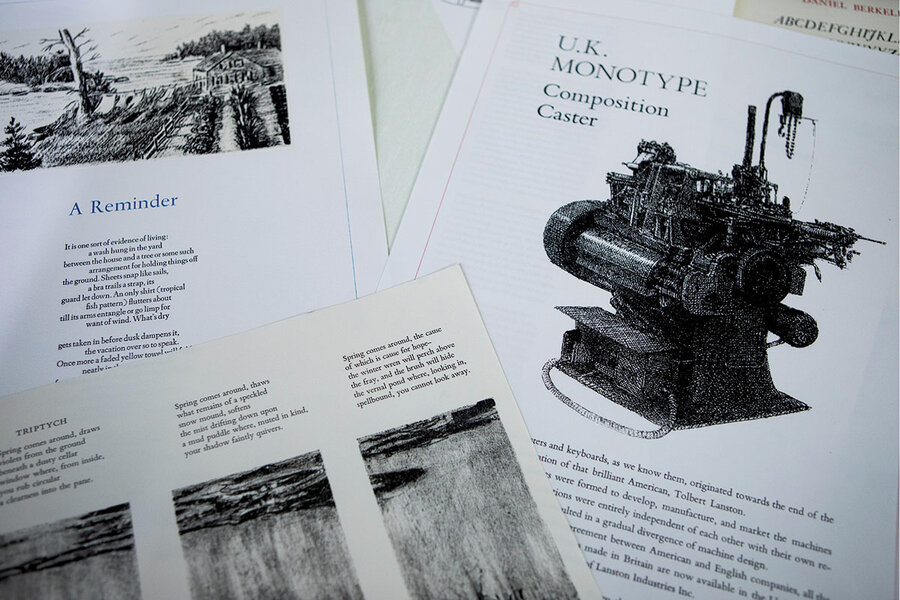
Photo: Melanie Stetson Freeman/CSM staff. In his Maine shop, master printmaker David Wolfe uses machines from bygone eras to create.
Don’t you love the look of old-time lead type printing? I once ordered sweet business cards from a New Shoreham letterpress, no longer operating, and Suzanne has often used Jacque’s Offset in Providence. Today’s story is about a letterpress in Maine that got some attention in the movies.
Jennifer Wolcott reports at the Christian Science Monitor, “Visitors to David Wolfe’s printing shop in Portland, Maine, can’t miss the statuesque Civil War-era Tufts hand-press machine that stands tall near the front door. It exited that same door several years ago, headed for a movie set.
“For its cameo in the 2019 film, his ‘Little Women machine,’ as he calls it, was hauled down to Massachusetts. Mr. Wolfe accompanied it, dressed in 1860s costume for his role as the printer of Jo March’s book. Yet as he recalls, laughing, ‘Only my hands made the cut.’
“Wolfe Editions is a place buzzing with activity. The master printmaker and fine artist treasures his many letterpress machines not only for their place in history, but also for their ability to help him craft exquisitely beautiful books, prints, posters, and more. They are essential tools for daily production, ones that stand out in an ever more high-tech world.
“Rather than using bits and bytes, Mr. Wolfe prints just as Johannes Gutenberg did when he developed the process of letterpress printing in the 15th century to make his famous Bible: Letters are cast in lead, then locked together, inked, and pressed into paper.
“ ‘The computer didn’t kill my business. It made it stronger,’ he says, noting that he’s also benefited from recent interest in the lost art of letterpress printing. ‘The product I make is high end, and computers took over all the other stuff.’ …
“On a recent afternoon, he has just paused production of an edition of John Steinbeck’s Of Mice and Men while waiting for a shipment of handmade paper. He’s using the time instead to create designs for one son’s new canned cocktails company (his other son is a printer). He’s also teaming up with artist and friend Charlie Hewitt to design a poster commemorating the anniversary of Muhammad Ali’s fight in Lewiston, Maine.
“Mr. Hewitt has known Mr. Wolfe for 20 years, has collaborated with him on multiple projects, and happens to have a studio right next door. He says it’s important to the printmaker to pass down the old techniques to a new generation. ‘He is always training and teaching others. He is incredibly generous, remarkably skilled, and brings so much to every medium,’ Mr. Hewitt adds. …
“Mr. Wolfe’s letterpress and hot-metal casting machines, about 10 in all, fill his spacious shop – a former bakery. Despite their age and frequent use, the devices appear impeccably cared for. …
“Not only is he passionate about his work, but it suits him. ‘Letterpress printing couldn’t be more tedious,’ he says. ‘But I like tedium.’ … Lately he’s been mentoring an apprentice, a student from nearby Maine College of Art & Design, who shares his taste in music and also for tedium. ‘I’ll ask Claire to put away the type,’ he says, ‘and she’ll respond, “Oh, I love putting away type!” ‘ …
“Mr. Wolfe has taught at schools in Maine including Bowdoin College, Haystack Mountain School of Crafts, and Gould Academy. He’s also shared his expertise further afield, at Dartmouth College in New Hampshire and Penland School of Craft in North Carolina.
“He most enjoys the workshop format, for its small size and short duration. ‘It’s more intense when you have to cover a lot in a short amount of time, and students in workshops are typically motivated and excited about learning.’ …
“Mr. Hewitt recalls a project he and Mr. Wolfe worked on together: the illuminated neon ‘Hopeful’ sign mounted in 2019 on the roof of Speedwell Projects, a nonprofit gallery in Portland. ‘I wanted to use the word “Hopeful,” and I scribbled it on paper for David,’ he explains. ‘I needed a master printer to facilitate the process and create the font.’
“Mr. Hewitt says he was elated with the design – inspired by the building’s history as an auto dealership, typeface from the badge of a 1940s Packard, and his own love for 1960s counterculture. …
“For his part, Mr. Wolfe relishes collaborations like that one: the process of give and take, the creative energy, the mutual admiration. Or as he puts it, ‘I enjoy helping people realize their ideas. It broadens my scope, and artists are pushing the mediums beyond what they were using before.’ “
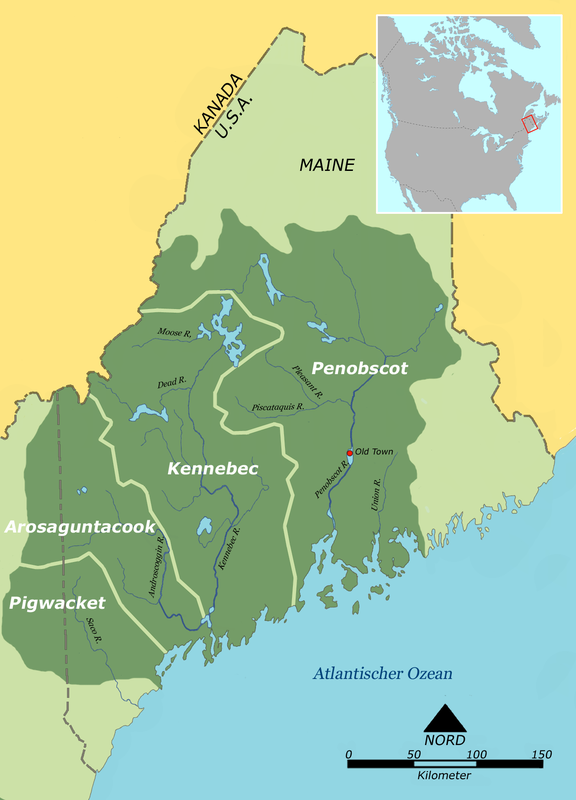
Map: Wikipedia. Eastern Abenaki tribes (Penobscot, Kennebec, Arosaguntacook, Pigwacket/Pequawket). Indigenous people often exhibit the best stewardship of natural resources.
What can we learn from people who have been taught from infancy how to live in harmony with the natural world? In an op-ed at the Washington Post, Bina Venkataraman suggests that “in Maine, a return of tribal land shows how conservation can succeed. …
“On a recent morning at the Penobscot Nation headquarters, moose mating rituals dominated the office banter: the wacky way a lovesick moose had stumbled around someone’s pickup truck [when] he heard a hunter’s [mating call]. …
“The Penobscot Nation’s record of caring for nature while still using it — hunting moose and duck while keeping their populations steady, selectively harvesting timber to preserve forests and restoring rivers to support fisheries — inspired an effort to return a 31,000-acre tract of forested land to tribal ownership.
“Late last year, the Trust for Public Land, a conservation group, bought the parcel from an industrial timber company, and today it announced it will give the land to the tribe once it pays off $32 million in loans. …
“The land is close to Mount Katahdin, sacred in Penobscot tradition, and to an 87,000-acre national monument created in 2016 in the North Woods of Maine. It contains 53 miles of streams in the watershed of the Penobscot River, which has been for the tribe a central highway and a source of food and water.
“The transfer is part of a movement to return lands to Indigenous stewardship and work with tribal communities to protect biodiversity. The hope is both to restore justice for tribes that were long ago stripped of their ancestral homelands and to learn from long-standing Indigenous practices new ways to save a beleaguered planet. The pending land return in Maine, or ‘rematriation’ as some Indigenous people call it, stands out because of its scale — many previous land returns in the eastern United States have been on the order of hundreds of acres — and because the Penobscot will decide how the land will be managed.
“This is a significant change. For most of the past two centuries, Western conservationists have largely ignored Indigenous people’s knowledge of landscapes and wildlife, along with tribes’ historic claims to the land. But that is no longer tenable. Worldwide, Indigenous-managed lands host 80 percent of the world’s biodiversity, by some estimates, and encompass much of the world’s remaining intact forests, savannas and marshes. If environmentalists and political leaders hope to conserve more natural landscapes … collaboration with tribal nation leaders is critical.
Modern environmentalism has been deprived of Indigenous knowledge, in part, because it has seen nature as something apart from humans.
“Early thinkers hold some responsibility for this. John Muir, long lauded as the father of the national parks, believed that natural landscapes needed to be stripped of the Native Americans who lived on them to create his ideal of pristine wilderness. In the Muir tradition, the U.S. government drove tribal people out of areas that today are considered America’s most beloved landscapes — Yellowstone, Yosemite, the Everglades — a history documented by David Treuer, an Ojibwe writer.
“The federal government created the National Bison Range in 1908 by evicting tribal members from more than 18,000 acres of the Flathead Indian Reservation — ignoring century-old practices for keeping up the bison herd. Only recently has the government returned the land to the Confederated Salish and Kootenai Tribes, whose successful traditional methods for maintaining the herd are featured in a forthcoming ABC documentary.
“When Henry David Thoreau … traveled to the Maine woods in the 19th century, he distinguished between ‘scientific men’ and Indian guides, even as he acknowledged the latter’s navigational expertise. It’s laughable now to think that communities that had inhabited a place for centuries, gaining intimate knowledge of the natural features, flora and fauna and passing down that knowledge across generations, could have less to offer scientifically than settlers encountering those lands for the first time. Yet it was only last year that the U.S. government formally recognized how much tribes can contribute to ecological knowledge of their ancestors’ landscapes. …
“For decades, tribal members in Maine advocated bringing down Penobscot River dams that once powered saw and paper mills to restore an Atlantic salmon fishery. The Penobscot method of timber harvesting, which leaves 75- to 100-foot buffers of trees around rivers and streams, creates ideal conditions for salmon. Salmon like to spawn upriver in shady pools, created by allowing the forest at a river’s edge to thicken and birch trees to fall into it. …
“Some evidence suggests that, globally, the track record for Indigenous management of wildlife is at least as good as that of formal conservation. Researchers have shown, for instance, that Indigenous-managed lands in Canada, Australia and Brazil contain biodiversity equivalent to that of areas designated for conservation.
“But perfect alignment between tribes and environmental groups doesn’t always happen. The economic challenges that many tribes face — and their efforts to acquire land to reclaim sovereignty — often force tough decisions about development, gambling and heavy industry. Some tribal nations have greenlighted oil and gas drilling. The Penobscot have allied with conservationists to oppose a proposed zinc mine in northern Maine because of its likely harm to fisheries. But several tribal members expressed to me their misgivings about wind farms, which most environmentalists see as essential to combat climate change.
“Penobscot leaders have varying visions about how they might one day develop the land that is now being returned to them. Some imagine using it to adapt to sea-level rise — by building housing or growing food; others envision ecotourism lodges or a cultural center that could be accessed by the general public. In the near term, tribal leaders aim to make it accessible to hikers and hunters with permits and to offer public access to the national monument via an old logging road.
“In other parts of North America, co-management of conservation areas is becoming more common. … Groups such as the Trust for Public Land and the Nature Conservancy are brokering more land returns and collaborating with tribes to manage ecologically important landscapes. But more private landowners, philanthropists, nonprofit groups and governments should mimic the efforts in Maine. …
“Environmental movements might have better protected nature if they had long sought to conserve cultures and communities along with land. Earning the trust now of people who have inherited wisdom for living in balance with nature will give conservation a fighting chance on a warming planet.”
Photo: Robert F. Bukaty/ Associated Press. An Atlantic puffin feeding its chick in a burrow under rocks on Eastern Egg Rock, a small island off mid-coast Maine on Aug. 5.
I learned a few years ago that that adorable seabird called the puffin might be in trouble. Because warming oceans were killing off their food, puffins were producing fewer successful offspring. This year, scientists who monitor the puffins say 2023 was the second consecutive rebound year for fledgling chicks. But it sounds like only a brief reprieve.
Patrick Whittle reports for the Associated Press (AP), “On remote islands off the Maine coast, a unique bird held its own this year in the face of climate change.
“Atlantic puffins — clownish seabirds with colorful bills and waddling gaits — had their second consecutive rebound year for fledgling chicks after suffering a catastrophic 2021, said scientists who monitor the birds. The news flies in the face of environmental trends, as scientists have said warming waters off New England jeopardize the birds because that reduces the kind of fish they need to feed their chicks.
“One fish, though — the sand lance — has remained in abundance this year, allowing puffins to thrive, said Don Lyons, director of conservation science at National Audubon Society’s Seabird Institute in Bremen, Maine. He said it’s a sign the impact of climate change on ecosystems is not always as tidy as we think.
“The encouraging news comes as the Audubon Society is celebrating its 50th anniversary of tending to Maine’s puffin colonies, which it restored from just a few dozen pairs. There are now as many as 3,000 birds, and the population is stable, Lyons said. …
“The puffins — also known as ‘clowns of the sea’ or ‘sea parrots’ — nest in burrows and feed their chicks small fish such as herring. Two years ago, the colonies suffered one of their worst years for reproduction in decades due to a lack of those fish. Only about a quarter of the birds were able to raise chicks that summer.
“Audubon and other conservation groups have tied the fish shortage to warming ocean temperatures.
The Gulf of Maine, which has puffin colonies on its islands, is warming faster than most of the world’s oceans. …
“The puffins’ ability to reproduce despite environmental changes speaks to the resiliency of seabirds, said Bill Sydeman, president and chief scientist of the Farallon Institute, a marine preservation organization based in California. However, the long-term dangers posed by climate change — such as fatal heat waves, loss of food, loss of islands to sea level rise, and inability to breed — remain existential threats. …
“ ‘The problem with climate change is these breeding failures and low breeding productivity years are now becoming chronic,’ Sydeman said. ‘There will be fewer young birds in the population that are able to recruit into the breeding population.’
“Maine’s puffins are the only breeding Atlantic puffins in the US Worldwide. The species lives in the North Atlantic from Maine and Canada to Europe. …
“The Maine puffin population once dwindled to only about 70 pairs on tiny Matinicus Rock. Hunters who pursued the birds for their meat and feathers had nearly wiped them out by the early 1900s. Stephen Kress, an Audubon ornithologist, sought to grow puffin colonies starting in the 1970s by relocating chicks from Canada to Eastern Egg Rock, another tiny island. …
“The effects of climate change on seabirds have been a focus of scientific inquiry in recent years. Interest in the subject has accelerated because of die-offs of some of the puffin’s auk family relatives, such as common murres and Cassin’s auklets off the West Coast.
“The challenges faced by seabirds make successful breeding seasons especially important, said P. Dee Boersma, a University of Washington professor of biology and director of the university’s Center for Ecosystem Sentinels.”
My husband saw puffins in Iceland. Have you ever seen them? I think I may have encountered them in a zoo, but unfortunately, that’s it.
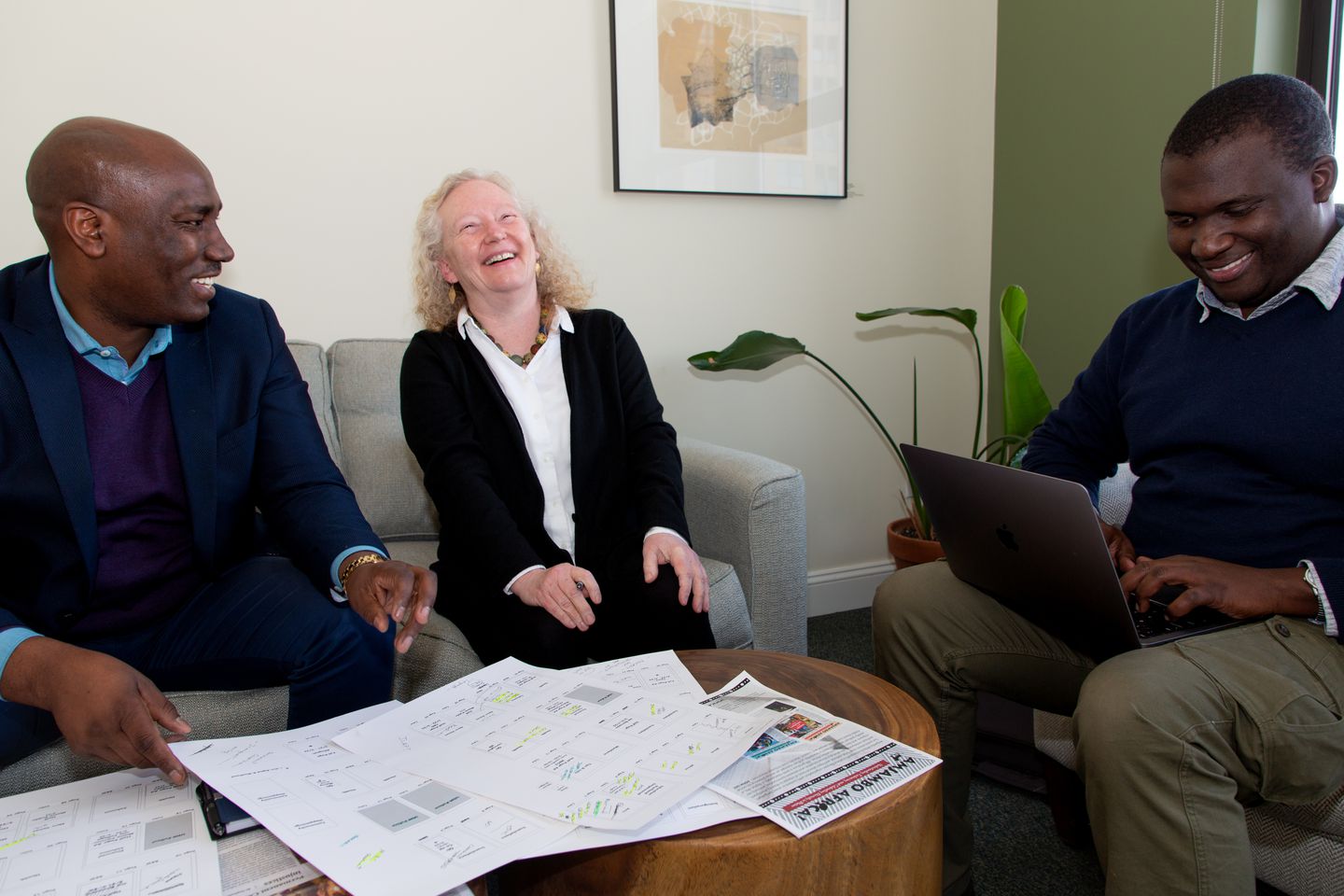
Photo: Molly Haley for the Boston Globe. The Amjambo Africa! team: Georges Budagu Makoko, cofounder and publisher; Kit Harrison, cofounder and editor in chief; and Jean Damescène Hakuzimana, deputy editor and kinyarwanda translator [Bantu language]. They make use of a co-working space at the Greater Portland Immigrant Welcome Center.
When I edited a Boston Fed community-development magazine, we had several articles on the resettlement of Somalians in Lewiston, Maine. With some exceptions, Mainers welcomed the refugees because that part of the state had been losing population. But I also read that among the immigrants themselves, the Bantu had a hard time. Prejudices had carried over from Africa. Today’s story focuses on the Bantu community.
Thomas Farragher reports for the Boston Globe about an unusual partnership.
“She is the daughter of a celebrated Washington Post correspondent who wrote from New Delhi and Tokyo, seeking out truth and telling the essential stories of people’s lives. And so, Kit Harrison continues to nurture the journalistic flame. …
“It’s a passion shared, too, by Georges Budagu Makoko, who is the publisher of the newspaper that Harrison edits here called Amjambo Africa!
“It’s a free publication about the African diaspora and immigration. And it’s intended for the eyes of newcomers to Maine with this lofty goal: to build a community by spreading information about its readership throughout Maine.
” ‘We operate on chutzpah and brains and energy and teamwork,’ Harrison told me when I visited her offices here the other day. ‘I grew up abroad quite a bit with my journalist father. I also taught kids in the range of (kindergarten) through eighth grade and the focus for me was always international. … I was constantly trying to teach kids about what we all have in common around the world — and why we can live together peacefully if we try.’ …
“Amjambo Africa! [chronicles] the efforts to curb hunger in Africa and the state of the forests of the Congo and the environmental challenges facing Burundian coffee farmers. There are stories about efforts underway in Nigeria, Kenya, and Uganda to address mental health issues — and another one about a center that helps kids in Nigeria with autism. …
“All of it done in seven languages: English, French, Kinyarwanda, Portuguese, Swahili, Somali, and Spanish. …
“Makoko first arrived in Maine in 2002 and thirsted for news about the Africa he had recently fled. He could find none. So, he set out to do something about it.
“ ‘When I came here,’ he told me the other day, ‘I didn’t speak English at the time. I had to take English classes. After that, I was hired by a nonprofit organization that develops housing.’
“The people for whom he provided housing wanted something else from him: help in navigating a bureaucracy without the language skills to do it.
“ ‘So I started thinking: “What can I do to help these people?” ‘ he said. … ‘They need information about how to find their way in the system.’
“Makoko had written a book, Ladder to the Moon. A Journey from the Congo to America.
“It told the story of a growing up in a beautiful peaceful village surrounded by family — a life upended during the genocide in Congo and Rwanda. …
“ ‘But then my book was not enough. I started thinking maybe we can come up with something that will regularly inform the immigrants about resources that are around here, but also the whole community as to why people are coming here and what’s happening where they are coming from.
“ ‘And that’s where the whole idea of the newspaper came from. I didn’t know how to do it. I didn’t know how to start a newspaper. I was thinking I have this idea. And I have zero background in journalism.’
“But Harrison did.
“And so a friendship and a critical collaboration and a partnership were forged.
“The first issue appeared on April 1, 2018, the product of a year’s worth of planning and answering critical questions: Who’s going to read it? Who’s going to advertise in it? How is this all going to work?
“ ‘You can’t print for free,’ Makoko said. ‘That’s an obvious cost that was there. We needed somebody to design the paper. Those are skills that we didn’t have. Kit was very good in writing and doing interviews and coming up with articles — but also translation. ‘You’ve got to understand that this newspaper is published in (multiple) languages.’
“All of that is a tall task. A monumental and important undertaking. And, yet, they have done it. It exists, telling stories about conflict in Ethiopia and about how to stay warm when Maine’s temperatures dip to dangerously low levels. …
“ ‘We’re about to celebrate our fifth anniversary,’ Harrison told me. ‘And we’ve grown. We’ve always been small and we still are. But within that smallness there’s been quite a lot of big reception and a lot of interest. We’re in it for the long haul. But it’s not easy. It’s very challenging to get the finances in place to do what we want to do, which is big stuff.’ …
“ ‘The word Amjambo — by the way — has meaning which you might want to know,’ Harrison said. “It means two things. It’s a greeting. But is also means W-O-R-D. Word.’ …
“ ‘You try to work for the common good, using whatever skills and attributes you happen to have,’ she said.”
More at the Globe, here. And at Amjambo Africa! here.
From a recent issue, you can read Bonnie Rukin’s article, for example. It’s on the Somali Bantu Community Association’s Liberation Farms in Lewiston, where farming skills have translated relatively easily from Africa to America.
“Two large building projects are planned for springtime at the farm – building a goat barn, and also a corn house for processing and storage. Local contractor Scott Doyon will oversee both projects. He has worked with the community before, on several projects. Good Shepherd Food Bank is supporting the goat barn; a State of Maine grant is funding the corn house. In addition, a new small commercial kitchen is going into the building that currently houses the farm stand. The space will allow community members to process produce grown at the farm.” More.
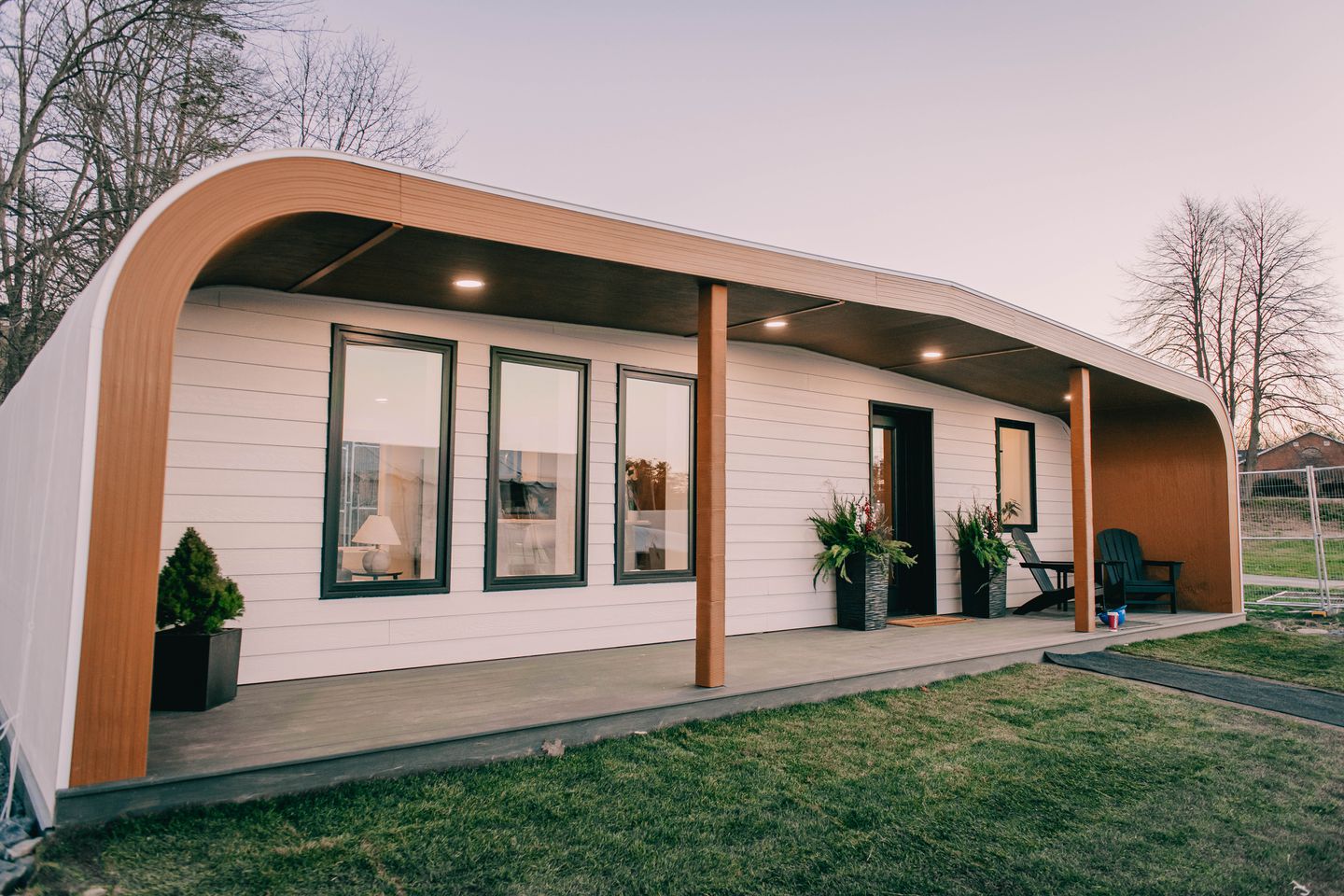
Photo: MJ Gautrau/ University of Maine. BioHome3D, the first 3D-printed home made entirely of organic, renewable materials, was unveiled on Nov. 21 at the University of Maine’s Orono campus.
I wonder if writer Laura Graves, blogging from what she calls the Hinterlands of Central Maine, has heard about this initiative in her state. It actually looks like a good idea for any state (or nation). See what you think.
Maya Homan writes at the Boston Globe, “How do you create lots of affordable housing with limited materials, labor, and other resources? One group of researchers at the University of Maine has come up with a proposed solution: hook up a 3D printer.
“The United States faces rising rents and housing shortages, intensified by the COVID-19 pandemic, but Maine has its own unique, overlapping challenges: The state needs another estimated 20,000 homes to meet the current demand for low-income housing. It also has the oldest average population in the nation, with a median age of 44.7, an issue that exacerbates the state’s labor shortage. With pandemic-related supply chain issues and rising costs of raw materials, the already-expensive housing market has surged.
“Enter BioHome3D, the first 3D-printed home made entirely of organic, renewable materials.
“The prototype, which was created by the University of Maine’s Advanced Structures and Composites Center, has been in the works for three years, according to founding director Habib Dagher. It is 600 square feet in total, with a modern, unvaulted barrel roof, and a wide front porch with white shiplap exterior walls. The interior contains an open-concept kitchen, living, and dining area with grooved wooden walls and tall windows. The single bedroom doubles as an office, and a tiled bathroom completes the space.
“The materials used to manufacture the 3D-printed home also help address another issue in Maine: the shuttering of several pulp and paper mills that once processed residual sawdust and other byproducts from local sawmills. …
“Dagher said, ‘We asked ourselves, could we print a home with that material?’ The answer, thus far, has been yes.
“The prototype, which was unveiled Nov. 21 at the University of Maine’s Orono campus, is now undergoing tests to see how the building fares during Maine’s harsh winters. …
“Dagher’s lab is building on over two decades of research into using biomaterials to create sound structures. Though Dagher’s lab is not the first to 3D print a house, they are the first to use a 3D printer to create the entirety of the structure, as well as the first to use environmentally friendly and reusable materials.
“ ‘The walls, the floor, the roof are all bio-based, and it’s 100 percent recyclable,’ Dagher said. …
“While there are certain drawbacks to using engineered materials over natural ones — fire safety being one — Dagher said the homes have displayed an added durability throughout different climates, as well as increased resistance to termites. …
“The homes are designed using modular construction, meaning that individual rooms are manufactured indoors and driven to the construction site, where they can be quickly assembled. Dagher hopes that this method will help cut down on construction time, as builders will not be as impacted by weather conditions.
“As the project is still in the testing phase, there aren’t yet definitive estimates for how many people will be needed to construct the homes, or how much each tiny house will cost to manufacture. However, Dagher said the use of sustainable materials and the ability to 3D print the structure ‘really changes the game in terms of how we think of housing content and how we think of construction.’
“Though the research process is far from over, ‘we’ve learned a lot,’ he said. ‘We’ve learned what not to do, as well as what to do, and the learning has not ended.’
“The lab’s next steps are to build a manufacturing plant (which Dagher affectionately nicknamed the ‘factory of the future’) to be able to produce the homes en masse. Once the factory is up and running, they hope to be able to 3D print a home within 48 hours, and move on to larger projects like housing developments.
“ ‘There’s a lot of potential, not only to solve a crisis in Maine, but to assist in a solution to the housing crisis nationally as well,’ he said.”
More at the Globe, here. See also my 2018 post on a different kind of 3-D house in the Netherlands, here.
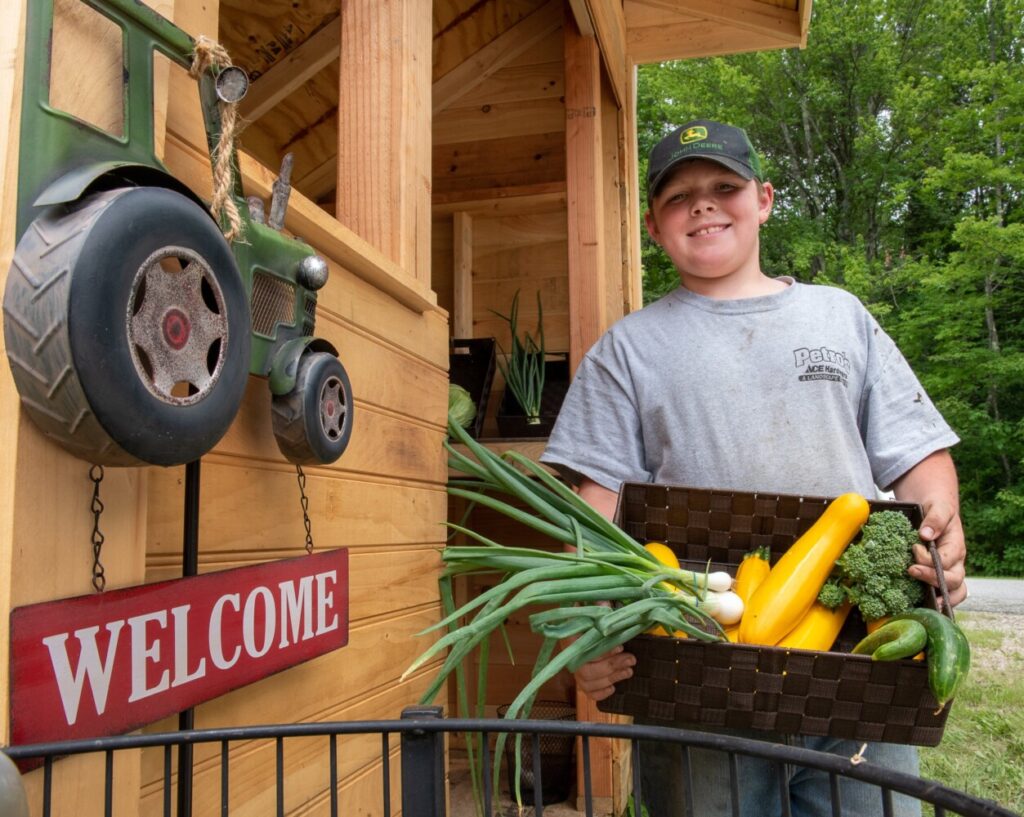
Photo: Russ Dillingham/Sun Journal. Brayden Nadeau, seen here at age 10, shows off vegetables he grew on his grandfather’s land in Auburn, Maine.
How great to see a kid who’s into agriculture! Cathy Free at the Washington Post reports on a 12-year-old farmer in Maine who got hooked on farming at age 2. There’s a lot to ponder here about what a close relationship with a grandparent can lead to.
“Brayden Nadeau was 2 when he helped his grandpa steer a John Deere tractor, and he was 3 when he helped feed the hogs and chickens on the family farm in Minot, Maine.
“At age 5, when he was asked by his kindergarten teacher what he hoped to do for a living one day, nobody was surprised when Brayden said he was going to be a farmer, said his mother, Kari Nadeau. …
“Brayden, now 12 and in seventh grade, is already on his way to achieving his career goal. On his own initiative, he does much of the work on his grandfather Dan Herrick’s 25-acre farm, and on the 275 acres that neighbors let Herrick use to grow hay, Kari Nadeau said. Brayden plants, tends and harvests produce, and sells his bounty.
“For the past two years, he has run Brayden’s Vegetable Stand, selling fresh food such as corn, cabbage and tomatoes. He used his savings to buy a new store structure in May 2021 for about $7,000 and install it at the edge of his grandfather’s farm. He posts live updates on Facebook about what’s fresh each day.
“He works on the farm and at his store 10 hours a day in the summer, and four hours a day (mostly after school) when school is in session. He’ll restock his store before school at 7:30 a.m. and leave an honor box for customers to drop in their money.
“Brayden said he puts most of his earnings into savings, but uses some of the money to add improvements to his veggie stand, such as a new floor.
“ ‘I’ve become his employee,’ joked Herrick, 64, adding that he still harvests hay on the farm but has allowed Brayden to take over most other responsibilities. ‘I taught him the basics, and he took it from there. … Brayden pretty much runs the show now. [He] knows how to use the equipment better than I do.’
“Brayden said it’s his favorite way to spend his days. ‘I really enjoy it — even getting up at 5 in the morning,’ he said. ‘I’m not into video games and goofing around on my phone like some of my friends. I’d rather be busy on the farm.’ …
“Maine was among the top five states with declining farmland between 2012 and 2017, according to a survey done by the U.S. Department of Agriculture. In rural towns like Minot in southern Maine, many families eventually sell their farms or stop working the land because their children find other ways to make a living, said Herrick, who has farmed for most of his life.
“ ‘It’s a hard job, and you really have to enjoy doing it,’ he said. …
“Brayden’s sense of duty to the farm has also helped to foster a close relationship with his grandparents, said his grandmother, Marie Herrick, 60.
“ ‘Nobody has ever asked Brayden to do this — there’s just nowhere else he’d rather be,’ she said. ‘It’s been a joy all these years to watch him learn everything he can from Dan.’
“At 6:30 every morning, one of Brayden’s parents drives him two miles to the Herricks’ farm, and he goes to work.
“Brayden said he feeds the livestock (100 chickens, 60 pigs, 30 laying hens, 20 turkeys and six cows), cleans stalls, picks ripe produce and gathers eggs. Then he stocks the shelves in his vegetable stand, which he operates until Thanksgiving.
“Every spring, he said, he starts his vegetables from seed, then puts them into the ground. To make the task of caring for the plants easier, he recently bought a drip irrigation system with money he’d saved from his produce sales. …
“His customers said they look forward to seeing what he has to offer each day, from broccoli and tomatoes to eggplant and summer squash. Brayden also sells bacon and sausage made from his grandpa’s hogs and loaves of his grandma Marie’s fresh zucchini bread, as well as jars of her zucchini relish.
“ ‘Zucchini is probably the favorite thing I plant,’ he said. ‘It’s always been amazing to watch something grow from an itty-bitty seed.’
“Some of his customers feel the same way about watching Brayden grow.
“ ‘He’s the hardest-working kid I’ve ever known,’ said customer Wendy Simard, 48, who was also Brayden’s reading teacher at Minot Consolidated School. …
“Simard said that when she taught Brayden in first grade, he was drawn to books about farming, and liked drawing pictures of tractors, pigs and cows.
“ ‘Now he comes in to tell our pre-K students all about vegetables, and he’ll bring in a baby pig at the end of every year to show the kids,’ she said.”
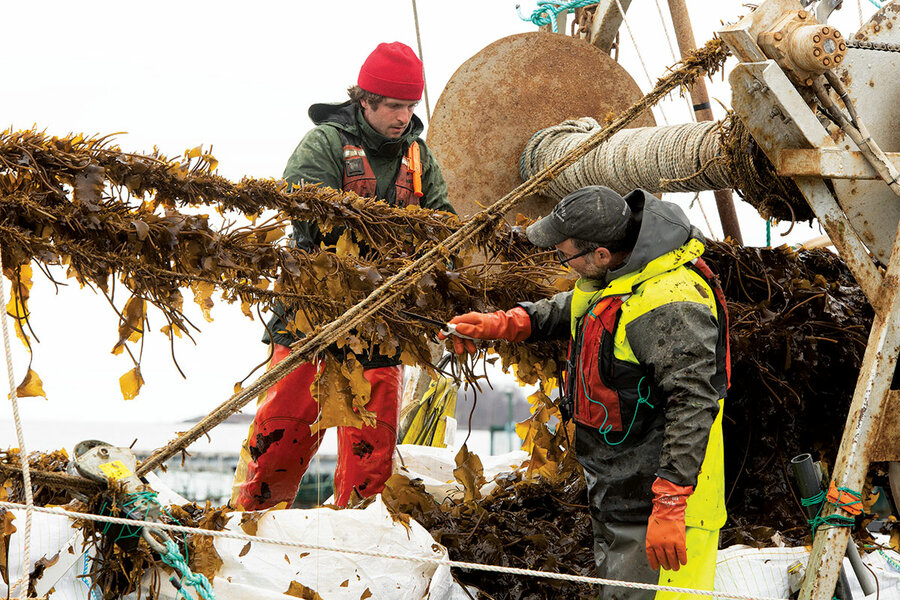
Photo: Melanie Stetson Freeman/CSM. Workers with Bangs Island Mussels, a Maine-based aquaculture company, harvest multiple lines of kelp in Casco Bay.
Humans never stop having to make adjustments. Consider all the confusing updates to your phone, problems with your printer, and the like. You are always having to learn something new.
Similarly, businesses have always had to adjust to market changes, floodplain dwellers have had to move to higher ground, families attacked by invaders have had to move to other countries … the list goes on.
Meanwhile, in Maine, lobster fishermen are having to consider new sources of income.
Stephanie Hanes wrote at the Christian Science Monitor, “The landing dock of the Portland Fish Exchange is busy this afternoon, in a way that almost reminds David Townsend of when there were still groundfish to catch in Casco Bay, when this pier was piled with cod and haddock … back before the fisheries collapsed.
“Now Mr. Townsend waves down to Justin Papkee, who has maneuvered his boat up to the dock. Mr. Papkee is a lobsterman. But hours earlier, he and his crew harvested thousands of pounds of sugar kelp, hauling the seaweed onto his boat from the ropes where it had been growing, cutting off the leafy blades and stuffing them into half-ton potato sacks. …
” ‘We love the new business,’ says Mr. Townsend. ‘This is the thing of the future.’
“Briana Warner smiles when she hears this. This is a new tune for the dockworkers, who not long ago grumbled about how their lives had descended to this, landing ocean weeds. But as the boats keep coming in, their enthusiasm for her efforts has grown. …
“It is her company, Atlantic Sea Farms, that is buying all of it, part of an ambitious effort to revamp not only Maine’s working waterfront, but also the way the state is fighting, and adjusting to, climate change. …
“Ms. Warner says, ‘We are presenting a climate change adaptation tactic that also does no harm, and in fact does positive things. … It makes the ocean better. It makes our coastal ecosystems better. It makes our coastal economy better. And it makes the consumer healthier.’ …
“The story of seaweed here in Maine, and how it is evolving into what some are calling Maine’s new cash crop, is part of a global story. … But it is also intensely local. And this, climate activists say, makes it even more important for understanding how humans around the world might adjust to a quickly changing planet.
“While few researchers would discount the importance of sweeping climate actions by international organizations and countries, there is a growing sense that, at least in the short term, real change will come from variations of what is happening in the waters off the coast of Maine. These will be place-specific initiatives. They will be based on cooperation and unity, not only between humans – the environmentally minded businesswoman and the sometimes conservative fishermen – but also among people and nature: the carbon and the kelp and the restaurateurs. …
“ ‘There’s no one silver bullet,’ says Susie Arnold, a marine scientist at the Island Institute, a Maine nonprofit focused on preserving the state’s working waterfront. ‘It’s going to take everybody. And at this point, we’ve taken such a toll on the Earth that there are going to have to be trade-offs.’ …
“For generations, life in this sparsely populated, ruggedly proud Northeastern state has focused on the ocean. Although Maine’s coast is only about 228 miles from north to south, when you include the various bays and inlets, the state’s shoreline measures more than California’s, totaling some 3,478 miles. Studies show that more than 80% of the household income in some communities traces back to fisheries. …
“For a generation now, lobster has been king of Maine’s seafood industry. It forms the base of a billion-dollar-plus business in the state, which provides the vast majority of domestically caught lobster in the United States. … And the people who hoist the traps take pride in crafting their own stringent measures to protect the fishery. They have imposed regulations on everything. ….
‘Lobster fishermen are notoriously good stewards of our coastal ecosystems,’ says Jesse Baines [of Atlantic Sea Farms]. ‘But we all know that the seasons are more variable every year.’
“Yet the seasons are not just more variable, starting unpredictably later or earlier. On the water, they are also warmer.
“ ‘The Gulf of Maine is one of the fastest bodies of warming water in the world,’ says Sebastian Belle, executive director of the Maine Aquaculture Association. ‘And frankly, it’s incredibly scary how fast it’s happening.’
“The reason, scientists say, is climate change. As humans release more greenhouse gases into the atmosphere, the air warms. Much of that heat is absorbed into the oceans. There are also ocean currents that some scientists believe are being disrupted. A shift in one particular circulation pattern has allowed warmer water coming up from the Gulf Stream to push away colder water coming down from Labrador, leaving warmer, saltier currents entering the Gulf of Maine. And that has prompted the lobster population to shift northward. …
“The warmer water has caused other species to migrate to the area, including the endangered right whale. Legal battles have erupted among the lobster industry, interest groups, and the federal government over protecting the mammal. Looking at all of this, economic development experts throughout the state are worried about the risk of so much of Maine’s economy being dependent on lobster. …
“Before she and her family moved to Maine, her husband’s native state, in 2013, Ms. Warner had spent nearly a decade as a U.S. Foreign Service economic development officer based in multiple African countries. There, she watched the struggles of individuals and communities working against forces far larger than themselves. And so she recognized what she was seeing in Maine.
“ ‘It’s just really devastating to see an industry that has taken such a leadership role in conservation and has no ability to stop the volatility because of the greater world’s usage of fossil fuels,’ she says. ‘No matter what the lobster fishery does, they can only control so much because the ocean is just warming.’
“The industry needed another way to make money, she realized – one that would be ecologically helpful instead of harmful. …
“The seaweed known as Saccharina latissima, or sugar kelp, is a yellowish brown alga that grows along rocky coastlines. It takes the shape of an elongated lasagna noodle, with crinkled edges, and can grow up to 16 feet long.
“It is high in a variety of nutrients, and also has a gelling capacity that makes it a useful ingredient for everything from cosmetics to ice cream to toothpaste. And like all plants, kelp absorbs carbon while giving off oxygen. …
“The idea of kelp as both a food source and an environmental solution is not new. Indigenous people in the Americas harvested kelp for generations. In Asia, it’s part of a multibillion-dollar seaweed farming industry.
“But in the U.S., where far fewer people eat seaweed, there has been scant commercial interest in kelp farming until recently. … Although seaweed currently makes up only a small percentage of [the aquaculture] industry, it is the fastest-growing subsector, according to the National Oceanic and Atmospheric Administration. …
“ ‘The kelp is sucking carbon dioxide directly out of the water, and actually reducing the acidity of the water in its general vicinity,’ [says one kelp farmer]. ‘So if you put the kelp close enough to the mussels, we have measurable, significant evidence showing that the kelp halo effect helps the mussels grow bigger and faster.’ ”
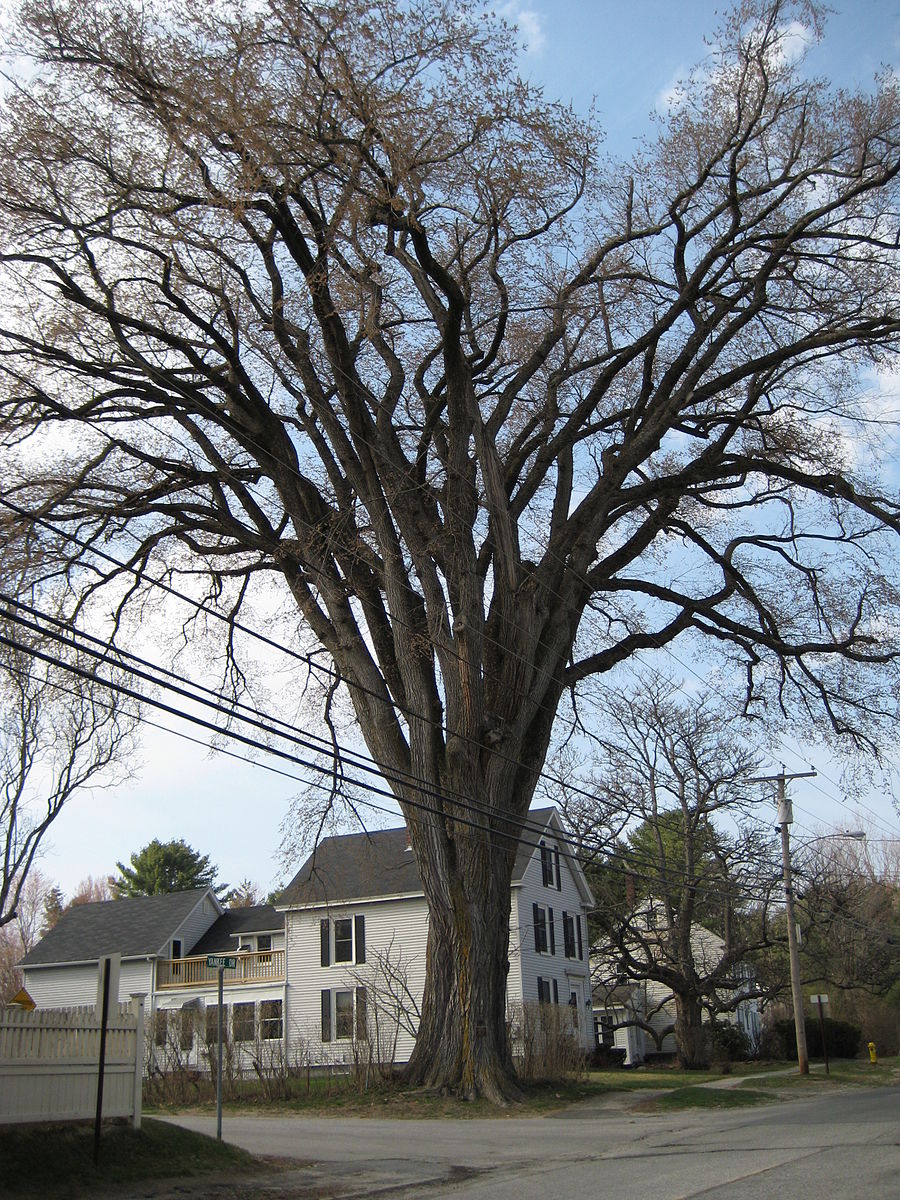
Photo: Dudesleeper/Wikimedia. “Herbie,” a notable American Elm in Yarmouth, Maine. America lost nearly all its graceful elms after the arrival of Dutch elm disease.
My father used to talk about the beautiful elms near his childhood home in Syracuse, New York, before the advent of Dutch elm disease. The trees’ graceful vase shape provided lots of shade on hot days.
Elizabeth Evitts Dickinson at the Washington Post has found a few surviving elms in Maine, where people take good care of their trees.
“It’s a sunny September day in Castine, Maine, and I’m standing in a stranger’s yard debating how best to hug a tree. Not just any tree, but an American elm, a fully mature Ulmus americana.
“I want to hug this elm for practical reasons. At least that’s my justification. I remember hearing somewhere that your arm span roughly equals your height — 5-foot-7 in my case — and I wonder if I can better decipher the size of this elm by encircling it. I’m sure my hands won’t come close to touching. The trunk is massive, channeled by thick gray ridges of bark and reaching high overhead to an elegant vase-shaped canopy. The light has changed under its shade; the sun filtered through so many leaves creates a chlorophyll coolness.
“This tree, which is tall enough that a schooner coming into Castine Harbor could navigate by it on a clear day, has been here awhile. I know from the literature on the Castine elms that many were planted in the 1850s. … This elm, with its view of the water, has seen villagers ship off for a Civil War, a First World War, and then a second one. It has survived its own pandemic, Dutch elm disease, which leveled the elms of Europe before hitting America in the 1930s and felling over 70 million of its species. So, truth be told, I wouldn’t mind hugging this particular tree just for the hell of it. This tree is a miracle. …
“Castine is one of the few places in America where you can still see hundreds of mature Ulmus americana. Roughly 300 survive in the historic village and surrounding area by a recent inventory, which is an exceptional number. Exploring Castine is a trip back in time to a landscape no longer visible anywhere else. A town shaded by mature elms, some nearing two centuries old. The town motto: Under the Elms and By the Sea. …
“Castine is one of North America’s oldest settlements. In the 1600s, Europeans coveted the land for its auspicious trade location on the Eastern Seaboard and its deep-water harbor, never mind that the Abenaki, Penobscot and Mi’kmaq tribes already lived here. Castine, bounded by Penobscot Bay and the Bagaduce River, has the feel of an island, but it’s really a peninsula that’s shaped like an ax head lying on its side. …
“Around the same time that New Yorkers were waking up to discover these elms [in the 1930s], an arborist in Ohio discovered Dutch elm disease in a tree there. The elm bark beetle had arrived from the sea, carried in the hull of a ship. Elm wood burls bound for the ports of America and meant to be used as veneer in decorative furniture carried the castaway, Scolytus multistriatus. The tiny beetle likes to feed on the sapwood of the elm, and it carries on its body a fungus, the spores of which infect a healthy elm by needling their way into the tree’s vascular system. Soon the tree is no longer able to carry nutrients or water to its outer branches. The elm is effectively strangled. …
“By the 1960s, the blight had spread across the country. ‘People speak of worrying about the trees,’ the novelist Elizabeth Hardwick wrote from her home in Castine in 1971. … ‘The great old elms, with their terminal woe, are dying grandly,’ she wrote.
“Most of America’s elms were dead by the 1980s. ‘It was an ecological calamity that changed the face of the American nation,’ … [Thomas J. Campanella, author of a cultural history of the tree, Republic of Shade: New England and the American Elm] wrote. But not in Castine.
“ ‘There was action taken back in the late ’60s and early ’70s by several townspeople to save the trees,’ Don Tenney tells me.
“Tenney holds what is quite possibly the greatest public office ever invented, that of the Castine tree warden. It’s Tenney’s job, along with the elected Tree Committee, to care for the town elms, about 75 of which are actively being treated to stave off Dutch elm disease.
“Back in the 1970s, no real treatment existed. Richard Campana of the University of Maine was one of the early researchers to try to create a serum to inoculate against the disease. Castine’s elms were injected with his experimental fungicide; Tenney, who is 75, remembers those early interventions: ‘One summer there were these orange tanks strapped to the trees all over town, and they were pressurized to deliver the fungicide. It was a total experiment.’
“Some believe it was this treatment that helped save many of the elms. Others [posit] that it is Castine’s unique topography, on a wind-swept peninsula, that made it hard for the beetles to take purchase here. Still, the disease found its way to Maine and on neck to Castine, and now, arborists fear, it’s on the rise.”
More at the Post, here, where you can read about the tree’s chances in the future. P.S. Maine also has a miracle chestnut tree, here.
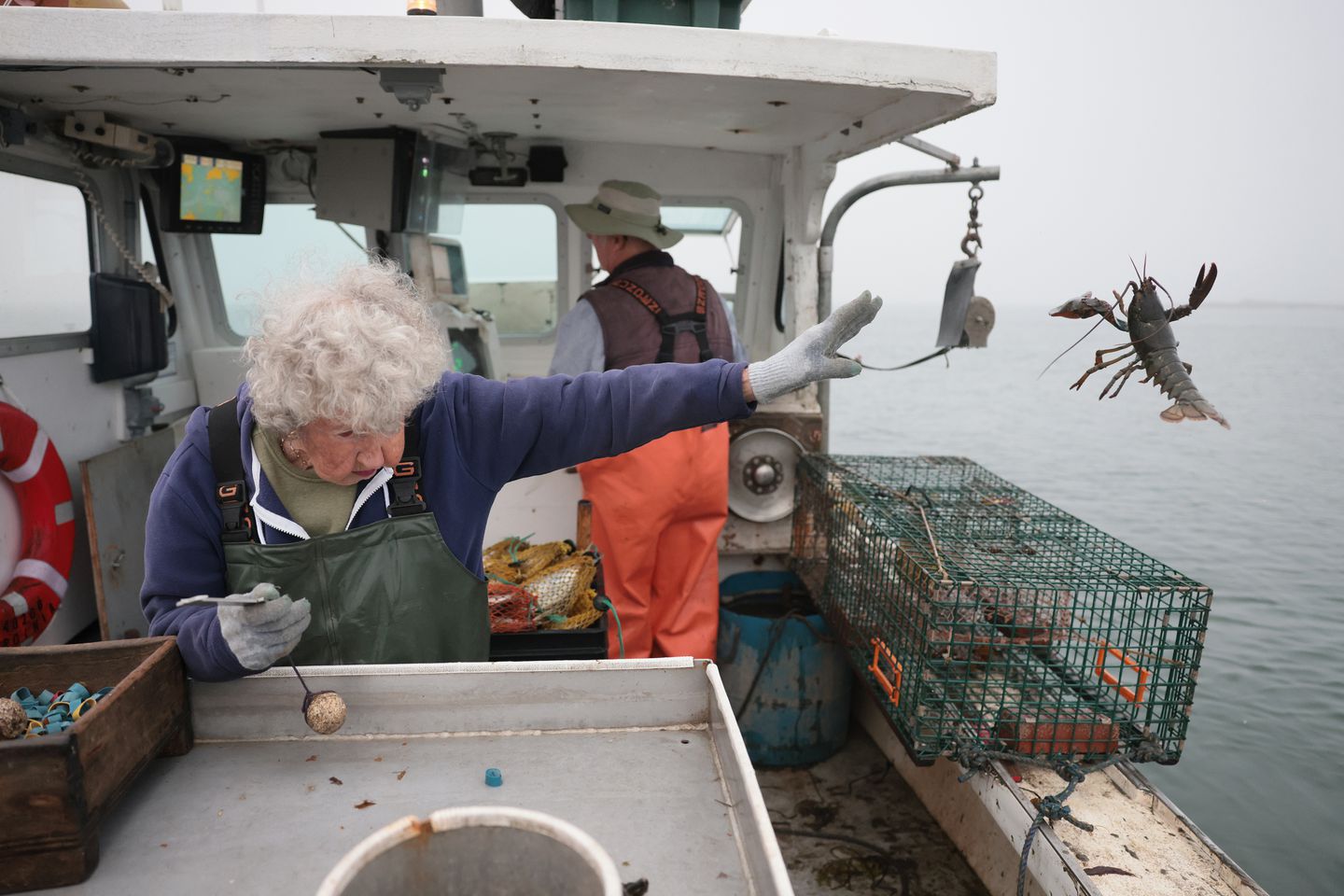
Photo: Jessica Rinaldi/Globe (WHAT a picture! Rinaldi is among the best.) Virginia Oliver tossed back an undersized lobster as she and her son, Max, haul traps in Maine.
Are you ready for another story about someone loving their job at an advanced age? Brian MacQuarrie of the Boston Globe interviewed a 101-year-old woman who still fishes for lobster — Virginia Oliver of South Thomaston, Maine.
“It’s not yet 5 a.m.,” he writes, “and the landing at the Spruce Head Fishermen’s Co-op is shrouded in predawn fog that obscures the waters beyond. It’s time to go to work, and Virginia Oliver and her son Max approach the dock in the dark in a 30-foot lobster boat.
“They tie up under the stark, mist-speckled glare from an overhead light. Bait is brought aboard, equipment adjusted, and Max peers into the gloom as he eases the boat into Penobscot Bay.
“In the world of Maine lobstering, it’s a scene that is repeated countless times up and down the state’s rugged coast. But here’s the difference: No other boat has a 101-year-old lobsterwoman aboard, and a fully working one at that.
” ‘I grew up with this,’ said Virginia Oliver, a Rockland woman who began lobstering when she was 8, just before the Great Depression. ‘It’s not hard work for me. It might be for somebody else, but not me.’ …
“The fog began to burn off shortly before 7 a.m., and … Max pointed out a ‘sweet spot’ for lobstering among the many small, rocky islands.
“His mother came to work this day with a bit of makeup on her face, her blue eyes and a pair of small earrings twinkling in the hazy dawn. …
“Virginia Oliver has been working these waters since she first accompanied her lobsterman father as a young girl. After raising four children, she returned to the bay with her husband, who died 15 years ago. Since then, she has continued to venture from shore, three mornings a week, to a saltwater world as familiar as the street where she was born and still lives.
“ ‘When I first started, there weren’t any women but me,’ Oliver said, dressed in olive-green overalls, a blue sweatshirt, and high boots. ‘My husband and I used to go out in all kinds of weather. There aren’t as many lobsters today, though. They’re way overfished, like everything else.’
“Oliver’s job is to measure the lobsters, using pliers to place tight bands around the claws of the keepers, tossing the undersized overboard, and stuffing small pogies into bait bags.
“Naturally right-handed, Oliver has worked the pliers with her left hand since she broke her right wrist several years ago. Despite the change, her hand movements seem remarkably supple and strong. …
“Oliver is meticulous when she measures, tossing back lobsters that are only a hair shorter than the 3¼-inch legal minimum from the eye socket to the rear of the body shell. She also can’t keep egg-bearing or reproductive females, a state requirement that helps bolster the lobster stock. …
“Max Oliver, 78, does double duty as helmsman and hauler, emptying every trap that a hydraulic wheel pulls from the water. Between mother and son, they have choreographed an intricate ballet of demanding, physical work that’s conducted quietly and efficiently.
“Max chuckled over his mother’s stamina and work ethic.
“ ‘It’s pretty damn good, that’s what I call it,’ he said, maneuvering the boat in low water past pine-studded islands. ‘She might give me hell once in a while, though,’ he added with a laugh. ‘She’s the boss.’ …
“Her son drives her to the boat during lobster season, which for the Olivers stretches from the end of May to the beginning of November. They rise about 3 a.m., go to bed at 10 p.m., and look mildly amused when asked how they manage it.
“Oliver said she doesn’t nap when the lobstering is done for the day. There’s shopping to do; there are errands and trips to the post office.
“ ‘I find plenty of housework, too. I don’t like to do it, but I have to do it,’ she said. … ‘I still drive — a GMC four-wheel-drive truck. As you can tell, I’m pretty independent.’
“Her three sons and one daughter range in age from 76 to 82. One of them, 79-year-old Bill, waited at the Spruce Head Co-op this recent morning as he prepared to go lobstering in a separate boat. His mother’s work habits seem to run in the family.
“ ‘Someone asked me, why don’t you retire? I said, “I can’t. My mother would break my neck.” ‘ “
Read more and enjoy all Jessica Rinaldi’s amazing photos of this woman at the Globe, here.
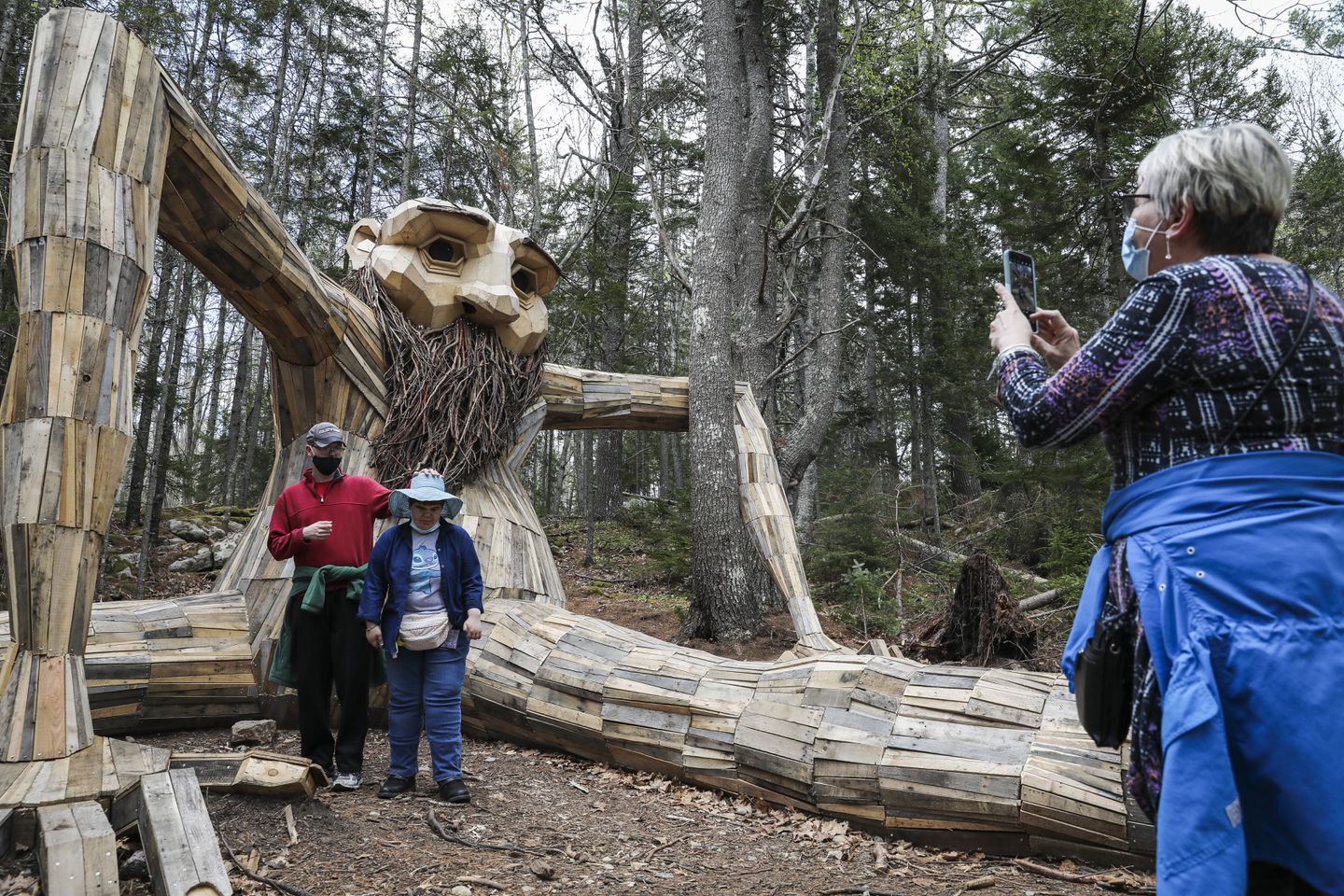
Photo: Erin Clark/Globe Staff. Visitors pose with Birk, one of five trolls created by artist Thomas Dambo in the Coastal Maine Botanical Gardens in Boothbay, Maine.
Who doesn’t love trolls? Especially big, ol’, harmless trolls amenable to selfies?
Steve Annear, a reporter who gets all the fun assignments at the Boston Globe, recently wrote an article about the Danish trolls that have shown up in Maine.
“These trolls, including one that stands nearly three stories tall, aren’t dastardly by any means. They come in peace, settling in Midcoast Maine to share an urgent message with those who discover them tucked away in the Coastal Maine Botanical Gardens in Boothbay: Please appreciate and take care of the planet, before it’s too late.
“ ‘These are nature’s protectors,’ said Gretchen Ostherr, president and chief executive of the gardens, the largest botanical garden in New England.
“Later this month, visitors to the 323-acre property may discover a series of five giant, whimsical troll sculptures, each immersed in nature and made from reclaimed and recycled wood and other natural materials.
“The exhibit, called ‘Guardians of the Seeds,’ is the work of Copenhagen-based artist Thomas Dambo, and was put together by a team of people, including community volunteers, during the past seven weeks. …
‘I really want it to stir two things,’ Ostherr said. ‘That people have a wonderful, connected, restorative experience, and that they are inspired to take care of their planet’ and become stewards of the woods.
“The Maine display officially opens May 29. While it’s similar to dozens of other eye-popping troll sculptures Dambo has built across the world and part of a shared narrative, the storyline of the Boothbay trolls is unique.
“In the United States, Dambo’s trolls have drawn crowds in Illinois, Florida, and Kentucky, with much fanfare. But the arrival of the mythical creatures to the woods of Maine marks a first for New England.
“Officials from the Coastal Maine Botanical Gardens first reached out to Dambo in 2019 as they discussed ways to have more visitors ‘share the magic of the gardens,’ Ostherr said.
“ ‘We loved the story of the trolls, and Thomas’s focus on the trolls being about biodiversity and taking care of the planet and the forest,’ she said. ‘It perfectly aligns with our mission, which is about connecting people with plants and nature.’ …
“Dambo, 41, said he built the faces and feet in his workshop (a.k.a. ‘troll factory’) in Denmark before they were transported to Maine. But the bulk of the sculptures were constructed on site using several tons of recycled materials, their positions and designs inspired by the precise spot in the woods they call home. …
“It’s the first international project Dambo has done since the coronavirus all but shut down the art world last year. He said he hopes the sculptures will bring people out of their homes to appreciate the great outdoors while also educating them about society’s wasteful habits.
“ ‘My art is about trying to convey the message of the importance of taking care of our natural world, and being better at recycling,’ he said. ‘I try to use the trolls as a medium for being the voice of nature, and how nature perceives us.’ ”
More at the Globe, here. By the way, while we’re on the subject of amazing gardens in New England, be sure to visit Bedrock Gardens in Lee, NH, where my brilliant friend, Jill Nooney, one of the founders, displays her wildly imaginative sculptures made of found objects, mostly metal.
Photo: Robert Klose. This shop in a low-income neighborhood of Bangor, Maine, has had the same owner since 1980.
People in my town love our independent bookstore, which seems to have been able to weather the pandemic so far. If I bought a book there before I was vaccinated, the staff would either mail it or offer curbside pickup. Now at last I feel comfortable going inside. Does your town have an indie?
Robert Klose wrote recently for the Christian Science Monitor about an indie bookshop in Maine. “The Dutch Renaissance humanist Erasmus of Rotterdam once wrote, ‘When I have a little money, I buy books; and if I have any left, I buy food and clothes.’
“This thought came to mind as I drove through one of Bangor, Maine’s poorest neighborhoods en route to a small, offbeat, secondhand bookstore that distinguishes an otherwise careworn street and bears the lofty moniker Pro Libris Books. …
“What a wonderful, wonderful thing to have a bookstore in one’s midst, especially in a place where other needs may incessantly intercede, and in an electronic age when so many bookstores – whether of the small, independent, mom and pop variety, or mega-outfits like Borders – have evaporated from our communities, seemingly overnight.
“Pro Libris Books is an unassuming but well-ordered cave of a shop occupying the ground floor of a peeling-paint clapboard building. … The owner, Eric Furry (is there a more appealing name for a bookseller?), has plied his trade since 1980 and, happily, still turns a profit.
“Mr. Furry, a small septuagenarian with an outsize crop of salt-and-pepper hair, touts his business as ‘A Reader’s Paradise.’ This seems to be enough to attract the rich variety of types I have observed there. …
“As I wander the stacks, dividing my time between titles and observing the other visitors, I note the interplay between patron and proprietor. Not everyone is there to buy. If I’m not mistaken in my interpretation of body language, my impression is that many are there to be – and I choose this word carefully – comforted. The familiar titles, the affordability of the volumes, the quirky touches (a coffin-turned-bookcase from the set of a Stephen King movie; a bumper sticker announcing, ‘Maybe the hokey-pokey is what it’s all about’; Mr. Furry’s roaming cat) return me to the consideration of what we need, of what is indeed essential. When I am visiting Pro Libris Books, I find myself siding with celebrated author John Updike, who once said, ‘Bookstores are lonely forts, spilling light onto the sidewalk. They civilize their neighborhoods.’ …
“When I broached the topic of necessity [of bookshops] with him, he recalled a woman who gave him a $20 bill for a $9.50 sale and told him to keep the change, remarking, ‘I just don’t want you to ever go away.’ And then there was the man who sent him $80 out of the blue because he was worried about how Mr. Furry was faring during the pandemic-induced lockdown. I asked about his survival secret. The answer: ‘Low overhead. And a loyal clientele.’ More here.
By the way, I never lose an opportunity to tell book lovers that https://bookshop.org/ has everything. Plus it gives a portion of sales to indies. Unless you think Amazon needs more money, please check it out.






 Suzanne's Mom's Blog
