Feeds:
Posts
Comments

Posts Tagged ‘marine’

John sent a link to a story at Business Insider about a science fair project that could have a real impact on the environment.

Jessica Orwig writes, “This 13-year-old is trying to save the world one ecosystem at a time. Chythanya Murali, an eighth grader from Arkansas, has created a safe, effective, non-conventional method to clean oil spills, by harnessing the cleaning properties of bacteria — specifically the enzymes they use to break down oil particles. These enzymes disassemble oil molecules, making way for the bacteria to convert it into harmless compounds. …

“In 2012, a study found a chilling discovery about the oil-cleaning agents dispersed in the Gulf of Mexico after the Deepwater Horizon oil spill of 2010. When combined with the oil itself, the resulting mixture was 52 times more toxic to small animals like plankton than oil alone. …

” ‘My inspiration for this project began [from] the immense damage caused by the BP oil spill in early 2010.’

“To improve oil-cleaning methods, Murali designed a science fair project that explored the different mixtures of oil-eating enzymes and oil-breaking-down bacterias, to see how they effect the marine environment.

” ‘The combination of bio-additive enzymes and oil-degrading bacteria as a novel combination for short and long-term cleaning, and its effect on ecosystems, was not explored before,’ Murali told Business Insider.

“So it only seemed natural to Murali to combine the two and see what happened. She discovered that in a small-scale aquarium, the combination of her chosen oil-cleaning agents could help remove oil while preserving the health of the overall ecosystem, something that some of the oil-cleaning agents we use today cannot achieve.” Read more here.

Kids are going to save the world, I think.

Photo: Chythanya Murali
Chythanya Murali with her science fair poster.

Read Full Post »

Someone has finally recognized seaweed for the artistic creation it is.

That someone is Josie Iselin, whose book An Ocean Garden: The Secret Life of Seaweed was reviewed by Dana Jennings in the NY Times Science section Tuesday.

Jennings begins, “The secret to finding unsuspected beauty, artists and naturalists will tell you, is in knowing how to slow down and really look. The writer and photographer Josie Iselin certainly knows how to do that, as she shows in her beguiling new book, An Ocean Garden.

“In her introduction Ms. Iselin … writes, ‘I fell in love with seaweed at the kitchen counter.’ (She would bring back samples and study them there.) And it vexes her that others don’t share in her tidal pool crush. …

“The 100 color photographs here, though, just might convince some people …  The book focuses on seaweeds found in Maine and California, both states she has lived in; the species names tickle the tongue in the same way that the seaweeds themselves can tingle bare feet: knotweed and bladderwrack, bull kelp and green scrap, pepper dulse and sugar kelp, Turkish towel and Irish moss.” Read more about the book, here.

We’re headed to the beach this weekend with John and his little ones. Maybe we will be able to identify some seaweeds there.

Photos: Josie Iselin
Clockwise from top left, seaweeds from Josie Iselin’s new book: Macrocystis, Ulva lobata, Calliarthron tuberculosum, Egregia menziesii, Gloiosiphonia verticillaris and coralline algae.

Read Full Post »

The radio show Living on Earth is a source of information that I find delightful — not only because the topics are about nature but because they are sometimes so offbeat.

Recently the focus was on a new species in the ocean under the ice.

“Under the Antarctic ice lurk newly discovered sea anemones. Frank Rack, Executive Director of the U.S. Antarctic Geological Drilling team, tells host by Steve Curwood about how the team discovered this new species that hangs upside down from the Ross Ice Shelf. …

CURWOOD: “A team from ANDRILL, that’s the Antarctic Geological Drilling, has discovered a new type of sea anemone, while testing a remotely operated vehicle under the Ross Ice Shelf off Antarctica. The researchers are geologists and sedimentologists. The director of the team is Frank Rack from University of Nebraska.

RACK: “We were melting holes through the 270 meters of ice. We were deploying oceanographic sensors to measure current speed and direction. …

CURWOOD: “How long did it take you to find sea anemones down there?

RACK: “It was a total surprise. We melted a hole through the ice, and we had been running a camera down to the sea floor and back up. And in those observations, the ice shelf looked plain and featureless, but when we put down the robot and had more sensitive camera systems and could get very close to the bottom of the ice, that’s where the anemones appeared. They were quite numerous and widespread, and they were living in burrows in the bottom of the ice shelf, hanging upside down into the water column. …

CURWOOD: “So if they’re on the bottom of the ice, way down under the sea, they’re upside down, they’re hanging down like bats, huh?

RACK: “They are. They’re at about 230 meters below the sea level, and then there’s another 650 to 680 meters of water below. So the currents are circulating water across the continental shelf and up underneath the floating ice shelf, and the anemones are feeding and surviving in that environment.”

Read the whole transcript here.

Photo: Frank R. Rack, ANDRILL Science Management Office, University of Nebraska-Lincoln
An underwater picture of the sea anemones.


Read Full Post »

Some posts at Andrew Sullivan I only need to glance at briefly and bells go off: for example, this entry about an artist who works with coral.

Andrew quotes Amelia Urry writing about Courtney Mattison, who became enamored of coral while studying conservation biology at Brown University and moonlighting at the Rhode Island School of Design.

“Mattison’s newest piece, Our Changing Seas III,” says Urry at Grist, “depicts a hurricane-spiral of bleached corals coalescing to a bright center. You can read it as a message of hope or one of impending doom, depending on your disposition …

At the heart of Mattison’s artwork is her desire to inspire real-life changes in how people view and treat the world’s oceans and environments. Similar to the Our Changing Seas series, Courtney Mattison’s Hope Spots collection comprises 18 vignettes, each of which represents a vital marine ecosystem in its ideal form (that is, protected from various threats such as global warming or pollution).” Read more at Grist, here.

Art: Courtney Mattison
“Our Changing Seas III,” a ceramic coral reef

Read Full Post »

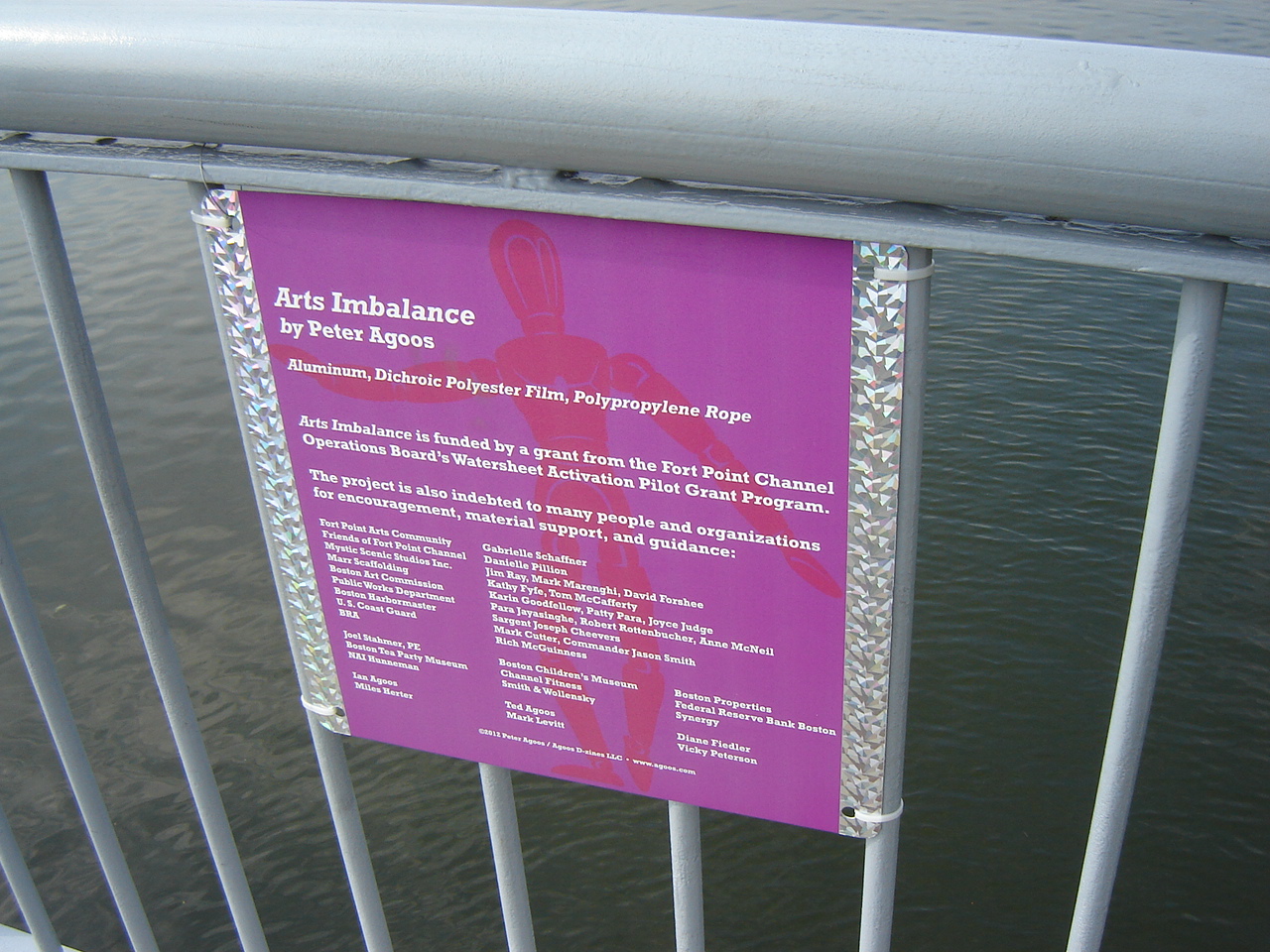
John and two college friends rented a motor boat in Fort Point Channel Friday to see the sights of Boston Harbor. But first they motored near my building so I could wave as they passed under this piece of public art.

The Mystic Scenic Studios site explains the art:

“A designer named Peter Agoos approached Mystic Scenic Studios with the idea of creating two life-sized human figures made of aluminum to hang above the Fort Point Channel in Boston.

“Mystic Metal’s, Mike Onischewski, fabricated the figures from an aluminum sheet; [they] were then covered with refractive dichroic film with the help of David Forshee, also of Mystic Scenic Studios.

“The piece was installed on July 2, 2012, with a team of 12 volunteers who worked from a small boat on the water and a scissor lift on land. The piece was strung from a 300-foot yellow tightrope between the Samson Post structure on Summer Street and the counterweight tower on Congress Street. The life-sized figures were counterbalanced on the rope and inspired by a classic articulated wooden artist’s manikin.”

Photograph: Mystic Scenic Studios

Read Full Post »

I have been on a few whale watches over the years. It is unbelievably thrilling to see those magnificent creatures rise up out of the ocean — and scary to think of threats to their continued existence. (I have heard that too many whale watches, though well-intentioned, are becoming a threat, too.)

Among the efforts being made to protect whales, there’s one that ordinary boaters can do: Go slow.

Colin A. Young writes in the Boston Globe about two sightings of North Atlantic right whales over the weekend. “Authorities are warning boaters to keep an eye out for the endangered marine mammals.

“On Friday, three whales were spotted off Scituate. On Sunday, three of the whales were observed off Nantasket Beach in Hull. Officials were not sure if it was the same set of animals.

“The National Oceanic and Atmospheric Administration fisheries service established a ‘voluntary vessel speed restriction zone’ in waters off the Boston area. Mariners are urged to either avoid the area or keep their speed lower than 10 knots while traveling through the zone. The restricted zone is in effect until April 27.” More here.

Defenders of Wildlife offers information on North Atlantic right whales here.

Photograph: Brian Skerry, National Geographic

Read Full Post »

« Newer Posts