Feeds:
Posts
Comments

Posts Tagged ‘media’

Photo: Emily Mesner/Anchorage Daily News.
Lenora Ward, general manager at KOTZ radio station, listens to a 2022 dog-sled musher interview while on-air at the station in Kotzebue.

Few places in the US rely more heavily on public radio than Alaska. That is why people who care about Alaska rushed to bridge the gap after the current Congress decided public radio is not needed.

Iris Samuels reports for the Anchorage Daily News, “An Alaska fund has raised $3.5 million as it seeks to replace federal funding rescinded by Congress for public radio and television stations.

“Amid fundraising efforts, station leaders say they are already beginning to cut some programming. …

“Congress in July voted to rescind $1 billion in federal funding for public media across the country. … Two of Alaska’s three-member congressional delegation voted in favor of the rescission, which eliminated roughly $15 million intended for more than two dozen stations in Alaska. …

“Sen. Lisa Murkowski was one of a few Republicans in Congress who attempted to salvage the federal funding that Congress members themselves had approved last year, pointing to its importance in alerting Alaskans to natural hazards like tsunamis, earthquakes and fires.

“In a recent call hosted by a coalition of Alaska public radio and television stations, PBS President Paula Kerger said that Alaska is at the forefront of national fundraising efforts intended to — at least temporarily — supplant federal funding with money from private donors and foundations. …

“Kerger said she was ‘deeply grateful to Sen. Murkowski, who really fought for us more than any other member of Congress.’

Alaska stations banded together in the days following the July rescission vote to, with the Alaska Community Foundation, establish the Voices Across Alaska Fund, which in its first two months raised more than $3.5 million.

“The funds came from 80 donors, which include individuals, corporations and foundations in Alaska and in the Lower 48, according to Alaska Community Foundation spokesperson Ashley Ellingson. The funds will be disbursed to stations [based] on stations’ needs, Ellingson said. …

“Alaska Public Media President Ed Ulman said that since the rescission, new donors have begun giving, or existing donors have upped their contributions. …

“Funds will be distributed to Alaska stations, which are also independently fundraising, several station managers said in recent days. Even as they have pivoted to fundraising efforts, the station managers reported making several targeted cuts to their programming in response to the loss of federal funding.

“Alaska Public Media, the state’s largest public station, has paused Alaska Insight, a television news program that was broadcast across the state. Ulman said Alaska Public Media has also cut its education programming and is considering cutting Debate for the State, a program that features candidate forums for statewide offices. …

“Gretchen Gordon, general manager of KUAC, a station serving Interior Alaska, said the station has cut overnight broadcasting, eliminated some national radio programs and lost television service in Nenana in response to the federal funding cut. Gordon said KUAC is ‘determined to find ways to restore lost programs and services.’

“Kristin Hall, general manager at KYUK, which serves Bethel and the Yukon-Kuskokwim Delta, said the station lost $1.2 million in federal funding, and could eliminate more than half its staff by the end of the calendar year.

“Justin Shoman, president and general manager of KTOO, said the Juneau-based station may need to adjust its coverage of the Legislature. Gavel Alaska, a live-streaming service for legislative hearings, press conferences and trial hearings, costs more than $1 million annually to run and receives no state funding, Shoman said. Until the rescission, federal funding made up more than a third of KTOO’s annual budget. …

“The federal funding cut comes after a yearslong refusal by Gov. Mike Dunleavy to spend state dollars on public media. Starting in his first year as governor, he repeatedly vetoed funding intended for public radio stations. This year, the Legislature did not fund the grants for public radio in the budget. …

“ ‘It’s not lost on many of us that the Legislature has every single year put in funding, in particular for rural public radio,’ said Ulman. ‘And yet, there is one individual who has the power of the veto who exercises that veto and goes against — I’m just going to say it — the will of the people.’

“When Begich, Alaska’s lone U.S. House member, voted in June to claw back federal funding for public media, he reasoned that public broadcasting was no longer essential because Alaskans now use ‘pervasive cellular, satellite, and wireline technologies.’

“But Gordon, with KUAC, said many Interior residents do not have access to broadband internet. … ‘Our lawmakers need to understand that a little better,’ she said.”

Will the new fundraising levels last? Only time will tell. More at the Anchorage Daily News, here. And do read about how an Alaska public radio station saves lives, here.
Read Full Post »

Sometimes a small, well-networked country or state can do a better job making challenging things happen than the big guys can. I’m thinking, for example, about West Virginia’s remarkable success in getting the Covid vaccine into people’s arms. (NBC has a cool story about Mom & Pop drugstores and the advantage of knowing your community.)

Today’s story comes from a very different part of the world and concerns a very different topic: the struggling print-magazine industry.

Elle Hunt reports at the Guardian, “At 8.31am on a Thursday, Henry Oliver received a text message from his employer, alerting him to a company-wide Zoom call in 29 minutes’ time.

“The day was 2 April 2020, a week into New Zealand’s national lockdown to control the spread of coronavirus. Oliver, who is the editor of Metro magazine, and his team had been scrambling to adjust to remote working and – with magazine publishing not among the ‘essential services’ permitted to continue through the pandemic – a new digital-first operation.

“Within an hour of that text, Oliver and the 300-odd other employees of Bauer Media New Zealand were told they were being made redundant, the titles they worked on would be put up for sale, and the entire company was to close. …

“A privately owned German company operational in 13 countries, including the US, UK and Australia, Bauer had been a pillar of the New Zealand magazine industry since 2012. In particular it was known for its current affairs and long-form features journalism, as the home of the Auckland-centric Metro, North & South and The Listener – titles with steady subscriber bases and some of the most experienced and awarded journalists in the country on staff.

“In its suddenness and its sweep, Bauer’s decision seemed to sound a death knell for an entire industry. … Yet less than a year later, not only have Bauer magazines been brought back to life under new ownership, but also new titles have been launched – reflecting a flurry of investment and innovation in New Zealand media precipitated by the pandemic.

“Sydney private equity firm Mercury Capital purchased Bauer NZ for an unspecified sum in June (later renaming it Are Media) – extending a lifeline to The Listener and four other mastheads.

Metro and North & South were both acquired by independent investors seeking to preserve New Zealand’s tradition of long-form features journalism.

“Meanwhile, four entirely new monthly titles – staffed by former Bauer editors and writers, with former CEO Paul Dykzeul advising – were launched by School Road Publishing in November.

“The recovery, since the dire outlook in April, has exceeded all expectations: testament to the appetite of New Zealanders not just to read magazines, but to make them.

“The day after he was made redundant, Oliver started work on a zine. With a budget procured from property developer Britomart Group, he was able to deploy the talents of many of the journalists and designers who had been let go with him from Bauer. He gave it the tongue-in-cheek title Essential Services, describing it as a ‘small affirmation of life in the face of media industry collapse.’

“Oliver went on to produce two more issues with funding from government agency Creative New Zealand. … ‘I just thought to myself, it’s not really up to a German billionaire whether I get to make magazines or not.’

“Others too had spied opportunity in among the rubble. German-born journalists Konstantin Richter and Verena Friederike Hasel … made a ‘spontaneous’ offer on North & South to ensure its survival, as subscribers themselves. Richter is also a board member of the Swiss media giant TX Group, founded by his family, and splits his time between the two countries. …

“Richter describes their vision as ‘a mix of change and tradition’: retaining North & South’s time-honoured focus on issues that span the length of New Zealand, bridging the urban-rural divide – while injecting news and perspectives from further afield. He sees an opportunity to build on the tradition of investigative and long-form features journalism in a nation that is more receptive than others to the concept.

Metro, meanwhile, was bought by media entrepreneur Simon Chesterman, who retained Oliver as editor and moved the magazine to quarterly publishing. It relaunched with a splash in November with an exclusive essay from Lorde.

“Oliver says they were aligned on the importance of an Auckland-centric title in the age of coronavirus. ‘We’re going to be living in a more local world for the foreseeable future, so a city magazine, an authority on a specific place, can be more relevant than ever.’

“Plus, at a moment of up-to-the-minute, pandemic-driven doom-scrolling, ‘here is space for a slower media,’ says Oliver. ‘That was really what was taken away with the shutdown of the magazines.’

“To [Colin Peacock, host of Radio New Zealand’s Mediawatch programme], the industry’s reinvention suggests a new era of ‘start-up-style media’ in New Zealand. … Peacock points to Shepherdess – a new quarterly magazine for rural women, which launched in mid-March – and the free ‘mountain culture’ publication 1964 as examples of how print might be reinvented to serve a specific, perhaps localised audience. …

“In April, Bauer’s Australia and New Zealand chief executive Brendon Hill had said magazines would be ‘untenable’ in New Zealand through the pandemic: ‘Publishing in New Zealand is very dependent on advertising revenue and it is highly unlikely that demand will ever return to pre-crisis levels.’

“But the industry’s bounceback from catastrophe reflects New Zealand readers’ loyalty to their long-standing magazines – potentially to a fault, Peacock suggests. … The resurrection of The Listener, almost identical in form and focus, suggests there was next to no enthusiasm for a refresh, says Peacock. …

“Richter and Friederike Hasel are hopeful that North & South readers will embrace a new global perspective – especially at this time of transition, not just for New Zealand’s media but New Zealand itself. Bauer’s exit was ‘a shock to many,’ says Friederike Hasel – ‘but I think something good might come out of that.’ ”

More at the Guardian, here.

Read Full Post »

093020news20band20lede

Photo: Richland Source
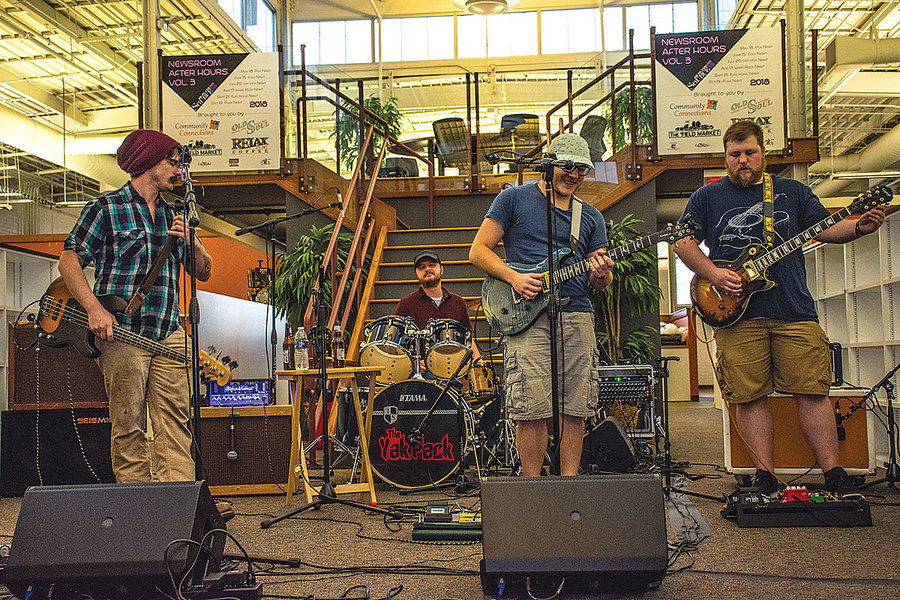
As part of its effort to engage community members, an online news startup in Mansfield, Ohio, holds free Newsroom After Hours concerts that feature local bands — and free beer and food.

Local journalism is in trouble as giant organizations like GateHouse Media buy up papers and cut staff. That’s a problem not only because of the jobs lost but because so much important news is first revealed thanks to investigations at the local level.

Still, there are always people who will find find opportunity when everything looks bleak.

Doug Struck writes at the Christian Science Monitor, “Noah Jones is working. The young reporter for the Richland Source, a local news startup in the heart of Ohio’s Rust Belt, listens to the jazz quartet warm up and eyes the crowd. Then he takes the mic.

“ ‘Thank you for coming out tonight,’ Mr. Jones intones, in his best master-of-ceremonies voice. ‘Now let’s welcome the Mansfield Jazz Orchestra quartet!’

“The small concert, with free beer and food for the public, is in the middle of the shared-space newsroom of the Richland Source, an online site started by a businessman who thought his city needed more news.

“The monthly Newsroom After Hours concert – from jazz to pop to hip-hop – is just one of the unfamiliar roles for some journalists and publishers trying bold experiments to buck the wholesale die-off of local news sources around the country. Like mad inventors, they are furiously writing and rewriting plans to find what works, often in small-scale, community efforts. …

The University of North Carolina at Chapel Hill last year found that in the past 14 years, 1,800 newspapers have closed – 1 in every 5 across the country – creating a U.S. map spotted with ‘news deserts.’

“A Pew Research Center analysis in July showed newspaper circulation since 1990 dropping by half, to 31 million last year. Pew noted jobs in all newsrooms plunged by one-quarter in the past decade. A Wall Street Journal study published in May said Google and Facebook have sucked up 77% of digital advertising revenues from local markets. …

“For years, observers have warned of the effects of this loss of news coverage: paralyzing partisanship, lower voting rates, government corruption, little accountability among public officials, less civic engagement. … Equity firms have bought up many local news outlets at fire-sale prices, often slashing staffs and coverage to drain the last bit of profits. …

“[Carl Fernyak, founder of the Richland Source,] says he knew ‘zero, nothing’ about news publishing when he began the Richland Source six years ago, but predicts the organization is now within 18 months of breaking even. …

“In 2013, Mr. Fernyak joined a Chamber of Commerce study of the sagging Rust Belt town. ‘Without fail, each one of the businesses said we have an image problem, a self-esteem problem,’ he says. ‘Ninety-five percent of the coverage was crime.’

“Mr. Fernyak was in the office equipment business, but within six months he had hired a president, a veteran managing editor, and a few journalists, and started the Richland Source. … The site, which Mr. Fernyak adamantly keeps free to readers, offers up a smorgasbord of hard news and homespun stories. A recent front page included a shooting-suicide next to news that Barb Weaver had once again won the county fair’s lemon meringue pie contest. The site has local sports, summer parades, short features on business owners, and occasionally a deep dive into a social problem.

“To support this, and to bond with readers, the Richland Source and its owner do some decidedly untraditional things. There are the newsroom concerts, trivia nights at a local brewery, movie nights, and roundtable discussions with high school students – all staffed in part by Richland Source employees.

“The Source has a marketing arm that crafts social media strategies and ads for businesses, the editors are trying to sell an artificial intelligence program they use to generate short stories on high school games, and the staff solicited $70,000 from businesses and community groups to pay for two extensive reporting projects. Reporters are expected to make an ‘ask,’ through email and social media appeals, for readers to sign up for memberships at $5 to $20 a month. …

“ ‘I like it,’ says Cheryl Moore, a clerk at the 111-year-old Hursh Pharmacy. ‘It’s current, it’s true, and it’s factual.’

“The mayor of the town concurs. ‘They’ve been a breath of fresh air,’ says Timothy Theaker, who was first elected in 2011. ‘If the news is always negative, it starts tearing down the community.’ …

“Mr. Fernyak thinks newsrooms and owners are figuring out models that will work. ‘We’ve had a crazy amount of support from our community for this,’ he says. ‘I had people saying, “It’s about time.” ‘ ”

More at the Christian Science Monitor, here.

Read Full Post »

A busy holiday here in New England with both our kids, their spouses, and the two grandsons. Every time we thought we were nearly done opening presents, one or more of us needed a nap.

The distaff side produced a chicken masala (with rice, nuts, raisins, cilantro, coconut, and chutney from Swaziland via the Servv catalog), creamed spinach, salad, and pear crumble.

Meanwhile, here’s a Christmas-y story from South America …

“In 2001, when Argentina’s economy was near collapse and property prices plummeted, UCLA art prof Fabian Wagmister bought a 15,000-square-foot abandoned warehouse in Buenos Aires. When he finally set out to clear the remaining debris from the building last year, he uncovered more than 100,000 Christmas ornaments piled in one of the back rooms.

“What to do with a trove of metallic bulbs, plastic wreaths, and bags of fake snow for a sunny Argentine Christmas?

“Re-gift them, of course,” writes Elise Hennigan at Pacific Standard.

“ ‘As artists we were immediately taken by the powerful expressive potential of the materials,’ says Wagmister.

“Now the director of the University of California, Los Angeles’s Center for Research in Engineering, Media, and Performance (REMAP), Wagmister invited a team of ten artists, researchers, and programmers from Los Angeles to distribute the ornaments to the surrounding community …

“Starting on December 15, the team invited community groups to visit the warehouse, one among many lining a historically working-class district that has seen an influx of technology companies. There, the researchers have encouraged participants to develop projects that will use the ornaments to express their identities, struggles and aspirations. On December 23, the groups took to the streets and decked the halls accordingly.” More.

 Photograph: Pacific Standard
Some of the found ornaments going up around Argentina’s capital

Read Full Post »

I learned about an unusual artist today because I was following @FortPointArts on twitter. Her name is Heidi Kayser, and just when I no longer have an office with a view of Fort Point Channel, she has launched an art project on the water. Sigh.

Anyway, I went to her website and poked around. This blog entry from 2011 is a typically amusing one, and I think one of my readers may want to try the experiment:

“Sarah Rushford arrived today and we got right to work … The mission, as we chose to accept it, was to construct some sort of wearable platforms to hold the cameras on the back of my legs. Wonderful engineers that we are, Sarah and I  ingeniously came up with [contraptions] made of CD cases, zip ties, rubber bands, twine and alligator clips. …

“Sarah filmed me tramping across the beach. I filmed my ankles tramping across the beach. It was very surprisingly difficult to walk wearing the cameras — I couldn’t extend my knees very much, so finding balance in soft sand proved challenging but oddly meditative. My attention had to be focused on every step, otherwise I’d fall and damage the cameras.

“When we were nearly finished, the curious beach-goers who had been pretending to ignore me as I walked steadily and weirdly by them, came up to us and asked what we were doing.” Read more.

Photograph: Sarah Rushford

Read Full Post »