Feeds:
Posts
Comments

Posts Tagged ‘minnesota’

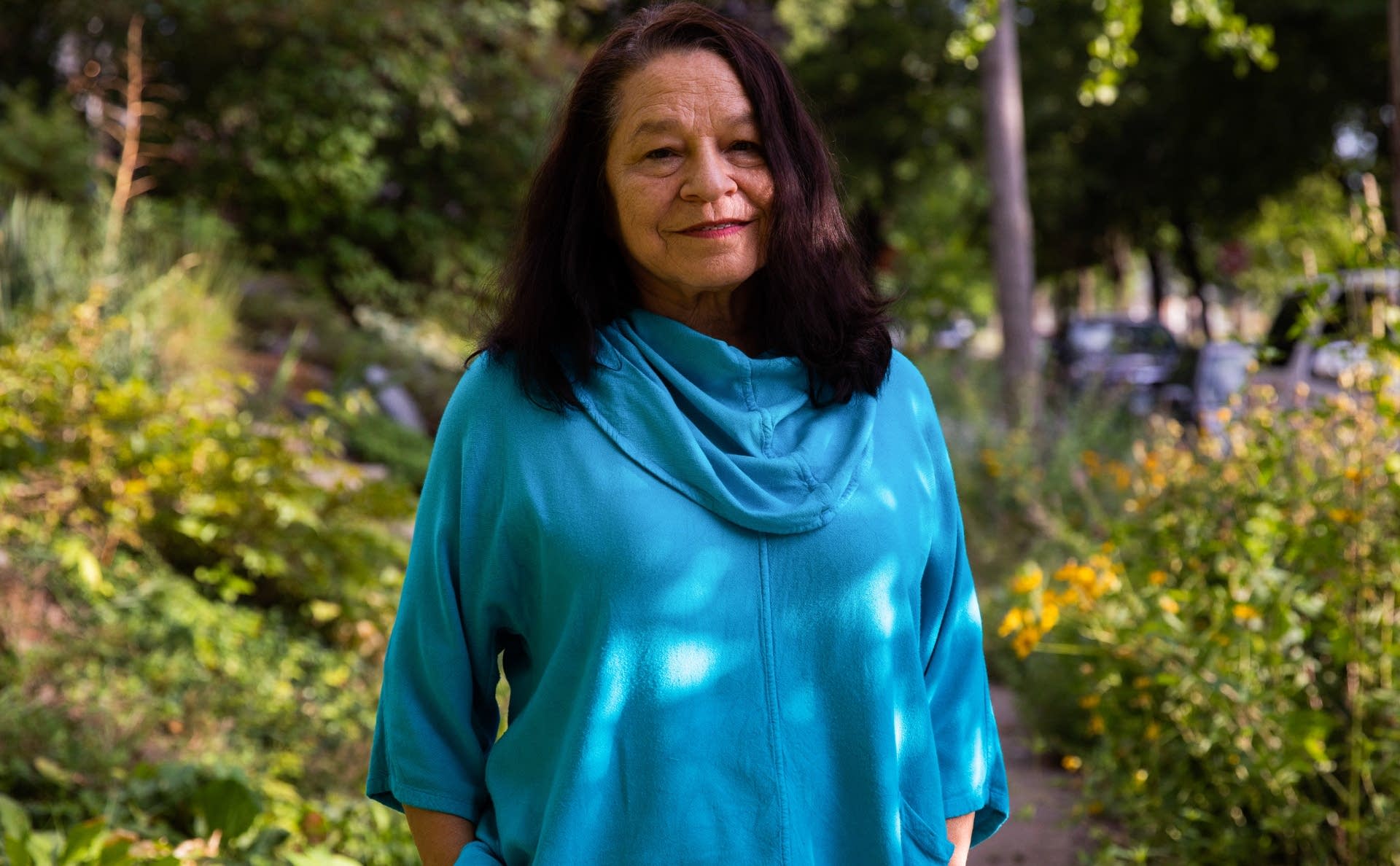
Photo: Jaida Grey Eagle via MPR News.
Among her many accomplishments, Twin Cities-based author Marcie Rendon writes a mystery series about indigenous investigator Cash Blackbear. 

I read a lot of mysteries, and I gravitate toward those about different cultures, often outside North America. But indigenous cultures here are equally foreign to me, which is why I have enjoyed Marcie Rendon’s Cash Blackbear series, about a tough young Ojibwe woman who investigates crimes against members of Upper Midwest tribes, often women.

I have several articles here for you to click on if interested, but I’m going to focus on what the Minnesota-based McKnight Foundation said about Rendon when they gave her an award.

“The McKnight Foundation is pleased to announce the selection of Marcie Rendon for its 2020 Distinguished Artist Award—a $50,000 award created to honor a Minnesota artist who has made significant contributions to the state’s cultural life. Rendon, an enrolled member of the White Earth Nation, is a writer whose poems, plays, children’s books, and novels explore the resilience and brilliance of Native peoples.

“ ‘Marcie brings a strong and necessary voice to so many genres,’ said Pamela Wheelock, McKnight’s interim president. ‘She has created a tremendous body of work, including poetry, plays, lyrics, and award-winning crime novels, all while raising up other Native voices in our community. Her commitment to making art in community embodies what a distinguished artist means to Minnesota and to McKnight.’ …

“A gifted storyteller and prolific writer, Rendon is the author of the award-winning Cash Blackbear mystery series, set in Minnesota’s Red River Valley. The first novel in the series, Murder on the Red River, earned the 2018 Pinckley Prize for Debut Novel, and the second, Girl Gone Missing, was nominated for the Mystery Writers of America – G. P. Putnam’s Son’s Sue Grafton Memorial Award. Rendon … is also the author of four nonfiction children’s books, including Powwow Summer (Minnesota Historical Society Press, 2013).

“Rendon’s plays include Sweet Revenge, chosen for the Oklahoma Indigenous Theatre Company’s 2020 New Native American Play Festival. She has also curated and produced a variety of Native-focused performances at the History Theatre, the Minnesota Fringe Festival, and Patrick’s Cabaret. She is the founder of Raving Native Theater, a platform that brings voice and visibility to other Native American artists and performers.

“ ‘We are more resilient than we are traumatized,’ said Rendon. ‘Art keeps us thriving, not just surviving. I try to make room for other Native artists. Every time someone steps forward, it makes room for others to step forward.’ …

“Rendon’s poem ‘Resilience’ is also included in US Poet Laureate Joy Harjo’s digital project ‘Living Nations, Living Words: A Map of First Peoples Poetry,’ which will join the permanent collection of the American Folklife Center at the Library of Congress.

“Rendon’s awards include a 2020 Ensemble/Playwright Collaboration Grant from the Network of Ensemble Theaters and the Playwrights’ Center, and a 2020 Covid-19 artist grant from the Tiwahe Foundation for demonstrating resilience during the pandemic. Rendon was named a 2018 50 Over 50 honoree by AARP Minnesota and Pollen Midwest and received Loft’s 2017 Spoken Word Immersion Fellowship with poet Diego Vazquez. …

“Said Sandy Agustin, a member of the Distinguished Artist Award selection committee, ‘Whether she is writing about boarding schools, incarceration, or the epidemic of missing and murdered Indigenous women, she is nurturing Native voices and amplifying communities that are too often unheard, especially Native women.’

“Born in northern Minnesota in 1952, Rendon was a voracious reader, creative writer, and poet from an early age. While studying criminal justice at Moorhead State College in the early 1970s, she was part of a group of Native student activists who successfully demanded the launch of the university’s first American Indian studies department.

“After moving to the Phillips neighborhood of Minneapolis in the late 1970s, she worked as a counselor and therapist, while raising her three daughters. In 1991 she saw a performance by Margo Kane, a Cree-Saulteaux artist, that inspired Rendon to share her own poetry and writing with a wider audience. …

“She is currently collaborating with artist Heather Friedli on an upcoming installation at the Weisman Art Museum about the high rates of incarceration among Native women.”

I have read most of the Cash Blackbear books (there’s a new one just out), and I find the urgent educational energy of the series both its strength and its weakness. Rendon feels empowered by a need to educate unenlightened readers like me, and I appreciate what she’s doing. After all, injustices continue and indigenous women in particular still disappear at an intolerable rate. I’ll just say that sometimes the mission overwhelms a good yarn.

More at the McKnight Foundation, here. See also Minnesota Public Radio, here, and Visual Collaborative, here.

Read Full Post »

Photo: Haley Friesen.
The Somali Museum Dance Troupe practiced at the Tapestry Folk Dance Center in Minneapolis a few years ago.

It has not been an easy adjustment for Somali refugees who were settled in Minnesota years ago. It’s been especially hard for new generations to find their way. So I’m happy to read about the positive things.

Amina Isir Musa reports at Sahan Journal that “the Somali Museum Dance Troupe’s TikTok presence has helped popularize traditional dances among U.S.-born Somalis.”

She says, “In the basement of the Midtown Global Market in Minneapolis you might find yourself transported to a different land. As you walk toward the Somali Museum of Minnesota, you might hear the joyful sounds of the jaandheer, a traditional dance from the Sanaag region of the Somali peninsula. To many listeners, particularly those from the Northern Somali region, the music says, Welcome home.

“On a recent day, a group of young Somali Minnesotans practiced the dance as their instructor replayed the past 30 seconds of music over and over until they got it right. The instructor, Abdurahman Muhumed, a young man with braided hair, had recently performed with the Somali Museum Dance Troupe  at the ‘Star of Unity’ concert at the Ordway Theatre in St. Paul. As a more experienced dancer, he was training the others as part of the troupe’s leadership training component. 

“A few days later, several members of the 20-member Somali Museum Dance Troupe –- Bashir Ismail, Ayan Furreh, Harun Mohammed and their coach, Mohamoud Osman Mohamed, who is also artistic director of the Somali Museum, talked about their work and their passion for celebrating Somali culture through dance. 

“Mohamoud helped found the Somali Museum Dance Troupe nearly 10 years ago to share his love of that culture and to elevate its artistic expression. His father, Osman Ali, had told him about the importance Somali performing arts held before that country’s long-raging civil war, and the two of them combined efforts to create the Somali Museum Dance Troupe. 

“In its early years, the troupe consisted of young recent immigrants who knew a lot of dances from back home and wanted to share those same dance styles,” and it has since grown to include many enthusiastic young people who have never known Somalia. For more about the dance troupe, click here.

The Sahan Journal has also covered what’s going on with a community leader my husband and I got to know when we lived in Minneapolis, Mohamed Wardere. Having once worked in community outreach for a US Senator, he is now “executive director of Hiddo Soor, a Somali nonprofit that hosts cultural events.” He said that “Somali business owners around the state, who sponsor the festivals, requested events in their towns so that their neighbors could understand their culture. 

“Wardere said when he began hosting cultural festivals, most attendees were members of the Somali community, but in recent years the wider community has participated in the festivities. Last year, about 4,000 people attended the festival in Plymouth, he said. 

“Wardere said he is excited that more people are learning about Somali history and gaining respect for his culture.” Mohamed was always good at sharing understanding of Somali culture.

Read the article by Yvette Higgins on the celebration of Somali independence, its “street festival in Minneapolis, a multiday soccer tournament, a concert at the Ordway, and festivals in Plymouth, Rochester, Owatonna and St. Cloud.” That story is here.

Read Full Post »

Photo: Burl Community Art Gallery.
Artist Julie Peters Krohn painted the rejected Minnesota State Fair entry “The Corn King” as an homage to Ron Kelsey, former superintendent of farm crops at the state fair.  It is on view for the “State Fair Rejects” exhibition at the Douglas Flanders & Associates gallery in Minneapolis.

Do you remember the Museum of Bad Art in Massachusetts? I wrote about it a few times (for example here). The art in today’s story about entries that were rejected by the Minnesota State Fair are not necessarily bad art; they just didn’t fit the taste of this year’s judges. It’s a nice challenge for the rest of us anyway. Would we reject these for an exhibition that doesn’t claim to offer high art in the first place?

A gallery in Minneapolis decided that some of these pieces really deserved to be judged by ordinary folk.

As Alex V. Cipolle reported at Minnesota Public Radio (MPR), “The Fine Arts Competition at the State Fair is one of the most competitive juried exhibitions in Minnesota. This year, artists submitted a total of 2,835 pieces; only 336 were accepted.

“Minneapolis artist Mike Welton says: Don’t take it personally. Welton submitted his painting, “QUEER,” part of a series of LGBTQ-themed signage that Welton has photographed around the country. It didn’t make the cut. In his career, Welton estimates he’s shown in about a dozen Fine Art Competitions, and been rejected from about seven or eight. …

“Welton has unique insight, too. Each year Jim Clark, the fine arts superintendent, chooses artists to curate the show. In 2017, Welton was one of those artists.

“ ‘The year I curated, I couldn’t even pick pieces I wanted to because not all of them could go in,’ Welton says.

“Welton — and many other artists — are taking their rejected entries elsewhere. “Queer” will be on view for ‘State Fair Rejects,’ an exhibition … at the Douglas Flanders & Associates gallery in Minneapolis. …

“ ‘There was a lot of professional artists complaining about being rejected all the time, and I thought, well, maybe we should do a reject show,’ Douglas Flanders says. Last year was the gallery’s first reject show with 50 artist submissions. This year, Flanders says there are almost 80 artworks, from sculpture and paintings to textiles and photography. …

“ ‘People loved coming and supporting it and having another opportunity, obviously, to show their work, too, at a gallery that maybe they would otherwise never have the chance to,’ [Gallery manager Syril McNally] says. “So this year, that’s even more popular, just [by] word of mouth.”

“Beth Stoneberg of the Burl gallery [in St. Paul] says it’s the fifth time they’ve hosted ‘Rejected!’

“ ‘It’s probably one of our most anticipated exhibits of the year. It draws a remarkable crowd. It sparks a lot of conversation,’ Stoneberg says. ‘People are really rooting for the underdog.’ …

“One of her favorite submissions this year is ‘The Corn King’ by artist Julie Peters Krohn. The painting depicts Ron Kelsey, Minnesota ‘corn historian’ and the former superintendent of farm crops at the fair’s Agriculture Horticulture building. Krohn has painted Kelsey with seed sacks (Kelsey may have the largest collection of seed sacks in the world at 1,400).

“ ‘I was inspired while attending the Minnesota State fair last year after I met Ron Kelsey and his scarecrow in the agriculture building,’ Peters Krohn said in her artist statement. 

“I learned about the fair honoring him with a lifetime membership for his many years of involvement, which has included, but is not limited to, corn producer, corn judge, seed art competition creator, scarecrow competition creator and the display of his collection of vintage seed bags. I saw humor in creating a painting of a sculpture of a man so involved but so little known.’ ” More at MPR, here.

You can find a piece that actually won a 2025 State Fair prize by clicking here. It’s called “There Might Be Dragons.”

Read Full Post »

Photo: Navajo Natural Heritage Program via Natural Resources Defense Council.
Diné Native Plants Program members work to restore a headwater stream impacted by livestock grazing.

The more that the US endangers its wetlands, the more we rely on the work that tribes do to protect them. Perhaps today’s article can help us see what the rest of us can do.

At the website for the Natural Resources Defense Council, or NRDC, Claudia Blanco Nuñez and Giulia CS Good Stefani describe how “Tribal Nations protect and manage millions of acres of wetlands, which help improve water quality, curb the risk of floods, recharge groundwater, and store large amounts of carbon.”

“Two years ago,” they report, “the U.S. Supreme Court slashed federal Clean Water Act protection of wetlands [with] harmful repercussions for droughts, wildfires, flooding, wildlife, and the drinking water supply. 

“In the absence of federal protection, the imperative to defend our shared waters falls increasingly on individuals, states, and Native American Tribal Nations. … Tribal Nations protect and manage millions of acres of wetlands in the United States, and with commitments made by the U.S. government to Tribal co-management and co-stewardship of federal lands, the amount of clean water safeguarded by Tribal Nations is growing.

“NRDC’s Science Office mapped the wetlands found within and intersecting the boundaries of Tribal reservation lands in the contiguous United States. Across the 294 federally recognized Tribal reservations mapped in this analysis, our scientists found that Tribes steward more than 3 million acres of wetlands. Even typically arid regions like the American Southwest have significant wetlands on Indigenous reservations. …

“In addition to the 56.2 million acres that are part of the Tribal reservation system, many Tribes have reserved or treaty rights on lands outside reservation boundaries, and most Tribes and their members maintain ongoing physical, cultural, spiritual, and economic relationships with their ancestral homelands. These reciprocal land and water relationships extend far beyond the political boundary of any designated reservation.

“This analysis is limited to federally recognized Tribes in the Lower 48 due to the complex Tribal governance systems in Alaska and Hawai’i. For example, the Alaska Native Claims Settlement Act of 1971 altered the previous Tribal ownership system to one led by Alaska Native Corporations. This system differs from federally recognized Tribes, which have a government-to-government relationship with the United States that includes eligibility for funding and services from the Bureau of Indian Affairs. That is to say, NRDC’s analysis looked at just a fraction of the total wetlands stewarded by and connected to the lives and well-being of Native peoples today.

“To learn more about Tribal wetland conservation, we spoke with leaders in the wetland management programs of the Navajo Nation and Red Lake Band of Ojibwe. …

“Navajo Nation agency staff are engaged in numerous projects to help restore and protect this essential resource. The Diné Native Plants Program recently submitted a grant application to remove invasive plant species along the Little Colorado’s riverbank. This will make space for native vegetation to grow and help with groundwater recharge for nearby Navajo farmers and families. The Diné Native Plants’ seed program also provides seed mixes for restoration projects that are solely sourced from Navajo plants. 

“Jesse Mike, the Diné Native Plants program coordinator, stepped out of the greenhouse to speak with us. He shared about the history of livestock grazing, trampling, and erosion that have impacted not only the health of the headwater streams on Navajo lands but also the underlying water table. His team is currently working to increase groundwater infiltration and improve the overall ecosystem health of three degraded streams in the Chuska Mountains. …

“The Red Lake Band of Ojibwe’s reservation is in northern Minnesota and has the greatest area of wetlands of any reservation in the contiguous United States. Across the Tribe’s more than 835,000 acres of land — all held in common by the Tribe — the Red Lake Band manages an astonishing 541,000 acres of wetlands. ‘So many wetlands,’ says Tyler Orgon, a biologist and the lead wetland specialist for the Red Lake Band Department of Natural Resources, ‘and we’re very fortunate for that.’ 

“A sizable portion of the Tribe’s wetland acreage north of Upper Red Lake is part of the largest expanse of peatlands in the continental United States. Peatlands cover about 3 percent of the earth and store more carbon than all of the planet’s other types of vegetation, including the world’s forests, combined. 

“One of the most important wetland-dependent plant species for the Red Lake Band — as well as other Anishinaabe and Dakota peoples across the Great Lakes region — is manoomin (Zizania palustris and Z. aquatica), the only wild rice native to Turtle Island. According to an Ojibwe prophecy, their ancestors were instructed to move west to the place where ‘the food floats on water.’

“The University of Minnesota research team We Must First Consider Manoomin (Kawe Gidaa-naanaagadawendaamin Manoomin) works to help protect this essential wetland-dependent plant by combining Western science with Indigenous science and learning from Ojibwe stewardship.

“The scientists have found that an increase in extreme weather conditions (like flooding events and record-breaking snowfall) negatively impact manoomin growth by uprooting the plant or drowning it out in its sensitive early stages. These weather events compound the already present settler-colonial impacts on wetlands in the region, including deforestation and conversion of wetlands into agricultural land use.

“Orgon hopes to restore some of the Red Lake Band’s wetlands that have been impacted by past agriculture.” More at NRDC, here.

Read Full Post »

Photo: MinnPost.
Cynthia Tu of Sahan Journal is using Chat GPT to improve revenue streams.

A few times in the past, I’ve had reason to link to a story at Sahan Journal, a nonprofit newsroom serving immigrants and communities of color in Minnesota. Now NiemanLab, a website about journalism, links to an article on a surprising development at the small publisher.

Lev Gringauz, reporting at MinnPost via NiemanLab, writes “As journalists around the world experiment with artificial intelligence, many newsrooms have common, often audience-facing, ideas for what to try.

“They range from letting readers talk to chatbots trained on reporting, to turning written stories into audio, creating story summaries and, infamously, generating entire articles using AI — a use case vehemently rejected by many journalists.

“But Sahan Journal, the nonprofit newsroom serving immigrants and communities of color in Minnesota, wanted to try something different.

“ ‘We’re less enthusiastic, more skeptical, about using AI to generate editorial content,’ said Cynthia Tu, Sahan Journal’s data journalist and AI specialist.

“Instead, the outlet has been working on ways to support internal workflows with AI. Now, it’s even testing a custom ChatGPT bot to help pitch Sahan Journal to prospective advertisers and sponsors. …

“While AI has plenty of ethical and technical issues, Tu’s work highlights another important aspect: The intended users — in this case, the Sahan Journal team.

“ ‘A lot of … this experiment is less of a technical challenge,’ Tu said. ‘It’s more like, how do you make [AI] fit in the human system more flawlessly? And how do you train the human to use this tool in a way that it was intended?’

Sahan Journal’s AI experimentation, and Tu’s job, are supported by a partnership between the American Journalism Project, a national nonprofit helping local newsrooms, and ChatGPT creator OpenAI. …

Liam Andrew, technology lead for the AJP’s Project & AI Studio, sees part of his job as helping newsrooms overcome hesitancy around AI. …

“Tu joined Sahan Journal fresh from a Columbia Journalism School master’s program in data journalism. She had played a little with chatbots, but otherwise didn’t have much experience working with AI. …

“For one investigation, Tu used a Google AI tool to process the financial data of charter schools in Minnesota. Thinking about how to save time on backend workflows, Tu then helped Sahan Journal generate story summaries, tailored for Instagram carousels, with ChatGPT. …

“ ‘You need to know what the workflow of the organization looks like…[and how] you push for change within a department when they’ve already been doing [something] for the past five years using a manual or human labor way.’

“That knowledge came in handy when finally tackling Tu’s core AI project: improving Sahan Journal’s revenue.

“The project stemmed from an anonymized database of audience insights, which included demographic information and interests. While an important resource, Sahan Journal’s small revenue team didn’t have the time to figure out how to leverage it. …

” ‘What if AI could feed two birds with one scone? A custom ChatGPT bot could process the audience data and personalize a media kit for clients. But it needed to work without being an extra burden on the revenue staff. …

“The magic of AI chatbots like ChatGPT is that you don’t need to know how to code to use them. Just type in a prompt and get rolling. …

“Less magically, AI chatbots can be hard to keep in line for specific tasks. Designed to be eager helpers, they hallucinate false results and stubbornly twist instructions in an attempt to please.

“Troubleshooting those issues was no simple task for Tu.

“The custom revenue chatbot struggled to keep Tu’s preferred formatting, and hallucinated audience data. The bot would also intermix results from the internet that Tu had not asked for. None of that was ideal for a tool that should work reliably for the revenue team.

“ ‘I was kind of jumping through hoops and telling it multiple times, “Please do not reference anything else on the internet,” ‘ Tu said. …

“Working with chatbots is an exercise in prompt engineering — mostly a trial-and-error process of figuring out what specific instructions will get the preferred result. As Tu said, ‘lazy questions lead to lazy answers.’ … Eventually, Tu settled on a reliable set of prompts.

“The custom chatbot takes about 20 seconds to find relevant data from the audience database — for example, pulling up how much of Sahan Journal’s audience cares about public transportation. Then it creates a summary for a media kit tailored to potential clients.

“The chatbot also double-checks its work by referencing the database again, making sure its output matches reality. And part of the database is shown for users to manually see the chatbot isn’t hallucinating. …

“Earlier this year, Tu introduced the final version of the revenue bot to Sahan Journal’s team. …

“By mid-April, the Sahan Journal revenue team had used the custom chatbot on six sales pitches, with three successfully leading to ads placed on the site. …

“But there’s a larger question hanging over this work: Is it sustainable? In a way, newsroom experiments with AI exist in a bubble.

“ ‘Everything is kind of tied to a grant,’ Tu said, referencing the AJP-OpenAI partnership that supports her work. But grants come and go as donor interests (and financials) change.”

The other unknowns are weighed at NiemanLabs, here.

Read Full Post »

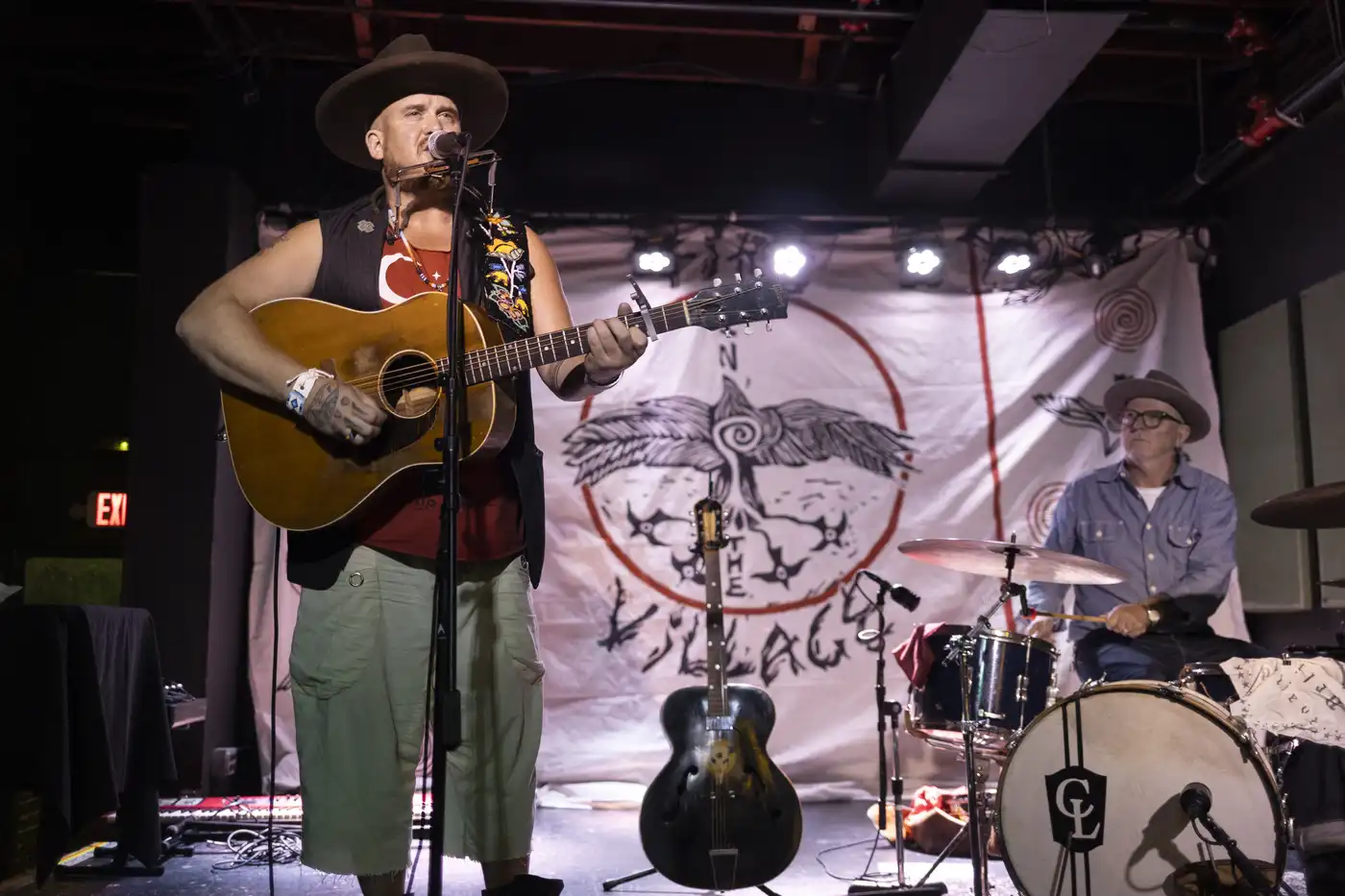
Photo: Liam James Doyle/MPR News.
David Huckfelt performs on the Turf Club stage. “We’re building these little fires in small places,” Huckfelt says.

Because I still believe that “one and two and fifty make a million,” as Pete Seeger used to sing, I get a kick out of all the stories I’ve been seeing lately that confirm the power of small.

Alex V. Cipolle reports at Minnesota Public Radio (MPR) about one small but mighty effort, a new arts collective that “goes on tour to build community in rural Minnesota and beyond. …

“On a September evening at the Turf Club in St. Paul, models weave through bar tables in upcycled designs.

Annie Humphrey, an artist and musician based on the Leech Lake Reservation, performs on the stage, followed by Minneapolis musician David Huckfelt. On a back table Shanai Matteson, an artist from Palisade leads printmaking demos with a stencil of a black aandeg (the Anishinaabe word for crow) and an orange-red sun.

“ ‘There’s a story about the crow. Long ago, the crow had bright, beautiful, vibrant colored feathers,’ Humphrey recalls. ‘But crow also saw that the people were suffering because they had no fire.’ To bring fire to the people, crow flew close to the sun and scorched his feathers black.

“ ‘He was able to grab the fire and bring it back down to the earth and bring fire to the people so that they could be warm,’ Humphrey continues. ‘If you take a crow feather and hold it in the sun, it’s iridescent, and all these colors are still in that feather.’

“The stencil is the logo for the new arts and community-building collective Fire in the Village, started by Humphrey, Matteson and Huckfelt this year. (Fire in the Village is also the title of a book of Ojibwe stories by Humphrey’s mother, Anne Dunn.) …

“The trio all share a background in activism, specifically fighting the Line 3 oil pipeline. … But with Fire in the Village, the collective wants to do something untethered from any one cause. 

“ ‘If we were going to start something, I knew that it should center on art and the human spirit, the human condition,’ Humphrey says, ‘and have no politics involved at all.’

“Through art, fashion, music and collaborative events with schools and local organizations, the collective is hoping to heal divides and put a dent in the loneliness epidemic in rural communities and on reservations.

“ ‘I think a lot of people are feeling isolated,’ Matteson says. ‘There’s a lot of divisiveness going on. Personally, I’m not interested in continuing that. I don’t want to be part of a cause where it feels like it’s putting another barrier between me and the people who live around me.’ …

“ ‘We like the feeling of the collective and not pushing one person as a front for something,’ Huckfelt adds. ‘So, we’re really working together with our skillset because we believe in music, we believe in art, we believe in community, and so that’s what’s being put forward here.’ …

“ ‘Fire in the Village is a way to connect with individuals and to smaller communities that you’re a part of,’ says Meira Smit, one of the Macalester students who came to the Turf Club. ‘A way to build messages and movements around the things that we deeply care about.’

“Haley Cherry, a producer for Minnesota’s Native Roots Radio on AM950, also came out to walk in the fashion show after meeting Humphrey and Huckfelt this past year.

“ ‘It’s important to hear from both perspectives: issues of Indigenous identity, but also [from] David, as a white ally, I think it’s important to draw those bridges of community concerns,’ says Cherry, who is a descendant of the Ho-Chunk Nation of Wisconsin. …

“In June, Humphrey also led a community mural with youth groups on the Leech Lake Reservation, the Boys & Girls Club in Deer River and the Long Lake Conservation Center. Soon, the mural will be installed at the powwow grounds in Ball Club, a village on the reservation. There are more murals to come, Humphrey says.

“The tour is also about revival, Huckfelt says, stopping at historic community buildings in small towns, such as the 210 Gallery and Art Center in Sandstone Oct. 19 and the Historic Chief Theater in Bemidji on Nov. 2. ‘A lot of these spaces are really beautiful old music and theater art spaces,’ Huckfelt says. …

“Huckfelt says, ‘We’ve been doing this work in our own ways for a long time, individually and together. It’s a natural step to call it “Fire in the Village” —  little fires that we can sustain and we can huddle around for good ideas and for community.’ …

“ ‘It’s a very gentle way to say really hard stuff,’ Humphrey says. ‘I have played in front of people who don’t agree with what I speak, but when I sing it?’ “

More at MPR, here. No firewall. Great pictures.

Read Full Post »

Photo: Alex V. Cipolle.
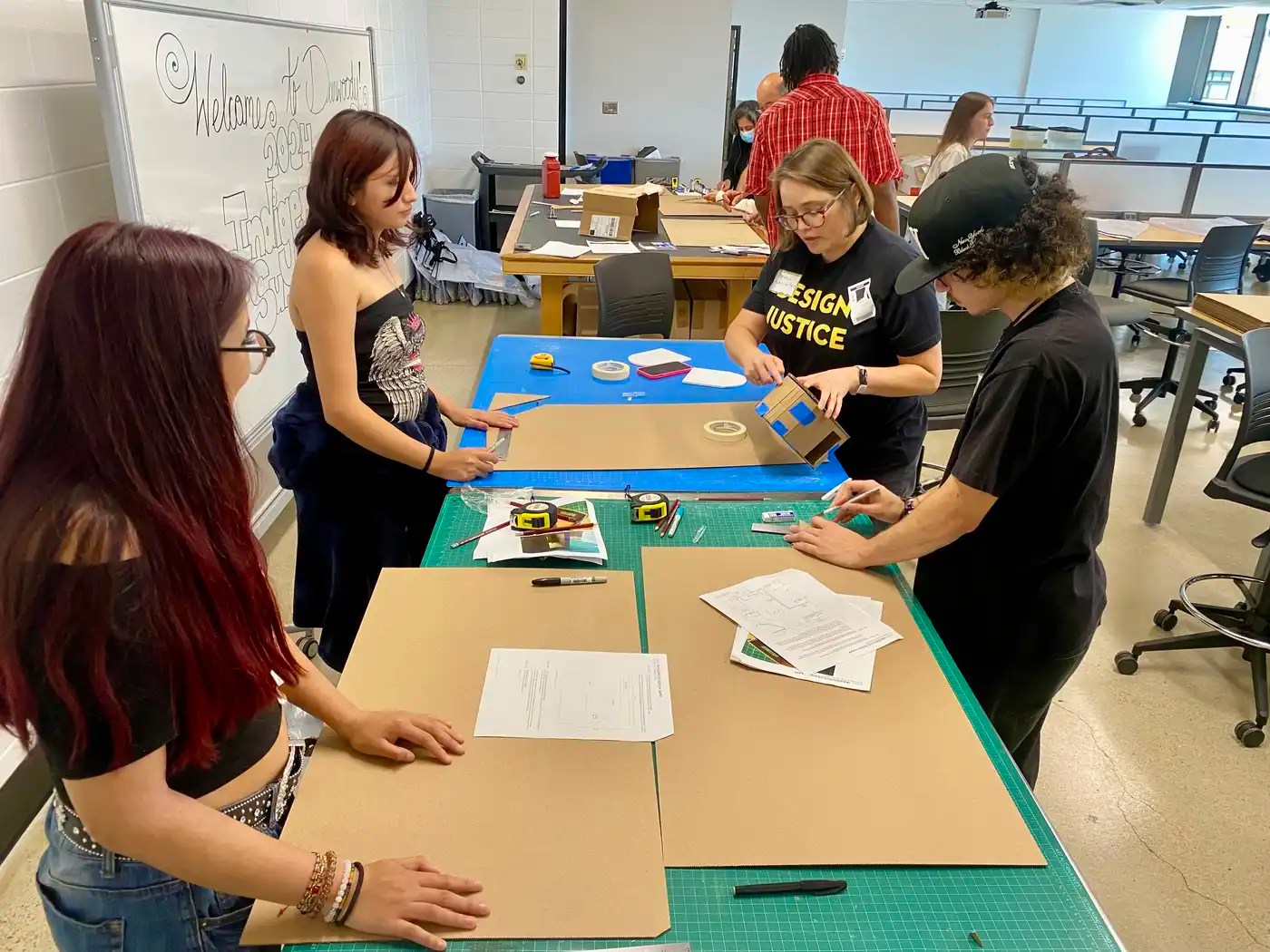
University of Minnesota architecture professor Jessica Garcia Fritz teaches Indigenous Design Camp campers cardboard scoring techniques on day one.

It seems like every year, the first question on the first day of school is, “What did you do over the summer?” This past summer, if you were an indigenous teen in the Twin Cities of Minnesota, you might have had some new experiences to report.

In July, Alex V. Cipolle at Minnesota Public Radio wrote about an unusual class at the Dunwoody College of Technology.

“A group of teens cuts cardboard with X-ACTO Knives. They will soon shape this cardboard into architectural models of their bedrooms. …

“ ‘It’s my first time doing something in architectural-related study,’ says Dominic Stewart of Burnsville.

“ ‘I’m excited to get that hands-on experience,’ says Carsyn Johnson of Elk River.

“They are here for the weeklong Indigenous Design Camp, the first camp of its kind in the U.S. The goal is to teach Indigenous teens about career options in architecture and design, a field where Native Americans are underrepresented.

“Two of the founders of the new camp — architects and friends Mike Laverdure and Sam Olbekson — estimate that there are only about 30 Indigenous architects total in the U.S.

“Laverdure is an enrolled member of the Turtle Mountain Band of Chippewa and a partner at DSGW Architects as well as the president of First American Design Studio. Olbekson is a citizen of the White Earth Nation and founded the firm Full Circle Indigenous Planning and Design. They are the only two practicing Native architects in Minnesota. 

“ ‘The need for creating a space for kids to become designers, Indigenous designers, is great,’ says Laverdure, who has wanted to start this camp for years. ‘Representation matters for these kids to see us as architects and designers. A lot of us who grew up in reservations or urban Indigenous communities only see a few career types.’ …

“The campers are Indigenous teens ages 14-18 from the metro area. They will be constructing architectural models all week. Campers will also tour the University of Minnesota School of Architecture and local architecture firms.

“They will also visit the American Indian Cultural Corridor on Franklin Avenue, where both Laverdure and Olbekson have designed buildings, as well as another Olbekson project, the recently completed expansion of the Red Lake Nation College downtown.

“Olbekson says, ‘to actually go and see [the buildings] and see the impact that they’re having on the community, not only as individual buildings, but how they’re forming an identity for the American Indian Cultural Corridor and how these projects are supporting education, economic development, community building, cultural development, and youth and elder spaces, I think is going to be a great way for them to understand the impact of what design, urban design, interiors, landscape, can have on creating a healthy, Indigenous urban community.’

“The camp began [with] a welcome from Laverdure, Olbekson and University of Minnesota assistant architecture professor Jessica Garcia Fritz, a citizen of the Cheyenne River Sioux Tribe. Fritz also helped start the camp.

“ ‘If you think about your home reservations, or your urban communities, you think about all the buildings that are there,’ Laverdure told the class, ‘Ninety-nine percent of all the buildings built that Indigenous people sit in are not designed by indigenous designers. … When you have Indigenous designers be a part of that process, what happens is that those buildings have a special kind of connection to the communities and that makes those buildings extra special.’

“Next came a presentation on Indigenous architecture, past and present, by Tammy Eagle Bull, who did a video call from her home in Arizona. Eagle Bull is a member of the Oglala Lakota Nation of Pine Ridge, South Dakota. In 1994, she became the first Native woman in the U.S. to become a licensed architect. …

“For the remainder of the first day of camp, Jessica Garcia Fritz guided campers in a design exercise to create their sleep space or bedroom.

“First, they taped 10 by 10-foot squares on the classroom floor to help them visualize the scale. Then they sketched blueprints of their bedrooms. Finally, they cut and scored cardboard to build shoebox-size models. …

“ ‘One of the things Tammy Eagle Bull had said this morning was, “I wish that a camp like this had existed when I was young.” I think that’s the sentiment among many of us,’ Garcia Fritz says. …

“Garcia Fritz, Laverdure and Olbekson hope this camp is the first of many. One of the goals is to expand the camp to greater Minnesota.

“ ‘Right now, it’s in the Twin Cities, but there are so many Indigenous communities regionally, up north and even in other states that could really benefit from this,’ Olbekson says. 

“ ‘Long term, we want to create a space where five to 10 years from now, we’ve got 10, 15, 20, Native designers that are out there and being a force for change,’ Laverdure says.”

More at MPR News, here.

Read Full Post »

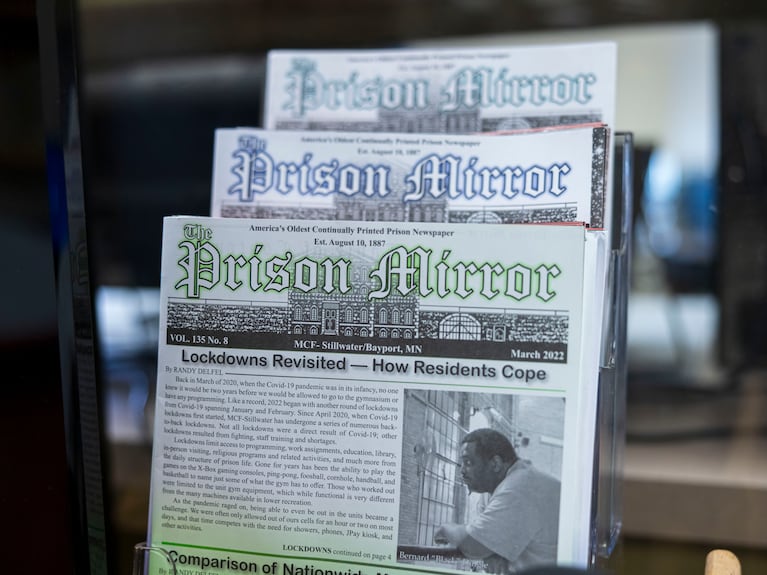
Photo: Kerem Yücel/MPR News via Oregon Public Broadcasting.
Previous issues of the Prison Mirror, which has been publishing since 1887, sit on display in the Minnesota Correctional Facility in Stillwater.

From time to time I like to run a story about interesting prison programs or ex-offenders trying to make good. I’m pretty sure we don’t have the right kind of prisons in the US. You may recall me writing about the system in Norway, which is completely different. (Click here and here.)

Meg Anderson (Minnesota Public Radio NPR) wrote recently about a longtime enrichment program at a prison in Minnesota.

“Inside a state prison near Stillwater, Minn., past the guards and the wings of cells stacked one on top of another, tucked in the corner of a computer lab, Richard Adams and Paul Gordon are fervently discussing grammar.

“Both men are on staff at the Prison Mirror, a newspaper made by and for the people held at the Minnesota Correctional Facility – Stillwater. Gordon had written a profile on the prison art instructor. He read it aloud to Adams. …

“Conversations like this have been happening in this prison for more than a century. The Prison Mirror is one of the oldest prison newspapers in the country, running since 1887. Publications like this aren’t common, but in an era where many journalism outlets in the free world are struggling to thrive amid scores of layoffs, journalism behind bars is actually growing.

“ ‘Overall we do see a growth and a lot of interest in starting publications, starting podcasts even. And so that’s really quite exciting,’ says Yukari Kane, CEO of the Prison Journalism Project.

“Thirty years ago, she says there were estimated to be only six prison newspapers. Today, there are more than two dozen. That doesn’t take into account the hundreds of incarcerated writers submitting work to publications on the outside, like The Marshall Project’s Life Inside series.

“Kane says this kind of work can offer a window into what prison is actually like, one that prison administrators aren’t necessarily going to offer up freely. … Even if a newspaper doesn’t circulate far beyond the prison yard, it can offer a sense of empowerment for its writers. …

“The Stillwater prisoners write book reviews, legal explainers, and summaries of local, national and international events for the monthly newspaper. One man recently submitted an essay on homesickness. Another wrote an editorial criticizing lockdowns. The men on staff — there are only three of them — had to apply for these unpaid jobs, and they’re highly sought after.

“Adams says the job requires a lot of reading and research about what’s going on around the world and the prison. There are challenges. They don’t have the internet, for instance, so they have to rely on print media and articles printed out by prison staff.

“The prison also has to approve everything the paper publishes. The men say that can limit what they write about, especially if they want to report on the harsher aspects of their lives.

“ ‘I am limited in the sense of, they’re not going to let me print all types of crazy things about the water or the lockdowns or getting restrained or anything like that, which is understandable to a degree,’ Gordon says.

“Last fall, around 100 Stillwater prisoners refused to return to their cells. Gordon says the disobedience was their way of protesting extreme heat, poor water quality, and staffing shortages, which he says often result in lockdowns. He plans to write about it, but says he has been retaliated against in the past for sending reporting to outside publications.

“ ‘I was a lot more aggressive in my writing back then, and that was a learning experience for me,’ he says.

Brian Nam-Sonenstein, a senior editor at the Prison Policy Initiative, says punishment for doing journalism behind bars is common. ‘You can lose what are called good time credits, which are essentially time off of your sentence based on good behavior. You could go to solitary confinement. You could have your privileges revoked,’ he says. …

“Marty Hawthorne works at the Stillwater prison and oversees the Prison Mirror.

“ ‘They have a lot of freedom. My philosophy is: It’s their newspaper. It’s not my newspaper,’ he says. ‘I believe they have a right to do what they’re doing.’ He says if the men plan to publish something critical, he makes sure whoever they’re writing about has an opportunity to respond. But he says he also pushes back when leadership tries to censor stories he believes are fair.”

More at NPR, here. No firewall.

Read Full Post »

Photo: Ben Hovland/MPR News.
Art Shanty #1 stands on the frozen surface of Lake Harriet in Minneapolis.

I once read that an eggshell is simultaneously one of the most fragile and also the most durable of Nature’s materials. Isn’t art like that, too? Both lasting and ephemeral?

Consider the on-again off-again role of ice in artistic output, from New Year’s Eve ice sculptures to colonies of working artists on frozen lakes. Alex V. Cipolle reported at Minnesota Public Radio about the latter.

“In the winter of 2004, something funny was afoot on Medicine Lake. There were ice fishing houses like always. But on the frozen lake, away from the fishing holes, was another shanty. This one was made with shiny red vinyl, a circle window and a wood sign hanging from the door that said, ‘The Poet is In.’

“The inhabitants weren’t fishing. Instead, they hosted birthday parties and built a heart-shaped ice skating rink for Valentine’s Day. They had a sleepover and screened the icy horror flick The Thing.

“This was the first-ever Art Shanty, created by local artists Peter Haakon Thompson and David Pitman.

“ ‘I had been talking with a couple of friends and was trying to convince them that we should build this shanty that we were going to put on Medicine Lake for the winter as our sort of fort-clubhouse-art studio,’ recalls Thompson.

“ ‘Just the creativity of what the possibilities were, were endless,’ Pitman adds. ‘As we’ve sort of seen 20 years later.’

“Twenty years later, one shanty has become a village, and a circle of artist friends became an arts nonprofit — Art Shanty Projects —  annually programming two weeks of free art events on ice. Now on Lake Harriet, Jan. 27 to Feb. 11, the frozen lake becomes a temporary arts community with about 20 shanties, each with a different theme, which host live performances, yoga sessions, and a polar bear (‘Lady Bear’) that walks the grounds. …

“To mark the 20th anniversary of the little red shack, the Art Shanty Projects team has recreated it, calling it Art Shanty #1.

“ ‘I had been going through old photos,’ says Erin Lavelle, the artistic director for Art Shanty Projects. ‘And the picture of the original shanty is just so iconic.’ … Lavelle wanted to bring in new artists to activate the classic shanty, so she tapped Richard Parnell and Tony Chapin, both based in Minneapolis and longtime shanty artists. During December and January, they rebuilt Art Shanty #1 in the Ivy Arts Building in South Minneapolis, using photos of the original as a guide. 

The original shanty was built with found materials and red-vinyl-covered plywood lifted from a Walker Art Center dumpster, says Thompson. 

“ ‘In the spirit of the way they had built theirs, we repurposed a lot of materials,’ Parnell says. Parnell volunteers in public schools so had access to gymnastic floor mats and plexiglass COVID shields that were being thrown out. The floor mats are now insulation and the shields are windows. …

“Thompson and Pitman, who are no longer officially involved with the event, say they are excited to see the shanty recreated, and the art shanty village flourishing two decades on.

“ ‘I don’t think either of us anticipated that it would be something that would continue hardly for any time at all,’ Thompson says. …

“ ‘What really excited me was seeing all these other people coming up with ideas for similar things within the limitations that were kind of set in this unregulated land,’ Pitman says.

“ ‘Relatively unregulated,’ Thompson adds, laughing. (The Hennepin County Sheriff’s Office Water Patrol board and the Department of Natural Resources require permits.) …

“The growing art village hopped from Medicine Lake to White Bear Lake and now Lake Harriet, and has had a few evacuations due to melting ice. In 2023, Art Shanty Projects moved it ashore for ‘Plan Beach.’ … 

“Today, the Art Shanty Projects is sometimes jokingly referred to as ‘Burning Man on Ice.’

“ ‘I’ve always been rankled by the whole Burning Man, Frozen Man comparison,’ Thompson says. The ever-expanding Nevada festival has become infamous for its impact on the environment.  With the art shanties, Thompson says, ‘We’ve followed this “Leave No Trace” ethos on the ice.’ ”

More at MPR, here. No paywall.

This year was one when the ice colony had to evacuate. The New York Times has that story here.

Read Full Post »

Photo: Isabella Segalovich/Hyperallergic.
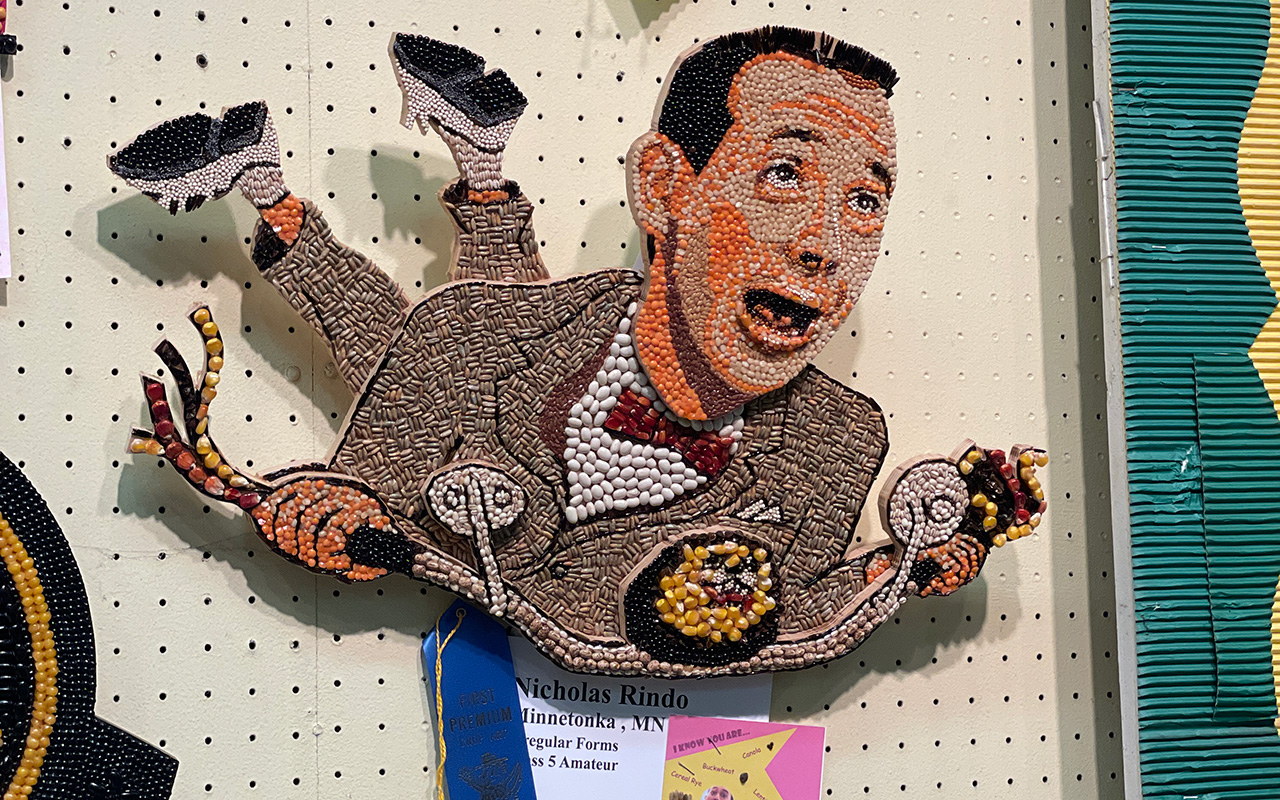
Nicholas Rindo’s “I know you are…” (2023), is made from cereal rye, buckwheat, flax, pearled barley, poppy, quinoa, rainbow flint corn, sweet lupine, red millet, viking corn, wild rice, navy beans, lentils.

What is your favorite exhibit at state fairs? One of mine is seed art. It looks like it would be fun to try.

Isabella Segalovich of the art magazine Hyperallergic went to the Minnesota State Fair and has this report on the seed art of 2023.

“The longest line at the second biggest state fair in the United States wasn’t for the prize cows, roller coaster rides, or various deep-fried foods served on a stick: It was for the seed art. 

“The wait was worth it. Past scores of vintage seed sacks and neatly stacked corn cobs vying for Best of Show ribbons, visitors craned their necks to marvel at the bounty of intricate mosaics made completely out of seeds at the Minnesota State Fair, which ran from August 24 to September 4. While the vast majority of participating crop artists were Minnesotans, the country’s only state fair seed art competition has also graciously expanded its dozens of categories to include out-of-state competitors, as long as they stick to one rule:

Every seed must be grown in Minnesota. 

“I was struck not just by this craft’s painstaking nature but also by the diversity of its subject matter, which ranges from impressive portraits and still lifes to timely pop culture references and biting political commentary. This year’s show included tributes to lost luminaries (Judy Heumann, Paul Reubens aka Pee Wee Herman), hot pink Barbie memorabilia, OceanGate (‘the little sub that couldn’t’), excitement over Minnesota’s marijuana legalization, displays of support for trans youth and adults, clap backs to Ron DeSantis (‘Minnesota, where woke goes to bloom!’), and lots and lots of yacht-smashing orcas. 

“This year there were over 400 submissions of crop art, which covered both seed art and the adjacent (also delightful) scarecrow competition.

“ ‘It has grown tremendously from the very beginning,’ said Ron Kelsey, superintendent of farm crops at the fair, who was 24 when seed art first bloomed in 1965. …

“During those first years, most artists arranged seeds into natural scenes, like flowers and landscapes, until hairstylist Lillian Colton changed the game by introducing seed art portraiture. Her hyperrealistic mosaics of figures like Abraham Lincoln, Ernest Hemingway, and Barbra Streisand raised the bar for crop artists at the fair. 

“Today, artist Liz Schreiber sits where Colton once did at the demonstration table, meticulously placing tiny quinoa and flax seeds to create a bullfrog. Schreiber is the artist behind this year’s commemorative fair poster, an incredibly detailed and boldly designed amalgamation of iconography that Minnesota fairgoers hold dear. ‘It’s very meditative,’ Schreiber told MPR News. ‘It’s kind of like doing a puzzle.’ 

“ ‘A crop art picture can take dozens and, in many cases, hundreds of hours to complete,’ said Joel Alter, a former political researcher and seed art newcomer who won a second premium ribbon this year. Many find that time passes quickly, as they enjoy the thrilling and addictive process. ‘Some people get started with it and they can’t stop,’ ” said Kelsey.”

More at Hyperallergic, here. There’s no paywall but subscriptions are encouraged.

Read Full Post »

Photo: Ben Toht.
Liz Sexton’s rat mask for Halloween in Brooklyn, New York, a few years ago started her papier-mâché art career.

I’m guessing that nearly everyone who launches into serious downsizing finds a papier-mâché puppet head that a kid made in school — in my case, not only Suzanne’s puppet head but also one that I made around age 10. Clumsy as the heads invariably are, it’s painful to get rid of something that feels so much like an accomplishment.

Today’s story is about a woman who has raised papier-mâché to high art.

Alex V. Cipolle reports at Minnesota Public Radio, “Hunched over her work bench with a box cutter, Liz Sexton carves out the spikes on the back of a horseshoe crab. … The crab is papier-mâché and the size of a shield. Composed of more than a dozen layers of paper bags, its shell feels as strong as one, too.  …

“The crab is one of more than 15 papier-mâché animal masks and sculptures Sexton is preparing for her first-ever solo exhibition. The show, ‘Liz Sexton: Out of Water,’ [opened] May 5 at the Minnesota Marine Art Museum in Winona, Minn. …

“At her home studio in St. Paul, many of these animal creatures — an Atlantic walrus, a humpback angler fish, a polar bear — stare down at her from the shelves. Others are placed around the house in various stages of completion. …

“Her masks are incredibly lifelike. And papier-mâché is only step one. She can spend upwards of 100 hours on a mask, honing the details using woodworking techniques, be that carving more than a hundred tri-pointed teeth of a marine iguana, or using an orbital sander to achieve the milky smooth skin of a beluga whale. …

“Sexton receives commissions from around the globe, so they must withstand all the perils of international shipping. And the masks, she says, are meant to be worn, after all. …

“Her partner, Ben Toht, is a fellow creative and collaborator. He shoots photos and creates gifs of Sexton wearing her masks in the wild, which will also be featured in the exhibition. Watching the masks progress from their initial lumpy gumdrop shape, he says, is incredible. …

“Like many of us, Sexton learned papier-mâché as a kid — her dad taught her. For many years, she did it as a hobby. …

“ ‘I moved around a lot. I was in France and Germany,’ she says of her time living in small apartments in Europe. With papier-mâché, ‘you don’t need a lot of supplies or space. You get some newspapers for free, some flour and water, and you can make whatever you want.’ 

“In her free time, she would make costumes and props for weddings. The turning point was Halloween in New York, when she and Toht were living in Brooklyn. For the city’s annual Halloween parade, she made them masks of the city’s patron saint, the rat. 

“ ‘It was kind of incredible,’ Toht says. ‘With all the insanity of New York, and all the insanity of New York Halloween, these always got a lot of attention. People love the rats.’ They recall how people would chant ‘New York City rats’ at them. …

“Since then, Vogue Singapore has used her masks in video shoots. And the New York Times Style Magazine commissioned 70 animal busts for a star-studded 2019 event. …

“Sexton and Toht moved back to Minnesota from New York right before the pandemic. Her family, a family of artists, lives here. As Sexton rips up paper bags, she says they are surprised by her career, but very excited. …

“Sexton has also been an animal lover since she was a kid, and she’s particularly keen on marine life. Part of her artistic process, she says, is doing deep research into her subjects. 

“She talks with ease about how the blood of horseshoe crabs is used for vaccines or describes the unusual mating habits of angler fish. 

“ ‘Oh, another fun fact: Manatees can regulate their buoyancy by releasing gas from their bodies,’ she says, laughing. ‘I put that in the show notes because I thought kids would appreciate it.’ “

Liz Sexton: Out of Water” runs through Sept. 3 in Winona, Minnesota. 

More at Minnesota Public Radio, here. No firewall. Delightful pictures.

Read Full Post »

Photo: Fatih Aktas / Anadolu Agency / Getty via the Atlantic.
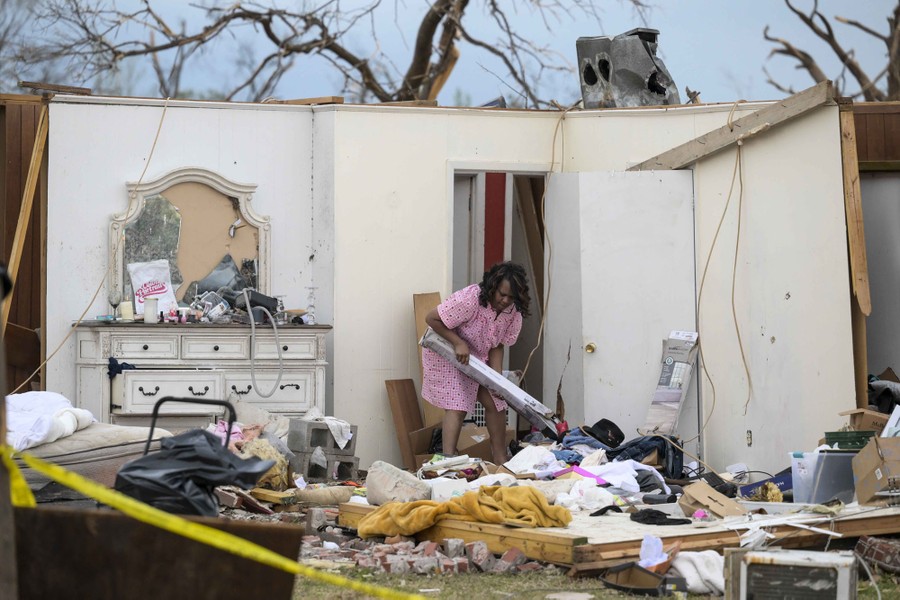
Cleaning up from the fierce tornado that struck Mississippi in March 2023.

Sometimes people who have suffered become hardened to the misfortunes of others. But very often when they see suffering, they want to reach out and help.

Daniel Wu reported recently at the Washington Post about refugees from Ukraine, currently living in Minnesota, who rushed to provide assistance in Mississippi after the March tornado.

“The seven Ukrainians set out just before midnight to make the long drive to their destination,” Wu wrote. “They were on an aid mission to a grimly familiar scene of devastated communities and leveled homes.

“But the refugees were thousands of miles from their homeland and the war that changed their lives. Their journey wound down Interstate 55, starting in Minnesota, where they had resettled just months earlier, and ending in a disaster zone wracked not by bombs, but by the wind: several towns in Mississippi recovering from a devastating tornado that killed at least 25 in late March.

“Dmytro Fedirko, a 34-year-old former van driver, puzzled through American road signs on his first road trip in the country. With him were couple Denys Pavliuk and Viktoriia Hasiuk, 19 and 18, who had arrived in the United States 10 days before. Iryna Hrebenyk, a 51-year-old hairdresser turned forklift operator for Home Depot, tried to stay awake — she joined the group after a night shift, with only a few hours of sleep in between.

“They had all been in the United States for a few months at most, thrust by war from cities and towns across Ukraine into new lives in Minnesota that had not yet settled — they had immigration forms to complete, job interviews to prepare for and families to support.

“But they said they decided, without hesitation, to put that on hold last week upon hearing news of the tornado that leveled towns in Mississippi. They made the 16-hour drive south to donate bottled water and volunteer with aid workers, buoyed by the idea that they could help a community facing a similar struggle to theirs.

“ ‘We had to leave our home,’ Pavliuk told the Washington Post in Ukrainian, in an interview interpreted by Hrebenyk. ‘And they don’t have a place to go back, either.’ …

“Pavliuk’s group had all been helped by the same nonprofit organization, the American Service. Aswar Rahman, a Minneapolis-based digital producer, founded the agency in March 2022 after visiting the Polish-Ukrainian border and seeing the challenges facing refugees there, he said. A month later, when the Biden administration’s Uniting for Ukraine program created a path for Ukrainians with an American sponsor to secure two-year stays in the United States, the American Service started helping refugees resettle in Minneapolis.

“Rahman said he was struck by the kinship that grew in the apartment building where the American Service found housing for Ukrainian refugees. Those who had been there for a few weeks or months were quick to help with the myriad challenges facing new arrivals: like buying SIM cards, applying for Social Security numbers and completing post-arrival immigration forms.

“ ‘I feel like I have a big family,’ said the American Service’s Minnesota director, Sofiia Rudenko, who arrived in the United States from Ukraine in late December. ‘realized that last week, I didn’t even cook because my neighbors kept feeding me every day.’

“That spirit convinced Rahman that the refugees wouldn’t hesitate to help other communities in need, too. When he saw news of the March 24 tornadoes that devastated Mississippi towns, he pitched the idea of taking a team to deliver aid. Rudenko, 22, thought it was a great idea. …

“Everyone leaped at the proposal. The team of eight — seven recent Ukrainian arrivals, accompanied by Rahman — had to turn down additional volunteers because they no longer had room in their cars, Rahman said. None of the Ukrainians had been in the United States for longer than three months. Pavliuk and Hasiuk didn’t mind that it had been less than two weeks since they arrived. …

“The group piled into two cars late Monday night and drove to Memphis, where they rented a U-Haul van and bought several pallets of water bottles from a Costco. The Ukrainian group paid for the water themselves against Rahman’s protests, he said. …

“Rahman contacted the nonprofit Volunteer Mississippi to ask where the group could be of use. A coordinator directed them to a school being used as a distribution center in the city of Belzoni. They distributed the water in Belzoni on Wednesday. In the afternoon, the group drove farther south to Silver City and helped unload additional trucks of aid and supplies. …

“Rahman said their donation, about 13,000 bottles of water, probably wasn’t much compared with those by large corporate donors. But the backstory of the Ukrainian volunteers resonated, both in teary exchanges with other workers on the ground and with Volunteer Mississippi’s coordinators. …

“The group returned to Minneapolis on Thursday evening, just in time for several people to make their shifts at the Home Depot and for Pavliuk to make a weekend job interview.

“Now, the seven Ukrainians will resume the new starts they’re pursuing for themselves. All of them are grappling with the devastating toll that the war is taking on Ukraine and their family members there. But the trip to Mississippi lifted their spirits, Rudenko said, and the American Service is looking for other ways that the refugee community can volunteer in Minneapolis.

“ ‘That’s something that is special about our community,’ Rudenko said. ‘Because we want to share, to give, and to keep doing that because we feel better, and we feel that we are not alone.’ ”

More at the Post, here.

Read Full Post »

The Little Sprouts Learning Center in Warren, Minn., is the town’s only day-care center. Residents recently voted to expand it — and fund it. 

The residents of a small town in northern Minnesota recently decided that “put your money where your mouth is” meant ponying up for a day-care center they couldn’t do without.

Cathy Free wrote at the Washington Post, “Lindsey Buegler learned that the only day-care center in her town of Warren, Minn., would be closing. She went to work that afternoon, upset and terrified. …

“She went to her boss, Phil Thompson, who owns the accounting and crop insurance firm where she worked, and told him: ‘We have no family here to help. If there is no child care, we’ll have to move.’

“Thompson said the moment hit hard as he realized Buegler and others were in a precarious situation. He decided to pitch in about $20,000 with a local banker to keep the Little Sprouts Learning Center open in the rural town, which has a population of about 1,600.

“That worked for a while, but Thompson said he knew it wouldn’t be enough to sustain the day-care center, which was operating as a nonprofit. …

“Thompson said he has written other large checks to help keep Little Sprouts running since that first crisis in 2015. He now employs about 30 people at his firm, and doesn’t mind when employees bring their children to work in a pinch when they need it.

‘I’ve seen firsthand how this affects people,’ said Thompson, who is also chairman of the Warren Economic Development Authority. ‘If people have to move away to work and raise their families, our town can’t grow.’

“In 2019, Thompson helped put together a committee that spent several years taking an in-depth look at Warren’s day-care dilemma. They explored several options to financially assist the day-care center, which was licensed for 47 infants and children and seven teachers. None of those options worked long-term.

“Last year, he and the committee proposed an idea: The city would ask residents to vote on a 20-year sales tax increase of half-a-cent to fund a $1.6 million low-interest loan for a new child care center, while keeping the old one open as it was being built. By doubling the number of teachers and increasing the availability of open slots, the day-care facility could survive.

“The plan was that Warren City would own the building and lease it to Little Sprouts, and the day-care center could continue to operate as a nonprofit. On Nov. 8, 2022, the measure narrowly passed. …

“ ‘We’re an agricultural community centered around corn, soybeans and sugar beets, and we have a lot of young people,’ [Thompson] said. ‘Now there’s an incentive to keep them here.’

“Nationwide, about 51 percent of the population live in child care ‘deserts‘ with no child care providers or not enough licensed child care slots, according to a 2018 study by the Center for American Progress. The pandemic made the situation more dire.

“Thompson and other residents of his farming community were determined to offer a day-care center option for working parents. ‘We became completely centered on solving this problem,’ said Mara Hanel, Warren’s mayor from 2018 to 2022. ‘At one time, we had a shortage of 180 child care slots in a 20-mile radius. We knew that we had to do something.’

“Shannon Mortenson, Warren’s city administrator, said the town decided that child care should become an essential service like water, electricity and sanitation.

“ ‘We knew that if we lost Little Sprouts, we would also lose revenue and some of our workforce,’ she said. ‘If parents had no options, they would move their families elsewhere.’

“The idea of moving to be near child care created stress in the community, said Adam Sparby, whose two daughters and son attend Little Sprouts. ‘Everyone was really worried — closing the day-care would mean a lot of us would have to move to another town and commute back and forth to work,’ said Sparby, who sells John Deere farm machinery in Warren.

“He said that his wife, Ashley, a pharmacist, would often volunteer at Little Sprouts on her lunch hour to help the teachers when the center was short on staff.

“ ‘Day-care is such a huge thing for families, so I’m really excited that the tax increase passed and we’ll soon have a new facility,’ Sparby said.

“Thompson said the sales tax increase will raise enough funds over 20 years for the town to pay off a $1.6 million loan for the new center but the community still needed to raise another $700,000 to $800,000 to offset price increases that occurred during the pandemic.

“ ‘We should meet our goal soon,’ he said, noting that businesses and residents have contributed about $600,000 to the effort. ‘Our community might be small, but people have been incredibly supportive and generous.’ ”

More at the Post, here.

Read Full Post »

Photo: AP.
A Buddhist community anchored by a temple in Hampton, Minnesota, is drawing dancers of all ages.

It’s interesting to see what draws people to a faith community — besides faith. When we moved to a town where we didn’t know anyone, I visited several churches and chose the friendliest one. As we got involved, we got acclimated. The children made friends, and I got to know parents who filled me in on the best public school teachers.

Other people may join for other reasons. Consider the dance opportunity in today’s story.

Giovanna Dell ‘Orto reports at the Associated Press (AP), “The Buddhist community anchored by an ornate temple complex here in the Minnesota farmland is trying a new way to ensure its faith and ancestral culture stay vibrant for future generations — an open call for the sacred dance troupe.

“Founded by refugees fleeing the Khmer Rouge regime, which sought to eradicate most religious institutions, Watt Munisotaram and its troupe hope that teaching young children sacred dance will strengthen their ties to both Buddhism and Cambodian traditions.

“ ‘The connection is stronger when I dance,’ said Sabrina Sok, 22, a Wattanak Dance Troupe leader. ‘The thing that stays in my head is this dance form almost disappeared with the Khmer Rouge.’

“During their 1975-79 regime, the Khmer Rouge caused the deaths of an estimated 1.7 million in Cambodia. Hundreds of thousands fled, first to neighboring Thailand and later the United States, where Southeast Asians are one of the largest refugee communities.

“They carried this sacred dance tradition with them. On a frigid early February evening, Sok rehearsed for the upcoming Cambodian New Year holiday with fellow troupe leader Garrett Sour and his sister Gabriella, whose parents were among those refugees. …

“While recruitment was by word of mouth, this winter’s enrollment — open to anybody eager to learn the dance form — brought in the highest number ever after being posted on the temple’s Facebook page.

“Clothed in traditional thick silk shirts and pants from Cambodia, the three dancers sinuously stretched and bent every part of their bodies, from joint-defying toe curls on up. …

“ ‘We’re never ourselves, we’re just physical embodiments of higher spirits,’ said Garrett Sour, 20, as he meticulously coached the poses, urging a smaller step here, a deeper calf tilt there. ‘Dance was seen not as entertainment but a medium between heaven and earth.’

“The marketing student at a Twin Cities university started dancing when he was six and has learned Khmer to better delve into the sacred storytelling. He will be one of the teachers for the incoming dancers – about 20, which nearly doubles the troupe, and most of them younger than teens. …

“In the temple’s ornate higher room, where the ten monks in residence chant and meditate daily surrounded by sacred books and large Cambodian-made paintings of Buddha’s life, the Venerable Vicheth Chum also highlighted the importance of what he called ‘blessed dance.’

” ‘Very important to have, and to keep our ancestral tradition even when moved to (Minnesota),’ said Chum, who came to the United States more than 20 years ago from Cambodia. ‘Buddhist teaching is practice for peace and happiness, no matter the nation.’

“Monks at Watt Munisotaram – which roughly means the place to enjoy learning from wise men – practice Theravada, one of the oldest forms of Buddhism rooted in Southeast Asian cultures. …

“Dozens of faithful in equally bright white outfits [met] to celebrate Magha Puja, a holiday marking the gathering of 1,250 of Buddha’s first disciples and the establishment of his rules for the new community.

“Chum and seven other monks in elaborately folded, bright orange robes led a candlelit procession multiple times past an altar with several golden Buddha statues, glittery decorations and a profusion of flowers including lotus blossoms – most artificial, though in more clement weather some are grown locally or shipped from Florida.

“Several children marched along, carrying the U.S. flag and Cambodia’s state and Buddhist flags, before everyone sat in neat rows on the carpeted floor for two hours of chanting in Khmer.

“Chum said the monks worry about young people’s growing disenchantment with religion but believe that life’s inevitable struggles will eventually bring most back to the temple for guidance from Buddha’s teachings. …

“ ‘The world is using them to educate the other communities, I keep on reminding them,’ Sophia Sour said. She hopes to take Garrett and Gabriella to Cambodia to learn even more about the roots of their spirituality, whose fundamental values she listed as respect for the elders and good deeds.

“ ‘If you do good, good will come to you,’ she said. ‘I’m not sure if that’s religion, or just life.’ ”

More at AP, here.

Read Full Post »

This morning’s Google video about the famous Osage ballerina Maria Tallchief got me thinking about Native American women in the arts and how difficult their path to fulfillment often is. Consider the writer Marcie Rendon, whose reputation got a big boost when she received a McKnight Foundation award in August.

Mary Ann Grossmann reported the story for the Pioneer Press. “Marcie Rendon, award-winning poet, playwright, author of children’s books, short stories and the popular Cash Blackbear mystery series, is the winner of the $50,000 McKnight Foundation 2020 Distinguished Artist Award.

“An enrolled member of the White Earth Nation [Ojibwe], Rendon is the first Native American woman to receive this prestigious award, which honors artists who stay in Minnesota and make the state more culturally rich. …

“ ‘I’m kind of in shock and overwhelmed,’ Rendon said last week in a phone interview from her home near Lake Hiawatha in Minneapolis, where she lives with two granddaughters and a great-granddaughter. She has three daughters and 12 grandchildren.

“The Artist Award is always a surprise to the winner. The McKnight folks lured Rendon onto Zoom in August by telling her they wanted to talk about her work. But when she dialed in she found herself facing a roomful of people who told her she was the awardee.

‘I started crying. It just seemed unreal,’ she recalled. ‘Then somebody said, “Tell her how much the check is,” and I cried even more. I could give you a hundred names of people who deserve it. It never occurred to me I was in that category.’ …

“Rendon is pleased that her award turns the spotlight on Native artists.

“ ‘I grew up in northern Minnesota and never lived in the city. I didn’t even know book awards were a thing until one of my books was nominated. I don’t have an MFA. I’m writing because I love to create and because I love my community,’ she said. ‘Jim (Denomie) and myself getting this award says that Native artists are doing not just what is important for us as Native people, but important to the entire landscape of artists and people in Minnesota. It says we exist and have a significant impact on the arts. We are resilient and thriving. It says to non-Native people, “We are here, we never left.” ‘

“Among Rendon’s previous awards [is] the Loft’s 2017 Spoken Word Immersion Fellowship with Diego Vazquez. … Vazquez, a poet, novelist and editor, has known Rendon for years. ‘I am so excited for Marcie I almost cried when I heard about her award,’ he said. ‘I admire her for everything she does, in her writing and her life, where she is the central focus for her family. She gives her heart to everything.’ …

“Rendon is especially proud of partnering with Vazquez in the eight-year-old women’s writing project, in which they teach women incarcerated in jails in Ramsey, Sherburne and Washington counties. They have reached some 300 women and published 40 anthologies of their writing. …

“Rendon, born in the Red River Valley of northern Minnesota in 1952, was a voracious reader, creative writer and poet early in life. She was with her family, poor but happy, until she was in first grade and put into the foster care system. It was a bad experience, but she survived.

“While studying at Moorhead State College in the early 1970s, Rendon was part of a group of Native student activists who successfully demanded the launch of the university’s first American Indian studies department. She graduated with degrees in criminal justice and American Indian Studies and earned a master’s in human development from St. Mary’s University.

“Rendon moved to Minneapolis in 1978, because ‘this is where my people are, the birthplace of AIM (American Indian Movement),’ and worked as a counselor and therapist while raising her daughters.

“A 1991 performance by Canadian Cree-Saulteaux artist Margo Kane inspired Rendon to share her poetry and writing with a wider audience at venues such as Patrick’s Cabaret in Minneapolis. …

“ ‘I am super-excited for Marcie,’ said [writing buddy Carolyn] Holbrook. … ‘She’s multi-talented and sticks with it, all the while raising a family and putting up with the trauma of having been a foster kid. Her crime fiction knocks me out. Others write (mysteries) about Native Americans but she’s doing it from an authentic place.’ “

Read more at the Pioneer Press, here.

Read Full Post »

Older Posts »