Feeds:
Posts
Comments

Posts Tagged ‘murals’

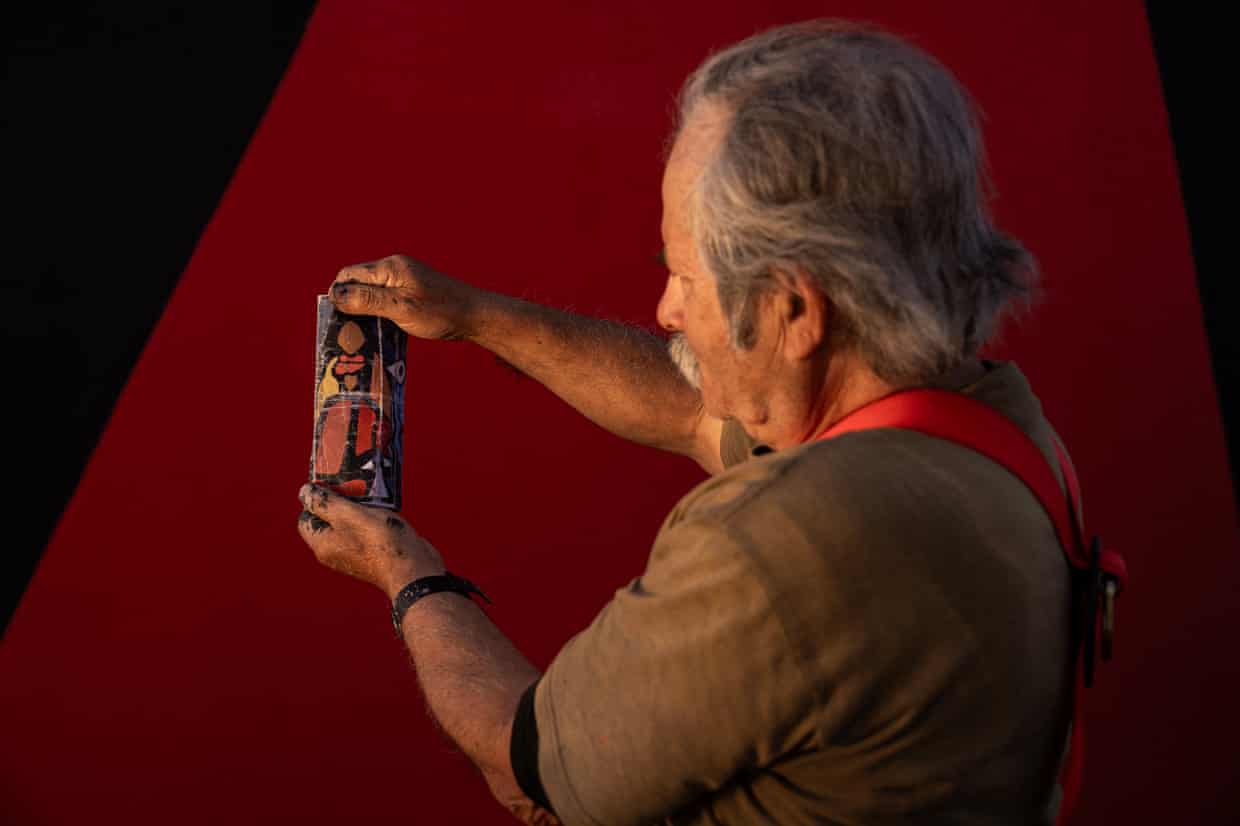
Photo: Tamara Merino/The Guardian.
Chilean muralist Alejandro ‘El Mono’ González compares the dimensions between his mock-up and a recent mural. 

For a long time, I’ve been curious about murals and street art. (Search on those terms at the top of this blog if you are interested.) Whether the art is shared openly or under cover of darkness, it seems to convey messages we don’t usually hear from smaller, less public works.

At the Guardian recently, John Bartlett wrote that “in Chile, walls and public buildings are blank canvases to express dissent, frustration and hope.” Blogger and friend of Chile Rebecca will know all about that.

“Bridges across dry riverbeds in the Atacama desert,” Bartlett continues, “are daubed with slogans demanding the equitable distribution of Chile’s water, and graffiti on rural bus stops demand the restitution of Indigenous lands from forestry companies. Every inch of the bohemian port city Valparaíso is plastered with paint and posters. …

“One renowned street artist in paint-spattered jeans spent two weeks transforming a water tower at the country’s national stadium into a powerful symbol of Chile’s battle to remember its past.

“ ‘I have always had a strong social conscience,’ Alejandro ‘Mono’ González exclaims brightly. ‘The fight was born inside me, it just didn’t have an escape. There’s so much you can say with paint and a blank surface.’

“González, 77, has painted across Latin America and Europe, and his murals adorn hotels and public buildings in China, Cuba and Vietnam.

“González’s giant creations combine bright petals of color, separated by thick black lines, and resemble stained-glass windows.

“ ‘I wouldn’t say it’s cheerful, but they’re hopeful colors, which go beyond victimhood, pain and sadness,’ he said.

“The stadium was one of Chile’s most notorious detention centers, where thousands were held after Gen Augusto Pinochet’s 1973 coup d’état. …

“González talks animatedly about how colors vibrate and interact. … His approach reflects a selfless view of the collective.

“ ‘In the streets, anonymity is important,’ he says, ‘The individual isn’t, it’s the message that is interpreted by the viewer that I care about.’

“González was born in the city of Curicó, 120 miles (193km) south of Santiago, in 1947, the son of a laborer and a rural worker. At primary school, his friends named their energetic classmate ‘Mono’ – monkey. …

“After dark, González would go out painting with his parents, both committed members of Chile’s Communist party. In art, he found a release for his burning social conscience. González joined the communist youth ranks in 1965 to develop its propaganda activities, and painted his first mural at the age of 17 during socialist candidate Salvador Allende’s presidential campaign.

“He was among the founders of the Brigada Ramona Parra, a street art and propaganda collective named after a murdered activist, during the heady days of the Allende campaigns. ‘We’d go out every night, sometimes to paint murals, sometimes just to write ‘Allende’ on any blank surface,’ he remembers.

“After Allende won the presidency in 1970, a sinister black spider began to appear on walls, sprayed by the adherents of a fascist paramilitary group. A battle for the streets began, and it has never truly died away.

“In 2019, protesters thronged the streets of Chile’s cities demanding a host of improvements to their lives and an end to the country’s entrenched inequalities. … Those protesters included members of Todas, a collective of more than 100 female muralists who mobilized in a WhatsApp chat.

“ ‘We organized ourselves so we could occupy the walls,’ said Paula Godoy, 34, an artist and muralist from a southern Santiago suburb. ‘We were talking all the time – “Where is there a wall free? Where do we need to get this message across?” – it was a really beautiful period.’ …

“Half a century earlier, González was 24 when Pinochet seized power on 11 September 1973, deposing Allende. … González slipped into the shadows. He stopped wearing his glasses, shaved off his mustache, and went by the name Marcelo as he worked as a set designer in the Municipal Theatre in Santiago.

“When the end of the dictatorship neared, González helped design the most famous campaign in Chile’s political history, the NO campaign against Pinochet’s continued rule in a 1988 plebiscite. …

“ ‘Chile is very conservative and reactionary – we advance, and then we go backwards,’ he says, stepping back from the water tower and shielding his eyes. ‘But memory is the one constant. The most important thing is having a lasting effect. This will still be here in 50 years’ time, and people will still have their memory.’ ”

More at the Guardian, here. No firewall. Donations solicited.
Read Full Post »

04062020_muralartists_105054-1020x574-1

Photo: Ramon Dompor
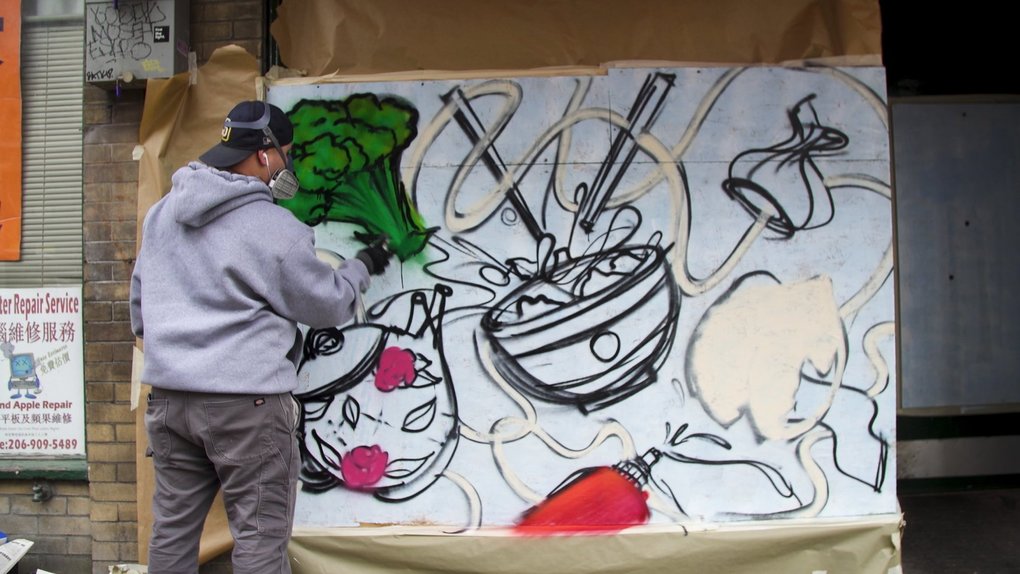
Artist Carlos Ruiz works on his mural to cover the boards on the Jade Garden Restaurant. Ruiz and other local artists donated their time and paint to help several restaurants in Seattle.

As we all know, Washington State had the first cluster of coronavirus cases in the US, and it is still struggling. That’s why the Seattle Times decided to solicit stories for a Stepping Up series meant to bring residents some encouragement.

In one example, Chris Talbott reported on artists beautifying boarded-up storefronts.

“Plywood is going up all over town. It’s not pretty. Give Seattle’s art community a little time, though, and it will catch up. Already artists are out and about, painting  murals to combat the growing blight as the novel coronavirus pandemic forces continued closures of local businesses and restaurants.

” ‘I have been homebound mostly like everybody else and trying to think of ways that I can help my community,’ artist Amanda Bishop said.

‘I’ve been feeling a little bit helpless because I’m not on the front lines. I’m not a nurse, I’m not a doctor. I don’t have a ton of money and my husband and I both lost work because of the virus. So when this opportunity came up, I was like, “This is a way that I can use my skills because this is my full-time thing.” ‘

“Working with permission from owners through the group Overall Creative, Bishop has started painting murals. She spent Sunday at the corner of Pike Street and 10th Avenue working in front of the Comet Tavern and Lost Lake Café along with other artists, each presenting their own vision. …

“Bishop said, ‘I actually did have a lot of people come up and say thank you. And I’ve done a ton of murals over the last eight years of doing this professionally and I haven’t had that as much as I had the last two days.’

“Plywood started going up [in March] after vandals began smashing windows of closed businesses. That led to more plywood from store owners who feared they might be next. Things were starting to look bleak all over town.

“The folks at Venue in Ballard realized this immediately. The shop sells the work of local artists and features a row of large picture windows. There was no question the windows needed to be covered up, but plywood seemed so … blah. So owners decided to hire a painter to beautify the plywood with a forest scene. …

“Venue owner Diane Macrae said, ‘Knowing artists are struggling as well with canceled shows and lack of sales, we figured it was a chance to provide some additional work for them. Our store is all about supporting local artists, so it made sense to continue to do this during this time in any way we can.’

“A similar effort has been under way in the International District and Little Saigon areas after vandals took out the windows of several restaurants nearly two weeks ago. …

“Ivy Chan and her family, which has run Jade Garden for 17 years, aren’t sure if the vandals were trying to break in or were just out to cause damage. But she feels the opportunity arose because the streets are virtually empty thanks to the stay-at-home order.

“ ‘Those people, they like to take advantage of the fact that there’s less people now because they’re all trying to do their diligent part to stay home,’ Chan said. “And then other people are like, ’Oh, it’s easier for me to go out there and do stuff. There’s less police patrolling, there’s less eyes to watch.’ …

“Keoke Silvano, a local photographer, … organized a group of artists who proceeded to paint the colorful mural at Jade Garden. He hopes it’s just the start, and that painters who might be out of work or looking for a way to contribute will continue the effort for businesses forced into fortress mode. …

“ ‘It seems to me that some of these businesses might’ve been targeted because they are Asian businesses,’ Silvano said. … He decided to fight back and put out word to the art community. He ended up with a half dozen or so painters who decorated the front of Jade Garden in a variety of colorful styles. They used mostly spray paint to craft scenes that included a meal of noodles, vegetables and tea with a fortune cookie, and a Seattle skyline framed by jacaranda blossoms.”

More here.

Isn’t that the way things go? First something bad like vandalism happens, then individuals in the community basically say, “I’m not on that team” — and join forces.

Read Full Post »

As everyone knows, there was serious unemployment when Franklin D. Roosevelt was president, so, in collaboration with Congress, he had the government hire people to create work that continues to benefit us —  roads and parks, for example, and fine art.

Unfortunately, some murals and sculptures from the 1930s and 1940s have been lost, so the search is on to reclaim it.

Matthew Blitz at Atlas Obscura has the story. “The United States government wants its art back. Special Agent Eric Radwick, who works in the Office of Investigations for the General Service Administration’s Office of the Inspector General, is working to do just that — to locate and recover government-owned long-lost artwork of the New Deal-era federal arts programs. It could be hidden in plain sight.

“It could be in grandma’s attic. It could be in the possession of art collectors. No matter if it was found in the trash or cost a few grand, the art is federal property. … Most people, upon realizing they are in possession of federal property, are cooperative. …

“On May 9th, 1933, President Franklin Delano Roosevelt received a rather curious letter from an old classmate and professional artist George Biddle. Since his March inauguration, President Roosevelt had implemented the most aggressive 100 days agenda in the country’s history in hopes of solving the Great Depression.

“While absurdly busy — he had just delivered his second Fireside Chat and was about to sign both the Farm Relief and Unemployment Relief bills — this note gave him pause. In it, Biddle wrote that he had long admired the Mexican government for paying artists ‘plumbers’ wages’ to paint murals on government buildings expressing Mexican ideals. Perhaps the President should consider something similar in the United States? …

“The letter got the President’s attention. A month later, Biddle met with members of FDR’s administration in Washington about his proposal. By the end of 1933, the first national art relief program — the Public Works of Art Project — was established.

“Over the next decade, the American art scene flourished thanks to the financial encouragement of the government. According to Smithsonian Magazine, in the first four months of 1934 alone, nearly 4,000 artists were hired to produce over 15,000 paintings, murals, sculptures and other works of art for federal buildings across the country. In 1935, the Works Progress Administration’s Federal Art Project was established, the largest of these programs both in scope and number of artists employed. …

“At a time of crisis in America, these programs not only provided an enormous collection of artwork for public consumption, but gave the creators a sense that they were needed. ‘It made them feel like they counted,’ says Virginia M. Mecklenburg, Chief Curator at the Smithsonian American Art Museum.”

Oh, my, what an enlightened federal government! Sometimes one hopes for history to repeat itself.

Read about the challenges of tracking down missing federal artwork at Atlas Obscura, here.

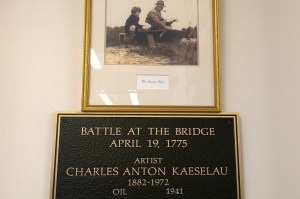
Once upon a time, when the federal government was concerned about unemployment, it paid people to work, artists included. That’s why many murals appeared in post offices and other government buildings in the 1930s and 1940s. This post office mural by Charles Anton Kaeselau depicts the shot heard ’round the world at Concord’s North Bridge.

042617-Kaeselau-North-Bridge-mural

042617-Kaeselau-North-Bridge-mural

Read Full Post »

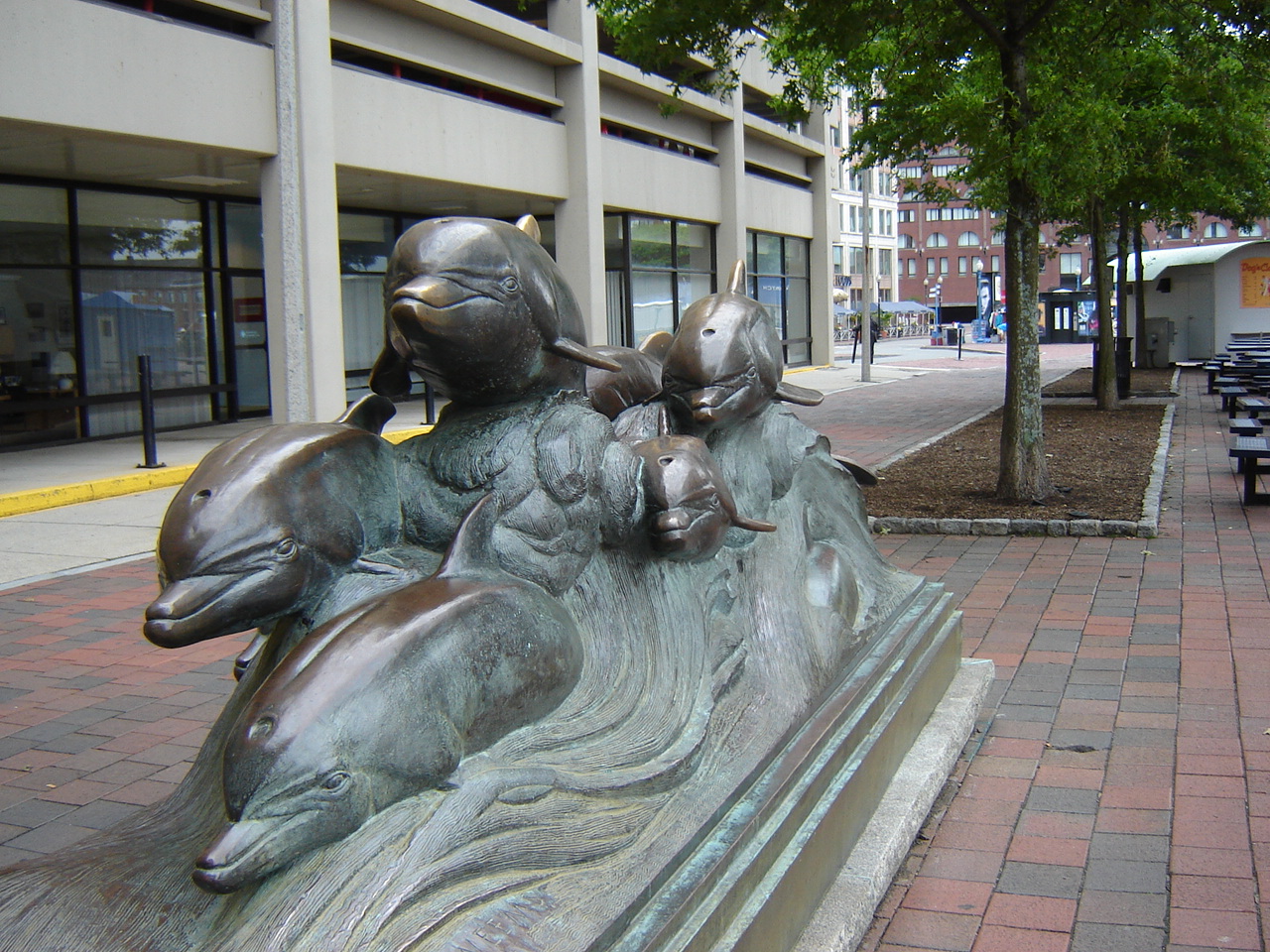
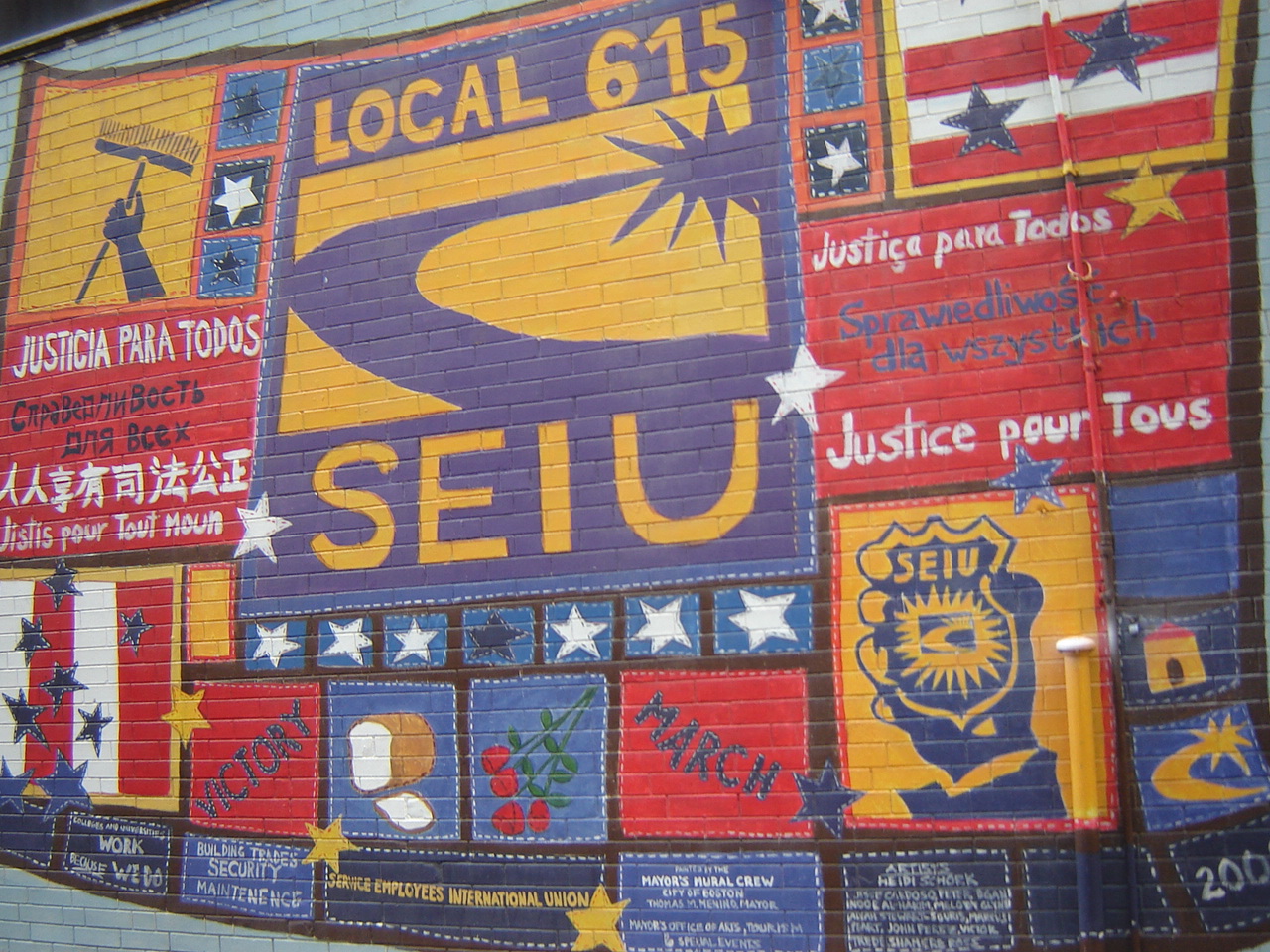
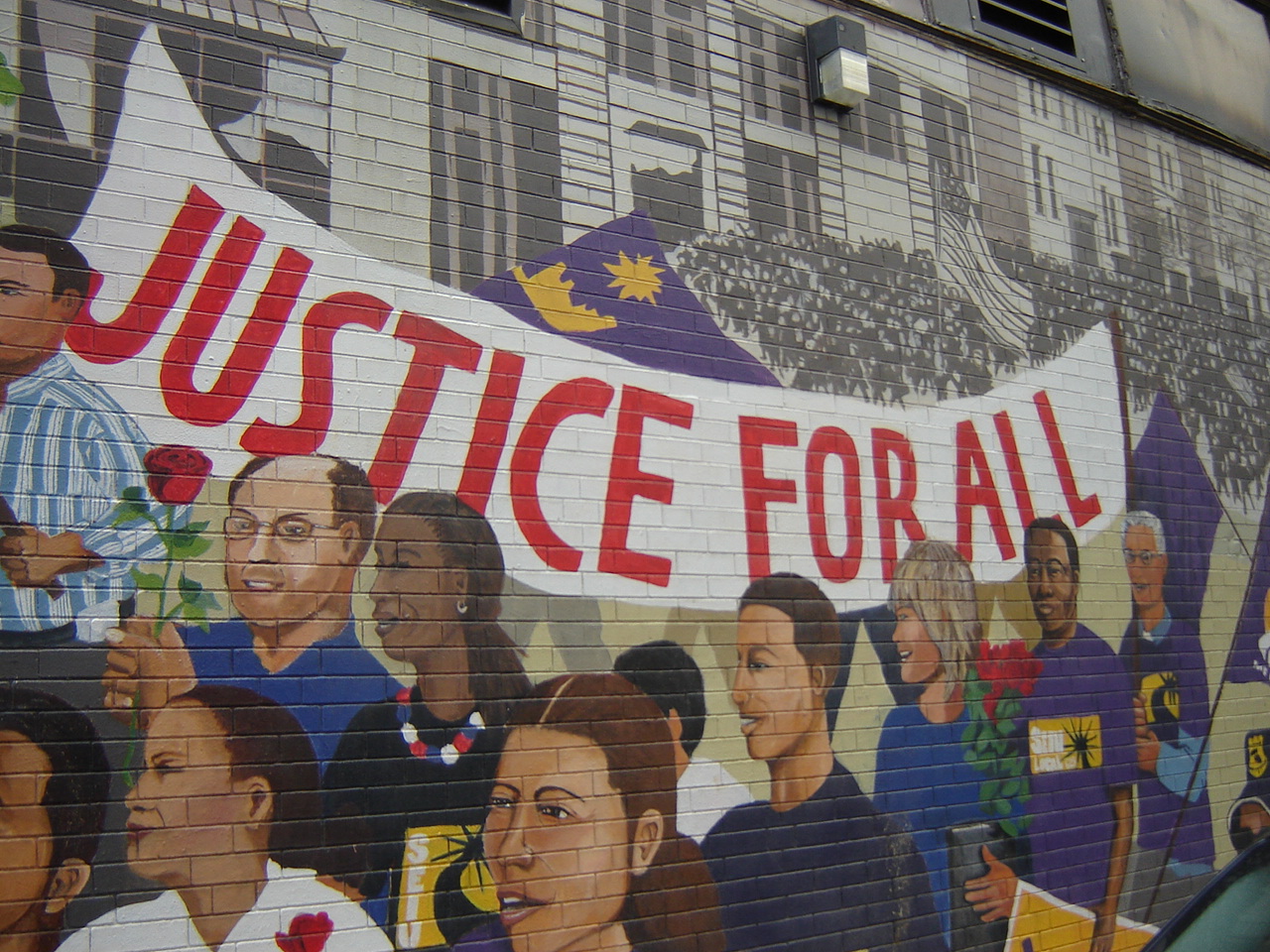
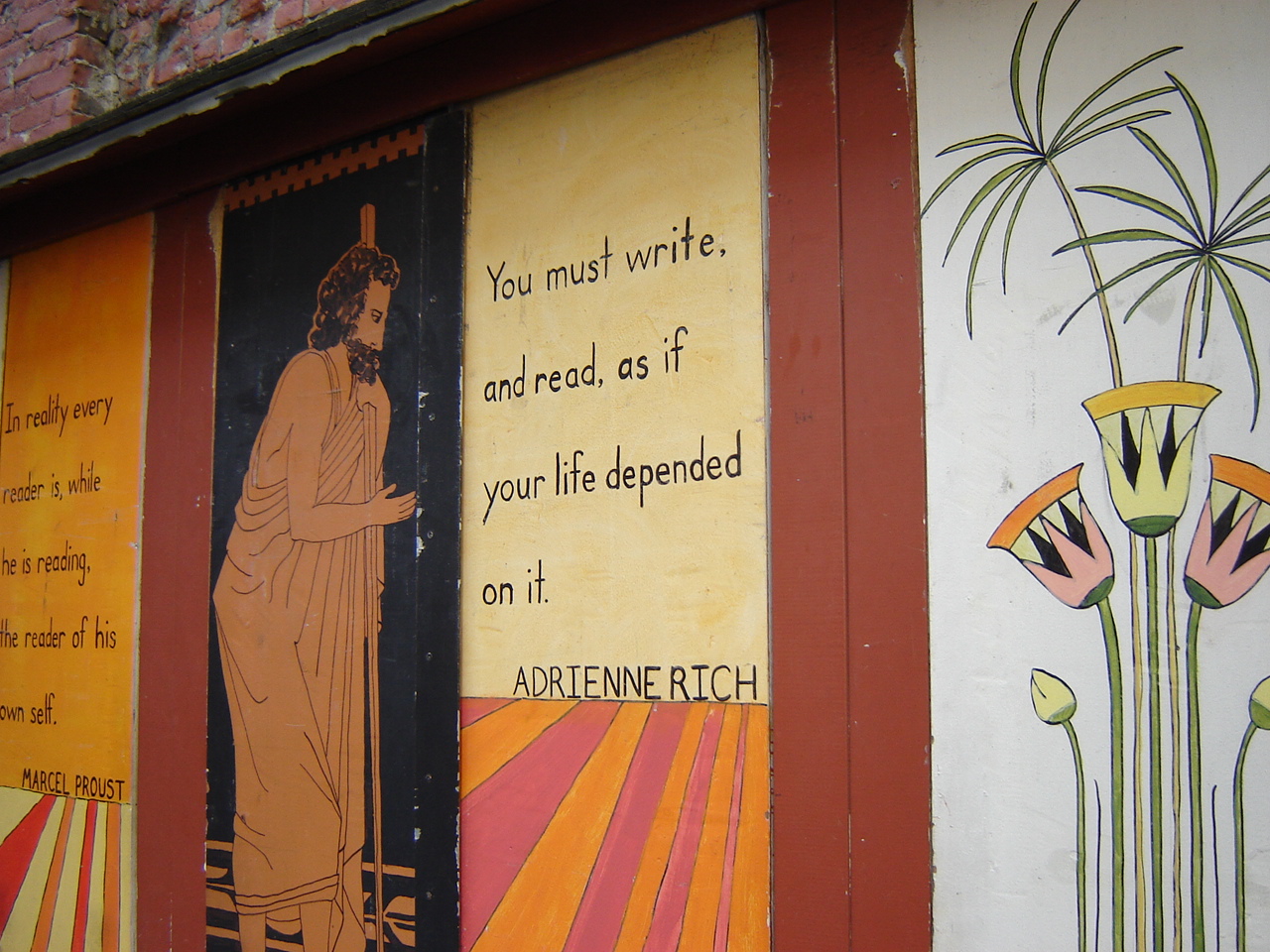
Some days I walk in Boston and snap the sights down side streets. The first photo was taken near the harbor. The others were taken near Downtown Crossing.

I like the Adrienne Rich line painted on a bookstore wall: “You must write, and read, as if your life depended on it.”

Read Full Post »