Feeds:
Posts
Comments

Posts Tagged ‘pinochet’

Photo: Chile’s National Monuments Council.
Chilean artist Julio Escámez finished “Beginning and End” in 1972. Dictator Pinochet ordered it destroyed, but it was recently discovered to have been only painted over.

Today’s story reminds me of the Power of One. It’s not the only example of a person (or persons) being be ordered to destroy a work of art and finding a way to hide it instead, but it was new to me. Probably Rebecca at the Fake Flamenco blog knows all about it.

Min Chen writes about the discovery at Artnet.

“Long thought lost, a historic mural by Chilean artist Julio Escámez that was erased by Augusto Pinochet’s military regime in 1973 is finally reemerging in Chile’s city hall.

“A team from the Heritage Unit of the Municipality of Chillán (UPA) is currently in its third phase of uncovering and restoring the celebrated mural in the Salon de Honor. Begun in 2021, the project involves the millimeter-by-millimeter removal of 12 layers of white paint, which were slathered over the original composition decades ago. The restoration is slated to be completed in December 2027.

“ ‘We will be working in grids, carrying out manual stripping daily,’ Elvira Fuchslocher, head of the restoration team, said in a statement. …

“The work by Escámez was commissioned in 1969 by Mayor Eduardo Contreras Mella on the eve of Salvador Allende‘s presidential election victory. Escámez spent two years creating the mural, which, when completed, spanned some 452 square feet across a wall of the Salon de Honor. Titled Beginning and End, it depicted the triumph of people over oppression. …

“In 1972, the mural was unveiled by Mella’s successor, Ricardo Lagos Reyes, before Allende visited the work himself months later. Nobel laureate Pablo Neruda described it as containing ‘the most extraordinary essences of creation have been recognized, essences that possess the stillness of depth, of truth.’

“The ardently right-wing Pinochet, however, saw the artwork differently, linked as it is to a democratic socialist project. After his military junta overthrew Allende, the dictator ordered the mural destroyed. Escámez was forced into exile in Costa Rica, wounded by the erasure of his work. …

“Nearly five decades on, Chile’s current mayor, Camilo Benavente, spearheaded the effort to recover Escámez’s mural. But the chances were slim that the work still survived. Over the years, reports had circulated about how the artwork was destroyed: It was demolished with bayonets, it was covered with tar, or, in the artist’s own account, chipped away with ‘chisel and hammer.’

“But in 2021, an initial analysis of the wall in the Salon de Honor by the University of the Arts found the first trace of Beginning and End. ‘We locked ourselves in the council chamber, and in a small window that opened [by removing the white paint], the orange color appeared, which is prominent in the mural and corresponds to the flame,’ Karin Cárdenas, a historian who worked on this first analysis, told El Pais. ‘We stopped and said, “There might be something here.” ‘

“Turns out, the mural had not been tarred or slashed with bayonets — it had simply been painted over. But as the UPA continued to uncover more of the artwork over the years, the team learned that its original height was reduced to make room for a second story, with a window cut directly through it.

“They also discovered that the mural was larger than previously believed. In fact, the city now suspects the artwork’s title, Beginning and End, might refer to two artworks, likely Beginning and End. Where the first part portrays the dramatic class struggle, the second reveals a serene group of women peering through a telescope, reflecting ‘calm and contemplation,’ said Cárdenas.”

What an emotional moment — that might-be-something-here moment! How I long to experience a moment like that for values that have been trashed! More at Artnet, here.
Read Full Post »

Photo: Tamara Merino/The Guardian.
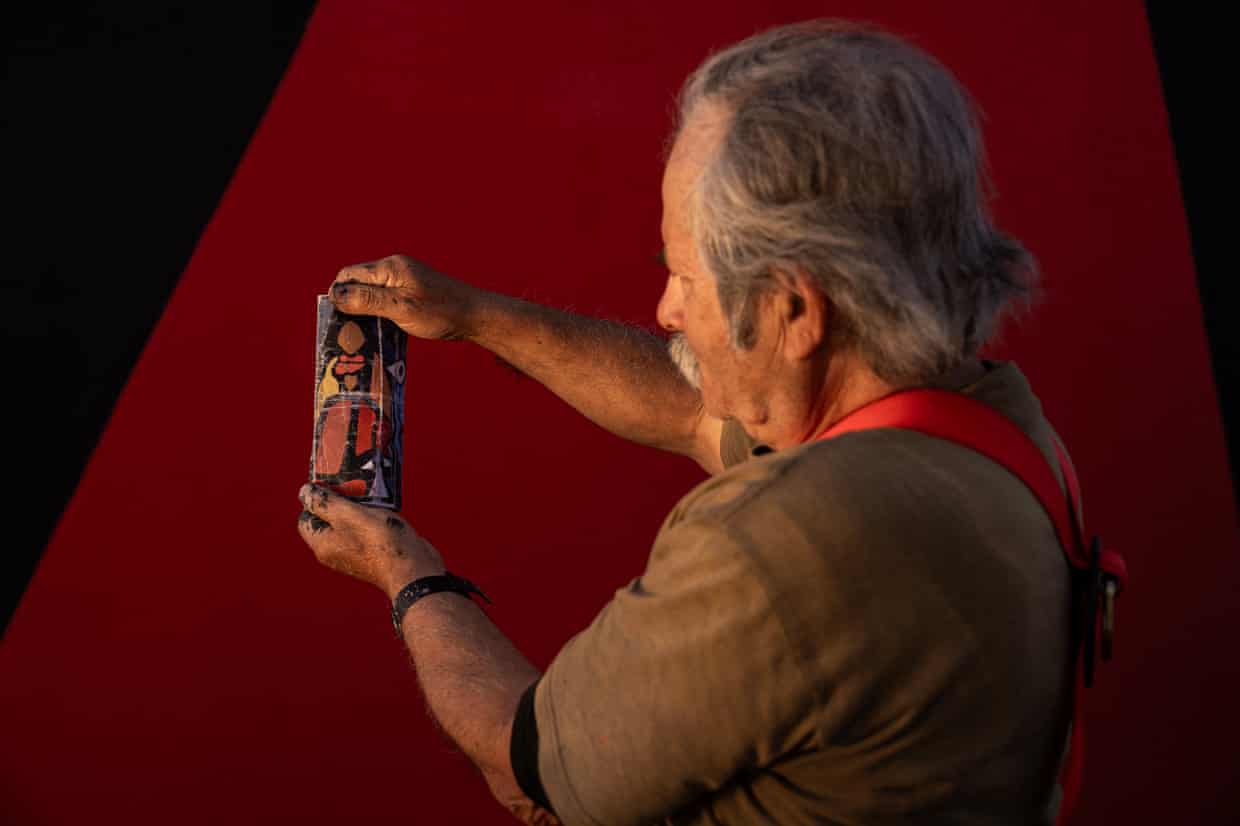
Chilean muralist Alejandro ‘El Mono’ González compares the dimensions between his mock-up and a recent mural. 

For a long time, I’ve been curious about murals and street art. (Search on those terms at the top of this blog if you are interested.) Whether the art is shared openly or under cover of darkness, it seems to convey messages we don’t usually hear from smaller, less public works.

At the Guardian recently, John Bartlett wrote that “in Chile, walls and public buildings are blank canvases to express dissent, frustration and hope.” Blogger and friend of Chile Rebecca will know all about that.

“Bridges across dry riverbeds in the Atacama desert,” Bartlett continues, “are daubed with slogans demanding the equitable distribution of Chile’s water, and graffiti on rural bus stops demand the restitution of Indigenous lands from forestry companies. Every inch of the bohemian port city Valparaíso is plastered with paint and posters. …

“One renowned street artist in paint-spattered jeans spent two weeks transforming a water tower at the country’s national stadium into a powerful symbol of Chile’s battle to remember its past.

“ ‘I have always had a strong social conscience,’ Alejandro ‘Mono’ González exclaims brightly. ‘The fight was born inside me, it just didn’t have an escape. There’s so much you can say with paint and a blank surface.’

“González, 77, has painted across Latin America and Europe, and his murals adorn hotels and public buildings in China, Cuba and Vietnam.

“González’s giant creations combine bright petals of color, separated by thick black lines, and resemble stained-glass windows.

“ ‘I wouldn’t say it’s cheerful, but they’re hopeful colors, which go beyond victimhood, pain and sadness,’ he said.

“The stadium was one of Chile’s most notorious detention centers, where thousands were held after Gen Augusto Pinochet’s 1973 coup d’état. …

“González talks animatedly about how colors vibrate and interact. … His approach reflects a selfless view of the collective.

“ ‘In the streets, anonymity is important,’ he says, ‘The individual isn’t, it’s the message that is interpreted by the viewer that I care about.’

“González was born in the city of Curicó, 120 miles (193km) south of Santiago, in 1947, the son of a laborer and a rural worker. At primary school, his friends named their energetic classmate ‘Mono’ – monkey. …

“After dark, González would go out painting with his parents, both committed members of Chile’s Communist party. In art, he found a release for his burning social conscience. González joined the communist youth ranks in 1965 to develop its propaganda activities, and painted his first mural at the age of 17 during socialist candidate Salvador Allende’s presidential campaign.

“He was among the founders of the Brigada Ramona Parra, a street art and propaganda collective named after a murdered activist, during the heady days of the Allende campaigns. ‘We’d go out every night, sometimes to paint murals, sometimes just to write ‘Allende’ on any blank surface,’ he remembers.

“After Allende won the presidency in 1970, a sinister black spider began to appear on walls, sprayed by the adherents of a fascist paramilitary group. A battle for the streets began, and it has never truly died away.

“In 2019, protesters thronged the streets of Chile’s cities demanding a host of improvements to their lives and an end to the country’s entrenched inequalities. … Those protesters included members of Todas, a collective of more than 100 female muralists who mobilized in a WhatsApp chat.

“ ‘We organized ourselves so we could occupy the walls,’ said Paula Godoy, 34, an artist and muralist from a southern Santiago suburb. ‘We were talking all the time – “Where is there a wall free? Where do we need to get this message across?” – it was a really beautiful period.’ …

“Half a century earlier, González was 24 when Pinochet seized power on 11 September 1973, deposing Allende. … González slipped into the shadows. He stopped wearing his glasses, shaved off his mustache, and went by the name Marcelo as he worked as a set designer in the Municipal Theatre in Santiago.

“When the end of the dictatorship neared, González helped design the most famous campaign in Chile’s political history, the NO campaign against Pinochet’s continued rule in a 1988 plebiscite. …

“ ‘Chile is very conservative and reactionary – we advance, and then we go backwards,’ he says, stepping back from the water tower and shielding his eyes. ‘But memory is the one constant. The most important thing is having a lasting effect. This will still be here in 50 years’ time, and people will still have their memory.’ ”

More at the Guardian, here. No firewall. Donations solicited.

Read Full Post »

Raising a family is challenging under any circumstances, but Simon Romero of the NY Times can tell you about families that have added on a somewhat more extreme challenge: settling in Antarctica.

He writes from Villa Las Estrellas, “Children at the schoolhouse here study under a portrait of Bernardo O’Higgins, Chile’s independence leader. The bank manager welcomes deposits in Chilean pesos. The cellphone service from the Chilean phone company Entel is so robust that downloading iPhone apps works like a charm. …

“Fewer than 200 people live in this outpost founded in 1984 during the dictatorship of Gen. Augusto Pinochet, when Chile was seeking to bolster its territorial claims in Antarctica. Since then, the tiny hamlet has been at the center of one of Antarctica’s most remarkable experiments: exposing entire families to isolation and extreme conditions in an attempt to arrive at a semblance of normal life at the bottom of the planet.

“It gets a little intense here in winter,” said José Luis Carillán, 40, who moved to Villa Las Estrellas three years ago with his wife and their two children to take a job as a teacher in the public school.

“He described challenges like trekking through punishing wind storms to arrive at a schoolhouse concealed by snow drifts, and withstanding long stretches with only a few hours of sunlight each day. …

“Most of the students at the village’s small school, who generally number less than a dozen, are the children of air force officials who operate the base; some of the parents say the isolating experience strengthens family bonds.

“That Villa Las Estrellas is so remote — its name can be translated as Hamlet of the Stars, since the lack of artificial light pollution here enhances gazing into the heavens — sits just fine with many who live here.

“ ‘People in the rest of Chile are so afraid of thieves that they build walls around their homes,’ said Paul Robledo, 40, an electrician from Iquique (pronounced E-key-kay). ‘Not here in Antarctica. This is one of the safest places in the world.’ More here.

And here you thought our cold snap was a little intense!

Photo: Daniel Berehulak for The New York Times  
Children being picked up from school in Villa Las Estrellas. Most of the students at the village’s small school, who generally number less than a dozen, are the children of air force officials who operate a nearby base. 

Read Full Post »