Feeds:
Posts
Comments

Posts Tagged ‘native’

Photo: Emily Mesner/Anchorage Daily News.
Lenora Ward, general manager at KOTZ radio station, listens to a 2022 dog-sled musher interview while on-air at the station in Kotzebue.

Few places in the US rely more heavily on public radio than Alaska. That is why people who care about Alaska rushed to bridge the gap after the current Congress decided public radio is not needed.

Iris Samuels reports for the Anchorage Daily News, “An Alaska fund has raised $3.5 million as it seeks to replace federal funding rescinded by Congress for public radio and television stations.

“Amid fundraising efforts, station leaders say they are already beginning to cut some programming. …

“Congress in July voted to rescind $1 billion in federal funding for public media across the country. … Two of Alaska’s three-member congressional delegation voted in favor of the rescission, which eliminated roughly $15 million intended for more than two dozen stations in Alaska. …

“Sen. Lisa Murkowski was one of a few Republicans in Congress who attempted to salvage the federal funding that Congress members themselves had approved last year, pointing to its importance in alerting Alaskans to natural hazards like tsunamis, earthquakes and fires.

“In a recent call hosted by a coalition of Alaska public radio and television stations, PBS President Paula Kerger said that Alaska is at the forefront of national fundraising efforts intended to — at least temporarily — supplant federal funding with money from private donors and foundations. …

“Kerger said she was ‘deeply grateful to Sen. Murkowski, who really fought for us more than any other member of Congress.’

Alaska stations banded together in the days following the July rescission vote to, with the Alaska Community Foundation, establish the Voices Across Alaska Fund, which in its first two months raised more than $3.5 million.

“The funds came from 80 donors, which include individuals, corporations and foundations in Alaska and in the Lower 48, according to Alaska Community Foundation spokesperson Ashley Ellingson. The funds will be disbursed to stations [based] on stations’ needs, Ellingson said. …

“Alaska Public Media President Ed Ulman said that since the rescission, new donors have begun giving, or existing donors have upped their contributions. …

“Funds will be distributed to Alaska stations, which are also independently fundraising, several station managers said in recent days. Even as they have pivoted to fundraising efforts, the station managers reported making several targeted cuts to their programming in response to the loss of federal funding.

“Alaska Public Media, the state’s largest public station, has paused Alaska Insight, a television news program that was broadcast across the state. Ulman said Alaska Public Media has also cut its education programming and is considering cutting Debate for the State, a program that features candidate forums for statewide offices. …

“Gretchen Gordon, general manager of KUAC, a station serving Interior Alaska, said the station has cut overnight broadcasting, eliminated some national radio programs and lost television service in Nenana in response to the federal funding cut. Gordon said KUAC is ‘determined to find ways to restore lost programs and services.’

“Kristin Hall, general manager at KYUK, which serves Bethel and the Yukon-Kuskokwim Delta, said the station lost $1.2 million in federal funding, and could eliminate more than half its staff by the end of the calendar year.

“Justin Shoman, president and general manager of KTOO, said the Juneau-based station may need to adjust its coverage of the Legislature. Gavel Alaska, a live-streaming service for legislative hearings, press conferences and trial hearings, costs more than $1 million annually to run and receives no state funding, Shoman said. Until the rescission, federal funding made up more than a third of KTOO’s annual budget. …

“The federal funding cut comes after a yearslong refusal by Gov. Mike Dunleavy to spend state dollars on public media. Starting in his first year as governor, he repeatedly vetoed funding intended for public radio stations. This year, the Legislature did not fund the grants for public radio in the budget. …

“ ‘It’s not lost on many of us that the Legislature has every single year put in funding, in particular for rural public radio,’ said Ulman. ‘And yet, there is one individual who has the power of the veto who exercises that veto and goes against — I’m just going to say it — the will of the people.’

“When Begich, Alaska’s lone U.S. House member, voted in June to claw back federal funding for public media, he reasoned that public broadcasting was no longer essential because Alaskans now use ‘pervasive cellular, satellite, and wireline technologies.’

“But Gordon, with KUAC, said many Interior residents do not have access to broadband internet. … ‘Our lawmakers need to understand that a little better,’ she said.”

Will the new fundraising levels last? Only time will tell. More at the Anchorage Daily News, here. And do read about how an Alaska public radio station saves lives, here.

Read Full Post »

Any one change has a cascading effect, and for tribes’ radio stations, the recent change to Corporation for Public Broadcasting has posed an existential threat. More than music is involved here. It’s about keeping a culture alive.

Neel Dhanesha reports at Neiman Lab, “In the most remote parts of Alaska, staying in touch can involve a bit more effort than sending a text. Cell service is spotty, highways are nonexistent, and the postal service remains a vital lifeline, delivering supplies and mail by plane. But for anyone who wants to broadcast a different kind of message — a reminder to pick up milk, for example, or birthday wishes — there’s always the Muktuk Telegram.

“Named for a traditional food of whale skin and blubber, the Muktuk Telegram (also called the Mukluk Telegraph, after a phrase referring to how gossip spreads in Alaska) is sort of like an amplified shout: Someone calls into a radio station with a message, and it gets broadcast on their airwaves so that anyone in range with a radio tuned to the right frequency will hear it. Usually, the radio station broadcasting the Telegram is one of the fifteen tribal radio stations in Alaska. But now, after Congress took away $9.4 billion in previously allocated public media funding and the Corporation for Public Broadcasting (CPB) subsequently announced it will shut down, the future of those stations, the Telegram, and tribal public media across the country is up in the air.

“ ‘Stations are trying to figure it out,’ said Jaclyn Sallee, president and CEO of KNBA, a tribal radio station in Anchorage, and Koahnic Broadcast Corporation, which produces shows that are distributed to tribal radio stations across the country. …

“Indigenous radio and television stations are unique in the landscape of American media. While many are part of the NPR and PBS networks, they are mostly staffed by Indigenous reporters and producers and primarily serve audiences in tribal nations around the U.S., many of which lack broadband or cell service. According to Native Public Media, an NPR-like network for tribal stations, there are 57 tribal radio and 3 tribal television stations in 20 states in its network across the country, and most if not all of them received CPB funding before the rescissions package passed.

“ ‘When a Tribal station goes dark, the silence is more than technical,’ said Loris Taylor, president and CEO of Native Public Media, in an emailed statement to Nieman Lab. ‘These stations are not just media outlets, they are cultural infrastructure. … Without these stations, many Tribal citizens, especially elders, low-income families, and those without broadband, would lose essential access to news and public discourse.’

Among the essential services at risk are emergency alerts, which are particularly crucial in areas with gaps in cellular coverage.

“At particular risk is the Missing Endangered Persons Alert, a new type of alert similar to an AMBER alert that the Federal Communications Commission (FCC) adopted in August 2024 and that is set for national launch in September. According to the FCC’s website, ‘The MEP code could be particularly beneficial to Tribal communities, where American Indians and Alaska Natives are at a disproportionate risk of violence, murder, or vanishing.’ …

“Kathryn Squyres reported in Current, a spokesperson from Sen. Mike Rounds (R-S.D.) office explained that the Department of the Interior’s Bureau of Indian Affairs (BIA) will distribute $9.4 million of previously appropriated funding to 35 tribal radio stations in 11 states, which matches the amount those stations received from the CPB in fiscal year 2025. But it’s unclear what will happen after this year’s grants are dispersed, or to the 22 radio stations and nine states left out of that deal. …

“In an emailed statement, a spokesperson from the Department of the Interior wrote that ‘a transfer of previously appropriated federal funds allows Interior to support tribal communications infrastructure through targeted grants. Indian Affairs will administer these funds under established authorities. At this time, Indian Affairs anticipates awarding the first set of contracts by the end of Fiscal Year 2025 or early Fiscal Year 2026.’ It’s not clear where that funding is coming from, or whether other programs at the Bureau of Indian Affairs will be affected by the funding being reappropriated.

“It wouldn’t be the first time stations have been funded through the Bureau of Indian Affairs. Before the CPB was created in 1967, says Mark Trahant, who spearheaded the revival of ICT (formerly Indian Country Today), tribal stations received funding through the BIA for almost 40 years. Trahant, a member of the Shoshone-Bannock tribe of Idaho, said the funding Rounds claims to have secured is probably ‘a handshake. And I don’t think it’ll be anywhere near what’s being funded [through CPB] now.’ …

“If the DOI funding gets delayed for any reason [stations] may have to shut down. For now, said Sue Matters, station manager at KWSO, a tribal station on the Warm Springs Indian Reservation in Oregon, ‘everyone’s scrambling.’

“If stations disappear, Trahant said, he’s worried about what might fill the gap. …

“Trahant said. ‘To me, this is a question of who owns the airwaves. The great thing about CPB was that it set as a national standard that the public owns the airwaves, and they have an investment in that. I think that’s what’s really been missing from this debate.’ ”

More at Nieman Lab, here.

Read Full Post »

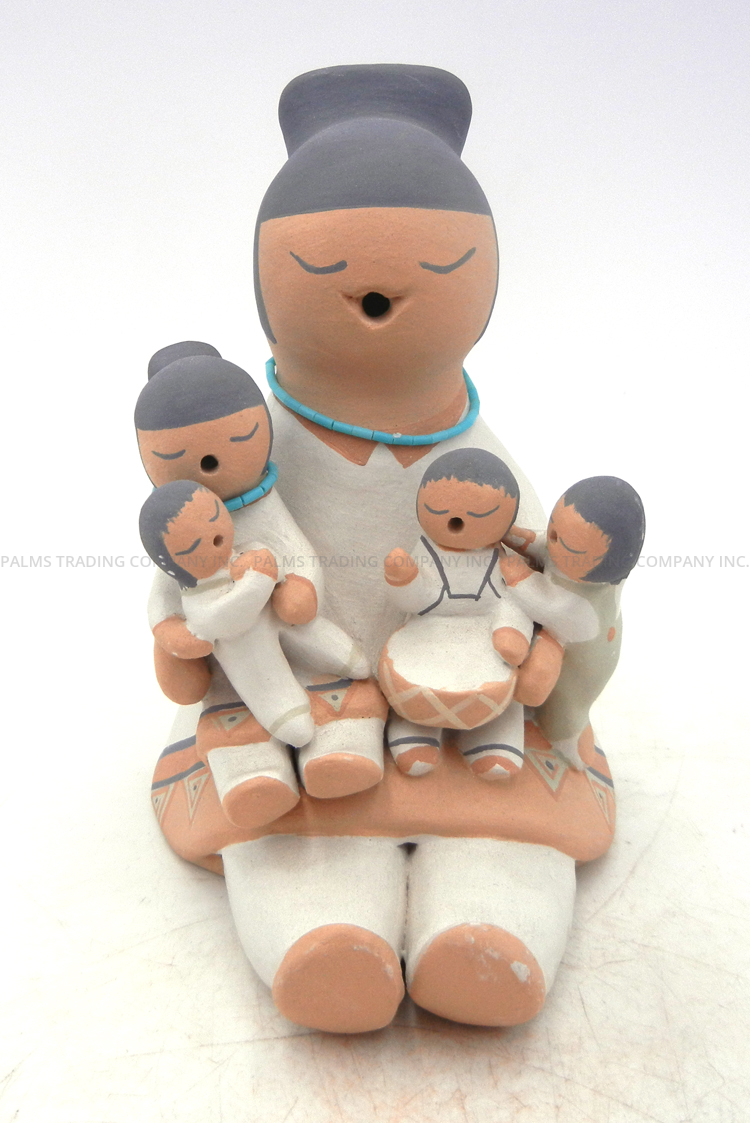
Art: Stella Teller.
“Seated Storyteller with Four Children.”

For too long, the dominant culture has missed out on some great storytelling. Gradually that is changing, and indigenous playwrights are part of the change.

Mark Kennedy wrote at the Associated Press (AP), “The financial crisis of 2008 hit Mary Kathryn Nagle differently. As a playwright and a citizen of the Cherokee Nation, she saw parallels to events that negatively impacted Indigenous people centuries ago.

“Her play Manahatta juxtaposes the recent mortgage meltdown when thousands lost their homes to predatory lenders with the shady 17th-century Dutch who swindled and violently pushed Native Americans off their ancestral lands. …

“Nagle’s 2018 play has landed in New York City at the prestigious Public Theater this winter and it’s just the latest in a flowering of Native storytelling. From Reservation Dogs, Dark Winds and Rutherford Falls on TV to Prey on the big screen and Larissa FastHorse becoming the first Indigenous female playwright on Broadway, barriers are being broken.

“ ‘I hope it’s not a moment. I hope it’s the beginning of an era,’ says FastHorse, a member of the Sicangu Lakota Nation and a 2020 MacArthur Fellow. …

“ ‘[Most] film studios had never produced any content actually written or produced by Natives. It may have been about some Native people, but it was not written by Native people. And we’ve just seen that flipped on its head,’ Nagle said. …

“Nagle recalls moving to New York in 2010 and asking artistic directors of theaters why they weren’t producing Native work. They would answer that they didn’t know any Native playwrights or that there weren’t enough Native audiences to power ticket sales.

“ ‘Good storytelling is good storytelling, whether the protagonist is white, Black, Asian, LGBTQ — it doesn’t matter,’ said Nagle, who is on the board of IllumiNative, a nonprofit working to deal with the erasure of Native people.

” ‘There’s a lot of projects out there that are changing the narrative and that are proving that our stories are powerful and that non-Natives are really moved by them because they’re good stories.’

“Madeline Sayet, a playwright and professor at Arizona State University who also runs the Yale Indigenous Performing Arts Program, sees the contemporary Native theater movement flowing from the Civil Rights Movement of the ‘60s and ’70s and an increase in awareness of Indigenous issues ever since Native people won the right to legally practice their culture, art and religion.

“She connects the Wounded Knee occupation of 1973 to the Standing Rock standoff over the Dakota Access Pipeline in 2016 to Ned Blackhawk’s The Rediscovery of America: Native Peoples and the Unmaking of U.S History winning the National Book Award this year.

“Sayet, a member of the Mohegan Tribe who became the first Native playwright produced at the Public when her Where We Belong made it in 2020, said keeping Indigenous stories being produced depends on changing funding structures and getting long-term commitments from theaters and programs like Young Native Playwrights Contest.

“FastHorse, who made history on Broadway in 2023 with her satirical comedy The Thanksgiving Play, which follows white liberals trying to devise a culturally sensitive Thanksgiving play, has since turned her attention to helping rewrite some classic stage musicals to be more culturally sensitive. …

“She has recently reworked the book for an upcoming touring musical revival of the 1954 classic Peter Pan, which was adapted by Jerome Robbins and has a score by Moose Charlap-Carolyn Leigh and additional songs by Jule Styne, Betty Comden and Adolph Green.

“FastHorse found the character of Peter Pan complex, the pirates funny, the music enchanting but the depictions of Indigenous people and women appalling. There were references to ‘redskins’ throughout, a nonsense song called ‘Ugh-A-Wug’ and Tiger Lily fends off randy braves ‘with a hatchet.’ …

“FastHorse widened the concept of Native in the musical to encompass members of several under-pressure Indigenous cultures from all over the globe — Africa, Japan and Eastern Europe, among them — who have retreated to Neverland to preserve their culture until they can find a way back.

“The playwright said one of her guiding principles in the reworking was to make sure a little Native girl in South Dakota could see herself and celebrate. ‘Then we’ve done our job and she can join the magic instead of having to armor herself against the magic.’ …

“ ‘I think one thing I’m just hoping that people take away from this play is like, “Wow, Native stories are really compelling. Native people are incredible. They’re incredibly resilient. They’re incredibly brilliant. Yes, there’s tragedy, but they have such incredible senses of humor,” ‘ [Nagle] said.

“ ‘I want them to love my characters the way I love them. I want them to feel the heartache. I want them to feel the laughter. I want them to feel the love,’ she said. ‘And I want them to leave the theater just wanting to know more about our tribal nations and our Native people.’ ” More at AP, here.

Got ideas for a show that needs the red pencil of FastHorse? I’d start with Annie Get Your Gun. Come to think of it, that show also needs the red pencil of poor, white mountain people. Their presentation is painful, too.

Read Full Post »

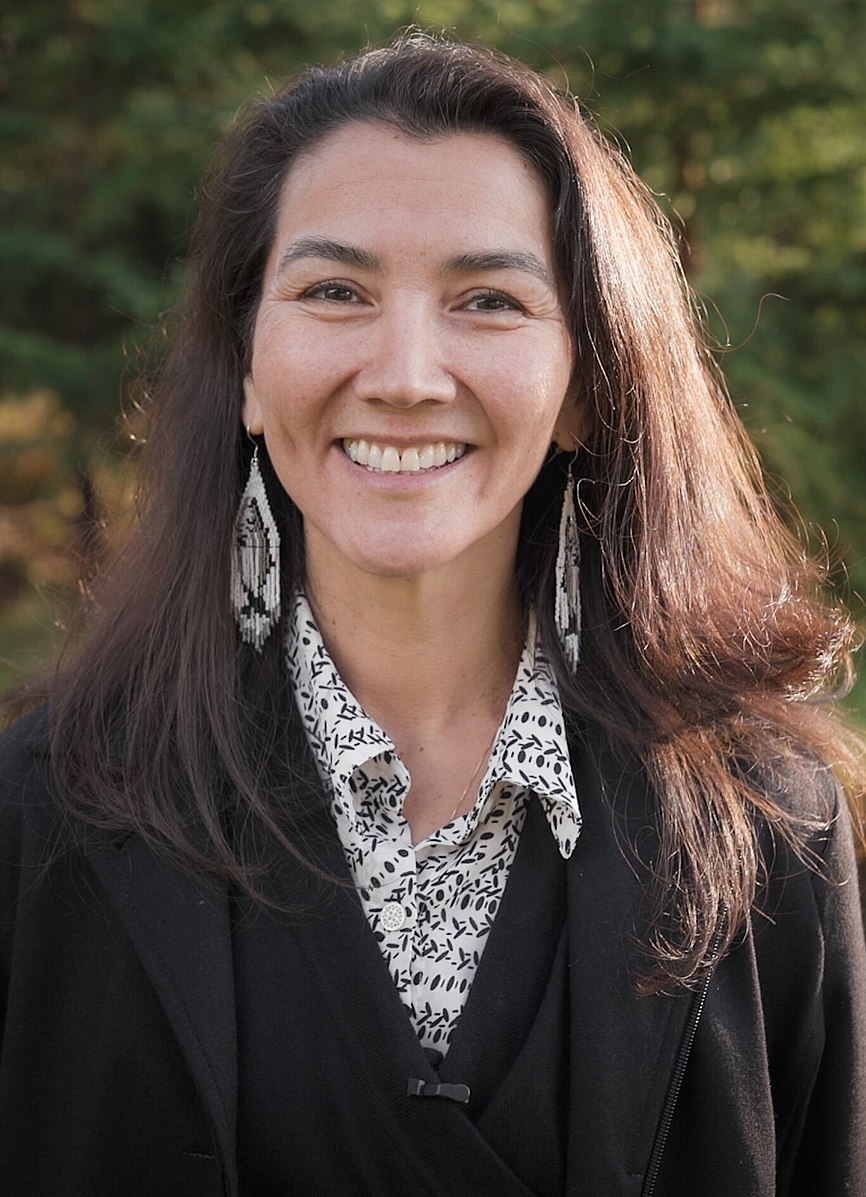
US Rep. Mary Peltola of Alaska.

Is there hope for Americans with different political views to get along? Well, why not? We used to get along. Now it seems that we have to teach ourselves that skill all over again.

Believe it or not, there’s actually a member of the House of Representatives who is showing people how it’s done.

Samantha Laine Perfas and Clayton Collins at the Christian Science Monitor created a podcast about her with West Coast bureau chief Francine Kiefer.

“A race for [Alaska’s] lone House seat had been won in a special election by Mary Peltola, an Alaska Native and a Democrat. … Representative Peltola had hired the chief of staff of her late Republican predecessor, and then hired two other Republican staffers.

“ ‘This just doesn’t happen in Washington,’ Francine says on the Monitor’s ‘Why We Wrote This’ podcast. ‘And I was curious about what kind of person it was that would make sort of a practical decision to hire folks who knew Alaska, who knew Washington, even though they’re not of your own political party.’ (Representative Peltola’s mother’s side of the family is Alaska Native and all Democrats; her father’s side is white Nebraska wheat farmers and all Republicans.)

“What Francine produced [is] a story about the ‘Alaska way’ at the root of such thinking. It’s about interdependence. And while there are many factors at play in Alaska politics – ranked choice voting among them – it’s really about something that might transfer beyond the 49th state. …

Samantha Laine Perfas
“Welcome to ‘Why We Wrote This.’ I’m today’s host, Samantha Laine Perfas. I’m joined by Francine Kiefer, a longtime, award-winning staff writer at the Monitor. … What was it that piqued your interest about Alaska? 

Francine Kiefer
“I have to admit that I’ve just been wanting to get back to Alaska for over 40 years. It was the scene of where I had my first job in journalism, at the Anchorage Daily News. I was just a pipsqueak intern, and I fell in love with the state and I’ve just always wanted to go back. And the political story was a fantastic reason. Here you have a red state. And it just elected two moderates to Congress.

“[Mary Peltola] was the first Alaska Native to be elected ever to Congress. And her whole persona is a bridge builder. One of the things that really got my attention was when I read that Mary Peltola had hired the chief of staff of her Republican predecessor, Don Young. She hired his Republican former chief of staff, his Republican scheduler, and she hired a Republican spokesperson from another office on the Hill. And I was curious about what kind of person it was that would make sort of a practical decision to hire folks who knew Alaska, who knew Washington, even though they’re not of your own political party. …

Laine Perfas
“What was it like talking to her for this story? 

Kiefer
“I’ve talked to many lawmakers over my journalistic career, and she sounded so authentic. She didn’t have her guard up. She wasn’t being measured about what she was saying. She is from an area in western Alaska that depends on fishing for survival. And she’s been fishing since she was six years old. She, as the Alaskans say, ‘She knows how to fill a freezer.’ And she also embraces the spirit of Alaska. It’s a large state. It’s a beautiful state, but it’s also a cold and a dangerous place. And people rely on each other. And there’s a real spirit of cooperation there where people help each other out in tough spots. … Having to help each other out, that is part of the ‘Alaska spirit.’ 

Laine Perfas
“I think it’s interesting to think about how this spirit of Alaska might be different than other parts of the US. How did you see that affecting the political arena? Did it affect the way that candidates interacted with their potential constituents? 

Kiefer
“It definitely did, because of the way that ranked-choice voting works. That allows voters to rank their choices in order of preference such that the one with the broadest appeal emerges from the system. When you’re out there on the campaign trail, you’re not only trying to get people to vote for you as their first choice, but you’re [also] trying to get people to vote for you as their second choice.

“I talked with a local candidate for the state Alaska Senate. And she said this time because of ranked-choice voting instead of knocking only on the doors of the Republican base, she knocked on over 6,000 doors, including many Democrats’, and they would open their door to her and say, ‘You don’t want to talk to me. I’m a Democrat.’ And her answer was, ‘Oh, yes, I do want to talk to you because you can put me as your No. 2 vote. And we may not agree on everything, but here is the stuff that we do agree on.’ And in the end, it was votes from Democrats who had ranked her second, who put her over the line into the majority. 

Laine Perfas
“In the beginning of the conversation, you referred to Peltola as a ‘bridge builder.’ What is the value of having someone like that in office? 

Kiefer
“I think it has two main impacts. One is it can help restore civility to a political dialogue and the other one is it can build understanding and mutual understanding among lawmakers, and hopefully lead to compromise.

“One of my sources for this story was a gentleman named Andrew Halcro. He’s a Republican. He talked to me about the time in which he served as a freshman legislator in the Alaska House at the state Capitol in Juneau. Right off the bat, within a few days of his arriving, he gave a speech where he said, you know, the way to solve Alaska’s fiscal problems is to cut the budget. Cut, cut, cut. And he pointed to rural Alaska, which is where most Alaska Natives live as the place [where the budget] needed to be cut.

“And this speech did not go over well. And within hours, he said, Mary Peltola, who of course, is from this region, knocked on his door and said, ‘You know, I know we’re both new here, but let me explain to you a little bit about what I know about rural Alaska and what their needs are.’ And he said that out of this discussion came a wonderful working relationship with her, as well as understanding and appreciation for the needs of a part of Alaska that he had never set foot in except for sport.

“So you get a sense there of the relationship building, of the understanding that can come about by having bridge builders in a legislature. At the same time, there are limits. And Mary Peltola also said to me, look, she can’t singlehandedly solve the political divide in the United States, but she can do her job of being a model in the way she communicates and the way she reaches out for other political leaders. 

Laine Perfas
“Do you think what we’re seeing in Alaska could be transferable to the rest of the country? 

Kiefer
“Well, definitely the voting system could be. Ranked choice voting has been practiced by Maine in a more limited sense since 2018. And in this very past election in November, Nevadans voted for a system very similar to what Alaska is practicing. So that part of it, I think, could be replicable. The other part of this that we’ve talked about is ‘the Alaska spirit,’ which is that cooperative spirit. I think that is rather specific to Alaska. And in fact, people told me that. But as Peltola said to me, it’s not exclusive to Alaskans, right? And she said, ‘You know, we have been civil before. If we’ve been civil before, we can do it again.’ ” 

Click the podcast arrow at the Christian Science Monitor, here.

Read Full Post »

On Twitter, I have been following @LakotaMan1, who notes on this weekend that “America wasn’t discovered — it was invaded.”

As I don’t want to take anything from Italians who are proud of the ancestry of Columbus but I need to acknowledge what indigenous people suffered from European contact, I have decided just to talk about corn. We all know that Europeans knew nothing about corn until they opened their minds to learn a thing or two from the continent’s original inhabitants.

Dina Spector wrote at Business Insider, “Glass Gem corn, a unique variety of rainbow-colored corn, became an internet sensation in 2012 when a photo of the sparkling cob was posted to Facebook.

“Shortly after, the company that sells the rare seeds, Native Seeds/SEARCH, began ramping up production to meet the high demand. The Arizona-based company still sells Glass Gem seeds on its website.

“Meanwhile, a Facebook page devoted to Glass Gem allows growers to share pictures of the vibrant corn variety. But the story behind Glass Gem is just as remarkable. It begins with one man, Carl Barnes, who set out to explore his Native American roots.

“The history was largely retold by Barnes’ protégé, Greg Schoen, in 2012, when the corn gained national attention. …

Barnes, who died in 2016, was half-Cherokee. He began growing older corn varieties in his adult years. …

“In growing these older corn varieties, Barnes was able to isolate ancestral types that had been lost to Native American tribes when they were relocated to what is now Oklahoma in the 1800s. This led to an exchange of ancient corn seed with people he had met and made friends with all over the country.

“At the same time, Barnes began selecting, saving, and replanting seeds from particularly colorful cobs. Over time, this resulted in rainbow-colored corn.

“A fellow farmer, Greg Schoen, met Barnes in 1994 at a native-plant gathering in Oklahoma. Barnes had his rainbow-colored corn on display. Schoen was blown away. That following year, Barnes gave Schoen some of the rainbow seed. Schoen planted the first seeds that summer.

“Schoen and Barnes remained close friends, and over the years, Schoen received more samples of the rainbow seed. In the beginning, Schoen only grew small amounts of the colorful corn in New Mexico, where he moved in 1999. In 2005, Schoen began growing larger plots of the rainbow corn near Sante Fe, alongside more traditional varieties.

“When the rainbow corn mixed with the traditional varieties it created new strains. Each year of successive planting, the corn displayed more vibrant colors and vivid patterns.

“According to an account from Schoen, Barnes told him that the rainbow seed originally came from a crossing of ‘Pawnee miniature popcorns with an Osage red flour corn and also another Osage corn called “Greyhorse.” ‘ …

“In 2009, Schoen passed on several varieties of the rainbow seed to Bill McDorman, who owned an Arizona seed company called Seed Trust.

“At that time, McDorman was the executive director of Native Seeds/SEARCH, a non-profit conservation organization. He brought the Glass Gem seeds with him, and they can now be purchased online.”

Saving ancient seeds is important work. To learn about the Svalbard Island Global Seed Vault in Norway, read my 2015 post, here, and my 2017 update highlighting concern that the protective permafrost is melting there.

For a bit more background on rainbow corn and some lovely photos, click at Business Insider, here. No firewall.

Read Full Post »

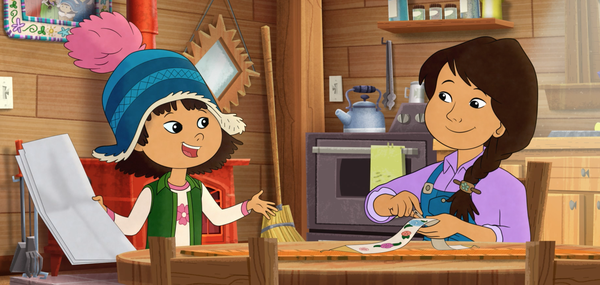
molly_approved_custom-4fd4462a2c5abefc308739f14d767a277e2b1d4c-s600-c85

Photo: WGBH Educational Foundation
In the PBS program
Molly of Denali, Alaska Native Molly Mabray helps her mom run a trading post in an Alaskan village.

In the old days, TV shows meant to educate children tended to be dry and clunky. Sesame Street began to move the bar, and now my grandkids and other children are learning a lot from shows that are fun, like Wild Kratts and the Octonauts. They amaze me with the facts they produce to correct my misperceptions about nature.

Now they are giving a thumbs up to a new show about indigenous people in Alaska.

Mandalit del Barco wrote about it at National Public Radio (NPR), “For decades, animated children’s stories included negative stereotypes of Indigenous people. …

“More recently, Disney and Pixar got kudos for more authentic representations of Native people in the films Moana and Coco. Now, TV networks and streaming services are reaching children with realistic portrayals on the small screen — where they consume most of their media.

“The new PBS show Molly of Denali is the first nationally distributed children’s series to feature an Alaska Native lead character. She’s 10 years old; her heritage is Gwich’in, Koyukon and Dena’ina Athabascan. She lives in the fictional village of Qyah, population 94. She goes fishing and hunting, and also looks up information on the Internet and on her smartphone.

“Molly is computer-savvy,’ says the show’s creative producer, Princess Daazhraii Johnson. ‘I think it’s really important for us to show that, because we are modern, living people that are not relegated to the past. That stereotype, that romanticized notion of who we are as Native people, is rampant.’

“Johnson says when she travels, she still meets people who assume all Alaskans live in igloos and are Eskimos — ‘which isn’t a term that people really even use anymore up here,’ she says. ‘We have 229 federally recognized tribes in Alaska; we have 20 officially recognized Alaska Native languages here. We are so diverse and dynamic.’ …

“In one episode, Molly learns that her grandfather stopped drumming and singing as a child when he was taken away to a Bureau of Indian Affairs boarding school. ‘At the school we weren’t allowed to sing the songs from our people,’ an elder tells her. ‘We were made to feel bad about who we were.’

“Johnson says this storyline really happened to one of the elders on the show’s advisory board. It’s a kid’s show, so it has a happy ending: Molly and her grandfather sing together.

” ‘We’re just over the moon about Molly of Denali, because this is exactly the type of thing that can really began to shift perceptions in this country,’ [Crystal Echo Hawk, CEO of the media watchdog group IllumiNative] says.

“Echo Hawk says that for years, Hollywood didn’t produce stories about or by Native people because it didn’t think a market existed for them. But that, she says, was shortsighted. Her organization polled more than 13,000 Americans, and found that nearly 80% of them said they want to learn more about Native peoples. …

“For several decades, the Australian and Canadian Broadcasting Corporations have spotlighted shows by and about their indigenous populations. Now, Netflix is partnering with three Indigenous cultural organizations to develop the next generation of First Nation creators across Canada.

“And in the U.S. and in Latin America, Netflix is running the animated film Pachamama. The story centers on a 10-year-old boy in an Andean village who dreams of becoming a shaman. His people suffer under both the Spanish conquest and the Incan Empire.

” ‘It’s told from the point of view of the Indigenous people,’ says Juan Antin, who wrote and directed the film. … Antin, who is from Argentina, says he was inspired by his travels with his anthropologist wife in Bolivia and Peru. ‘There, I fell in love with the culture of Pachamama, which is how the indigenous people call Mother Earth, having respect, love to the Earth,’ he says.

“The Cartoon Network series Victor and Valentino features two half-brothers in a fictitious Mesoamerican village, exploring myths that come to life. For example, they follow the dog Achi into the land of the dead, where they encounter a chupacabra and other legends.

“Animator Diego Molano, whose heritage is Mexican, Colombian and Cuban, … says it’s about time networks began showing cartoons with Indigenous characters and themes. He just hopes it’s not just a fad.”

More at NPR, here, and at the New York Times, here.


Read Full Post »

Photo: Annie Tritt for the New York Times
Muriel Miguel, a founder of the feminist Native American collective Spiderwoman Theater, is considered a grandmother of the Indigenous theater movement in the United States and Canada.

I’ve been interested to read how indigenous peoples around the world are reaching out to one another and starting to benefit from the strength of numbers. One result has been the emergence of international festivals staking out a place for native people in the arts world. I’m late with this story, but I wanted you to know about one such festival. It took place in January in New York City.

Siobhan Burke at the New York Times noted in particular that a grandmother of the Indigenous theater movement in the United States and Canada, Brooklyn-born playwright Muriel Miguel, was scheduled to be “among the 30 or so artists participating in this year’s First Nations Dialogues New York/Lenapehoking. (Lenapehoking is the homeland of the Lenape, the original inhabitants of the area encompassing New York City.) Taking place at multiple downtown theaters, the Dialogues bring together Indigenous performing artists from Australia, Canada and the United States for a week of performances, discussions and other gatherings, beginning Jan. 5. …

“In drawing attention to the breadth of contemporary Indigenous performance — with works spanning dance, theater, performance art and genres in between — the Dialogues are something rare for New York, if not unprecedented. Describing what to expect is not easy and not intended to be. In deciding what to program, the chief organizers — [Merindah Donnelly, an organizer of the series and the executive producer of BlakDance in Australia], the choreographer Emily Johnson, and Vallejo Gantner, the former director of Performance Space — set out to challenge a notion they often come across, that Indigenous performance fits any single description. …

“Ms. Donnelly said. ‘The people making it are Indigenous, but Indigenous is not a genre.’ …

The offerings here — many of which deal with themes of trauma, grief and healing — include Ms. Miguel’s Pulling Threads Fabric Workshop, in which storytelling and quilting serve as tools for mending old wounds. …

“While the tone may be somber at times, there is also much to celebrate. SJ Norman, an Australian artist of Wiradjuri and Wonnaruah heritage, said in an email that the opportunity to gather in New York ‘feels like an honoring of the continued existence of our peoples in the big city, as well as the dynamism and globalism of our peoples, which is absolutely vast.’ …

“A Native Alaskan artist of Yupik ancestry, Ms. Johnson has been working tirelessly to counter what she calls ‘the perceived invisibility’ of Indigenous performing artists, particularly in the United States. …

“One approach to bringing the United States up to speed is an ambitious pilot program, the Global First Nations Performance Network, which will be in development during this year’s Dialogues. … The network also requires, of each presenter, a commitment to undergoing what Mr. Gantner calls ‘a kind of decolonization process.’ …

“Ms. Johnson sees this year’s Dialogues as a microcosm of what the network may eventually accomplish, including opening up international exchange. For the Australian choreographer Mariaa Randall, whose ‘Footwork/Technique,’ [explores] the footwork of Aboriginal dances, a highlight of the Dialogues is the chance to simply talk and listen with peers from around the world.

“ ‘In our countries we can become kind of siloed,’ she said. ‘I want to be able to sit with and see and hear from other First Nations females: what their struggles are, their achievements, and how they continue to keep their culture and their practice together, to keep moving forward, because sometimes it is really hard.’ ”

More at the New York Times, here.

Read Full Post »

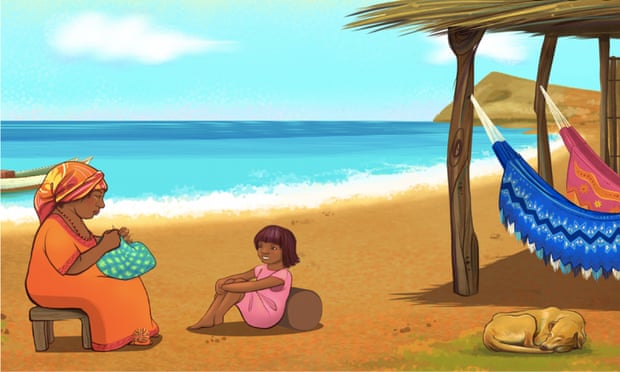
Photo: Colombia Games
A scene from the ‘Ancient Wisdom’ smartphone games, which allow players to learn about Colombia’s indigenous peoples.

As we have discussed before, there are many cultures and languages in danger of dying out, often because few people know about them.

A Colombian game company has taken a step toward addressing that ignorance, providing school children with entertaining phone games to help them learn about their indigenous neighbors.

Joe Parkin Daniels writes for the Guardian, “In a simple wooden hut on a Caribbean beach, a young girl sits at the feet of her grandmother, who is crocheting a brightly coloured shoulder bag whose intricate design draws on the mythology of the Wayuu people.

“It’s the opening scene from a smartphone game that seeks to educate Colombian children about their country’s endangered indigenous cultures.

“Some 3.4% of the Colombia’s population belongs to 87 different indigenous groups that speak 71 languages. But experts warn that these diverse cultures are at risk of dying out, threatened by climate change and violent armed groups operating in isolated regions the state has not reached. The National Indigenous Organisation of Colombia (Onic) estimates that 35 ethnic groups are at risk. …

“The games, available for iOS and Android devices, challenge players to learn the languages and cultures of the country’s indigenous groups, which vary from farming communities in the northern Darién jungle to nomadic hunter-gatherers in the Amazon. …

“The games narrate indigenous creation stories, and players must solve puzzles and draw the wild animals that populate indigenous myths.

“ ‘From one day to another these cultures could be lost,’ said Juan Nates, the CEO of Colombia Games, which recently relaunched the games. ‘When we started this project, I assumed there were three or four indigenous tribes; it was a shock to know how many there are – and how little we know about them.’

“The project was funded by the Sura Foundation, an educational subsidiary of the Sura banking group. The Sura Foundation has also sent about 200 teachers to schools to educate children about endangered cultures. …

“For Nates, raising awareness is key to preserving at-risk indigenous cultures. ‘People can’t worry about something, can’t do something, if they don’t know about it,’ he said. ‘It feels good to help with that.’ ”

Unfortunately, native children themselves usually don’t have smartphones, so it seems like the next step for a kindly philanthropist or foundation would be to get them some to use in school. (Can’t imagine anyone wants children looking at phones more than that.) And it would be nice if the different groups of kids could actually meet.

But what a good start! I’d love to see a game like this in parts of the US where there are large indigenous populations.

Finally, I don’t want to close without giving a shout-out to the Tomaquag Museum, which works to improve New Englanders’ knowledge of Rhode Island tribal culture through educational activities for children.

More at the Guardian, here.

Read Full Post »

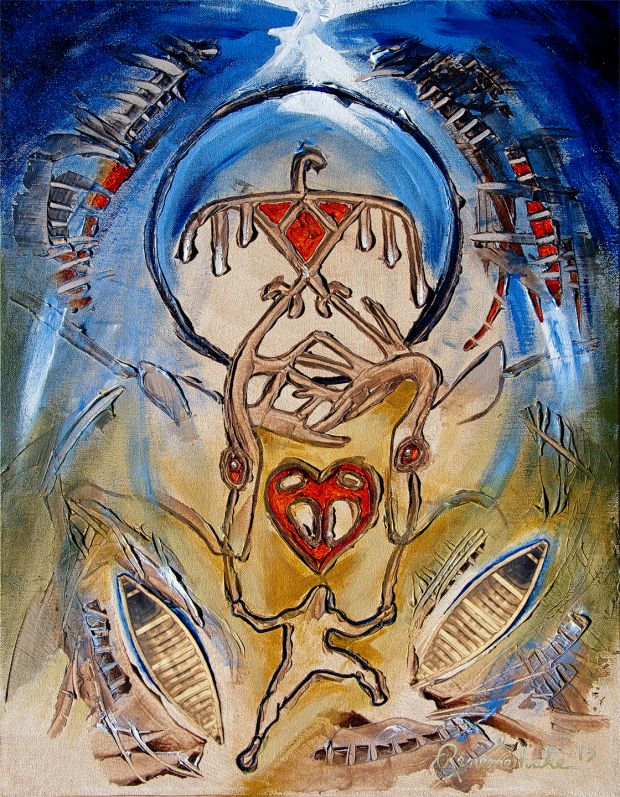
Art: Rene Meshake
Ojibwe artist Rene Meshake was part of a group of indigenous storytellers from Canada who attended the Untold Stories conference in Ireland in May.

As many people know, there was a dark period in US history when authorities thought is would be a good idea for indigenous children to be separated from their language, families, and culture. The same thing happened in Canada. Today, those children and their children are reclaiming their voices and telling their own stories.

Here is Catherine Conroy at the Irish Times: “On a Friday morning in a house in Dublin, I sit down to speak with three indigenous storytellers from Canada. They are here for a conference called The Untold Stories of the Past 150 Years/Canada 150 at [University College Dublin]. …

“Maria Campbell, Rene Meshake, and Sylvia Maracle, from Canada’s ‘Indian Country,’ accompanied by indigenous historian Kim Anderson, tell me a story of pain, resilience and the rebuilding of a shattered community through stories.

“Sylvia Maracle is an activist and storyteller from the Tyendinaga Mohawks. She believes their stories will resonate with Irish people, ‘with colonisers having come and disrupted what was probably the natural order.’ …

“She tells me of a conversation she had with an Irish taxi driver when she arrived. ‘He asked, “Are people recovering their memories?” I said, “They were always there, we just didn’t have the conversation.” He said, “That’s what happened here.” ‘ …

“Maracle believes in the power of storytelling as a force for rebuilding their communities. She feels privileged to have been ‘old woman raised’ by her traditional grandmother. …

“Maracle tells me that people now visit Maria Campbell ‘because they want this good medicine, this traditional stuff.’

“Campbell agrees that storytelling is medicine. ‘I grew up with a great grandmother and she never spoke English, she was a total “savage” according to the priest because she never converted.’

“But while Campbell grew up with stories, she always felt split between her traditional home life and her life outside. It was only after she stopped using drugs and attended her first ceremony in her late 20s that she realised the healing power of the stories, which came from ‘the old ladies, always women laughing.’ It was a revelation to realise ‘that you’d got this medicine, everything you need to help put yourself back together.’

“Campbell tells a story about the effects of colonisation that she learned from her teacher, the Old Man. …

“He had been trying to explain to her the effect of colonisation on their community’s wahkotowin, which in English means kinship, ‘but if you look at the word bundle, it’s all of our laws, it’s the way that we talk to each other, the way that we laugh.’

“He threw [a] jigsaw in the air. ‘He said, ‘”That’s what happened to us, everything was shattered and wahkotowin flew. Maybe you have three pieces, maybe she’s got half of one, if we come back together and we start to rebuild that, you bring your three pieces, you bring yours, and soon we’ll make the picture.” ‘…

“She recalls one story she wanted from her father that he would not give. ‘Then he got diagnosed with a terminal illness and I had to do the translating for him [in hospital]. I kind of went to pieces when we were driving home. He pulled to the side of the road, rolled me a cigarette, and he said, “That story you want, I’ll give it to you now.” He retold it and she understood now that it was a story about death, not the funny story she’d always thought it was.

“She translated and published the story. ‘In my family’s way, they were telling me that they trusted that I would treat it with integrity.’ ”

More at the Irish Times, here.

Read Full Post »