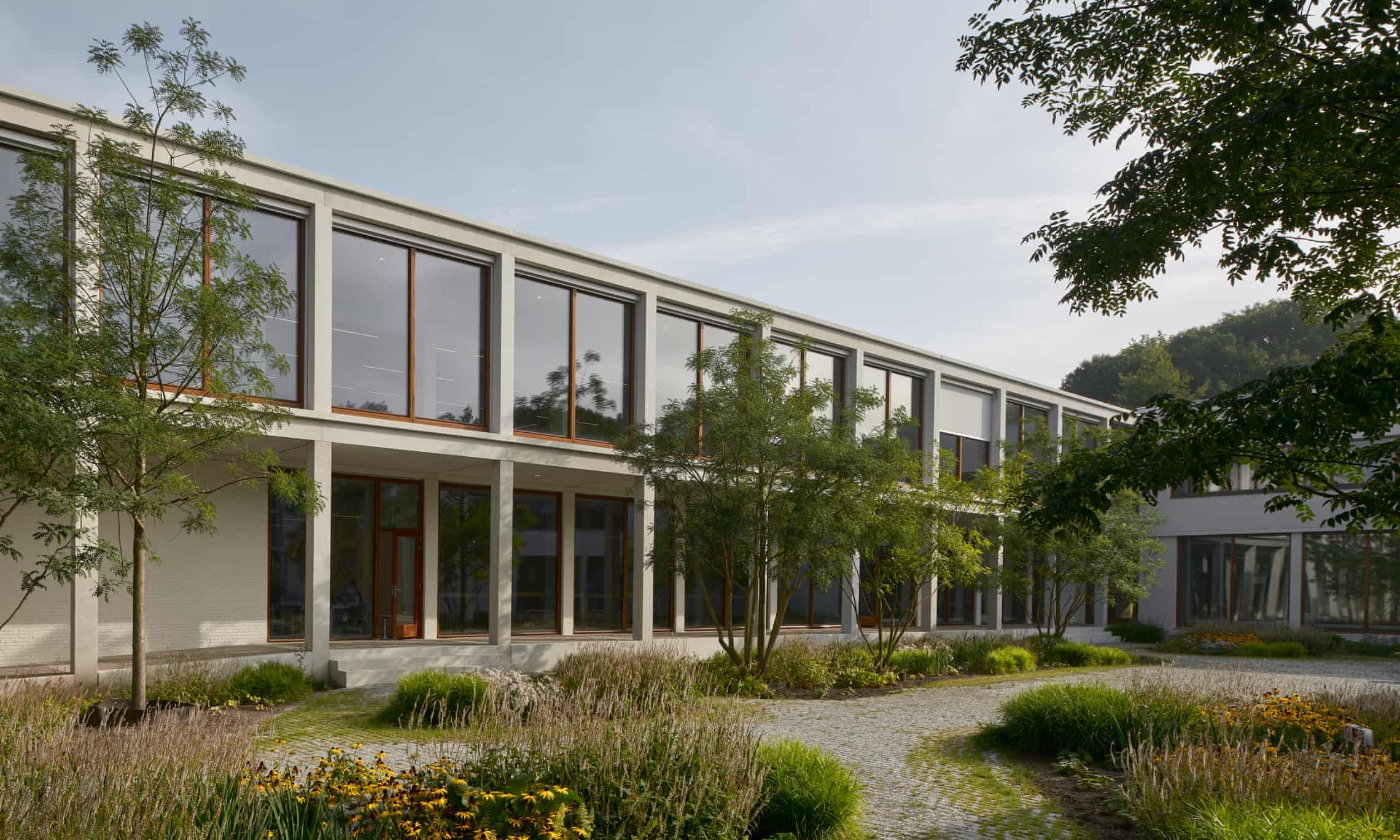
Photo: MWA Hart Nibbrig.
The makeover by Maarten van Kesteren Architects of a 1960s Utrecht college at less than half the cost of a new building and a third the carbon footprint is a lesson in sustainability.
In today’s story, a design company worked with what was available to make an old building sustainable. Apparently there’s some controversy about the approach, refitting the old instead of building everything new. See what’s happening in the Netherlands.
Rowan Moore writes at the Guardian, ” ‘The greenest building,’ to quote a slogan now popular among architects, ‘is one that is already built.’ It sums up the belated realization that the carbon impact and energy consumption of demolition and new building can be more significant than those of heating, cooling and running a building when it’s in use. It’s still a principle that is only patchily put into practice, in the UK and elsewhere. But the Dutch not-for-profit organization Mevrouw Meijer (meaning Mrs Meijer), which works to give new life to old school buildings, is quietly showing how it can be done.
“Her organization’s approach, says its founder, Wilma Kempinga, makes environmental, financial and practical sense, but it’s also about the experiences and memories of childhood. ‘It’s very important that students experience beauty,’ she says. ‘This is a place you will remember for the rest of your life.’ For Kempinga, beauty is best achieved by making the most of existing buildings – even those thought unremarkable – and getting the best young architects to design the transformation.
“We’re sitting in Nimeto, a trade school in Utrecht where students aged 16 to 21 learn shop window dressing, theatre set design, painting and decoration, specialist restoration and other skills. It’s a decent work of 1960s Dutch welfare state modernism – one of thousands from the country’s postwar educational construction boom: well lit and well proportioned, built in white-painted brick, within whose plain walls are the sights, sounds and smells of young people making things. Some of them are painting at encrusted easels beneath north-facing skylights, or planing and cutting timber; others trying out their decorating techniques on a house-like structure built to offer them as many awkward junctions and other challenges as possible. The school is populated with trompe l’oeil fragments of architecture – parts of stage sets – and experimental displays of objects you might find in a shop window.
“Now it’s better than ever. Where once the school was divided into two main blocks, they are now linked by first floor bridge and gallery with a colonnade underneath. A central courtyard that was a car park is now a garden that marks the cycle of the school year with yellow-and-white flowers in September, and blue-and-white flowers in spring. Double-height spaces bring light into a large basement, which can now be used for learning rather just storage. They also break open a regimented former arrangement of internal corridors double-loaded with classrooms. You can now look up, down, sideways and across, as well as straight ahead.
“The canteen is in one of the two blocks, the library in another, meaning that the two facilities shared by all students are distributed across the school. Previously, says Nimeto’s principal, Henk Vermeulen, students working in one part would refer to those in another as being ‘on the other side,’ but now all parts of the building are equally theirs. …
“The new design, by Maarten van Kesteren, a young architect based in The Hague, is about opening up and connections and making a shared container for the multifarious creativity of the students. The ‘whole school has a feeling that you are part of a lively workshop,’ as Van Kesteren puts it. The detail is simple, with what Kempinga calls ‘very beautiful pure materials that are unusual in school buildings,’ such as an oak floor whose woody smell mixes with that of the workshops. The project is achieved by the minimum of means, the only new structure being the long gallery/bridge, and gains additional education space. … It is also less than half the cost of an equivalent new building, with 30% of the carbon footprint.
“Mevrouw Meijer’s role, here and elsewhere, is to make the case for renovating rather than replacing, generating the evidence that it will be cheap, practical and climate-friendly. They also help select the architect. … Young practices without previous school experience, such as Van Kesteren’s, are preferred. ‘We don’t want an old guy or an old girl,’ says Vermeulen, but someone who will bring fresh thinking. As his school is always making the case that its inexperienced students should be trusted with opportunities, he says, it should do the same when appointing architects. …
“The original Nimeto building is typical of many in the Netherlands, whose design is quietly humane without being spectacular or special enough for it to be designated as significant heritage. Yet, says Kempinga, they are part of the country’s shared memory. …
“Schools also tend to be located in the centre of the communities they serve, whereas new replacements are often more remote. Yet, as Vermeulen puts it, ‘our neighborhood should profit from a new school, and our students are supposed to be working for this society,’ so it’s better if they stay put. The external landscape at Nimeto has been designed so as to connect the school’s garden with its surroundings and form part of the ‘ecological structure,’ as Van Kesteren says, of Utrecht.
“Mevrouw Meijer now have a number of school projects under way and recently completed. … Mevrouw Meijer is named after a well-loved children’s book character who worries a lot about nothing until she adopts and raises a baby blackbird, which teaches her to concentrate on essentials. If this sounds whimsical, the organization’s projects seem to be based on impeccable logic and well-founded aspirations; the only mystery is why their ideas are not applied more widely. There’s a mistaken belief that the best way to be sustainable to is to build something with all the latest environmental materials and devices. …
“Kempinga says it’s a question of attitude. ‘A lot of people like new buildings,’ she says, ‘and don’t have the imagination to see what’s possible with old ones.’ “
More at the Guardian, here.









 Suzanne's Mom's Blog