Feeds:
Posts
Comments

Posts Tagged ‘nursery’

Photo: Phil Torres, Dr. Geoff Wheat
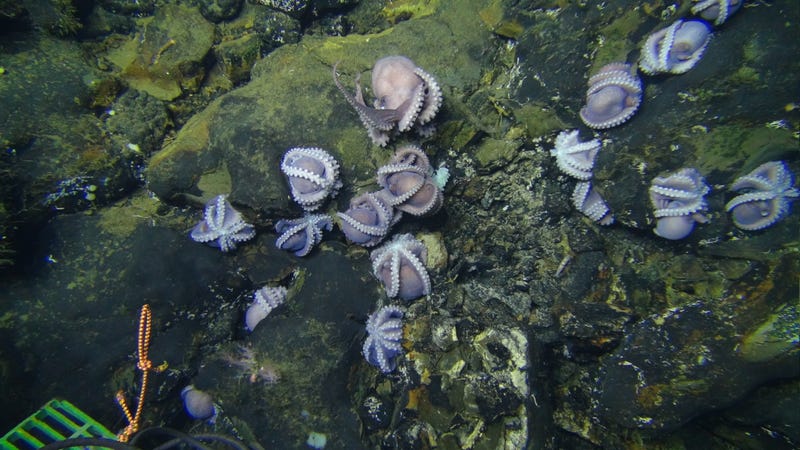
Seventeen octopods huddled on the Dorado Outcrop, two miles underwater near Costa Rica. Most are in a brooding (in the sense of baby-launching) posture.

Not sure where I picked up this octopus story, maybe from twitter. But who knows? Sometimes I learn facts about sea creatures from the Octonauts-loving grandchildren. (I’m grateful that cartoons these days have educational content. The cartoons I watched as a child were often no more than a bunch of mice running around and squeaking.)

Maddie Stone reports at Earther, “Scientists have made a truly bizarre discovery on an expanse of cooled lava 150 miles west of Costa Rica and nearly two miles underwater. There, they laid eyes on more than a hundred female octopuses, tending to eggs that didn’t seem to be growing in water that seemed too warm for their liking.

“Deep sea octopuses are a rare sight, and it’s even rarer to catch them in the act of brooding. So when Janet Voight, a deep sea biologist at the Field Museum of Natural History, examined footage collected at the Dorado Outcrop during a 2013-14 study of warm hydrothermal fluids seeping out of cracks in the rocks, it was nothing short of shocking to discover an enormous camp of tentacled, seemingly-expectant moms. …

“It’s [puzzling], because deep sea octopuses tend to thrive in near freezing temperatures. Warm water speeds up their metabolism, causing them to use up too much oxygen. And indeed, when lead study author Anne Hartwell examined the octopods’ breathing patterns in hundreds of hours of video footage collected by an ROV and a crewed underwater vehicle, she learned that those in or near hydrothermal fluids were breathing faster, suggesting oxygen stress.

“Moreover, none of the nearly 200 eggs the researchers examined appeared to be developing at all. …

“The researchers go on to speculate that females are drawn to the area because of the lack of sediment, which makes it easier to anchor their eggs, blissfully unaware of their new home’s thermostat problem.

“As the authors explain, hydrothermal fluid discharges can ramp up quickly at any given site, and once a female chooses a place to brood, she’s stuck with it — stressful environment or not. …

“Nicole Morgan, a deep sea biologist at Florida State University who also wasn’t involved, told Earther in a Twitter DM that while the water is warm, it’s ‘not outside known ranges for the octopus genus.’ The oxygen levels are also low but not lethal, she said, suggesting ‘the authors are probably right that this is sub-par brooding habitat.’

“ ‘I think they have captured a snapshot of what evolution looks like in real life — they are brooding in an area that is stressful but available and not immediately lethal,’ Morgan continued. ‘More likely than not this subpopulation will die out because of the high egg fatality, but if some eggs do survive, that could be a start to speciation.’ ”

More here.
Read Full Post »

Vanessa Thorpe wrote recently at the Guardian about some old nursery tales that are finding a new audience.

“Old-fashioned language and quaint illustrations are part of the ageless appeal of a classic children’s book, so stop modernising them: this is a growing plea from the parents of young readers – and it seems publishers are beginning to listen.

“[A September 2016] decision to turn back to the original look and vocabulary of the Famous Five books by Enid Blyton has opened the door for another classic children’s author, a forgotten star of storytelling, to be republished, as written, this autumn. Convinced that the best stories stand the test of time, editors at Pikku Books are to bring out original versions of stories by writer Elizabeth Clark, once a familiar sight on nursery bookshelves.

“ ‘There’s always going to be a market there for an elegant turn of phrase and a beautifully crafted story,’ said Elena Sapsford, founder of Pikku. ‘As a child, there are a few well-known classics you work your way through, but it is quite obvious there must have been more good writing going on, and often things are out of print just because copyright contracts have been lost.’

“Clark was a Winchester vicar’s eldest daughter, born in 1875. She found her vocation telling stories to the children in her village and began to teach others, moving to London and becoming a lecturer at teachers’ training colleges as well as the author of a series of successful children’s books, often illustrated by the acclaimed Nina Brisley.

“Clark’s stories, including ‘Dobbin and the Silver Shoes’ and ‘The Cat that Climbed the Christmas Tree,’ were often drawn from foreign folklore and legend and many were broadcast on the BBC’s Children’s Hour radio show in the 1920s. Sapsford came across the writer when secondhand editions were given to her family, and she then set about tracking down the Clark literary estate.

“ ”You have to become a detective because there was a lot of poor record-keeping in many publishing companies and I had to dig quite deep,’ she said. ‘I really don’t think they need any change of vocabulary.

People are looking for something fresh but we tend to forget that for young children everything is new.

More.

Children do seem to like the flowery language. My three-year-old granddaughter, for example, is a fan of the way Beatrix Potter tells the story of Peter Rabbit and can fill in the blanks when an adult reads the book to her. I myself like that explaining a word can lead to an interesting discussion or tangent.

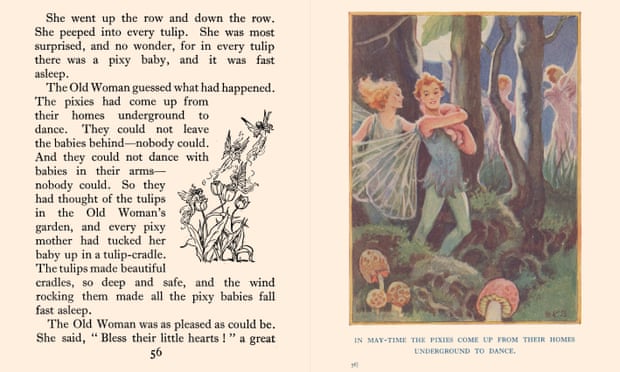
Reprint from the Talkative Sparrow & Other Stories, by Elizabeth Clark 

Read Full Post »

Today KM added three short poems to my recent blog post “Do you feel a poem coming on?”

Because of KM and the fact that everyone on twitter seems to be writing Valentine rhymes today, I thought I would point out an Andrew Sullivan post on the connection between poetry and childhood games.

Andrew quoted poet Sandra Simonds, who writes in the Boston Review, “The first thing is that sound itself intoxicates and that we connect sound, rhythm, and rhyme to form very early on, probably from infancy.

“The music of language forms our understanding of the world and that is why it seems so fundamental, in poems, to follow the music and sounds over sense, and to trust that your ear will take you where you want to go.

“We also learn that language is deeply connected to play — riddles, jokes, nonsense, and, for lack of a better word, fun. But it is also wedded to tragic losses, lost time, lost childhood, the loss of the child itself and the body of the child. … As poets, we take [a feeling of childhood] smallness with us into adulthood and turn it into poetry.” More here.

I need to think about that.

And while I’m thinking, I’ll share a rhyme that goes with jumping rope — and also perhaps with Valentine’s Day.

“Cinderella dressed in yella
“Went downtown to see her fella.
“How many kisses did she get?
“One, two, three, four, five, six, seven, eight …”

You are limited only by your jumping ability.

Photo: Luna & Stella, the birthstone jewelry company

Read Full Post »