Feeds:
Posts
Comments

Posts Tagged ‘Ojibwe’

Photo: Navajo Natural Heritage Program via Natural Resources Defense Council.
Diné Native Plants Program members work to restore a headwater stream impacted by livestock grazing.

The more that the US endangers its wetlands, the more we rely on the work that tribes do to protect them. Perhaps today’s article can help us see what the rest of us can do.

At the website for the Natural Resources Defense Council, or NRDC, Claudia Blanco Nuñez and Giulia CS Good Stefani describe how “Tribal Nations protect and manage millions of acres of wetlands, which help improve water quality, curb the risk of floods, recharge groundwater, and store large amounts of carbon.”

“Two years ago,” they report, “the U.S. Supreme Court slashed federal Clean Water Act protection of wetlands [with] harmful repercussions for droughts, wildfires, flooding, wildlife, and the drinking water supply. 

“In the absence of federal protection, the imperative to defend our shared waters falls increasingly on individuals, states, and Native American Tribal Nations. … Tribal Nations protect and manage millions of acres of wetlands in the United States, and with commitments made by the U.S. government to Tribal co-management and co-stewardship of federal lands, the amount of clean water safeguarded by Tribal Nations is growing.

“NRDC’s Science Office mapped the wetlands found within and intersecting the boundaries of Tribal reservation lands in the contiguous United States. Across the 294 federally recognized Tribal reservations mapped in this analysis, our scientists found that Tribes steward more than 3 million acres of wetlands. Even typically arid regions like the American Southwest have significant wetlands on Indigenous reservations. …

“In addition to the 56.2 million acres that are part of the Tribal reservation system, many Tribes have reserved or treaty rights on lands outside reservation boundaries, and most Tribes and their members maintain ongoing physical, cultural, spiritual, and economic relationships with their ancestral homelands. These reciprocal land and water relationships extend far beyond the political boundary of any designated reservation.

“This analysis is limited to federally recognized Tribes in the Lower 48 due to the complex Tribal governance systems in Alaska and Hawai’i. For example, the Alaska Native Claims Settlement Act of 1971 altered the previous Tribal ownership system to one led by Alaska Native Corporations. This system differs from federally recognized Tribes, which have a government-to-government relationship with the United States that includes eligibility for funding and services from the Bureau of Indian Affairs. That is to say, NRDC’s analysis looked at just a fraction of the total wetlands stewarded by and connected to the lives and well-being of Native peoples today.

“To learn more about Tribal wetland conservation, we spoke with leaders in the wetland management programs of the Navajo Nation and Red Lake Band of Ojibwe. …

“Navajo Nation agency staff are engaged in numerous projects to help restore and protect this essential resource. The Diné Native Plants Program recently submitted a grant application to remove invasive plant species along the Little Colorado’s riverbank. This will make space for native vegetation to grow and help with groundwater recharge for nearby Navajo farmers and families. The Diné Native Plants’ seed program also provides seed mixes for restoration projects that are solely sourced from Navajo plants. 

“Jesse Mike, the Diné Native Plants program coordinator, stepped out of the greenhouse to speak with us. He shared about the history of livestock grazing, trampling, and erosion that have impacted not only the health of the headwater streams on Navajo lands but also the underlying water table. His team is currently working to increase groundwater infiltration and improve the overall ecosystem health of three degraded streams in the Chuska Mountains. …

“The Red Lake Band of Ojibwe’s reservation is in northern Minnesota and has the greatest area of wetlands of any reservation in the contiguous United States. Across the Tribe’s more than 835,000 acres of land — all held in common by the Tribe — the Red Lake Band manages an astonishing 541,000 acres of wetlands. ‘So many wetlands,’ says Tyler Orgon, a biologist and the lead wetland specialist for the Red Lake Band Department of Natural Resources, ‘and we’re very fortunate for that.’ 

“A sizable portion of the Tribe’s wetland acreage north of Upper Red Lake is part of the largest expanse of peatlands in the continental United States. Peatlands cover about 3 percent of the earth and store more carbon than all of the planet’s other types of vegetation, including the world’s forests, combined. 

“One of the most important wetland-dependent plant species for the Red Lake Band — as well as other Anishinaabe and Dakota peoples across the Great Lakes region — is manoomin (Zizania palustris and Z. aquatica), the only wild rice native to Turtle Island. According to an Ojibwe prophecy, their ancestors were instructed to move west to the place where ‘the food floats on water.’

“The University of Minnesota research team We Must First Consider Manoomin (Kawe Gidaa-naanaagadawendaamin Manoomin) works to help protect this essential wetland-dependent plant by combining Western science with Indigenous science and learning from Ojibwe stewardship.

“The scientists have found that an increase in extreme weather conditions (like flooding events and record-breaking snowfall) negatively impact manoomin growth by uprooting the plant or drowning it out in its sensitive early stages. These weather events compound the already present settler-colonial impacts on wetlands in the region, including deforestation and conversion of wetlands into agricultural land use.

“Orgon hopes to restore some of the Red Lake Band’s wetlands that have been impacted by past agriculture.” More at NRDC, here.
Read Full Post »

Photo: Kerem Yücel/MPR News.
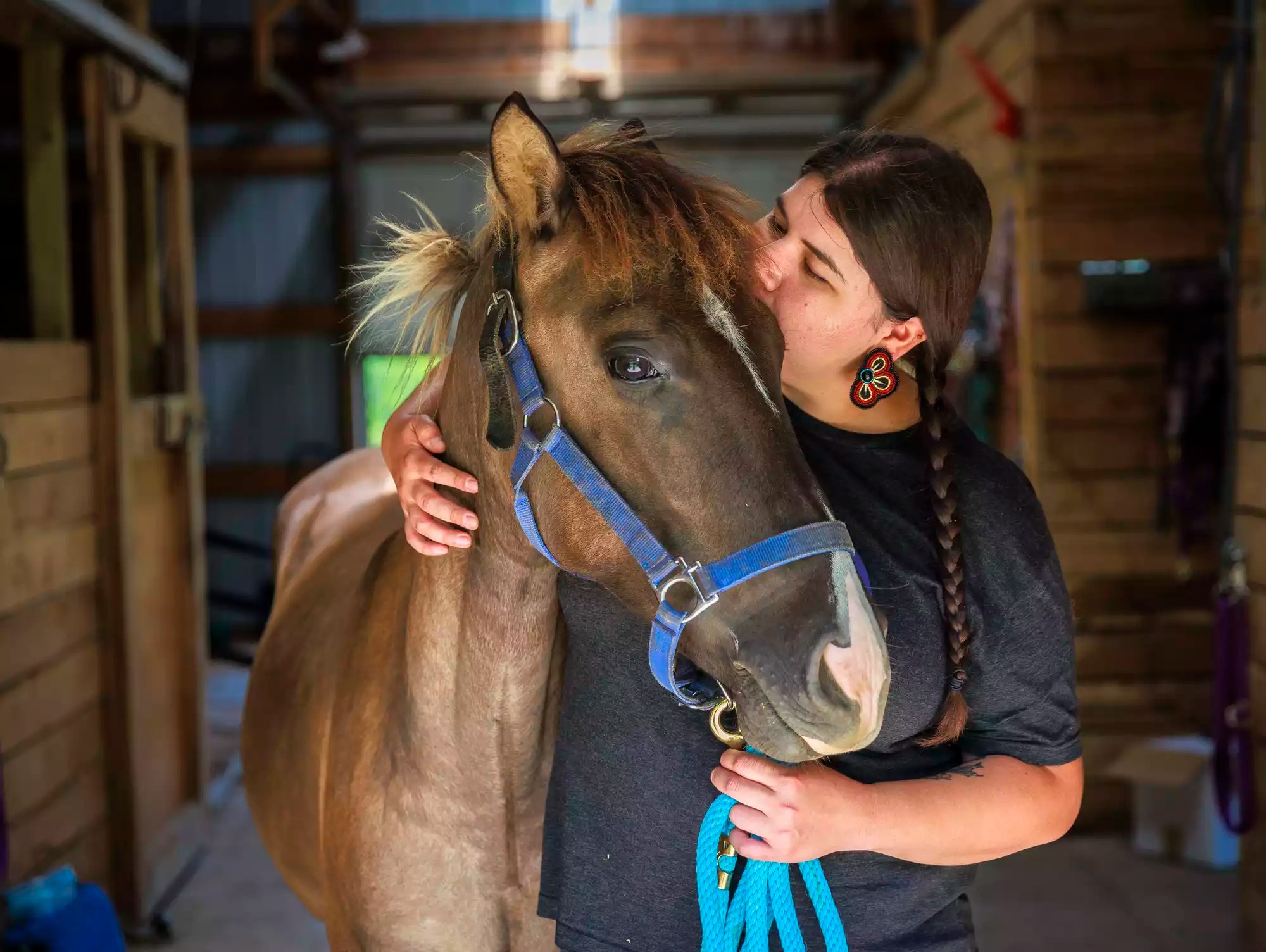
Em Loerzel is a graduate student and White Earth Nation descendant who started The Humble Horse, a nonprofit in River Falls, Wisconsin. The nonprofit is dedicated to reviving the Ojibwe horse, a rare breed adapted to the forests along the Minnesota-Canada border. 

Here’s s story that weaves threads such as indigenous life, endangered species, love of horses — and brings along associations with Icelandic ponies and Misty of Chincoteague.

Dan Kraker writes for MPR News from River Falls, Wisconsin, “Em Loerzel grew up hearing stories about the Ojibwe horse from her uncle, about small ponies that would roam free near Ojibwe communities tucked among the forests and lakes along the Minnesota-Canada border, and help with tasks such as hauling wood and trap lines. 

” ‘I think when people think about Native people and their horses, they think of Lakota people or southwest people, but he would tell me, don’t forget that we are horse people too,’ said Loerzel, a descendant of the White Earth Nation.

“Loerzel has taken that teaching to heart. Earlier this year, the 28-year-old graduate student in social welfare at the University of Washington raised money to rescue six of the horses from a Canada rancher who could no longer afford to keep them. 

“She brought them to a farm owned by a friend outside River Falls, where Loerzel moved last year with her husband. And she started a nonprofit called The Humble Horse, to raise awareness about the breed – which is also known as the Lac La Croix pony, and to help revive it. Only about 180 Ojibwe horses remain, mostly in Canada. 

“The horses are small, sturdy and friendly. Last month, Loerzel nuzzled a 2-year-old stud colt named Mino. ‘Short for Mino Bimaadiziwin. That’s our word for “a good life.” All of our Ojibwe horses have their Ojibwe names,’ Loerzel explained. … We Anishinaabe people bred them to be really smart, sweet, docile.’ 

“They also adapted over the generations to survive in the border lakes country. Their small stature made it easier to navigate the forest. …

“Loerzel says her main goal is to keep the horses safe and healthy. But she also wants to help Ojibwe people to reconnect with the horses. …

“Thousands of Ojibwe horses once lived near Ojibwe communities on both sides of the border. They would roam free part of the year, but at other times were gathered to help with labor.  But their population dwindled in the first part of the 20th century. Many were killed and used to make dog food, even glue. 

“By 1977 there were only four left, on the Lac La Croix First Nation in Ontario, just north of the U.S.-Canada border.  Word spread that the Canadian government planned to exterminate them. So four men from the Bois Forte Reservation in Minnesota planned a rescue mission. 

“They piled in a pickup truck, hooked up a horse trailer, drove across like beaver dams and portages and frozen ice in the middle of February, said Heather O’Connor, a Canadian author and journalist who spent five years researching Ojibwe horses. 

“It was dubbed the ‘Heist across the Ice.’ 

” ‘I was thinking, well, I’m wondering if this is the last time I’m going to ever see those horses,’ recalled Norman Jordan, a Lac La Croix council member who as a young boy remembers watching the men lead the horses away.  

“ ‘Everybody was so attached to them, in a deep way, a spiritual way. And it was sad just seeing them being taken away.’

“But those four rescued mares allowed the breed to survive. In Minnesota, they were bred with a Spanish mustang, and slowly, their numbers increased, largely among small herds in Canada. …

“A dedicated network of people has developed to help preserve the breed, [Kim Campbell of Grey Raven Ranch on the Seine River First Nation] said. But often, a breeder will retire, or run out of money. She said more are needed for the breed to survive. …

“Dr. Gus Cothran, an emeritus professor at the veterinary college at Texas A&M University who has studied the genetics of the Ojibwe horse, said rare and endangered breeds like it often encounter the same challenge — they need more people willing to take care of them and breed them. 

“ ‘And so one of the things that people involved with rare breeds need to do is create a market for them, and create a demand. And for a horse, that can be very difficult. They’re very expensive and demanding.’

“In 2017, almost 40 years to the day after those four remaining horses were taken away from the Lac la Croix First Nation, the horses returned. 

“Norman Jordan, the boy who watched them leave, became Chief. And he helped bring a herd back to the community. 

” ‘It’s almost like when they left there was a piece of my history that was leaving, a piece of me, like a void that I’ve had for all these years. And then that night they came back, it’s like that piece that was missing was back now.’ ” 

More at MPR, here. No firewall.

Read Full Post »

Photo: Tayler Gutierrez.
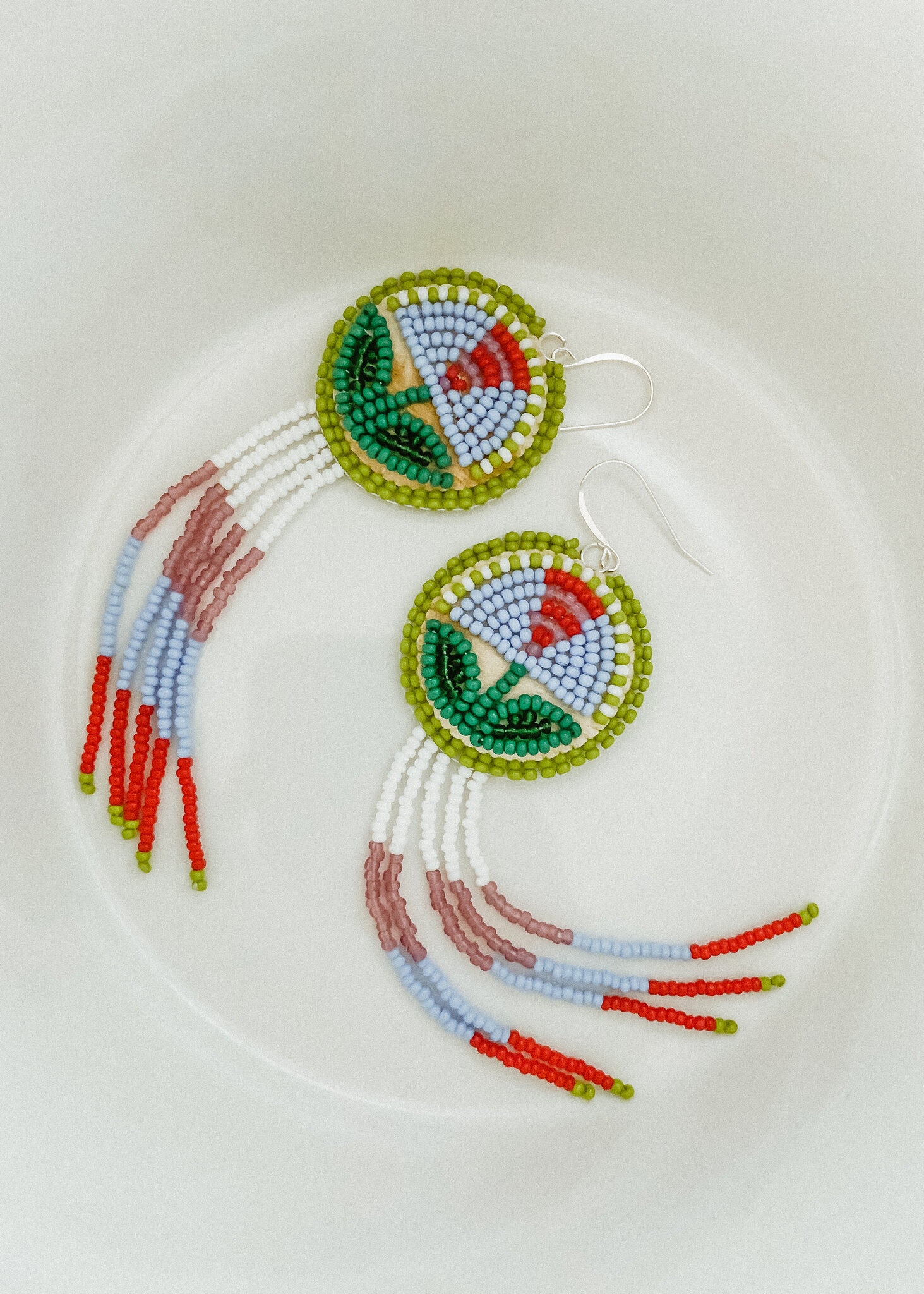
Earrings beaded onto smoked hide by the Cherokee artist Tayler Gutierrez.

You’re probably tired of all the whistling in the dark about good things that have come from lockdown when you know the past year has been mostly bad. But I wouldn’t want you to miss this cheerful story about indigenous beadworkers finding a market on Instagram during the pandemic.

Anna V. Smith reports on the phenomenon at the New York Times. “Last year, after the museum that Tayler Gutierrez worked at in Salt Lake City closed temporarily because of the coronavirus, she turned to her beadwork.

“A citizen of the Cherokee Nation of Oklahoma, Ms. Gutierrez, 24, had been practicing beadwork for years after learning from a mentor, the Diné poet Tacey Atsitty, and she already had a modest following on her Instagram page, where she posted her custom hat brims, earrings and leather pouches.

“But when the museum reopened in May, Ms. Gutierrez decided to take a much bigger leap: She put in her resignation notice and committed full-time to her craft. In July, she dropped her first collection of beadwork on Instagram; it included a set of earrings layered with two-tiers of dentalium shells and Swarovski crystals, and another pair with blooming flowers stitched with beads onto moose hide.

“With relatively few followers, she wasn’t expecting many people to buy. Instead, everything sold in five minutes.

“Ms. Gutierrez was shocked but thrilled — especially after the months of labor and love she had put into the work. (It takes around eight hours to make one pair of floral beaded earrings.) …

“Ms. Gutierrez just started her business ‘Kamama Beadwork last year, but she is one of many Indigenous beadwork artists on Instagram who have seen a spike in followers and sales that far outpaces their available stock.

“Partially, that’s because with craft fairs, powwows and art markets shuttered, many vendors and buyers are relying more heavily on the internet, [including] e-commerce websites like From the People, which launched in May as an online market space for Indigenous artists.

“Sales have been spurred by a national dialogue around racial injustice that has led to increased efforts to support Black and Indigenous artists and businesses. …

“As the Ojibwe fashion writer Christian Allaire has documented, the beading world is full of Indigenous artists blending traditional methods and contemporary forms: for example, Jamie Okuma and her beaded Louboutin stilettos; Skye Paul and her tattoo-inspired beaded patches or cow print beaded fringe earrings; and Tania Larsson’s fine jewelry made from musk ox horn and other natural materials of the Canadian Arctic.

“On Instagram, these artisans and others have amassed huge followings; when they drop collections or individual pieces, they sell out in minutes. Followers set alarms, pre-log into PayPal and have to buy as soon as the goods are available if they want a chance to snag anything at all. Recently, the same is true for Indigenous artists with half the amount of followers, including Ms. Gutierrez.

“Jaymie Campbell of White Otter Design Co. is one beadwork artist who has perfected the art of the Instagram drop. … As a full-time beader, Ms. Campbell made an Instagram account in 2016, a year after starting her business. At the time, there were seemingly fewer accounts by fellow artists, Ms. Campbell said. But that’s changed somewhat suddenly, as the isolation of the pandemic has connected more people in the digital sphere.

Virtual beading circles — online versions of community gatherings where beaders share techniques — have popped up, and many artists have experienced a surge in followers.

“ ‘The growth has been unprecedented, in my experience,’ Ms. Campbell said from her home in New Denver, British Columbia (population 473). On Indigenous People’s Day alone she gained over 2,000 followers from people promoting her work on social media.

“But in beadwork economics, more demand doesn’t necessarily mean more supply — and that is an important aspect of the work itself. As the Indigenous studies scholar and bead artist Malinda J. Gray, who is Anishinaabe Ojibwe Caribou Clan, from the Lac Seul Band, has written: ‘Beadwork encompasses a temporality that transcends the capitalist view of exchange.’

“Beadwork knowledge, materials and motifs are passed down through generations, Ms. Gray said, and those layers of time, meaning and memories give a piece of work ‘its own essence. And that’s something that cannot be mass produced.’ ”

And now for a word from our “sponsor”: Suzanne also sells jewelry on Instagram @lunaandstella, where you can find gorgeous antique heart lockets for Valentine’s Day. Or go to the website, here.

More at the New York Times, here.

Read Full Post »

This morning’s Google video about the famous Osage ballerina Maria Tallchief got me thinking about Native American women in the arts and how difficult their path to fulfillment often is. Consider the writer Marcie Rendon, whose reputation got a big boost when she received a McKnight Foundation award in August.

Mary Ann Grossmann reported the story for the Pioneer Press. “Marcie Rendon, award-winning poet, playwright, author of children’s books, short stories and the popular Cash Blackbear mystery series, is the winner of the $50,000 McKnight Foundation 2020 Distinguished Artist Award.

“An enrolled member of the White Earth Nation [Ojibwe], Rendon is the first Native American woman to receive this prestigious award, which honors artists who stay in Minnesota and make the state more culturally rich. …

“ ‘I’m kind of in shock and overwhelmed,’ Rendon said last week in a phone interview from her home near Lake Hiawatha in Minneapolis, where she lives with two granddaughters and a great-granddaughter. She has three daughters and 12 grandchildren.

“The Artist Award is always a surprise to the winner. The McKnight folks lured Rendon onto Zoom in August by telling her they wanted to talk about her work. But when she dialed in she found herself facing a roomful of people who told her she was the awardee.

‘I started crying. It just seemed unreal,’ she recalled. ‘Then somebody said, “Tell her how much the check is,” and I cried even more. I could give you a hundred names of people who deserve it. It never occurred to me I was in that category.’ …

“Rendon is pleased that her award turns the spotlight on Native artists.

“ ‘I grew up in northern Minnesota and never lived in the city. I didn’t even know book awards were a thing until one of my books was nominated. I don’t have an MFA. I’m writing because I love to create and because I love my community,’ she said. ‘Jim (Denomie) and myself getting this award says that Native artists are doing not just what is important for us as Native people, but important to the entire landscape of artists and people in Minnesota. It says we exist and have a significant impact on the arts. We are resilient and thriving. It says to non-Native people, “We are here, we never left.” ‘

“Among Rendon’s previous awards [is] the Loft’s 2017 Spoken Word Immersion Fellowship with Diego Vazquez. … Vazquez, a poet, novelist and editor, has known Rendon for years. ‘I am so excited for Marcie I almost cried when I heard about her award,’ he said. ‘I admire her for everything she does, in her writing and her life, where she is the central focus for her family. She gives her heart to everything.’ …

“Rendon is especially proud of partnering with Vazquez in the eight-year-old women’s writing project, in which they teach women incarcerated in jails in Ramsey, Sherburne and Washington counties. They have reached some 300 women and published 40 anthologies of their writing. …

“Rendon, born in the Red River Valley of northern Minnesota in 1952, was a voracious reader, creative writer and poet early in life. She was with her family, poor but happy, until she was in first grade and put into the foster care system. It was a bad experience, but she survived.

“While studying at Moorhead State College in the early 1970s, Rendon was part of a group of Native student activists who successfully demanded the launch of the university’s first American Indian studies department. She graduated with degrees in criminal justice and American Indian Studies and earned a master’s in human development from St. Mary’s University.

“Rendon moved to Minneapolis in 1978, because ‘this is where my people are, the birthplace of AIM (American Indian Movement),’ and worked as a counselor and therapist while raising her daughters.

“A 1991 performance by Canadian Cree-Saulteaux artist Margo Kane inspired Rendon to share her poetry and writing with a wider audience at venues such as Patrick’s Cabaret in Minneapolis. …

“ ‘I am super-excited for Marcie,’ said [writing buddy Carolyn] Holbrook. … ‘She’s multi-talented and sticks with it, all the while raising a family and putting up with the trauma of having been a foster kid. Her crime fiction knocks me out. Others write (mysteries) about Native Americans but she’s doing it from an authentic place.’ “

Read more at the Pioneer Press, here.

Read Full Post »

broken20treaty20quilt20performance

Photo: Portland (Maine) Museum of Art
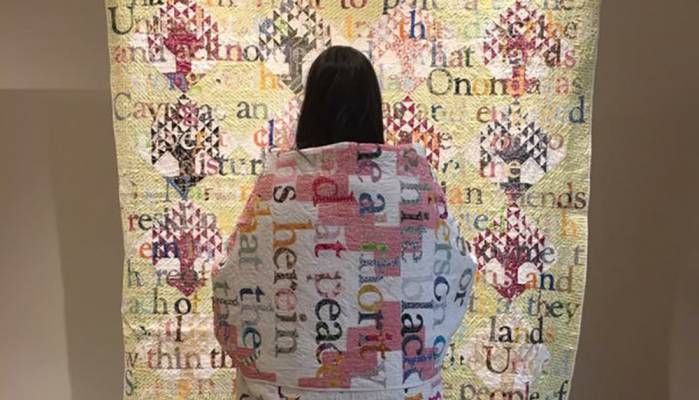
The quilts of artist Gina Adams tell the tale of broken treaties.

Lately, I’ve been reading books that have given me a deeper, more disturbing understanding of American history. Of course I knew about slavery and broken Indian treaties and adventurism abroad, but I tended to slink away from knowing too many details. You can hide only so long. Two books I would recommend are the novel Underground Railroad and the history Ramp Hollow.

Artist Gina Adams found her metier in quilts about broken treaties. There are no shortage of those, she says. This article by Indian County Today recounts the evolution of her work “Broken Treaties Quilts.”

“Gina Adams’ journey to becoming a political artist began as she probed deeper into her Native roots. Trained as a painter and printmaker, Gina Adams made apolitical art for many years. …

“While studying the effects of post-Colonial trauma and assimilation at the University of Kansas, Adams identified feelings of remorse and grief in her own life, stemming from her Ojibwe-Lakota grandfather’s forced boarding at the Carlisle Indian Industrial School in Pennsylvania. Her art began to change.

“ ‘I realized how powerful it was to be able to speak about all of those feelings,’ said Adams, who lives in Longmont, Colorado. …

“ ‘Broken Treaties Quilts,’ involves sewing text from Indian treaties onto antique quilts. … Sewing the words of injustice, letter by letter, onto objects of comfort and beauty represents the turmoil that Indians have suffered. …

“Adams, 52, recently finished quilts about both the 1851 and 1868 Fort Laramie treaties, which she made in response to the Dakota Access Pipeline standoff at Standing Rock. She has made 18 quilts so far, and shown them from Maine to the Midwest. Wherever she shows her work, she makes a new quilt that’s relevant to the treaty history of that geographic area.

Her goal is to create a quilt for every U.S. state.

“There’s no shortage of broken treaties, she said, and all were populated with twisting, confusing language that purposefully misled people and subjected the treaties to misunderstanding and different interpretations.

“Adams has spent most of the past three years reading the treaties, word for word.

” ‘In cutting up these letters and reading and re-reading these treaties, you begin to realize how the language was meant to be confusing when they were written. They are still confusing today. They’re very duplicitous in their meaning,’ she said. ‘You can understand why the misunderstandings happened. …

“In Native cultures, the quilt transcends modern timekeeping. It’s been around forever, serving as a source of warmth and comfort, as well as a feeling of home and family. Quilting is also thoroughly American, she notes, and both the quilt and quilting bees symbolize community and the idea of working together. …

“Adams begins with antique quilts that she finds at flea markets and elsewhere. Many people also give them to her. She prefers quilts that are a century old or older, so they reflect the general vintage of the treaties she represents. …

“The process of making the quilts is time-consuming and labor intensive, and enjoyable, Adams said.

“ ‘It’s very contemplative. It’s very mindful,’ she said. ‘I so look forward to every single aspect of it, even when I am doing the detailed stitching on the quilt. It’s a really focused time. I am lost in my thoughts and just focusing on the work itself. I find it to be so rewarding.’

“Adams … descended from indigenous and colonial Americans. Her grandfather was Ojibwe and Lakota, and Adams has always identified with her Native roots. ‘I remember being 3 and 4 years old and going on hikes with my grandfather. He would talk to me and introduce me to plants and animals and things in nature in the Ojibwe language,’ she said. ‘He would tell me everything in Ojibwe and then translate it. It was a wonderful connecting point that stuck in my heart and soul and has been there my whole entire life.’

“Adams, who is not an enrolled tribal member, plans to take Ojibwe language classes this fall, to deepen her cultural immersion.”

Read about Adams’s quilting process here.

Hat tip: @WomensArt1 on twitter.


Read Full Post »

Photo: Star Tribune
Ojibwe poet Jim Northrup

I have been trying to learn something about tribal cultures in the United States. I liked Spokane/Coeur d’Alene tribal member Sherman Alexie’s Thunder Boy (a charming picture book for young children) and The Lone Ranger and Tonto Fistfight in Heaven (an early, painful collection of short stories). Now I am reading some Native American poetry.

One poet, Jim Northrup, recently died. Here is a beautiful obit by Jana Hollingsworth in the Duluth News Tribune.

“Jim Northrup was a ‘tough man’ who taught his eldest sons to survive in the elements by living in a tepee on the Fond du Lac Reservation for several years, when money and jobs were scarce.

“But it was more than physical survival, said his son, Matthew, on Tuesday, the day after his father died from cancer-related complications. He taught them how to be strong in a world that didn’t treat everyone the same, he said, using humor — and education — as tools.

” ‘ “When you have really nothing else,” he said to me a lot, “you have your humor,” Matthew said. ” ‘When you grow up poor on the rez and when you grow up a lower class in society, you realize that.’

“Northrup, an award-winning writer of books, columns, plays and poetry — and a prominent member of the Fond du Lac Band of Lake Superior Chippewa — died [in July]. He was 73.

“Northrup was a storyteller, known for his stark and honest writing about his experience as a U.S. Marine in Vietnam and his early years at a federal boarding school. He was funny and pointed in his writings about everyday life on the reservation, politics and change in Indian Country. He wrote as a way to heal himself from some of the trauma he experienced during the war, he said earlier this year.

” ‘I knew my poetry was being used in vets’ groups to help people open up (and) maybe even write their own poetry as part of their healing,’ he told the News Tribune in March. ‘It worked for me, so I hoped it helped (others).’ ”

More here, where you can hear Northrup read a poem in Ojibwe about passing along the culture. Read the whole obit. It’s really lovely. I hated to cut it.

Read Full Post »