Feeds:
Posts
Comments

Posts Tagged ‘painter’

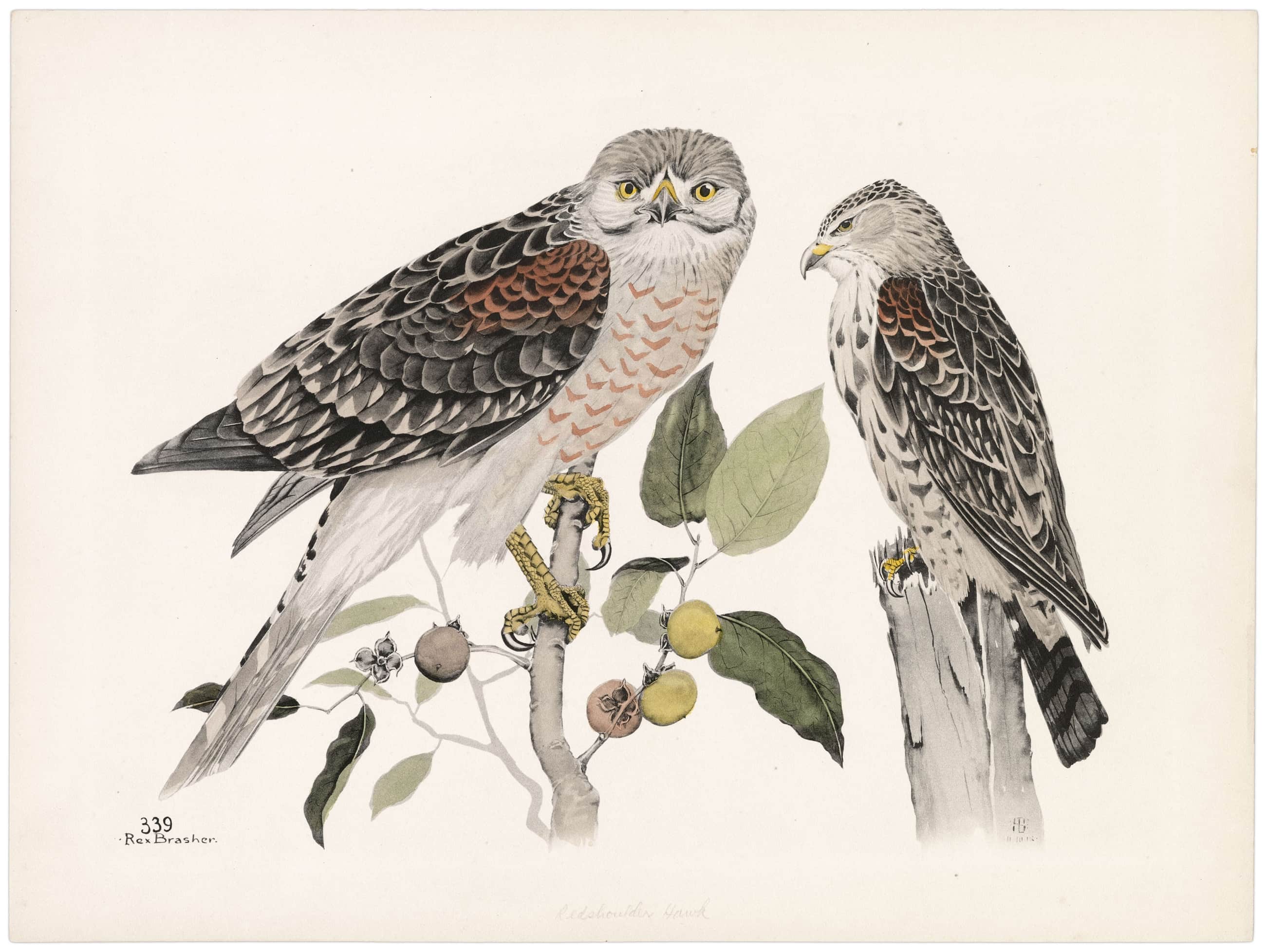
Art: Rex Brasher.
Rex Brasher painted more birds than Audubon — and never owned slaves.

With the more widespread understanding that bird painter John James Audubon owned slaves, controversy about honoring his name has erupted. Although for now the National Audubon Society is still the National Audubon Society, carrying on its otherwise great work, a small group called the Rex Brasher Association is advocating for more attention to another prolific bird painter of roughly the same period, Rex Brasher.

Philip Kennicott writes at the Washington Post, “On a gray day in March, Rex Brasher’s place looks a bit forlorn. The farmhouse is empty and the little shop made of cinder blocks feels derelict. But the leaders of the Rex Brasher Association who have gathered to show off the place see only possibilities for the 116-acre property.

“They want to place this wooded patch of the Taconic Range into conservancy, add modern studios for artist and naturalist residencies, refurbish the main house and cottage, and build a small museum inside the old shop. Two years after the death of the last Brasher relative to live on-site, they hope to resurrect the legacy and reputation of a man many people feel painted birds as well as or better than John James Audubon.

“Born in 1869, Brasher left an enormous body of paintings, almost 900 large-scale watercolors documenting American bird life and habitat, that became the source material for a monumental 12-volume compendium of hand-colored reproductions published as Birds & Trees of North America. He also made an unknown number of miscellaneous paintings and drawings, wrote a delightfully eccentric volume of philosophical reflections called Secrets of the Friendly Woods, and penned a hand-illustrated autobiographical account of his early forays, by sailboat, to document waterfowl from New England to Florida.

“Brasher was a retiring artist — a modest man who lived much of his life off the grid — which may be one reason he isn’t more famous. But his life’s project to document American birds, an effort to outdo Audubon that began in the 1890s and continued into the 1920s, was celebrated in its day, with an exhibition at the Explorers Hall of the National Geographic Society in 1938. Later, when he began hand-coloring more than 87,000 individual plates for publication, the project attracted subscriptions from collectors and patrons, as well as universities and libraries. Today, a complete set of his printed work can fetch more than $40,000. 

“He was praised by naturalists including John Burroughs (‘he is the greatest bird painter of all time’) and T. Gilbert Pearson, who helped found the organization that would ultimately become the National Audubon Society.

‘When you see a Brasher bird, you have seen the bird itself, lifelike and in a natural attitude.’

“But Brasher was very much a man of the 19th century, and despite periodic efforts to revive his work, his legacy — closely observed, naturalistic renderings of animal life — still suffers from having been out of step with the avant-garde and experimental art of the 20th century.

“That could change, however. The Connecticut State Museum of Natural History, which owns some 800 of the original watercolors, is planning to make them more accessible to the public with exhibitions in a new building, for which they will shortly begin fundraising. The efforts of the Rex Brasher Association, which has taken stewardship of the Upstate New York property near Kent, Conn., where Brasher lived until the mid 1940s, include digitizing and publicizing his work. And cultural changes, including a broader sense of what qualifies as fine art and a new urgency about the fragility of the natural world, may make people today more sympathetic to rediscovering his legacy.

“Brasher may also benefit from growing awareness that Audubon, to whom he was often compared, was a complicated, often odious figure, whose interest in birds grew out of a raw will to power more than any particular love of the species. Audubon was a formidable artist but also a ferocious antagonist within what Audubon scholar Gregory Nobles calls the ‘ornithological wars of the 1830s.’ He was also an enslaver and deeply contemptuous of the abolitionist movement in both the United States and the United Kingdom, where he spent considerable time preparing his landmark publication, The Birds of America, published between 1827 and 1838. The National Audubon Society is in turmoil today as local chapters drop the Audubon name and board members resign because the national leadership refuses to do so.

“Audubon studied birds in the wild before shooting them and then staging their carcasses in lifelike poses, a work process that has also aroused criticism even though it was standard practice for naturalists to kill animals they sought to collect and preserve. Those collections remain scientifically invaluable. …

“Audubon’s original paintings are a marvel, especially when seen up close. They are marvelously detailed and dramatic, and Audubon was particularly alert to the iridescent quality of feathers, which he reproduced with layers of silvery graphite over the pigments. But these images are also stagy and contrived, as if his birds are players on a stage, dramatically illuminated in the glow of gaslight. …

“Brasher sought a more naturalistic treatment, without Audubon’s operatic drama. Although he hunted and collected birds as a young man, he gave up that approach later, preferring close observation to specimen hunting. His paintings have a lightness and transparency wholly different from Audubon’s heightened atmosphere. He also had access to museums with extensive specimen collections and the published work of predecessors. He painted over 1,200 species of birds, far more than Audubon’s 497, but he was also building on the legacy of Audubon and others. …

“Between the early days of the artist-woodsman ornithologists and the death of Brasher a century and a half later, the science of ornithology spun off a vital and flourishing adjunct: birdwatching. Brasher might be considered the patron saint of that project. He was keenly interested in making accurate images of birds, but he was also interested in learning from birds. In Secrets of the Friendly Woods, he wrote about nature with a mix of genial animism and psychological insight. Nature was inexhaustible for him: ‘Forty years have not diminished the hope that each time afield I shall see something new, learn a novel habit of a bird or animal, and that expectation is seldom disappointed.’ …

“The difference between the artists’ work is like the difference between a grand aristocratic portrait and a psychologically nuanced character sketch. Audubon gets the dress and regalia right, and his birds project a powerful, self-fashioning sense of their own presence and importance. Brasher’s birds live contentedly in their own world and don’t need to perform or impress the viewer. If Brasher sometimes tends to moralize when he writes about birds, it isn’t Aesopian. The moral is almost always the same: We could learn a lot from birds.”

More at the Post, here.

Read Full Post »

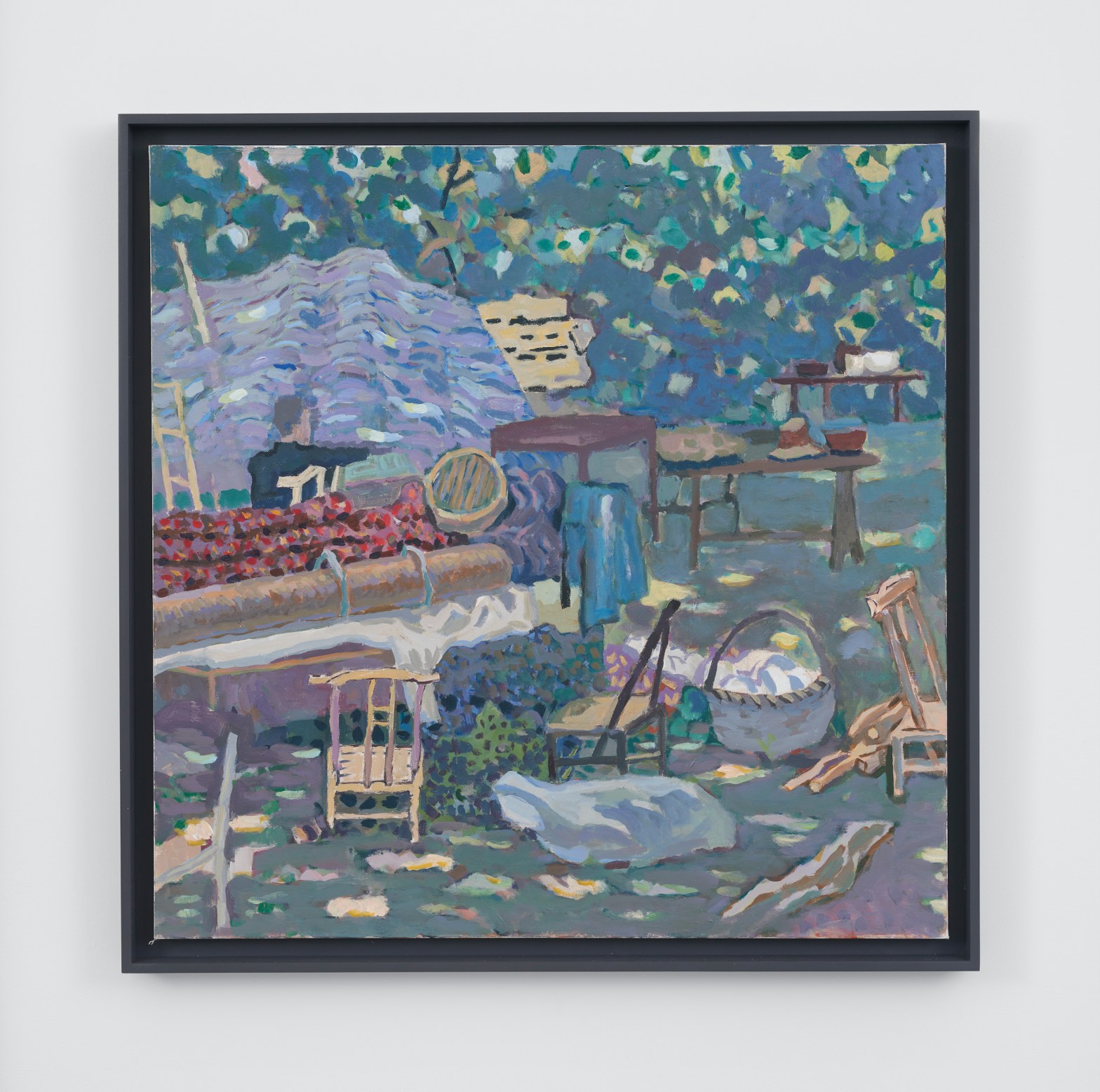
Art: Yun-Fei Ji via James Cohan Gallery.
Yun-Fei Ji, “Everything Moved Outside” (2022), acrylic on canvas.

The daughter of my mother’s college friend visited us in about 1980. Her family had been deeply traumatized by the anti-intellectual fervor of the Cultural Revolution in China. She couldn’t speak much English at the time, but I understood constant repetitions of “very painful, very painful.”

When I read today’s article about an artist who evolved from the Socialist Realism he was taught at the time, I thought of Ching and the way she grew, never completely shedding the deep hurt of totalitarian madness turned against friends and neighbors.

John Yau writes at Hyperallergic about Yun-Fei Ji, a Chinese painter who learned the state-sanctioned style of Socialist Realism “and then elected to unlearn it in order to reinvent himself.

“Yun-Fei Ji was born in Beijing in 1963, three years before the start of the Cultural Revolution (1966–76). Launched by the demagogue Mao Zedong, who distrusted intellectuals, the Cultural Revolution was an attempt to turn China into a utopian paradise run by and for workers. … 

“Ji belongs to the generation that studied at the Central Academy of Fine Art (CAFA) in Beijing in the first years after it reopened. Like the other painters in this group, he learned the state-sanctioned style of Socialist Realism and then elected to unlearn what he had absorbed in order to reinvent himself. … He secretly studied calligraphy — which was considered intellectual, bourgeois. …

“He opened it up and used it to respond to current events, such as post-revolutionary China’s massive Three Gorges Dam Project and the consequent displacement of more than 1.5 million people. …  

“As long as Ji continued to work in the tradition of Chinese landscape painting, Western audiences may have seen his views of displacement and protest, wayfarers carrying all their possessions, and melancholic ghosts as foreign to their experience. 

“This is why Ji’s change is radical. He decided to take on the Western tradition of painting in order to suggest that his subject matter is global, rather than local to China. … While the traumatic social upheaval caused by the Three Gorges Dam Project is still very much on Ji’s mind, as evidenced by painting titles such as ‘Migrant Worker’s Tent,’ ‘Satellite Dish on a Bed,’ and ‘Everything Moved Outside,’ new things are happening in his work.

“Three paintings signal a departure for Ji: two depictions of flowers (‘Sunflower Turned Its Back’ and ‘Early Spring Bloom 2020’) and a three-quarter-length view of a standing man — and my favorite work — ‘The Man with Glasses.’ … 

“Against a mottled brown, violet, and gray-blue abstract ground Ji has depicted an elderly man in blue pants and a long blue jacket over a pale blue shirt. The man is looking down, his hands in his pockets, and we cannot see his eyes. His head seems too large for his body, a deliberate choice by the artist. The shirt becomes a series of dry brushstrokes near the bottom and the gray-blue pants are largely unpainted. The jacket’s color reminds me of the blue surgical scrubs worn by doctors, which folds another level of feeling into the painting. The fact that the portrait resists a reductive reading is important to the change in Ji’s work and thinking. 

“The premier coup approach is in keeping with ink painting, which cannot be revised or layered, but in his use of paint he works differently, as seen in the mottled background and single dry brushstroke used to separate the front pockets of the shirt. The incompleteness of the man set against a dark, fully painted abstract ground seems both a formal and emotional decision. The man is ephemeral, while the dark, inanimate ground is permanent. The evocation of change and transience is also inherent to Ji’s paintings of sunflowers and blossoming branches. In these works, he meditates on the relationship between forced change and inescapable transformation.”

More paintings at Hyperallergic, here. No firewall. Subscriptions welcomed.

It was interesting to me that “Everything Moved Outside” (2022) makes this reviewer think of the migrant life. For me “everything moved outside” means Covid. Would love to hear more reactions to the paintings shown at Hyperallergic.

Read Full Post »

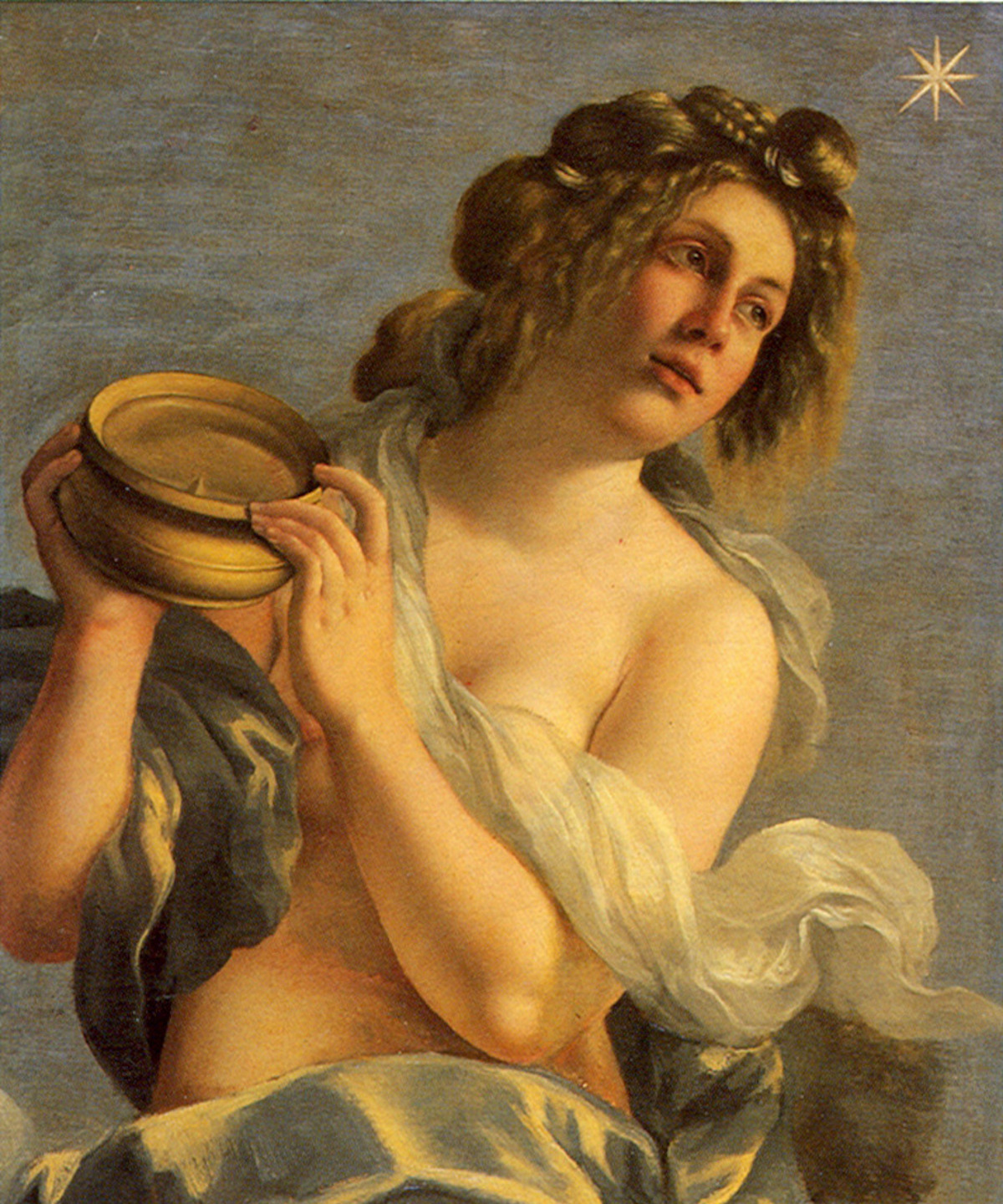
Art: Artemisia Gentileschi via Wikimedia Commons.
Artemisia Gentileschi, an an Italian Baroque painter, is considered one of the 17th century’s most accomplished artists. Shown here is her “Allegory of Inclination” (1616).

Have you been seeing the name of seventeenth-century painter Artemisia Gentileschi mentioned more these days? I have. Finally the world is coming to grips the astonishing proposition that some female artists are better than many male artists.

Elaine Velie has some thoughts on Gentileschi at Hyperallergic.

“In 1616, the 22-year-old artist Artemisia Gentileschi painted a nude woman perched in the clouds and holding a compass at the Florence home of Michelangelo Buonarroti the Younger, Michaelangelo’s great-nephew. The work was the first in the Buonarroti family’s home gallery dedicated to their famous ancestor, and the impasto ceiling painting, likely a self-portrait, was also one of Gentileschi’s first commissions. ‘Allegory of Inclination’ remained untouched for around 70 years until a descendant of Michelangelo Buonarroti commissioned the Late Baroque painter Baldassarre Franceschini (il Volterrano) to paint draping over the nude figure in the interest of modesty.

“Now, the former Buonarroti residence is the Casa Buonarroti museum, and a team of conservators there is working to ‘virtually restore the original appearance’ of the painting in a project called ‘Artemisia Unveiled.’ Using imaging techniques such as X-rays and raking light to examine the over 400-year-old brush strokes, the team will determine which additions were Gentileschi’s and which were Franceschini’s, and the final result will be an uncensored image.

“Elizabeth Wick, the restorer leading the project, told the Florentine that the team will not physically alter the existing painting for two reasons: Franceschini’s layer is considered a historic addition that contributes to the painting’s story, and since the two layers of paint were applied only 70 years apart, removing Franceschini’s draping would likely damage Gentileschi’s original coat of paint. …

“Gentileschi’s success in the male-dominated art world of 17th-century Italy, and the woman-focused subject matter of her work, have turned her into somewhat of a feminist icon. Although she earned recognition during her lifetime, Gentileschi’s work has been revisited in recent years through museum shows and other conservation projects.”

More at Hyperallergic, here. No firewall, but contributions are sought.

At Wikipedia, we learn that Gentileschi started out working in the style of Caravaggio and “was producing professional work by the age of 15. In an era when women had few opportunities to pursue artistic training or work as professional artists, Gentileschi was the first woman to become a member of the Accademia di Arte del Disegno in Florence, and she had an international clientele.

“Many of Gentileschi’s paintings feature women from myths, allegories, and the Bible, including victims, suicides, and warriors. Some of her best known subjects are Susanna and the Elders (particularly the 1610 version in Pommersfelden), Judith Slaying Holofernes (her 1614–1620 version is in the Uffizi gallery), and Judith and Her Maidservant (her version of 1625 is in the Detroit Institute of Arts).

“Gentileschi was known for being able to depict the female figure with great naturalism and for her skill in handling color to express dimension and drama. … For many years Gentileschi was regarded as a curiosity, but her life and art have been reexamined by scholars in the 20th and 21st centuries. She is now regarded as one of the most progressive and expressive painters of her generation.”

P.S. Check out SJ Bennett’s Queen Elizabeth II murder mystery, All the Queen’s Men, in which the Queen’s Gentileschi painting plays an important role.

Read Full Post »

stella2

Stella McLennan Roca (1879–1954), a painter known for her landscapes and her influence on the arts community in Arizona.

At Christmas, friends in Minnesota sent a letter that included this update: “Out of the blue in the spring, Mariana was contacted by Lonnie Dunbier, an art historian who was searching for information about Mariana’s grandmother, Stella Roca.

“Lonnie was preparing a series of lectures, to be given in Lincoln, Nebraska, about early Nebraska women artists. Stella [had] grown up in Nebraska City before attending the Chicago Art Institute and moving to Mexico, where she met and married Mariana’s grandfather, subsequently settling in Tucson, where she became a widely acclaimed landscape artist. Over a couple months in the spring, all of Stella’s landscapes that we have were photographed and quite a lot of historical information was exchanged, updated and edited, resulting in a comprehensive biography for use in her lectures.”

What a lovely experience! As a person who saves every letter ever written to her, I thought about what fun it would be if someone contacted me for information like that.

And I’m always interested in women artists, so I went to Wikipedia to learn more. I got a little sidetracked fixing typos in the entry, but I figured out that an offer Roca received through the Art Institute of Chicago to teach in Mexico was what led to her meeting her future husband.

I also read that her “work was known for light colored desert landscapes and glowing mountains” and that she served as president of the Tucson Fine Arts Association in 1932 and “was featured in the ‘Who’s Who in American Art.’ ” I search the internet for some of her work and was impressed. Delightful.

As for being sidetracked, do you know that anyone can edit Wikipedia? People will check up on you, of course, but it is ridiculously easy, and as a former editor, I simply had to fix a couple misspellings and a run-on sentence. If I was wrong to do that, Wikipedia experts will let me know.

Art: Stella McLennan Roca

Read Full Post »

Self-Portrait as Saint Catherine by Artemisia Gentileschi, a painter whose reputation is second only to Caravaggio among 17th-century Italian artists.

Lately, I’ve been following a really cool twitter feed called Women’s Art, @womensart1. It’s astonishing how many women, known and unknown, have been creating beautiful works over the centuries. Paintings, embroidery, sculpture, photos, quilts — you name it. The pictures have been an absolute treat.

Speaking of women’s art, I just learned about Artemisia Gentileschi, a painter whose reputation is apparently second only to Caravaggio among 17th-century Italian artists.

Paul Jeromack reported at Art Newspaper that she recently scored a big price at auction. Too bad she doesn’t get to benefit.

“A previously unknown Self-Portrait as Saint Catherine,” writes Jeromack, “sold at Drouot in Paris on 19 December for an artist record of €2,360,600 [about $2.9 million]. …

“The work, which dates from the same period (1614-16) as another Saint Catherine picture by the artist held by the Uffizi, was discovered by auctioneer Christophe Joron-Derem and presented in his sale of European paintings. …

“Lionised as an icon of feminist empowerment and artistic accomplishment since the 1970s … Gentileschi was canny enough to exploit her singular fame as a female painter in the form of self-portraits in the guise of religious or allegorical figures (her most notable depiction by another artist is by her friend Simon Vouet, who portrayed her with her brushes and palette and a wonderfully commanding swagger).  …

“Despite the artist’s popularity, she is not represented in many important museums: neither of the National Galleries in London or Washington, DC, nor the Getty, nor the Louvre, which curiously did not pre-empt the sale under French patrimony laws. While the picture’s relatively modest size of 71 sq. cm would endear it to private collectors, one hopes a major museum would be astute enough to acquire it.” More here.

Don’t you love it when someone “discovers” a lost masterpiece? That’s what I dream of — finding a masterpiece at a garage sale. Or like the blogger Things I Find in the Garbage, finding something amazing dumped on the curb.

Read Full Post »

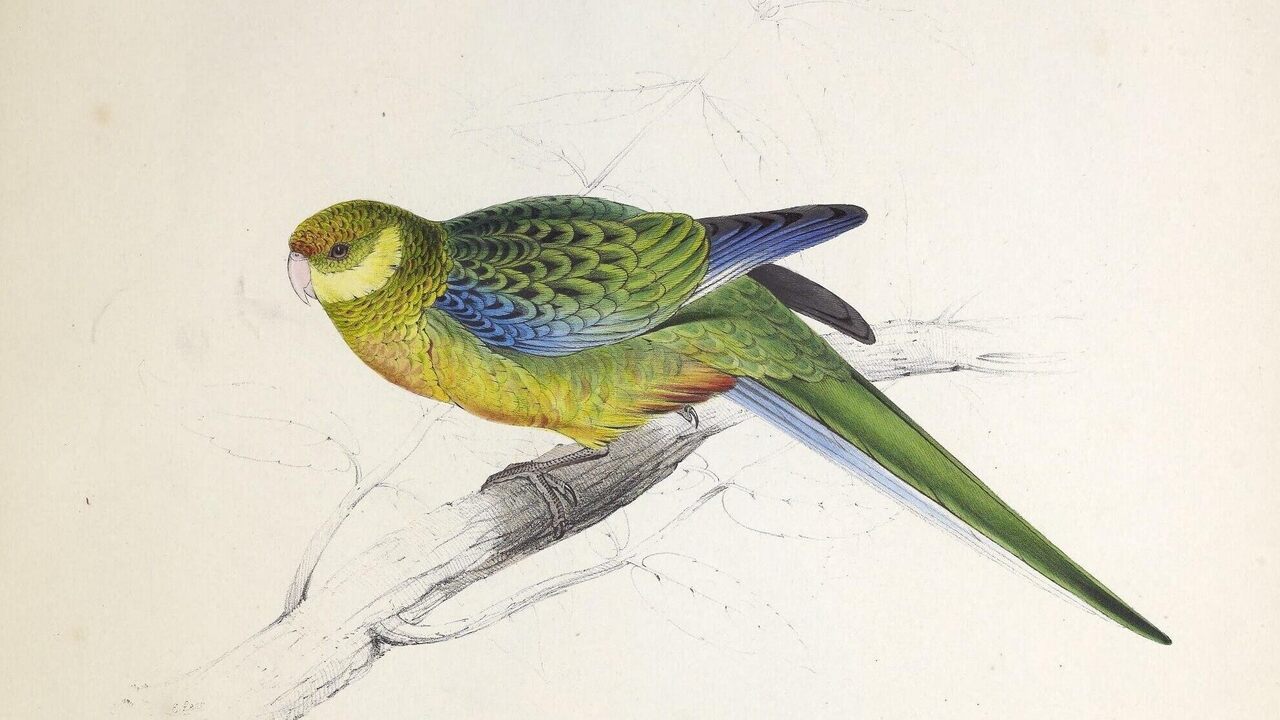
Source: Biodiversity Heritage Library
A Stanley parakeet, one of 42 plates in Edward Lear’s
Illustrations of the Family of Psittacidae, or Parrots.

Years ago, I read a biography of Edward Lear in which I learned that Lear had distinguished himself at a young age as an illustrator of nature — long before his playful limericks found an audience.

A new biography by Jenny Uglow brings more details to Lear’s story. And Cara Giaimo has a post about him at Atlas Obscura, where she reviews Peter Levi’s Lear biography.

“Edward Lear was a man unafraid of his own imagination,” writes Giaimo. “In his best-known nonsense poems and limericks, he wrote of things the world has never seen: green-headed Jumblies; toeless Pobbles; oceanic romances between birds and cats.

“But before he began bringing these impossibilities to life, Lear had a different focus: he drew parrots. When he was young, Lear was employed as an ornithological illustrator, and he spent years learning to draw birds, favoring live models in an era when most worked from taxidermy. Before he turned 20, he’d published Illustrations of the Family of Psittacidae, or Parrots, a critical success, and the first monograph produced in England to focus on a single family of birds.

“Lear was born in London in 1812. One of the youngest of a gaggle of kids. … He was raised mostly by his oldest sister, Ann. According to biographer Peter Levi, it was Ann who taught Lear to draw. …

“Early on in Lear’s childhood, his father went into debt, and his family fell on hard times. When he turned 15, he decided to put his talents to work professionally, and began taking commissions for everything from decorative fans to ‘morbid disease drawings for hospitals,’ as he later wrote a friend. In this way, he explained, he managed to make enough money ‘for bread and cheese.’

“But when he found the time to choose his own subjects, he often made his way to London’s Zoological Gardens. … While many artists of the time relied on taxidermied specimens—which, after all, were better at staying still—Lear preferred drawing live animals, and was known to occasionally enter their cages, so as to get a better look. …

“Lear’s models inspired at least one bit of verse. In December of 1830, he ended a letter to a friend with an account of a parrot-filled day that had left him rather peckish:

‘Now I go to my dinner,
‘For all day I’ve been a-
‘way at the West End,
‘Painting the best end
‘Of some vast Parrots
‘As red as new carrots,—
‘(They are at the museum,—
‘When you come you shall see ‘em,—)
‘I do the head and neck first;
‘—And ever since breakfast,
‘I’ve had one bun merely!
‘So — yours quite sincerely.

“As this poem suggests, the job was rather demanding. … Eventually, though, he boiled the process down to a science. First, Levi writes, ‘A young zookeeper would hold the bird while Lear measured it in various directions.’ Then Lear would make a few pencil drawings of the parrot, in different poses, doing his best to ignore the curious public (although sometimes he drew them, too). …

“By 1831, he and Ann had moved houses to be closer to the Zoo; the next year, he put out what would be his final batch of parrot lithographs, drew up a table of contents, and encouraged his subscribers to bind them into a complete book. He was 19 years old.

“Although he started out expecting to produce 14 sets of illustrations, depicting about 50 species, Lear ended up stopping just short. … He didn’t want to make the same mistakes as his father. ‘To pay colourer and printer monthly I am obstinately prepossessed,’ he explained, ‘[and] I had rather be at the bottom of the River Thames than be one week in debt.’ …

“Levi writes of Lear’s participation in [John] Gould’s Birds of Europe, ‘The queerer the animal the more it arrested him.’ ”

More here.

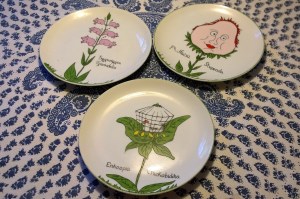
Lear-inspired plates that my family members have cherished for years.
012518-Edward-Lear-plates


Read Full Post »

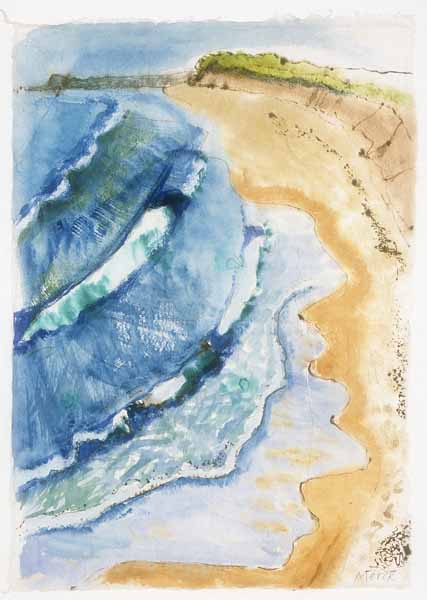
Art: Josie Merck
Mansion Beach, New Shoreham, Rhode Island

Oh, my poetry-loving readers, you are in for a treat! Praised by poets Lisa Starr and Naomi Shihab Nye and US Senator Sheldon Whitehouse, among others, a book of paintings and poems that captures a powerful love of a place just became available. It’s Present on Block Island, by poet Nancy Greenaway and painter Josie Merck.

I have written about Nancy Greenaway in several posts, including the time she asked for feedback on her owl poem. Her collaborator Josie Merck is both a fine painter and an extraordinary benefactor of environmental causes. Her love of nature, especially in Rhode Island, is palpable in the art illustrating the collection.

I welcomed like an old friend Nancy’s owl poem, but the other poems were new to me. They cover a variety of themes, especially the joy that the beauty of nature can inspire. But there are also poems about friendships; a poem about a big-shot visitor who failed to engage school children; a moving contribution about a brush with death (the plane’s fuel line froze; “we all now know/ just how we’d handle/ a situation like that”); a funny one about being trapped in brambles near home and calling out for help before deciding to crawl on her belly to safety; and a very touching poem about island great Fred Benson, who lived to 101 and hoped that the afterlife would be something like Block Island.

I enjoyed Nancy’s many intriguing turns of phrase, too — like a new meaning for “weather underground” and the reference to ice cream as George Washington’s “revolutionary dessert.”

You can find the book at http://www.lulu.com. Or you can call the Island Bound Bookstore at 1 401 466 8878, as I did to buy my copy with a credit card. It arrived in the mail soon after.

From “Astonished,” by Nancy Greenaway

“Each morning that I wake
“to sun painting black sky blue
“and inhale ocean-chilled air,
“I am astonished.

“First glance out my window
“grants me cloud migrations
“over Great Salt Pond,
“sails on Long Island Sound.

“I drive to work with crows,
“gulls, hawks, terns, herons
“following overhead,
“pass waddling ducks, walkers,

“check ocean choppiness
“in scene-slots between dunes,
“wave to fellow drivers
“who wave to me in turn. …

Read Full Post »

After Brian Bailey started to follow this blog, I took a look at his own WordPress blog. The first thing I saw was the watercolor below. I said, “Oh, wow.” Then I looked through his other drawings and watercolors and liked them just as much. So I want to share the Art of Brian site with you.

I’ve always loved watercolors, the gentle suggestiveness, the uncertainty of how the the paints will run. Although good work takes a lot of skill, there’s an element of the unexpected that to me is about the randomness of experience and the beauty of randomness.

Here are some thoughts from Brian on one of his recent paintings.

“When pulling together the shapes and lines that make up a composition it can be challenging to determine how much information is enough.  Some of my favorite drawings and paintings exhibit a very economical approach to line, saying just enough to let the viewer see what the artist sees.  In recent weeks, I’ve been doing many gesture drawings, as I’ve mentioned before, and I’m trying to let my paintings be, somewhat, more gestural.  I started my painting today outside with lots of light and finished it at home by bumping up the shadows and contrast.  I’m really trying to stop myself from overworking each painting.”

Brian also has an Etsy store. I am liking everything I see there.

Art: Brian Bailey
The Orange Van, Watercolor, 4″ x 4″, © 2015

Read Full Post »

Another good lead from the voracious reader of magazines in my household.

This Smithsonian story shows how a relatively simple invention made it possible for the Impressionists to do much more painting outdoors, en plein air.

Perry Hurt writes, “The French Impressionists disdained laborious academic sketches and tastefully muted paintings in favor of stunning colors and textures that conveyed the immediacy of life pulsating around them. Yet the breakthroughs of Monet, Pissarro, Renoir and others would not have been possible if it hadn’t been for an ingenious but little-known American portrait painter, John G. Rand.

“Like many artists, Rand, a Charleston native living in London in 1841, struggled to keep his oil paints from drying out before he could use them. At the time, the best paint storage was a pig’s bladder sealed with string; an artist would prick the bladder with a tack to get at the paint. But there was no way to completely plug the hole afterward. And bladders didn’t travel well, frequently bursting open.

“Rand’s brush with greatness came in the form of a revolutionary invention: the paint tube. Made from tin and sealed with a screw cap, Rand’s collapsible tube gave paint a long shelf life, didn’t leak and could be repeatedly opened and closed.

“The eminently portable paint tube was slow to be accepted by many French artists (it added considerably to the price of paint), but when it caught on it was exactly what the Impressionists needed to abet their escape from the confines of the studio, to take their inspiration directly from the world around them and commit it to canvas, particularly the effect of natural light.

“For the first time in history, it was practical to produce a finished oil painting on-site, whether in a garden, a café or in the countryside.” More.

Dear artist friends, I can picture what it would have been like for you traveling by train after an outing to some scenic spot before this invention. “Oh, Madame, I am so terribly sorry. I’m afraid my cobalt pig’s bladder burst!”

Photo: Chrysler Museum of Art
The tin tube, below, was more resilient than its predecessor (the pig bladder), enabling painters to leave their studios.

Read Full Post »

For an artsy, literary treat, take a look at the Project Gutenberg version of painter Marsden Hartley‘s out-of-print book, Adventures in the Arts: Informal Chapters on Painters, Vaudeville, and Poets, dedicated to Alfred Stieglitz.

Hard to resist an introduction like this:

“Sometimes I think myself one of the unique children among children. I never read a fairy story in my childhood. I always had the feeling as a child, that fairy stories were for grown-ups and were best understood by them, and for that reason I think it must have been that I postponed them. I found them, even at sixteen, too involved and mystifying to take them in with quite the simple gullibility that is necessary. But that was because I was left alone with the incredibly magical reality from morning until nightfall …

“I was constantly confronted with the magic of reality itself, wondering why one thing was built of exquisite curves and another of harmonic angles. It was not a scientific passion in me, it was merely my sensing of the world of visible beauty around me, pressing in on me with the vehemence of splendor, on every side. …

“It is because I love the idea of life better than anything else that I believe most of all in the magic of existence.”

(Thank you, Ellen Levy, for sending me the link.)

Art:  Marsden Hartley

Read Full Post »

I have admired the New England artist James Aponovich for some time but had not seen his paintings up close until the Clark Gallery in Lincoln had a show of his recent work. Amazing!

I am probably not using accepted art history terms, but the paintings  make me think of Italy and the Renaissance and are breathtakingly luminous. He might feature, for example, a large, glorious amaryllis flower in an ornate urn on a wall high over a traditional, distant landscape. You just want to go there.

The work in the current show is the result of Aponovich making up his mind to create a painting a week for an entire year. He succeeds splendidly, often making everyday items like Chinese takeout feel exceptional. For my money, there is not a dud in the bunch. (Although my money can’t stretch to even the smallest of the 52 pictures.)

I am so grateful to galleries that make work like this free for anyone who walks in off the street to view. Museums, wonderful as they are, don’t often let you in free.

Read Aponovich’s blog about the 52 weeks. Cate McQuaid in the Globe captures the essence of the show. Check her out, too.

Read Full Post »

Today I went to the last performance of Red, a drama about Abstract Expressionist painter Mark Rothko at the SpeakEasy Stage. It starred the inimitable Thomas Derrah with a young actor who was new to me, Karl Baker Olson.

It’s always interesting to read reviews of shows that touch different creative realms. For example, an opera critic who reviews Porgy and Bess might have a different take from a theater critic.

In the case of Red, theater critics were full of praise, but an art critic I read found the story thin.

Not being either kind of critic, at least not at the moment, I thought it moving, well acted, and well directed. The set by Cristina Todesco and featuring Rothko’s studio was amazing, dim, with the chapel-like quality Rothko found necessary for communing with a painting and seeing it vibrate.

Read Full Post »