Feeds:
Posts
Comments

Posts Tagged ‘palestinian’

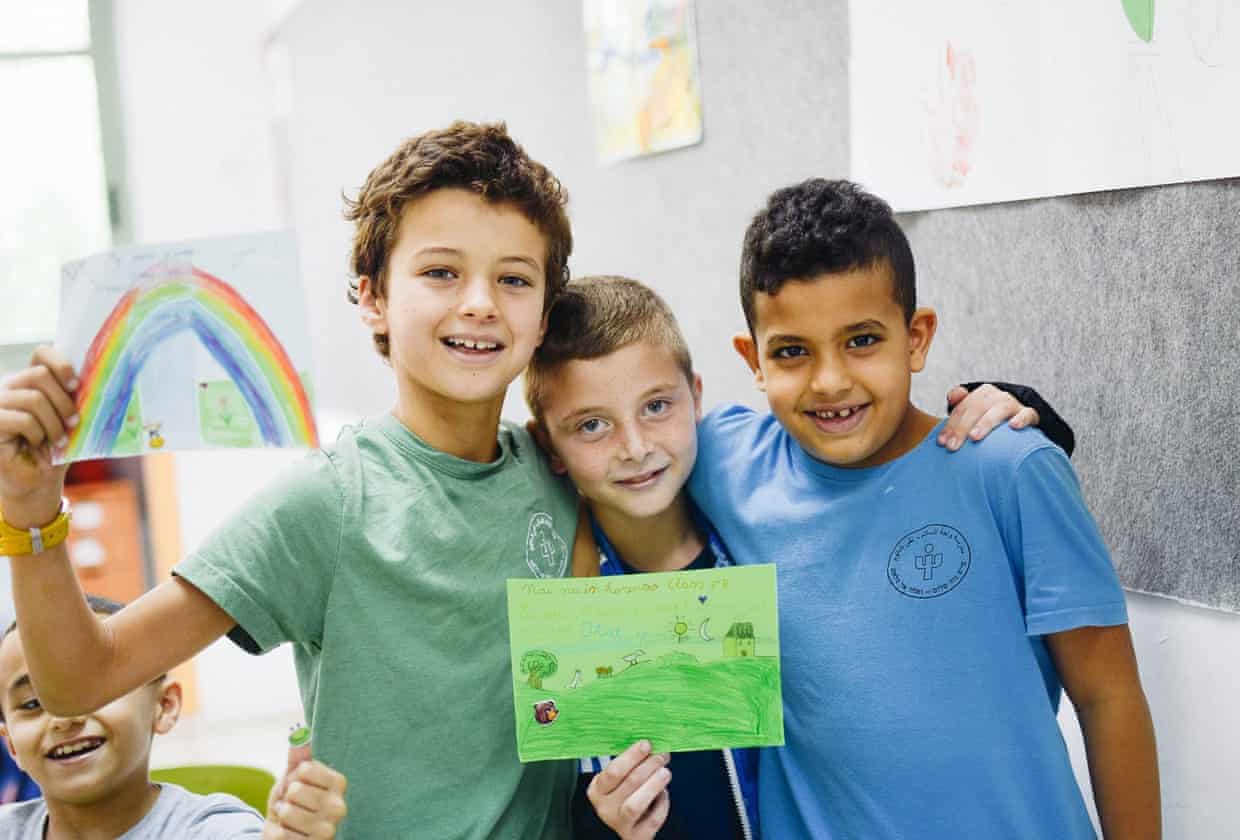
A classroom in the village of Wahat al-Salam/Neve Shalom, an Israeli village where Jews and Palestinians live together to promote peace.

Here’s an impossibly hopeful story that is in danger because its approach to peace is not the same as the government’s.

Chris Osuh reported at the Guardian in May, “An Israeli village where Jews and Palestinians live together to promote peace is in danger of losing vital overseas funding following Israeli government proposals to impose an 80% tax on foreign donations, residents have warned.

“Leading figures from the unique community – Wahat Salam/Neve Shalom, which translates as ‘Oasis of Peace’ – flew to the UK [in May] in a visit hosted by the Co-operative Group, which is calling for the UK government to support peace-building cooperatives worldwide with foreign and development policy.

“Samah Salaime, an Israeli Palestinian, and Nir Sharon, an Israeli Jew, co-direct the village’s educational institutions, which include the School for Peace for activists and a primary school where 250 Jewish and Palestinian children learn each other’s histories, in Arabic and Hebrew.

“The co-directors addressed a parliamentary round table, attended by Labour and Co-operative MPs and non-governmental organizations (NGOs) … in a visit coinciding with the 77th anniversary of the Nakba, when more than 700,000 Palestinians were dispossessed. On Saturday, the pair addressed the Co-operative Group’s annual general meeting in Manchester.

“Before the meeting, Salaime told the Guardian of the threat posed by a bill being debated in Israel’s Knesset. If it became law, it would decimate the finances of NGOs in Israel that receive funding from foreign states. …

“ ‘The biggest supporters for Wahat Salam come from the UK, from the Co-op, our friends in Switzerland, in Sweden, in the US. We don’t have any local Israeli support for our project … financially and ideologically, they are against us.’ …

“Conceived by Bruno Hussar, a Jewish Catholic priest, the village started with a handful of residents in 1978, in ‘no man’s land’ between Jerusalem and Tel Aviv.

“It now has 300 residents, half Israeli Palestinians and half Israeli Jews, including academics and tech professionals, with a waiting list of about 200 families.

There is no synagogue or mosque: instead, residents pray or meditate in a dome called the Court of Silence.


“Surrounded by olive trees, communal life in the village revolves around committee meetings where the co-operative’s decisions are voted on, shared meals, the swimming pool and the Garden of Rescuers, which commemorates heroes of global catastrophes. There is a guesthouse in the village, and children from surrounding areas are bussed in to attend the school.

“Salaime said: ‘We were attacked by settlers three times. … We have all kinds of unfortunate incidents, and we survive. … We break the rules, we break the stereotype, the brainwashing of the Israeli mainstream that peace isn’t possible,’ Salaime said. ‘We have to win this and offer a different agenda.’ “

More at the Guardian, here. France’s Le Monde has more here.

Read Full Post »

Photo: Alfredo Sosa/CSM.
Police officers at a headquarters briefing before departing on assignment in Columbus, Ohio, Nov. 24, 2024.
Columbus is learning to deal with protest marches differently. And with more success.

As a country, the US is not exactly on the cutting edge when it comes to handling large protests. As Clifford Stott, professor of social psychology at Keele University in England and visiting professor at Ohio State, says, “Policing of crowds in America is about 20 years behind what it is in Europe.”

This is in spite of the fact that an American, Gene Sharp, practically wrote the book on peaceful protests. (See my post, here.) We seem to have an issue of learning, unlearning, and relearning.

In January, Simon Montlake wrote at the Christian Science Monitor about how the police in Columbus, Ohio, have been handling pro-Palestinian protests.

“At a pro-Palestinian street protest in Columbus, Ohio, last fall, demonstrators march to the rhythm of liberation chants, punctuated by occasional horns from passing cars. ‘Free, free Palestine,’ they cry, waving flags and banners.

“But mingling among the demonstrators are four uniformed police officers wearing powder-blue police vests emblazoned with ‘Columbus Police Dialogue.’ One of them is Sgt. Steve Dyer, the team leader of a special unit that talks with protesters rather than confronting them with riot gear.

“ ‘Their goal is to have their voices heard,’ Sergeant Dyer says. ‘We will walk and work with those who are there to peacefully protest.’ By walking with and talking to protesters, police hope to build legitimacy – a bridge of communication that could deescalate potential conflicts.

“This kind of policing stems from a more nuanced understanding of crowd dynamics, researchers say. It seeks to measure how officers’ words and deeds can steer participants toward peaceful self-expression.

“It appears the approach is working. Since October 2023, there have been more than 50 pro-Palestinian demonstrations with a total of about 13,000 protesters in Columbus. During this time, police made only three arrests, despite ‘significant public order challenges.’ …

“[At a recent event] Jineen Musa, a student leader wearing round, tortoiseshell glasses and a black hoodie, is holding a bullhorn to her lips. ‘Don’t talk to any cops, even the dialogue cops!’ she says. …

” ‘Some have already talked with officers who have radioed the information to Sgt. Steve Dyer, the dialogue unit’s team leader at the steps of the Statehouse.

“He learns they plan to march north behind a black pickup truck as they protest on one of the city’s main roads. Now Sergeant Dyer can alert the nine-officer bicycle patrol that will help direct traffic during the demonstration. The cruisers will follow the protesters. At the same time, the dialogue team will continue to mingle among the crowd.

“There are only a few units in the United States specially trained for this type of policing. Columbus police try to ensure that marchers are able to exercise their rights to free speech and assembly. At the same time, they use engagement and dialogue with an aim to maintain peace and order. …

“ ‘It’s been more of a one-way conversation in the past,’ says Robert Sagle, a deputy chief of police in Columbus who oversees the dialogue team. … Police officers are now trying to do more than issue warnings. Staying on the ground and walking with and talking to protesters, police hope to build legitimacy – a bridge of communication that could de-escalate potential conflicts. …

“As word has spread of what Columbus is doing, the department has begun to train police officers from other cities in crowd management. Last July, its dialogue officers worked outside the Republican National Convention in Milwaukee to help facilitate order and defuse tensions during protests. …

“Columbus is a case study into these kinds of reforms. Still, the violent responses of its police department during the racial justice protests of 2020 still hover over it. …

“As in many U.S. cities, the Columbus police were unprepared for the intensity and duration of the protests that followed. It was a destabilizing experience to try to maintain peace and order, many say, in a crowd directing its anger precisely at them. …

“ ‘The intensity of what happened in 2020 was nothing like anything I experienced as a police officer before,’ says Sgt. Kolin Straub, a Black officer who worked the front lines.

“Still, police responded aggressively, using rubber bullets, pepper spray, tear gas, and other violent tactics against protesters. … In July 2020, over 30 people filed a federal lawsuit against Columbus police, seeking damages for unnecessary brutality and violations of their constitutional rights. In December 2021, Columbus settled the lawsuit, paying out $5.75 million in damages. …

“In June 2021, Mayor Andrew Ginther, a Democrat who had clashed publicly with police leadership over the need for reform, appointed Elaine Bryant, a Black deputy chief from Detroit, to head the department.”

Read what happened next at the Monitor, here.

Read Full Post »

Photo: FeelBeit.
FeelBeit is a cultural center for Israelis and Palestinians on the border of East and West Jerusalem.

Today’s story, published at Public Radio International’s The World on April 12, 2024, is one of those beauties one hopes is still true two months later. It’s about a group of Jewish and Palestinian artists who have provided a safe space for different cultures to be together in Jerusalem. It’s called FeelBeit.

Host Marco Werman reported, “For years, isolated pockets of quiet resistance in Jerusalem have tried to bring together people from both sides of the conflict, but the Oct. 7 attacks seem to have put a lot of that resistance on indefinite hold.

“But since then, one place is trying again to establish common ground between Israelis and Palestinians: FeelBeit, an event space and bar in Jerusalem.

“Located on the seam line between east and west Jerusalem, FeelBeit is an Israeli-Palestinian arts house and incubator, according to one of its managers, Karen Brunwasser. Each Wednesday night, the venue gives audiences a few hours of escape from the latest news engulfing the lives of Israelis and Palestinians.

“The venue intentionally sits on the line that divides Arab East Jerusalem and Israeli West Jerusalem. In both Arabic and Hebrew, bayt or beit means ‘home,’ so ‘FeelBeit’ literally means ‘feel at home.’ …

“ ‘This is our sort of sacred refuge,’ Brunwasser said.

“FeelBeit is an offshoot of Jerusalem Season of Culture, another organization that runs a summer festival in the city. The festival calls itself a laboratory for connection between people of different backgrounds, but it has struggled in the past against deeply entrenched opinions about the conflict.

“But Brunwasser and [Riman Barakat, a fellow manager] felt like they had a responsibility to continue hosting events amid the increased tension after Oct. 7.

“ ‘We understood how scared people are because we, ourselves, were afraid in the beginning,’ Brunwasser said. … ‘We understood that people were terrified to talk.’

That’s where they got the idea to call this evening of the arts ‘No Words,’ a stealth tool to bring people together.

“There have been eight or nine ‘No Words’ shows since the Israel-Hamas war began.

“According to Barakat, the audience every week is a mix of Israelis, Palestinians and people from other international backgrounds. And every show features Israeli and Palestinian artists alongside one another on stage. In fact, Barakat said it has actually been easier to coordinate joint performances with Israeli and Palestinian artists since the war began.

“ ‘And that’s something that has blown our mind,’ she said. …

“Zudhi Naguib is another FeelBeit member who started working on communications for the group about five years ago. He said he felt instantly at ease, partly because of the violence experienced growing up as a Palestinian in Jerusalem.

“He described the nature of this violence: ‘Eh, getting attacked by extremist Jewish Israelis, by being attacked by extremist Palestinians. Like I was attacked from both sides.’ Naguib said FeelBeit gave him a home.

“ ‘It actually shows me that Jerusalem is really much bigger than what I thought before. It shows me that there’s space for everyone. It was the trust that we succeeded to build with the people who come to FeelBeit, it really was what rescued us after the seventh of October,’ he said.

“After Oct. 7, Naguib felt too scared to leave his house. He didn’t speak to anyone for five days. It was the FeelBeit community that finally helped him. Naguib drove to the home of his boss at FeelBeit, who wanted him to join her at a kibbutz — an Israeli commune — where the parents of their mutual friend Oz had been killed in the attacks. … Naguib recounted Oz’s response to his condolences: ‘It’s not my sorry, it’s ours.’

“ ‘And he told me, “I don’t want anyone to use my mom and dad’s blood for revenge,” ‘ Naguib added.”

More at The World, here. No firewall. Donations encouraged.

Read Full Post »

Photos: AFP/THOMAS COEX
Renovated mosaics and columns inside the Church of the Nativity in the occupied West Bank biblical city of Bethlehem.

Do you like mosaics? I relate to arts such as mosaics or collage because I love putting pieces of things together to make something new. As quilters do. And editors. And activists who change the world one by one.

This is a story from Bethlehem, in the Palestinian Territories, where restoration work has tapped the artistry of workers who can envision how small pieces together make a whole.

Clothilde Mraffko writes at Yahoo News, “Masked for centuries by the soot of candles and lately by scaffolding, the mosaics of Bethlehem’s Church of the Nativity have been restored. …

“Over the past 15 months, experts have cleaned and repaired surviving fragments of the 12th century masterworks, preserving 1,345 square feet (125 square metres) of what was once 21,528 square feet (2,000 square metres) of glittering gold and glass. The rest has been eaten away by wear, humidity, wars and earthquakes.

“Now the restored remains shine against the white walls above the heads of visitors to the church in the Israeli-occupied West Bank city of Bethlehem that marks the traditional birthplace of Jesus.

“Overlooking the nave are seven angels framed in gold who appear to have landed on a carpet of vivid green grass. …

” ‘These mosaics are made of gold leaf placed between two glass plates,’ Marcello Piacenti, who supervises the work on behalf of his Italian family restoration firm Piacenti, told AFP [Agence France-Presse]. ‘Only faces and limbs are drawn with small pieces of stone.’

“One of the partially destroyed angel figures was restored using different materials to the original so as not to mislead future archaeologists. [!]

“Ibrahim Abed Rabbo, a Palestinian Authority (PA) engineer said the transformation caused by the restoration is striking. ‘When you entered the church before, you could not even make out that there were mosaics, it was so black,’ he said.

“In a rarity for the period, the works were signed by the craftsmen responsible, Abed Rabbo said. …

“Father Asbed Balian is the senior cleric of the Armenian church at the basilica, where property rights are shared with the Roman Catholic and Greek Orthodox faiths. After seeing the completed restoration, he said, he was ‘stunned. … Spiritually, we feel more exalted.’ …

“When the Palestinian Authority began renovations in 2013, ‘the basilica was in danger,’ PA restoration consultant Afif Tweme said. …

” ‘It’s very special, because of the location,’ said Piacenti. ‘Sometimes I have to force them (workers) to leave’ at the end of the day.” More here.

Read Full Post »

Today I wanted to share several links on the power of getting to know those with views that are opposed to yours. It’s not something I’m especially good at, but I’m sure there are few things more important.

ArtsJournal posted a New York Magazine/”Science of Us” link about “the contact hypothesis” recently.

Jesse Singal wrote, “In the last few months I’ve found a bit of solace and much-needed solidity in a social-psychological idea that has been developed for the better part of the last century: the contact hypothesis.

“It’s the simple, inspiring idea that when members of different groups — even groups that historically dislike one another — interact in meaningful ways, trust and compassion bloom naturally as a result, and prejudice falls by the wayside.

“The contact hypothesis, or contact theory as it’s sometimes known, is a really powerful, promising idea for a country like the United States — one that is big and diverse and whose national conversation on a host of subjects ranging from poverty to crime is veined through with implicit and explicit racism. …

“[For example,] if you could get more non-Muslims to interact with Muslims, whether as neighbors or business partners or in a host of other contexts, [the percentage of those with bias] would likely drop. And while this idea sounds idealistic, there’s solid evidence behind it — significantly more than there is behind other ideas, like corporate diversity trainings for reducing prejudice that focus more on information and awareness than personal relationships. …

“As I read about [the work of LindaTropp, a social psychologist and contact-theory expert at the University of Massachusetts Amherst] and spoke with Tropp, I kept thinking about the airport protests [this year].

“Suffice it to say that many of the protesters were simply there because they thought it was the right thing to do, because they were motivated by politics or religion or their social networks or whatever else. But think about how much more potent that drive is when you know and value and worry about people who could be personally affected: Think about the difference between I am protesting this policy because it is wrong and I am protesting this policy because it is wrong and could hurt people I care about.

“That’s the ultimate promise of the contact hypothesis: You don’t need fancy educating or lecturing or anything else to get people to treat one another better. To a certain extent, you just need to get them to interact on the same level, and progress will follow.”

Two favorite examples of the power of human contact: Parents Circle, in which Israelis and Palestinians who’ve lost loved ones to the conflict come together, and Kids4Peace, summer camps for Jewish, Muslim, and Christian youth to get to know one another.

Also note this Guardian story about a descendant of General Custer reaching out to the Dakota Access Pipeline tribes!

Photo: David Valdez 
Alisha Custer – whose lineage traces back to the US army commander who led the 19th century wars against Lakota Sioux and Cheyenne warriors – meets with Standing Rock members.

Read Full Post »

Photo: Boston Globe
Al Filipov died on Sept. 11. He was on the plane from Boston.

After September 11, 2001, good works sprouted around the country, launched by people from all walks of life who were determined that goodness should have the last say.  The Huffington Post collected a bunch of these initiatives for one anniversary of the tragedy, here, but you can find examples in nearly every community.

In Concord, Al Filipov, who was on one of the planes, is honored in several ways, including by the Filipov Peace and Justice Forum.

Al’s son, Boston Globe reporter David Filipov, once recalled his father as “engineer, inventor, sailor, deacon, coach, husband, dad, raconteur.” The Filipov forum website adds that he was a painter and a human rights activist, noting,

“He sought out the best in people and cared passionately about the world in its beauty and pain. He earnestly believed in the power of an individual to make a difference in the world.”

The 2016 Al Filipov Peace & Justice Forum will take place on September 25 at the Trinity Congregational Church on Walden Street in Concord. Representatives from the Parents Circle-Families Forum are the featured guests. The Parents Circle is made up of bereaved Palestinian and Israeli families that have come together to support “peace, reconciliation and tolerance.”

As one member says in the video below, people from different sides of a conflict need to get to know one another as individuals and share commonalities in order to let go of “being right” all the time instead of creating peace. Otherwise any future agreement is just a cease fire.

The presentation will be from 4 p.m. to 6 p.m.

Read Full Post »

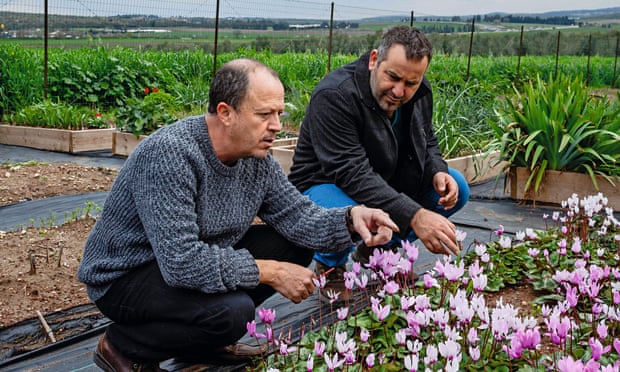
Shared interests can bridge cultures. The Guardian‘s Jim Cable offers up a nice example in his report on “two plantsmen in Israel – one Jewish, the other Muslim – [and their] mission to save their region’s rare native species.”

He writes that Oron Peri, a Jewish garden designer who lives halfway between Haifa and Nazareth, has long partnered with Mansour Yassin, a Muslim, on landscape work. Now they are collaborating to share a large collection of Eastern Mediterranean native species with other plant enthusiasts. He says their affiliation is perfectly natural in the part of Israel where they live.

“Yassin adds, ‘We have the same ideas about relationships between Christians, Jews and Muslim people. We don’t hold to stereotypes about where you come from.’

“Peri realised the time had come to formalise the way he shared plants with other enthusiasts. So Seeds of Peace was born; a scheme where seed sales of garden-worthy bulbous plants support conservation of rare species. Yassin is gradually matching up botanic names with the Hebrew he naturally uses for plants he has known since playing in the mountains as a boy. …

“For Peri, the collection represents 20 years of travel and botanising, specialising in plants from the Mediterranean and Middle East. Indigenous populations have suffered due to tourism (particularly on the Greek islands and Cyprus) and illegal harvesting for the bulb market. Some plants are endangered in the wild, with no conservation scheme to protect them in their native country. They give these refugees, as Peri refers to them, a place to thrive and set seed.” Read about the work here.

Photo: Yadid Levy
Oron Peri, left, is Jewish and his Seeds of Peace partner, Mansour Yassin, is Muslim. Here they examine cyclamen in their beds in Kiryat Tiv’on.

Read Full Post »

Margarida Santos Lopes has a hopeful story at the Christian Science Monitor about an Israeli rabbi and a Palestinain who are friends.

“Shaul David Judelman is an Israeli rabbi who moved from Seattle to Bat Ayin, a religious community in the occupied West Bank.

“Ziad Abed Sabateen is a Palestinian farmer who endured imprisonment during the first intifada against the Israelis more than 20 years ago and whose family was dispossessed of most of its land to accommodate Jewish settlers.

“The two men are good neighbors, friends, and business partners – not enemies.

“Mr. Judelman and Mr. Sabateen are committed to ‘peaceful coexistence’ between Israelis and Palestinians, whether they live together in one state or two separate states.

“The majority of those in both their camps may find it hard to understand the two men’s close relationship. But neither side repudiates them as traitors or collaborators. …

“On a mountaintop with a view of the Mediterranean Sea … Judelman and Sabateen plan to create the Heavens Field Farm, which will put ’emphasis on belonging to the land, not ownership of it,’ according to their joint manifesto.

“Their idea is to run an organic farm that will sell vegetables in local markets, support families in need, and attract volunteers and tourists. Among their partners are a joint Israeli Palestinian journal, called Maktub, and other nonpolitical groups such as Eretz Shalom (Land of Peace).”

Read more to understand how each came to their worldview through different paths.

Photo: Udi Goren
Shaul David Judelman (l.) and Ziad Abed Sabateen, in Bethlehem. They want to create an organic farm in the West Bank as a project for peace.

Read Full Post »

When wars are not going on in the Palestinian territories, people try to live normal lives.

Megan Kelly writes at Global Envision that “in recent years, business development and entrepreneurship programs surfaced … and suddenly there was an influx of people trying to start their own business …

“However, many of the programs put in place lacked follow-through. Entrepreneurs were left to sink or swim on their own. ‘It was like walking them to a cliff,’ explains Samin Malik, coordinator of Women’s Empowerment Programs at Tomorrow’s Youth Organization based in Nablus. So TYO took a different approach …

“TYO’s Women’s Incubation Services for Entrepreneurs (WISE) brought back six businesses that had developed a foundation from their initial women’s entrepreneurship program—Fostering Women Entrepreneurs in Nablus—and recruited nine additional female entrepreneurs by running advertisements in local newspapers, radio, and on Facebook. The requirements were simple—businesses had to have a foundation or business plan already completed, and had to be based in the northern West Bank.

“Candidates who responded to ads underwent two rounds of interviews, designed not only to determine the entrepreneur’s eligibility for the program, but also to assess her strengths and needs moving forward. Partnering with the Small Enterprise Center, TYO sent their final 15 candidates to one-on-one coaching early in the process in order to set their women up for targeted support and success. Additionally, the year-long incubation project will provide marketing, access to capital, and financial-growth trainings, as well as business English and social-media training facilitated by last year’s Palestinian TechWomen delegation. …

“By serving as a support system to the businesswomen, Samin and Inas Badawi—a local Palestinian—provide examples of female-to-female support that is uncommon in Nablus, and try to foster the same sense of encouragement between the women they work with.”

More.

Photograph: Ammar Awad/Reuters/File
Palestinian women sit together at a newly opened upscale Italian cafe in the West Bank city of Ramallah in July 2012. Tomorrow’s Youth Organization serves as a support system to Palestinian businesswomen, encouraging new enterprises.

Read Full Post »