Feeds:
Posts
Comments

Posts Tagged ‘Picasso’

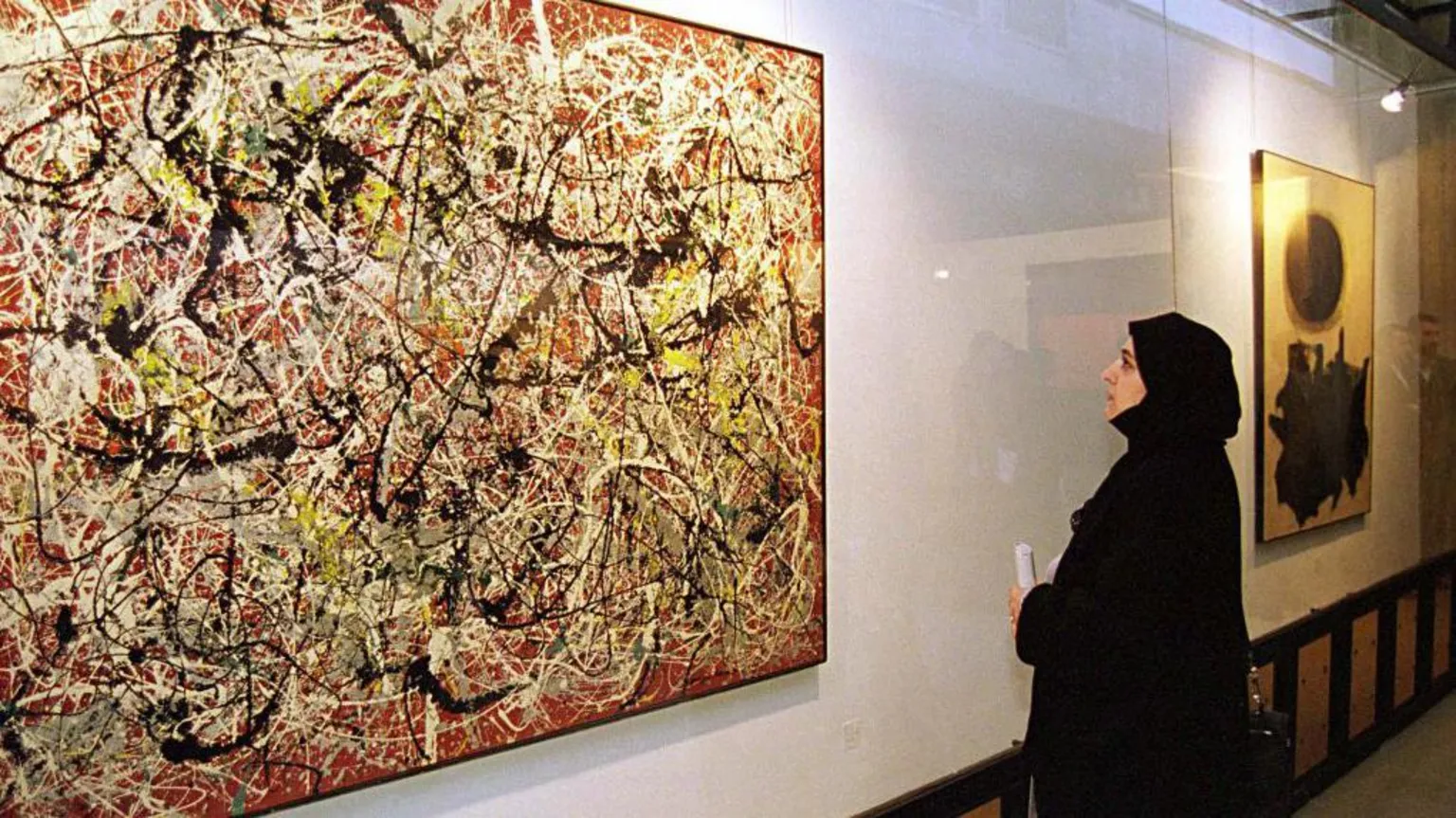
Photo: Kaveh Kazemi/Getty Images.
The family of Iran’s former shah collected modern art, including Jackson Pollock’s “Mural On Indian Red Ground.”

A recent BBC story about modern art in Iran (modern like Picasso, Jackson Pollock) took me by surprise. There is so much we don’t know about other countries — especially “enemy” countries.

The art described was collected by the Westernized, pre-Ayatollah Pahlavi family, but what’s interesting to me is the enthusiasm of contemporary Iranians — and the fact they’re allowed to see it.

Armen Nersessian writes, “It has been dubbed one of the world’s rarest treasure troves of art but few people outside its host country know about it. For decades, masterpieces by the likes of Pablo Picasso, Vincent Van Gogh, Andy Warhol and Jackson Pollock have been kept in the basement of a museum in Iran’s capital Tehran, shrouded in mystery. …

“Only a small portion of the work has been exhibited since the 1979 Iranian Revolution but in recent years, the Tehran Museum of Contemporary Art has been showcasing some of its most captivating pieces.

The Eye to Eye exhibition at the Tehran Museum of Contemporary Art, which opened in October 2024, was extended twice due to overwhelming public demand, running until January 2025.

“The display was widely regarded as one of the most significant exhibitions in the history of the museum, and it also became its most visited. …

“Among the artwork is Warhol’s portrait of Farah Pahlavi – Iran’s last queen – a rare piece blending his pop art flair with Iranian cultural history. Elsewhere, Francis Bacon’s work called ‘Two Figures Lying on a Bed with Attendants’ shows figures appearing to spy on two naked men lying on a bed.

“On the opposite wall in the basement of the museum, a portrait of Ayatollah Ruhollah Khomeini, the founder of the Islamic Republic of Iran, is on display in juxtaposition.

“The museum was built in 1977 under the patronage of Pahlavi, the exiled widow of the last Shah of Iran who was overthrown during the revolution. Pahlavi was a passionate art advocate and her cousin, architect Kamran Diba, designed the museum.

“It was established to introduce modern art to Iranians and to bridge Iran closer to the international art scene.

“The museum soon became home to a stunning array of works by luminaries including Picasso, Warhol and Salvador Dali, alongside pieces by leading Iranian modernists, and quickly established itself as a beacon of cultural exchange and artistic ambition.

“But then came the 1979 revolution. Iran became an Islamic republic as the monarchy was overthrown and clerics assumed political control under Ayatollah Khomeini. Many artworks were deemed inappropriate for public display because of nudity, religious sensitivities or political implications.

“Pierre-Auguste Renoir’s ‘Gabrielle with Open Blouse’ was deemed too scandalous. And Warhol’s portrait of the former queen of Iran was too political. In fact, Pahlavi’s portrait was vandalized and torn apart with a knife during the revolutionary turmoil.

“After the revolution, many of the artworks were locked away, collecting dust in a basement that became the stuff of art world legend. It was only in the late 1990s that the museum reclaimed its cultural significance during the reformist presidency of Mohammad Khatami. …

“Some pieces were loaned to major exhibitions in Europe and the United States, briefly reconnecting the collection with the global art world.

“Hamid Keshmirshekan, an art historian based in London, has studied the collection and calls it ‘one of the rarest treasure troves of modern art outside the West.’

“The collection includes Henry’s Moore’s ‘Reclining Figure’ series – an iconic piece by one of Britain’s most celebrated sculptors – and Jackson Pollock’s ‘Mural on Indian Red Ground.’ …

“Picasso’s ‘The Painter and His Model’ – his largest canvas from 1927 – also features, a strong example of his abstract works from the post-cubism period. And there is Van Gogh’s ‘At Eternity’s Gate’ – one of the very rare survivals of his first printmaking campaign during which he produced six lithographs in November 1882. …

“Challenges remain for the museum which operates under a tight budget. Shifting political priorities mean that it often functions more as a cultural hub than a traditional museum. Yet it continues to be a remarkable institution — an unlikely guardian of modern art masterpieces in the heart of Tehran.”

More at the BBC, here.

Read Full Post »

Photo: Marc Domage/© Private collection.
A detail from one of Picasso’s sketchbooks for his daughter. 

I have read things about Picasso over the years that have made me think that he might not have been a person I would enjoy knowing. Then he goes and does something like this, and I have to remind myself that people are complicated: almost everyone weaves the good with the not good.

Dalya Alberge has a charming story about Picasso at the Guardian.

“They are the ultimate ‘how to draw’ books for a young child,” Alberge writes, “created by a doting dad who just happened to be one of the greatest artists of the 20th century. The granddaughter of Pablo Picasso has discovered an extraordinary collection of sketchbooks used by the artist to teach his eldest daughter to draw and color.

“Picasso filled the pages with playful scenes – animals, birds, clowns, acrobats, horses and doves. … He created them for Maya Ruiz-Picasso when she was aged between five and seven. On some pages, the little girl made impressive attempts to imitate the master. She also graded her father’s work, scribbling the number ’10’ on a circus scene, to show her approval.

“He drew two charming images of a fox longing for grapes – inspired by the 17th-century fabulist Jean de La Fontaine’s sour grapes fable, The Fox and the Grapes – and Maya colored in one of them. He also drew simple but beautiful eagles in a single movement, without raising the pencil from the paper, conveying his love of form and pure line to her.

“The previously unseen collection includes exquisite origami sculptures of birds that he brought to life for Maya from exhibition invitation cards.

“His granddaughter, Diana Widmaier-Ruiz-Picasso, found the works by chance while looking through family material in storage. Intrigued, she showed them to her mother, now 86, for whom memories came flooding back.

“Widmaier-Ruiz-Picasso told the Observer: ‘She said, “Of course, those are my sketchbooks when I was little.” ‘ …

“Picasso, who died in 1973, had been taught to draw by his father, a professor of drawing, ‘so that was something natural for him to do’ with Maya, his granddaughter said: ‘There’s a beautiful page where he’s drawing a bowl and she’s drawing a bowl.

“ ‘Sometimes she’s making an image and he’s doing another, showing her the right way to do it. Sometimes they would depict different scenes. Other times, he would draw a dog or a hat. Sometimes he’s using the whole page to draw one particular thing. Other times, he’s depicting certain scenes, scenes of the circus.’ …

“Maya particularly remembers that, during the second world war, color pencils and notebooks were in short supply: ‘That’s probably why my father wrote in my exercise books and colored with my pencils. I still have fond memories of those moments when we met up in the kitchen to draw together. It was the only place in the apartment where it was warm.’

“Widmaier-Ruiz-Picasso is an art historian, curator and jewelry designer, who has just published her latest book, Picasso Sorcier, exploring his superstitions and belief in magic.

“She described the discovery of the sketchbooks as ‘fortuitous’ because she was co-curating a major exhibition for the Musée Picasso-Paris on his close bond with his first daughter. … The exhibition, Maya Ruiz-Picasso, daughter of Pablo, runs until 31 December and includes his many portraits of Maya, personal possessions and photographs, along with the sketchbooks and origami sculptures, which are being shown for the first time. …

“In the exhibition’s accompanying book, [his granddaughter] writes: ‘Who has never heard it said when looking at a canvas by Picasso, “A child could have done that!” Many of the artistic revolutions of the 20th century were greeted with mockery and scandal, it is true, but in Picasso’s case there is a hint of truth in that judgment. As Maya, his first daughter, recalls, “the mystery of life, and therefore of childhood, always filled that father of mine with interest.” …

” ‘Picasso borrowed extensively from the unruly lines of children’s drawings. Where Van Gogh, Gauguin and Matisse concentrated on the graphic and pictorial naivety with which children draw, Picasso emphasized more the elements that upset figurative traditions, that is to say, distortion and deformity.’ ”

More at the Guardian, here.

Read Full Post »


Art: Susan Jaworski-Stranc
Neighbors

I’m on the email list of 13 Forest Gallery in Arlington, Mass. The first time I went there, the owner enlivened his art opening with guest opera singers.

This time, he had a printmaker demonstrate a type of linoleum printing that Picasso dubbed “suicide” printmaking. Others use the word “reduction” instead of “suicide.”

When I tell you how the work is done, you will understand why Picasso felt as he did.

Instead of carving, say, four different blocks for a four-color print, the artist uses only one block. A mistake at one stage can end the whole project.

Lowell resident Susan Jaworski-Stranc has been doing reduction linoleum printmaking for more than 30 years. As the website for 13 Forest explains, “with each layer, you carve more of the block away — so once a layer has been printed and you start carving for the next layer, there’s no going back.”

The artist herself says, “After each successive printing of a color, the surface of the block is reduced while at the same time the printing surface is built up with multi-layered colors. Born from one block of linoleum, my relief prints have the nuance and rich textural surfaces of an oil painting.

“Although Picasso coined this method of working a ‘suicide print,’ I rather think of this printmaking process as emulating the journey of life. While creating my prints, I am never able to re-visit past stages. I can only proceed forward with the acceptance of all good and not so good choices which were mediated and acted upon with the hope and joy of completion.”

On August 13, the gallery was packed as Jaworski-Stranc demonstrated. Many in the audience were experienced printmakers who asked intelligent questions that showed the rest of us what sorts of issues matter to artists.

One person asked if Jaworski-Stranc knew what the picture was supposed to look like in advance, and she explained that she started with a detailed drawing. Another artist wanted to know if the colors of Jaworski-Stranc’s very first reduction print (which she showed us) were what she anticipated.

The artist laughed, holding up that print. “Are you kidding? How would I ever think up a color like this!?”

Clearly, despite all the careful planning that goes into a print, Jaworski-Stranc relishes the beauty of randomness.

More here.

Art: Susan Jaworski-Stranc
Coastal Forces at Sunset

Read Full Post »

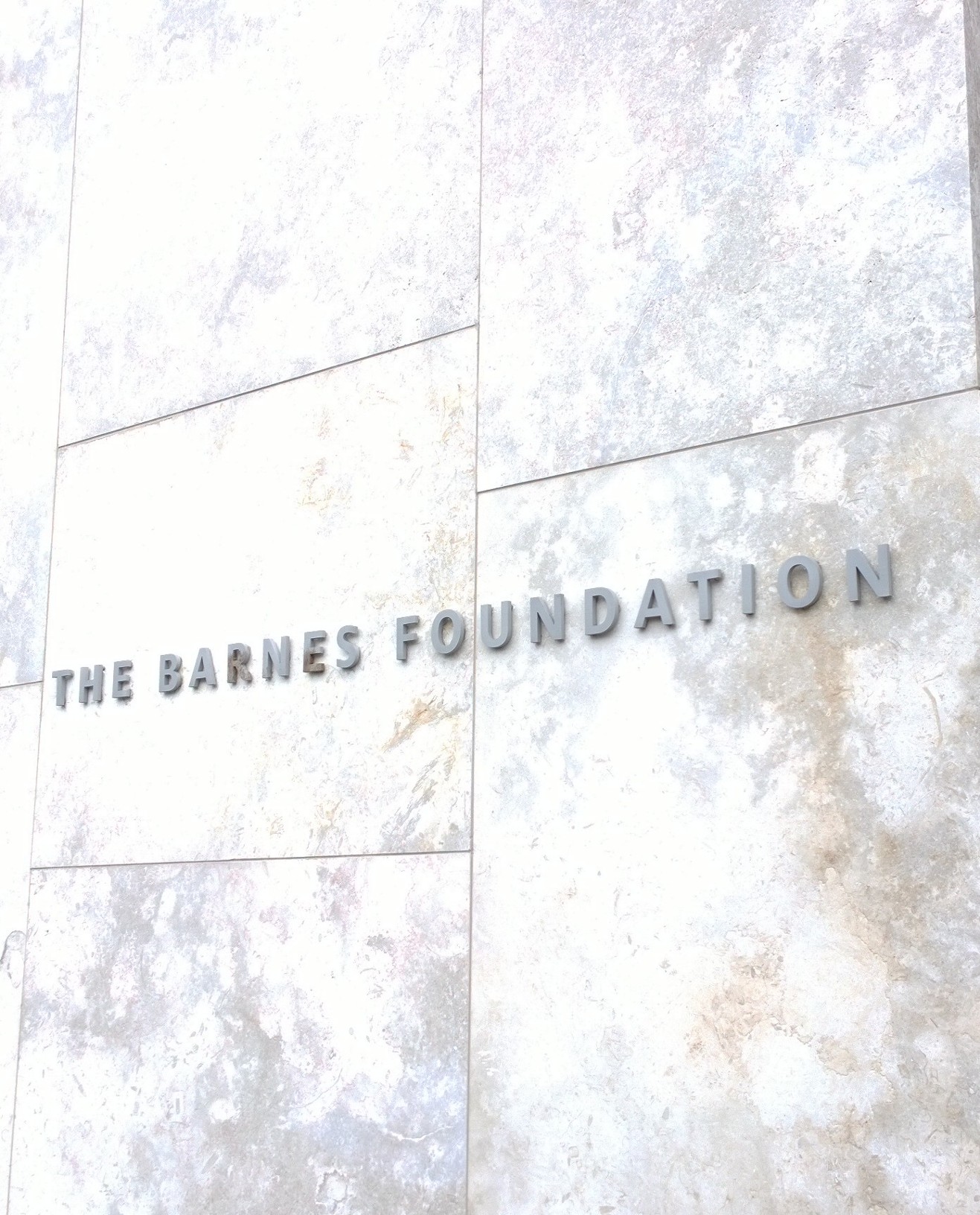
Barnes-3


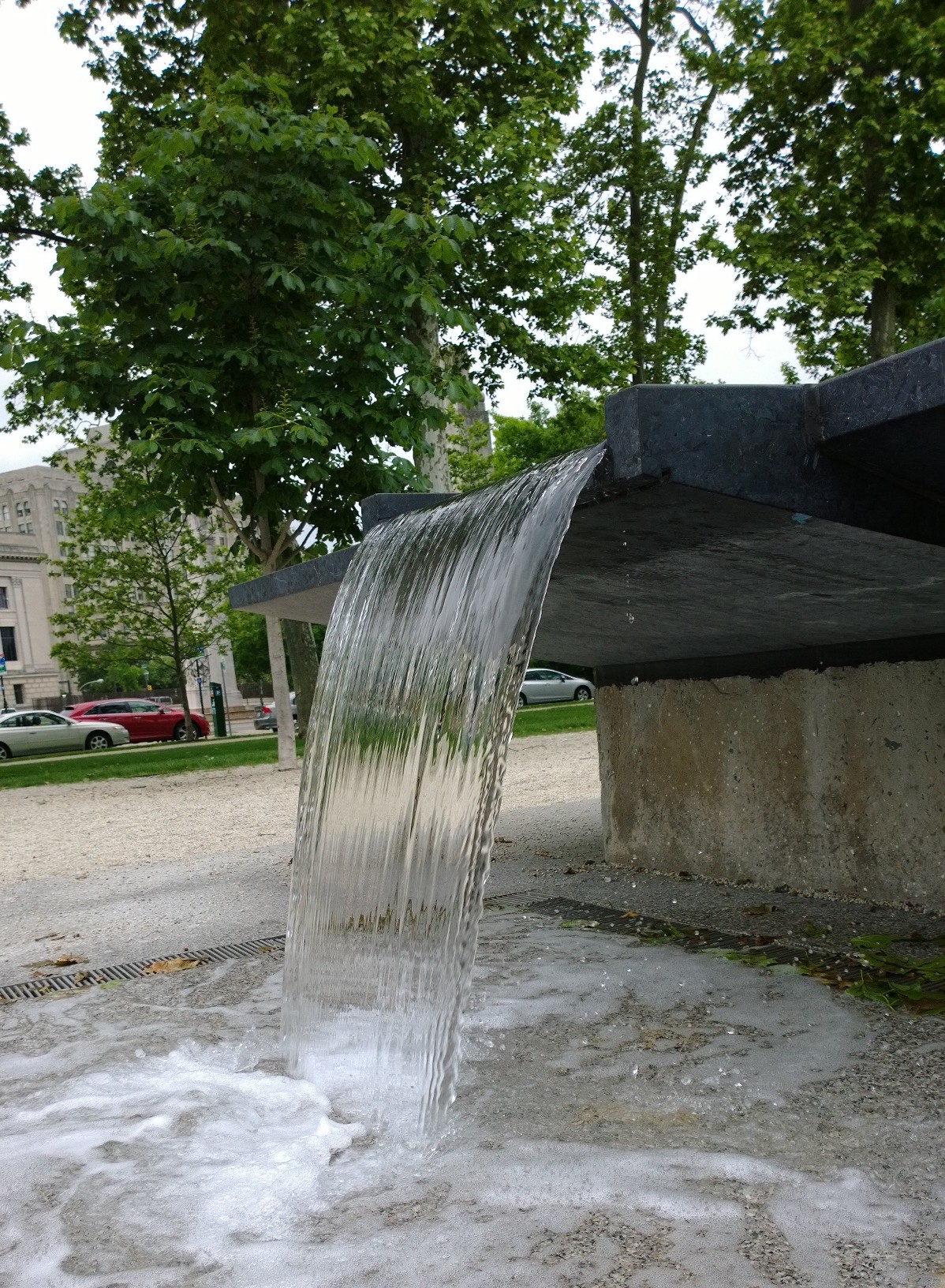
Barnes-waterfall

Today I need the Indian goddess with the many arms because I want to say about the Barnes Collection in its new home, “On the one hand, on the other hand, on the third hand …”

After I saw the documentary The Art of the Steal, about how the fabulous art collection that was willed to a historically black college to keep it from art-world experts ended up in the hands of art world experts, I thought a trustee at Lincoln University had sold his patrimony for a mess of pottage. Now I think that receiving untold wealth is a curse and the donor better have a good plan and lots of resources to support the unfortunate recipient. (More about the movie.)

That’s two hands.

On Thursday, having visited the Albert C. Barnes collection in its new Philadelphia Museum of Art building, I needed a few more hands.

On the third hand, the building is gorgeous in its simplicity and displays the art (69 Cezannes, anyone? How about 60 Matisses? 44 Picassos? 178 Renoirs? Do you love Seurat? Van Gogh? Pennsylvania Dutch furniture?) in the quirky layout of the old Merion, Pa., setting and without labels as Barnes did. On the fourth hand, lack of labels is annoying. On the fifth hand, the art experts provide an ipod with lectures on selected works and a booklet to identify all the items exhibited. On the sixth hand, faithful as the layout is, Dr. Barnes, who made his money in pharmaceuticals and wanted ordinary working families to enjoy and study art without the filter of the art establishment — would have had a heart attack about the entry fee and the standard gift shop and coffee shop and other luxurious museum appointments.

The museum is definitely worth seeing, for the building, the art, and the way the roaring controversy was all handled. But it’s the little things I will cherish like finding black and white illustrations that reminded me of Dickens illustrations and turned out to be by the school friend Barnes asked to help form his taste and get him started on collecting (William Glackens).

Giorgio de Chirico, Portrait of Albert C. Barnes, 1926

Read Full Post »

Today it’s a bit hard to imagine Cezanne, Matisse, Duchamp, and Van Gogh shocking anyone, but at the Armory art show in New York City 100 years ago, they did. Tom Vitale at National Public Radio has the story.

“On Feb. 17, 1913, an art exhibition opened in New York City that shocked the country, changed our perception of beauty and had a profound effect on artists and collectors.

“The International Exhibition of Modern Art — which came to be known, simply, as the Armory Show — marked the dawn of Modernism in America. It was the first time the phrase ‘avant-garde’ was used to describe painting and sculpture. …

“It was the Europeans — Van Gogh, Gauguin, Cezanne, Picasso, Matisse, Duchamp — that caused a sensation.

“American audiences were used to seeing Rembrandts and Titians in their galleries — ‘a very realistic type of art,’ says Marilyn Kushner, the co-curator of an exhibition called ‘The Armory Show at 100’ that opens in October at the New York Historical Society. …

“The most talked-about painting in the 1913 Armory Show deconstructed a human figure in abstract brown panels in overlapping motion. Marcel Duchamp’s Cubist-inspired Nude Descending a Staircase was famously described by one critic as ‘an explosion in a shingle factory.’

“In 1963, on the 50th anniversary of the Armory Show, Duchamp was interviewed by CBS reporter Charles Collingwood. The audio is now at the Smithsonian’s Archive of American Art.

“When Collingwood asked Duchamp if he had realized that the piece would create ‘such a “furor,” ‘ the artist responded: “Not the slightest.” …

“Duchamp went on in the 1963 interview to say that, at the time, artists had lost the ability to surprise the public.

” ‘There’s a public to receive it today that did not exist then. Cubism was sort of forced upon the public to reject it. You know what I mean?’ Duchamp said. ‘Instead, today, any new movement is almost accepted before it started. See, there’s no more element of shock anymore.’ ” More.

Photograph: Marcel Duchamp’s Cubist-inspired Nude Descending a Staircase was famously described by one critic as “an explosion in a shingle factory.” (Copyright succession Marcel Duchamp / ADAGP, Paris / Artists Rights Society (ARS), New York 2013)

Read Full Post »