Photo: Melanie Stetson Freeman/CSM.
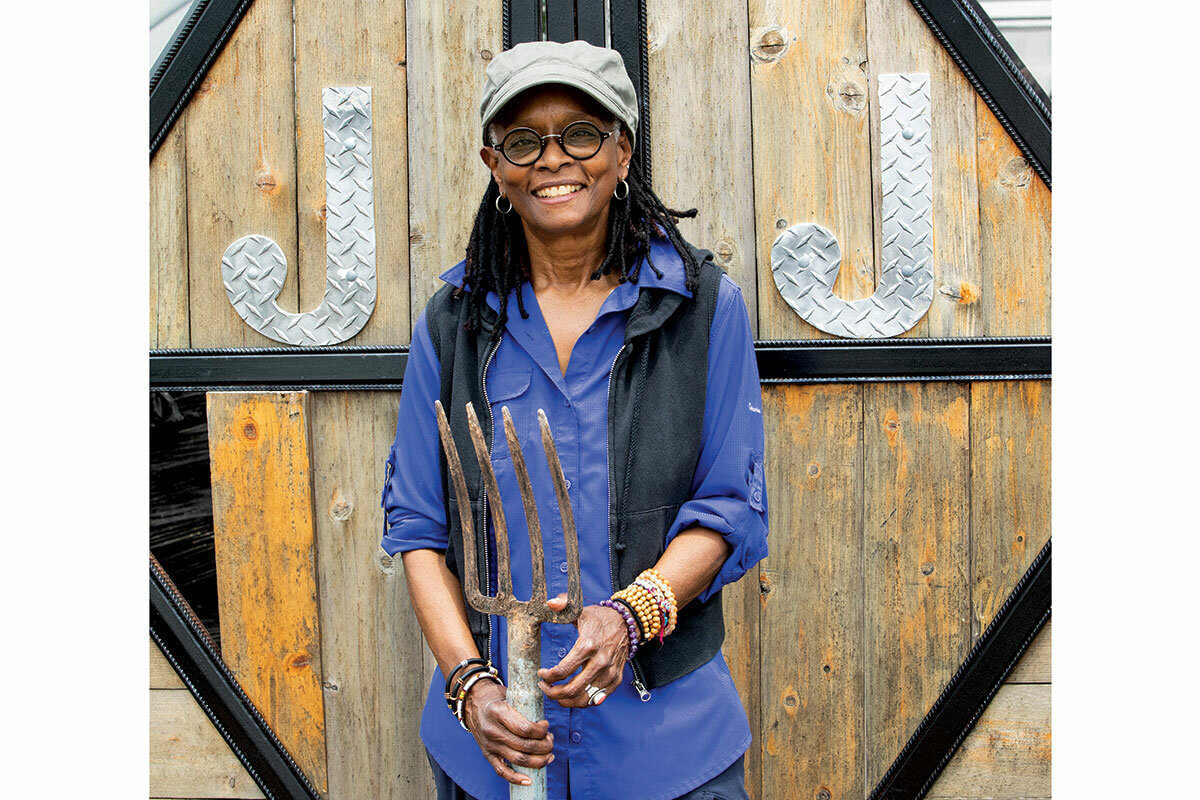
Konda Mason, founder of the nonprofit Jubilee Justice, poses at her farm in Alexandria, Louisiana, May 7, 2023. She teaches Black farmers a sustainable and environmentally friendly method for growing rice.
There are people who try their hand at many different things over a lifetime until something clicks. Or until all the pieces converge to make a new whole.
Consider Konda Mason, currently of Louisiana. Diane Winston has a long article about her at the Christian Science Monitor.
“It’s past daybreak on a muggy July morning when Konda Mason reaches the farm, a 5-acre plot in rural Louisiana. Mindful of the heat to come, several workers are already weeding, and Ms. Mason – her daily meditation and yoga done – is ready for a busy day.
“She’ll field calls from farmers and suppliers, check the progress of the industrial rice mill she’s building, and meet with a journalist curious about why a Black Buddhist from Oakland, California, is growing rice in a red county of a very red state. …
“A slender, muscled woman with waist-length dreadlocks, Ms. Mason sees the farm as the apex of her efforts as a social entrepreneur and eco-spiritual activist. Today she’s sporting a red bandanna to shade herself from the sun, but in her nearly 70 years, she has worn many hats. She’s been a concert promoter, filmmaker, and supporter of Black innovators and problem-solvers. As with her other endeavors, this new project manifests the values that have guided her life: love, justice, community, and a willingness to leap into the unknown.
“ ‘I was taught by my family that I had a role to play in making this world a better place,’ Ms. Mason told listeners in her keynote address at the 2015 Wisdom 2.0 forum in San Francisco. …
“ ‘The question I ask myself is, how can you go deeper, what do you have to let go of in order to do that, and are you willing to do it?’
“This time, going deeper meant leaving her home, her sister, her partner, and her friends to promote what she hopes is a revolution in rice production. Her goal is to support a more sustainable and less expensive way to grow rice, in hopes of staunching the loss of Black-owned farmland. Working alongside an agronomist from Cornell University, she uses what’s called the System of Rice Intensification, common in developing nations but new to American farmers. Going deeper has also meant mastering the complexities of soil and weed management, crop rotation, fertilization, the milling of rice, and bringing it to market. Equally complex, of course, is working in a region where race relations are historically fraught. …
“Though deeply committed to Buddhism, Ms. Mason is not an evangelist. At the farm, she rarely discusses her practice, and if she does, she talks about mindfulness, not Buddhism.
“ ‘Konda’s had many lives, and I never thought there would be a home for her,’ says Dianne Houston, a longtime friend. ‘But the combination of working on the land with people who share her beliefs about social justice – all the boxes are checked.’
“Ms. Mason’s work on the 3,700-acre former plantation is equal parts passion project, spiritual mission, and response to the loss of 12 million acres of Black farmland over the past century. … Since arriving in Louisiana in 2020, Ms. Mason has grown a network of nearly a dozen Black farmers whom her team visits regularly. Her agronomy colleagues offer technical assistance, and she provides rice seed and access to loans. She secured a centrally located, solar-powered industrial mill for processing the plants, and has a distributor to help with marketing. When she’s not working the land or promoting the project, Ms. Mason sometimes dons another hat, leading intentional conversations across racial and economic divides.
“Both the farming project and the conversations are part of Jubilee Justice, a nonprofit Ms. Mason created to help change a system that she says has profited by discriminating against people of color and despoiling the planet. It’s the natural outcome of her lifework. …
“in 1973, when she arrived for her first year at the University of California, Berkeley, … a new friend introduced her to yoga and broadened her taste in music. Soon Ms. Mason was running the Berkeley Jazz Festival, a well-funded community program sponsored by the university. Ultimately, she left school to team up with the manager for Sweet Honey in the Rock, a Black, female a cappella group whose music blended blues, gospel, and jazz. The two joined forces to promote female musicians.
“ ‘We would put a Native American group with a Black group or a lesbian group,’ she says. ‘We kept building coalitions. We did it all over the country.’ …
“[Some years later in Louisiana] she helped organize a gathering of progressive women; most of the wealth-holders were white, and the activists people of color. Among the attendees was Elizabeth Keller, a white woman and devout Christian. Her grandfather had purchased a former plantation in Louisiana, hoping to ‘redeem’ the land, but he never did. When he died, he left all 3,700 acres to her.
“At the gathering, Ms. Keller spoke about the farm and her desire for healing there. She had prayed for someone to show her the way, and, to her surprise, Ms. Mason seemed to be the answer to that prayer. The plantation could be redeemed, Ms. Mason realized, by using the System of Rice Intensification (SRI) to cultivate a pilot crop and develop a network of Black farmers to adopt the technique.
“Ms. Keller, acknowledging that Ms. Mason ‘saw something I couldn’t,’ agreed to let her use the land. Now Ms. Mason needed expertise. She cold-called Erika Styger, the Cornell agronomist, who knew from working with farmers around the world how SRI increases crop yields, improves the soil, cuts costs, enhances profits, and reduces the environmental impact of rice production. It took some convincing, but in the end, Ms. Mason’s vision and practicality persuaded her to provide technical assistance.”
Read more at the Monitor, here. No firewall. Subscriptions are encouraged and are reasonably priced.


 Suzanne's Mom's Blog