Feeds:
Posts
Comments

Posts Tagged ‘poetry’

Maybe one of my Egyptian relatives will know about this poet. I enjoyed what Abdalla F. Hassan had to say about him in the NY Times, but I wish there had been examples of his poems to share with you. (Sorry, Poets!)

“Along a narrow, leafy road just past a small domed mosque is an electric pole with a handwritten sign showing the path to the country home of the poet Abdel-rahman Elabnoudy. The sign reads Aya and Nour, the names of his daughters.

“Sequestered from the big city, Mr. Elabnoudy, a songwriter, dramatist, social critic and man of verse, lives in a whitewashed home on small plot of land planted with mangoes and date palms in a village in Ismailia Province, along the Suez Canal. A couple of decades ago, he tilled and sowed the earth, and designed a home modeled on the traditional architecture of Abnoud, the Upper Egyptian village of his birth.

“ ‘I am from a village where everyone sings, except the shop owners, who reap the output of the singing at the end of the day,’ said Mr. Elabnoudy, 74, one of the Arab world’s best-known vernacular poets. ‘People work and sing, and with their earnings they would buy simple things like cigarettes and tea.’

“Books and awards line the shelves of his sunny study and reception room. On one wall, below a black-and-white portrait of his father, Mahmoud Elabnoudy, is a photograph of a beaming Abdel-rahman embraced by his mother, Fatma Qandil.

“ ‘It was an exaggerated love,’ he said of his mother. ‘She is present a lot in my poetry, but my father isn’t. She is my true educator.’ …

“Mr. Elabnoudy wrote the songs and the dialogue for the landmark 1969 film ‘Touch of Fear,’ which tells the story of a tyrannical village chief and his demise. The film narrowly passed the censorship authorities and was screened only after Mr. Nasser had seen it and given his approval. …

“Its theme — a mass uprising against tyranny ignited by a senseless death — was what unfolded four decades later to topple a system of authoritarianism established by the military coup-turned-revolution of Nasser and the Free Officers in 1952. Mr. Elabnoudy’s only poem in homage to a leader was written to Nasser 40 years after his death in 1970 and weeks before the 2011 revolution, praising his incorruptibility.

“Mr. Elabnoudy’s ascendancy has endured through six decades. His poem ‘The Square’ … captured the dreams and hopes of a nation during the height of the 18-day revolution. ‘A ruler should never think he understands Egypt,’ he said.”

More.


Photograph of vernacular poet Abdel-rahman Elabnoudy is by Abdalla Hassan

Read Full Post »

The Poem-a-Day for today, from poets.org.
Election Day, November, 1884

If I should need to name, O Western World, your

powerfulest scene and show,
‘Twould not be you, Niagara–nor you, ye limitless

prairies–nor your huge rifts of canyons, Colorado,
Nor you, Yosemite–nor Yellowstone, with all its

spasmic geyser-loops ascending to the skies,

appearing and disappearing,
Nor Oregon’s white cones–nor Huron’s belt of mighty

lakes–nor Mississippi’s stream:
–This seething hemisphere’s humanity, as now,

I’d name–the still small voice vibrating–America’s

choosing day,
(The heart of it not in the chosen–the act itself the

main, the quadriennial choosing,)
The stretch of North and South arous’d–sea-board

and inland–Texas to Maine–the Prairie States–

Vermont, Virginia, California,
The final ballot-shower from East to West–the

paradox and conflict,
The countless snow-flakes falling–(a swordless

conflict,
Yet more than all Rome’s wars of old, or modern

Napoleon’s:) the peaceful choice of all,
Or good or ill humanity–welcoming the darker

odds, the dross:
–Foams and ferments the wine? it serves to

purify–while the heart pants, life glows:
These stormy gusts and winds waft precious ships,
Swell’d Washington’s, Jefferson’s, Lincoln’s sails.


Read Full Post »

I’m a sucker for a good title. I even bought a novel once just because I liked the title — Time Will Darken It. (I didn’t like the book, but what a great title!)

So here I am recommending a song by Greg Brown called “Playing the Poet Game.” The other words are good, too. See how you like them.

As wistful as the lyrics are, you could do worse than play the poet game. I know someone who is building a fine reputation as a poet today. It is clearly a better arena than the one he was in before. He was active in politics and got carried away with his enthusiasm for one guy and his fear of what would happen if the other guy won. He broke the law. And paid for it.

Today, his poetry is enriched by his hard life lessons.

Poetry is good for everyone because, at its best, it is first cousin to truth.

Read Full Post »

Although I have always bought chrysanthemums in the fall and put them out on the front stoop like everyone else, this year I decided I was tired of them.

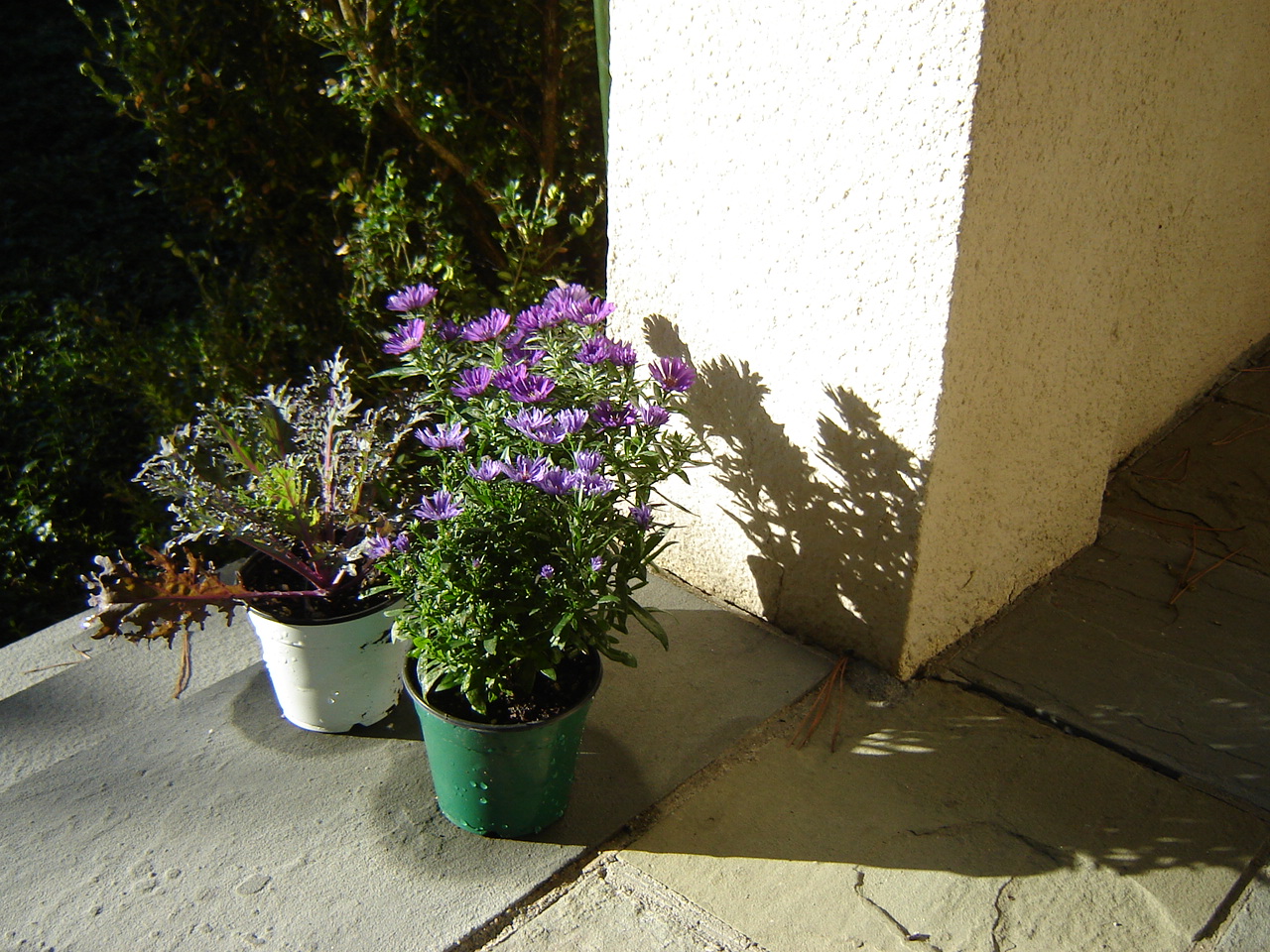
I consulted a woman who gardens, someone I see on the commuter train. She said, “How about asters? How about kale?”

So that’s what I’m doing this year. I need a few more, though, because my neighbors’ chrysanthemums do look more substantial.

In coming down rather hard on chrysanthemums, I am reminded of the A.A. Milne poem about the dormouse. Do you remember?

The dormouse’s favorite thing was to lie in bed of delphiniums (blue) and geraniums (red). But a doctor and a team of experts decided the dormouse was sick, sleeping too much. The doctor prescribed chrysanthemums (yellow and white).

The self-effacing dormouse says wistfully, “I suppose all these people know better than I.” He lets them have their way and they tear up his beloved delphiniums (blue) and geraniums (red) and plant chrysanthemums (yellow and white). The dormouse comes up with his own solution.

“The Dormouse lay there with his paws to his eyes,
“And imagined himself such a pleasant surprise:
” ‘I’ll pretend the chrysanthemums turn to a bed
Of delphiniums (blue) and geraniums (red)!’ ”

Read Full Post »

This Canadian critic doesn’t think much of the aurora borealis or the “noble sorrow of being descended from rugged settlers” as subjects worthy of poetry. That is perhaps why he is rejoicing at the current poetry trends in his country.

Russell Smith writes at the Globe and Mail that Canadian poetry is experiencing a renaissance.

“You know where Canadian literature is excelling? In its poetry. There hasn’t been so much challenging work around – so much that is playful, amusing, dazzling or simply exasperating – for as long as I can remember. Some of this has to do with a new generation of tough-minded editors, some of it has to do with the fading of a certain kind of weepy folksiness, and a lot of it has to do with the Internet. Quite simply, it is easier to read and share poems now, and people are actually doing it.

“Exhibit A: The Walrus magazine, a general-interest journal that bravely publishes poems every month, has been spreading the word online about their ‘readers’ choice’ competition. They asked for submissions of individual poems, then their poetry editor, the truculent Michael Lista, selected his five favourites (blind – that is, he saw no names). Lista has posted the five finalists and is asking for a public vote on the best. (You can vote at the Walrus’s website; voting ends Sept. 30.) The winner gets $1,000. More importantly, the poem will be widely linked to and forwarded, which means it will be read, unlike prize-winning poems of my youth.

“Also unlike the prize-winning poems of my youth – which tended to be about aurora borealis and the great noble sorrow of being descended from rugged settlers – the ones selected for this shortlist are amazingly, some might say frustratingly, dense and intellectual. They are not about birds. (Well, only one is.)” Read more.

I have to thank ArtsJournal.com for linking to wonderful stories like this in newspapers I would never see otherwise. (P.S. I personally have nothing against poems about birds.)

Read Full Post »

For an artsy, literary treat, take a look at the Project Gutenberg version of painter Marsden Hartley‘s out-of-print book, Adventures in the Arts: Informal Chapters on Painters, Vaudeville, and Poets, dedicated to Alfred Stieglitz.

Hard to resist an introduction like this:

“Sometimes I think myself one of the unique children among children. I never read a fairy story in my childhood. I always had the feeling as a child, that fairy stories were for grown-ups and were best understood by them, and for that reason I think it must have been that I postponed them. I found them, even at sixteen, too involved and mystifying to take them in with quite the simple gullibility that is necessary. But that was because I was left alone with the incredibly magical reality from morning until nightfall …

“I was constantly confronted with the magic of reality itself, wondering why one thing was built of exquisite curves and another of harmonic angles. It was not a scientific passion in me, it was merely my sensing of the world of visible beauty around me, pressing in on me with the vehemence of splendor, on every side. …

“It is because I love the idea of life better than anything else that I believe most of all in the magic of existence.”

(Thank you, Ellen Levy, for sending me the link.)

Art:  Marsden Hartley

Read Full Post »

In case you don’t usually read blog comments and missed the ones on yesterday’s post, the owl poet sent word about two great poetry events coming up soon.

“Just a reminder to your readers that The Massachusetts Poetry Festival begins in Salem this Friday, April 20, and runs through Sunday, April 22. Go online to discover details and to register for a wide variety of sessions.

“Also, the Block Island Poetry Project is sponsoring a weekend on Getting Published, running Friday, April 27, through Sunday, April 29. For details, go to Block Island Poetry Project 2012.”

Read Full Post »

Kate Colby, New England poet, is a friend of Suzanne’s.

I struggled with her pithy collection Fruitlands but am now happily into Beauport. Which is not to say I understand everything. But I am loving the spare naturalness of the language.

It hits the same pleasure buttons as deceptively casual-sounding passages in T.S. Eliot’s The Waste Land, like:

“Madame Sosostris, famous clairvoyante,
“Had a bad cold, nevertheless
“Is known to be the wisest woman in Europe,
“With a wicked pack of cards.”

I don’t know what Eliot is getting at exactly, but I’m crazy about the way that sounds.

Here’s a bit from Beauport that made me smile:

Fashionable Turn-outs in Central Park (1869)

“Those were the days.                  Don’t you think?
“Sunday driving in plein-
“air affairs of gold
“rims and spokes,
“upper-lip-shaped
“lisping, bespoke
“tailcoats.

“No incendiary pamphleteers,
“here, no lady lecturers,
“temperance hoo-hah …”

Read Full Post »

in Just-
spring          when the world is mud-
luscious the little
lame balloonman
whistles          far          and wee
and eddieandbill come
running from marbles and
piracies and it’s
spring …
— from e.e. cummings

Read Full Post »

Nancy Greenaway, also known to readers of this blog as the Snowy Owl Poet, just told me about two New England poetry events taking place this spring.

The ninth annual Block Island Poetry Project, featuring Rhode Island Poet Laureate Lisa Starr, will be offering four workshops, starting in April 12 and going to May 13.  Former U.S. Poet Laureate Billy Collins will be there there May 12 and 13. I include a photo of Collins from the event website.

The other event is scheduled for a city best known for witches: “The fourth Massachusetts Poetry Festival will be held Friday, Saturday, and Sunday, April 20–22, in historic Salem. The three-day event, which will bring 1,500 poets and poetry lovers to the city, will showcase a variety of extraordinary local and regional poets, and engage the public through poetry readings, interactive workshops, panel discussions, music, film and visual arts, and performances geared toward a diverse statewide audience.” Check the line-up. It looks super.

(I see that my brother’s longtime friend Michael Ansara is on the advisory board!)

Read Full Post »

The Poem-a-Day service of the Academy of American Poets featured two of my favorite poets this week. I love the personable vibes from these women, the particularity, the quirkiness.

My father got me interested in poetry, giving me a volume of Emily Dickinson and telling me I could “get started” on her, but he admitted that he didn’t think there were any “great” women poets. I think he was wrong about that. I don’t know if he ever changed his mind.

Dear March – Come in
by Emily Dickinson

Dear March – Come in –
How glad I am –
I hoped for you before –
Put down your Hat –
You must have walked –
How out of Breath you are –
Dear March, how are you, and the Rest –
Did you leave Nature well –
Oh March, Come right upstairs with me –
I have so much to tell –

I got your Letter, and the Birds –
The Maples never knew that you were coming –
I declare – how Red their Faces grew –
But March, forgive me –
And all those Hills you left for me to Hue –
There was no Purple suitable –
You took it all with you –

Who knocks? That April –
Lock the Door –
I will not be pursued –
He stayed away a Year to call
When I am occupied –
But trifles look so trivial
As soon as you have come

That blame is just as dear as Praise
And Praise as mere as Blame –

@@@@@@

Silence
by Marianne Moore

My father used to say,
“Superior people never make long visits,
have to be shown Longfellow’s grave
or the glass flowers at Harvard.
Self-reliant like the cat—
that takes its prey to privacy,
the mouse’s limp tail hanging like a shoelace from its mouth—
they sometimes enjoy solitude,
and can be robbed of speech
by speech which has delighted them.
The deepest feeling always shows itself in silence;
not in silence, but restraint.”
Nor was he insincere in saying, “Make my house your inn.”
Inns are not residences.

Read Full Post »

My sister is a poet, among other things, and she sent me this story about a famous poet and his association with the not-always-poetic city of Hartford, where he worked for insurance industry. (Which just goes to show that poetry blossoms where it will.)

Jeff Gordinier writes in the NY Times about taking a Wallace Stevens walking tour that was, “like Hartford itself, quite modest. …  Along the walk there are pale slabs of Connecticut granite engraved with verses from one of Wallace Stevens’s most indelible poems, ‘Thirteen Ways of Looking at a Blackbird.’ That’s about it.

“Nevertheless, I found the walk to be deeply moving,” writes Gordinier, “After all, how often do we get to explore the cranial machinery of a literary titan by slipping into the groove of his daily commute?

“Stevens never learned to drive. Even though many of his neighbors had no idea what he was up to, he would amble along Asylum Avenue methodically measuring the pace of his steps and murmuring phrases to himself …

“ ‘It seems as though Stevens composed poems in his head, and then wrote them down, often after he arrived at the office,’ Prof. Helen Vendler, Harvard’s grande dame of poetry and the author of Wallace Stevens: Words Chosen Out of Desire, explained to me in an e-mail. ‘As for his commute, he enjoyed it profoundly. It was his only time out of doors, alone, thinking, receptive to the influx of nature into all the senses.’ …

“Evidence suggests that he rather liked his peaceful routine in Hartford — his backyard garden, his wine cellar, even his job at the insurance company.

“ ‘Stevens enjoyed his work very much,’ said James Longenbach, a poet, a professor at the University of Rochester, and the author of Wallace Stevens: The Plain Sense of Things. ‘It was crucial to his achievement. He turned down an offer to be the Norton Professor of Poetry at Harvard because he didn’t want to leave his work. He continued to go to the office even when he was beyond the mandatory age of retirement. He never showed that he felt any conflict or tension between what might appear to be the different aspects of his life.’ …

“What moved me about the walk, in the end, was that he had chosen to walk at all. In a car-mad country that prides itself in being perpetually in motion, the poet made a clear and conscious decision to stop, to slow down, to burrow into his imagination. And walking had opened his eyes and ears to a place that was full of surprises. As Stevens himself put it in a poem:

“ ‘It is like a region full of intonings./It is Hartford seen in a purple light.’ ” Read more.

Read Full Post »

Margareta sent me a poem in Swedish by Karin Boye. She said it was apt for Erik and Suzanne, who are embarking on several new “voyages” simultaneously.

Erik sent a follow-up: “That poem is very well known in Sweden; everyone will know the sentence ‘Nog finns det mål och mening i vår färd-Men det är vägen, som är mödan värd,’ which roughly means that it is the act of voyage, and not the end goal, which is the purpose of acts, and life.”

Erik also sent me a poem by his childhood friend Jonathan. “The poem is written with the Lake District in mind, where he traveled frequently with his family as a child.”

FALLS, by Jonathan Wallis

Waterfalls,
silently,
crystal clear to frozen ground
Snowdrifts from currents, lightly
muted all disturbing sound

Colours bound, in touch of frost
Summer’s splendour lost,
and found

Touched now, mirth is drained
Laughter caught, angels choir stained

No whisper above, but below,
Scurrying
feet

Hair twisting,
body rushing, twisting

Here I cannot see only feel

In dark,
colours shift too rapidly
Body heat, maddeningly
Why did I laugh at the beauty of such curiosity?

Run, silently
beneath covering snow
and in time
warm life shall grow

Waterfalls
lightly now,
Crystal clear to spring warm ground
Naked body laughs
All is sound
Colours unbound,
in touch of waters tossed
Dreams are lost,
and found

Read Full Post »

A week ago two lovely owl poems on this blog generated praise and suggestions for the poet.

So when I saw this article about the sensitive role of a poetry editor, I thought you would be interested.

Sameer Rahim, assistant books editor of the Telegraph in the UK, begins his essay by saying that Dante acknowledged Virgil as his literary guide.

“Every poet needs a Virgil. Wordsworth had Coleridge; Tennyson had Arthur Hallam; and Edward Thomas had Robert Frost. However, the best-preserved example of one poet editing another is Ezra Pound’s work on TS Eliot’s ‘The Waste Land.’

“The poem’s manuscript, first published in 1971 and now available on a snazzy iPad app, shows Pound’s boldness. On the first page of the second part, ‘A Game of Chess,’ he wrote disapprovingly: ‘Too tum-pum at a stretch’; further down he complains a line is ‘too penty’ – too regular a pentameter. Eliot redrafted the lines until he got an ‘OK’ in the margin. Eliot acknowledged his friend’s role when he dedicated the 1925 edition to Pound, calling him Il miglior fabbro or ‘the better craftsman’ – a phrase from Dante. …

“One of Eliot’s successors … is Matthew Hollis, a poet-editor and biographer whose account of the literary friendship between Edward Thomas and Robert Frost, Now All Roads Lead to France, [just won the] Costa Prize.

“ ‘There is sometimes a feeling that to edit poetry you have to be a poet,’ he says, going on to cite Pound. ‘If you think you may have broken your leg, you don’t take a straw poll of your friends to find out, you visit a doctor for an expert opinion.’ ”

That expert is probably another poet, but not necessarily.

“Most important is that ‘an editor listens to an author tuning into their poems.’ ” Read more here.

I know Emerson isn’t one of the greats in the poet department, but he was the only one available on short notice.

Read Full Post »

Photograph: Mark Brown, Boston Globe

What a treat! A poet who follows this blog just sent me two lovely poems about a snowy owl she once saw. Or perhaps I should say, she once experienced. She would appreciate feedback on the poems, so please let me know your reactions in the Comments feature. E-mail is fine, too, suzannesmom@lunandstella.com. (And if you have a photo of a snowy owl in flight, I will replace the rather contemplative owl from National Geographic, below.)

Snowy Owl, by Nancy Greenaway

White shuttle of silken feathers
wefting across cloud warp of winter gray,
silently weaving sky with sea,
looming above watching walkers
tucked between patchworks
of stone-bound fields
and folds of silvered awe.

Snowy Owl 2, by Nancy Greenaway

Wide-winged whiteness
sensed before seen
swooping soundlessly
under low-lying layers
of cloud gauze

white on white
white on gray
soft on soft

too large to be living
and airborne

too white to be
worldly and wild

floating unruffled
on drafts of arctic cold

piercing consciousness
not with bill
or talon
or quill

but with light
and motion

avian divinity
spirited from
another dimension

penetrating dusk
by force of feathers

Read Full Post »

« Newer Posts - Older Posts »