
Feeds:
Posts
Comments

Posts Tagged ‘polarization’

Photo: Bowl of Delicious.
According to the
Christian Science Monitor, participating in a “dugnad” is just part of being Norwegian. A kind of community volunteering there, it usually involves an element of fun, such as waffles for mud-spattered workers or a cookout for kids.

Most Norwegian children are raised knowing that service for the good of the community is an essential part of life. It’s not presented as an unpleasant chore, according to the Christian Science Monitor, but work that you do with others and always combine with some fun.

Mark Sappenfield writes, “There is no precise word in English for what Ann Helen Myrvold is doing. ‘Volunteering’ perhaps comes closest. But it’s more than that.

“She has not come to this part of suburban Oslo just to beautify the stream Gjersrudbekken on its forested tumble toward the fjord. She has come from some deeply ingrained Norwegian sense of obligation, of community, of responsibility – and, of course, for the waffles.

“True, what she is doing looks remarkably like a run-of-the-mill cleanup, removing everything from car tires to motorized scooters from the stream’s path with a sweet treat for everyone afterward. But she and her friends from a nearby university have been doing things like this since kindergarten, cleaning neighborhoods and holding bake sales to fund sports teams.

Dugnad is not just the activity, but the mindset behind it. And at a time when social scientists see the fabric of societies fraying – churches and community organizations declining, connections across demographic lines dwindling – dugnads are something of an antidote.

“No one here would argue that dugnads are the reason why Norway consistently ranks as one of the highest-trust countries in the world. But no one would argue that they don’t play a role, either. They are a binding force, both simple and sweeping, that give Norwegians not only a sense of doing good, but of doing it together. …

“Says Ms. Myrvold, ‘You start at a young age, and you just learn to do it and love it. You see it as teambuilding.’

“The tradition has its roots in Norway’s history as a poor nation of small farmers and fishermen. When a church or bridge needed to be built, or a neighbor was building a barn, everyone came together to help.

“ ‘It was a kind of social insurance or a mobilizing of resources, and it was steeped in a sense of justice,’ says Karl Henrik Sivesind, a professor at the Institute for Social Research in Oslo who has studied the tradition. ‘It’s not for your own advantage. You chip in, and everyone chips in.’

“Today, social scientists lament the loss of ‘social capital’ – the connections in a community that drive trust and bring broader benefits for all. The dugnad is an incubator of social capital, Dr. Sivesind says.

“ ‘If you look at the word itself, it has a social element,’ he says, noting that its verbal roots reference the concept of virtue. ‘You contribute to necessities of organization, and you meet people, build networks, and get to know people in your neighborhood.’

“The Gjersrudbekken cleanup is organized by Rusken, a three-person bureau in the Oslo city government that organizes volunteer cleanups and is celebrating its 50th anniversary this year. Ms. Myrvold signed up with several friends who attend the nearby Norwegian University of Life Sciences. …

“To all the young women clad in bright orange vests and industrial work gloves, participating in a dugnad is just part of being Norwegian. And it usually involves an element of fun, whether that’s waffles for mud-spattered workers or a cookout for kids.

“Across town, Norway’s biggest hiking and outdoor activities organization is holding a dugnad of its own, skewers for sausages included.

“The Norwegian Trekking Association is among the most beloved groups in the country, maintaining trails and cabins for a nation of nature lovers. Today, in a playground of the residential neighborhood of Bærum, they’ve built a bonfire.

“The plan is to teach local children wilderness skills such as first aid. Many kids have brought stuffed animals to practice on. But it’s also a chance for neighbors to meet and talk….

“Maria Ruud has brought her 7-year-old daughter. She says she’s been doing these sorts of things ‘forever.’ Local carnivals for kids, neighborhood cleanups where ‘you find a task the kids can do,’ and Norway’s famous May 17 Independence Day celebrations – all made possible by dugnads.

“She acknowledges that she sometimes doesn’t look forward to the work, whether that’s planning games and food or raking leaves. But there’s a bigger benefit.

“ ‘The good part is the social side,’ Ms. Ruud says. ‘You come together and share the work. As humans, you feel like you’re a part of something bigger. We need that to make our life meaningful.’ …

“Kristin Sandaker ticks off the dugnads she has done over the years. At one flea market to support a local youth orchestra, she recalls getting in 24,000 steps simply lugging items around. …

“But she worries that the forces that would divide Norway are growing. The political polarization that shapes much of European politics has a foothold in Norway, too. And immigration can inadvertently raise the risks of different communities becoming detached and distant from one another.

“Dugnads are a counterbalance. There’s a fellowship that comes from taking 24,000 steps or being ankle-deep in mud with someone.

“ ‘It is the most obvious proof that we can do things together,’ Ms. Sandaker says. With the current state of things, ‘this gets even more important – that people get together in this way.’ ”

More at the Monitor, here. Do you see anything like a dugnad in your community?
Read Full Post »

Photo: Melanie Stetson Freeman/Christian Science Monitor.
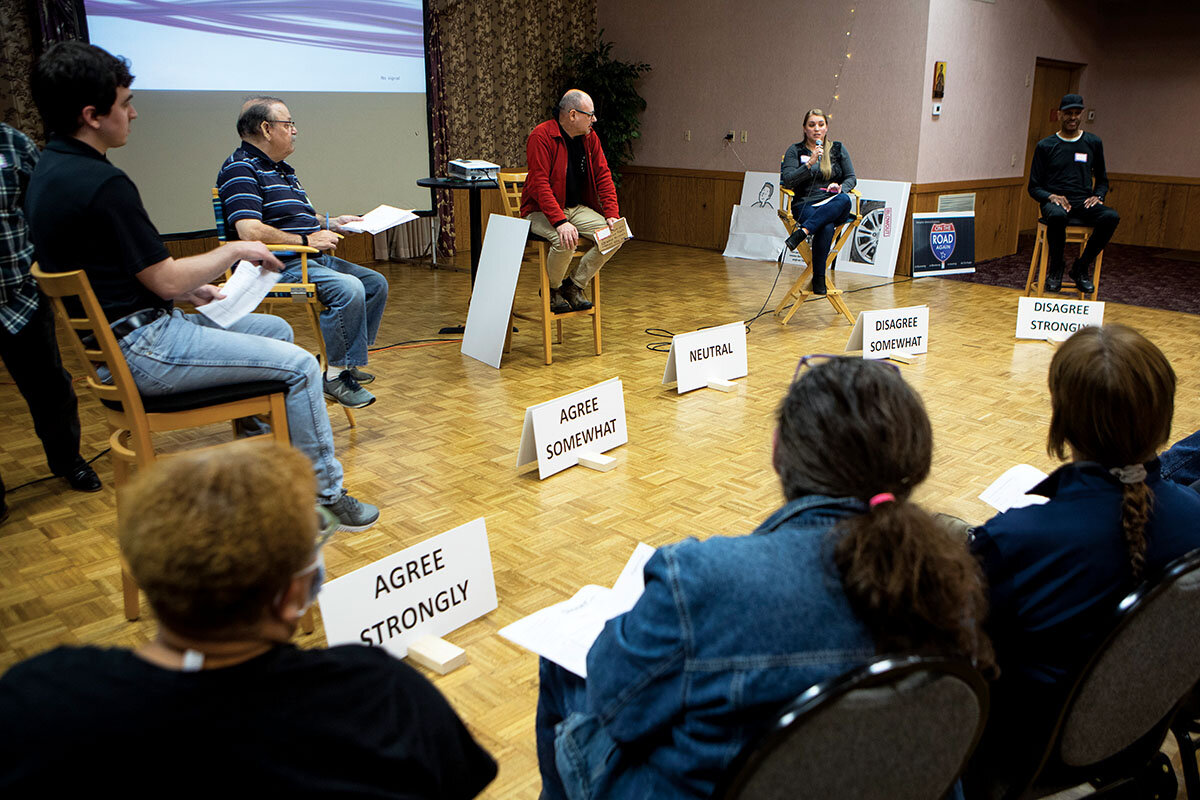
Participants in an Oct. 12 “Dinner and a Fight” event in Fairlawn, Ohio, sort themselves according to their feelings of agreement or disagreement with the statement: “The results of the U.S. voting system do reflect the will of the people.”

Christian Science Monitor has done a great job of digging out stories about Americans working to overcome our unhealthy polarization. Today’s story makes me think of my friend Nancy L and how she was part of a similar effort before Covid. How I admired her for braving some rather acrimonious interactions!

Simon Montlake reports at the Christian Science Monitor about one Ohio man’s “quest to get more voters to agree to disagree.” It starts with breaking bread together.

“About 50 people, many of them meeting for the first time, have gathered in this Greek Orthodox church hall in a suburb of Akron, Ohio. Over a buffet of chicken, pasta, and tossed salad, they politely get to know one another, five to a table, including this reporter, asking icebreaker questions provided on a sheet of paper. The atmosphere is cordial if a little hesitant. After all, they didn’t come just for the meal. 

“They cast sidelong glances to the front of the room to five spotlighted director’s chairs. Each chair sits behind a printed sign, from left to right: ‘agree strongly,’ ‘agree somewhat,’ ‘neutral,’ ‘disagree somewhat,’ and ‘disagree strongly.’ …

“As the meal ends, Arlin Smith, one of the event organizers, fades the music playing from his laptop and picks up a microphone. ‘Let’s get ready to rumble!’ he growls, emulating boxing announcer Michael Buffer. 

“Before the ‘rumble,’ Mr. Smith offers some guidance: Listen to the speaker, try to understand where he or she is coming from, use positive language, and be responsible for your own feelings. ‘We all have emotions. So when you feel those feelings kind of rattled up, try to get comfortable. Lean into the situation and take control of your own self,’ Mr. Smith tells the diners.

“Then he hands the mic to Ted Wetzel, the creator of this grassroots effort to help Americans of all political stripes disagree constructively and, perhaps, rebuild civic bonds in an era of intense polarization and social atomization. He titles this gathering ‘Dinner and a Fight,’ but ‘Fight’ is crossed out and replaced by ‘Dialogue.’

“Mr. Wetzel … looks both elated and antsy. ‘This is the eleventh Dinner and a Fight, so give yourselves a round of applause,’ he says. 

“As the clapping ends, he explains that he’s about to reveal tonight’s ‘divisive topic.’ (Previous topics have included face masks, guns, and gender identity.) Once the topic is announced, anyone can take a director’s chair: First come, first served. …

“For proponents of dialogue, reaching across that chasm is complicated by a suspicion on the right that liberals are setting the agenda. ‘Typically, [these dialogue forums] are very blue,’ says Peter Coleman, a psychologist who studies polarization at Columbia University. ‘One side is more eager to do it than the other side, and that is part of the problem.’

“But by advertising a fight and using folksy language and metaphors, Mr. Wetzel seems to have cracked the code. His speak-your-mind dialogue dinners attract conservatives and liberals, as well as independents. Older pro-Trump voters break bread with Bernie Sanders-supporting millennials. Racial and religious minorities join the conversations. Many come back for more.

“ ‘It’s hard to get people who really see the same world differently into the same room, and he succeeds at that,’ says Bill Lyons, a political scientist at the University of Akron and an informal adviser to Mr. Wetzel. …

“The long-term goal, he says, is a rediscovery of bonds that are stronger than the political tribalism that divides us. … For now, each dinner is something of a gamble: Who will show up? Will opponents find common ground? Might disputation turn into confrontation? It takes a large dollop of faith to believe that getting a roomful of strangers talking can hold back the partisan tide. Mr. Wetzel’s brother likens his work to ‘boiling the ocean.’ But Mr. Wetzel isn’t about to quit. He’s just getting started. 

“It all began, appropriately, with a meal, and a fight. It was 2017, and Mr. Wetzel and his wife were meeting two other couples for dinner. The two men were his former colleagues, back when he was a young engineer before he went into sales and management, then bought a specialist painting company in Akron.  

“He had been looking forward to seeing old friends. But the dinner talk got heated over the topic of President Trump’s ban on Muslim immigrants and the perceived threat of sharia (Islamic law) to U.S. freedoms. The testy conversation continued over dessert and into the parking lot. ‘It didn’t end well,’ says Mr. Wetzel. He knew that his rancorous reunion was being repeated all over the country, as friends and families clashed over politics. 

“But he wanted to study the underlying problem, to figure out what really ailed American society and democracy. So he took a three-month sabbatical, which turned into a year and a half. Eventually he sold his paint company so he could work full time on this project. …

“At his brick ranch-style house in a Cleveland suburb, Mr. Wetzel filled a wall with sticky notes as he kept researching polarization and talking to others who shared his concerns. He self-published a book, Is America Broken? 11 Secrets for Getting Back on Our Feet.

“But he didn’t have a formula yet for how to bring people together to disagree constructively. He tried holding a seminar at a church, but it fell flat. ‘Not one person said, let’s do it again,’ he says. 

“In 2019, Mr. Wetzel attended a national conference on civility in Alexandria, Virginia, where he learned about a dialogue method developed in 2004 at Arizona State University (ASU).

The five-chair method offered an alternative to standard debates between hyperpartisans who reinforce a binary choice.

“Instead of a simple binary, the method gives moderates a greater voice since three of the five chairs are taken by those who somewhat agree/disagree – or are undecided. The occupants of the chairs start the discussion and can question one another; then the audience joins in. 

“Serendipitously, Rob Razzante, an ASU Ph.D. graduate trained in the five-chair method, grew up nearby. … Mr. Wetzel had tried the five-chair method in Professor Lyons’s classes and found it effective at guiding a respectful dialogue. Now, he told Mr. Razzante that summer evening, he wanted to bring it to the wider community and to insert it into a communal meal. And he wanted to call it a fight. Why? Because people ‘want to get into it,’ he says.

“Mr. Razzante liked the dinner format, but wasn’t sure about the name. He wasn’t alone: Other ASU dialogue facilitators also blanched at this branding. ‘The Arizona people were constantly trying to get him to call it a dialogue,’ says Professor Lyons. 

“Mr. Wetzel resisted. It was a fight – and a dialogue. He says the name is both humorous and honest about the fact that disagreement in public can be awkward. 

“Doug Oplinger, a former editor of the Akron Beacon Journal who has worked on other civil dialogue efforts in Ohio, also tried to dissuade Mr. Wetzel from advertising a fight. ‘Oh my word, Ted. You can’t do that,’ he recalls telling him.  But his determination to use that phrase was of a piece with his approach to the challenge, says Mr. Oplinger. …

“The first Dinner and a Fight took place here in September 2021, amid a national surge in COVID-19 infections. Most of the 30 attendees had been personally invited by Mr. Wetzel or his associates. Mr. Razzante agreed to moderate. After dinner ended, the topic was announced, along with a dialogue prompt, which participants could support or oppose, or be neutral. 

“It read, ‘Wearing a mask is the American thing to do.’ The room fell silent. ‘You could cut the tension with a knife,’ recalls Mr. Wetzel. … ‘It was awesome.’ ” 

Imagine this retired small-business owner just taking it on himself to do something about our toxic polarization! Beautiful! More at the Monitor, here. No firewall.

Read Full Post »