Feeds:
Posts
Comments

Posts Tagged ‘politics’

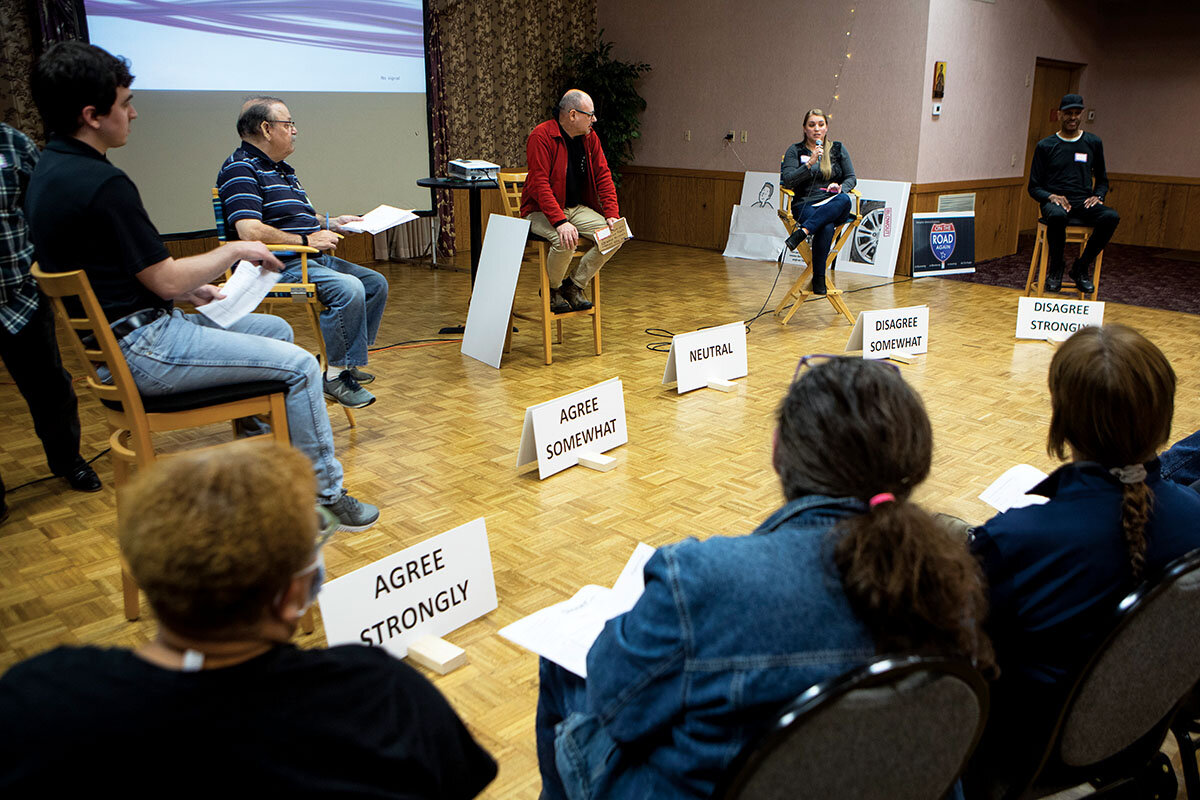
Photo: Melanie Stetson Freeman/Christian Science Monitor.
Participants in an Oct. 12 “Dinner and a Fight” event in Fairlawn, Ohio, sort themselves according to their feelings of agreement or disagreement with the statement: “The results of the U.S. voting system do reflect the will of the people.”

Christian Science Monitor has done a great job of digging out stories about Americans working to overcome our unhealthy polarization. Today’s story makes me think of my friend Nancy L and how she was part of a similar effort before Covid. How I admired her for braving some rather acrimonious interactions!

Simon Montlake reports at the Christian Science Monitor about one Ohio man’s “quest to get more voters to agree to disagree.” It starts with breaking bread together.

“About 50 people, many of them meeting for the first time, have gathered in this Greek Orthodox church hall in a suburb of Akron, Ohio. Over a buffet of chicken, pasta, and tossed salad, they politely get to know one another, five to a table, including this reporter, asking icebreaker questions provided on a sheet of paper. The atmosphere is cordial if a little hesitant. After all, they didn’t come just for the meal. 

“They cast sidelong glances to the front of the room to five spotlighted director’s chairs. Each chair sits behind a printed sign, from left to right: ‘agree strongly,’ ‘agree somewhat,’ ‘neutral,’ ‘disagree somewhat,’ and ‘disagree strongly.’ …

“As the meal ends, Arlin Smith, one of the event organizers, fades the music playing from his laptop and picks up a microphone. ‘Let’s get ready to rumble!’ he growls, emulating boxing announcer Michael Buffer. 

“Before the ‘rumble,’ Mr. Smith offers some guidance: Listen to the speaker, try to understand where he or she is coming from, use positive language, and be responsible for your own feelings. ‘We all have emotions. So when you feel those feelings kind of rattled up, try to get comfortable. Lean into the situation and take control of your own self,’ Mr. Smith tells the diners.

“Then he hands the mic to Ted Wetzel, the creator of this grassroots effort to help Americans of all political stripes disagree constructively and, perhaps, rebuild civic bonds in an era of intense polarization and social atomization. He titles this gathering ‘Dinner and a Fight,’ but ‘Fight’ is crossed out and replaced by ‘Dialogue.’

“Mr. Wetzel … looks both elated and antsy. ‘This is the eleventh Dinner and a Fight, so give yourselves a round of applause,’ he says. 

“As the clapping ends, he explains that he’s about to reveal tonight’s ‘divisive topic.’ (Previous topics have included face masks, guns, and gender identity.) Once the topic is announced, anyone can take a director’s chair: First come, first served. …

“For proponents of dialogue, reaching across that chasm is complicated by a suspicion on the right that liberals are setting the agenda. ‘Typically, [these dialogue forums] are very blue,’ says Peter Coleman, a psychologist who studies polarization at Columbia University. ‘One side is more eager to do it than the other side, and that is part of the problem.’

“But by advertising a fight and using folksy language and metaphors, Mr. Wetzel seems to have cracked the code. His speak-your-mind dialogue dinners attract conservatives and liberals, as well as independents. Older pro-Trump voters break bread with Bernie Sanders-supporting millennials. Racial and religious minorities join the conversations. Many come back for more.

“ ‘It’s hard to get people who really see the same world differently into the same room, and he succeeds at that,’ says Bill Lyons, a political scientist at the University of Akron and an informal adviser to Mr. Wetzel. …

“The long-term goal, he says, is a rediscovery of bonds that are stronger than the political tribalism that divides us. … For now, each dinner is something of a gamble: Who will show up? Will opponents find common ground? Might disputation turn into confrontation? It takes a large dollop of faith to believe that getting a roomful of strangers talking can hold back the partisan tide. Mr. Wetzel’s brother likens his work to ‘boiling the ocean.’ But Mr. Wetzel isn’t about to quit. He’s just getting started. 

“It all began, appropriately, with a meal, and a fight. It was 2017, and Mr. Wetzel and his wife were meeting two other couples for dinner. The two men were his former colleagues, back when he was a young engineer before he went into sales and management, then bought a specialist painting company in Akron.  

“He had been looking forward to seeing old friends. But the dinner talk got heated over the topic of President Trump’s ban on Muslim immigrants and the perceived threat of sharia (Islamic law) to U.S. freedoms. The testy conversation continued over dessert and into the parking lot. ‘It didn’t end well,’ says Mr. Wetzel. He knew that his rancorous reunion was being repeated all over the country, as friends and families clashed over politics. 

“But he wanted to study the underlying problem, to figure out what really ailed American society and democracy. So he took a three-month sabbatical, which turned into a year and a half. Eventually he sold his paint company so he could work full time on this project. …

“At his brick ranch-style house in a Cleveland suburb, Mr. Wetzel filled a wall with sticky notes as he kept researching polarization and talking to others who shared his concerns. He self-published a book, Is America Broken? 11 Secrets for Getting Back on Our Feet.

“But he didn’t have a formula yet for how to bring people together to disagree constructively. He tried holding a seminar at a church, but it fell flat. ‘Not one person said, let’s do it again,’ he says. 

“In 2019, Mr. Wetzel attended a national conference on civility in Alexandria, Virginia, where he learned about a dialogue method developed in 2004 at Arizona State University (ASU).

The five-chair method offered an alternative to standard debates between hyperpartisans who reinforce a binary choice.

“Instead of a simple binary, the method gives moderates a greater voice since three of the five chairs are taken by those who somewhat agree/disagree – or are undecided. The occupants of the chairs start the discussion and can question one another; then the audience joins in. 

“Serendipitously, Rob Razzante, an ASU Ph.D. graduate trained in the five-chair method, grew up nearby. … Mr. Wetzel had tried the five-chair method in Professor Lyons’s classes and found it effective at guiding a respectful dialogue. Now, he told Mr. Razzante that summer evening, he wanted to bring it to the wider community and to insert it into a communal meal. And he wanted to call it a fight. Why? Because people ‘want to get into it,’ he says.

“Mr. Razzante liked the dinner format, but wasn’t sure about the name. He wasn’t alone: Other ASU dialogue facilitators also blanched at this branding. ‘The Arizona people were constantly trying to get him to call it a dialogue,’ says Professor Lyons. 

“Mr. Wetzel resisted. It was a fight – and a dialogue. He says the name is both humorous and honest about the fact that disagreement in public can be awkward. 

“Doug Oplinger, a former editor of the Akron Beacon Journal who has worked on other civil dialogue efforts in Ohio, also tried to dissuade Mr. Wetzel from advertising a fight. ‘Oh my word, Ted. You can’t do that,’ he recalls telling him.  But his determination to use that phrase was of a piece with his approach to the challenge, says Mr. Oplinger. …

“The first Dinner and a Fight took place here in September 2021, amid a national surge in COVID-19 infections. Most of the 30 attendees had been personally invited by Mr. Wetzel or his associates. Mr. Razzante agreed to moderate. After dinner ended, the topic was announced, along with a dialogue prompt, which participants could support or oppose, or be neutral. 

“It read, ‘Wearing a mask is the American thing to do.’ The room fell silent. ‘You could cut the tension with a knife,’ recalls Mr. Wetzel. … ‘It was awesome.’ ” 

Imagine this retired small-business owner just taking it on himself to do something about our toxic polarization! Beautiful! More at the Monitor, here. No firewall.

Read Full Post »

Chaos and Calm

Can’t help thinking that whatever adds to the current chaos is bad for everything — people, creatures, trees, air. Throughout history and mythologies, chaos is generally not considered a good thing.

What to do?

I like people who seek calm and who, when enmity is abroad in the land, try harder to find commonalities.

Yesterday as I was reading an advice column in the Globe, I saw a situation I recognized. A reader was upset that on social media, her hair stylist had criticized a politician she supports, and she was thinking of switching to a different salon. Maybe even telling her stylist the reason.

To the columnist’s credit, she didn’t think much of her reader’s rigidity.

But I recognized that thought process. Four years ago, I experienced some of the same impulses after reading a social media post. Fortunately, I came out safe on the other side. It didn’t seem like leaving my stylist would have been the action of a grownup, making a break with someone that I liked, that I shared many common interests with, that I never discussed politics with anyway. If I couldn’t build a bridge to someone I enjoyed talking to about recipes, children, Halloween costumes, nature, museums, and elephants, how could I (or the country) ever move beyond the point where we seem so stuck?

And there are other things to consider. I could afford to leave. I had options. She couldn’t afford to find a different job if she wanted to get away from the high percentage of clients whose politics opposed hers. She needed the income.

Another thought: shouldn’t that advice-column reader and I both be thinking about why hairdressers might have the kind of lives and experiences that make them gravitate toward a different kind of candidate or listen to a different kind of station for news? Who am I to say what this hardworking single mom’s life experience tells her?

A writer I admire who has lived on both sides of the current divide has been doing a great job of explaining one side to the other. Her name is Sarah Smarsh, and I heartily recommend the book that introduced me to her, Heartland: A Memoir of Working Hard and Being Broke in the Richest Country on Earth.

I also appreciated her insights in this recent Guardian article about the presidential election, and I’m on my library’s waiting list for her upcoming book on Dolly Parton, She Come By It Natural. Get to know her.

Read Full Post »

kn4sz5w33ii6tp66lm5d3bh6qu

Photo: Erin Clark for the Boston Globe
Lucy Wisson hugged her son, Giani DiTrapani, in their Port Huron home. Giani, a junior at Michigan State University, had always shared his mom’s political beliefs. Then in fall 2017, he went to college.

A recent Boston Globe story by Liz Goodwin (here) about how politics is both dividing — and not dividing — families spoke to a growing preoccupation of mine. Even the Dalai Lama tweets about it: how do we find common ground and things to love about people who think very differently from us? Next to climate change and inequality, that may be the biggest challenge of our time.

What struck me most in reading about the religious, politically conservative young man who went off to college and began to think differently from his mother was the mother’s tolerance and ability to change enough to stay close to him. I thought, Wow, I really don’t agree with all her views, but I do see that there are things about which she has an open mind.

We can always learn.

The Lothlorien elf Haldir in the Fellowship of the Ring says, “The world is indeed full of peril, and in it there are many dark places; but there is still much that is fair, and though in all lands love is now mingled with grief, it grows perhaps greater.” Now there’s a thought to ponder! That love in times of darkness grows more powerful.

So here’s a poem to help us all remember that we really do know how to appreciate things about people who are not like us.

Small Kindnesses
~ a poem by Danusha Lameris ~

“I’ve been thinking about the way, when you walk
“down a crowded aisle, people pull in their legs
“to let you by. Or how strangers still say ‘bless you’
“when someone sneezes, a leftover
“from the Bubonic plague. ‘Don’t die,’ we are saying.
“And sometimes, when you spill lemons
“from your grocery bag, someone else will help you
“pick them up. Mostly, we don’t want to harm each other.
“We want to be handed our cup of coffee hot,
“and to say thank you to the person handing it. To smile
“at them and for them to smile back. For the waitress
“to call us honey when she sets down the bowl of clam chowder,
“and for the driver in the red pick-up truck to let us pass.
“We have so little of each other, now. So far
“from tribe and fire. Only these brief moments of exchange.
“What if they are the true dwelling of the holy, these
“fleeting temples we make together when we say, ‘Here,
“have my seat,’ ‘Go ahead — you first,’ ‘I like your hat.’ ”

Oh, my, oh, my! Bless all poets!

Read Full Post »

070620grand20rapids20lede

Photo: Christa Case Bryant/Christian Science Monitor
Krista Badiane, a sustainability consultant, is raising two daughters with her Senegalese husband in Grand Rapids, Michigan. She always imagined settling on the East or West Coast but says it would be hard to recreate the quality of life they have in Michigan.

The country is divided, or so commentators tell us over and over. Sometimes I wonder if it’s exaggerated. Many of us make a point of enjoying all the things we have in common with folks whose politics seem to be different.

In a recent article, we also learn that when people start living side-by-side with those who have a different world view, benefits rub off in both directions.

Christa Case Bryant writes at the Christian Science Monitor, “Aaron Ofseyer and his wife, Anne Rosenbaum, planned on staying a few years, but eight years later they’re still in Grand Rapids. They’ve bought a house, had two children, joined a synagogue, gotten library cards, and are regulars at cultural events. Like many transplants from costly coastal cities, they find Grand Rapids to be welcoming and affordable. …

“Ofseyer and Ms. Rosenbaum also like the diversity of political viewpoints that gets them out of their liberal bubble. When they eat out in hip neighborhoods, they sometimes look over to see fellow diners praying or holding a Bible study group.

“ ‘We’re forced to confront people who are different than us … [and] even though politically you might have a different frame of reference, there’s way more that unites us than divides us politically,’ says Ofseyer. …

“Across the country, young professionals are carving out a new niche in second-tier cities where their wages go further. Most are seeking a more affordable lifestyle, as well as a stronger sense of community and the opportunity to make more of an impact. That this movement is largely from Democratic-run cities to conservative corners of the country raises questions over what political values may emerge, and whether it’s possible to find common ground in a hyper-partisan era. …

“Says Joel Kotkin, executive director of the Houston-based Center for Opportunity Urbanism, ‘It’ll be interesting to see whether we see a new politics, which combines some of the social values of the blue states with some of the cultural beliefs of the red states,’ like religion, community, and self-sufficiency. …

“Among young professionals who do migrate, there is a strong desire for community, says Anne Snyder, a writer and scholar who studies civil society in small and mid-sized cities. Their formative years were shaped by disillusionment with politics and distrust of institutions such as marriage.

“ ‘I think Millennials are just so hungry – hungrier than their predecessors were – to experience the sense of belonging that I think is a timeless need and desire, and have not wound up finding it in their national political expression,’ says Ms. Snyder, a millennial herself.

“That makes the social-media generation less ideological and eager to make a practical contribution wherever they live. ‘The things that matter most are serving your community, people in the flesh,’ she says.”

More at the Christian Science Monitor, here. I’d love to hear how you maintain friendly relations across real or perceived political divides in your world.

Read Full Post »

Huck Gutman, the chief of staff for Vermont Senator Bernie Sanders, is a man who knows the value of putting your head into a poem once in a while and leaving the chaos behind. And according to the Boston Globe, an increasing number of people are signing up for his poetry listserv.

“The chief of staff for the Senate’s liberal firebrand has created an unlikely patch of common ground. That place lies in the power of the poetry that longtime University of Vermont professor Huck Gutman … distributes by e-mail to 1,700 readers who include all the Senate chiefs of staff, several White House staffers, university presidents, academics, journalists, and former students.” Read more.

Wallace Stegner has written, “No place is a place until it has a poet.” In fact, there are countries where poetry, ancient and modern, is core to national identity. Perhaps surprising to Americans, one such country is Iran.

I have blogged about Mirrors of the Unseen: Journeys in Iran before. It’s taking me a while to finish it because, for a travel book, it is seriously intellectual. (Here is a post in which author Jason Elliot describes the earliest known electric battery. And here is my post called “Horse Agrees Not To Be Extinct.”)

One of the most intriguing aspects of Elliot’s book is how many ordinary people he meets who have interests that would seem quite high brow to the average Westerner. Workmen who know all about ancient architecture. Postal employees who are still angry that the Greeks twisted the facts about Persia hundreds of years ago. And people who love poetry.

In one anecdote, Elliot makes a vague poetic reference to a seatmate on an airplane who encourages him to go on and read from the blind poet Rudaqi. “I read the first couplet in Persian,” writes Elliot, “but before I could reach the second [my seatmate] said, ‘No, no, it’s like this.’ ” He reads the rest with deep feeling, adding, “Poetry … makes us very emotional.”

Similarly, at a private home, Elliot watches a man rapt and gently swaying to a musical recitation of classical poetry. The man turns out to be the Foreign Minister.

And when Elliot goes to see the chief of immigration police in Isfahan on a routine matter, he interrupts him reading a poetry book and observes that “the final syllables as he stood up, with an unmistakably distant look on his face, were still fading visibly from his lips.”

Read Full Post »