Feeds:
Posts
Comments

Posts Tagged ‘postaday’

Did you catch the NY Times article before Thanksgiving featuring a special recipe from every state? Asakiyume says she made the wild rice recipe and the persimmon pudding, “both of which were fabulous.”

Since my husband and I lived in Minnesota for a few years in the 1990s, I had to check out that state’s recipe. If you listen to Garrison Keillor’s radio show A Prairie Home Companion, you know that food in the “hot dish” capital of the world is often a little … different. (“That’s different!” as the book How to Talk Minnesotan teaches us to say when we’re feeling skeptical.)

Anyway, the Minnesota Thanksgiving dish is grape salad. I’m not saying it wouldn’t be delicious, but some of the other state recipes look positively luscious.

Here is the grape salad recipe. It gave me a chuckle.

  •  pounds seedless grapes, removed from stems and rinsed, about 6 cups
  •  cups sour cream
  •  cup brown sugar
  • ¾ cup toasted pecans (optional)
  1. Heat broiler. Put grapes in a large mixing bowl. Add sour cream and stir with a wooden spoon or spatula, making sure all grapes are well coated.
  2. Transfer mixture to a 2-quart ceramic soufflé dish or other baking dish. Sprinkle brown sugar evenly over top. Place dish under broiler as far from heat source as possible and broil until sugar is caramelized and crispy, about 5 minutes (be vigilant or you’ll risk a burnt black topping). Rotate dish as necessary for even browning. Chill for at least one hour. May be prepared up to 24 hours ahead. Just before serving, sprinkle with toasted pecans, if using.

More state recipes here. Save the collection for a special occasion — or next Thanksgiving.

Photo: David Tanis/NY Times

More here.

Photo: David Tanis/NY Times

Read Full Post »

I liked this story at TreeHugger on protecting trees and fighting poverty at the same time — especially the part about the importance of women in the effort.

Sami Grover writes, “The old trope that we can either have economic development or environmental protection has been pretty much blown out of the water by this point. …

“Nowhere is this more true than the dry lands of Africa, where desertification, resource depletion, climate disruption and political unrest have all taken their toll on communities’ ability to survive and thrive. There is, however, plenty to be hopeful about too. …

Tree Aid, a charity which works with villagers living in the drylands of Africa, has long been at the forefront of this fight. By working cooperatively with villagers and on-the-ground non-profit partners in Africa, the charity doesn’t just plant trees, but rather increases villagers’ capacity to protect, nurture and utilize trees to protect their soils, increase agricultural yields, and provide a buffer against the drought, floods and failed crops that are predicted to get ever more common with the advance of climate change.

“A new free report from the charity, entitled Building Resilience to Climate Shocks, the charity is seeking to spread the word about how trees can be used to both alleviate poverty and protect the environment at the same time. …

“Previous tree planting efforts in the drylands have often failed because they’ve either focused on the wrong species of trees, or they have failed to take into account the needs, resources and skills of the local population. …

“Unless short-term needs are met, long-term needs are compromised. … Tree Aid has worked with villagers to develop alternatives to ecologically damaging land management practices:

TREE AID provides training for villagers to plan ways to make money in the short-term as well as the long. For example by producing honey from the bees which live on unburnt land and using fallen trees for fuelwood. This gives them enough income to sustain and invest in their futures and environments, as well as preparing themselves for weather extremes. …

“One of the strategies the charity uses to build climate resilience is to establish ‘Tree Banks’ within a community. These banks are essentially mixed-species tree plantings that can provide for a range of needs from fuel wood to animal fodder to fruit or other products. Each community establishes rules and management practices for when and how a Tree Bank may be used. …

“Any successful strategy for regreening these regions must work within those cultures to empower and educate women as caretakers of the environment: When women take part in decision-making there is a long-term positive impact on trees. They become important forest caretakers.”

More at Tree Aid, here ,and at Treehugger, here.

Photo: Tree Aid


Read Full Post »

I like to listen to the radio show Studio 360 (on the arts) as I drive to tai chi Saturday mornings.

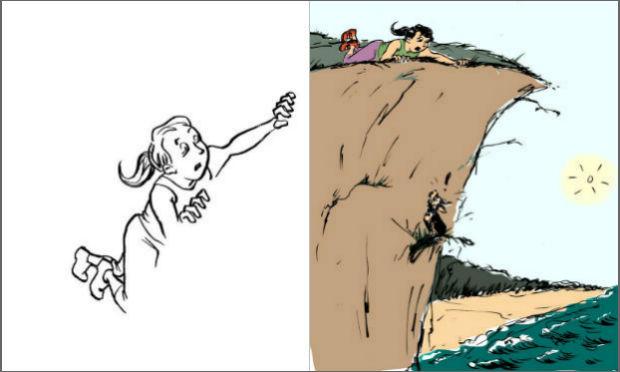
In October, I heard about a contest the show was running. The Studio 360 website explains: “We challenged you to The Great Studio 360 Doodle Dare. Cartoonist and newly-minted MacArthur ‘genius’ grant winner Alison Bechdel started a drawing — of a disconcerted young woman grasping at something unseen — and we asked you to complete the picture.

“More than two hundred doodlers took our challenge, putting Alison’s character in every imaginable situation — fighting spaghetti, hitching a ride on a dragonfly, hanging off of Iggy Azalea’s backside. …

“ ‘I was amazed by how many submissions there were,’ says Bechdel. ‘And many of them were really, really wonderful.’

Carlolita Johnson explained in her submission that the drawing depicts something that really happened to her. ‘She had a little dog that was rolling around on a cliff above the ocean and the dog went over,’ Bechdel explains to [Studio 360 host] Kurt Andersen. ‘So it was exciting to me, because I like to write about my own life, to see someone turn this into a real scene from their own life.’ ”

More here.

Alison Bechdel’s original drawing next to the winning submission from Carlolita Johnson (Studio 360 Doodle Dare) 

Read Full Post »

Tara Mitchell writes at EcoRI News, about the many virtues of compost. It’s a timely topic for gardeners starting to think about spring and what to order from the seed catalogs that arrive this time of year.

Mitchell reports from Wrentham (MA), “John Engwer, owner of Groundscapes Express Inc., and Butch Goodwin, operations manager, recently led Ecological Landscaping Alliance (ELA) participants on a tour of the company’s composting facility, explaining how compost is made and discussing its many benefits and uses. …

“With the recent implementation of the Massachusetts ban on food waste being buried or incinerated, food scrap from hospitals, restaurants and supermarkets have become another component in the composting process. Food scrap from a local hospital is now incorporated into Groundscapes’ composting operation. …

“Goodwin said the material takes about four months to decompose and is then left to cure for another two months. It’s then screened. The finished product, dark brown, moist, light and crumbly, smelling of earth and full of microbes, is then ready to be delivered. …

“Engwer emphasized the importance of using, reusing and retaining existing wood, stumps, brush and other natural material on site so that organic matter can remain part of the cycle of growth, death, decomposition and renewal.”

You can find more on the how-to here.

Photo: Ecological Landscaping Association
The first step in the Groundscapes Express composting process is mixing the raw materials. 

Read Full Post »

Do you know “The Story of the Other Wise Man,” by Henry Van Dyke? It’s about a fourth wise man who sets out with treasures to give the baby born in Bethlehem.

He never makes it, because along the way he has to spend the treasures one by one to help someone in need. At the end of his life, he feels he has failed. Then he hears a voice saying, “Verily I say unto thee, Inasmuch as thou hast done it unto one of the least of these my brethren, thou hast done it unto me.”

Background on the tale is at wikipedia, here. You can get the whole story at Amazon. Better yet, how about your local library?

Sleep tight, Everyone.

Art: Hans Memling
Adoration of the Magi.

Read Full Post »

After my older grandson (4-1/2) and older granddaughter (nearly 2) let me play too as they decorated their gingerbread cookies, I went home and pulled out the sugar-cookie recipe from the nursery school cookbook John made in 1975. It’s still the best.

Observation on cookie cutters: Swedes know their moose. I have several moose/reindeer cookie cutters, but the only one that works well is the one from Erik’s mother. It has plump legs and antlers. Why is that important? Because skinny legs and antlers invariably break off.

The grandson, granddaughter, and I have the same abstract aesthetic when it comes to decorating.

The Little Mermaid window ornament is from Erik’s sister, who lives in Denmark.

121414-abstract-Xmas-cookies

Read Full Post »

Ferguson Library

When the town of Ferguson was turned upside down and the schools had to close, the library stayed open and provided children with learning activities and comfort.

People around the world felt the urge to “do something” for Ferguson, and I began seeing tweets about donating to the Ferguson Library. To have an objective like that was a relief to the feelings, but I had no idea what a special library it turned out to be, how many kinds of help would coalesce around it, and how much I would learn about libraries in general from following @FergusonLibrary on twitter and Facebook.

The Ferguson Library has been sharing the work of other libraries and exhibiting great insight about using this moment of fame to benefit the community and the important work of libraries in our society.

One of the many nice things that have happened is that a children’s book author has organized donations from other authors, and they are coming in from near and far. It all makes one want to spend a lot more time in the library.

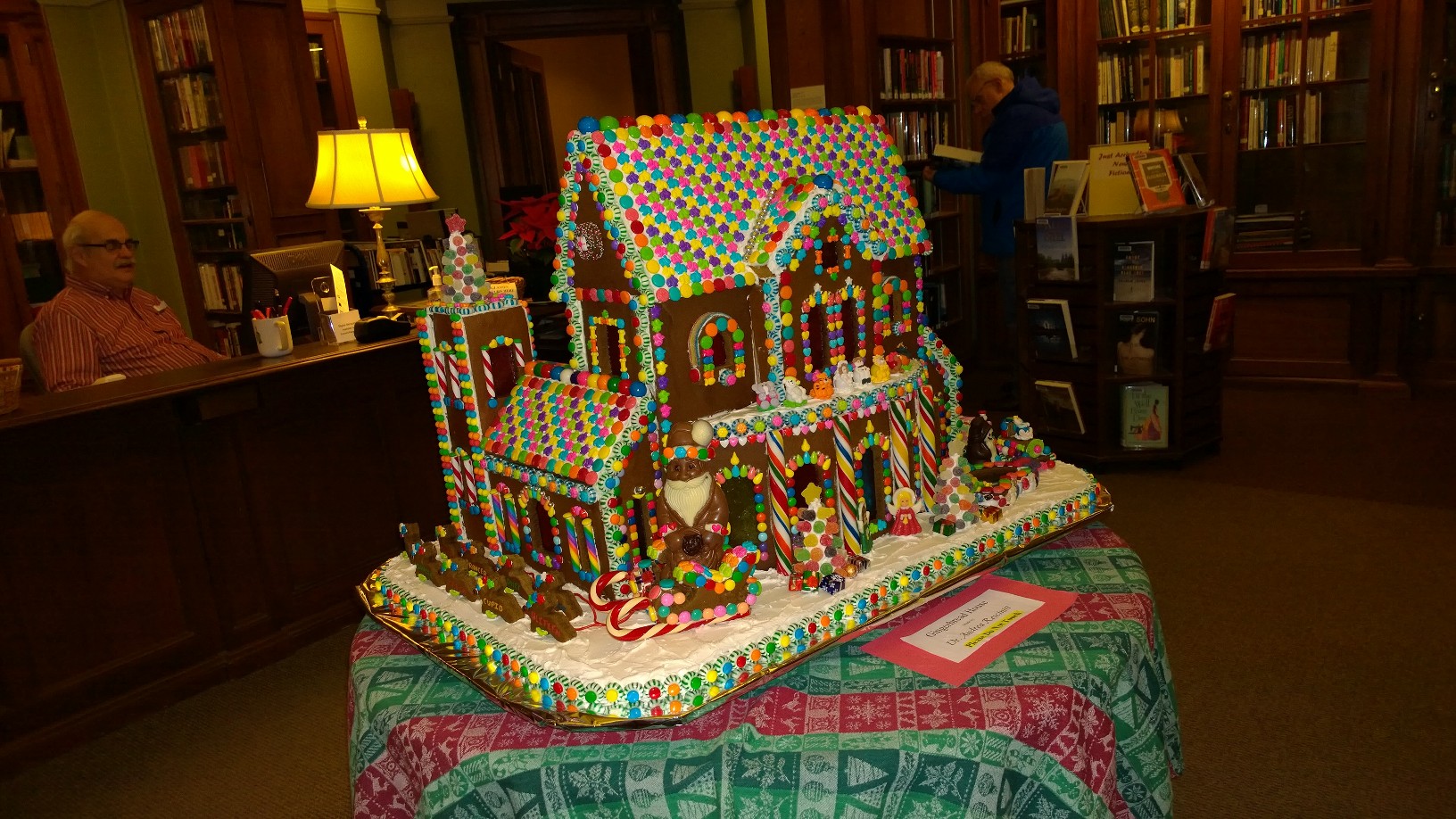
Gingerbread house at Concord Library

library-gingerbread-house


Read Full Post »

xmas-treeThis is the tree in my warm and cozy house. The tree in the picture below, a picture you may think is entirely black, is actually sitting all by itself on a river bank that floods in spring.

It makes me think of the carol about King Wenceslas, who “on the Feast of Stephen” (December 26) spied a poor man out in a blizzard and went with his page to take care of him. “Bring me flesh, and bring me wine; bring me pine logs hither: Thou and I will see him dine, when we bear them thither.”

The story goes that “heat was in the very sod that the saint had printed.”

Not being able to heat the sod underneath our feet (or command a page, for that matter), many of us consider sending a check to a food bank at this time of year. Still too many hungry people.

tree-on-river-bank

Read Full Post »

Rainy days at the shore and holidays are for many families today the only time they play board games.

But for folks in Omaha, Nebraska, an unusual coffee shop provides frequent opportunities to play games — including some that, guaranteed, you never heard of.

Robyn Murray reported the story at the radio show Only a Game.

“Remember playing Monopoly and Scrabble around the dinner table? Arguing with your siblings about who gets to be the car or the Scottish Terrier? Or whether Z-A-Q could ever be a real word? Well those days are coming back — with just one variation: The arguments are getting weird. Did you feed your monster properly? Can you trust her to save the world with you? And what’s the best way to ensure your family doesn’t have to go begging — selling bread or planting beans?

“Welcome to the revamped world of board games.

“At Spielbound in Omaha, Neb. — a newly opened coffee shop and board game library with what’s believed to be the largest collection of board games in the country — the Short family recently played Takenoko, a Japanese board game.

“ ‘We are trying to please the emperor by taking care of his panda and growing a most excellent garden that feeds his panda,’ Justin Short explained.

“There’s a comfortable feeling about Spielbound. The tables are wooden and the booths leather. There are no television screens, just a cozy bar that serves beer and coffees with names like ‘Taste of Sweet Victory’ and ‘Dice Delight.’ Downstairs, four foot shelves are stocked with board games. Each box is a little work of art, with titles like ‘Arkham Horror’ and ‘The Road to Canterbury,’ with pictures of ships, dragons and submarines.

“The Shorts come here a lot on their monthly family pass. Short has a collection of 200 board games at home. But that’s nothing compared to the 1,200 available at Spielbound, at least according to the Shorts’ children:

“ ‘It’s just fun to play as a family whenever we get down here,’ Isabelle said.

“ ‘I like pretending to be something else and do something else,’ Sabrina said.

“ ‘I like beating people,’ Cameron said, laughing.”

More here.

Photo: Robyn Murray/Only A Game 
Spielbound, a coffee shop and board game library in Omaha, Neb., holds what’s believed to be the largest collection of board games in the U.S. with over 1,200 games available for patrons.

Read Full Post »

When John was 3, I made a 16 mm movie for a class. It was abstract. It involved giant road signs saying, “You Slow Down!” and my 3-year-old doing one of his favorite activities — dragging all the yard tools onto the top of my car.

My teacher didn’t give me a good grade because (a) there was no logic to it (so?) and (b) there were too many jump cuts (point taken). But who can see a sign like that and not want to take a picture of it? “You Slow Down!”

Wherever I drove today, there were too many crowds and too few parking spaces. An anxious vibe was abroad in the land.

Fortunately, there are activities that invariably slow me down: an hour at tai chi, with lots of ocean breathing; a couple hours playing with grandchildren and singing with them to John’s guitar; an amble among the hurried shoppers; doing my exercises; drinking hot cider; writing about it all. I can’t do any of that fast.

Now I have a question. Does ambling among hurried shoppers just make them irritated or help to calm them, too?

The photo below shows my boss’s boss’s boss’s boss moderating the tempo at work yesterday.

top-boss-at-the-office

Read Full Post »

We’ve been speaking of public transit and well-planned cities of late. Here’s a story from the radio show Living on Earth about a Boston neighborhood that is fed up with streets built to keep cars and trucks happy and is demanding a more human focus.

“JAKE LUCAS: On a bright Tuesday morning, in Boston’s western neighborhood of Allston, a small group of locals with picket signs crowds onto a little wedge of concrete. They’re standing on Cambridge Street, right where a highway on-ramp splits off from the fiercely busy six-lane road that has been a sore point for years.

“HARRY MATTISON: Cambridge Street is a street that’s a crucial link in our neighborhood, and it’s also an incredibly unsafe, dangerous street.

“LUCAS: That’s Harry Mattison, a 31-year-old software developer who’s a longtime advocate for pedestrian and cyclist rights in the area. Since Cambridge Street was last redesigned 50 years ago, it’s been high on the list of residents’ complaints, and with good reason.

“Two pedestrians were killed here in the last two years. And one of those accidents happened just a few weeks before this rally, when a car hit a man as he tried to cross from the on-ramp to where the protesters are standing now.

“They’re holding signs with messages like ‘My kids walk here,’ and they’re demanding a safer Cambridge Street. Mattison has three kids, and laments not feeling safe on a street that cuts through the heart of his own neighborhood. …

“The city is already working on a short-term fix to make Cambridge Street safer. But in the long term, the transportation department has bigger plans. It’s going to bring the street into the modern day and transform it using the principles of what’s called a ‘complete street.’ Complete streets look different in different places, but the idea’s simple – make transportation systems about people, so there’s equal access for all forms of travel and all people.

“Boston’s Transportation Department has its own complete street guidelines. The head of policy and planning, Vineet Gupta, says that in Boston, every street redesign will include a handful of features from a menu of possibilities.

“GUPTA: Any street that’s going through a redesign process will have some elements of complete streets in it based on its size, based on what the community wants and based on where it’s located.

“LUCAS: In some places that’s as simple as narrowing the road by adding a bike lane. Projects with more room and better funding, like Cambridge Street, might also allow for things like new bike sharing stations, more trees along the street or smart parking meters that direct drivers to open spaces. The final design will be tailored toward the wants and needs of the people who use it.” More here.

Photo: Jake Lucas
Harry Mattison and residents of Boston’s Allston neighborhood march at the Rally for a Safer Cambridge Street on July 28, 2014.

Read Full Post »

Lately, there have been so many stories about kindhearted people tucked in among the opposite kind of headline that, at this rate, if I wait another week there will be too many for one blog post. A good problem to have, of course, but I think I’ll just go ahead and give you what I’ve collected so far.

First there was the woman who went to the Toys R Us in Bellingham and paid off all the layaway plans. Then there was the woman who did the same thing in another Massachusetts town.

Next was the widow who put her engagement ring and wedding ring in a red Salvation Army bucket hoping that, if someone bought them, the charity would receive $20,000. Another widow did just that. She also put out the word that she would like to give the rings back to the first widow.

On Cape Cod, a man believed to be an emissary of a grateful resident has been showing up in fast-food restaurants, asking the manager how many people work there, and dolling out that number of $100 bills. All those generous souls are anonymous.

If you’re not full to bursting yet, how about the homeless man in Preston, UK, who gave a student his last $3 to get a taxi after she lost her money? And how about the student herself, who then organized her friends for on overnight on the streets and raised over £20,000? Now the homeless man is getting an apartment and advising on ways to help the nonprofits that had helped him.

Sam Rkaina at the Mirror writes, “A campaign to raise money for a homeless man has raised an incredible £21,000 after it went viral. Dominique Harrison-Bentzen set up the appeal for an ‘incredibly kind’ homeless man called Robbie who offered her £3 for a taxi home when she lost her bank card on a night out.

“She set up a fundraising page to pay for a deposit on a flat for him and yesterday took part in a 24 hour sleep-out on the streets of Preston. The 22-year-old says she has been overwhelmed by the support from the public after the fundraising target was completely smashed.” More on that story here.

Photo: The Mirror
Dominique, second from left, and friends experiencing a night of homelessness to raise funds.

Read Full Post »

I commute to work, first by commuter rail, then by subway. It should take 1 hour each way but usually takes 1 hour 15 minutes — and it can take much longer as there are often signal problems, equipment breakdowns, lack of a crew, etc.

Still, I always say that it’s better than sitting in traffic. All the train commuters I know complain abut public transit and yet prefer to take it. We can sit and read the news or a book. We can chat with friends and strangers.

Now I see from a tweet linking to CNN that lots more people are getting on board.

Thom Patterson at CNN Travel offers his five reasons for believing that Americans are falling in love with public transit.

1. “Ridership is experiencing a winning streak. The nation is on track to top 2013’s annual ridership, which was the highest since 1956. …

2. “Americans are breaking up with their cars. Since 2007, Americans have been driving less, breaking a trend that had been rising for more than two decades. … The public transportation industry says commuters could gain an average annual savings of $9,635 by taking public transit instead of driving.”

3. Cities seem to like streetcars and trolleys. “In Oregon, Portland’s success with its streetcars in the early 2000s helped spur similar projects around the nation. New streetcar projects are in service, under construction or being planned in Atlanta; Charlotte, North Carolina; Cincinnati; Dallas; Detroit; Kansas City, Missouri; Salt Lake City; Tucson, Arizona; and Washington. …

4. “Several city planners are pinning their hopes on spectacular new transportation facilities that combine transportation with other activities such as shopping and eating. …

5. “These days, jobs are where you find them, not necessarily where you live. Supporters say the need for faster, affordable mass transit between nearby cities has never been greater. Utah Transit Authority’s light-rail line called TRAX has connected communities within the sprawling Salt Lake County for 15 years. … Now, commuter rail lines have been proposed connecting other regional cities — such as Chicago with St. Louis, Dallas with Houston and Orlando’s airport with downtown Miami.” More here.

Read Full Post »

At the radio show Living on Earth, host Steve Curwood recently interviewed the former mayor of a planned city that has a strong emphasis on public transit and quality of life.

From the transcript …

“CURWOOD: Some say the best-planned city in the world is Curitiba, the eighth largest metropolis in Brazil and the capital of the state of Paraná. And much of the credit goes to the the charismatic architect and urban planner Jaime Lerner, who was mayor of Curitiba three times and twice the governor of Paraná. The path to sustainable success he says is often found in doing simple things quickly that enhance the life of a city. Now in his eighth decade and retired from politics, Jaime Lerner has traveled the world and documented some ways various cities create pleasant and sustainable atmospheres in a book called Urban Acupuncture. …

“CURWOOD: Your book isn’t so much a manual about how to make your city sustainable, more sustainable. It’s more an ode to those little things that make a city vibrant — pinpricks you call them. So why did you choose to write a book that focuses on these tiny, little details?

“LERNER: I didn’t want to write a manual, because I wanted to provide the people the sense of what makes a city. … People, they have so many ideas and there’s so many things that can make people happier. I give an example. In my city we had a dentist. At the end of the week, Friday afternoon, he went to his window. He was good clarinet player, and he played a concert.

“And people, they knew that every Friday afternoon this guy is giving a concert of clarinet. It’s not about works; it’s about feelings, feeling a city.

“Sometimes to make a change in a city takes time. The process of planning takes a lot of time. Sometimes it has to take time, but you can through local interventions, pinpricks, you can start to give a new energy to a city…

“A city has to give opportunity to everything, music, poetry. In my state it’s 399 municipalities. We didn’t have money, for instance, for a small city of 4,000 people to have a theater. So what we did, we organized a cultural convoy with 10 buses, recycled buses. One bus was recycled for theater, the other for dance, the other for music, the other for opera, and they travelled all around the state during 5 years. We had an average of 1,500 spectators every night.”

More at Living on Earth.

Photo: Thomas Hobbs; Flickr CC BY-SA 2.0
Curitiba couldn’t afford a subway and decided to focus on buses. The stations look like little subway stations.

Read Full Post »

Research highlighted at Pacific Standard sometimes strikes me as a little lightweight, but I am happy to endorse a study that Tom Jacobs covered recently, because I have some personal experience. It’s about the benefits of both cultural activities and Internet usage for older people.

Jacobs writes, “A new British study of people age 50 and older finds a link between health literacy — defined as ‘the capacity to obtain, process and understand basic health information’ — and two specific behaviors: Regular use of the Internet, and participation in cultural activities.

“ ‘Loss of health literacy skills during aging is not inevitable, a research team led by Lindsay Kobayashi of University College London writes in the Journal of Epidemiology and Health. ‘Internet use and engagement in various social activities, in particular cultural activities, appear to help older adults maintain the literary skills required to self-manage health.’

“The study used data on 4,368 men and women age 50 or older who participated in the English Longitudinal Study on Aging. Their health literacy was measured two years after they joined the project, and again five years later, by having them read a fictitious medicine-bottle label and then answer four reading-comprehension questions.”

I am over 50, enjoy cultural events and the Internet, and understand most medicine bottle labels. So there you go. It’s all true.

Get the key details at Pacific Standard.

Photo: Popova Valeriya/Shutterstock 

Read Full Post »

« Newer Posts - Older Posts »