Feeds:
Posts
Comments

Posts Tagged ‘predator’

Photo: Ryan Kellman/NPR.
Inside this lab in Hawaii, David Sischo and his team care for 40 species of snails. For some snails, it’s the only place they live, having been brought into captivity to stave off extinction.

If we take care of the least of Earth’s organisms, we ultimately take care of ourselves. That’s one reason why today’s story on some obscure research actually matters, even at a time when humanity seems to have bigger issues on its plate.

Lauren Sommer and Ryan Kellman report at National Public Radio about Hawaii’s “jewels of the forest.”

“When Hurricane Douglas came barreling toward Oahu in 2020, David Sischo quickly packed up and drove to higher ground. But he wasn’t evacuating his family. He was evacuating snails.

“Sischo works with some of the rarest endangered species on the planet, kāhuli — Hawaii’s native tree snails. The colorful, jewel-like snails were once so abundant, it’s said they were like Christmas ornaments covering the trees. Almost all of the 750 different species were found only in Hawaii.

“Today, more than half of those species are gone, the extinctions happening in the span of a human lifetime. Sischo and his team with Hawaii’s Department of Land and Natural Resources have the heavy task of saving what’s left.

“To stave off extinction, 40 species of snails, each about the size of a dime, live in human care inside an unremarkable trailer near Honolulu. For some, it’s the only place they’re found, their wild populations having completely disappeared.

” ‘Most people, when they think endangered species going extinct, they think of pandas and tigers and elephants, but imagine having 40 different panda species that are all as rare as pandas are,’ Sischo says. ‘That’s what this facility is.’

“This winter, one species of snail will inch toward an auspicious milestone. It will be released in a special enclosure in the mountains of Oahu, one that has been painstakingly prepared to give the snails the best chance of survival in their natural environment.

“Still, the outlook for Hawaii’s snails is uncertain, symbolizing a new era in the conservation of endangered species. Around the world, plants and animals are being brought into captivity as a last-ditch effort against extinction. But as the climate heats up and invasive species continue to spread, many have no clear path to return to nature in the near-term. That could mean they stay in human care, isolated in zoos for the imperiled. …

” ‘I don’t think people realize how fast things are changing,’ Sischo says. ‘It’s happening, like right now as I’m talking to you, there’s species blinking out, out in the wild right now.’

“To keep that from happening to Hawaii’s native snails, Sischo never turns off his phone. They rely on life support systems in the Snail Extinction Prevention Program trailer, kept in environmental chambers that control temperature and release mist to simulate their native rainforest habitat. Sensors are set up to detect any problems, alerting Sischo and his team 24 hours a day. …

“Sischo pulls out one with snails the size of a fingernail hiding among the leaves. It’s Achatinella fulgens, a snail with a pale yellow shell and a bold black stripe swirling around it. … Other snails have intricate stripe patterns, almost like they’re sporting a plaid shirt. One snail has a shell like a miniature cinnamon roll. Some are almost iridescent, glowing with golds and greens.

” ‘Our tree snails are known as the jewels of the forest,’ he says. ‘The islands were dripping in snails. They were everywhere.’

“Hawaii’s tree snails play a crucial role in the ecosystem, having evolved over millions of years on the isolated islands. They don’t actually eat leaves, instead eating the fungus that grows on them. That helps keep the native trees clean and recycles nutrients in the forest. The snails also hold an important place in Native Hawaiian culture, their shells used to make lei.

” ‘In Hawaiian tradition, snails sing,’ Sischo says. ‘They represent voice. So they were probably one of the most revered invertebrates in the world.’

“Hawaii’s tree snails were no match for the barrage of changes that humans brought. Rats eat snails, and they arrived on ships, both Polynesian and European. The snails’ habitat disappeared as Hawaii’s forests were cleared for agriculture. But the biggest threat came in the form of another snail.

“In the 1950s, a predatory snail was introduced to Hawaii from Florida. The rosy wolf snail was released to control another invasive snail, but as so many invasive species stories go, it quickly spread. Rosy wolf snails are exceptionally good at eating native snails, hunting them down by following their slime trails and ripping them from their shells.

” ‘When they encounter a slime trail, they know the direction it was going,’ Sischo says. ‘Once they’re locked in on a trail from a native snail, they go right up to it. There’s no getting away.’ “

Oh, gee. That’s exactly what I meant in a recent post about introducing a species to address a problem. What if the fix goes awry and creates new problems?

More at NPR, here. No paywall.
Read Full Post »

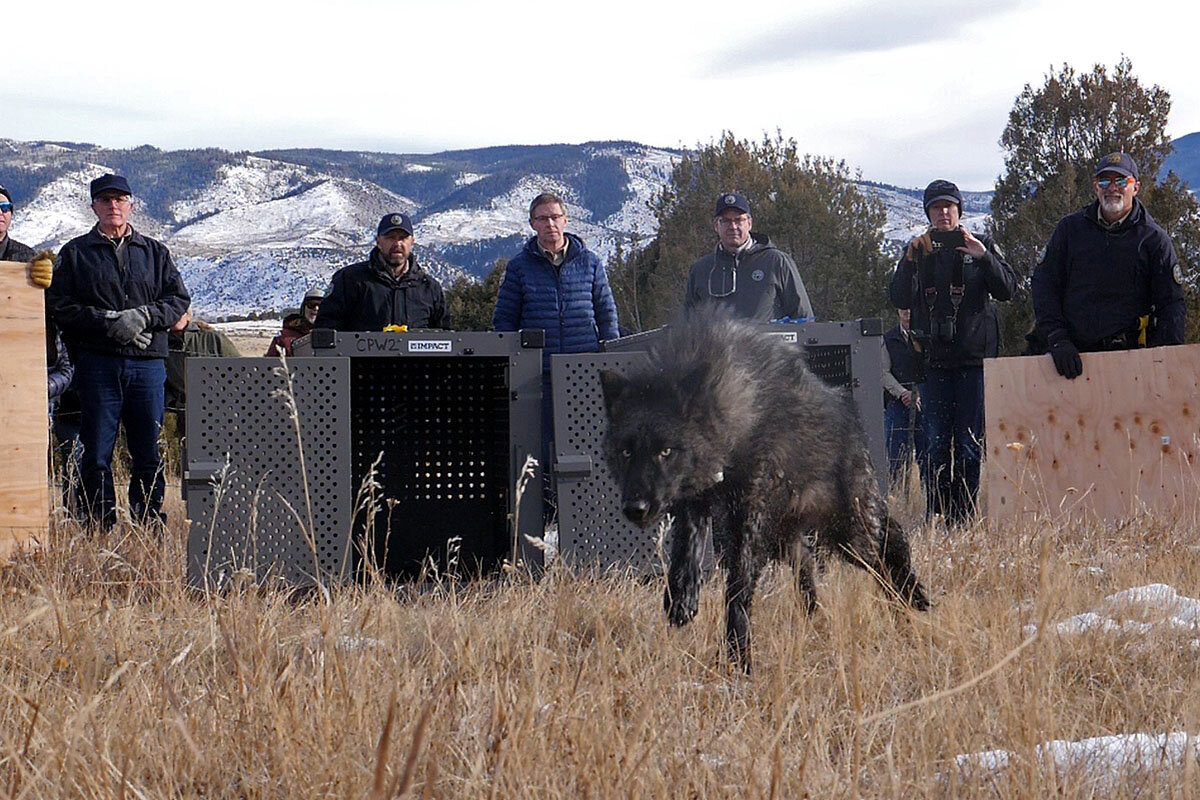
Photo: Jerry Neal/Colorado Parks and Wildlife.
Via Christian Science Monitor: “Wolf 2302-OR runs into the wilderness as Colorado Parks and Wildlife released five gray wolves onto public land in Grand County, Colorado, on Monday, Dec. 18, 2023.”

Rewilding involves trade-offs. That’s why reintroducing the gray wolf with the scary eyes to its old haunts requires taking the needs of many constituencies into account.

As Sarah Matusek reports at the Christian Science Monitor, “A new era dawned in Colorado’s Rocky Mountains [in December] with the release of five gray wolves. 

“The reintroduction of the wild canines to Colorado fulfills a voter-passed plan to begin restoring the endangered species here by the end of 2023. The first batch of furry predators, flown in from Oregon, bounded out of crates in Grand County, Colorado, across an undisclosed meadow. 

“Wolves are contentious in the western United States, with disagreement about the threats they may pose versus their ecological benefit. A judge last week denied a last-minute lawsuit from the Colorado cattle industry seeking to block the release.  

“Despite the culture-war status of wolves, their release has also spurred cooperation. Many ranchers, wolf advocates, scientists, and wildlife officials have engaged in knowledge-sharing and strategizing around conflict reduction. …

“Gray wolves, wildlife experts say, are native to the Centennial State. Killed off in Colorado by the 1940s, some have since migrated here across state lines. Colorado biologists recorded the birth of wild wolf pups in the state’s north in 2021. 

“The animal is subject to a patchwork of protections. Listed as endangered in Colorado, for instance, the gray wolf loses that status once it crosses the northern border into Wyoming. Gray wolves are protected nationally under the federal Endangered Species Act, with exceptions in the northern Rocky Mountains. 

“After the 2020 vote, Colorado got special permission from the U.S. government for its state restoration plan. This generally allows management flexibility in Colorado, such as killing wolves that attack livestock.

“The Colorado cattle industry sued state and federal wildlife agencies last week seeking to block the rollout of the plan. The Gunnison County Stockgrowers’ and Colorado Cattlemen’s associations argued that the U.S. Fish and Wildlife Service failed to produce a certain environmental study on wolf impacts that federal law required.

“On Friday, a U.S. district judge denied the plaintiffs a temporary restraining order. Their arguments, the court found, didn’t merit halting Colorado Parks and Wildlife’s wolf plan, which ‘would be contrary to the public interest.’  

“Thirty to 50 wolves could be reintroduced on Colorado’s Western Slope over the next three to five years, according to the state’s wolf management plan. 

“The Western Slope, a largely rural area, sits west of Denver and several other population centers, which carried the pro-wolf vote. The outcome underscored an urban-rural divide in a Democratic-led state that used to trend more purple.

“Supporters, including environmentalists, argue for restoring a natural balance. ‘Wolves, for millennia, have been one of the primary engines of evolution and the drivers of ecological health throughout the Northern Hemisphere,’ says Rob Edward, strategic adviser at the Rocky Mountain Wolf Project. 

“He cites an example in Colorado’s Rocky Mountain National Park. An abundance of elk there has depleted vegetation ‘in the absence of their primary predator, gray wolves,’ says Mr. Edward,. …

“Critics, including agricultural producers, raise concerns about predation of wild and cultivated animals. ‘There’s obviously the concern with the impacts to our own livestock, both financial and emotional,’ says rancher Greg Peterson, a member of the Gunnison County Stockgrowers’ Association. ‘It’s traumatizing when that animal suffers.’ …

“Wolves may help reduce elk overbrowsing and bolster habitat diversity, [Kevin Crooks, director of the Center for Human-Carnivore Coexistence at Colorado State University] says, based on research in national parks like Yellowstone, which reintroduced gray wolves in 1995. But the science also suggests that ‘wolves were likely not solely responsible’ for ecosystem changes there.

“And while wolves could harm individual livestock, he says, in terms of ranching concerns, research shows that a rebound of wolves is unlikely to have a major economic impact on the cattle industry. Yet that’s cold comfort to one Colorado ranching family that’s already seen several livestock deaths and injuries from wolves since 2021, reports the Washington Post.

“In an effort to bridge trust gaps, Dr. Crooks’ center has compiled peer-reviewed research and crowdsourced funds for nonlethal wolf mitigation, like fencing or guard dogs. The university has also engaged Western Slope stakeholders like Jo Stanko, who runs a ranch with her husband near Steamboat Sp​​rings in northwestern Colorado.

“As a voter, Ms. Stanko says she cast her ballot in 2020 against wolf releases. Though she still has concerns, three years later she holds an attitude of acceptance – and hope for solutions around wolves and ranchers sharing land. Her family continues to train livestock dogs and install new fencing, and Ms. Stanko hosted a dialogue with wolf advocates and other ranchers last year. 

“ ‘We’ve got to learn to have – and relearn how to have – civil conversations with each other,’ she says.”

More at the Monitor, here.

Read Full Post »

Did you know that plants can protect themselves from predators?

Writes Douglas Quenqua at the NY Times, “It has long been known that some plants can respond to sound. But why would a plant evolve the ability to hear? Now researchers are reporting that one reason may be to defend itself against predators.

“To see whether predator noises would affect plants, two University of Missouri researchers exposed one set of plants to a recording of caterpillars eating leaves, and kept another set of plants in silence. Later, when caterpillars fed on the plants, the set that had been exposed to the eating noises produced more of a caterpillar-repelling chemical. …

“Plants exposed to other vibrations, like the sound of wind or different insects, did not produce more of the chemical, suggesting they could tell the difference between predator noises and atmospheric ones. The researchers published their work in the journal Oecologia.” More here.

I have an idea. How about farmers, instead of using genetically modified seed to protect plants, just pump recordings of crunching predators into their fields so that the plants could protect themselves?

As they say where I work, “More research is needed.”

The NY Times posted this Pieris Silhouette video by mubondlsc
Can you hear the crunching of the caterpillar?

Read Full Post »