Feeds:
Posts
Comments

Posts Tagged ‘production’

Photo: Melanie Stetson Freeman/CSM Staff.
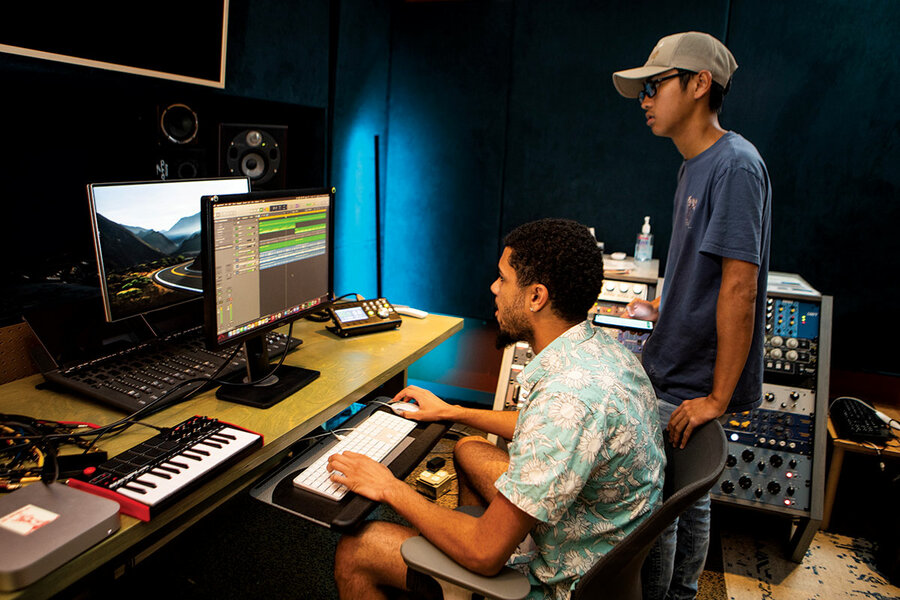
Kyle Johnson (left) and Jonathan Hua-Phan create beats in a studio Aug. 24, 2023. Musicians can rent studio space for as little as $10 an hour – as opposed to the $100 an hour average rate in Boston.

Music belongs to everyone, but sometimes making music is expensive, especially if you need a soundproof studio with electronic bells and whistles. Fortunately, there are options.

Alessandro Clemente writes at the Christian Science Monitor, “Sanyé Mylo’s eyes twinkle with excitement. He is standing in the sound booth of The Record Co. in Boston, eager to bring his creation to life.

“ ‘This place is a musical creative sandbox,’ he says. With the press of a button, his latest rap track fills the room. As the speakers blast Mr. Mylo’s beat-pulsing rhythms, it’s hard to resist the urge to dance. ‘I didn’t know spaces like this existed,’ says Mr. Mylo, who grew up in the low-income neighborhood of Dorchester. ‘It’s the community. It’s the mission. It’s the energy. It’s more than just the environment.’

“Mr. Mylo is one of the young musicians in Boston who, thanks to The Record Co., has turned his music into a full-time occupation. The sound studio, located amid a graying backdrop of warehouses on Massachusetts Avenue, is an unexpected island of creativity and hope.

“Founded in 2010 by Matt McArthur, The Record Co. aims to give musicians more affordable access to creative workspaces and introduce the world of music to those who may have never considered their place in it.

“Mr. McArthur understands this challenge firsthand. As a music technology student at Berklee College of Music, he was frustrated by the high costs of renting time in production studios. …

“On average, a recording studio in Boston costs more than $100 per hour to rent. Mr. McArthur’s vision flipped that model on its head. He saw a recording studio not as a sanctuary for wealthy people but as a community hub available to all.

“He took out loans, collected donations, and opened a studio in a tiny basement in Cambridge, Massachusetts. Slowly but steadily, Mr. McArthur expanded it and eventually rented a new property to include rehearsal spaces and production suites.

“Today, The Record Co., with a full-time staff of more than 20 people, is a state-of-the-art, 12,000-foot facility that can be rented for as little as $10 per hour. Each month, it receives about 1,000 reservations, and around 3,500 musicians pass through its doors.

‘We don’t care if you’re good or trying to do it for a living,’ says Mr. McArthur. ‘Our philosophy is that every single person deserves to express their musical creativity.’

“At The Record Co., the ethos is clear: Music belongs to everyone, and so does the space to create it. The building has been shaped not only with an ear to acoustics but also with an eye to inclusivity, ensuring it is as welcoming to a musician in a wheelchair as to one who walks in with a guitar slung over their shoulder. …

“Beat the Odds serves low-income communities to help young people channel their energies into creative pursuits, and confront and discuss their mental health challenges. Thanks in part to the music production facility available at The Record Co., the group continues to expand its reach. It recently received a $600,000 grant from Boston Mayor Michelle Wu to finance its after-school programs. …

“Since rental fees don’t fully cover the operational costs, The Record Co. relies on donations. As a graduate of Berklee with her own memories of scraping by as a poor music student in Boston, Rachel Jordan says her investment feels personal. Now head of marketing for a tech startup in California, she says she welcomes the opportunity to help eliminate barriers to producing music, and she is committed to attracting investors to believe in the value of The Record Co.’s mission.

“ ‘There are so many quantitative ways to measure impact,’ says Ms. Jordan, ‘but sometimes the most meaningful way is through one human story at a time. We can talk about the economic impact of a thriving arts community, and that matters. But the artists themselves also tell the story of impact so well.’ …

“The Record Co.’s purpose becomes more meaningful in the context of the neighborhood surrounding it, which struggles with addiction and homelessness.

“In Boston, the stretch where Massachusetts Avenue intersects with Melnea Cass Boulevard is known as Methadone Mile, a reference to the addiction treatment centers that share the same block as the studio. Mr. McArthur, who lives in the neighborhood, acknowledges the challenges facing those with addictions, noting, ‘I’m not delusional to think that somebody is going to kick a chemical habit just because they got in the studio one day.’ Yet he holds that music offers a positive alternative to counter the pull toward destructive behaviors.

“Mr. Mylo can attest to the transformative power of music. He felt the one-size-fits-all educational system stymied his creativity. College seemed more like an insurmountable debt rather than an opportunity to learn and grow.

“A friend introduced him to Beat the Odds and The Record Co. Here he felt that his talent was not only recognized, but also nurtured.. .. Walls, built from years of distrust and self-preservation, began to crumble, recalls Mr. Mylo.  

“Now he works not only as a musician but also as a producer and mentor for new musicians who join Beat the Odds.”

More at the Monitor, here. No paywall.

Read Full Post »

I love reading about and sometimes seeing offbeat and experimental theater. You may recall a couple recent posts on Iranian productions, for example — one play performed in a taxi, and another featuring a script the actors aren’t allowed to see until it’s time to go on stage.

So I was intrigued by a story in the Guardian about an experiment with one-on-one productions. Lyn Gardner writes, “Earlier this year I was lucky enough to take part in Whispers, a project created by the Exeter-based Kaleider, that takes the form of a co-operative gifting chain of performance, as a story and a metal tablet pass from person to person who each take responsibility for passing it on.

“At the Brighton fringe something similar is taking place with Host, a project created by the Nightingale Theatre that takes place in one of two bathing huts. Taking the form of a short text written by Tim Crouch … it works like this: You enter the bathing hut and somebody performs the text to you, and then you perform the text – reading from the script – to the next person.

“All participants subsequently get sent a copy of the script via email. This means that they can set off their own chains of reading and receiving, which creates in effect a tree that then has branches going off from it but which are all traceable back to that first performance by Tim Crouch in Brighton. It’s like a baton being passed.” More here.

This week, I’m having dinner with three other women who have at various times been active in the Concord Players. We meet up a couple times a year to indulge in theater talk as most of our other friends are not into that. I’ll be sure to pass along some of these experiments. The Concord Players isn’t a place that indulges in avant garde, but we all like hearing about what’s going on in the wider world.

“Host,” a one-on-one play at the Brighton Fringe Festival in England, is performed in this bathing hut.

Read Full Post »

A Syrian actor who visited a refugee camp, felt compassion for the children, and returned to help them put on a play decided to start at the top. Only the best playwright would do.

From the Zaatari refugee camp in Jordan, NY Times reporter Ben Hubbard describes the scene: “On a rocky patch of earth in this sprawling city of tents and prefab trailers, the king, dressed in dirty jeans and a homemade cape, raised his wooden scepter and announced his intention to divide his kingdom. His elder daughters, wearing paper crowns and plastic jewelry, showered him with false praise, while the youngest spoke truthfully and lost her inheritance.

“So began a recent adaptation here of King Lear. For the 100 children in the cast, it was their first brush with Shakespeare, although they were already deeply acquainted with tragedy. All were refugees who had fled the civil war in Syria. …

“ ‘The show is to bring back laughter, joy and humanity,’ said its director, Nawar Bulbul, a 40-year-old Syrian actor known at home for his role in ‘Bab al-Hara,’ an enormously popular historical drama that was broadcast throughout the Arab world.

“Last year, he and his French wife moved to Jordan, where friends invited him to help distribute aid in Zaatari. …

“Children he met in the camp made him promise to return, and he did — with a plan to show the world that the least fortunate Syrian refugees could produce the loftiest theater. …

“The mere fact that the play was performed was enough for the few hundred spectators. Families living in nearby tents brought their children, hoisting them on their shoulders so they could see. …

“The crowd burst into applause, and a number of the leading girls broke into tears. Mr. Bulbul said they were overwhelmed because it was the first time anyone had clapped for them.”

More here, at the NY Times, where you can also see a slide show and watch a video about the refugee-camp theater initiative.

Photo: Warrick Page for The New York Times

Read Full Post »

A lovely, warm day for walking, grandkids, and friends.

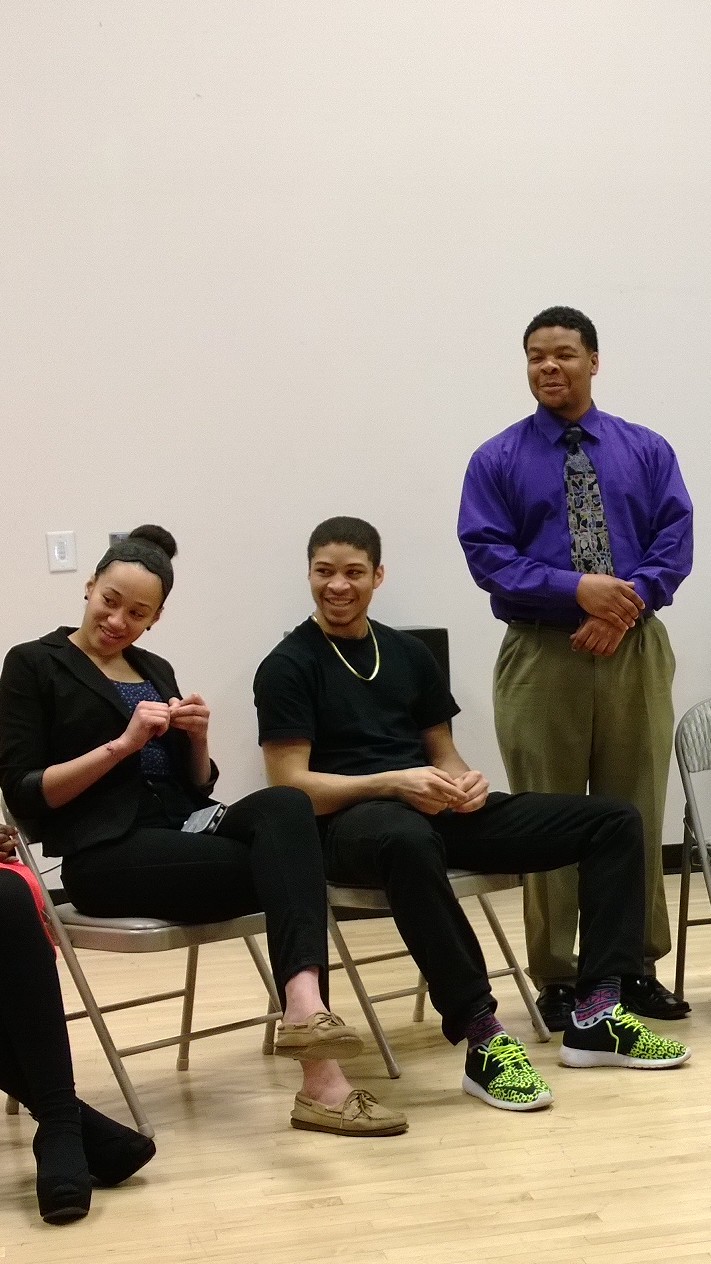
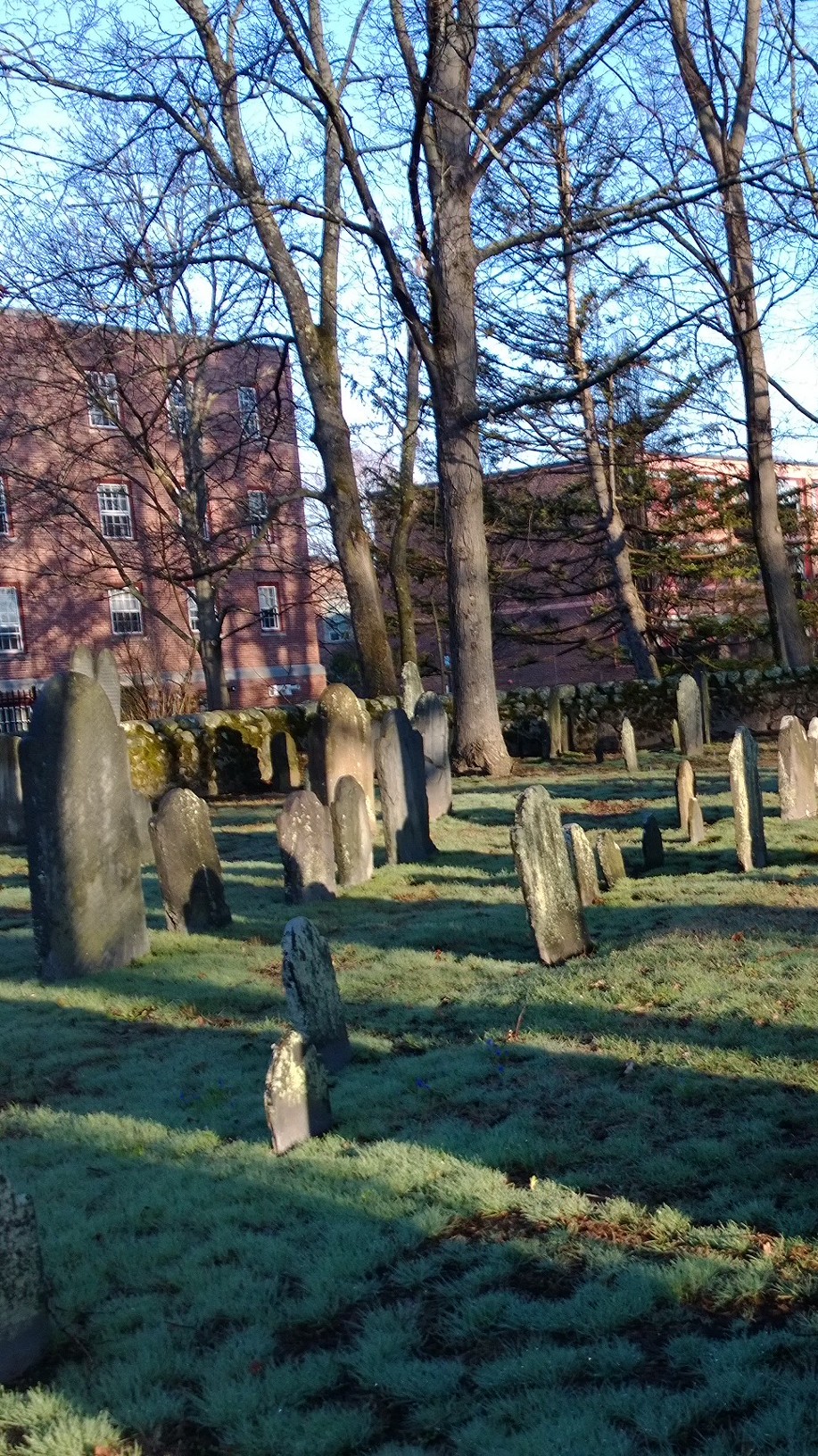
Here are a few photos, including one of director-playwright Jermaine Hamilton with cast members at Brandeis University.

I was so happy I managed to get to Jermaine’s senior-thesis play about inequality of U.S. high schools, Bridging the Gap. What a challenge to make it work for both his social sciences major and his theater minor! A great bunch of natural actors and Jermaine’s lighting and sound collaborators pushed it over the finish line, and judging from the audience comments in the talk-back, the issues that the play presented struck chords.

Jermaine has a teaching job lined up for next year, after graduation. The school is lucky to have him.

Jermaine, standing, joins his cast for a talk-back with the audience. The other pictures are walking-around shots.
Jermaine-Hamilton_with-cast

daffodils


gravestone-shadows

flower-box-april-12-14


032214-library-wndow

tree-face


Read Full Post »

Hidden Faces of Courage, a “theater piece with music” created by Mary Driscoll in collaboration with formerly incarcerated women, is coming soon. I will write more after I have seen the production in November, but I need to alert you that if you want tickets, you might want to get them now as the performance space is rather small. Go to Fort Point Theatre Channel, here.

I met Mary in the playwriting class that I blogged about a few times. I didn’t continue with theater after the class, but Mary kept working at this play. She has a deep commitment to helping women who have been in prison, having worked with them for years at her nonprofit, OWLL (On With Living and Learning Inc.).

Mary writes: “The voices of previously incarcerated women are notably absent in the artistic world—a world that can engage a broader community in reform and foster greater understanding between the individual and diverse audiences. Sometimes in unexpected ways.”

Read more about her show at Broadway World, Boston, here.

Hidden Faces of Courage is directed by Tasia A. Jones, with music by Allyssa Jones, and runs November 8-10, 15-17,  at The Boiler Room, 50 Melcher Street, Fort Point, Boston.

Read Full Post »

Twenty years ago I helped out on what local people jokingly refer to as the Concord Passion Play: Little Women. It’s performed every 10 years by the Concord Players because (a) author Louisa May Alcott lived at Orchard House in Concord and (b) she was a founder of the theater group that became the Concord Players.

Kate Clarke is directing the show this year, and she just got some great publicity in the Boston Globe.

“ ‘Preparing to direct the play, I started to do some research and was fascinated to discover just how meaningful the book is to so many people,’ Clarke said.

“ ‘Even the rock star Patti Smith wrote in her recent memoir that “Little Women” was what made her feel as a young high school student that she could be an artist. It motivated her to go to New York and become a performer. I started thinking, “Good Lord, Jo March is everywhere! Why do people find her so compelling?”

“ ‘That’s the question I’ve been tackling with this group of actors. Yes, it’s about the Civil War era, and the societal restrictions that females were under at that time. But the fact that the book’s popularity has endured reflects what compelling characters these young women were.

“ ‘This story is so uniquely Concord and yet reaches far beyond the boundaries of Concord, just as it is a story about the 1860s that also brings up a lot of contemporary issues,’ Clarke said.” Read more.

Here’s photo by Jon Chase for the Boston Globe. Pat Kane, an incredible costume designer, is in the middle. (I don’t think she remembers, but the first time she worked for the Concord Players was when I sought her help on a one-act I directed, Stoppard’s After Magritte.)

Read Full Post »