Feeds:
Posts
Comments

Posts Tagged ‘protection’

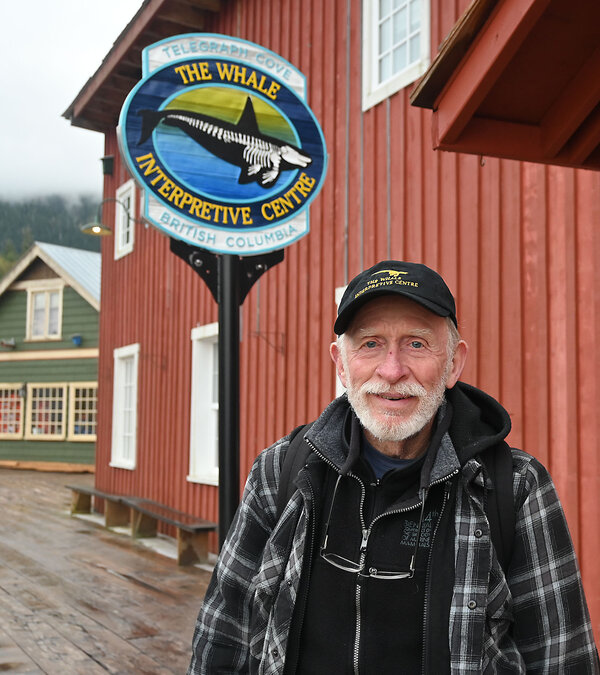
Photo: Jules Struck.
Jim Borrowman was part of a successful lobby to create an ecological reserve in western Canada’s Johnstone Strait in the 1980s.

Today’s story is about a few people whose determination helped to reverse the decline of a group of Orca whales — people who just don’t give up.

At the Christian Science Monitor, Jules Struck wrote recently about their work.

“Jim Borrowman cut the engine of the Nisku in the gray water of the Johnstone Strait, relinquishing his boat to an eastbound tide. He unraveled the line of a hydrophone – a cylindrical, underwater microphone – and dropped it portside.

“On the other end of the cord a pint-size Honeytone speaker in the cabin broadcast a conversation from the deep: the ethereal, two-toned call of an orca whale to her clan.

“ ‘I think they’re what we call “A1s,” ‘ said Mr. Borrowman, browsing a database of local orcas on his phone.

“Mr. Borrowman has been watching, and watching over, these whales for decades. He was one in a band of Vancouver Islanders who successfully lobbied in the early 1980s to set aside a protected area for Northern resident orcas, which lost a third of their population to hunting and capture in the 1950s and ’60s.

“This early act of ocean preservation laid a foundation from which decades of important research – and a deep local allegiance to the whales – have flourished. Galvanized by this data, environmentalists and First Nations just won a battle to evict commercial open-net fish farms from the area, which compete with the orcas’ food supply.

“With early signs of abundant salmon, and a small but decades-long uptick in Northern resident population numbers, it feels to some like nature rallying.

“ ‘You can see the whales coming back,’ says Alexandra Morton, an author and marine biologist who has studied salmon in the Johnstone Strait since the 1980s. She was part of a group that occupied a Vancouver Island fish farm in 2017 in protest of the industry.

“The A1s spotted by Mr. Borrowman from the bow of the Nisku are one pod of one type of orca, called Northern resident killer whales, which number some 400 and live along the coast of British Columbia.

“They’re doing particularly well, and have been growing by a handful of members each year since the ’70s. Northern residents are the most reliable visitors to the Robson Bight (Michael Bigg) Ecological Reserve, where Mr. Borrowman has served as a warden and run a whale-watching tour business with his wife, Mary, for decades until recently retiring.

“ ‘This is a beautiful, sensitive estuary at the terminus of a 100,000-acre watershed, the last untouched one on the east coast of Vancouver Island at the time,’ he says.

“It’s unique for another reason. At two known beaches at the mouth of the Tsitika River, Northern resident orcas rub gracefully along the seafloor pebbles in what scientists have dubbed a unique ‘cultural behavior.’

“It was this behavior, first captured in underwater footage by Robin Morton, Alexandra Morton’s late husband, that convinced the public, the press, and finally the federal government to set aside about 3,000 acres of water plus shore buffer as a protected area closed to boat traffic.

“Today, volunteer wardens with the Cetus Research & Conservation Society Straitwatch program monitor the reserve and gather population data on the whales and their pods. …

“Today, the whales’ major issues are food scarcity, noise, and chemicals in the water. But if the threats to orcas have become more complex, the responses have grown increasingly well-informed by a bedrock of research, much of which has come out of the ecological reserve and its orbit. …

“Decades of research have since shown that major pathogens and lice leak from [salmon] farms’ huge, suspended net pens straight into the paths of migrating salmon, ravaging their thin-skinned young and immobilizing the adults.

“Pacific salmon are also an important food source and cultural pillar for First Nations. They are intricately linked to the ecosystem, and scientists have even tracked nutrients from decomposed salmon high into the mountains.

“Ms. Morton campaigned for decades to close the fish farms. Nothing changed until she and Hereditary Chief Ernest Alexander Alfred, with a group of other First Nations people, peacefully occupied a Vancouver Island salmon farm owned by Marine Harvest.

“That protest led to a 2018 agreement with the British Columbia government requiring the consent of three First Nations – ‘Namgis, Kwikwasut’inuxw Haxwa’mis, and Mamalilikulla – for fish farms to operate around Vancouver Island.

“First Nations closed more than a dozen salmon farms in and near the strait. Then, the federal government announced it would ban all open-net farms in British Columbia by 2029.

“The decision is not universally supported by First Nations along the coast: 17 have agreements with salmon farming companies, which collectively employ around 270 Indigenous people, according to the Coalition of First Nations for Finfish Stewardship. Overall, open-net salmon farming accounts for 4,690 jobs and $447 million in gross domestic product across Canada, according to the BC Salmon Farmers Association.

“But for many, it was a turning point. Coho and especially Chinook salmon stocks spiked this year in Vancouver Island and its inlets, according to the Pacific Salmon Foundation, after years of downturn.”

Read more at the Monitor, here.

Read Full Post »

Photo: Ryan Kellman/NPR.
Inside this lab in Hawaii, David Sischo and his team care for 40 species of snails. For some snails, it’s the only place they live, having been brought into captivity to stave off extinction.

If we take care of the least of Earth’s organisms, we ultimately take care of ourselves. That’s one reason why today’s story on some obscure research actually matters, even at a time when humanity seems to have bigger issues on its plate.

Lauren Sommer and Ryan Kellman report at National Public Radio about Hawaii’s “jewels of the forest.”

“When Hurricane Douglas came barreling toward Oahu in 2020, David Sischo quickly packed up and drove to higher ground. But he wasn’t evacuating his family. He was evacuating snails.

“Sischo works with some of the rarest endangered species on the planet, kāhuli — Hawaii’s native tree snails. The colorful, jewel-like snails were once so abundant, it’s said they were like Christmas ornaments covering the trees. Almost all of the 750 different species were found only in Hawaii.

“Today, more than half of those species are gone, the extinctions happening in the span of a human lifetime. Sischo and his team with Hawaii’s Department of Land and Natural Resources have the heavy task of saving what’s left.

“To stave off extinction, 40 species of snails, each about the size of a dime, live in human care inside an unremarkable trailer near Honolulu. For some, it’s the only place they’re found, their wild populations having completely disappeared.

” ‘Most people, when they think endangered species going extinct, they think of pandas and tigers and elephants, but imagine having 40 different panda species that are all as rare as pandas are,’ Sischo says. ‘That’s what this facility is.’

“This winter, one species of snail will inch toward an auspicious milestone. It will be released in a special enclosure in the mountains of Oahu, one that has been painstakingly prepared to give the snails the best chance of survival in their natural environment.

“Still, the outlook for Hawaii’s snails is uncertain, symbolizing a new era in the conservation of endangered species. Around the world, plants and animals are being brought into captivity as a last-ditch effort against extinction. But as the climate heats up and invasive species continue to spread, many have no clear path to return to nature in the near-term. That could mean they stay in human care, isolated in zoos for the imperiled. …

” ‘I don’t think people realize how fast things are changing,’ Sischo says. ‘It’s happening, like right now as I’m talking to you, there’s species blinking out, out in the wild right now.’

“To keep that from happening to Hawaii’s native snails, Sischo never turns off his phone. They rely on life support systems in the Snail Extinction Prevention Program trailer, kept in environmental chambers that control temperature and release mist to simulate their native rainforest habitat. Sensors are set up to detect any problems, alerting Sischo and his team 24 hours a day. …

“Sischo pulls out one with snails the size of a fingernail hiding among the leaves. It’s Achatinella fulgens, a snail with a pale yellow shell and a bold black stripe swirling around it. … Other snails have intricate stripe patterns, almost like they’re sporting a plaid shirt. One snail has a shell like a miniature cinnamon roll. Some are almost iridescent, glowing with golds and greens.

” ‘Our tree snails are known as the jewels of the forest,’ he says. ‘The islands were dripping in snails. They were everywhere.’

“Hawaii’s tree snails play a crucial role in the ecosystem, having evolved over millions of years on the isolated islands. They don’t actually eat leaves, instead eating the fungus that grows on them. That helps keep the native trees clean and recycles nutrients in the forest. The snails also hold an important place in Native Hawaiian culture, their shells used to make lei.

” ‘In Hawaiian tradition, snails sing,’ Sischo says. ‘They represent voice. So they were probably one of the most revered invertebrates in the world.’

“Hawaii’s tree snails were no match for the barrage of changes that humans brought. Rats eat snails, and they arrived on ships, both Polynesian and European. The snails’ habitat disappeared as Hawaii’s forests were cleared for agriculture. But the biggest threat came in the form of another snail.

“In the 1950s, a predatory snail was introduced to Hawaii from Florida. The rosy wolf snail was released to control another invasive snail, but as so many invasive species stories go, it quickly spread. Rosy wolf snails are exceptionally good at eating native snails, hunting them down by following their slime trails and ripping them from their shells.

” ‘When they encounter a slime trail, they know the direction it was going,’ Sischo says. ‘Once they’re locked in on a trail from a native snail, they go right up to it. There’s no getting away.’ “

Oh, gee. That’s exactly what I meant in a recent post about introducing a species to address a problem. What if the fix goes awry and creates new problems?

More at NPR, here. No paywall.

Read Full Post »

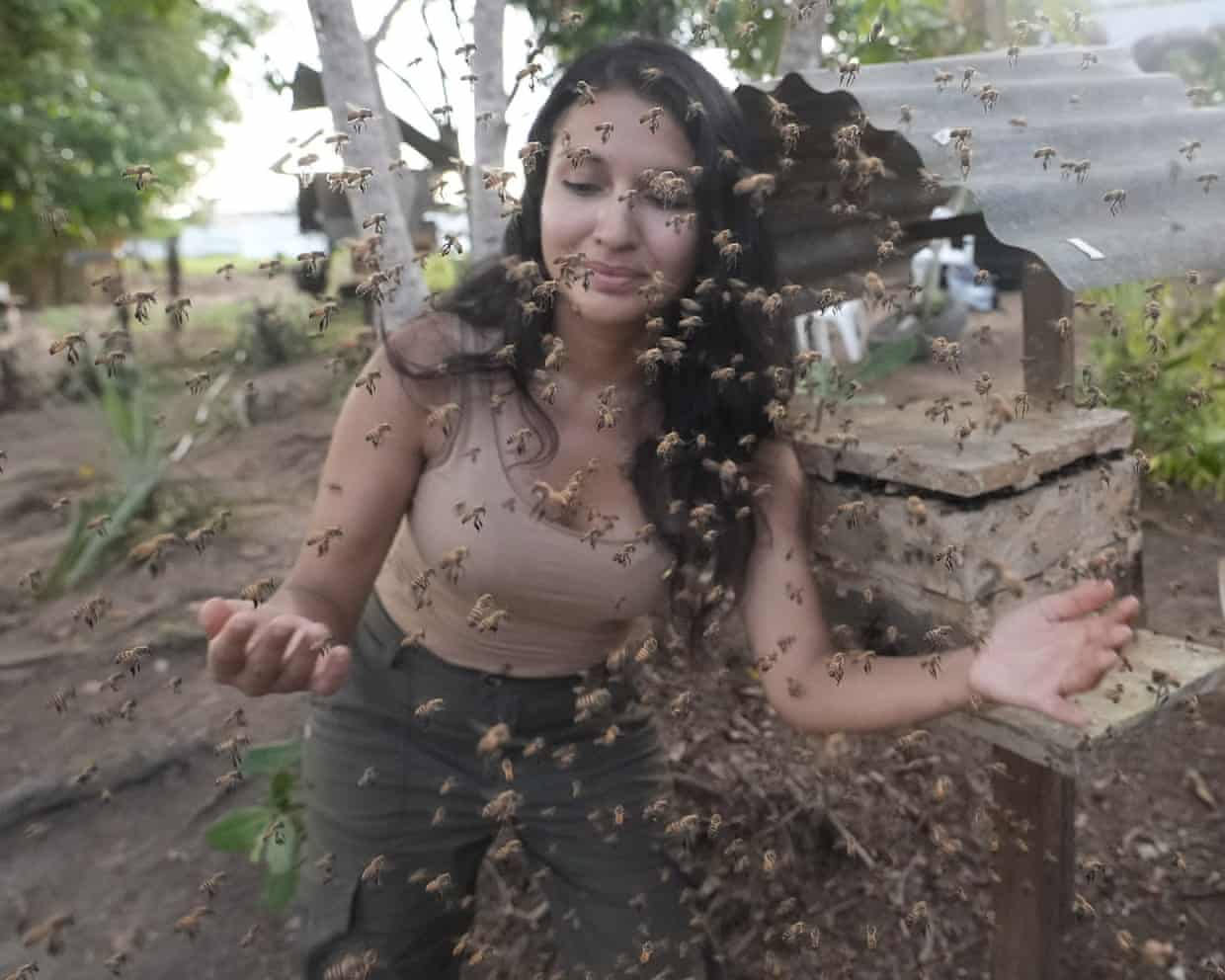
Photo: Claudia Morales.
The
Guardian reports from Bolivia: “The founders of Team Uru Uru found that totora reeds – which have long been used by their Indigenous community to build houses, boats and even floating islands – can absorb heavy metals.”

“One and two and 50 make a million.”

I still believe in that line from the Pete Seeger folk song about righting wrongs. Today I want to point out that, when it comes to protecting the environment, it’s often indigenous people who see what’s going wrong and decide to do something about it.

Sarah Johnson writes at the Guardian, “Looking out over Lake Uru Uru in the Bolivian highlands, it is hard to imagine that it once supported thousands of people, and was a sanctuary for wildlife, including 76 species of birds.

“Plastic waste now stretches as far as the eye can see, the water is tinged black or brown, and the stench is overwhelming.

“But in among the filth that chokes the water are submerged rafts that hold thousands of native reeds called totora – a bulrush that can grow to 6 metres [~20 feet] and was used to make Lake Titicaca’s famous floating islands. This aquatic plant, Schoenoplectus californicus, has been shown to be very effective at absorbing heavy metals and contaminants.

“Made of recycled plastic collected from the lake, the rafts were placed there by the Uru Uru Team, a group of about 50 Indigenous people.

“For years, lakeside communities have faced pollution from the mining industry, and from the waste of the nearby city of Oruro. The pollution also threatens flora and fauna in the lake, an internationally recognized wetland under the Ramsar convention.

“ ‘It’s very difficult to live and work in these conditions,’ says Dayana Blanco, 25, an Aymara woman who is co-founder of the Uru Uru Team and a Fulbright fellow studying peace-building at the University of Massachusetts in the US.

“ ‘The smell here is very strong and affects our health. When the sun rises and sets, it is intolerable. I had stomach ache from it once. Who knows what illnesses we could get in the future?’

“People living around the lake … used it for drinking water, fished in it, irrigated their crops with it and watered their cattle, says Blanco. This is no longer possible and many of the community have been forced to migrate.

“The lake used to be home to about 120,000 flamingos but only half that number remain. Years of damage to the lake’s fragile ecosystem has pushed wildlife into a small area of unspoiled habitat.

“Changing temperatures and rain patterns have seen Lake Uru Uru’s shoreline recede dramatically over recent years and, as Oruro city has grown, people have built houses in what were protected areas. Bolivia’s other highland lakes, all protected under Ramsar, face similar threats. …

‘Indigenous people know that if a lake dies, it’s as if the soul of a people dies,’ says Tatiana Blanco, 30, Dayana’s sister and in the Uru Uru Team.

“ ‘With colonialism and globalization, new generations have lost their way,’ she says. ‘They’ve forgotten where they’ve come from and that we are not superior to animals, plants, mountains, lakes and rivers. It is because of this lack of respect and care for nature and mother Earth that there’s an imbalance.’

“Fed up with the ever-increasing pollution, the sisters and other young women formed the Uru Uru Team in 2019.

“The first step was to clean the water. Their forebears used totora and so they decided to do the same. As well as being used to build floating platforms and houses, totora is important for treating sewage and mining wastewater as it traps minerals in its roots, leaves and stems.

“They transplanted about 600 young totora from a place where they grow in abundance and placed them on top of rafts made out of plastic bottles and a grid of sticks.

“ ‘We didn’t think the totora would grow, because the pollution is so strong. The water has a lot of heavy minerals,’ says Dayana. ‘But we’ve seen the plants remediating nature little by little and having an effect.’

“The team commissioned laboratory tests from Juan Misael Saracho University in Tarija, which found that areas in the lake with totora had reduced pollution by 30%. Flamingos and other birds have begun to return.

“The Uru Uru Team has planted about 3,000 totora plants so far. … The team’s aim is to plant 4,000 totora a year and completely clean up the lake to bring back the birds and allow the community to grow vegetables again.

“A 2023 Future Rising fellow, she is writing a graphic novel that tells the Uru Uru Team’s story from the perspective of a lake flamingo. The group has a Facebook page and international organizations, such as the United Nations children’s agency, Unicef, have provided technical support.

“Last year, the Uru Uru Team won the UN Development Programme’s 14th Equator prize, which celebrates initiatives by Indigenous peoples and other communities in adapting to and mitigating the climate crisis.”

Read more at the Guardian, here. No paywall but donations encouraged.

Read Full Post »

062120whitefish20lake

Photo: Doug Struck
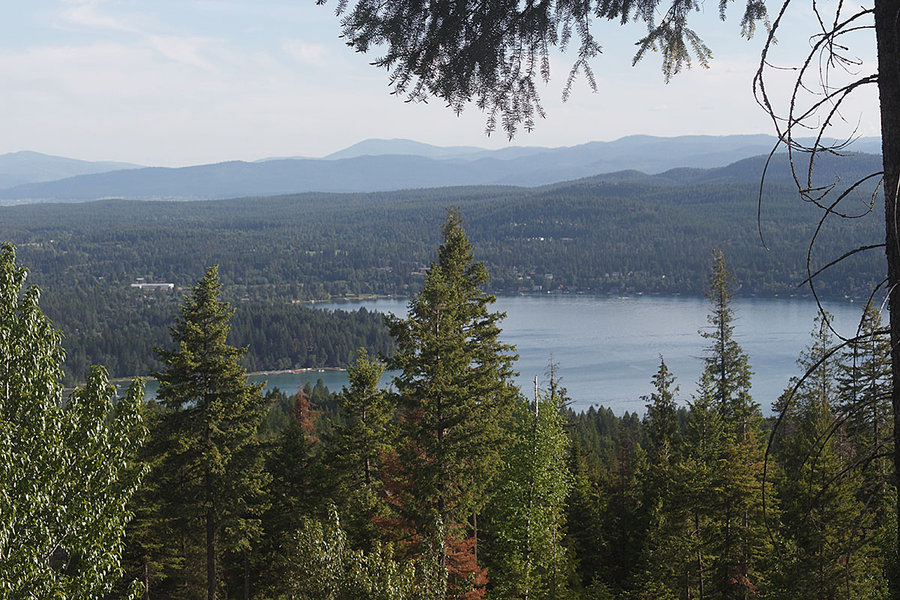
Access to streams in Whitefish, Montana, was threatened by development, so the town used the increasingly popular strategy of buying rights to the forest.

People can change their minds.

That’s what happened in Montana as property-rights advocates began to see that their water bills would be cheaper if they let government entities buy rights to forests on private lands.

Doug Struck writes at the Christian Science Monitor, “When the appetite for high-priced housing threatened the water source of [Whitefish, Montana], the residents raised taxes and spent money on forests. Three years later, when rising tourism upped the summer demand for water, more money was raised to buy more forests.

“The equation used by local and state officials, nonprofit groups, and private residents was straightforward: It’s cheaper and easier to have the forests cleanse the water than to throw chemicals and machinery at the task.

“ ‘Protecting forests of watersheds makes economic sense,’ says John Muhlfeld, the mayor of this town of 7,000 nestled in Montana’s Rocky Mountains. ‘And it’s a much different way of traditionally looking at a public water supply infrastructure.’ …

“As town planners look at the high cost of building water filtration plants and operating them year after year, the thought of letting the trees do it becomes a budgetary no-brainer.

“And the trees do it well. The natural filtering process that rain and snow undergo in seeping through forest canopies and forest beds, slowly toward streams and lakes, is so effective that five major cities in the United States – New York, Boston, Seattle, San Francisco, and Portland, Oregon – can pump unfiltered water from distant pristine watersheds to customer homes.

“New York is the poster-city example in this country. Twenty years ago, the city engaged in a wrenching political battle over whether to build a $6 billion water filtration plant that would cost $300 million per year to filter water for the city. Instead it gambled and spent $2 billion to protect the forested watershed in the Catskill Mountains, 125 miles away, the source of 90% of the city’s water. It was a bold and controversial decision – and it worked.

“ ‘Here we are, 20 years later they have been meeting the safe drinking water standards through tropical storms and superstorms,’ says Paul K. Barten, one of the junior architects of the original Catskills program who now chairs a current National Academy review of the system. …

‘People are not necessarily doing it because they love trees. … ‘They are doing it because it’s a lot less expensive.’ …

“The state and national park programs that began to emerge in the U.S. 150 years ago, and evolved at the prodding of such visionaries as John Muir, Frederick Olmsted, Gifford Pinchot, and Teddy Roosevelt, now preserve 13% of U.S. land, according to the World Bank. Another 56 million acres are held by various forms of private or public ‘trusts’ that allow some use but prohibit development, according to the Land Trust Alliance in Washington, D.C.

“In the case of Whitefish, that meant keeping land for logging. The Haskill Basin northeast of town was forestland owned for more than a century by the Stoltze lumber company. …

“Over the years, development pressures loomed larger as Whitefish blossomed into a high-end, expensive resort town sprouting multimillion-dollar second homes. … Stoltze ‘could have gotten an offer that they couldn’t refuse,’ says Kris Tempel, a biologist at the Montana Fish, Wildlife and Parks agency. …

“The Trust for Public Land … helped bring together $9 million from federal conservation funds. And Stoltze agreed to take a $4 million cut on the $21 million price of giving away development rights to its 3,000 acres in Haskill Basin. …

“That left a shortfall of $8 million. City residents had balked before about increasing the town’s ‘resort tax’ on restaurants, lodging, and retail. But in 2015, after a ‘Vote Yes for Water’ campaign by the mayor and others, residents gave an overwhelming 84% approval to a 1% tax increase. Late last year, the purchase of another 13,000-acre property helped protect a watershed for Whitefish Lake, a secondary source of water for the town.

” ‘The public support is a change in a place where encroachment on private land is viewed with suspicion, says [Montana Fish, Wildlife and Parks resource conservation manager Alan Wood]. ‘Twenty years ago there was a lot of opposition’ to these proposals.’

“But this deal ‘gave everyone what they wanted,’ says Mr. Wood. The town kept its access to clean and cheap water. Stoltze can keep harvesting timber on the land, employing an average of 110 workers.”

More at the Christian Science Monitor, here.

Read Full Post »

Photo: Rose Franklin’s Perennials
A Monarch alights on Butterfly Weed. It also loves milkweed.

Sometimes I find the background for a post in a roundabout way. I heard about Mexico’s Monarch butterfly hero, Jose Luis Alvarez, recently on Public Radio International, which had borrowed his story from the BBC. But because I like to have text to work with, not just audio, I searched online for additional information.

I’m glad I did because practically in my own backyard there’s an organization that’s partnering with Alvarez and helping folks far from Mexico to plant the Butterfly Weed that Monarchs love. Here’s what I learned at Vermont Woods Studio.

According to Peggy Farabaugh, “Jose Luis Alvarez  … is a silviculturist in Mexico who has devoted his life to restoring the forested winter habitat of the Monarch.  [In March 2016] I traveled to Michoacan, Mexico, to meet Jose Luis & see his work. I love Monarchs & we’ve been conserving their summer habit here in Vermont for many years, so I thought maybe we should collaborate and get some Vermont-Mexico synergy going!

“In 1997, Jose Luis created a non-profit called ‘Forests For Monarchs,’ which came to be known as the La Cruz Habitat Protection Program (in the USA) and the Michoacan Restoration Fund (in Mexico).  With donations from people all across the USA, Canada and Mexico, ‘Forests for Monarchs’ has been able to plant nearly 6 million trees.  …

“During the winter Michoacan, Mexico, is home to the entire species of the Eastern Monarch Butterfly (which summers in Vermont). [Illegal] deforestation has devastated the area. … [Jose Luis has] made great progress, but much re-planting still needs to be done.

“Here in rural Vernon, Vermont, a number of friends, neighbors, customers, gardeners and Vernon Elementary School children have been planting milkweed. … We’ve been growing milkweed from seed and giving the seedlings away to fellow Monarch lovers.

“Monarchs summering in Vermont are programmed to migrate to Michoacan, Mexico, in the fall.  There they join the entire population of their species, huddled together in the shelter of the last few remaining acres of their wooded winter habitat.  Mind-boggling, right?  How can an insect (that only weighs as much as a raisin) fly 3,000 miles, to the exact same location its ancestor came from –- when it’s never even been there before? I had to see it to believe it.  So …

“I traveled to Mexico (with my now grown up sons) to meet Jose Luis and we took his Spirit of Butterflies Tour last month. It was amazing.  But we were alarmed to see the extent of deforestation in the area.  Without help reforesting their habitat, the Monarch will soon go the way of the passenger pigeon & that would be just too sad.  So we brainstormed about developing a Vermont-Mexico partnership to help save the butterfly.

“Besides being a forester, Jose Luis is an internationally renowned speaker. He’s been featured in numerous documentary films by the BBC, National Geographic, the Canadian Broadcasting Channel and others. He’s been an advisor and guide to researchers, scientists, photographers & videographers from all over the world as they seek to save the Monarch. His work has been written about in newspapers including the Wall Street Journal & The New York Times.

“So we thought we should bring Jose Luis up to Vermont and New England for a speaking tour to raise awareness about the Monarch’s plight. I guess I got a little carried away and volunteered to help Jose Luis Alvarez plant a million trees in the Monarch’s over-wintering area of Mexico.” More here.

The Vermont Studios post was written originally in 2016 and updated last August.

Photo: Fernando Laposse/BBC
Jose Luis Alvarez is protecting Monarch butterflies by planting deforested areas with the trees they need when they winter-over in Mexico.

https://butterflywebsite.com/foundats/lacruz/project.cfm

Read Full Post »

Jeremy Hance has an article at the Guardian on the quest to save from human encroachment a huge — and largely unknown — raptor: Blakiston’s fish owl.

“It’s not easy studying an endangered species few people have ever heard of,” says Hance. “It’s difficult to raise money, build awareness, or quite simply get people to care. But still, Jonathan Slaght – one of the world’s only experts on the massive, salmon-eating, frog-devouring Blakiston’s fish owl – insisted there are upsides. …

“Blakiston’s fish owl is the world’s largest [owl], and in the Russian forests, where Slaght conducts his research, it cohabits with a lot of big names: the Ussuri brown bear, the Amur leopard, the Asiatic black bear and, of course, the grand-daddy of them all, the ever-popular Amur Tiger. …

“Slaght is a project manager with the Wildlife Conservation Society and a co-founder of the Blakiston’s Fish Owl Project along with Russian ornithologist, Sergei Surmach. But his first run-in with a Blakiston’s came in 2001 when he was a Peace Corps volunteer in Russia. At the time, all he knew about the species was from a tattered bird book more than 40 years old, including an ‘inaccurate, terrible illustration of Blakiston’s fish owl. …

“Although an avid birder, Slaght never expected to actually see one of these things. He was told the owl was so rare that even seasoned ornithologists rarely saw it. Yet one day, hiking in the forest with a friend, he had an encounter that changed the course of his life.

“ ‘Something enormous flies away from us and lands close by and it’s just this big owl.’

“He assumed it was a Eurasian eagle owl – which can be found across the entirety of Eurasia, from the coast of Spain to that of Primorye – but took a few photos just in case.

“ ‘My brain wouldn’t believe it was this mythical thing.’ …

“A few weeks later, though, Slaght gets his pictures developed and takes them to a local ornithologist.

“ ‘He says: “don’t show anyone this picture; this is a Blakiston’s fish owl.” ‘

“Slaght … has become one of the foremost experts on the great owls and continues to find them where people thought them vanished.”

Read about other places this rare bird is found (including Hokkaido, where it was once considered a god), here.

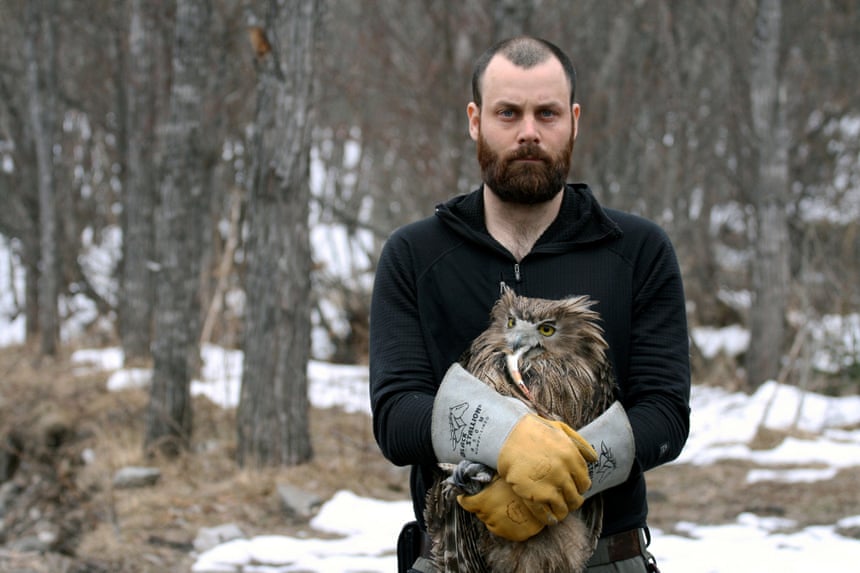
Photo: Jonathan C. Slaght/WCS Russia  
Jonathan Slaght holds a Blakiston’s fish owl in his arms. He is one of a handful of researchers studying this massive raptor, which is threatened by human activity.

Read Full Post »

An old, falling-apart film of a heath hen has been unearthed.

Why is that thrilling? The heath hen is extinct.

Writes Carolyn Y. Johnson in the Boston Globe, “The bird stamps its feet on the ground, taking mincing dance steps through the corn stubble. Neck feathers flare like a headdress, and the male puffs out his neck, making a hollow, hooting call that has been lost to history.

“These courtship antics are captured on a silent, black-and-white film that is believed to be the only footage of something not seen for nearly a century: the extinct heath hen.

“The film, circa 1918, is the birding equivalent of an Elvis sighting, said Wayne Petersen of Mass Audubon — mind-blowing and transfixing to people who care. It will premier Saturday [March 8] at a birding conference in Waltham.

“Massachusetts officials commissioned the film nearly a century ago as part of an effort to preserve and study the game bird, once abundant from Southern New Hampshire to Northern Virginia. Then, like the heath hen, the film was largely forgotten.

“Martha’s Vineyard is where the last known heath hens lived, protected in a state preserve. But the last one vanished by 1932. …

“Jim Cardoza, a retired wildlife biologist who worked for the Division of Fisheries and Wildlife, said that for him, the film holds lessons about how conservation efforts have evolved.

“ ‘The thing that is striking to me is the habitat of the animal — it looks like they’re out in corn fields and open areas and things like that,’ Cardoza said. ‘That isn’t what the birds really inhabited — they were a scrub-land species.’ Conservationists at the time, he said, ‘didn’t know what the habitat requirements of the species even was.’  ”

Read the rest of the article and watch the film here.

I love the idea of a long-rumored, valuable film finally being found. It’s a great story. It’s also an argument for better filing systems.

State of Massachusetts woodcut, 1912. The fancier heath hens are males.

Read Full Post »

Have you been reading about Elizabeth Warren, the temporary head of the new Consumer Financial Protection Bureau? People say she is too controversial to be approved by the Senate and that maybe her employee, Raj Date, a former banker, would be a good compromise candidate. Maybe so, but I just want to tell you about the extraordinary consumer advocate that I know Elizabeth Warren to be.

As a professor at Harvard Law School and an expert on bankruptcy, she has worked tirelessly to reverse the erosion of the of the middle class and lower-income families that has occurred over the last few decades. The CFPB was really based on her work, and she is the right person for the job. Growing up among a lot of older brothers, she learned to argue for herself and be persuasive. I have sat in meetings and heard her talk about her research and outreach, and my jaw just dropped. She is so passionate, and her arguments are so clear and incisive. She is capable of persuading many others who think they have different positions, because she always can find the common interest. But I think the country needs a consumer advocate who doesn’t back down.

Elizabeth Warren has a powerful effect on people. One day several years ago, I was standing in a grocery checkout line and by chance I overheard the cashier telling a customer that when she was thinking of filing for bankruptcy, she contacted Elizabeth Warren and received energetic help — for free. Later she would e-mail Warren anytime and get a response and advice. Probably Warren can’t answer such e-mails now, but I will check with that cashier next time I see her.

If Elizabeth Warren hired Raj Date, then he is a good guy. But if he is a real consumer advocate, I don’t see that his chances of being approved by the Senate are any greater than hers.

Comments may be sent to suzannesmom@lunaandstella.com. Luna & Stella is apolitical, but Suzanne said I could write about anything that interests me, and that is what I have been doing.

Read Full Post »