Feeds:
Posts
Comments

Posts Tagged ‘recovery’

Photo: Melanie Stetson Freeman/CSM.
One Man Swamp Band street musician Brian Belknap performing in the French Quarter of New Orleans in April.

Here’s a story of resilience, 20 years after the devastation of Hurricane Katrina in New Orleans, Louisiana.

Patrik Jonsson writes at the Christian Science Monitor, “When Hurricane Katrina careened into Mississippi and Louisiana 20 years ago this week … the overtopping of New Orleans’ levees caught local, state, and federal officials flat-footed in the days after the storm’s Aug. 29, 2005, landfall just east of New Orleans, near the Pearl River. …

“As I head back to New Orleans ahead of the 20th anniversary of that historic storm, looking to chronicle the growth that has taken place since that disaster threatened to wash away the soul of this vibrant city, I’m following some of the paths I took when covering the aftermath of Hurricane Katrina, remembering that time, those scenes.

“Twenty years after that catastrophe, New Orleans’ larger recovery has been a complicated story of progress, ongoing challenges, and missed opportunities.

“It was still a lawless city when I arrived in 2005. As dark descended and I settled into my van for the night, so did fear. Rumors abounded – most outrageous, but some not far from the truth about the human toll. About 1,800 people are believed to have perished during Katrina and its aftermath, most from the storm surge in Mississippi and catastrophic flooding in New Orleans. The most expensive natural disaster in United States history, it caused over $200 billion in damage. …

“Communities reemerge, but they reemerge differently. People search for what once was – a piece of flatware, a boat transom, a bent-up old .22 rifle. Or an old guitar. They drag the past from the wreckage and use it to imagine the future.

This year, I’ve brought my Guild A-20 dreadnought guitar, my road companion. I’m realizing that this reporting trip is also to build a connection across the decades – maybe one as rickety and rusty as that old Huey Long – and to see the effects on communities and people, including myself, and how they recover. …

“This time I am staying in a rental, a shotgun-style short-term place near the Tremé, the city’s iconic music district.

“I go to a nearby coffeehouse the next morning, where schoolkids in uniforms are already plinking away standards on a well-tuned upright piano. Wrens are cajoling amid the Magnolia grandiflora. I sip chicory-infused coffee and chat with the shop owner about a day that’s dawning with surprising coolness.

“Afterward, I find a great, steep stoop from where I can less watch but rather consider the city. I grab my Guild and sit down, strum some cowboy chords in B major, and noodle some lines from my reporter’s notebook: ‘She’s an angel, even when she’s falling down / She’s an angel, in the wrong part of town.’ …

“Brian Belknap traded a guitar for a life in New Orleans.

“The Chicago native arrived a decade ago, well after the ravages of Katrina. Like so many before him, he fell for the languid city’s slow charms. With little money, he lived on the streets for a while, busking for change. But then he traded his 1942 Martin D-18 for a battered shotgun shack in St. Roch. …

“Every day, Mr. Belknap walks into the French Quarter in the early, cooler parts of the day, setting up the instruments that now make up his One Man Swamp Band on Royal Street.

“ ‘There’s still desperation here,’ Mr. Belknap says. ‘But out here it’s an intimate experience. The people are close. The music is everywhere. Even in hard times, the sense of joy is unmistakable.’

“To punctuate that point, he grabs an accordion, gives a kick on a high hat pedal, and rolls into an original song about folks stomping the varnish off a dance floor.

“Though he’s not a native, in some ways Mr. Belknap’s presence here is a small part of New Orleans’ recovery. The city lost a third of its population after the hurricane. But it has been bouncing back – though not to what it was before Katrina.

“There’s a new $15 billion system of levees, floodgates, and drainage canals built to better withstand storms like Katrina. The public school system, among the worst in the country before 2005, has been revamped. Today, graduation rates have risen significantly, and more New Orleans high schoolers are going straight to college than before.

“But the city continues to grapple with the lasting impacts of the initial federally funded rebuilding plan, called Road Home. Over $9 billion in federal funds was allocated for residents to rebuild – but within a tangle of Byzantine application procedures. Disbursements, too, were based on property values before Katrina struck. This left mostly Black, low-income residents with far less to rebuild, and long-standing racial disparities continue today.

“ ‘Katrina in many ways reshaped the way we think about vulnerability in disasters,’ says Jeannette Sutton, a sociologist who studies emergency preparedness at the State University of New York at Albany. Road Home and other programs, she says, have proved that ‘If you were poor before a disaster, the [disaster response] is not going to improve your well-being’. If you were barely getting by before, you’re not going to be better off with the funding in the aftermath. But those who could ‘afford’ a disaster are probably going to recover pretty well.’ …

“Gentrification has also changed the flavor of New Orleans in many ways. The city continues to debate limiting short-term and highly profitable tourist rentals – like the one I’m staying in – which create a demand for housing and cause other rents to rise. The checkerboard of empty lots in the hard-hit Lower Ninth Ward, too, still defines many of the failures of the federal rebuilding plan. …

“Liz LeFrere was 8 years old, living in New Orleans East, when Katrina struck. She thought she’d miss a day or two of school. Four months later, the family returned to live in the broken city, since her father was a police officer.

“Ten years ago, when she was a student at Tulane, the campus flooded on Aug. 29 – the Katrina anniversary. Ms. LeFrere broke down in uncontrollable tears. ‘It came out of nowhere,’ she says. ‘It’s definitely part of a communal trauma.’

“Yet the storm’s indelible impact also created a new life for her. Today, Ms. LeFrere is part of an artist collective dedicated to understanding Katrina and its aftermath through art – including massive portrait murals that now dot and define the city.

“Artists like Ms. LeFrere are committed to telling a tangibly redemptive story. ‘The art is where expression can be a catalyst for change,’ she says. The murals ‘help create a sense of people seeing themselves reflected in the face of the city. The narrative of New Orleans expanded.’ ”

There’s a lot more at the Monitor, here. Impressive photos. No paywall, but subscriptions keep responsible news coming. Reasonable prices.

Read Full Post »

Photo: Mike Belleme for the New York Times.
Barbara Kingsolver said she felt indebted to the people who shared their stories when she was doing research for her novel about addiction, and wanted to give back. 

Long before popular author Barbara Kingsolver decided to base a novel on one by Charles Dickens, Mr. Dickens was taking controversial positions on social justice. I think he believed he was not having an influence, but he kept shouting, and over time other voices chimed in and change happened.

There’s a time and place for writers to be impartial, but not in novels. And recently Kingsolver put her money where her mouth is by deciding to take the profits of her novel on the opioid crisis and give it to an addiction center.

Alexandra Alter wrote at the New York Times about Kingsolver’s decision.

“When Barbara Kingsolver was writing Demon Copperhead, a novel that explores the devastating effects of the opioid crisis in southern Appalachia, she was doubtful that people would want to read about such a grim subject.

“To draw readers in, she knew she would have to ground the narrative in real stories and push against stereotypes about the region. So she traveled to Lee County, Va., a corner of Appalachia that’s been battered by drug abuse, and spoke to residents whose lives had been wrecked by opioids.

“ ‘I sat down and spent many hours with people talking about their addiction journey,’ Kingsolver said. …

“The novel was an instant success, in time selling three million copies and winning a Pulitzer Prize for fiction in 2023. But even before the novel came out, Kingsolver felt indebted to the people who shared their stories. …

“Kingsolver decided to use her royalties from Demon Copperhead to fund a recovery program for people battling addiction [and] founded a recovery house for women in Lee County, where the novel is set.

“The center, Higher Ground Women’s Recovery Residence, will house between eight and 12 women recovering from drug addiction, offering them a place to stay, for a small fee, for up to two years, as well as counseling and other forms of support, like free community college classes.

“Kingsolver grew up in rural Kentucky and lives on a farm in Virginia. As someone raised in the region, she said, she felt she couldn’t ignore the opioid epidemic in her fiction. But she struggled for years with how to write about the issue in a way that would make readers pay attention.

“While on a book tour in England, Kingsolver stayed in a bed-and-breakfast where Charles Dickens had worked on his novel David Copperfield, and found inspiration in the story and its resilient young narrator.

“In Demon Copperhead, which is loosely based on Dickens’ novel, Kingsolver tells the story of Damon Fields, a boy who is born to a single teenage mother who struggles with drug addiction. He ends up in foster care and later succumbs to opioid abuse. …

“ ‘I had these royalties that Demon brought me. I took that money and went back to Lee County and said, what can we do with this?’

“The biggest need, she learned, was for support for people in recovery, who often had no housing or job prospects. She and her husband, Steven Hopp, started a nonprofit, Higher Ground, to create a residential home for women, and provided the funds for the nonprofit to purchase the property last summer. …

“Kingsolver said she’s been heartened by support the project has received from local organizations, including church groups that have helped get the living space in shape, a local store that donated furniture and a grant from the Lee County Community Foundation.

“ ‘You might, in earlier times, have expected stigma, for people not to be open to this, but instead it’s been, “Yes in my backyard,” ‘ Kingsolver said.

“ ‘This is the reality of where we live,’ she continued. ‘Everybody knows someone touched by the opioid epidemic.’ ”

Have you read the novel or are you a Kingsolver fan? Say something about this.

More at the Times, here.

Read Full Post »

Photo: Upcycle Stitches.
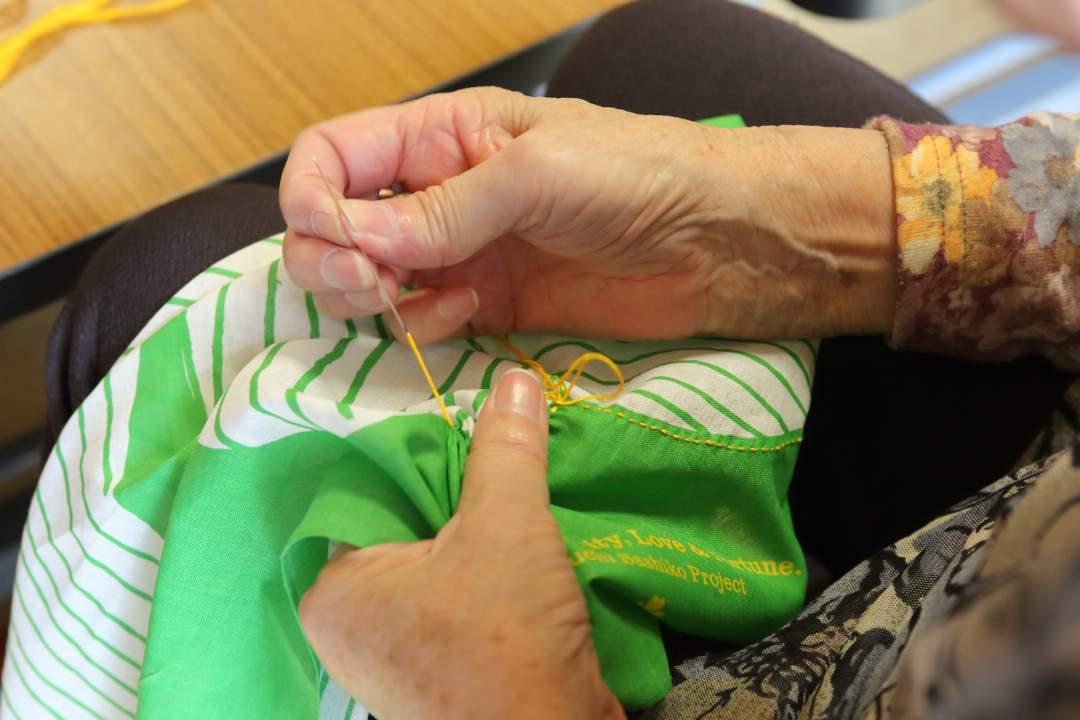
Sashiko is a needlework to reinforce, to repair, to mend, and to decorate the fabric. 

Whenever I hear something good on Public Radio International’s the World, I hope they will post a text version online so I have something to edit, but today’s story is accessible only as audio. So I am combining it with a May 2018 blog post that “atsushijp” wrote at Upcycle Stitches: “Otsuchi Recovery Sashiko Project.” (Atsushijp did us all a favor by sharing this work with a different audience, and I have not tried to tweak her English.)

“It has been almost 7 years since I had encountered this beautiful project: Otsuchi Recovery Sashiko  Project. … After the earthquake followed by Tsunami on March 11th, 2011, the five volunteers established the project to support the people in Otsuchi, especially those who had nothing to do but sitting in the evacuation shelter. The men had a lot of things to require the muscle power after the disaster. The young generation also had many tasks to revive the infrastructure such as distributing the support goods and clean. However, those who wouldn’t be able to move, mostly elderly women, did not have things to do and had to wait. …

“The project tries to create jobs for those who couldn’t do hard labor outside. They have been trying to create the community where anyone can gather for the purpose of stitching. We all then hope that the stitching can be a part of the purposes of their new life after the earthquake. I, Atsushi, first join the project in June 2011. …

“I had written many articles and reports regarding the Otsuchi Sashiko in English, but I had to give them up when my father passed away and the stakeholders decided to shut down the website. Well, even after the sad reality of me leaving Sashiko behind for while, my mother, Keiko Futatsuya, kept in touch with them. Now, she is the advisor of Sashiko technique and designing in Otsuchi Recovery Sashiko Project. …

“Otsuchi town was badly damaged by the earthquake followed by Tsunami, including the loss of town hall and the mayor and more than 1,280 of people’s life. The survivors [who] needed an evacuation shelter by losing their house were more than 9,000 people.

“In the evacuation shelter, mothers and grandmothers, who were very much hard worker in their own house as a house-maker, didn’t have anything to do. There were no kitchen to cook, no living room to clean, no dishes to wash. Men and young generation could work for the cleaning debris, but the job required a lot of muscle power. Mothers and Grandmothers couldn’t help them even if they wanted to. …

“The answers they had come up with was Sashiko, in which requires only a needle, thread, and piece of fabric. The Sashiko was doable in a limited space of the evacuation shelter. The mothers and grandmothers wanted to do ‘something’ instead of just waiting.

“An elder woman who lied down all the day in the evacuation shelter. A hard-working mother who lost her house-making job. A young woman who lost their job opportunity. Everyone in Otsuchi moved the needle with hoping the recovery of Otsuchi. Otsuchi Recovery Sashiko project is their first step to the recovery by women in Otsuchi since June 2011. The Earthquake destroyed the houses and jobs and took away our previous people. We, as Otsuchi Recovery Sashiko Project, would like to re-establish the town of Otsuchi throughout Sashiko by strengthening, mending, and making it more beautiful. …

“When a mother, who enjoy Sashiko, is happy, the household will be filled with smiles. If the household is filled with smiles, the town of Otsuchi will be energetic. When the town of Otsuchi become energetic, everyone in the town and related to the town will be happy. …

“We strongly respect the value of hand-made craft culture with spending so much time and putting the good-heart in it in the era of ‘speed’ and ‘efficiency (productivity)’ with mass-production and mass-information. ‘Hand-Made Craft’ provide us ‘Care’ and ‘Mindfulness (Mental Wellness)’ by thinking of other, and using our own hands.”

More at Upcycle Stitches, here. The audio story at the World, here, covers aspects of the initiative in which men have helped, too.

Read Full Post »

Photo: Ibl/REX/Shutterstock.
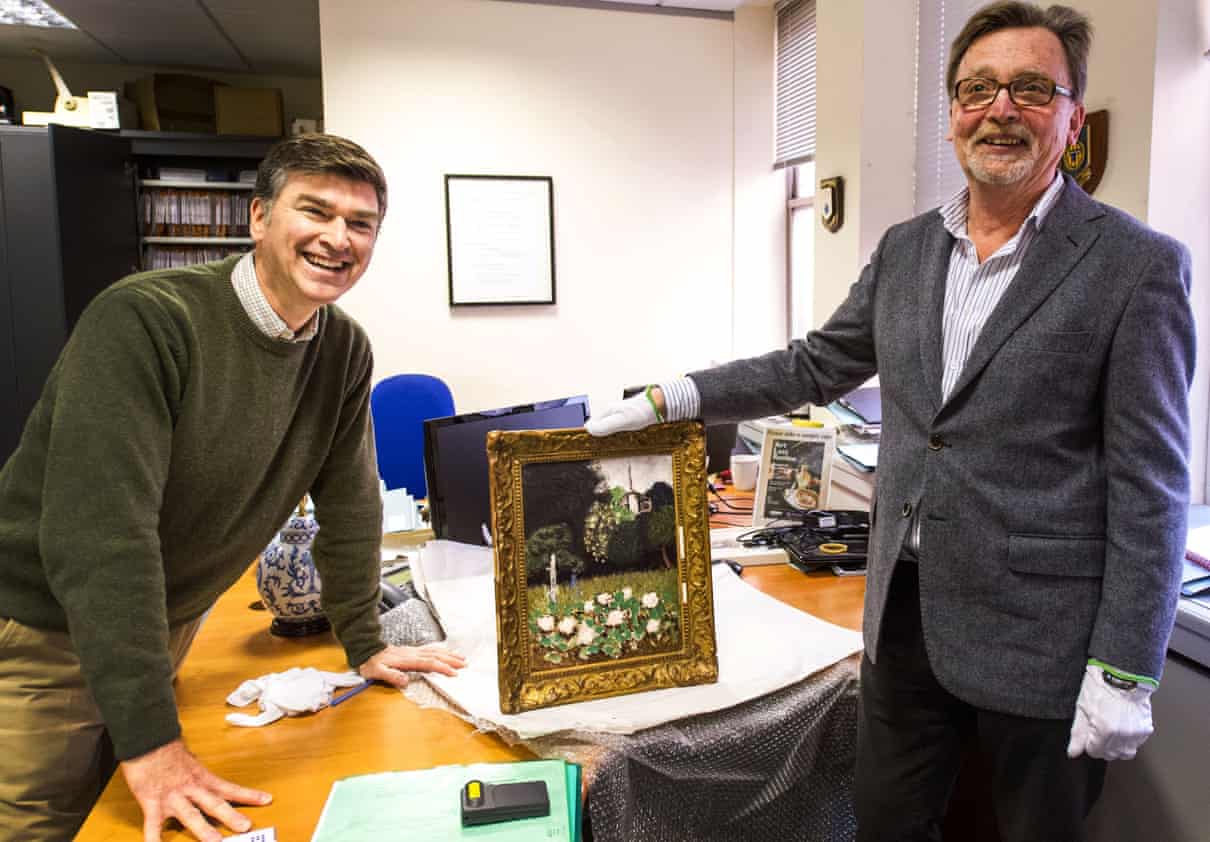
Art detective Christopher Marinello, left, returning the long-lost Le Jardin by Matisse to Lars Bystrom of the Modern Museum in Stockholm in 2013.

Now for something completely different, how about we delve into the life of a lawyer who walks some dangerous paths to recover stolen art?

Alex Daniel writes at the Guardian, “One summer morning in 2008, Christopher Marinello was waiting on 72nd Street in Manhattan, New York. The traffic was busy, but after a few minutes he saw what he was waiting for: a gold Mercedes with blacked-out windows drew near. As it pulled up to the kerb, a man in the passenger seat held a large bin-liner out of the window. ‘Here you go,’ he said. Marinello took the bag and the car sped off. Inside was a rolled-up painting by the Belgian artist Paul Delvaux, Le Rendez-vous d’Ephèse. Its estimated worth was $6m, and at that point it had been missing for 40 years.

“Marinello is one of a handful of people who track down stolen masterpieces for a living. Operating in the grey area between wealthy collectors, private investigators, and high-value thieves, he has spent three decades going after lost works by the likes of Warhol, Picasso and Van Gogh. In that time, he says he has recovered art worth more than half a billion dollars. …

“Cases tend to go the following way. A stolen artwork – in this instance, a bird by the Martin Brothers pottery makers, which was swiped from a London library in 2005 – will often turn up at auction or on social media. It then falls to Marinello to establish whether it is actually the missing work and, sometimes, to get it back. This, he says, is usually relatively simple.

“Stolen works often change hands several times before resurfacing, leaving subsequent possessors in the dark about their provenance. This is most likely what happened with the Delvaux. The painting, completed in 1967, depicts several nude women in a dreamlike landscape that’s part classical architecture, part mid-century tram station. Delvaux himself sold it a year later, but it was stolen before it reached the buyer. In 2008, Marinello got a call from somebody who wanted to return it. What happened to it in the intervening 40 years is unclear, although its final location is known. It was rolled up, says Marinello, in the wardrobe of ‘a very well-heeled celebrity. And their very expensive lawyer made it clear they would never be named.’ …

“A slight, 58-year-old Italian American with a soft Brooklyn accent, Marinello … trained as a lawyer, cutting his teeth as a litigator in New York representing galleries, collectors and dealers in cases involving disputed works. ‘Eventually, it developed into a full-time art recovery practice,’ he says. In 2013, he formed his own company, Art Recovery International, which is based in Venice but has offices in London. …

He says. ‘[I’m] a pretty good negotiator. I can convince people to do the right thing. … The bottom line [is] that if you are trying to sell something that is stolen, you’re the one with a problem, not me.’ …

“He adds: ‘With a lot of art crime, there is nobody to arrest and people rarely go to prison. It’s just a matter of recovering the work.’

“However, sometimes a suspect will refuse to cooperate. Then, things are different. ‘We go after them like pitbulls and never let go,’ he says. ‘And that is when they start getting nasty, when they are concerned they’re going to go to prison.’ “

More at the Guardian, here. If you don’t follow the Guardian online, do check it out. I really love it. It’s free, but grateful readers volunteer to pay what they can.

Read Full Post »